Tech
Silent Angel H1 Pure Music Hub Wants to Be More Than Just a Streamer

Despite continued gains in CD and vinyl record sales, streaming remains the dominant way most people consume music. For audiophiles, however, getting the best performance from streaming can still involve a small tower of boxes: a network streamer, DAC, music server or storage drive, power supplies, and enough cables to make the back of the rack look like an electrical substation.
The alternative is often considerably simpler, but not necessarily better. Smartphones, wireless headphones, earbuds, and mainstream streaming devices make accessing millions of tracks almost effortless, but they are not always designed around the sound quality, connectivity, local music storage, and system flexibility that enthusiasts expect from a serious two-channel setup.
Silent Angel thinks there is room between those two extremes. The streaming and digital audio specialist has introduced the H1 “Pure Music Hub,” the first product in its new Lifestyle Hub (LSH) category, designed to consolidate digital music playback and decoding into a single component that can serve as the command center for a desktop system, executive office, or contemporary living room.
What the H1 Offers
The H1 is an integrated digital music player and decoder designed to serve as a central hub for digital playback. Silent Angel is positioning it for use in an executive office, desktop gaming setup, or contemporary living room, where it can connect directly to smart TVs, media consoles, and other digital sources.
Combining “ultra-quiet” digital decoding, expandable local library storage, and continuous cloud streaming within a single aerospace-grade aluminum chassis, the H1 is designed to bridge the gap between dedicated audiophile listening and everyday entertainment. The H1 also incorporates a range of hardware and software features intended to improve digital playback across connected home media sources.
Dual ESS Sabre 9039Q2M Architecture: The H1 uses two ESS Sabre ES9039Q2M DAC chips paired with a third-generation XMOS XU316 processor. Silent Angel also employs dual-stage jitter rejection with Asynchronous Sample Rate Conversion (ASRC) to reduce timing errors in the digital signal path.
According to Silent Angel, the combination is designed to improve channel separation, soundstage precision, and background noise performance across a range of digital sources.
Built-in Four-Rail Independent Audiophile Power Architecture: Clean power matters in digital audio, and Silent Angel has designed the H1 around a low-ripple power supply with four independent power rails. These provide 12V to the mainboard, ±15V to the DAC and op-amp circuitry, and 5V to the DAC chips.
The analog stage incorporates six K-Muse op-amps alongside two Texas Instruments OPA1612 op-amps. By isolating the power requirements of the H1’s major circuits, Silent Angel says the design helps reduce cross-circuit interference and provides cleaner DC power to the audio stages.
Proprietary VitOS Operating System: Silent Angel’s VitOS platform is purpose-built for audio playback and runs on a quad-core RK3568 processor with 4GB of DDR4 RAM. The company says the streamlined operating environment minimizes unnecessary background processes while supporting responsive navigation and bit-perfect audio delivery to the DAC stage.
The H1 can be controlled through the VitOS Orbiter mobile app, which provides access to playback, library management, and system controls from a smartphone or tablet.

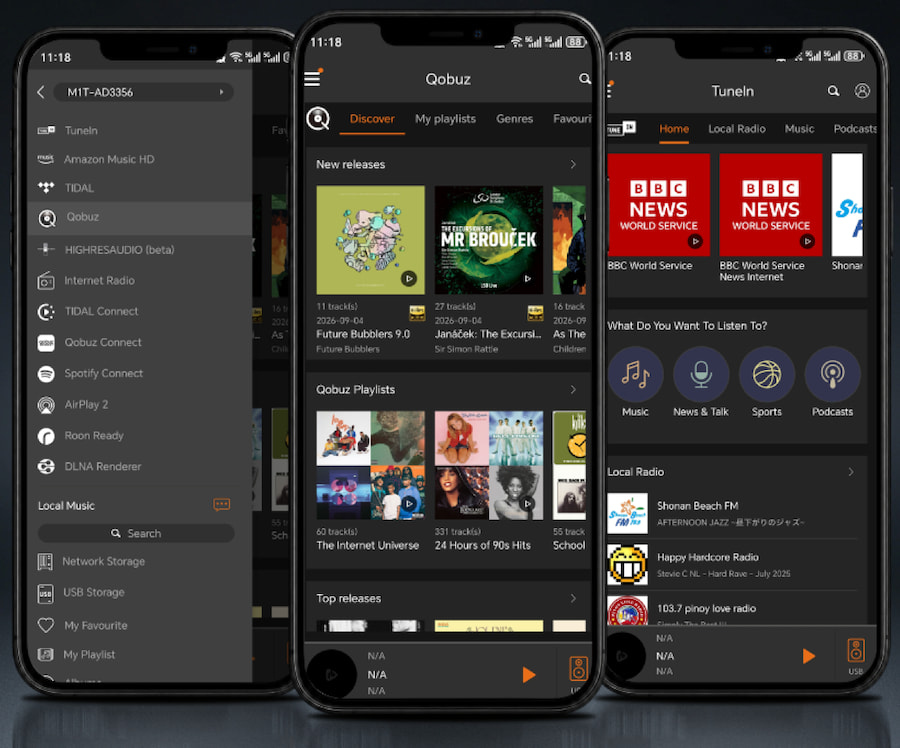
Streaming Support: The H1 supports TIDAL Connect, Spotify Connect Lossless, Qobuz Connect, TuneIn Internet Radio, AirPlay, and DLNA Renderer playback, giving users multiple ways to access streaming services and networked music.
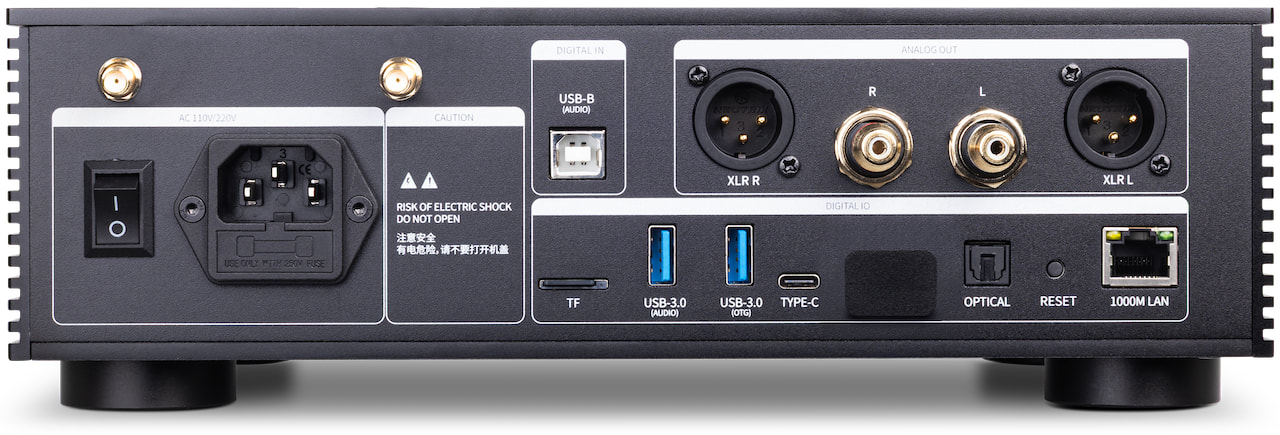
Wired Connectivity: Digital sources can connect directly to the H1 through its USB-B input, allowing them to use the unit’s dual-DAC architecture. The H1 can also send audio to active speakers or an integrated amplifier through its analog outputs, or function as a digital transport through USB audio and Toslink for use with an external DAC.
Local Library and Storage Management: The H1 supports local playback from USB 3.0 storage devices, network-attached storage (NAS), and internal M.2 NVMe PCIe 3.0 SSD expansion up to 8TB. The system can automatically scan connected libraries, organize music metadata, and split CUE-based album files into individual tracks.
High-Resolution Audio Decoding: The H1 supports PCM playback up to 32-bit/768kHz and native DSD up to DSD512 through USB, with DSD256 supported in DoP mode. Compatible formats include FLAC, WAV, AIFF, ALAC, DXD, DFF, and DSF.
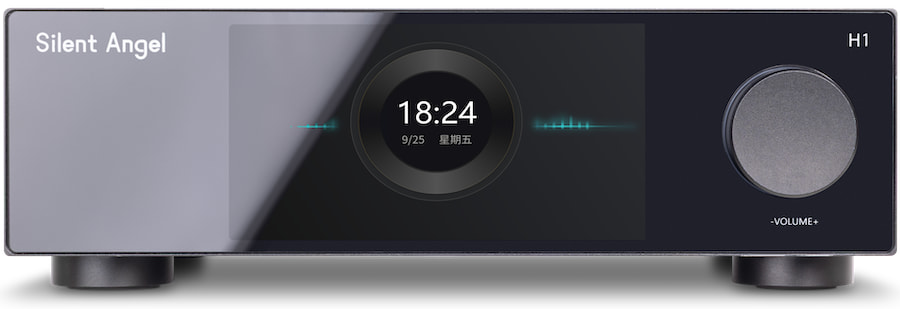
Dynamic Artwork Display: A 5.5-inch high-definition display presents full-color album artwork, lyrics, and track metadata during playback.
Craftsmanship: The H1 uses a precision-machined, aerospace-grade aluminum chassis with a matte-blasted finish. Silent Angel also incorporates subtle ambient lighting that tracks the volume level, giving the unit a more contemporary appearance for desktop systems, media consoles, and living-room installations.

Silent Angel H1 Specifications
| Silent Angel | H1 |
| Product Type | Integrated Digital Music Player & Decoder |
| Price (MSRP) | $849 |
| Color | Black |
| Body Material | Aerospace-grade full aluminum chassis with matte blasting process consistent with Apple’s finishing standard |
| Display | Screen Size: 5.5-inch non-touch screen Resoluton: 1280 x 720 landscape orientation |
| Operating System | Linux OS |
| UI Language | Multi-:Language selection available |
| Chip Solution | CPU Model: RK3568 quad-core ARM Cortex A-44, maximum main frequency up to 2.0 Ghz |
| Memory Configuration | DD4 4GB |
| TF Card | Built-in 32GB TF Card |
| Audio DAC | Dual ES9039Q2M |
| Audio Processor | XMOS XU316 3rd Generation, 16-core |
| Operational Amplifier Chips | 6 units of Silent Angel self-developed Kmuse + 2 units of OPA1612 |
| Power Supply | High-quality low-ripple audiophile-grade power supply |
| Hard Disk Interface | M.2 (NVMe PCIe 3.0) interface |
| USB Interfaces | 1 x USB-C (UsB 2.0) supports audio transfer
2 x USB 3.0 ports: Compatible with external removable storage devices and audio output |
| Wired Network | RJ-45 (1000M / 100M / 10 Mbps) |
| Wireless Network | Model AP6275PR3, supports dual-band Wi-Fi 6 (2.4GHz / 5GHz) |
| Music Streaming & DAC Decoding | DSD: DSD64 TO DSD256, compatible with DSF, DFF, ISO-DSD, and ISO DST formats.
PCM: Supports sampling rates from 44.1kHz to 768kHz (16-Bit to 32-Bit) Supports Audio formats including DXD, WAV, FLAC, AIFF, ALAC, MP3, MP2, AIF – sampling rate coverage: 8kHz – 768kHz (16-Bit to 32-bit) CUE file supported, enabling automatic track splitting, track selection playback, fast-forward, and rewind functions. |
| Network Streaming & Audio Casting | High-Resolution Audio (Beta), AirPlay 2, DLNA Renderer
Built-in Apps: Xianiai Premium version of QQ Music, Spotify Connect, TIDAL Connect, Internet Radio |
| File Management | Supports automatic scanning of music files to generate albums; functions including favorites collection, custom playlists, album browsing, and content search are available. |
| Playback Display | Supports display of lyrics, album covers, and song metadata |
| Playback Settings | Playback modes include sequential playback, shuffle play, single-track repeat, and all-track repeat.
Compatible with NAS and streaming servers. |
| System Settings | Audio output configuration, language settings, advanced settings, device information. |
| USB-B Audio Input | Supports DSD512 Native PCM up to 768kHz/32-Bit
System Compatibility: Windows 7 – 11, macOS, Android, iOS, HarmonyOS |
| USB-AUDIO Audio Output | Max support: PCM 32-Bit/768kHz and DSD256.
DSD Audio can be output in D2P and DOP Modes |
| USB-C Audio Output | Max support PCM: 328kHz/768kHz and DSD256
DSD signals can be output via D2P and DOP Modes |
| OPT (Optical Audio Output) | Max supports PCM 24-Bit/192kHz DSD can be output in D2p and DOP Modes |
| XLR Audio Output Characteristics | Output level (Vrms): 4.5 Vrms (Bandwidth 20 Hz- 20 kHz)
Total Harmonic Distortion plus Noise (THD + N): < 0.00008% @1 kHz (-121 dB @ 1 kHz) Noise Floor: <1.7 uVrms. Signal-to-Noise Ratio (SNR): 129dB @ 1kHz. Frequency Response: 20Hz – 20kHz (+/- 0.07 dB Channel Separation (Crosstalk): – 120dB Dynamic Range (DNR): 129 dB @ 1 kHz |
| RCA Audio Output Characteristics | Output level (Vrms): 2.5 Vrms (Bandwidth 20 Hz- 20 kHz)
Total Harmonic Distortion plus Noise (THD + N): < 0.0001% @1 kHz (-118 dB @ 1 kHz) Noise Floor: <1.5 uVrms. Signal-to-Noise Ratio (SNR): 126dB @ 1kHz. Frequency Response: 20Hz – 20kHz (+/- 0.06 dB Channel Separation (Crosstalk): – 120dB Dynamic Range (DNR): 126 dB @ 1 kHz |
| Control Method | Supports control via dedicated VitOS Mobile APP on mobile phones and tablets running Android and iOS systems; the APP enables full-function operation of the player. |
| Power Input | AC 110 – 120 V / AC 220 – 240 V, 50/60 Hz |
| Rated Power Consumption | 25 W |
| Overall Dimensions | 280 x 220 x 77.7 mm
11 x 8.7 x 3.05 inches |

The Bottom Line
The H1 is the first Silent Angel product we have covered in depth at eCoustics, aside from brief mentions in our AXPONA 2026 coverage and previous look at the Mission 778S Music Streamer. Based on the company’s broader lineup, however, Silent Angel is hardly new to network audio, and the H1 represents the first step in a new “Lifestyle” series designed to combine serious digital engineering with more approachable pricing and contemporary industrial design.
At $849, the H1 occupies an interesting position in an increasingly crowded streamer market. It combines network streaming, dual ES9039Q2M DACs, expandable internal SSD storage, local library management, extensive power-supply isolation, and a 5.5-inch display in a single component. That puts it into competition with products ranging from the $349 WiiM Ultra and $999.95 Yamaha WXC-70A to the $2,180 Eversolo T10. Those products are not direct equivalents, but they demonstrate just how broad and competitive this category has become.
There are some important limitations. The H1 does not include HDMI eARC, analog inputs, or a phono stage, making products such as the WiiM Ultra and Yamaha WXC-70A more flexible for listeners who want their streamer to become the control center for a television, turntable, and other analog sources. The Eversolo T10, meanwhile, is a dedicated digital transport without an internal DAC, while the IDEON Nous adds a full analog preamplifier section at a price that could fund an entire very serious audio system.
That makes the H1’s mission considerably clearer. It is aimed at listeners who already own an AVR, stereo receiver, separate amplifier, or active loudspeakers and want to add high-resolution streaming, local music storage, and serious digital conversion without adding several more boxes to the system. At $849, there is a lot here to suggest Silent Angel deserves more of our attention — and we will be keeping a much closer eye on what comes next in the Lifestyle series.
Pricing & Availability
The Silent Angel H1 is priced at $849 and is available for pre-order through authorized North American Silent Angel dealers.
You must be logged in to post a comment Login