Tech
Slow Mo Guys Capture Glass Mirror That Waves Like Water Before It Snaps

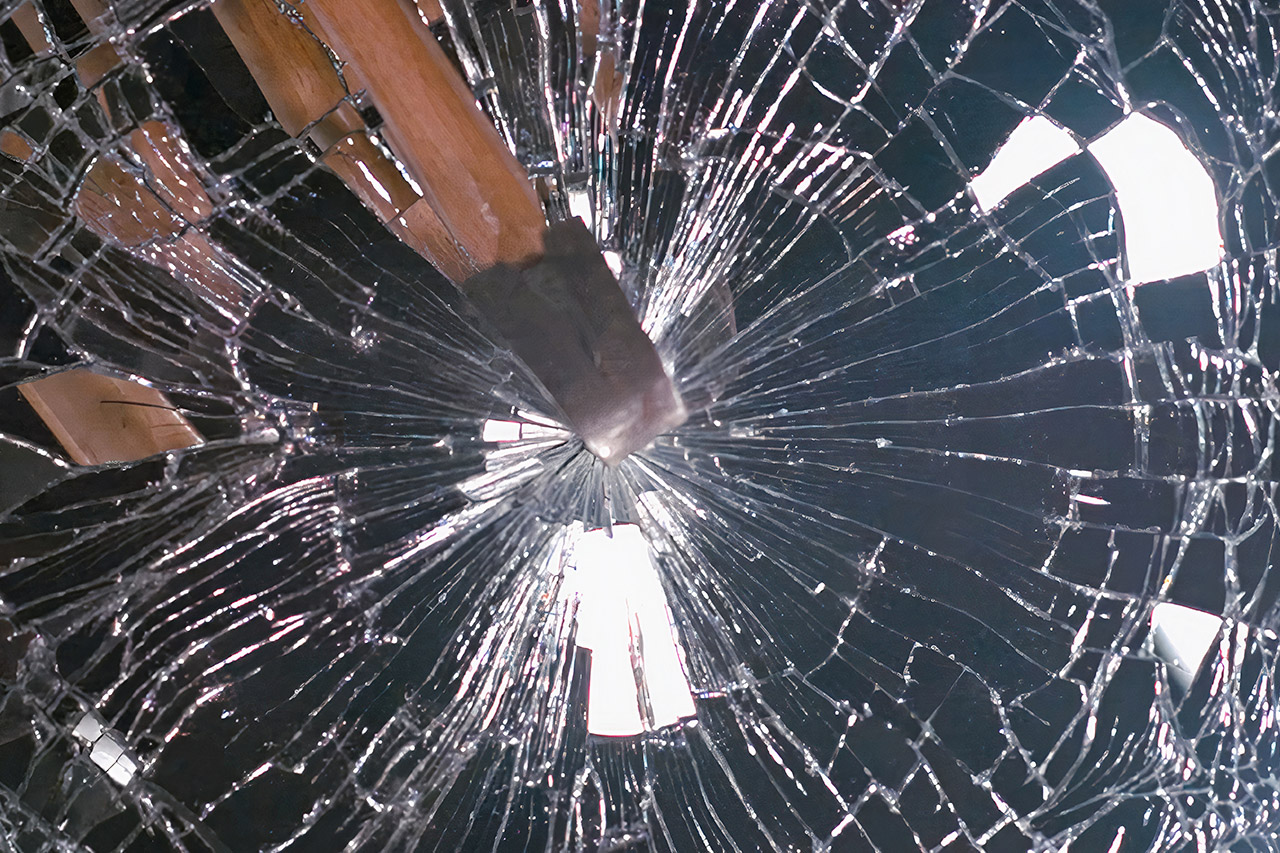
Gav Free of the Slow Mo Guys has spent years chasing moments too fast for ordinary eyes. Several years back a hammer strike on a single mirror left him staring at the footage in confusion. Right at the moment of impact a small ripple spread across the surface. He kept returning to those frames, wondering how something so rigid could flex like that. This time he arrived with a Phantom TMX 7510, a pile of spare mirrors, and the determination to settle the question for good.


To shield him from flying shards, protective gear was placed up over him, including a flame suit donated by Adam Savage. There were lights on both sides of the camera, as well as another running parallel to a large sheet of glass against which cracks would be clearly evident. Later, a slew of Colored Titan tubes were used to paint the reflections in varying hues. The mirrors were mounted on cheap platforms, and the camera simply waited at frame rates of up to a fraction of a second, resulting in extended, mesmerizing sequences.


Insta360 X6, 8K 360 Camera with 1/1.1” Sensors
- DUAL 1/1.1″ SENSORS & TRIPLE AI CHIP SYSTEM: Custom-built dual 1/1.1″ square sensors deliver unprecedented 360 image quality. Combined with a triple…
- FLAGSHIP 8K50FPS 360 VIDEO: Hit record on our 360 action camera and capture your world in stunning native 8K50fps video. Every view, every highlight…
- IN-HOUSE AI MODEL FOR EFFORTLESS 360 EDITING: Insta360’s own AI model, built specifically for 360 editing. New AI Director edits your footage…
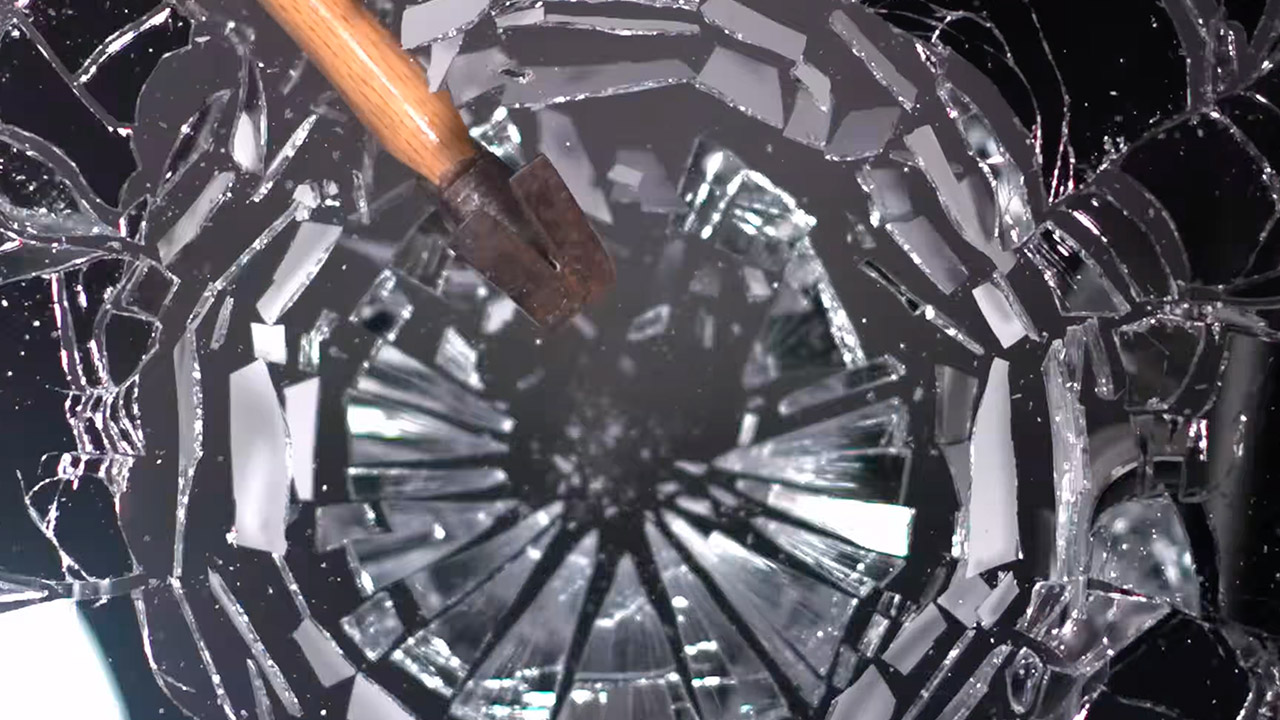
First strikes were happening at 120,000 frames per second. When the hammer hits the glass, a large wave comes out. The center pieces begin to spin away from the place of impact, and the hammer’s reflection becomes larger as the shards tip. Once the surface has bent far enough, which is pretty significant, the glass will break at the impact zone. The initial crack that forms is essentially a perfect circle and only extends as far as the wave has rolled. Beyond that line, the glass breaks in more random, jagged patterns. Even at this speed, the cracks nearly disappear in a few frames, making it difficult to notice their progress.

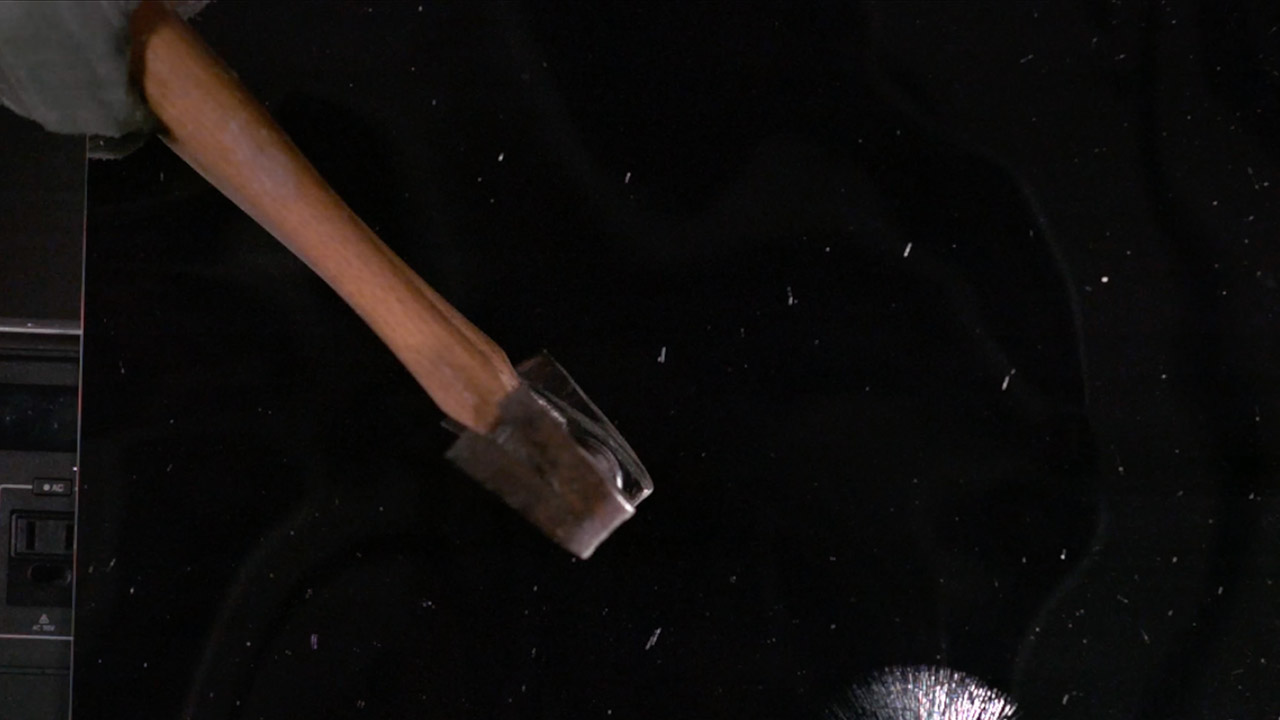
It’s not simply the speed, but also how forcefully or softly you hit the glass, which shapes the story, literally. A particularly forceful strike causes a larger ripple, which occasionally reaches the edge of the mirror first. When this happens, the initial cracks appear along the rim rather than in the center. A softer hit allows the wave to die out sooner and keeps the break more central. At 80,000 frames per second, two cracks that appear to be simultaneous to any conventional camera are actually four frames apart, with a 50 microsecond delay. It’s little, but the high-speed footage makes it clear.
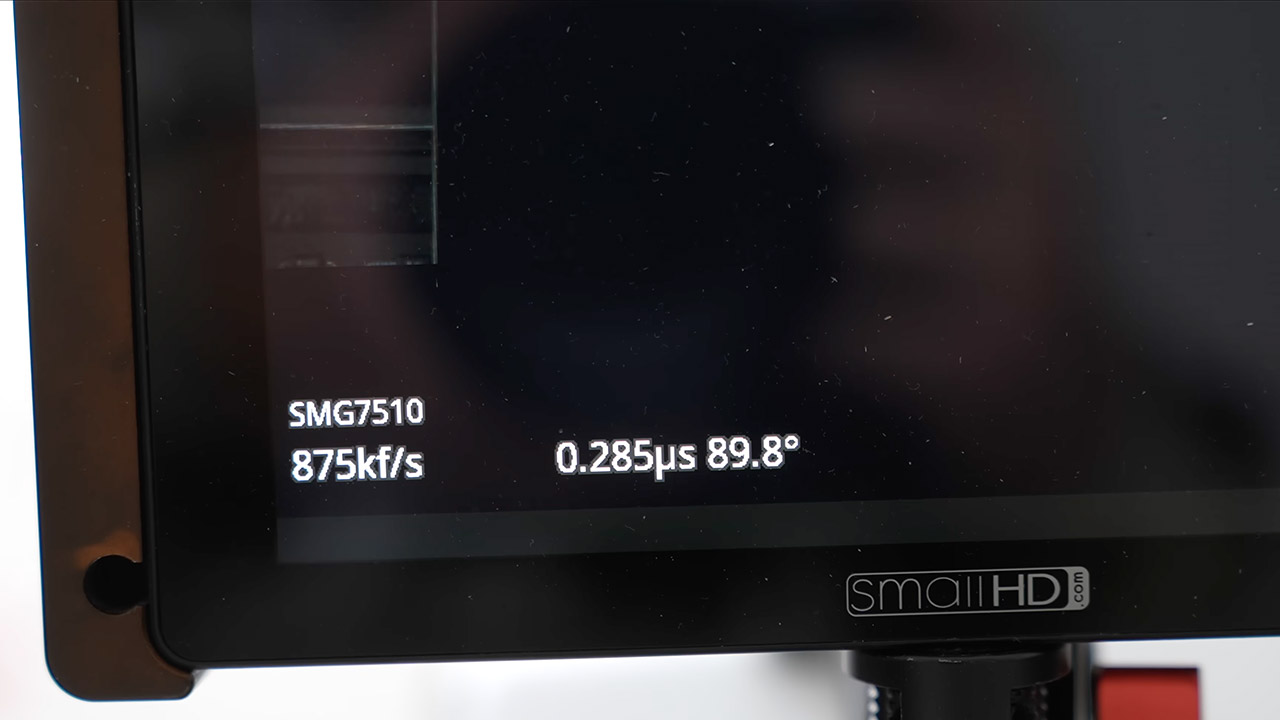
Pushing the frame rate even higher, up to 875,000 frames per second at lower resolution, transforms the entire scene into something virtually abstract. Black and white frames with millisecond exposure periods sharpen the leading edge of each fracture. These fronts are moving in nearly perfect circles, with each point along the edge traveling at the speed of sound through glass. The circular shape holds because all directions advance at the same rate until the entire surface gives way.
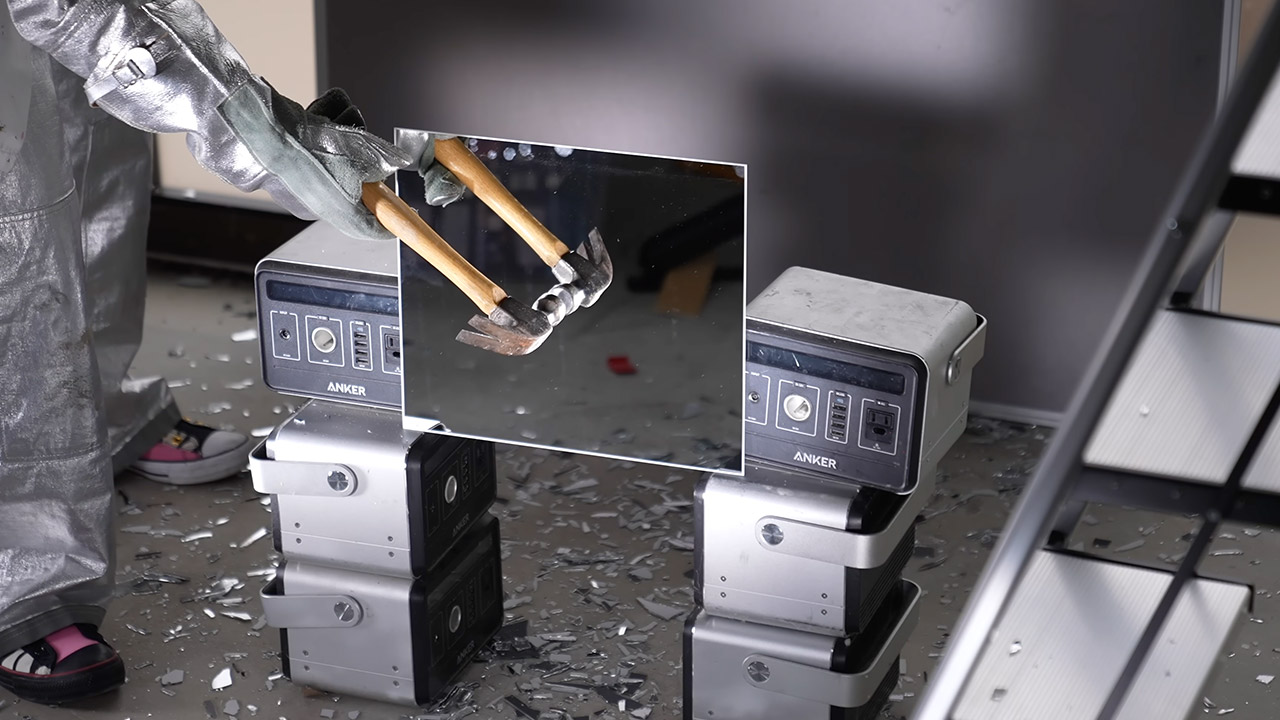
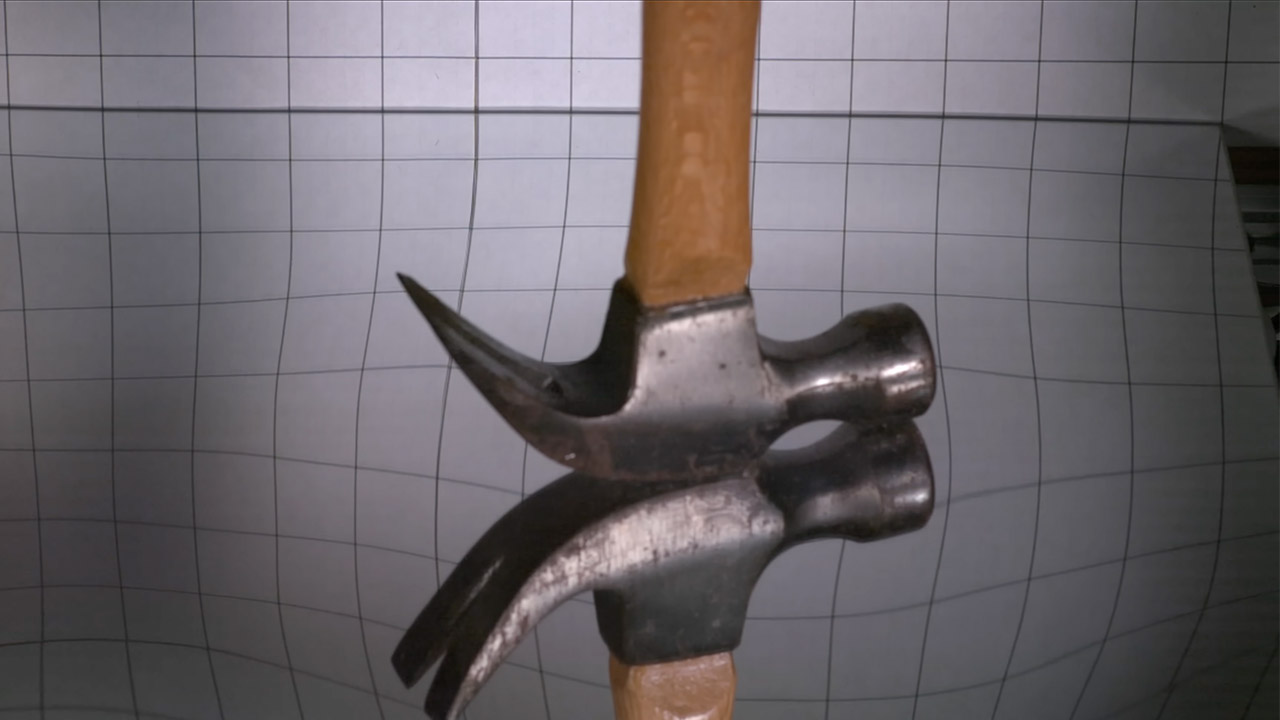
When you look at it from the side, you notice the most surprising behavior. The hammer does more than just bounce off or punch through; it sinks into the surface for an extended period of time while the glass continues to bend. Looking through the mirror to a grid behind it clarifies the duration of contact even further. The surface is curved in smooth lines, rising and sinking like the skin of a pond after a stone has been dropped in. Only after that deep flex do cracks appear and begin to spread outward.
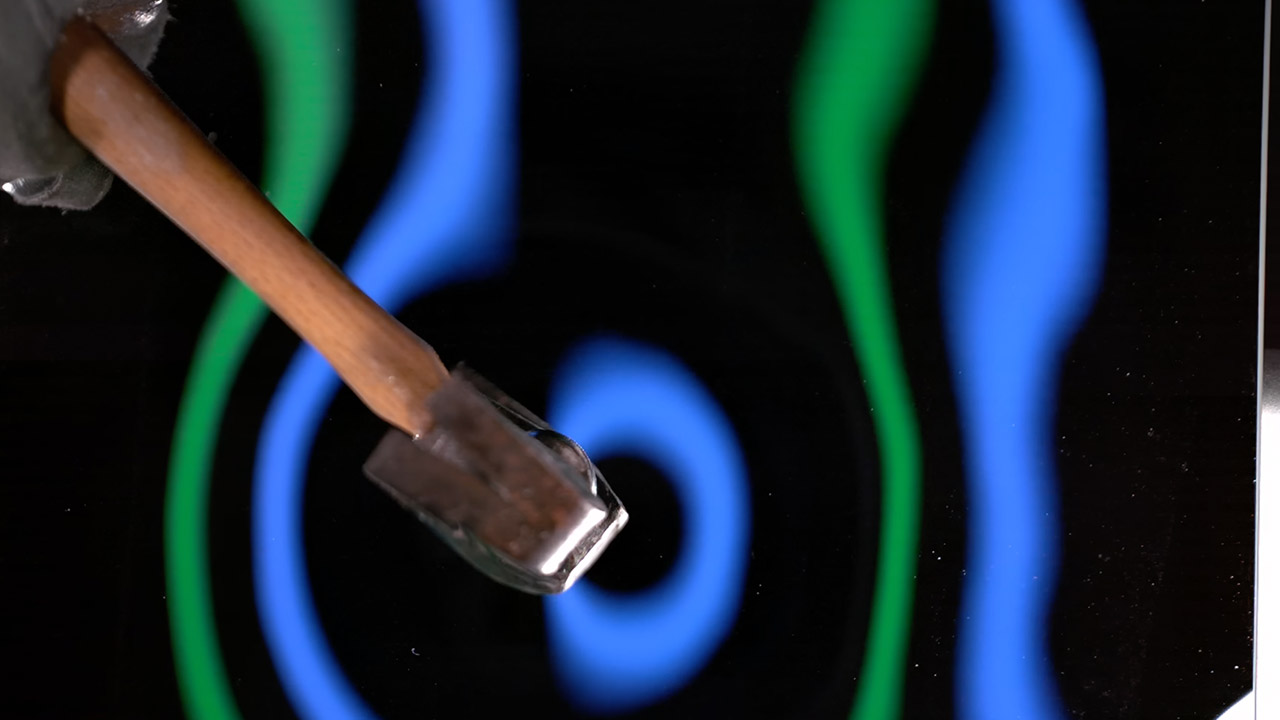
Colored lights bounce off the glass, suddenly transforming those moments into a surreal landscape. The stable blue and green tubes appear to contradict the frenzied dance of the other colors as they flicker, painting the waves and eventually shattering in an ever-changing tapestry of shifting patterns. The fragments swirl and catch the light, giving the entire collapse the appearance of an explosion of frozen color rather than broken glass. One scene in particular made Gav think of a glass peacock falling apart or a hammer crashing through someone’s most vivid dream.
Later frames demonstrate how the final crack pattern captures the mirror’s three-dimensional shape at the exact moment it gave way. Long, open cracks develop where the surface dips into a bowl, whereas tight groups of fine cracks appear where it rises into a hump. The shatter process appears to petrify the vibration pattern in place, much like sand on a vibrating plate settles into distinct, defined lines. Looking down from the top, you can nearly make out the height map of the glass by observing how the cracks had organized themselves.
You must be logged in to post a comment Login