
Tech
Solar Panels Freeze a Bucket of Water by Day to Run Free Air Conditioning at Night



Summers in Florida are terrible, forcing people to get creative in order to stay cool without breaking the bank or overloading the electricity grid. Hyperspace Pirate took on the problem and came up with a clever mechanism that absorbs solar energy throughout the day and stores it as ice for use when cooling is required, bingo.
Three regular 100-watt solar panels are put on the back of a vehicle and simply plug into a normal charge controller connected to a 35-amp-hour lead-acid battery. Once the battery is fully charged, the microcontroller activates an inverter, which powers a miniature refrigerator compressor. That compressor sucks up around 80 to 100 watts and begins to draw heat from a 2-gallon water bucket coated in substantial insulation, as we’re talking one-inch foam panels and a lot of fiberglass wool here.
Sale

Portable Solar Generator, 300W Portable Power Station with Foldable 60W Solar Panel,110V Pure Sine Wave…
- Portable Generator with 60W Solar Panel Included: with a big battery pack, ZeroKor 300W power stations Generator are powerful enough to charge…
- Multiple Charging outlets for camping gear with SOS Flashlight: with 2* 300W Max AC outlets, 1* DC port (9V-12.6V/10A max ), 3* 5V/3A Max USB ports…
- Multiple Charging Optional, Solar Panel 60W Included: ZeroKor portable power bank generator can be recharged by wall AC outlet, DC5521 Solar Panel…

Hours under the hot afternoon sun transform the entire bucket into a solid block of ice. The phase transition from liquid water to ice manages to store approximately 2.5 million joules of energy in that rather normal container. When the procedure is reversed, these numbers add up to adequate cooling capacity to provide around 700 watts of chilled air for an hour. On the cooling side, a pump circulates a 50-50 mix of water and ethylene glycol via twenty feet of copper tubing coiled deep inside the frozen block. That liquid sucks cold from the ice and drains to a standard automobile radiator with a little fan attached. Only a few watts are required to run the pump and fan, so the battery may continue to provide power even after sunset.
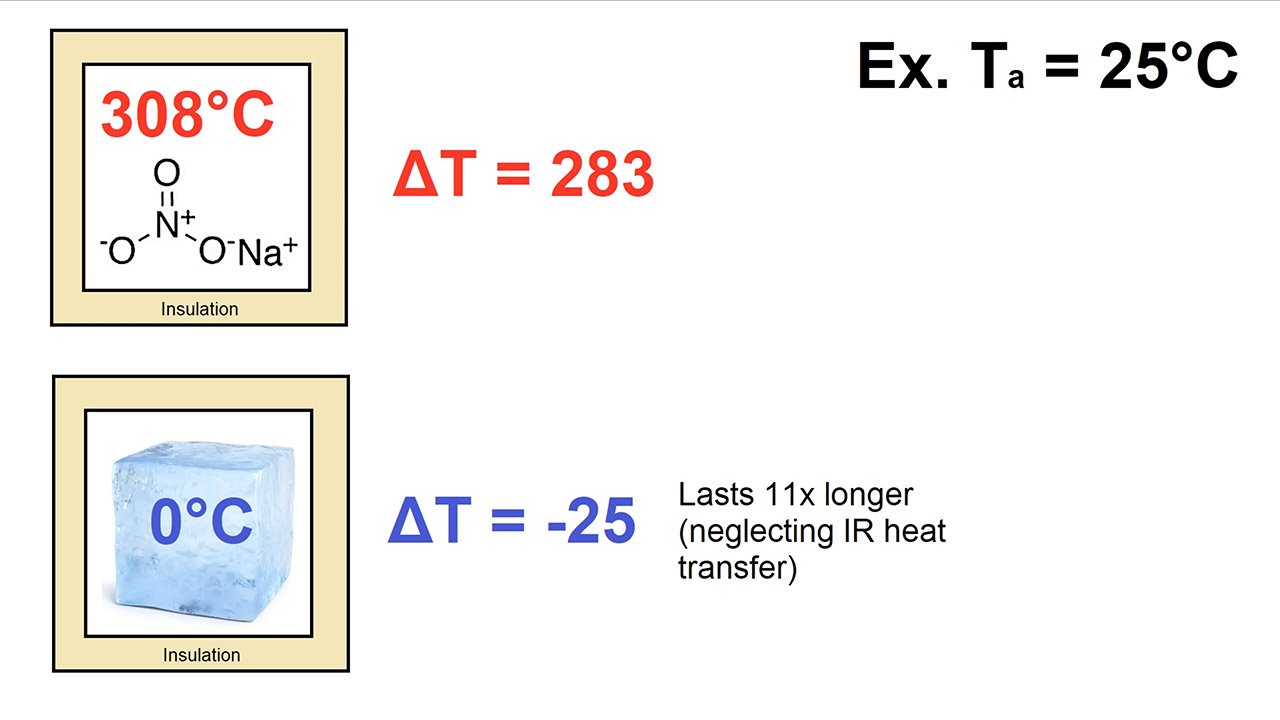
The insulation around the bucket is so strong that heat only leaks in at about 7 or 8 watts. Testing revealed that the ice remained frozen solid for several days, with almost no evidence of melting. The microcontroller’s voltage logging revealed that the compressor was kicking in at 12.9 volts and shutting out at 11.1 volts to keep the battery happy, while solar was still charging. The real-world trial put it through its paces inside the truck cab. Even on a warm day, circulating that refrigerated glycol significantly reduced the inside temperature over a few hours. The entire setup is slightly heavier than a basic battery pack, but it is still suitable for mobile use or small structures where grid ties do not seem like an option.
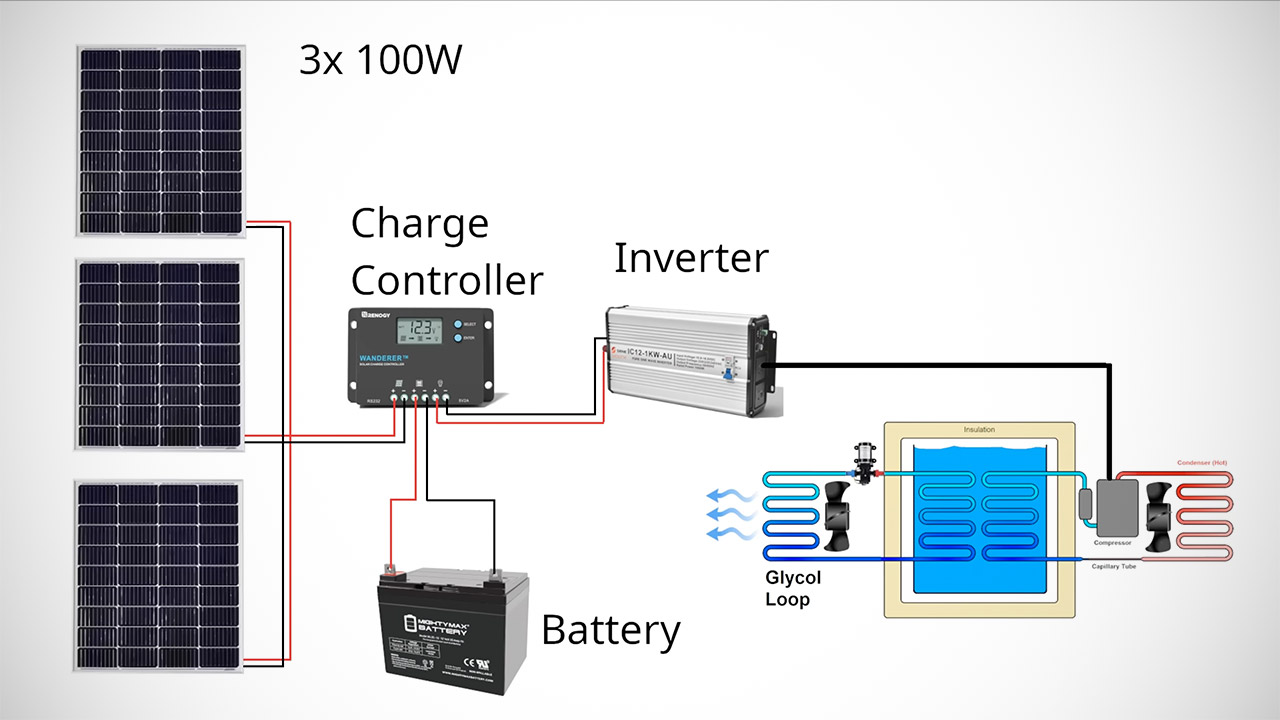
Scaling up becomes easy from here on out, since adding more solar panels and a larger water tank increases the output to several kW. Cabins and recreational vehicles were already an appropriate fit, both in terms of size and energy requirements. As an added plus, a whole house may use the system as an extra cooling source when it’s really hot outside without having to transfer any excess electricity back to the power company.

Water carries the load rather than all those chemical batteries. So the storage remains compact while the pricing remains affordable. One cubic metre of ice has roughly 93 kilowatt-hours of cooling power and weighs less than a stack of cells. The compressor runs on standard n-butane refrigerant that has been charged into a closed loop. It never interacts with the glycol side. Every last piece was built with off-the-shelf parts, some copper fabrication, and some custom code for monitoring.
[Source]

An anonymous Substack post published this week accuses compliance startup Delve of “falsely” convincing “hundreds of customers they were compliant” with privacy and security regulations, potentially exposing those customers to “criminal liability under HIPAA and hefty fines under GDPR.”
Delve is a Y Combinator-backed startup that last year announced raising a $32 million Series A at a $300 million valuation. (The round was led by Insight Partners.) On Friday, the startup attempted to refute the accusations on its blog, calling the Substack post “misleading” and saying it “contains a number of inaccurate claims.”
The Substack post is credited to “DeepDelver,” who described themselves as working at a (now former) Delve client. In response to emailed questions from TechCrunch, DeepDelver said that they and their collaborators “chose to remain anonymous out of fear for retaliation by Delve.”
In their post, DeepDelver recounted receiving an email in December claiming the startup had “leaked a spreadsheet with confidential client reports.” While Delve CEO Karun Kaushik apparently assured customers in a subsequent email that they were in compliance and that no external party gained access to sensitive data, DeepDelver said they and other customers had become suspicious.
“Having the shared experience of being underwhelmed with the Delve experience, and having the overall sense that something fishy was going on, we decided to pool resources and investigate together,” they wrote.
Their conclusion? That Delve “achieves its claim of being the fastest platform by producing fake evidence, generating auditor conclusions on behalf of certification mills that rubber stamp reports, and skipping major framework requirements while telling clients they have achieved 100% compliance.”
DeepDelver went into considerable detail about those claims, accusing the startup of providing customers with “fabricated evidence of board meetings, tests, and processes that never happened,” then forcing those customers to “choose between adopting fake evidence or performing mostly manual work with little real automation or AI.”
Techcrunch event
San Francisco, CA
|
October 13-15, 2026
DeepDelver also claimed that virtually all of Delve’s clients seem to have gone through two audit firms, Accorp and Gradient, which they described as “part of the same operation,” one that operates primarily in India, with only a nominal presence in the United States.
Those firms, they said, are just rubber-stamping reports that were generated by Delve. As a result, DeepDelver said the startup “inverts” the normal compliance structure: “By generating auditor conclusions, test procedures, and final reports before any independent review occurs, Delve places itself in the role of both implementer and examiner. This is not a technicality. It is a structural fraud that invalidates the entire attestation.”
In addition to accusing Delve of misleading its customers, DeepDelver said the startup is helping those customers “mislead the public by hosting trust pages that contain security measures that were never implemented.”
DeepDelver said that while their company was discussing its issues with Delve, the startup “sent us multiple boxes of donuts […] to keep us happy.” Nonetheless, DeepDelver’s employer supposedly unpublished its trust page and no longer relies on the startup for compliance.
Delve responded to the accusations by saying it does not issue compliance reports at all. Instead, it’s an “automation platform” that ingests information about compliance, then provides auditors with access to that information.
“Final reports and opinions are issued solely by independent, licensed auditors, not Delve,” the company said.
Delve also said that its customers “can opt to work with an auditor of their choosing or opt to work with one from Delve’s network of independent, accredited third-party audit firms.” Those auditors, the startup said, are “established firms used broadly across the industry, including by other compliance platforms.”
In response to the accusation that it’s providing customers with “fake evidence,” Delve countered that it’s simply offering “templates to help teams document their processes in accordance with compliance requirements, as do other compliance platforms.”
“Draft templates are not the same as ‘pre-filled evidence,’” the company said.
Delve added that it is “actively investigating any leaks” and is “still reviewing the Substack.”
When asked about Delve’s response, DeepDelver told TechCrunch that they were “baffled by the laziness, clumsiness and brazenness of it.”
“They are trying to snake their way out [of] being held accountable by denying having ‘pre-filled evidence’ but calling it ‘templates’ instead, effectively shifting the blame to customers for adopting the ‘templates’ as is,” DeepDelver said. “They’re claiming they are not the ones to ‘issue’ the report, which is easy to claim if you define issuing a report as providing the final stamp.”
They added that there are “a number of very serious allegations” that Delve did not address at all: “The India accusation, the lack of AI (they only talk about ‘automations’), and the trust (lol) page containing controls that were never implemented.”
Apparently DeepDelver isn’t done with its criticism, as it promised, “Part II will follow soon.”
In addition, following the initial Substack post, an X user named James Zhou said they were able to gain access to sensitive information from Delve, such as employee background checks and equity vesting schedules. Dvuln founder Jamieson O’Reilly shared more details from what O’Reilly said was a conversation with Zhou about “several gaping security holes in Delve’s external attack surface.”
TechCrunch sent an email seeking additional comment to the media contact address listed on Delve’s website. The email bounced, but after this article was published, I received a calendar invite for a “Delve demo” later this week.
This post was initially published on March 21, 2026. It has been updated with emailed answers from DeepDelver, additional information about purported security vulnerabilities provided by Jamieson O’Reilly, and additional details about Delve’s response to TechCrunch.
If you want professional-grade power tools, you’re going to have to pay a premium price. At least, that’s how it goes with many of the top power tool brands. And of that bunch, few brands come with higher prices than Milwaukee. The brand certainly has its fans, but there’s no way around it: Milwaukee leverages its good reputation to justify charging high-end prices for its power tools. As tool prices climb across the industry, more and more people would probably appreciate a way to get Milwaukee power tool performance without Milwaukee power tool prices.
If that’s you, you might want to check out Harbor Freight. In recent years, this hardware store has greatly expanded its lineup of professional-grade equipment through its in-house brands like Hercules. In fact, their Hercules line is meant to compete directly with higher-end tools sold by brands like Milwaukee… all while keeping prices much, much lower than the big-name brands. To show you what we’re talking about, we’ve found five of the best Harbor Freight alternatives to Milwaukee’s more expensive versions.
1. Hercules random orbit sander
No matter if you’re doing some woodworking, a home renovation, or finishing a furniture project, you’re probably going to need to do some sanding. Cordless random orbit sanders are one way to do so. The Hercules 20V Brushless Cordless 5-inch Random Orbit Sander sells for $54.99 at Harbor Freight, which undercuts the price of the Milwaukee Tool M18 brushless 5-inch random orbit sander, priced around $149 at Home Depot.
And even with that cost difference, the Hercules model is still built with many of the same modern performance features expected of a Milwaukee-type tool. Its brushless motor gives you variable-speed control capable of delivering up to 12,000 orbits per minute. When paired with a Hercules 5 amp-hour battery or larger, the sander can deliver up to 40 minutes of continuous operation. The sander also includes an ergonomic rubberized grip to reduce vibration, and it uses an eight-hole dust collection system paired with a dust bag to help keep your work surface cleaner.
2. Hercules hammer drill/driver
Hammer drills are a cornerstone tool for both construction professionals and home renovators, especially when projects involve drilling into masonry, concrete, or other dense materials. And while Milwaukee has options for you (like the M18 FUEL hammer drill), you can expect to pay upwards of $229 at places like Home Depot. Meanwhile, Harbor Freight has the Hercules 20V Brushless 1/2-inch Compact Hammer Drill/Driver for $79.99 instead.
This tool can give you up to 1,200 inch-pounds of maximum torque, so you can drive large fasteners or drill holes into dense materials like it’s nothing. It’s also capable of up to 32,000 blows per minute in hammer mode. That rapid percussive action helps the drill break through concrete and masonry more efficiently than a standard drill ever could. Under typical conditions, Harbor Freight says the Hercules can drill up to 110 holes in concrete on a single charge.
3. Hercules trigger-grip angle grinder
Angle grinders are another popular power tool that people might look to Milwaukee for. For example, the 15-amp large-angle grinder from Milwaukee Tool sells for $299 at Home Depot. Compare that to the Hercules 15-amp 7-inch/9-inch Trigger-Grip Angle Grinder going for $129 at Harbor Freight. That’s more than 50% savings if you’re willing to swap the popular red tool for this lesser-known blue one.
The Hercules grinder is powered by a 15-amp motor that can produce speeds up to 6,500 revolutions per minute. You also get a trigger-grip handle for more leverage and control compared with traditional side-handle-only grinders. The handle includes an optional lock-on function that lets the tool run longer without you constantly applying pressure to the trigger. The Hercules grinder also includes tool-free guards for both 7-inch and 9-inch grinding wheels. It’s all protected by an all-metal aluminum gear case with a reinforced plastic housing to reduce that annoying vibration.
4. Hercules reciprocating saw
Reciprocating saws are a must-have for demolition, remodeling, or rough-cutting applications. Milwaukee’s M18 FUEL reciprocating saw costs $249 at Home Depot. That’s not the brand’s most expensive power tool, to be clear, but it’s still not cheap. The Hercules 20V Brushless Cordless Reciprocating Saw, however, is priced at $79.99 at Harbor Freight, which is quite a steep price drop.
The saw can deliver up to 3,000 strokes per minute via its variable-speed trigger. It also uses a pivoting shoe with three depth adjustment positions to give you more control over the cut. (Beyond the extra control, adjusting the shoe means extending the blade life by exposing different parts of the blade during repeated cuts.) Blade changes are nice and easy thanks to a keyless single-action mechanism that lets you swap things out without any additional tools. The reciprocating saw also includes a super safe electric brake that stops the blade immediately after the trigger is released.
5. Hercules right angle drill
Right angle drills are great for working in those tight spaces where traditional drills just won’t fit. But if you want one from Milwaukee, you’ll have to pay $329 for it at Home Depot. On the other hand, Hercules can get you a 20V Brushless Cordless 1/2-inch Variable-Speed Right Angle Drill for only $94.99 at Harbor Freight. It’s one of the most dramatic differences between Milwaukee and Hercules pricing that we’ve seen.
It comes with a variable-speed trigger for adjustable drilling speed based on the material you’re drilling. (That’ll also help prevent the drill from overheating and avoid any bit damage that can come from switching between softer materials and denser wood or construction lumber.) It also includes a built-in LED work light that shines on the drilling area. All in all, you’re looking at more than 120 holes drilled per battery charge. Combine that with the fact that it’s a third of the price of the Milwaukee version, what’s not to like?
Tech
Elon Musk announces Terafab project he claims will be the ‘largest chip manufacturing facility ever’

Elon Musk has announced the Terafab project, a joint venture between Tesla, SpaceX and xAI, to build the “largest chip manufacturing facility ever.” In his usual grandiose fashion, Musk claims Terafab is the next step towards harnessing the power of the sun and creating a “galactic civilization.”
Musk, CEO of all three companies, announced plans for the Terafab in a livestream on X. As the name implies, the project’s ultimate goal is to produce a terawatt of computing power each year so that it can match the companies’ growing demand for chips. Musk explained during the livestream that he’s grateful to existing supply chain partners like Samsung, TSMC and Micron, but the current capacity of chip manufacturers only adds up to about two percent to what Tesla and SpaceX needs in terms of future computing power needs.
“We either build the Terafab or we don’t have the chips,” Musk said during the event. “And we need the chips so we’re going to build the Terafab.”
The Terafab project, estimated to cost at least $20 billion, will start with the Advanced Technology Fab in Austin, Texas, where Tesla is already headquartered. Musk said that the two types of chips will be produced in the Terafab: one for terrestrial purposes, like to power Full Self-Driving or Optimus robots, and another more high-powered, durable chip to be used in space. If you’re wondering what Musk has in store for space, the SpaceX CEO filed an application with the Federal Communications Commission to launch a million satellites to create an “orbital data center” earlier this year. As promising as this sounds, it’s worth noting that Musk has previously overpromised and underdelivered on other projects, like the Hyperloop, a $40,000 Cybertruck and fully autonomous driving.
AI coding company Cursor launched a new model this week called Composer 2, which it promoted as offering “frontier-level coding intelligence.”
However, an X user posting under the name Fynn soon claimed that Composer 2 was “just Kimi 2.5” with additional reinforcement learning — Kimi 2.5 being an open source model recently released by Moonshot AI, a Chinese company backed by Alibaba and HongShan (formerly Sequoia China).
As evidence, Fynn pointed to code that seemed to identify Kimi as the model.
“[A]t least rename the model ID,” they scoffed.
It was a surprising revelation, since Cursor is a well-funded U.S. startup that raised a $2.3 billion round last fall at a $29.3 billion valuation, and is reportedly exceeding $2 billion in annualized revenue. Also, the company didn’t mention anything about Moonshot AI or Kimi in its announcement.
However, Cursor’s vice president of developer education Lee Robinson soon acknowledged, “Yep, Composer 2 started from an open-source base!” But he said, “Only ~1/4 of the compute spent on the final model came from the base, the rest is from our training.” As a result, he said Composer 2’s performance on various benchmarks is “very different” from Kimi’s.
Robinson also insisted that Cursor’s use of Kimi was consistent with the terms of its license, a point the Kimi account on X repeated in a subsequent post congratulating Cursor, where it said Cursor used Kimi “as part of an authorized commercial partnership” with Fireworks AI.
Techcrunch event
San Francisco, CA
|
October 13-15, 2026
“We are proud to see Kimi-k2.5 provide the foundation,” the Kimi account said. “Seeing our model integrated effectively through Cursor’s continued pretraining & high-compute RL training is the open model ecosystem we love to support.”
So why not acknowledge Kimi upfront? Beyond any potential embarrassment in not creating a model from scratch, building on top of a Chinese model might feel particularly fraught right now, with the so-called AI “arms race” often framed as an existential battle between United States and China. (See, for example, Silicon Valley’s apparent panic after Chinese company DeepSeek released a competitive model early last year.)
Cursor co-founder Aman Sanger acknowledged, “It was a miss to not mention the Kimi base in our blog from the start. We’ll fix that for the next model.”


A quieter week by headline standards, but one that reveals a great deal about where European venture capital is quietly concentrating: AI agents for physical industries, agritech automation, and the growing operator-to-VC pipeline.
What the week of 16-22 March delivered was something different in texture rather than volume: smaller rounds, more specific theses, and a pattern of investment that points more clearly at where European capital is actually building conviction. AI agents entering complex physical environments.
Agricultural automation that finally has the engineering to match its ambitions. A new generation of European VC funds drawing on operators who have scaled the continent’s own companies.
1. Upvest – $125M Series D | Berlin, Germany
Upvest has raised $125 million just a year after its last round, pushing its valuation to €640 million from €360 million.
The Berlin fintech powers the infrastructure behind investing apps used by clients including Revolut, N26, Openbank, and Zopa. Tencent’s backing also points to growing global interest in European fintech infrastructure.
2. Partech Impact Fund – €300M close | Paris, France
Partech has closed a €300 million impact fund aimed at one of Europe’s most persistent climate tech gaps: growth capital.
The Paris-based firm will back around 15 B2B companies with more than €10 million in revenue across sectors such as clean manufacturing, sustainable agriculture, green construction, mobility, and digital health. Its first investment is Luxembourg-based SustainCERT.
What makes the fund stand out is its structure. Partech has linked carried interest to impact performance, not only financial returns, and registered the vehicle as an Article 9 fund under EU sustainable finance rules.
3. Montis VC – €50M first close | Warsaw, Poland
Montis VC has reached a €50 million first close for a new fund focused on European startups in energy transition, industrial tech, and AI. Backers include the European Investment Fund, Poland’s Development Fund, and family offices from across Central and Eastern Europe.
The fund plans to invest €0.5 million to €2 million in 20 to 25 pre-seed and seed-stage companies, with half the capital reserved for follow-ons. Its launch also reflects a broader trend, as CEE investors push deeper into climate and industrial deep tech with support from both public and private capital.
4. Parallel – €20M Series A | Paris, France
Parallel, a Paris-based startup building AI agents for hospital billing and medical coding, has raised a $20 million Series A led by Index Ventures, less than a year after its seed round.
The company focuses on the French public hospital system, using AI to navigate legacy software without deep integrations. Parallel says that approach can cut deployment times dramatically and could eventually expand into broader hospital workflows.
5. Rivia – €13M close | Zurich, Switzerland
Rivia, a Zurich-based startup building AI for clinical trial operations, has raised €13 million to expand its agentic data platform.
The company says its system helps biotech teams unify fragmented trial data, surface insights, flag anomalies, and manage operational risks in regulated environments. The round follows a €3 million seed in 2024 and marks a bigger bet on AI tools that do more than store data.
6. Kupando – €10M Series A | Schönefeld, Germany
Kupando has added €10 million to its Series A, bringing the round to €23 million as it pushes its lead drug, KUP101, into a Phase 1b trial. The German biotech is developing an innate immunity therapy for advanced solid tumours and drug-resistant infections, a less crowded path in immunotherapy.
The funding suggests investors believe the science is finally ready to move from preclinical promise into patients.
7. eternal.ag – €8M seed | Cologne, Germany
Eternal.ag, a greenhouse robotics startup founded by former Honest AgTech co-founder Renji John, has raised €8 million. Based in Cologne and Bengaluru, the company is building autonomous harvesting systems for greenhouses, starting with tomatoes.
Its pitch rests on simulation-led development: robots are trained in virtual greenhouses using NVIDIA Isaac Sim before being deployed in real ones. Eternal.ag says this speeds up testing and iteration in one of agtech’s toughest automation problems.
8. Choice – €7.1M Series A | Prague, Czech
Choice, a Prague-founded restaurant tech startup, has raised $7.1 million in Series A funding to expand from Central and Eastern Europe into Western Europe, starting with Portugal.
The company offers an all-in-one platform for restaurants, covering ordering, payments, reservations, and delivery integrations, and says it now serves more than 7,000 paying customers across nine markets.
9. Ofiniti – $6.8M | Oslo, Norway
Ofiniti, an Oslo-based maritime fuel software startup spun out of DNV, has raised $6.8 million to expand beyond Singapore into major global bunkering hubs.
Its platform digitises fuel delivery paperwork, scheduling, and compliance, and the company says it processed more than 25,000 bunker operations in 2025 while capturing about 40% of Singapore’s digital bunkering market.
10. Reson8 – €5M pre-seed | Amsterdam, Netherlands
Reson8, an Amsterdam startup building speech AI for Europe’s linguistic complexity, has raised a €5 million pre-seed round led by Balderton Capital.
The company’s platform supports more than 20 European languages and adapts to industry jargon, accents, and speaking patterns without retraining. Its focus is on high-precision sectors such as healthcare, logistics, legal, and finance.
11. BBLeap – €5M | Rijen, Netherlands
BBLeap, a Dutch agritech startup focused on precision spraying, has raised €5 million in a round led by ESquare Capital, with backing from Yield Lab Europe and existing investors.
Its technology retrofits existing sprayers to control each nozzle individually and, with its LeapEye system, adjusts treatment in real time based on what crops actually need. The funding will support LeapEye’s commercial rollout and international expansion.
12. Homaio – €3.6M seed | Paris, France
Homaio, a Paris startup opening the carbon allowance market to retail investors, has raised €3.6 million in seed funding led by RAISE Ventures.
The company lets individuals buy securities physically backed by EU carbon permits and says it has drawn users from more than 30 countries since its public launch in September 2024. The new capital will help it expand beyond carbon allowances into broader energy transition markets.
13. Elea & Lili – €2.5M seed | Finland
Elea & Lili, a Finnish spinout from VTT, has raised €2.5 million in seed funding led by Lifeline Ventures to commercialise a cellulose-based alternative to the fossil-derived absorbents used in diapers and agriculture.
The company says its material matches conventional performance while being biodegradable and microplastic-free, though industrial-scale validation is still ahead.
14. Ringtime – €1.8M seed | Ghent, Belgium
Ringtime, a Ghent startup building AI agents for blue-collar recruitment, has raised €1.8 million in funding led by Volta Ventures.
Its platform automates candidate outreach, screening, and matching across 22 languages, targeting sectors such as logistics, retail, food processing, and construction. The company is led by Vincent Theeten, the former CEO of Belgian software firm Cheqroom.
15. eYou – €300K pre-seed | Bucharest, Romania
eYou, a Bucharest-based social media startup, has raised €300,000 in pre-seed funding from Fil Rouge Capital ahead of its planned May launch.
The platform aims to tackle misinformation and echo chambers with built-in AI fact-checking and tools that show users how recommendation systems profile them.
Positioned around GDPR compliance and European data sovereignty, eYou is pitching itself as a trust-first alternative to mainstream social media.
The week’s dominant investment theme was not frontier AI models or data-centre buildout, but AI agents entering physical and institutional environments where automation has historically struggled: hospital administration, greenhouse harvesting, farm spraying, blue-collar recruitment, and many more.

Marshals, a new Yellowstone spinoff starring Luke Grimes as Kayce Dutton, is airing on CBS right now. You can also tune in with Paramount Plus. The Yellowstone sequel series sees Grimes as a former Navy SEAL who joins an elite unit of US Marshals to bring range justice to Montana, according to a synopsis from CBS.
The show includes Yellowstone actors Gil Birmingham as Thomas Rainwater, Mo Brings Plenty as Mo and Brecken Merrill as Tate. Spencer Hudnut is the showrunner of Marshals — formerly known as Y: Marshals — and Taylor Sheridan is an executive producer.
When to watch new Marshals episodes on Paramount Plus
Episode 4 of Marshals airs on CBS on Sunday, March 22. Viewing options for Paramount Plus customers vary by subscription tier. You can watch the episode live if you have Paramount Plus Premium, which includes your local CBS station. If you subscribe to Paramount Plus Essential, you can watch the installment on demand the following Monday, but not live on Sunday.
Here’s a release schedule for the next three episodes of Marshals.
- Episode 4, The Gathering Storm: Premieres on CBS/Paramount Plus Premium on March 22 at 8 p.m. ET/8 p.m. PT/7 p.m. CT. Streams on Paramount Plus Essential on March 23.
- Episode 5, Lost Girls: Premieres on CBS/Paramount Plus Premium on March 29 at 8 p.m. ET/8 p.m. PT/7 p.m. CT. Streams on Paramount Plus Essential on March 30.
- Episode 6, Out of the Shadows: Premieres on CBS/Paramount Plus Premium on April 5 at 8 p.m. ET/8 p.m. PT/7 p.m. CT. Streams on Paramount Plus Essential on April 6.
You can also watch CBS and the fourth episode of Marshals without cable with a live TV streaming service like YouTube TV, Hulu Plus Live TV or the DirecTV MyNews skinny bundle. In addition to offering a lower-cost option, Paramount Plus lets you watch the other two Yellowstone spinoffs: the prequels 1883 and 1923.
After a price increase in early 2026, the ad-supported Essential version runs $9 per month or $90 per year. The ad-free Premium version runs $14 per month or $140 per year. Paying more for Premium gives you downloads, the ability to watch more Showtime programming than Essential and access to your live, local CBS station.

Nvidia’s GTC conference had everything: trillion dollar sales projections, graphics technology that can yassify video games, grand declarations that every company needs an OpenClaw strategy, and even a robot version of the beloved snowman Olaf from Disney’s “Frozen.”
On the latest episode of TechCrunch’s Equity podcast, TechCrunch’s Kirsten Korosec, Sean O’Kane, and I recapped CEO Jensen Huang’s keynote and debated what it means for Nvidia’s future. And yes, a big part of our discussion focused on poor Olaf, whose microphone had to be turned off when he started rambling.
Even if the demo had gone flawlessly, Sean might still have had some reservations, as he noted these presentations always focus on “the engineering challenges” and not the “really messy gray areas” on the social side.
“But what happens when a kid kicks Olaf over?” Sean asked. “And then every other kid who sees Olaf get kicked or knocked over has their whole trip to Disney ruined and it ruins the brand?”
Read a preview of our conversation, edited for length and clarity, below.
Anthony: [CEO Jensen Huang] was basically saying that every company needs to have an OpenClaw strategy now. I think that is just a very grand statement that’s meant to be attention grabbing; I think it’s also interesting coming at this kind of transitional moment for OpenClaw.
The founder has gone to OpenAI. So it’s now this open source project that potentially can flourish and evolve beyond its creator, or it could languish. If companies like Nvidia are investing a lot into it, then [it’s] more likely that it’ll continue to evolve. But it’ll be interesting to see a year from now, whether that looks like a prescient statement or everyone’s like, “Open what?”
Techcrunch event
San Francisco, CA
|
October 13-15, 2026
Kirsten: In the case of Nvidia, it costs them nothing in the grand scheme of things to launch what they call NemoClaw, which is an open source project, which they built with the OpenClaw creator. But if they don’t do something, they have a lot to lose. So really that message to me, the way I translated it when Jensen was like, “Every enterprise needs to have an OpenClaw strategy,” it was, “Nvidia needs to have a solution or strategy for enterprises, because if it’s successful, it is another way or another pathway for Nvidia to be part of numerous other companies.” So doing nothing is a greater risk than doing something that doesn’t go anywhere.
Sean: The real question here is why have we not talked about what is clearly the end game for Nvidia, and the thing that is going to turn it into the first $100 trillion company, which is an Olaf robot.
Anthony: How could I forget?
Kirsten: Anthony, just go to the end of the two and a half hours to watch this.
So, the Olaf robot comes out, and this is something that Jensen loves to do. He loves to have these demos and some of them go better than others. It is also to demonstrate Nvidia’s technology in robotics, and I don’t know if Olaf was actually speaking in real time or if it was programmed — it felt a little programmed, or it had specific keywords that it used.
But the greatest part about it is that they had to cut its mic at the end because it just started rambling and speaking to the crowd. And then it went over to its little passageway and was slowly lowered. And you could see it on the video. It was still talking, but no mic.
Sean: Now we just need to give this little robot a wheelbase. And I know the perfect founder who can provide it.
I mean, these demos are always silly. I don’t want to get up on my soapbox, because I know that we’ve talked about this a little bit earlier this week, but this was an impressive demo up until the moment where it fell a little bit short.
This is another really good example, though, of [how] robotics is a really interesting engineering problem and a really interesting physics problem and a really interesting integration problem, and all of this stuff, but this was presented as, in partnership with Disney, and it’s supposed to be the future of Disney parks and things like that: You’re going to be able to walk around and see Olaf from “Frozen” and take pictures of them and everything.
But these efforts never consider — or certainly don’t put front and center in events like this — all the other things you have to consider when you roll stuff out like this. There’s a really good YouTuber, Defunctland, that did a really good video about this — four hours long, not too long — about the history of Disney trying to get these kinds of robotics into their park, these automatons.
The engineering challenges are really interesting and it’s fun to see that history, but it always comes back to the same question of: Okay, but what happens when a kid kicks Olaf over? And then every other kid who sees Olaf get kicked or knocked over has their whole trip to Disney ruined and it ruins the brand?
There’s just so much on the social side of this. And that sounds silly, but this is the question that we’re kind of asking about humanoid robots, too. There’s so much hype about all this other stuff and we just don’t really hear as much conversation about the really messy gray areas on the social side of these things, and also just integrating them into people’s lives. We only ever really hear about the engineering challenges — which again, are really impressive.
Kirsten: I have a counterpoint and then we have to get to our next [topic]. This is a job creator, because Olaf will have to have a human babysitter in Disneyland, probably dressed up as Elsa or something else. You can imagine that actually, what we’re doing is creating jobs [with] this engineering experiment.


A new video (above) out of South Korea features the field tests and interaction capabilities of KAIST Humanoid v0.7, developed at the Korea Advanced Institute of Science and Technology (KAIST).
The impressive humanoid robot was developed at KAIST’s Dynamic Robot Control & Design Laboratory (DRCD) and deploys actuators and other technology that was developed in-house.
In the video below, you can watch the bipedal bot walk, jog, and jump in an incredibly human-like way. It also shoots a soccer ball toward a goal (disappointingly there’s no robot goalkeeper there to challenge it), and performs a perfect moonwalk along astroturf. And it was the moonwalk that created a bit of a buzz in the comments accompanying the video.
“Moonwalk was flawless,” wrote one, while another commented, “Okay all of this was impressive, but you convinced me with the moonwalk.”
In its robotics work, KAIST deploys Physical AI, a form of AI technology that enables machines to understand and act in the physical world, helping to explain why robots such as the KAIST Humanoid v0.7 appear to move in such a human-like manner.
Instead of just “thinking in words” like typical AI, Physical AI gives machines a sense of space and timing in real environments.
Under KAIST’s broader collaborative intelligence initiative led by Young Jae Jang, the approach trains robots and systems to learn continuously through simulation and real time feedback, rather than relying only on enormous historical datasets.
Essentially, Physical AI merges brain and body by tightly integrating software intelligence with hardware such as motors and sensors so that the machines do not only compute, but also act, react, and collaborate in complex environments, whether as part of fully automated factories or in humanoid robots doing something like kicking a ball.
Engineers are refining the KAIST Humanoid v0.7 with the aim of enhancing its mobile and dexterous capabilities, thereby building on its existing walking and dynamic movement skills. By further integrating AI with mechanical hardware, it plans to get the robot to perform more complex tasks like carrying items or operating machinery, bringing Physical AI to real-world humanoid robot applications.
KAIST is one of South Korea’s top universities and is often compared to top global tech schools like MIT in the U.S. Founded in the early 1970s to drive Korea’s scientific and technological growth, KAIST focuses heavily on research in fields such as AI, robotics, physics, and engineering.

Verdict
Samsung’s best wireless earbuds so far, improving on the Galaxy Buds 3 Pro with a stronger noise-cancelling performance, more balanced sound, better call quality, and solid battery life. If you have a Galaxy Ultra smartphone, you can buy with confidence
-
Wide, spacious, clear sound
-
Strong noise-cancelling
-
Comfortable fit
-
Improved call quality
-
Solid battery life
-
Need a Galaxy smartphone to get the best performance
-
Controls are still fiddly
Key Features
-

Review Price:
£219
-
SSC-UHQ
Higher quality, 24-bit/96kHz sound over Bluetooth
-
360 Audio with Head Tracking
Have music follow your movements
-
Super Clear Call
Clearer calls with Samsung smartphones
Introduction
Every year there’s a new Samsung Galaxy smartphone, and more often than not, alongside them is a new pair of headphones – in this case, it’s the Galaxy Buds Pro 4.
The Galaxy Buds Pro 4 don’t receive as much fanfare as the smartphones (in this case the Samsung Galaxy S26 Ultra), less the headline and more a sub-header; but similarly to how Apple approaches its true wireless pairs, the Galaxy Buds are a partner to the smartphones rather than an entity that exists on its own.
The Galaxy Buds have been getting better – aside from the strange burst of designs a few years ago – are these the best yet?
Design
- Plush level of comfort
- IP57 rating
- White, black and pink gold finishes
Samsung has toned down the AirPods-vibe though, at the end of the day, these are a pair of stem-based wireless earbuds – there’s not much you can do with the actual design.
But Samsung has tried and the Galaxy Buds 4 Pro do look nice, the silver ‘real metal blade’ finish of the stem feels suitably premium. Comfort levels are very good. I’ve worn these for hours and not felt any discomfort. Small, medium and large ear tips are provided, with medium as default.

I do, however, find that the seal for these earbuds can come loose while walking. Even munching on food can cause the fit to loosen and require a push back in.
Samsung continues with gesture/pinch controls. I’ve never been a big fan and I can’t say the Galaxy Buds 4 Pro have persuaded me to think otherwise. I find it fiddly, and often when I’ve tried to play/pause a track I’ve ended up lowering the volume. I often just use the controls in-app than use the onboard controls – it’s much easier for me.

The charging case differs from the Galaxy Buds 3 Pro and is different from the Galaxy Buds 4 launched alongside the Pro version. Compared to the 3 Pro, this new case is more compact but also slightly taller – the see-through case is a nice visual touch. Rated at IP57, these earbuds put out a stiff hand against water, dirt and dust (more so than most premium true wireless), though the case doesn’t sound like it has any protection.
Colours come in white and black, but buy directly from Samsung and there’s the option of a Pink Gold (which looks like it costs the same).
Noise-Cancellation
- Galaxy AI-supported features
- 26 hours battery life with ANC
- Galaxy Wearable app for customisation
In general, the Galaxy Buds 4 Pro’s adaptive noise-cancellation is good, very good even, especially in terms of how consistent the performance is.
Whether I’m on the Victoria Line, a train, a bus, an aeroplane, the DLR or walking outside with traffic going past, the level of quiet and calm has always been very high. The barometer I have with ANC headphones is whether I need to raise the volume to mask more noise and I never felt the need to do that with the Galaxy Buds 4 Pro.
Cars are reduced to hums, the Underground is no longer a constant noise machine, and compared to the Galaxy Buds 3 Pro, these do thin out noise better.

But against the Sony WF-1000XM6, Bose QuietComfort Ultra Earbuds 2 and Technics EAH-AZ100, they’re just a step beyond the Samsung, with more noise peering in when wearing the Galaxy Buds 4 Pro during a pink noise test. They’re not too far off though.
The transparency mode sounds clear – big and broad in terms of what you can hear, and it sounds natural enough, though again perhaps not to the same levels of Sony and Bose produce.
Call quality is very good. With Samsung Galaxy phones there’s a Super Clear Call feature that enhances clarity and reduces noise, but even using a OnePlus smartphone the performance was very good.
Background noise was reduced and though my voice did sound muffled – at times it was hard for the other person to hear some words – but overall the performance is good for use when you’re outside.
Features
- Galaxy smartphone exclusive features
- Wear app for non-Galaxy smartphones
The Galaxy Buds 4 Pro aren’t short of features, though you’ll need to have a Galaxy smartphone to get the most out of them, especially one that’s been updated to the One UI 8.5, as that has access to features not present in previous versions.
Like with Apple’s AirPods, the Galaxy Buds’ UI is built into the Samsung smartphone UX, but for everyone else, you’ll need to download the Galaxy Wear app.

Wirelessly there’s Bluetooth 6.1, which brings some enhancements over Bluetooth 5 (everything is just better, in simple terms), and I’ve found the connection to be strong wherever I am (and that’s without a phone that supports Bluetooth 6). Instability and interference have barely been an issue.
The headphones support an interesting array of codecs for the Bluetooth fans out there, with SBC, AAC, LC3, and Samsung’s own SSC and SSC-UHQ, the latter acting as Samsung’s high quality codec of choice against Sony’s LDAC and Qualcomm’s aptX. SSC is only available on Samsung Galaxy phones though.
You can toggle it on in the app/settings and it lets loose 24-bit/96kHz audio over a Bluetooth connection – though don’t take that to mean it’s lossless. It’s very likely to be lossy (which means detail is lost).

There’s 360 Audio with Head Tracking that builds on top of immersive audio formats such as Dolby Atmos music. The head tracking works well when listening to Sarah Kinsley’s Truth of Pursuit and Brent Faiyaz’s Other Side on Tidal, but there’s possibly the slightest lag when moving my head and waiting for music to respond.
Otherwise, I’m rather impressed in terms of clarity – immersive audio tends to sound less detailed and softer but the Galaxy Buds 4 Pro do a good job of keeping clarity levels high.
There are Head Gestures for accepting and rejecting calls (just added to One UI 8.5). and Earbud fit test (much less annoying than the Sony Sound Connect version): customisation of controls, battery life indicators and swapping through noise-cancelling modes, EQ options and Audio Broadcast (Auracast by another name). There are voice controls (mainly through Bixby) and accessibility controls if needed.
Want to translate words from a different language? You can read a transcript of what the earbuds hear, translated to your language via Galaxy AI, speaking of which, Samsung seems to have calmed down the AI narrative and rightly so. I don’t need to be told about AI, I just need it to work in the way it’s meant to.

You can switch to nearby devices without having to jump into pairing mode, though the fine print indicates these need to be connected to your Samsung account. With that in mind, Bluetooth multipoint is a slight mystery in that it is supported (with Samsung devices) and isn’t (with anything other than Samsung). I can’t have the Galaxy Buds 4 Pro connected to a Galaxy smartphone or OnePlus model at the same time.
Lose the earbuds and you can locate them through Samsung Find, although it seems to think I’m not in my house but next door – close enough I suppose. The Adapt Sound feature is not what I initially thought it’d be. It tunes the sound for how old you are, boosting frequencies based on your age. You can add a personalised sound profile by going through audio tests to determine your hearing.
Battery Life
- Six hours per charge
- Wireless charging
Samsung claims the Galaxy Buds 4 Pro are capable of six hours with ANC on, which doesn’t sound the most progressive (and isn’t), with a total of 26 hours with the charging case (without ANC it’s 7 and 30 hours).
Perhaps Samsung have erred on the safe side but I’ve found battery life pretty strong. An hour’s listening saw both earbuds fall to 87%, which would put the Galaxy Buds 4 Pro at around 8 hours, not six.
There’s fast-charging for those in a fix, and wireless charging support as well.
Sound Quality
- Clear, detailed, spacious sound
- Wide soundstage
- Balanced, warm approach
Not too dissimilar to the Galaxy Buds 3 Pro, the Galaxy Buds 4 Pro feature a two-way speaker that’s been redesigned from before.
There’s now a wider woofer alongside a precision tweeter, with the aim of delivering deep, textured sub-bass to extended highs with a “faster transient response, a rich midrange body and sharp detail”. Each driver has its own amplifier, which should lead to reduced distortion.
Paired with a non-Galaxy smartphone and the results are… fine. The Galaxy Buds 4 Pro sound on the rich side but the bass isn’t the most assertive, the highs don’t come across as the brightest and they’re not the most dynamic or energetic sounding pair I’ve ever heard.

Some of the traits carry over when paired to a Galaxy smartphone, but to unlock the highest level of performance from the Galaxy Buds 4 Pro, you need to toggle on the SSC-UHQ feature. With that, these earbuds ascend to a higher level.
Which is not to say they match the Sony WF-1000XM6, which beat the Galaxy Buds 4 Pro for insight, detail and energy, but they have qualities of their own that aren’t to be dismissed.
The soundstage is very wide. Bass never hogs the limelight but I’d vote for having a bit more depth and energy to the low frequencies. With a track like Hard Life’s Skeletons, the bass performance leaves me wanting a bit more in terms of energy.
But it’s the clarity of these earbuds that impresses, as well as the natural tone they strike whether it’s with more upbeat K-pop tracks like ILLIT’s Magnetic or slower, more downtempo tracks like Amy Winehouse’s Back to Black – the wide soundstage, crisp tone to highs and levels of insight and detail with vocals stand out.

Andreas Ihlebæk’s Come Summer is a track I play to try and catch headphones out – the highs sound bright, but it can expose a lack of precision and detail, sounding soft and almost too bright if headphones get it wrong. The Galaxy Buds 4 Pro stay on the right side of balanced, bringing brightness and variation to the highs while maintaining higher levels detail and clarity.
However, are the Galaxy Buds 4 Pro better sounding than the Galaxy Buds 3 Pro? Initially there’s a question mark around that. The approach both take is similar but the Galaxy Buds 4 Pro eke out a little more insight and detail from tracks, administering a slightly more natural tone. It isn’t enough to necessarily trade the older model for the newer ones, but if you’re coming from the Galaxy Buds 2, this level of sound is a jump up
Should you buy it?
If you’ve got a Galaxy phone
Enable the SSC-UHQ feature and the Galaxy Buds Pro 4 show off their best selves.
You don’t have a toe in the Samsung ecosystem
No Samsung Galaxy phone? Then much like with the Galaxy Buds 3 Pro, there’s not much point even glancing at these headphones.
Final Thoughts
I had to have a good think in terms of how to approach the scoring for these headphones. They are better paired with a Galaxy smartphone, in particular the Ultra series, and the way Samsung markets these headphones, there’s little reason to buy them if you’re not a Galaxy owner.
So the score relates to the experience you’d get with a Galaxy smartphone, much like AirPods work best with an iPhone.
The Galaxy Buds 4 Pro sound good, they could be a little more bolder and exciting but I’ve enjoyed them. It’s not quite Sony WF-1000XM6 or Status Pro X level, but for Samsung owners with the SSC-UHQ codec enabled, they’re a good listen.
The noise-cancelling impresses, the fit is comfortable, battery life is solid and the call quality is good. Overall, this is a strong effort from Samsung, and their best true wireless earbuds yet.
How We Test
The Samsung Galaxy Buds 4 Pro were tested over the course of a month.
They were used on public transport and aeroplanes to test the noise-cancellation, while a pink noise test was carried to test against other headphones. In cities such as London and Munich to test real-world performance.
A battery drain was carried to test the battery life, while calls were made to test the call quality
- Tested for a month
- Tested with real world use
- Battery drain carried out
FAQs
Along with wireless charging, the Galaxy Buds 4 Pro support fast-charging via a USB input, with a 10-minute charge providing an hour of playback
Full Specs
| Samsung Galaxy Buds 4 Pro Review | |
|---|---|
| UK RRP | £219 |
| Manufacturer | Samsung |
| IP rating | IP57 |
| Battery Hours | 26 |
| Wireless charging | Yes |
| Fast Charging | Yes |
| ASIN | B0G58R6868 |
| Release Date | 2026 |
| Audio Resolution | SBC, AAC, SSC, SSC-UHQ, LE Audio |
| Driver (s) | Wide woofer, tweeter |
| Noise Cancellation? | Yes |
| Connectivity | Bluetooth 6.1 |
| Colours | Silver, Black, Pink Gold |
| Frequency Range | – Hz |
| Headphone Type | True Wireless |
| Voice Assistant | Bixby |


For Dakota Shearer, a driver with IMC Logistics, that shift began on a tight bend outside Sparks, Nevada. He took a wrong turn hauling a 40-foot trailer and found himself on a curve too narrow to complete. In a conventional rig, he would have had to climb in and out…
Read Entire Article
Source link

Ian Huntley: No funeral for Soham child murderer as ashes scattered ‘in secret’

Incyte: An Undervalued Healthcare Gem

Tom Brady pays Logan Paul compliment after flag football game


-

 Fashion2 days ago
Weekend Open Thread: Adidas – Corporette.com
-

 Politics2 days ago
Jenni Murray, Long-Serving Woman’s Hour Presenter, Dies Aged 75
-
 Tech5 days ago
Are Split Spacebars the Next Big Gaming Keyboard Trend?
-
 Crypto World2 days ago
NIO (NIO) Stock Plunges 6.5% as Shelf Registration Sparks Dilution Worries
-

 Crypto World1 day ago
Best Crypto to Buy Now: Strategy Just Spent $1.57 Billion on Bitcoin During Fear While Early Investors Quietly Enter Pepeto for 150x Potential
-

 News Videos4 days ago
RBA board divided on rate cut, unusually buoyant share market | Finance Report | ABC NEWS
-

 Crypto World1 day ago
Bitcoin Price News: Bhutan Sells $72 Million in BTC Under Fiscal Pressure, but the Smart Money Entering Pepeto Sees What the Market Does Not
-

 Business7 days ago
Australian shares drop as Iran war enters third week
-

 Crypto World7 days ago
Crypto Lender BlockFills Enters Chapter 11 with Up to $500M in Liabilities
-

 Politics5 days ago
The House | The new register to protect children from their abusers shows Parliament at its best
-

 Fashion7 days ago
25 Celebrities with Curly Hair That Are Naturally Beautiful
-

 Tech3 days ago
inKONBINI Lets You Spend Summer Days Behind the Register
-
 Politics6 days ago
Real-time pollution monitoring calls after boy nearly dies
-

 Crypto World4 days ago
Canada’s FINTRAC revokes registrations of 23 crypto MSBs in AML crackdown
-
 NewsBeat4 days ago
Residents in North Lanarkshire reminded to register to vote in Scottish Parliament Election
-

 Business7 days ago
Meta planning major layoffs as AI spending and automation reshape workforce
-

 News Videos5 days ago
PARLIAMENT OF MALAWI – PAC MEETING WITH REGISTRAR OF FINANCIAL ON AMARYLLIS HOTEL – INQUIRY LIVE
-

 Business11 hours ago
No Winner in March 21 Drawing as Prize Rolls to $133 Million for Next
-
Entertainment7 days ago
Oscars reunite Rob Reiner supergroup of 17 stars for emotional tribute: Here's who appeared on stage
-

 Business4 days ago
Who Was Alex Pretti? 5 Key Facts About the ICU Nurse Killed by Federal Agents in Minneapolis
You must be logged in to post a comment Login