Tech
Sony Bravia 7 II True RGB TV Review: Color Me Impressed

Sony’s new True RGB TV lineup – there are two models, the Sony Bravia 7 II under review here and the step-up Bravia 9 II – is in some ways the most eagerly awaited TV launch of the decade. That’s down to Sony demonstrating promising prototypes of its RGB backlighting technology for several years in a row, and then taking its sweet time to release actual products, even as the competition hurriedly started shipping their own versions of an RGB TV.
Is Sony’s True RGB worth the wait? I’ll get into that more below. But before I do, it will be useful to discuss True RGB and the differences between it and other RGB TV variants (e.g., Samsung Micro RGB, LG Micro RGB evo, TCL RGB Mini-LED and Hisense RGB MiniLED).
A typical mini-LED TV uses a backlight array with blue or white light modules and relies on a color filter to create the red green and blue color components that make up an image.True RGB TVs like the Sony Bravia 7 II, in contrast, use a mini-LED backlight with clusters of independently controlled red, green and blue light modules. The advantage to this design is that the red, green, and blue lighting components are more efficiently transmitted to individual pixels in the TV’s LCD panel, bringing the benefits of extended P3 and BT.2020 color space coverage, along with enhanced brightness and reduced backlight blooming effects.
Of course, since there is not a one-to-one relationship from backlight to pixel, you still need a color filter, in the form of individual red, green and blue sub-pixels on the LCD panel that create the final colors on each of the 8 million plus pixels on the screen.

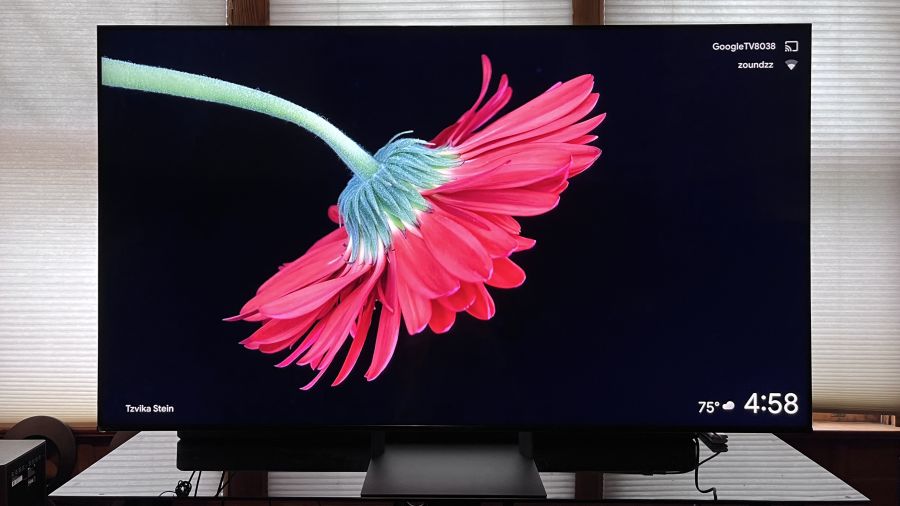
While most RGB TVs take a similar approach, Sony’s advanced processing and control algorithms enable the TV to deliver full red, green and blue backlighting even when displaying complex images with a range of colors, resulting in consistent color saturation and a reduction of the “color crosstalk” other RGB TV designs are subject to.
Sony has effectively demonstrated the advantages of True RGB over the RGB LED competition in press demos that eCoustics has attended. LG has also demonstrated the presence of “color crosstalk” which can occur in certain RGB-backlit TVs (in a comparison designed to showcase the superiority of its OLED models). And TCL acknowledged the same even issue with its own RGB Mini-LED TVs, which it says are inferior to SQD (Super Quantum Dot) Mini-LED models like the TCL X11L and TCL QM8L that use a standard, non-RGB, backlight array.
What Is It?
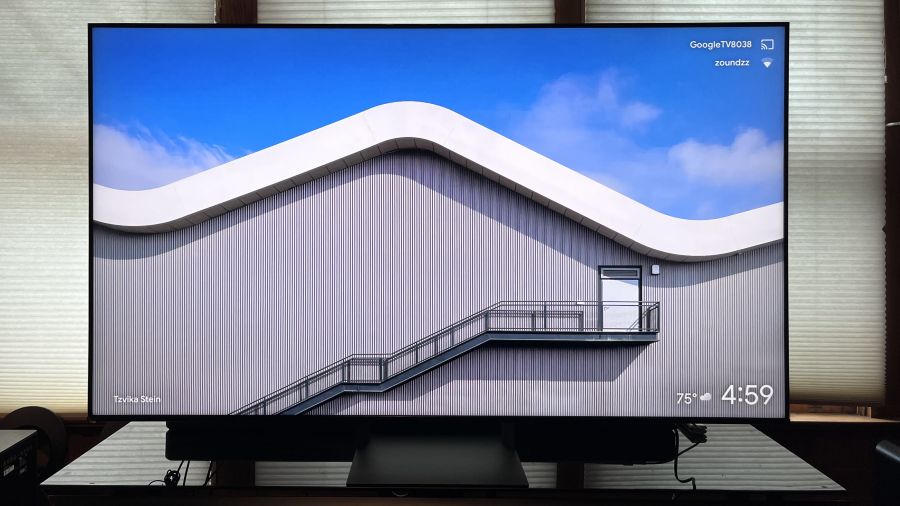
The Sony BRAVIA 7 II is the company’s entry-level True RGB TV series. It is available in 50-, 55-, 65-, 75-, 85- and 98-inch screen sizes and is priced from $1,599.99 to $8.999.99. The 65-inch model that Sony sent me to review costs $2,599.99, a price that exceeds its entry-level RGB LED competition by a few hundred dollars.
Sony calls the backlight design for its True RGB TVs RGB Backlight Master Drive Pro. Along with this, the Bravia 7 II features Sony’s XR Processor which provides a full suite of XR features such as Clear Image AI (for upscaling high-definition and lower-res content), XR Contrast Booster and XR Motion Clarity. An X-Wide Angle Pro feature of the BRAVIA 7 II’s display panel helps to provide uniform color and contrast when viewing from off-center seats. This alone marks a notable improvement over its predecessor, the BRAVIA 7.
The BRAVIA 7 II supports the Dolby Vision, HDR10 and HLG high dynamic range formats, but not HDR10+. It is also IMAX Enhanced, supporting IMAX Enhanced movies on Disney+ and Sony’s Sony Pictures Core streaming service, including their DTS-X audio tracks sourced from the original IMAX cinematic soundtracks. Calibrated Modes, including Netflix Calibrated Mode, Prime Video Calibrated Mode and Sony Pictures Core Calibrated Mode are included as well, automatically optimizing picture settings when streaming content from these services. My Cinema presets, a new Sony feature, can also be used to optimize picture settings for dark and bright room viewing.
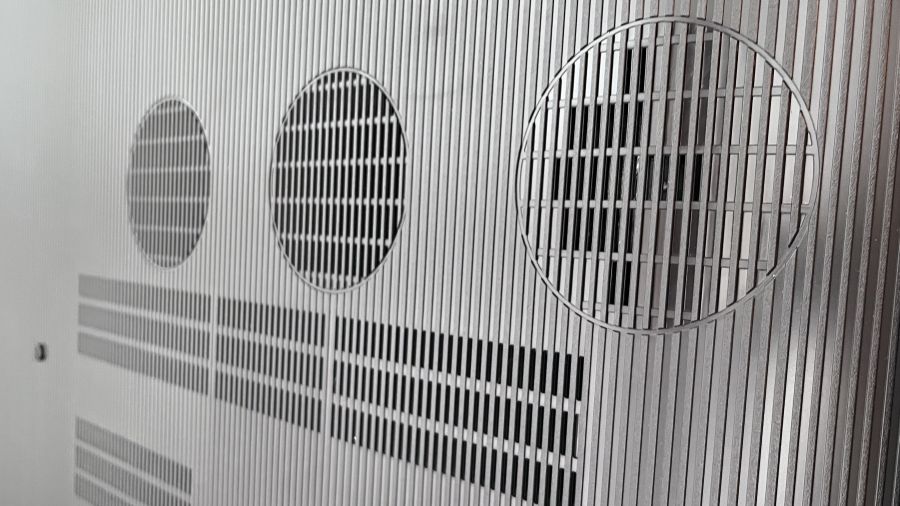
Both the Dolby Atmos and DTS:X immersive audio formats are supported by the BRAVIA 7 II’s built-in speaker array, which pairs dual full-range drivers with tweeters for more accurate directional sound. The set also features 3D Surround Upscaling to create an expansive effect even from two-channel material. The BRAVIA 7 II also has Sony’s upgraded Voice Zoom 3 feature, which uses AI to recognize and either amplify or reduce (an adjustment is provided in the TV’s onscreen menu) dialogue in movie and TV soundtracks.
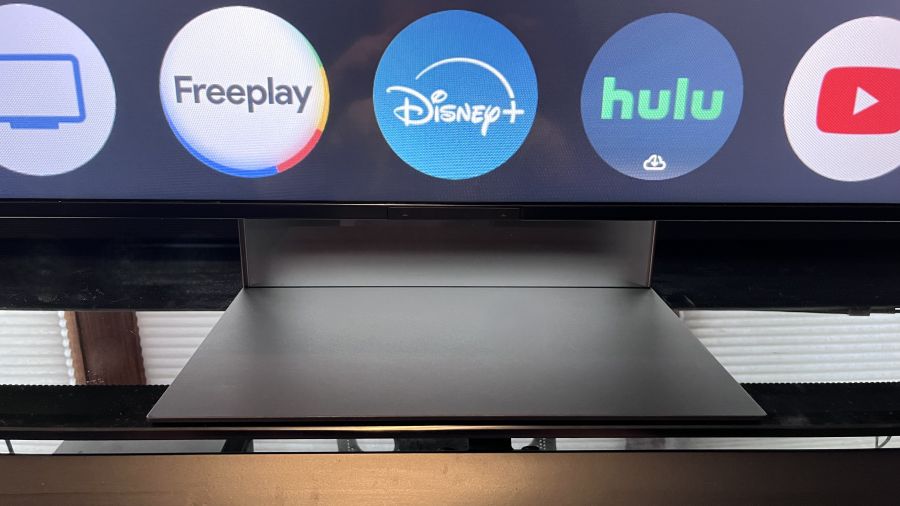
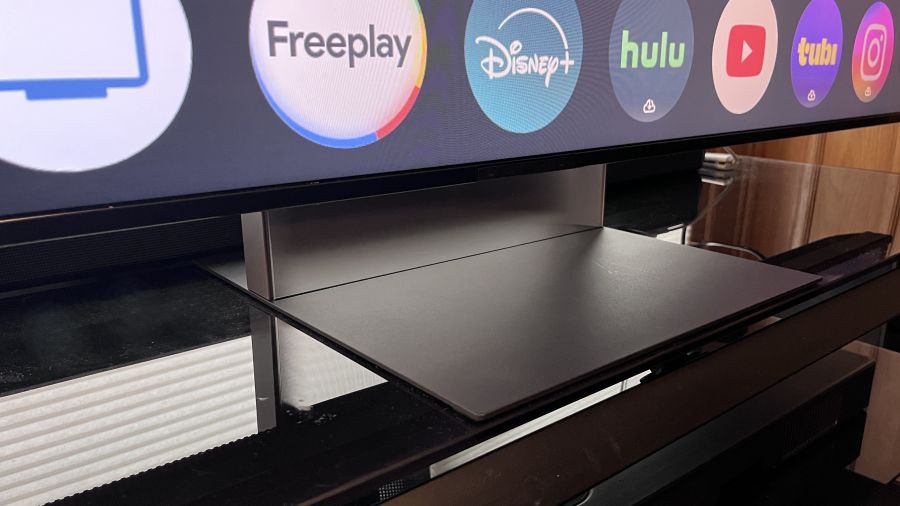
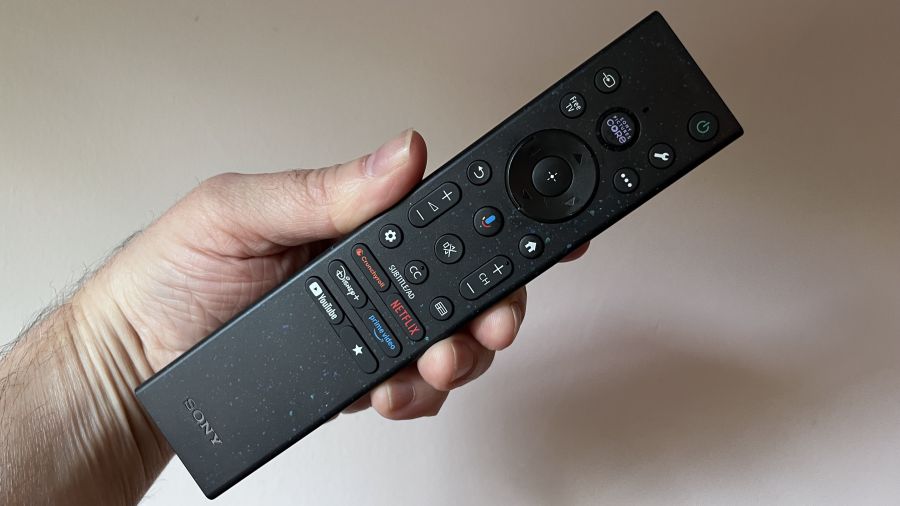
Sony calls its design for its True RGB TVs “Harmonic Presence.” And while that name might seem somewhat flowery for a TV, the BRAVIA 7 II really does look great in person. A key design element is the TV’s Mirage Stand, which is a steel pedestal stand with a semi-transparent panel that gives it a floating appearance. The rear of the stand also provides effective cable management. Design effort also went into the TV’s remote control, which has textured sides and back and a blue flake pattern embedded in its front surface.
Google TV is used as the BRAVIA 7 II’s smart TV platform, and this version includes the Gemini AI assistant found on several other new TVs. An advantage to Google TV is that, aside from having a wide array of available apps, it can tap your viewing and web search history to make accurate program recommendations. A disadvantage to Google TV is that, like many other smart interfaces, it will show you the occasional ad. Gemini takes content search to the next level by providing a conversational component. (An example: “Hey Google, show me movies directed by David Cronenberg,” followed by, “Show me only the ones from the 1980s.”) And it’s not just for movies – Gemini can be used to research a wide range of topics. Assisting in this task is a built-in mic on Sony’s remote control, and there’s also a built-in mic on the TV for hands-free voice commands.
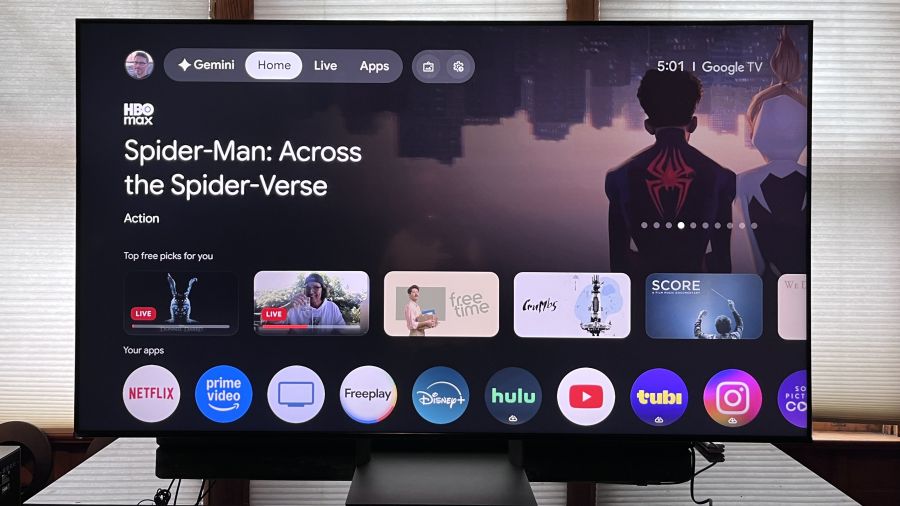
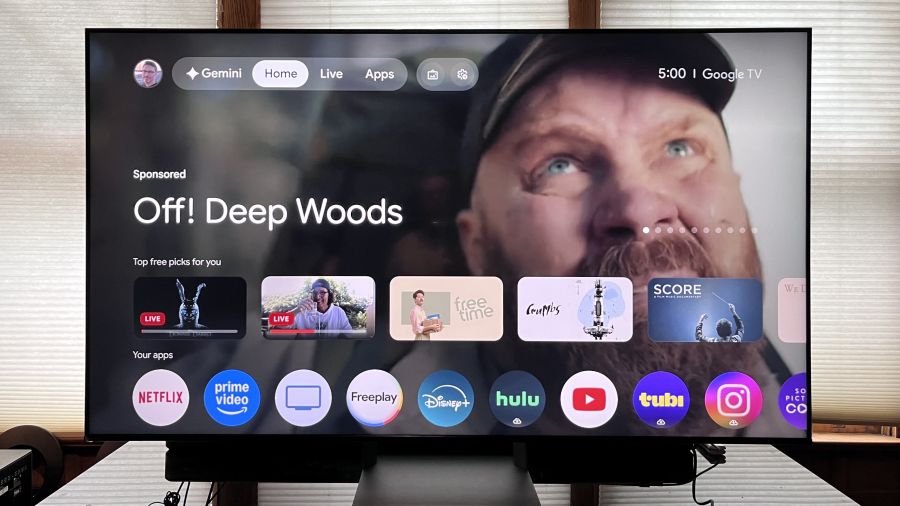
Sony’s Quick Settings menu gives you easy onscreen access to a range of adjustments including picture mode and brightness. The more in-depth All Settings menu offers up a wide range of picture adjustments such as Auto Local Dimming, Peak Luminance, Advanced Contrast Enhancer, and 2-point and 10-point color temperature adjustments.
Curiously, there are no color management system (CMS) adjustments, a standard feature on many TVs. When I asked Sony why this was the case, I received this reply: “Thanks to our rigorous factory calibration process — backed by our engineering design that accurately calculates and optimizes performance at the production stage — color accuracy and gamma are already dialed in. A simple white balance/greyscale adjustment is all that’s needed to achieve reference picture quality, and everything else falls into line automatically.”
I had expected that the Sony True RGB lineup would continue the trend started by the BRAVIA 3 II earlier this year with its four gaming-friendly HDMI 2.1 ports, but that didn’t turn out to be the case. The BRAVIA 7 II has two HDMI 2.1 ports with 4K/120Hz support and two HDMI 2.0b ports (one with eARC). Other gaming features include Perfect for PlayStation5, which enables ALLM, Auto HDR Tone Mapping and Auto Genre Picture Mode when a PS5 console is connected, and a Game Menu 2 onscreen pop-up menu for making gaming-related adjustments.
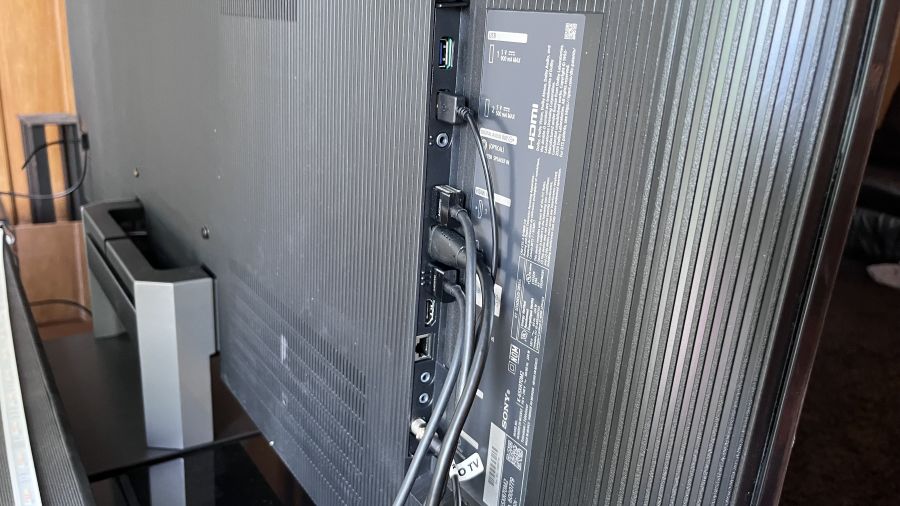
Aside from its four HDMI ports, the BRAVIA 7 II provides USB Type-A (x2), Ethernet and RS-232C data connections, an IR receiver input and a combined optical digital audio output/analog center speaker input, with the latter meant for Sony wireless speaker systems that use the TV’s built-in audio as a center channel speaker. There’s also an RF input for the set’s ATSC 3.0 (Next Gen TV) digital TV tuner. When an external antenna is connected to this, both ATSC 3.0 and standard digital broadcast channels can be browsed separately in the Google TV Live TV grid guide.
Go Pro?

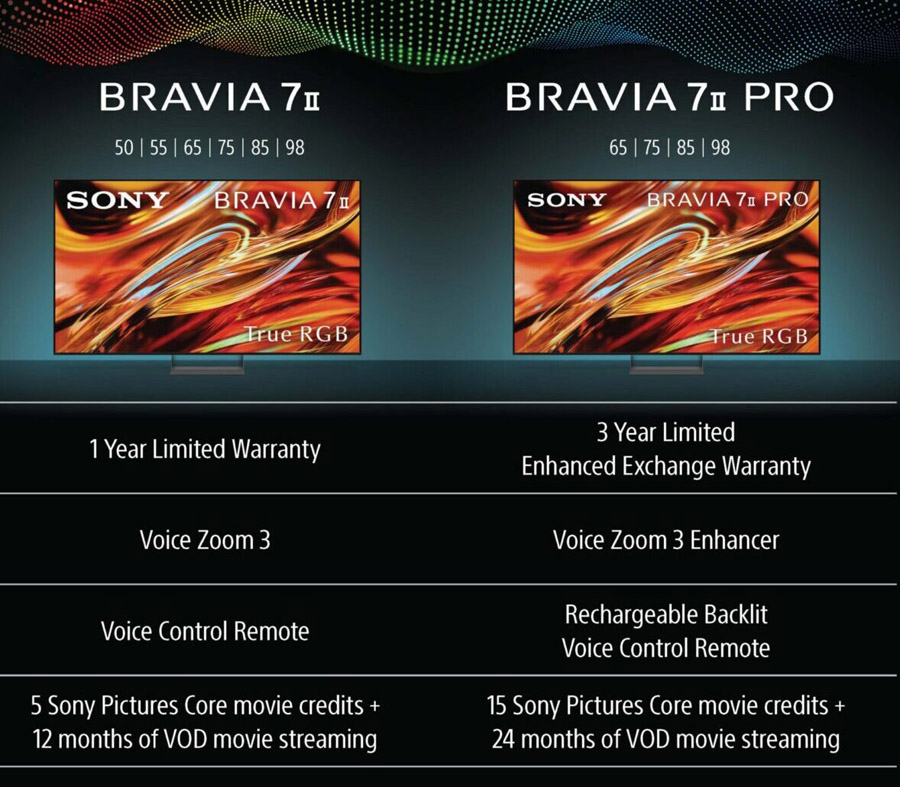
The Sony BRAVIA 7 II (and the BRAVIA 9 II) in 65-inch and above screen sizes will also be available in a “Pro” package that includes a longer 3-year full replacement warranty, an upgraded rechargeable and backlit remote control, additional Sony Pictures Core movie credits and an enhanced version of Voice Zoom 3. Hardware for the standard and Pro versions is otherwise identical. Sony didn’t share pricing for the Pro package, which is aimed at the CI (custom installation), channel but it seems to be a nominal increase over the standard offering.
Setup & Viewing Impressions
Before doing any subjective viewing, I ran a basic set of measurements on the BRAVIA 7 II using Portrait Display’s Calman Color Calibration software. The TV’s ambient light sensor was disabled before I began testing; otherwise, measurements were made in the TV’s Cinema and Standard picture modes with the default settings left intact. Sony’s Professional mode is said to be the most accurate picture preset option, but I found it to be way too dim for SDR viewing at its default settings and I expect most viewers would have the same take. But since it is the most accurate mode, we did include some out of the box measurements in Professional mode for HDR content.
Peak HDR brightness measured on a white 10% window pattern in Cinema Mode was 1,800 nits and 701 nits on a 100% (fullscreen) white pattern. For Professional mode, the results were 1,971 nits and 790 nits, respectively, on the same tests. In Standard mode, peak HDR brightness was 1,554 nits on a 10% pattern and 626 nits for fullscreen.
In SDR (standard dynamic range) tests, the BRAVIA 7 II measured 486 nits on a 10% pattern in Cinema mode and 421 nits on a fullscreen one. In Standard mode, the results were 576 nits for 10% and 372 nits for fullscreen.
Those brightness results were essentially what I expected from the Bravia 7 II, which Sony reportedly stated would be half as bright as the step-up Bravia 9 II (at 4,000 nits). For context, the Sony’s brightness measurements put it in roughly the same range as the TCL QM8L SQD Mini-LED TV, which measured 1,922 nits (10% window) and 708 nits (fullscreen) in Filmmaker Mode when I tested it.
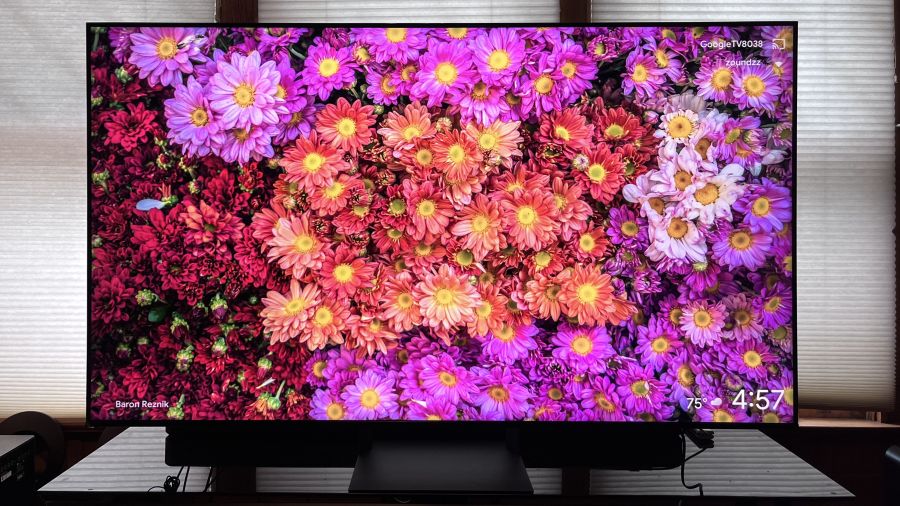
The BRAVIA 7 II’s color gamut coverage in Cinema Mode measured 88.5% for BT.2020 and 98.5% for P3. That BT.2020 result trails the only other RGB TV I’ve measured, the Samsung R95H Micro LED, which yielded 92% coverage (in Filmmaker Mode). For comparison’s sake, the BRAVIA 7 II’s color gamut coverage is closer to the TCL QM8L, which measured 89.3% for BT.2020 and 97.7% for P3 (both in Filmmaker Mode) when I tested it.
In other BRAVIA 7 II measurements, the Delta-E (the margin of error between the test pattern source and what’s displayed on-screen) averaged 1.6 for grayscale and 3.5 for color. The Sony’s color result is slightly higher than the 3.0 Delta-E that’s considered to be the threshold for what’s indistinguishable from perfect to the human eye, and it was also heavily weighted by a 6.4 red error.
Starting off my viewing tests with the Spears & Munsil Ultra HD Benchmark demonstration reel (2,000 nits version), the BRAVIA 7 II displayed excellent color, contrast and detail throughout. High-contrast shots of brightly-lit objects and animals against a pitch black background showed no signs of backlight blooming, and overhead shots of a city at night revealed excellent micro-contrast. Switching to the 10,000 nits version, the Sony’s HDR tone mapping at the default Gradation Preferred setting was excellent, revealing much the same level of highlight detail as in the 2,000 nits version of the demonstration reel.
The disc’s starfield test loops showed the TV’s local dimming to be a bit too aggressive at the Cinema preset’s default Medium setting, obscuring significantly more stars than at the Low setting, but I ultimately found Medium to be my preferred preset when watching movies and TV. The Spears & Munsil disc’s Dots test pattern, which is used to evaluate off-axis picture uniformity, revealed very good color saturation and contrast when viewing from off-center seats, showing the strength of Sony’s X-Wide Angle Pro panel. A bit of blooming was visible when viewing off-axis, but that was mostly an issue when looking at test patterns.
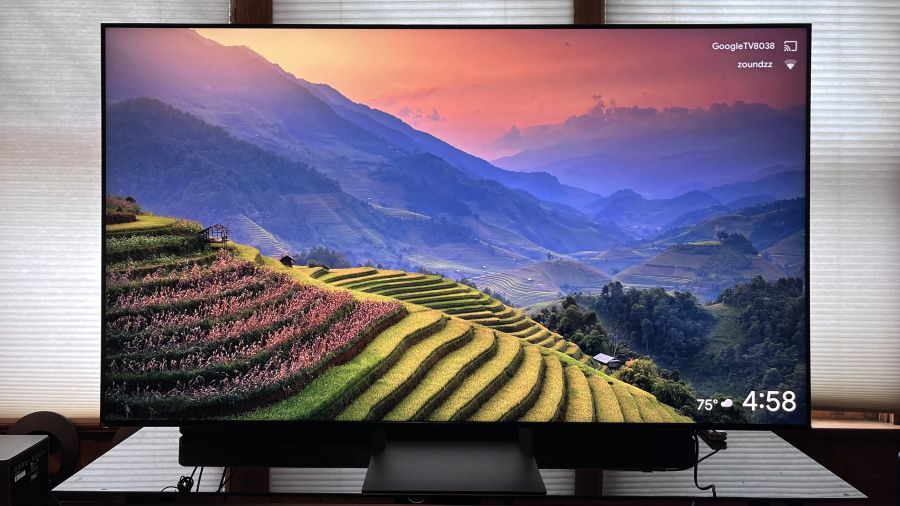
Sony TVs are usually very good at upscaling lower-resolution video, and when I watched a DVD of David Lynch’s Wild at Heart, I was impressed at how clear and detailed the picture looked. (I’ve certainly seen this disc look much worse on other 4K TVs.) As far as I know, the Wild at Heart Blu-ray is out of print, and there’s been no 4K Blu-ray version yet, so the DVD will have to do for now!
Watching a 4K Blu-ray of the James Bond film No Time to Die, a scene that I use as a spot-check for motion handling where 007 walks across a craggy hillside cemetery looked solid and mostly judder-free. I say “mostly” because there was a very slight amount of judder, but it was easily eliminated by adjusting the Smoothness (Film) setting to 1 in the TV’s MotionFlow menu.
I also use the car chase from No Time to Die, a sequence that follows after an explosion at the cemetery, as a spot-check for TV sound, and the Bravia 7 II’s built-in speakers proved to be very much up to the task. Bass effects were solid, and there was a good sense of spaciousness to the movie’s Dolby Atmos soundtrack. Dialogue in this and other movies was also very clear, even without having to engage the TV’s Voice Zoom 3 feature.
To evaluate shadow depth/detail and color, I watched scenes from Spider-Man: Into the Spider-Verse and Alien: Romulus (both in 4K/Dolby Vision) on my Apple TV 4K. In Spider-Man, contrast was strong and there was plenty of shadow detail visible in the dark subway tunnel scenes. Colors in the fight sequences with the Green Goblin also looked bright and bold. I had similar impressions when watching Alien: Romulus: Dark chambers in the abandoned space station were rendered with deep, uniform blacks, and the colored lights of control panels popped with a good degree of intensity.
The Bottom Line
I thought I had tested the ultimate Sony TV when I had a chance to review the Sony Bravia 9 mini-LED, but the new mid-range Sony Bravia 7 II True RGB TV not only matches, but in key ways exceeds that model, specifically its P3 and BT.2020 color gamut coverage.
As you might expect given the True RGB backlight, color is the star of the show here, with the Bravia 7 II consistently serving up clean, rich-looking color. While its peak brightness doesn’t hit the same lofty heights as some other TVs I’ve recently tested, the Bravia 7 II is plenty bright enough even for viewing in a well-lit room, and its low screen reflectivity means you won’t have to worry that much about screen reflections. (With the step-up Bravia 9 II, which costs $1,000 more and features an Immersive Black Screen Pro glare-free screen, you won’t have to worry about reflections at all.)
Is the Bravia 7 II the best TV you can get for the money? If I were a serious gamer, I’d find its two HDMI 2.1 port count limit off-putting, especially when many new-for-2026 TVs feature three or more HDMI 2.1 connections. Also, there’s no support for HDR10+ or the forthcoming Dolby Vision 2 format, which offers numerous important and forward-looking features. Given that the Bravia 7 II is pricier than competing models such as the TCL QM8L and Samsung R85H, I might give those points some consideration.
But the real bottom line here is that everything I watched looked great on the BRAVIA 7 II, my old Wild at Heart DVD included. And with its elegant Harmonic Presence design and Mirage Stand, Sony’s entry-level True RGB TV looks good even when turned off.
Pros:
- Refined local dimming
- Rich, mostly accurate color
- Very good off-axis uniformity
- Impressive brightness
- Clean, detailed upscaling
- Solid built-in audio and sound features
- Elegant design
Cons:
- No HDR10+ or Dolby Vision 2 upgrade support
- Only two HDMI 2.1 ports
- Pricier than mid-range mini-LED TV competition
- Some screen reflections
Our Ratings:
★★★★★★★★★★ Picture Quality
★★★★★★★★★★ Design
★★★★★★★★★★ Usability
★★★★★★★★★★ Sound Quality
★★★★★★★★★★ Features
★★★★★★★★★★ Value
Where to buy
BRAVIA 7 II
BRAVIA 7 II PRO
Also available from: B&H, Sony USA, Value Electronics
You must be logged in to post a comment Login