

Connect with us
DAPA Banner
DAPA Coin
DAPA
COIN PAYMENT ASSET
PRIVACY · BLOCKDAG · HOMOMORPHIC ENCRYPTION · RUST
ElGamal Encrypted MINE DAPA
🚫 GENESIS SOLD OUT
DAPAPAY COMING

Tech

Soundcore Liberty 5 Pro Max Review

Published

on

Verdict

An impressively-feature laden true wireless that looks to take on the big guns and does an admirable job in many ways though its beaten when it comes to sound and noise cancellation. When it comes to call quality, these might just be the best but the less expensive Liberty 5 Pro have the same performance and are better for value

  • Excellent call quality

  • Stable fit

  • Strong noise cancellation

  • Lots of features

  • Battery life better than expected

  • Humdrum EQ modes are humdrum

  • AI assistant is not great

  • Bass-forward sound won’t be for everyone

  • Liberty 5 Pro model is less expensive and virtually the same

Key Features

Introduction

Soundcore has a knack for being prolific. In the past year, it has released several headphones as it looks to challenge its rivals for sheer quantity of releases

Advertisement

But quantity only matters so much if it’s backed up by quality. The Liberty 5 Pro Max are Soundcore’s flagship true wireless, surpassing the Liberty 5 Pro, which brings an extra tier of expectation in terms of performance.

What’s different? The charging case mostly, but there’s also the AI Note Taker feature that would fit neatly into a work/meeting environment.

From the features only, Soundcore want these to be the only earbuds you’ll ever need, but are they its best true wireless?

Advertisement

Advertisement

Design

  • Secure fit
  • Anonymous looks
  • Interesting charging case

Style is not what the Soundcore Liberty 5 Pro Max are about. Function? Absolutely

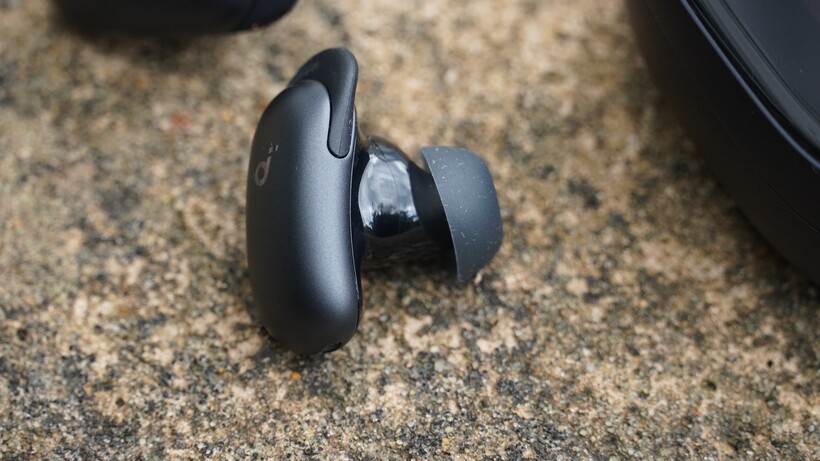
The looks are anonymous – a choice of black and titanium gold finishes doesn’t really dispel the kidney bean look that slots in the ear. The ear-fin design keeps them tucked in, and comfort levels are strong – once they’re in, there’s no discomfort I’ve felt, and the security of the fit means they don’t fall out.

There are five ear-tips to find a fit tailored to you, from extra small to large, as well as two sizes of ear-fins that you can clip on.

Soundcore Liberty 5 Pro Max designSoundcore Liberty 5 Pro Max design
Image Credit (Trusted Reviews)

Advertisement

The Liberty 5 Pro Max rely on touch controls, which are fine and usually respond, though it’s worth delving into the Soundcore app to shore up the control options. A single press did nothing until I went into the app and assigned play/pause; and a triple press does nothing either. Seems odd to me to leave them unassigned by default.

The charging case is a point of interest. This is different from the one that comes with the Liberty 5 Pro, featuring a larger screen; and like the charging case that comes with the JBL Live Beam 3, you can customise settings without reaching for the app.

Advertisement

It’s a little confusing at first figuring out the navigation. Swipe up to unlock and then swipe right (or left), and you can play with ANC, EQ, and playback. Or, swipe up after the screen is unlocked and visit more settings (AI Note Taker, Remote Camera and more). You can pick a custom wallpaper for the screen too through the Soundcore app.

Soundcore Liberty 5 Pro Max settingsSoundcore Liberty 5 Pro Max settings
Image Credit (Trusted Reviews)

It’s a little bit fiddly, but you can see how Soundcore are looking to add more functionality, reaching for the phone.

It does mean the charging case is a bit bulky compared to the more svelte options of others, but as I’ll get to, it has many purposes.

Advertisement

An IP55 rating means they’re protected against dust and low-pressure jets of water, making these a more than solid fit for workouts, especially with that secure fit.

Advertisement

One last thing, though. Getting these earbuds in and back into the case is surprisingly more challenging than I’d think. I’m always confused about which way they’re meant to go back into the case.

Features

  • LDAC Bluetooth
  • Triple Multi-point
  • AI Note Taker

When it comes to features, Soundcore has cast its eyes across the market and tried to incorporate everything from its rivals. It makes for an absolutely stuffed pair of true wireless earbuds.

Let’s start with Bluetooth, which covers the Bluetooth 6.1 standard with SBC, AAC and LDAC streaming. There’s Bluetooth multi-point for connecting to multiple devices at once, and like the Technics EAH-AZ100, the Soundcore connects to three devices at the same time. The wireless performance has been strong – no noticeable dropouts or flaky connections so far.

However, going full bore on Bluetooth multi-point means you won’t be able to partake in any LDAC goodness, and other instances where LDAC isn’t available is by toggling on the AI Sound Enhancement.

Advertisement

Advertisement
Soundcore Liberty 5 Pro Max app settingsSoundcore Liberty 5 Pro Max app settings
Image Credit (Trusted Reviews)

Speaking of, let’s kick off with the sound modes the Liberty 5 Pro Max offers. There’s HearID, which tests your hearing and creates a sound profile for you (say if you’re sensitive to treble, the in-app testing can compensate for this). If you want to use HearID across other devices, you must create a Soundcore account.

There’s the ‘Curated Sound Effects’ which include Signature, Clear Vocals, Powerful Bass, Calm and Soothing and Custom, which involves creating an 8-band EQ. I’d say stick with Signature as the other modes flatter to deceive. None improve audio in the way intended, which is something I’ve pointed out with other Soundcore headphones.

If the Curated Sound Effects don’t do anything, there’s AI Sound Enhancement, but giving this a listen, I found that while vocals sound clearer, there’s not much of an uptick elsewhere.

Then there’s Dolby Audio, which opens up the headphones to spatial audio (why it’s not called this, I don’t know). Again, it’s ok – the head tracking works, but switching to spatial audio results in a decrease in overall detail.

Soundcore Liberty 5 Pro Max appSoundcore Liberty 5 Pro Max app
Image Credit (Trusted Reviews)

Advertisement

Part of what Soundcore is offering with these earbuds is a big dollop of AI assistance, thanks to Anker’s Thus AI chip. While other brands use AI (or machine learning), Anker’s very much jumping on the supposed AI gravy train, with the “first large model compute-in-memory AI audio chip” that Soundcore says can deliver 150x computing power – although 150x more than what Soundcore doesn’t say.

Advertisement

Rather than go for Google or Alexa, Anker’s developed its own AI assistant (named Anka). It’s an interesting development, but the results could be better.

For one, she sounds stilted, robotic and not very conversational. I asked her for the weather, and that seemed fine until she kept repeating herself. So I asked a different question – the results from Wimbledon tennis – and instead of telling me the results from 2026, she referenced the 2024 final between Djokovic and Alcaraz. And then she wouldn’t stop talking about all the tennis tournaments.

During this kerfuffle, I asked her to play music again, but that seemed to confuse her – firstly she pronounced resume in the manner of a work resume, and then went back to talking about the weather. My feeling is that she’s very unfinished, or this LLM is old, and there’s little reason to give her a workout.

Soundcore Liberty 5 Pro Max recordingSoundcore Liberty 5 Pro Max recording
Image Credit (Trusted Reviews)

The most interesting aspect about the Liberty 5 Pro Max is the charging case, which adds even more functionality. The case, which also needs to be connected to your mobile device, can act as an AI Note Taker (I’ve seen someone use the case for this very reason). It took my rambling nonsense and transcribed it pretty accurately, although it did not there were two speakers when actually it was just me.

Advertisement

Advertisement

But, as a tool for capturing audio from meetings it’s an interesting use case, even if it comes with a catch. You can record the first 120 minutes for free, but after that, a membership and monthly fee are required.

Otherwise, you’ve got the usual assemblage of features in the Soundcore app: customising controls (bizarrely, play/pause is not assigned by default), carrying out a Fit Test to make sure the seal is correct, enabling wearing detection, Sound Mode (LDAC or AAC) and others.

Battery Life

  • 6.5 hours per charge
  • USB-C and wireless charging

Soundcore implies 6.5 hours of battery life with noise cancelling on, but that is overly cautious. Streaming a Spotify playlist for an hour at 50% volume, the headphones fell by 10%. I reckon you could get more from these earbuds.

The case holds 28 hours in total, while a five-minute spell over USB-C offers another four hours of playback. Wireless charging is also supported.

Noise Cancellation

  • Thus AI chip
  • Impressive call quality

Advertisement

The noise cancellation of the Soundcore Liberty 5 Pro Max is impressive. Thanks to the fit and noise cancellation power of the earbuds, they cut down on a great deal of sounds. People talking, busy areas, public transport- these earbuds do well on cutting out everyday noise.

Advertisement

With the Liberty 5 Pro Max, Soundcore is venturing out in the territory traditionally owned by the likes of Sony and Bose, and putting them through a pink noise test, they’re not far off but they aren’t better, with the Sony in first place (for me) and Bose behind, but as a less expensive alternative, the Liberty 5 Pro Max are a more than respectable option.

Soundcore Liberty 5 Pro Max in caseSoundcore Liberty 5 Pro Max in case
Image Credit (Trusted Reviews)

Call quality is where the Liberty 5 Pro Max excels. While their Guinness World Book of Records attempt is a bit daft (would other brands resort to this just for the attention?), it’s among, if not the best true wireless I’ve used for calls.

The AI-assisted microphones latch on to my voice, and there’s no background noise coming through. The earbuds might be doing something that alters my voice, but not much and nothing that takes away from the clarity.

Sound Quality

  • Warm presentation
  • Bass forward
  • Highs can sound unbalanced

Advertisement

Sound is a personal thing. Some prefer it one way, others another – it’s very much an “each to their own”, but there’s room for different types. After all, if everything sounded the same, that wouldn’t be interesting.

The Liberty 5 Pro Max go for a bass-heavy tuning, and it rather belies its status as the flagship model, as you’d think clarity and detail would be uppermost in the tuning. But these earbuds are warm, the 9.2mm Wool-Paper Diaphragm drivers deliver a rich and bassy approach to audio. Ultimately, they sound fine, but is fine what you want?

Advertisement
Soundcore Liberty 5 Pro Max touchSoundcore Liberty 5 Pro Max touch
Image Credit (Trusted Reviews)

It does depend on your device of choice. I’ve tested these wireless earphones on two smartphones that filter through a different sound – the Soundcore remain bass-heavy, but I found more clarity and detail present on one than I did the other.

Every track I listen to takes on a bassier response, whether it’s Norah Jones Don’t Know Why to Soundgarden’s Black Hole Sun. Voices come through clearly and with warmth but the main problem is that the Soundcore don’t relay as much detail or clarity as I’d like.

They’re also not the most exciting to listen to, which is not to say that they’re plodding, but every track is gripped by the same sound profile.

Advertisement

With GoGo Penguin’s Erased by Sunlight the highs are clear, and there’s some variation to how those highs pan out, but it’s not the brightest treble performance and there are times where it sounds a little unbalanced.

Advertisement
Soundcore Liberty 5 Pro Max in frontSoundcore Liberty 5 Pro Max in front
Image Credit (Trusted Reviews)

The smoothness of the earphones means that insight isn’t as high as, say, the Sony WF-1000XM6, and they’re not particularly dynamic. Pair them with a track or music genre that its bass energy works well with – like K-pop – and they’ll be very enjoyable.

I noticed that there is a less-than-natural tone to music as well, but overall I found the Liberty 5 Pro Max enjoyable enough; the soundstage is solidly wide, and if you like bass you’ll enjoy the sub-bass power and thump these deliver. That said, the JBL Live Beam 3 sound similar but less emphasis on bass and more clarity and detail. In fact, even the older Sony WF-1000XM5 sound clearer and more balanced, tonally.

Should you buy it?

If you’re a serial phone caller

Quite possibly the best wireless earphones for calls, it doesn’t seem to matter where you are, your voice will get through with no noise.

Advertisement

You expect high fidelity sound

Advertisement

The one obvious area where the Soundcore are humdrum. They sound fine, but you need to do better than fine to compete.

Advertisement

Advertisement

Final Thoughts

As an overall package, the Liberty 5 Pro Max packs a lot of bang for buck, which is what you’d expect from Soundcore. Is it enough to challenge and undercut the big players? No, as the performance is lacking in a few areas.
 
When it comes to sound, I think you’re placing an emphasis on balance, clarity and insight at this price, and the Liberty 5 Pro Max’s bassy sound can’t compete with recent 2026 releases of Sony, Status Audio and even Samsung. However, if you’re someone who likes dance, R&B, rap, electronic – I think these earphones will suit that sound.
 
Call quality is excellent, the noise cancellation is very good; the fit and comfort are also areas where the Soundcore are strong.
 
The Anka assistant is a miss though, and while the AI Note Taker with the charging case is an interesting idea, who’s likely to pay for a membership? Speaking for myself, it won’t replace Otter AI for me.
 
And ultimately, Soundcore offers a less expensive option in the Liberty 5 Pro. It doesn’t come with the same charging case, but it’s more or less the same. In terms of value, those are the Soundcore earphones I’d go for.

How We Test

The Soundcore Liberty 5 Pro Max were tested for five weeks with ANC, Bluetooth performance, call quality and sound tested in real world settings

  • Tested for five weeks
  • Tested with real world use
  • Battery drained

FAQs

What’s the difference between the Liberty 5 Pro and Liberty 5 Pro Max?

The main difference between the two Soundcore earbuds is the charging case. The Liberty 5 Pro Max has a different design with a bigger screen and more functionality (such as AI Note Taker recordings). Otherwise, the wireless earbuds are exactly the same.

Advertisement

Full Specs

  Soundcore Liberty 5 Pro Max Review
Manufacturer Soundcore
IP rating IP55
Battery Hours 28
Wireless charging Yes
Fast Charging Yes
Release Date 2026
Audio Resolution SBC, AAC, LDAC
Driver (s) Liberty 5 Pro model is less expensive
Noise Cancellation? Yes
Connectivity Bluetooth 6.1
Colours Black, Titanium Gold
Frequency Range – Hz
Headphone Type True Wireless
UK RRP £199.99
USA RRP $229.99

Source link

Continue Reading
Click to comment

You must be logged in to post a comment Login

Leave a Reply

Tech

Adobe Firefly AI video editor review

Published

on

Why you can trust TechRadar


We spend hours testing every product or service we review, so you can be sure you’re buying the best. Find out more about how we test.

Adobe is a popular brand when it comes to all things creative, including AI content generation and editing. With its newly improved Firefly tool, Adobe has taken AI content generation a step further with realistic, real-time outputs.

In addition to being highly accurate, Firefly is also one of the most affordable tools on the market today. But is it the best AI video editor for your needs? Read on to find out. In this article, we’ve put Firefly to the test, examining its features, pricing, ease of use, and overall value for money.

Advertisement

Adobe Firefly: Plans and pricing

Source link

Advertisement
Continue Reading

Tech

Google Cloud outage shows it’s still hard to understand hyperscalers’ real resilience regimes

Published

on

off prem

Single datacenter and just three services taken down by ‘upstream’ power problem, while the rest of a zone and region kept humming

Google Cloud last week experienced an outage that analysts say demonstrates that not all promises of cloudy resilience are created equal.

Google’s incident report explained that three services – the VMware Engine (GCVE), NetApp Volumes, and Bare Metal Solutions (BMS) – experienced a 15-hour outage due to a cooling failure in its europe-west4-a zone.

Advertisement

The report includes the following detail: “The datacenter serving europe-west4-a for GCVE, BMS, and NetApp has experienced a power failure, which subsequently caused a cooling failure.”

The important detail there is that Google uses a discrete datacenter for those three services.

Another notable element of the incident report is the admission that “An electrical fault occurred on the utility grid upstream of the datacenter, disrupting the electrical distribution gear and cooling equipment.”

Google hasn’t explained how an upstream failure caused that disruption but did say it “proactively turned down workloads in order to protect customer data from any risks posed by running infrastructure in a high temperature environment.”

Advertisement

Whenever your correspondent talks to hyperscalers or datacenter operators about how they ensure resilience, they tell me about their use of multiple redundant pieces of energy infrastructure, plus on-site generation capabilities that can keep a datacenter powered for days if necessary.

We’ve asked Google if it had generators or other energy sources at this site, and if so, why it nonetheless had to turn down workloads. We’ve not received a response at the time of writing. Google told us its incident analysis “is currently ongoing” and promised to follow up once it is available.

Hidden dependencies

We also asked Google if it advertises the fact that some of its services are tied to a single datacenter, a matter of interest because like other hyperscalers it divides its cloud into “regions” that typically comprise multiple “zones” spread across a city or other locale. Like its hyperscale peers, Google recommends placing workloads across different zones and regions to ensure resilience. Yet this incident shows some services can be tied to a single datacenter in a zone – and that those single datacenters can experience problems while the rest of the zone keeps working.

Analysts told The Register the outage shows organizations need to dig into clouds’ promises of resilience.

Advertisement

“The real issue is transparency: customers are generally told to use multiple zones and regions for resilience but are rarely given visibility into whether a particular managed service has a single-datacenter dependency within a zone,” said Biswajeet Mahapatra, principal analyst at Forrester. “As a result, many organizations assume the cloud abstraction provides more facility-level redundancy than may actually exist for specialized services.”

“The underlying architecture is not necessarily unusual,” he added. “AWS, Azure, and Google all operate services that rely on dedicated hardware, storage platforms, or tightly coupled infrastructure that may not be distributed across multiple facilities in the same way as core compute and storage services.”

Gartner Director Analyst Adrian Wong reminded The Register of the 2023 outage at Google Cloud’s europe-west9-a region, the cause of which was a water leak that Google said “originated in a non-Google portion of the facility.”

Google uses a tool called “Spanner” to replicate data across zones, but in the flooded zone Google’s Spanner configuration didn’t work once one building became unavailable.

Advertisement

“It is very hard to figure out how an individual region is architected,” Wong said. “Our customers are often surprised by that,” he added.

The incident report for last week’s outage includes an apology.

“We know how much you rely on Google Cloud, and we regret the impact on your productivity,” the document states, before promising a final incident report will detail “preventative actions.”

But as this incident shows, knowing how Google plans to avoid future incidents of this sort won’t arm customers with the knowledge to understand if those mitigations will address hidden design issues that can reduce resilience. ®

Advertisement

Source link

Continue Reading

Tech

New Ryzen 7 7700X3D drops to $279, just days after launch

Published

on

Newegg is knocking $50 off AMD’s Ryzen 7 7700X3D with promo code PKC337, bringing it down from its $329 to $279. At that price, it becomes a stronger value proposition against the Ryzen 7 7800X3D while gaming performance stays nearly identical. Our full review is coming this week.

Read Entire Article
Source link

Continue Reading

Tech

Google Photos adds a quick toggle between AI and classic search

Published

on

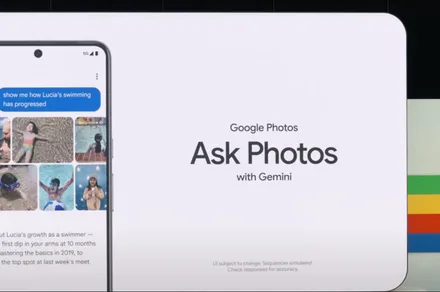
Google Photos is giving users an easier way to leave its Gemini-powered search when a simple keyword would do. A new toggle now sits at the top of the results page, letting users switch between Ask Photos and classic search without digging through settings.

The change appears to address feedback from people who opted into Ask Photos but wanted a quicker way to return to classic search when Gemini was slower or less useful for a straightforward query.

Why did Google add the toggle?

Ask Photos is built for complicated requests. It can understand natural-language questions and search for details inside images, including prompts such as “What’s my license plate?” Classic search is quicker when you only need to find a person, place, object, date, or keyword.

Reddit users complained about irrelevant results, missing keyword matches, and the disappearance of an obvious route back to classic search. Some found that the most reliable workaround was disabling Ask Photos through the Gemini settings entirely.

Advertisement

Google had already acknowledged the problems. It paused the rollout in June 2025 over latency, quality, and user-experience concerns before bringing Ask Photos back with faster handling for simple searches.

What the new toggle actually does

Users who have enabled Ask Photos will see classic search on the left and Ask Photos on the right. Google still chooses which system it believes suits the query, but either view is only a tap away. Classic search can remain selected across several basic searches. A more complicated question may switch the app back to Ask Photos, where it stays until changed manually.

People who have not opted in can continue using regular search. Google may still show them the toggle, but selecting the AI side opens the onboarding process first. Gemini still gets a prominent place in Google Photos. At least users no longer have to hunt through settings whenever classic search would work better.

Advertisement

Source link

Continue Reading

Tech

Quordle hints and answers for Tuesday, July 21 (game #1639)

Published

on

Looking for a different day?

A new Quordle puzzle appears at midnight each day for your time zone – which means that some people are always playing ‘today’s game’ while others are playing ‘yesterday’s’. If you’re looking for Monday’s puzzle instead then click here: Quordle hints and answers for Monday, July 20 (game #1638).

Quordle was one of the original Wordle alternatives and is still going strong now more than 1,500 games later. It offers a genuine challenge, though, so read on if you need some Quordle hints today — or scroll down further for the answers.

Enjoy playing word games? You can also check out my NYT Connections today and NYT Strands today pages for hints and answers for those puzzles, while Marc’s Wordle today column covers the original viral word game.

Advertisement

Source link

Continue Reading

Tech

Britain’s sewage pumps are getting smart batteries as one start-up tries to stop pollution before the next blackout strikes

Published

on


  • Rheya combines emergency battery power with software designed to predict sewage spills
  • Power failures at pumping stations can turn routine blackouts into environmental pollution
  • Rheya battery will predict the underlying causes of spills before they occur

UK startup Rheya Labs has developed backup batteries designed specifically to keep sewage pumping stations running during power failures across Britain.

The company was named one of 20 finalists in Ofwat’s £7.5 million Water Discovery Challenge, run by the Water Innovation Fund.

Source link

Continue Reading

Tech

Jimothy keeps on giving: Amazon and others match winning bid for raccoon art, to benefit food bank

Published

on

A painting of Jimothy, the viral raccoon, by Seattle artist Ryan Henry Ward. (@henry_beyond_museums via Instagram)

Jimothy isn’t just a viral internet sensation — he’s a cause for good.

A painting of the beloved raccoon by Seattle artist Ryan Henry Ward attracted a winning bid of $6,543.21 in an informal Instagram auction this weekend, with all proceeds directed to the Ballard Food Bank.

The winning bidder for the 24-by-24-inch painting was identified by Ward as Angela Galdabini, who posted a picture of the painting hanging on her wall.

Now the auction gift is going viral in its own way, attracting a matching donation from Amazon, which encouraged other Seattle-area companies to follow suit. According to the tech giant on Monday, T-Mobile, Alaska Air and Brooks have all gotten on board.

Advertisement

@media (max-width: 600px) {
aside.callout { float:none !important; max-width:100% !important; margin-left:0 !important; margin-right:0 !important; }
aside.callout .callout-img { display:none !important; }
}

“When we saw a local artist giving back to the Ballard Food Bank, inspired by a little raccoon that’s brought so much joy, we wanted to help,” Kara Hurst, Amazon’s chief sustainability officer, said in a statement. “Amazon is proud to match the winning bid, and we’re calling on other Seattle-based companies to join us.”

Jimothy seemed destined to be captured by Ward, a prolific muralist whose colorful, whimsical work is seen across the Seattle region on buildings, fences, garage doors and elsewhere. His art frequently features a variety of animals and other characters, including Sasquatch.

Ward called Jimothy “the hero we needed” in his Instagram post on Saturday, and said he was giving to Ballard Food Bank because the organization helped him through some of his hardest times.

The viral Jimothy sensation took off last week when the raccoon was spotted in Ballard and a video attracted millions of views on Instagram. The craze spread around the world and other videos have emerged online, sparking immense curiosity and adoration, and a flood of memes, artwork, food, crafts, poetry, songs and more. 

Advertisement

Source link

Continue Reading

Tech

Halo’s Ringworld Showcased in New Campaign Evolved Versus the 2001 Original Graphics Comparison

Published

on

Halo Campaign Evolved vs Original Graphics Comparison
In 2001 a green-armored soldier woke up on a mysterious ring and changed everything for console shooters. Twenty-five years later Halo Studios has torn that entire campaign down to the studs and rebuilt it in Unreal Engine 5. Campaign Evolved is not a simple polish pass. Every corridor, every beach, every Forerunner structure has been constructed again from scratch. Side-by-side footage now circulating makes the gap impossible to ignore.


When you walk into the Cryo Bay of the Pillar of Autumn, the first thing you notice is the difference. The earliest chambers were basic boxes with flat panels and a gentle, even glow. In the new version, the same space is turned into a thick tangle of machinery, cables that appear to be hanging free, frost clinging to every surface, and crew members bustling about with purpose, and the light no longer simply sorta… fills the room like it used to. No, it bounces off polished metal, catches on frost, and creates these lovely soft shadows that appear to change and move every time you turn a corner.

As players step outside onto the Silent Cartographer beach, the difference becomes even more apparent. The original shoreline was a rather uninteresting expanse of sand and rock, with a limited outlook. However, Campaign Evolved takes the same shoreline and transforms it into an actual place. The waves are now smashing in with considerable volume, and rather than being flat smooth sheets of grass and scrub, they are pushing up through the sand in small groups. And way out in the horizon, you can see the distant rocks with their evident fissures and weathering. The ring continues to curve overhead, but the sky and atmosphere now adjust to time of day and weather in ways that the 2001 engine could never have predicted.

Halo Campaign Evolved vs Original Graphics Comparison
The most significant transition in materials can be seen in forerunner architecture. Early Halo structures were basically large slabs of concrete with simple geometric designs on them. The new buildings have the same immense scale and harsh shape, but each surface has fine grooves, slight discoloration, and reflective edges that catch the light in a completely different way depending on whatever angle you look at them from. Because the team has been able to push the level of detail without sacrificing performance, distant walls remain sharp rather than blurring, and the lumen lighting inside those same halls is a game changer, filling the space with soft bounced light and proper reflections that move with you as you move.

Halo Campaign Evolved vs Original Graphics Comparison
Character models and vehicles are making the same transition. Elites used to move around with these rigid, limited joints and basic armor plates. Every plate now has a genuine thickness, every joint has adequate articulation, and the energy shields respond with clearer visual input. The Warthog has gained some weight and is now more stable on the ground. The tires leave actual tracks, and as it goes, it creates actual heavy clouds of sand and dust that linger in the air for a while. Even little items like ammo crates and computer terminals now have readable lettering on them, and you can see all these wear marks that are worth looking closely at.

Halo Campaign Evolved vs Original Graphics Comparison
Campaign Evolved will be released on July 28 for the Xbox Series X|S, PlayStation 5, and PC. Early footage shows that the technological leap is enormous, since the geometry is denser, the materials respond to light properly, and the surroundings can bear careful examination. The original game was groundbreaking for its time, but this upgraded edition simply brings the same plot and locations to life in a way that modern hardware can now handle.
[Source]

Source link

Advertisement
Continue Reading

Tech

Detection Of A Four-Carbon Sugar In Interstellar Space

Published

on

Although life tends to find a way, something first has to kickstart said lifeforms. Exactly how the first biological cells formed on Earth – and potentially on other worlds – remains an enduring mystery. Some theories point to the early Earth’s surface conditions as a viable laboratory for the self-assembly of the first viable membranes, RNA, DNA and associated molecular machinery, while seeding of the Earth’s primitive atmosphere by sugars and other precursors from asteroids and kin is required in other theories.

Recently [Izaskun Jiménez-Serra] et al. added to this debate with the reported detection of four-carbon sugars in the form of erythrulose in the interstellar medium. Using the 40 meter radio telescope at Yebes and the 30 meter radio telescope at Granada the signatures of this sugar was detected in a molecular cloud near the center of the Milky Way.

These sugars likely form on these interstellar dust grains from more basic two-carbon aldehydes and alcohols, with them providing conceivably a source of energy for early metabolic processes of developing lifeforms. This specific type of sugar is highly prevalent in Earth’s fruits, and thus its prevalence in interstellar space is at the very least an interesting coincidence, if not another puzzle piece in the overarching question of abiogenesis.

Advertisement

Source link

Advertisement
Continue Reading

Tech

Hackers Are Exploiting Recently Patched WordPress Bugs, Putting Millions of Websites at Risk

Published

on

An anonymous reader quotes a report from TechCrunch: Hackers are breaking into websites that run vulnerable versions of the popular blogging software WordPress, according to several cybersecurity firms. One estimate puts the number of vulnerable WordPress websites at tens of millions as of Monday. Last week, WordPress patched two critical security flaws, urging people who run its software on their websites to update it “immediately.” The vulnerabilities are so severe that WordPress enabled forced updates where possible. Since then, cybersecurity companies Patchstack, Hexastrike, and WatchTowr have all warned that hackers are exploiting the vulnerabilities in the wild, meaning they are taking over websites that are still running susceptible versions of WordPress.

It’s unclear how many WordPress-powered websites on the internet are at risk, but it’s possible to make some educated guesses. The vulnerable versions of WordPress are 6.9.0 through 6.9.4, and 7.0.0 to 7.0.1. According to WordPress’ official stats, there are more than 400 million websites that run those flawed versions, although these statistics likely don’t reflect websites that have recently been patched. Cybersecurity consultant Daniel Card, who told TechCrunch that he looked at a sample of around 3,500 WordPress websites, estimates that less than 15% are vulnerable. Applying Card’s projection across the total population of WordPress websites on the internet, the total figure would still be around 90 million. […] One of the critical WordPress bugs was found and reported by Adam Kues of cybersecurity firm Searchlight Cyber, which dubbed it WP2Shell. Paired with the other bug, hackers can take full remote control of vulnerable websites.

Source link

Continue Reading

Trending

Copyright © 2025