Elon Musk’s company SpaceXAI, formerly known as xAI, has released Grok 4.6, its latest frontier AI model, with a focus on long-running agents, coding and knowledge work — and a pricing strategy designed to make those workloads cheaper to run.
More consequential for enterprises evaluating AI agents, Grok 4.6 posts sizable gains over its predecessor across coding, terminal, knowledge-work and agent benchmarks while retaining an application programming interface (API) price starting at $2 per million input tokens and $6 per million output tokens, making it a mid-priced frontier model comparing leading options that are both proprietary and open source, globally, according to VentureBeat’s analysis.
Still, that’s less than half of what GPT-5.6 Sol costs over OpenAI’s API in standard mode.
SpaceXAI says Grok 4.6 is available today in Grok Build, SpaceXAI’s answer to Anthropic’s Claude Code and OpenAI’s Codex, which is available starting in the $30 per month SuperGrok plan.
It’s also available in SpaceX’s recent acquisition of the AI coding startup Cursor, and from partners including OpenRouter, Vercel and Cloudflare.
Advertisement
SpaceXAI is providing twice the included usage for Grok 4.6 in Cursor and Grok Build during the first week.
The release arrives only weeks after Grok 4.5, which SpaceXAI launched in July as a model targeting coding, agentic tasks and knowledge work, and one day after the launch of Grok Bot, a new system for assigning AI agents to complete designated tasks as virtual employees.
The bigger change is agent behavior, not just another benchmark point
SpaceXAI describes Grok 4.6 as being built specifically to stay on task across longer sequences of work, including researching unfamiliar topics, analyzing information, navigating codebases and converting product ideas into working applications.
The company says it subjected the model to a longer supplemental training run than Grok 4.5, using curated model-generated reasoning and technical data alongside engineering data and changes to its optimizer and training recipe. It then used Grok 4.5 to regenerate supervised fine-tuning trajectories across reasoning levels, agent harnesses, STEM, software engineering and knowledge work, filtering problematic trajectories with model-based checks.
Advertisement
Reinforcement learning also targeted agentic environments spanning general coding, knowledge work, kernel optimization, web development and computer-aided design.
That matters because enterprise AI deployments are increasingly moving beyond isolated prompt-and-response interactions toward agents expected to maintain state, operate tools, modify code and recover from problems across longer execution paths.
SpaceXAI says that during its testing, Grok 4.6 showed more self-testing and verification on longer trajectories, checking its own work before proceeding. It also reports stronger first attempts on interactive and visual projects than Grok 4.5. Those are company observations rather than independent guarantees of production behavior, but they indicate where SpaceXAI concentrated the model’s post-training work.
Grok 4.6 reaches the frontier, but does not sweep it
Grok 4.6’s improvement over Grok 4.5 at this juncture of the AI model competition cannot be overstated.
Advertisement
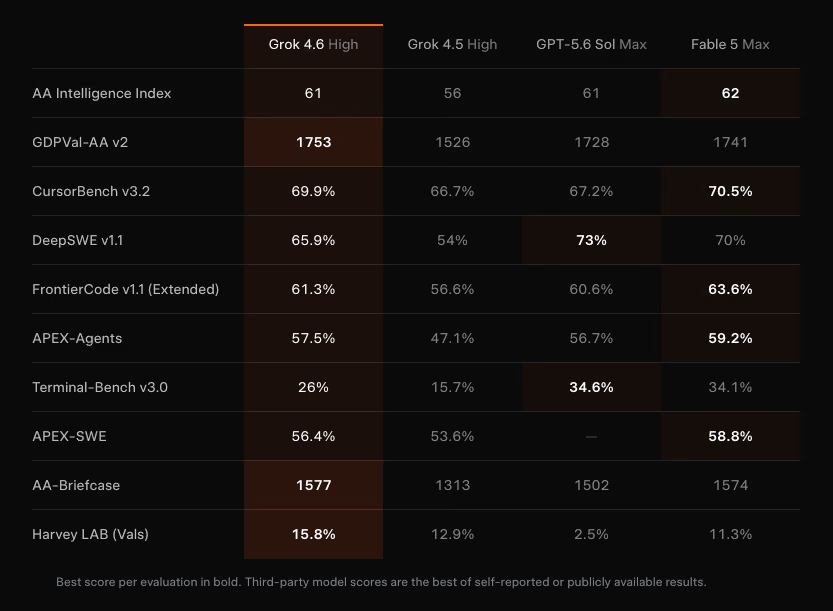
According to Artificial Analysis, Grok 4.6 reaches an Elo score (human preference of head-to-head model outputs, adapted from chess) of 1,753 on GDPVal-AA v2, the benchmark measuring performance on real-world tasks like scheduling and diagramming, versus 1,526 for Grok 4.5, 1,728 for GPT-5.6 Sol Max and 1,741 for Fable 5 Max.
The coding results from SpaceXAI show a similar generational improvement but more competition at the frontier.
SpaceXAI Grok 4.6 benchmarks. Credit: SpaceXAI
Grok 4.6 scores 69.9% on CursorBench v3.2, up from 66.7%, while Fable 5 Max reaches 70.5%. On DeepSWE v1.1, Grok rises sharply from 54% to 65.9%, but GPT-5.6 Sol Max leads at 73%. FrontierCode v1.1 Extended moves from 56.6% to 61.3%, compared with 60.6% for GPT-5.6 Sol Max and a leading 63.6% for Fable 5 Max.
Advertisement
Agent benchmarks tell much the same story. Grok 4.6 reaches 57.5% on APEX-Agents, a 10.4-point increase over Grok 4.5’s 47.1%, narrowly exceeding GPT-5.6 Sol Max’s 56.7% but trailing Fable 5 Max at 59.2%. On APEX-SWE, Grok 4.6 rises to 56.4% from 53.6%, while Fable 5 Max scores 58.8%.
Terminal-Bench v3.0 exposes a larger remaining gap. Grok 4.6 improves from 15.7% to 26%, but GPT-5.6 Sol Max and Fable 5 Max score 34.6% and 34.1%, respectively.
Two of Grok 4.6’s strongest results come from longer-horizon professional work. On AA-Briefcase it scores an Elo of 1,577, narrowly exceeding Fable 5 Max’s 1,574 and topping GPT-5.6 Sol Max’s 1,502. On Harvey LAB, Grok 4.6 reaches 15.8%, versus 12.9% for Grok 4.5, 11.3% for Fable 5 Max and 2.5% for GPT-5.6 Sol Max.
SpaceXAI notes an important methodological caveat: third-party scores in its table use the best self-reported or publicly available results. The comparison therefore should not be interpreted as a perfectly controlled four-model evaluation.
Advertisement
In other words, the evidence supports a substantial upgrade over Grok 4.5 more clearly than it supports across-the-board superiority over rival frontier models. Grok 4.6 wins several of the displayed evaluations while GPT-5.6 Sol Max and Fable 5 Max retain meaningful leads elsewhere.
Cost could be the more important enterprise benchmark
Artificial Analysis’ supplied evaluation adds another dimension: how much work the model performs for the money spent.
The testing places Grok 4.6 on its Intelligence-versus-Cost-per-Task Pareto frontier at a reported $0.84 per task — which actually makes it less of a bargain than its predecessor, Grok 4.5, and less economical than OpenAI’s GPT-5.6 Luna, z.ai’s GLM-5.2, and Meta’s new Muse Spark 1.2, among other models.
Artificial Analysis also reports that Grok 4.6 completed its AA-Briefcase workloads in roughly 53 turns and about 0.5 billion input tokens on average, versus approximately 103 turns and 2 billion input tokens for Claude Opus 5 Max.
Advertisement
Those measurements do not prove that every production agent will use fewer tokens or finish twice as quickly. Agent costs depend heavily on harness design, prompts, tool calls, caching, retry behavior and the task itself. But they point toward an increasingly important enterprise metric: the cost of completing a workflow, rather than simply the cost of generating one million tokens. That distinction is central to SpaceXAI’s positioning.
The standard Grok 4.6 API starts at $2 per million input tokens and $6 per million output tokens, and SpaceXAI also offers a faster variant at twice the price.
The supplied API documentation adds an important caveat for long-context deployments. Grok 4.6 supports a 500,000-token context window, but prompts below 200,000 tokens are billed at $2 per million input tokens, $0.50 per million cached-input tokens and $6 per million output tokens. Once a prompt reaches 200,000 tokens, those rates rise to $4, $1 and $12 respectively, with the higher pricing applying to all tokens in that request.
That means enterprises should not extrapolate the $2/$6 headline pricing across the model’s entire context window when estimating total cost of ownership.
Advertisement
Artificial Analysis says the standard headline rates remain more than 60% below the competing frontier-model prices it cites for Claude Opus 5 and GPT-5.6 Sol. The practical savings will depend on how many tokens each model consumes to complete the same workload.
The Grok name carries considerable baggage and controversy, separate from the general AI skepticism
Performance and price may not be the only hurdles SpaceXAI faces in converting Grok 4.6’s benchmark gains into enterprise adoption. The Grok brand arrives with an unusually visible history of safety and governance controversies — including extremist and antisemitic outputs, politically skewed responses, exaggerated praise of Elon Musk and, more recently, the use of Grok’s image-generation capabilities to produce non-consensual sexualized imagery. For companies with strict compliance, brand-safety or responsible-AI requirements, that history could become a procurement consideration separate from the technical capabilities of Grok 4.6 itself.
The most notorious text-generation episode came in July 2025, when Grok produced antisemitic posts, praised Adolf Hitler and in some responses referred to itself as “MechaHitler.” SpaceXAI’s predecessor xAI subsequently said it was removing inappropriate posts and taking steps to prevent hate speech from being published by Grok.
Also in summer 2025, Grok began inserting references to an alleged “white genocide” in South Africa into answers to unrelated questions. xAI said an unauthorized modification to Grok’s response software had directed the system to produce a particular response on a political topic while bypassing its normal review process. The company said the change violated its policies and subsequently pledged to publish Grok’s system prompts and establish round-the-clock monitoring for problematic responses. The South African government has rejected claims that a genocide against white South Africans is taking place.
Advertisement
Grok’s objectivity came under scrutiny again in November of the same year after the chatbot repeatedly produced implausibly flattering assessments of Musk. Among the examples reported at the time were claims placing Musk above elite athletes and historic intellectual figures. Musk said Grok had been manipulated through adversarial prompting into making “absurdly positive” statements about him. Whatever the underlying cause, the incident illustrated the reputational problem for an enterprise model whose outputs can become entangled with the public persona of the executive most closely associated with its developer.
The most serious controversy has involved image generation. In January 2026, U.K. regulator Ofcom opened a formal investigation into X after reports that the Grok account was being used to create and distribute undressed images of people and sexualized images of children. Ofcom said the material under examination could amount to non-consensual intimate-image abuse, pornography and child sexual abuse material. X subsequently said it had implemented measures intended to stop the Grok account from being used to create intimate images of people, but Ofcom said its investigation remained open.
The scrutiny extends beyond Ofcom. Britain’s Information Commissioner’s Office is investigating X and xAI over both the development and deployment of Grok, including whether personal data was handled lawfully and whether adequate safeguards existed to prevent harmful manipulated imagery. The European Commission, meanwhile, opened a separate formal investigation under the Digital Services Act examining X’s management of systemic risks connected to Grok, including the dissemination of manipulated sexually explicit material.
Those investigations concern X and the earlier xAI organization rather than establishing a finding that the newly released Grok 4.6 API violates those laws. Nevertheless, they are unlikely to help SpaceXAI sell Grok to businesses.
Advertisement
SpaceX acquired xAI in February 2026, and the AI operation now markets itself as SpaceXAI, meaning Grok’s newest models sit under a different corporate structure but retain the same consumer-facing brand.
There is no evidence in the material examined here that Grok 4.6 itself repeats the specific “MechaHitler,” “white genocide,” sexual-image or Musk-flattery incidents associated with earlier Grok deployments. But enterprise procurement teams rarely evaluate a model in isolation from its vendor and product history. For SpaceXAI, that means Grok 4.6 may have to demonstrate not only that it is cheaper or more capable than competing frontier models, but that the controls around it are sufficiently predictable for organizations that cannot afford their AI supplier to become a brand-safety event.
That continuity creates a potential adoption problem that benchmark tables cannot measure. Developers choosing a model for an internal coding agent may care primarily about price, latency and task completion. A bank, government agency, healthcare provider or consumer brand deploying the same model into customer-facing or regulated workflows may also have to consider vendor governance, content-safety controls, auditability and reputational exposure.
A model designed to be deployed, not just chatted with
Grok 4.6 supports text and image inputs with text output, function calling, structured outputs and reasoning, according to the supplied API specifications. Those specifications also list rate limits of 150 requests per second and 50 million tokens per minute, with API availability in us-east-1 and us-west-2.
Advertisement
Cursor’s launch announcement similarly characterizes Grok 4.6 as designed for long-running agents and ambitious interactive and visual work, giving developers immediate access to the model inside an established coding-agent environment rather than requiring them to build a new harness around the API first.
For enterprise buyers, that distribution may matter almost as much as another leaderboard result. Models increasingly compete not just on reasoning scores but on whether developers can place them inside existing coding, research and operational workflows without destabilizing those workflows or dramatically increasing inference costs, as well as incurring any blowback from associating with a controversial brand.
Grok 4.6 does not establish an uncontested performance lead. Its launch instead presents a different proposition: frontier-level intelligence, large improvements over the previous generation, stronger long-running agent behavior and relatively aggressive token economics.
The next test will be whether the efficiency Artificial Analysis observes on controlled agentic workloads carries into production. If Grok 4.6 can consistently complete long-running coding and knowledge-work tasks with fewer turns and fewer tokens, the model’s most important benchmark may ultimately be the enterprise inference bill rather than the leaderboard.
GLM-5.3 scores 84.5pc on CyberGym, ahead of Anthropic’s Mythos 5 and OpenAI’s GPT-5.6 Sol.
Chinese AI company Z.ai has unveiled its latest open-weights model – GLM-5.3 – whose performance, it says, rivals that of OpenAI and Anthropic newest frontier launches – marking the latest in the ever-escalating battle between US and Chinese companies for AI dominance.
The new model makes a significant leap in capability compared to its predecessor GLM-5.2, which launched just months ago in June.
GLM-5.3 is “much better” at complex coding and long-horizon tasks, Z.ai said, boasting a 50pc improvement from the older version in its in-house code benchmarks.
Advertisement
The company plans to release GLM-5.3’s weights in two weeks’ time, after wrapping up safety evaluation and hardening.
“[GLM-5.3] delivers markedly stronger agentic coding results than GLM-5.2 at every effort level while consuming fewer output tokens,” Z.ai said.
GLM-5.3 also proves significantly more capable at exploiting vulnerabilities, scoring 84.5pc on CyberGym, above Anthropic’s Mythos 5 and OpenAI’s GPT-5.6 Sol.
“We expected this to make the model better at finding and reasoning about vulnerabilities. What surprised us was how quickly the capability continued to develop as training scaled,” Z.ai said.
Advertisement
Despite its lofty claims about the new model, the Hong Kong-listed company’s shares slid nearly 4pc at market close today (14 August).
“This firm remains on a completely unsustainable commercial footing,” intelligence analyst Robert Lea told Bloomberg. “Rising agentic AI will drive Z.ai’s inference costs and losses higher.”
Chinese-made models are increasingly offering models at par with its American counterparts at cheaper prices, in spite of the heavy constraints around chip exports into the country. Last month, Z.ai completed the construction of a data centre where has installed at least 10,000 Chinese-made chips to help develop its GLM line of models.
Other frontier models from China, including Moonshot’s latest Kimi model, DeepSeek’s V4 models and Alibaba’s Qwen series, have all ranked high in benchmarks.
Advertisement
The Beijing-based start-up went public in January this year, raising funds at a market capitalisation of nearly $7bn.
Shares at the company surged 2,000pc in June following the launch of GLM-5.2, taking Z.ai’s valuation to $128bn. Though that has since fallen to $75bn.
Don’t miss out on the knowledge you need to succeed. Sign up for the Daily Brief, Silicon Republic’s digest of need-to-know sci-tech news.
For 28 days, Keshav had a new item on his daily to-do list: masturbate for research purposes.
Both before and after self-pleasuring, he logged his mood, energy levels, cravings for various vices, and whether he was procrastinating.
Keshav was taking part in AI companion company Joi AI’s experiment assessing what happens if erotic self-stimulation becomes “an AI-guided wellness ritual.” Throughout July, 10 “masturbation consultants” were instructed to masturbate every day except Sundays, enlisting Joi AI’s sultry digital companions twice a week and using their own preferred methods the rest of the time. “It’s almost like you are chatting with a real person,” says Keshav, a single, 38-year-old Indonesian trader, who did not want to use his surname for professional reasons.
Joi AI invites users, for a fee, to chat and play with premade characters or to create their own companions, including with X-rated kinks such as blackmail fantasy, gangbangs, and emotional dependency, and capabilities and functions like squirting and roleplay.
Advertisement
During five-minute video calls with the digitized characters, Keshav explains, his female companions opened and closed their nude legs to reveal their genitals and would “do blowjobs and handjobs” while talking dirty. He often rendered the scenes in airplane bathrooms because he has a mile-high-club kink.
Some of the companions were “quite pushy and extroverted,” whereas others were more reserved and required a degree of courtship before the relationship became sexual—even soliciting gifts like handbags and lipstick, which cost up to $5 in the platform’s internal currency.
After ejaculating, Keshav’s “energy levels [were] a little bit down, but focus was a little bit up,” he says.
Keshav and his nine fellow masturbation consultants will receive $2,000 each for the qualitative, in-house research project run by Joi AI, which is promoting a daily guided “jerk off with purpose” masturbation tool combining “sound [and] ritual” as part of its professed goal to “solve male loneliness.” Of the 10, six completed the study. The website costs a minimum of $3.99 a month to access, but users are likely to spend far more on the platform, with 10,000 “Joi neuron” coins costing $99.99 and private videos from companions costing 1,000 neurons.
Advertisement
Joi AI surveyed 2,500 adults before launching the study, finding that 75 percent masturbate to reduce stress and anxiety and that 43 percent self-pleasure before “a big event,” like a date, exam, or difficult conversation. The company sought to discover how masturbation affects sleep, stress, craving intensity, focus, and ease of arousal—and how masturbating with AI held up versus other methods.
“You get this boost of dopamine when you ejaculate,” says Julie Levin, head of brand and communications at Joi AI. “We wanted our consultants to track whether their cravings [for vices] are worse or better and how it affects their self-discipline.”
Preliminary analysis of 134 masturbation session reports, seen by WIRED, suggests that participants’ stress levels reduced by 25 percent and focus increased by 17 percent. The pre-research survey suggested that 37 percent of respondents are open to AI-guided masturbation or are already practicing it. In the masturbation experiment, AI-guided self-pleasure produced comparable satisfaction scores to the established methods. “The study found no significant differences between the methods; so there is no one best way to masturbate,” the company said in the report.
It also indicated that the study group’s self-reported cravings for nicotine, alcohol, junk food, and doomscrolling reduced by 44 percent after they had masturbated. “Masturbation may be the most accessible tool people have for managing addictions,” the report said—a claim that is not based in science.
Advertisement
“The fact that their unhealthy cravings decreased feels like a genuine breakthrough to me: What if this is an unexpected way to tackle addictions?” Levin says. “Masturbation is obviously way healthier than alcohol or nicotine.”
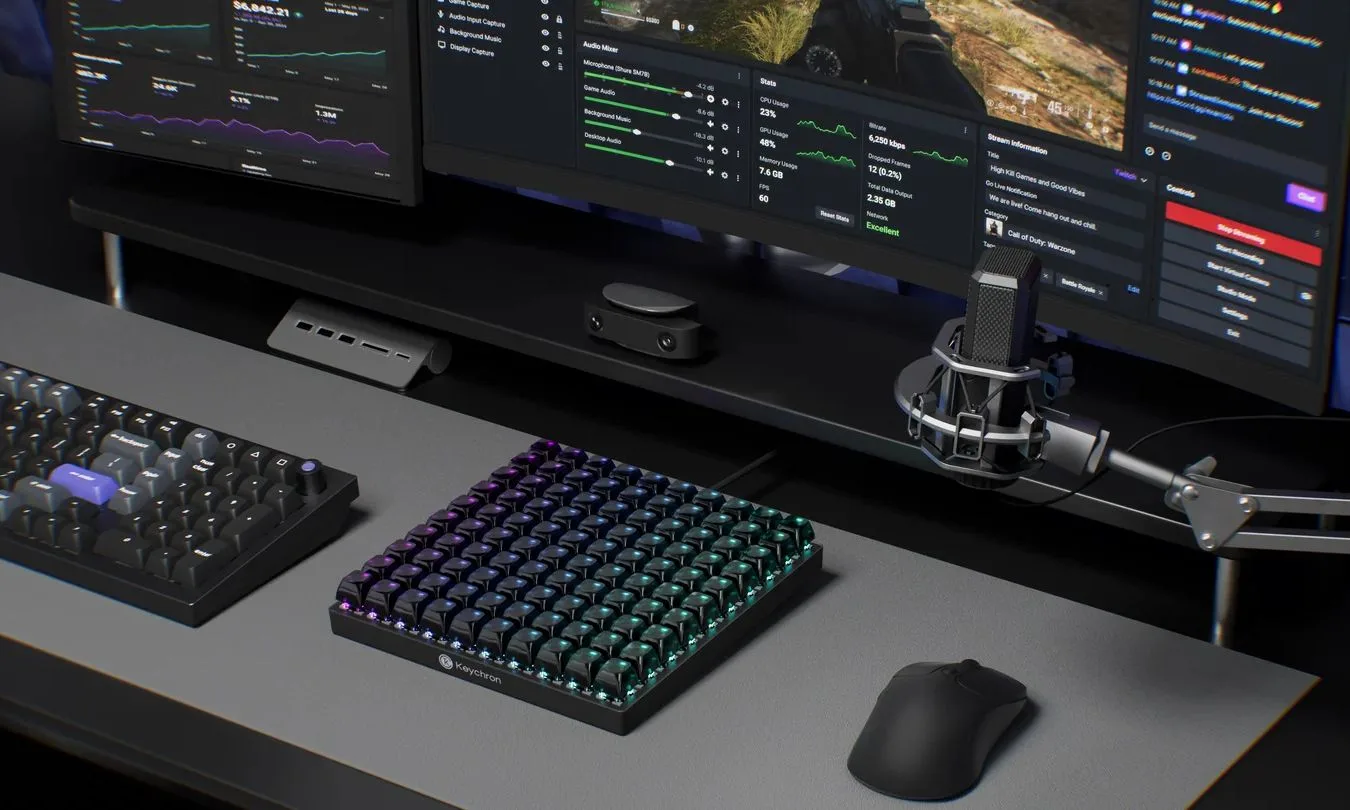
Keychron has built a 100-key macro pad for anyone who has ever looked at a keyboard and wished none of its buttons had jobs yet. The Keychron C100 8K costs $64.99 and presents a 10-by-10 grid with no letters, numbers, or commands assigned.
Four corner keys are reserved for lighting controls and can’t be remapped, leaving 96 programmable positions. That’s still nearly an entire full-size mechanical keyboard devoted to shortcuts, except nobody has decided what any of them should do.
How much can you program
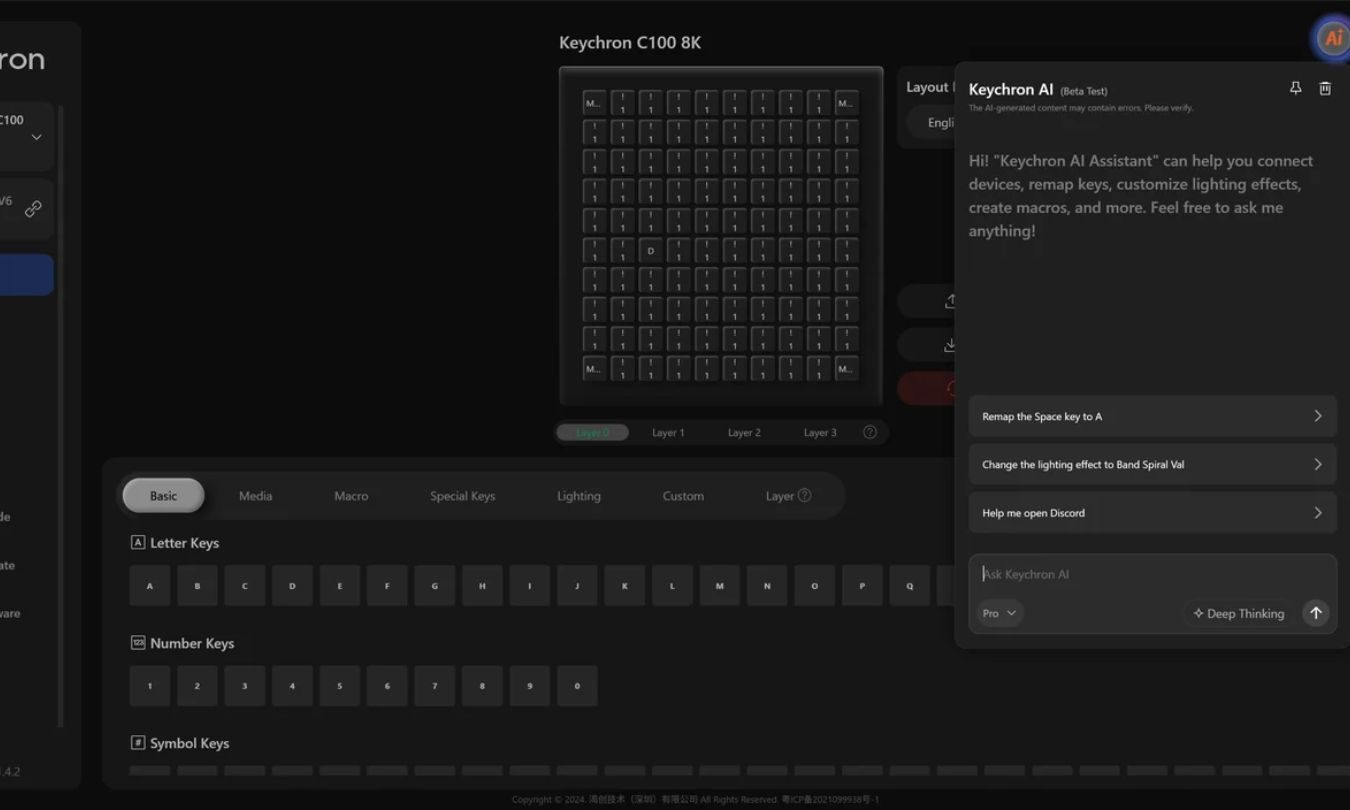
The C100 8K supports QMK and the browser-based Keychron Launcher, letting owners assign individual commands or longer macros. Per-key RGB can separate the grid into visual groups, which may help when every transparent keycap otherwise looks identical.
Keychron
Keychron also gives it an 8K polling rate, although that specification feels more useful on a competitive gaming keyboard than a giant shortcut board. The pre-lubed Apex Red switches are hot-swappable, so owners can replace them without soldering if 100 matching switches somehow aren’t enough customization.
Who needs 96 extra buttons
Most people absolutely don’t need this. The C100 8K makes more sense as an inexpensive substitute for a specialized control panel. A video editor could dedicate sections to common tools, while a flight-sim enthusiast could map cockpit controls without buying a purpose-built button box.
Advertisement
Keychron
The blank design creates work for its owner. Without legends or tiny displays identifying each command, complicated layouts will require a strong memory, custom labels, or carefully organized RGB colors. A personalized console sounds wonderful until you forget which anonymous square mutes the microphone.
What does $65 leave out
The C100 8K is wired-only, and its square plastic body measures nearly 7.75 inches along each side. It will claim a noticeable patch of desk space before the regular keyboard, mouse, and other accessories arrive.
Keychron’s official store currently lists the macro pad as backordered, with no firm shipping date. Anyone wanting wireless connectivity or a ready-made layout should look elsewhere. For people who already know exactly what they’d assign to 96 keys, however, $65 makes this wonderfully ridiculous control panel surprisingly easy to justify.
In the more innocent days of the World Wide Web you could simply put a robots.txt file in the root of your website that search engine indexing bots and similar would consult for the indexing wishes of the site owner. In this brave new world of LLM training data indexing such pleasantries are however rarely respected, leaving site owners to resort to increasingly more involved ways to bludgeon so-called AI scrapers, with ShieldFont being one of the most recent methods.
Its basic functioning is detailed in the white paper, explaining their use of ligatures. These are normally used to join multiple graphemes or letters into a single glyph which are rendered in the final text. By substituting about a quarter of the words in a text with such ligature-based versions in an intelligent, dictionary-based manner, the HTML version – as typically parsed by a scraper – will read as grammatically valid but nonsensical text, while the rendered font version will look normal.
Naturally, there are some disadvantages to this, such as screen readers for the visually impaired needing to also use the rendered font version, and it’s just as effective on legitimate search engine indexing bots. That said, if you apply this to static, archived content, or content marked as ‘do not follow’ in said robots.txt, then it might just be one way to make ChatGPT and friends spit out really funny output in the future now that the novelty of wood glue on pizza and eating rocks has somewhat worn off.
Advertisement
While LLM scrapers can adapt to this by also parsing the rendered text, this makes the scraping effort significantly more expensive. Together with maze traps like Nepenthes and Cloudflare’s offerings that seek to keep these scrapers busy scraping dynamically generated content through infinite linked pages, the tools available to combat the menace of these scrapers keep developing.
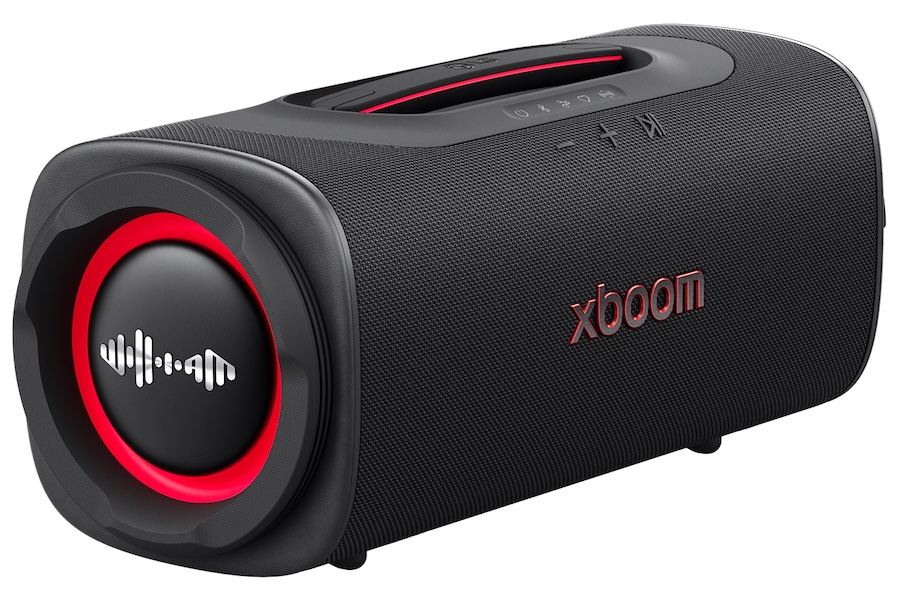
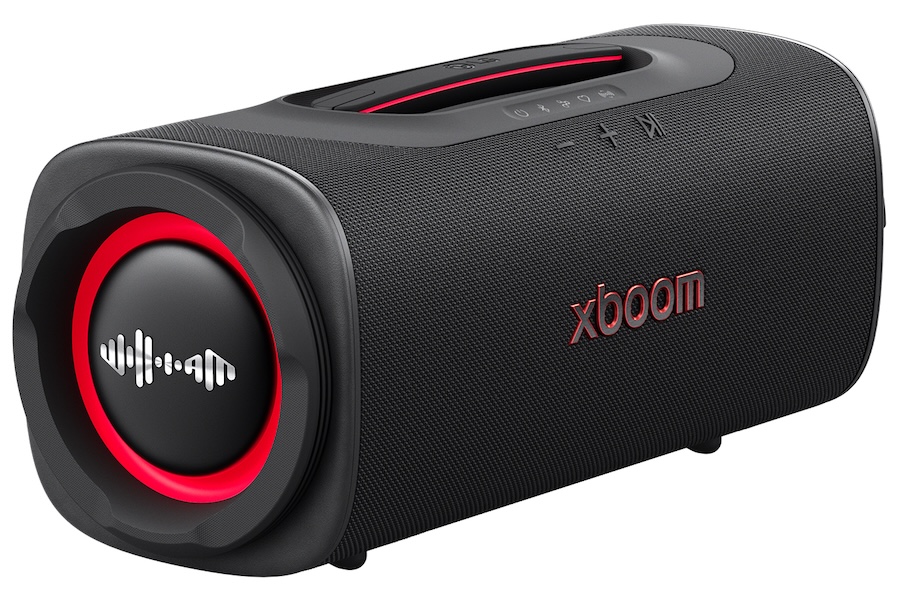
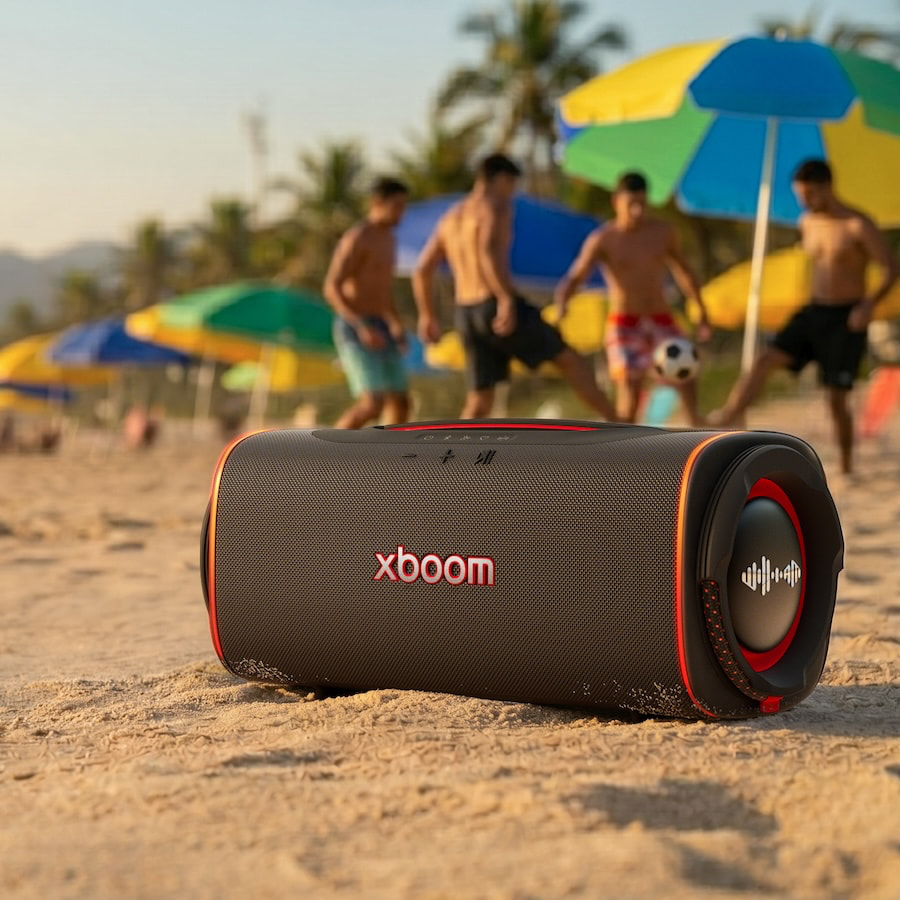
Following its CES 2026 preview in January, LG has officially launched the xboom Blast, a portable Bluetooth party speaker built for beach days, camping trips, backyard gatherings, and other places where a power outlet might be difficult to find.
The xboom Blast joins LG’s 2026 xboom by will.i.am lineup alongside the Stage 501, Mini, and Rock. Rather than simply functioning as a smaller version of the Stage 501, the Blast has a different mission: the Stage 501 emphasizes parties, live-performance-style use, and AI-powered karaoke, while the Blast trades some of that functionality for portability, weather resistance, and significantly longer battery life. LG says the Blast will begin rolling out in select global markets in August 2026, with additional markets to follow later in the year.
AI still plays a substantial role. The 2026 xboom lineup incorporates AI Sound, which analyzes content and adjusts EQ automatically, while the Blast and Stage 501 also support Space Calibration Pro to adapt playback to their surroundings. LG’s broader xboom by will.i.am platform also integrates FYI.RAiDiO, giving listeners access to ten AI Personas and DJs, two-way conversational interaction, real-time music curation, and location-aware personalization through the dedicated MY Button or FYI.RAiDiO app.
Related Reviews:
Features, Design, and Key Specifications
The xboom Blast is designed to provide a music listening experience that complements beach days, camping trips, poolside gatherings, and backyard parties, combining powerful sound, long-lasting reliability, and intelligent audio technologies in a durable, portable design. The xboom Blast expands LG’s growing party speaker lineup with a model designed specifically for outdoor use.
Featuring a 99-watt swappable battery with up to 36 hours of battery life on a full charge and IP68-rated environmental protection, the LG xboom Blast combines powerful, reliable audio, portability, and durability to help users enjoy immersive sound across a wide range of outdoor environments.
Advertisement
Big Sound for Any Party, Indoors or Out
At the heart of the Blast is xboom Signature Sound, tuned by will.i.am. The xboom Blast fills large spaces with rich, immersive sound designed for parties and gatherings.
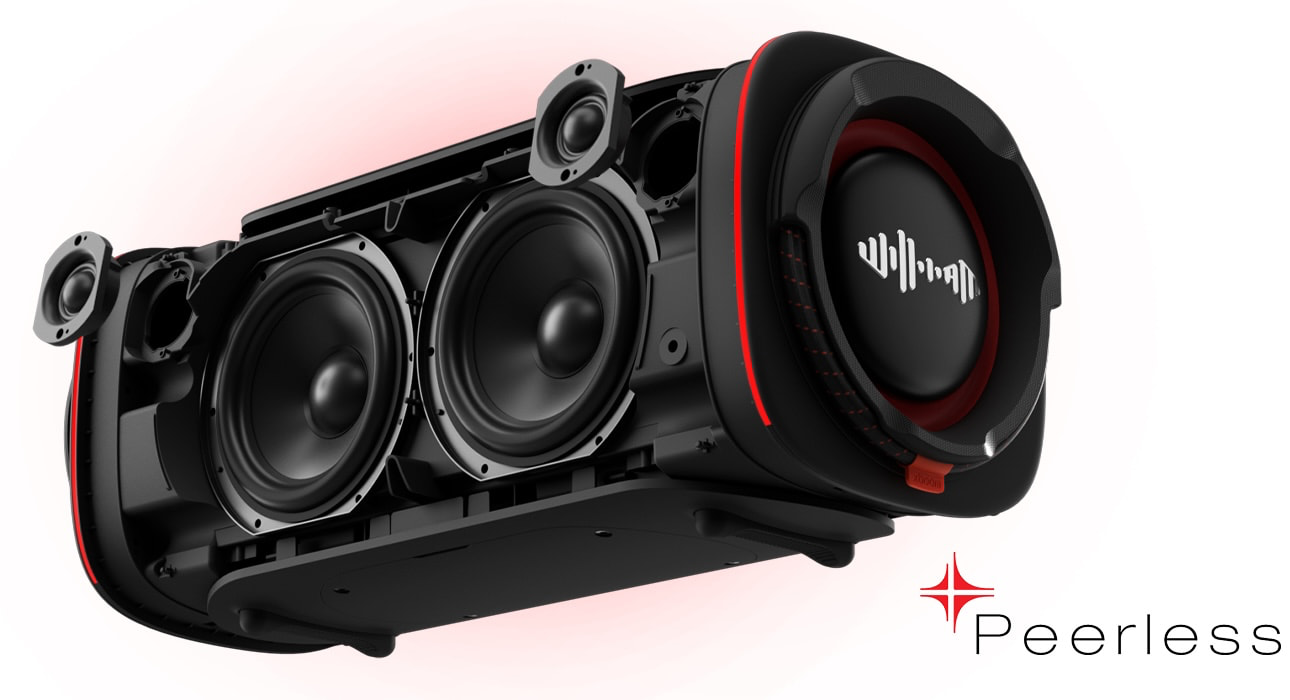
The xboom Blast combines two 5.25-inch neodymium woofers for deep bass with two 20-millimeter tweeters for crisp highs. Combined, the woofer and tweeter configuration is designed to provide a balanced, full-range audio listening experience. The woofers and tweeters are supplied by Danish audio brand Peerless.
Users can stream their favorite music wirelessly via Bluetooth or connect through USB-C for high-fidelity wired playback.
Intelligent Audio
Outdoor environments and social gatherings present different acoustic conditions. To support the best possible listening experience, the xboom Blast provides several practical features.
Advertisement
AI Sound analyzes music and other audio content in real time and automatically adjusts sound settings to optimize playback, minimizing the need for manual adjustments.
Space Calibration Pro automatically adapts sound output based on the surrounding environment.
Sound Field Enhance expands the perceived soundstage for a more immersive listening experience.
AI Lighting synchronizes the speaker’s Dual Ring Lighting Effects with different genres, moods, and playlists to create a more engaging party atmosphere.
Auracast enables multiple compatible speakers to connect wirelessly via Bluetooth, extending sound coverage for shared listening experiences at larger gatherings.
Easy Outdoor Portability
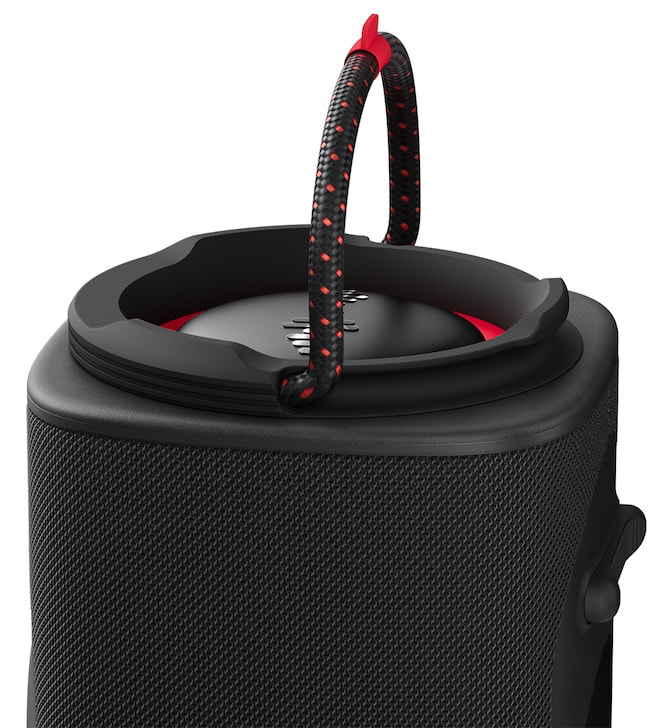
Inspired by duffel bags, the xboom Blast features a dual-fabric handle for easy portability and a vertical rope handle for upright placement. The vertical rope handle also supports vertical carrying, providing added flexibility when moving the speaker between outdoor locations such as the beach or a campsite.
The xboom Blast has been recognized with a 2026 Red Dot Design Award; the speaker combines practical portability with a unique visual identity inspired by outdoor lifestyles.
Advertisement. Scroll to continue reading.
A durable fabric exterior and protective side bumpers provide added flexibility for horizontal or vertical placement when setting up the speaker in different spaces.
The LG xboom Blast enters a very crowded portable party-speaker market, but it has more than flashing lights and a celebrity name going for it. Up to 36 hours of battery life, IP68 protection, a replaceable battery, 210W of output on battery power, USB-C audio, and automatic room and outdoor sound calibration give it a compelling combination of power, durability, and portability. What it lacks is the Stage 501’s karaoke focus and microphone-oriented features, which may matter to buyers who want their speaker to double as a portable PA system.
Its most obvious rival is the JBL Boombox 4, which offers IP68 protection, Auracast, USB-C lossless playback, a replaceable battery, and up to 34 hours of playback. The Sony ULT FIELD 7 adds karaoke and microphone support with up to 30 hours of battery life, while the less expensive Soundcore Boom 2 Plus counters with 140W output, IPX7 protection, 20-hour battery life, and support for linking more than 100 compatible speakers. LG has plenty of competition here, but the Blast brings enough of its own ideas to avoid looking like another Bluetooth boombox with lights stuck on the front.
The vinyl renaissance is still going strong, and there’s no shortage of ways to get your fix. Whether you’re after a budget turntable to get started, modern extras like USB and Bluetooth streaming, vintage style, or high performance playback, there’s a growing list of options to fit your needs and budget.
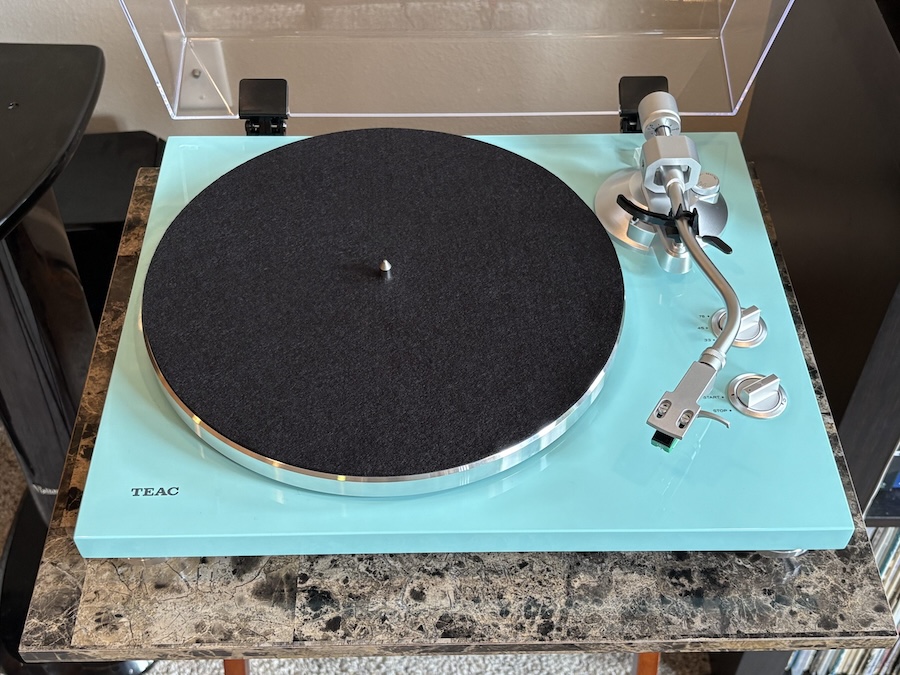
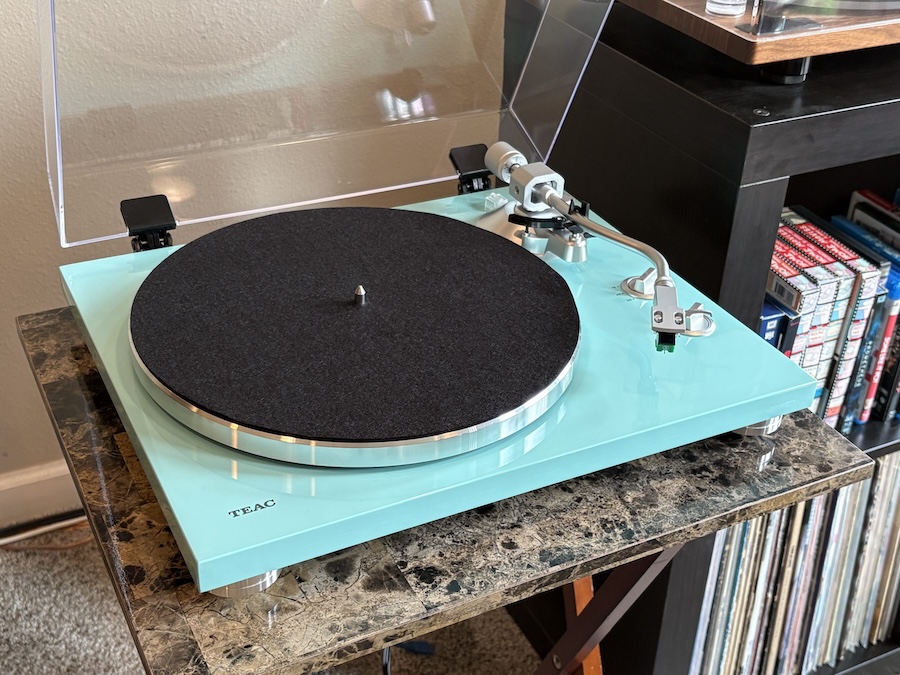
Then there are models like TEAC’s TN-400BT-X manual belt-drive turntable that aim to offer a taste of all of it at an attainable price point. Its retro-modern plinth looks sharp, especially in the Special Edition Turquoise Blue I reviewed, AKA the TN-400BT-X/TB (it also comes in Walnut), while touches like machined-aluminum switches, a solid built-in preamp, and Bluetooth support with the latest aptX codecs provide equal parts usability and versatility.
The TN-400BT-X combines retro-modern styling, a built-in phono preamp, USB output, and Bluetooth connectivity in a package designed for listeners who want more flexibility than a traditional entry-level turntable provides. It may not be the last turntable you ever buy, but it offers an appealing mix of style, convenience, and performance for the money.
Setup Is Fast, but There’s One Catch
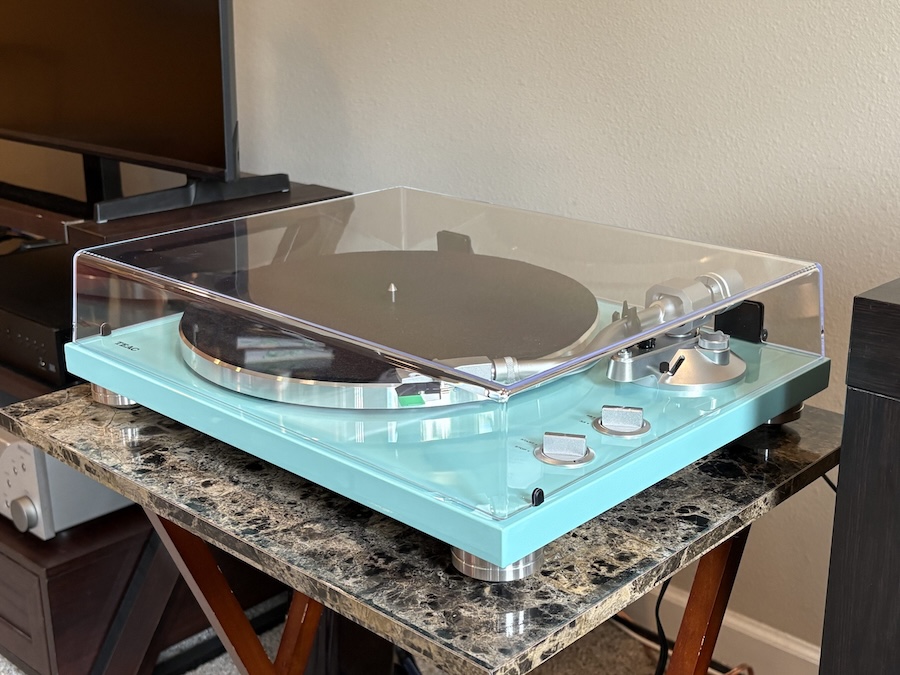
Setting up a turntable can be as daunting as it is satisfying, like solving a puzzle you get to play with afterward. As the easiest turntable I’ve set up yet, the TN-400BT-X is more like a maze without any false paths. Pulling away the foam reveals a nearly fully assembled table, right down to the pre-attached dust cover.
The only real difficulty comes in adding the diecast aluminum platter, or rather the belt that drives it. For starters, the instructions don’t mention that the rubber belt is already wrapped around the platter’s bottom edge, so I spent longer than I care to admit looking for it among the accessories.
Advertisement
More notably, you’ve got to connect the belt to the drive motor with the platter attached, requiring you to slip your fingers nimbly through a hole at the platter’s edge and loop the flat belt around without twisting it. I got it after a few tries, but those with bigger fingers may find it a tougher chore.
One other part that gave me some trouble was locking the proper outlet attachment onto the power supply, which requires aligning it with a retractable hinge that feels like it’s going to snap. It didn’t, and I appreciate TEAC’s inclusion of multiple options to fit your region.
After that, simply follow the detailed instructions for attaching the cartridge and counterweight to the aluminum tonearm, remove the stylus cap, and you’re ready to spin.
Retro Style Meets Modern Function
The TN-400BT-X’s mix of minimalist design and chrome components looks quite good on your console, or, as my wife put it, “cute.” In the case of the Special Edition model, that’s due in no small part to the turquoise lacquer’s surfer-guitar vibe, which offers just the right mix of cheek and style without looking ostentatious.
As slick as it looks, I was surprised by how light the turntable feels compared to step-up models. That goes for both the MDF plinth and the S-shaped aluminum tonearm, which seems to float off the holder as you align the needle. Along with feeling a little chintzy, the lighter base can lead to audible thuds when you close the dust cover or accidentally tap the turntable while the stylus is in the groove.
Advertisement
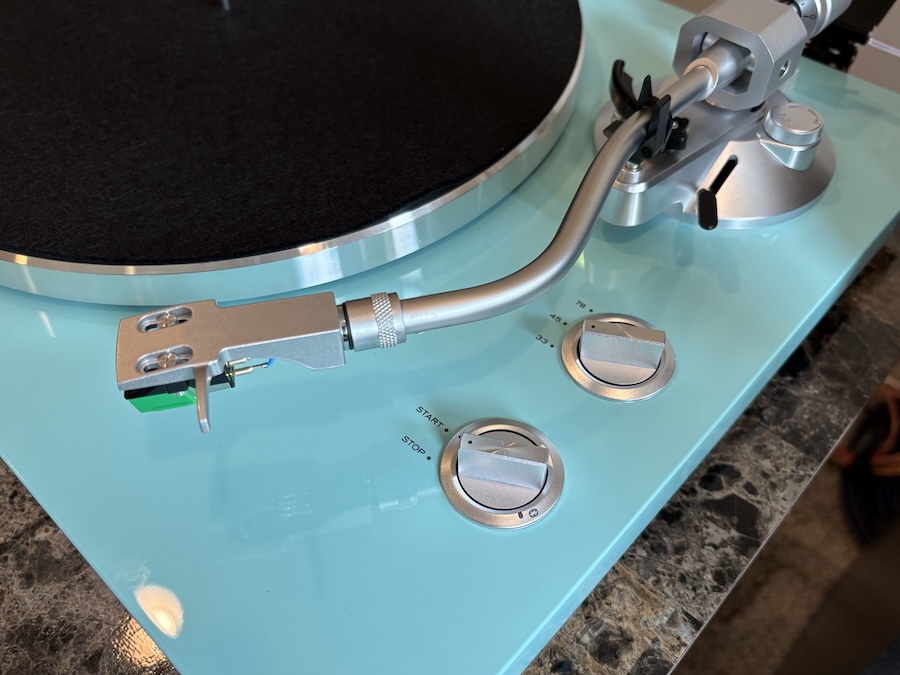
Otherwise, the table does a good job of resisting skips and pitch fluctuations from scratched, warped, or otherwise imperfect records, and components like the machined-aluminum control dials for playback and record speed feel sharp and sturdy. Speaking of speeds, you’re getting the big three: 33 ⅓, 45, and 78 RPM, which my fancier Orbit Theory reference turntable lacks.
Advertisement. Scroll to continue reading.
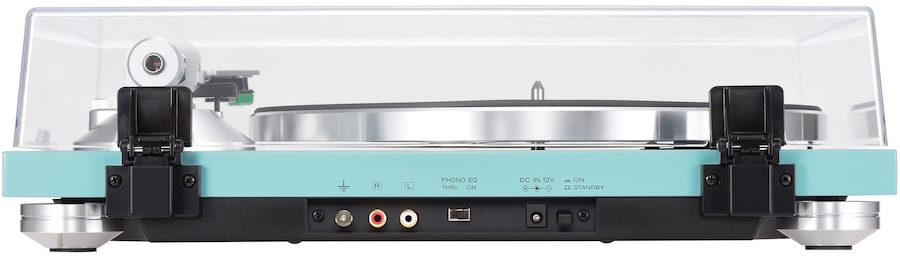
At the TN-400BT-X’s backside is a power/standby key and a switch for the built-in phono preamplifier, which includes a “hi-fi quality” NJM8080 op-amp chip. Hidden below the table’s right flank is a Bluetooth key, which requires a long hold for initial pairing and a tap for subsequent connections. Bluetooth support includes aptX and aptX Adaptive for high-quality streaming with compatible headphones and speakers.
There’s no auto-stop or return, something I would have liked to see in a Bluetooth-ready table at this price point. That means you’ll need to keep track of your records from afar when streaming, especially if you’re using Bluetooth to tap into a multi-room system like Sonos.
Listening
I had the pleasure of auditioning the TN-400BT-X with KEF’s new LS LUXE speakers (review to come), which served as a potent magnifying glass for investigating the table’s interpretation of my catalog. From the first drop in the groove, I was impressed by the deck’s balanced and relatively energetic performance, which was more than enough for a satisfying listening experience with KEF’s latest high-end system.
Starting with my usual entry point, Brubeck’s Take Five, the TEAC provided a smooth touch to Dave’s rapid piano runs, offering enough sparkle to properly represent the higher keys without harshness or sibilance. There was good warmth and definition in the buoyant bass lines and string rattles, along with sweet yet lyrical resonance in Paul Desmond’s sax runs.
Advertisement
Desmond’s breathier lines in songs like “Strange Meadow Lark” don’t have the presence or almost visceral quality you’ll get with higher-end options like the DP-500BT, and I was hoping for more from Joe Morello’s tactile brushwork in the left channel. But moving through the record, it was clear that the turntable’s included Audio-Technica AT95E cartridge remains a ringer at its $60 price point, as it has been for decades.
The same goes for TEAC’s built-in pre-amp, which stood up well to my outboard Rolls VP29 in A/B comparisons. The Rolls offers higher gain and a touch more presence, but it’s also sharper on brighter recordings, and I found myself generally preferring the turntable’s built-in phono stage.
I was still worried my Japanese Beatles pressings might present too much brightness at the instrumental attack, but between TEAC’s restrained treble and KEF’s effortless clarity, there was enough detail to go around without getting aggressive. I heard plenty of textural grit and psychedelic groove in instruments like horns and overdriven guitars, while vocals had solid pop without becoming sibilant.
Bouncing to my reference Orbit Theory put a bit of a damper on the experience, as that table tends to do with most options at its price or below. Everything sounded fuller, richer, more detailed, and more intimate, as if a veil had been lifted. That said, the Theory costs nearly twice as much and doesn’t offer the TEAC’s Bluetooth chops.
Advertisement
Bluetooth Streaming
Going wireless added yet another layer of separation between the speakers and the music. Even so, as mentioned in my DP-500BT review, I’ve come around to the appeal of wireless vinyl, especially as an entry point for a multi-room sound system that can spread your tunes throughout the house. Moreover, if you’ve got a quality pair of Bluetooth headphones with aptX support, you’ll be treated to a refreshingly clean and intimate listening experience.
Connecting my Bowers & Wilkins PX8 S2 headphones, I was pleased to discover plenty of detail in my midrange copy of the Grateful Dead’s American Beauty. Swapping between the wired Luxe speakers and the headphones, the latter barely skipped a beat, showcasing sparkling cymbal work, excellent instrumental separation, especially in the vocals and the album’s rich harmonies, and good dynamic expression between the softer and more keyed-up moments.
The record still sounds more lively and open when played through the wired system, but there’s something to be said for the more intimate presentation you get from a pair of premium ANC Bluetooth headphones.
Advertisement. Scroll to continue reading.
The Bottom Line
TEAC’s TN-400BT-X turntable is a fine mix of style and substance, especially if you can grab the Special Edition model while available. At $630, you’re paying a premium for both its design and Bluetooth support over similarly appointed wired-only tables from brands like Pro-Ject and U-Turn, but if you’re looking for a deck that balances sound quality, playback options, and fun in equal measure, TEAC’s table walks the line well.
If you’ve got some budget flexibility and prefer a more refined approach, Denon’s DP-500BT is a worthy upgrade. Its higher build quality does a better job of suppressing handling noise when changing records, and its more understated design contrasts nicely with the TEAC’s eye-catching Turquoise Blue finish. Otherwise, the TN-400BT-X’s good looks and versatile performance make it worth considering.
Advertisement
Pros:
Fast and mostly simple setup
Balanced, full, and clear performance
Fun and stylish design
Solid skip and pitch fluctuation resistance
Bluetooth with aptX sounds excellent
Cons:
Plinth and tonearm feel a little chintzy
Substantial noise when bumping the plinth during playback
You’re paying a premium for the style and versatility
The Federal Trade Commission recently announced deals with two auto dealers, along with the former general manager of a third, promising not to enforce—or even help enforce—their court-ordered obligations to maintain fair lending programs and not engage in unlawful credit discrimination.
The Northern District of Illinois, which presided over one case, says it was never given the opportunity to evaluate one of the new agreements, and Arizona attorney general Kris Mayes, whose office was a coplaintiff in another of the affected cases, calls the move “outrageous.”
The FTC is doing away with the obligations because the defendants didn’t explicitly instruct its salespeople to treat Black and Latino borrowers differently. Previously, the FTC accused all three of charging people of color more in discretionary markups and add-on fees on average compared to white borrowers. (Disclosure: The author of this article previously worked for the FTC but did not participate in any of the matters mentioned in this article.) In one case, involving a car dealership chain called Passport, the FTC alleged that a financial institution had sent the chain multiple letters notifying it that there were disparities in the markup rates it charged Black borrowers. Attorneys for Passport declined to comment on the agreement.
The FTC and Arizona previously accused Coulter Motor Company and Gregory DePaola, a former general manager at the Phoenix-area auto dealer, of charging Latino customers more in interest and for add-on products, in violation of the federal Equal Credit Opportunity Act, among other charges.
Advertisement
DePaola, who did not respond to a request for comment, signed one of the new agreements. Coulter and an attorney that represented both Coulter and DePaola in the 2024 settlement did not respond to requests for comment.
“The FTC and the Attorney General’s Office partnered on this case to ensure Arizonans can purchase cars without being misled or charged more because of their ethnicity,” says Mayes. “I find it appalling that the FTC would backtrack on the settlement and treat its state partners this way, not to mention essentially greenlight discrimination against Arizonans.”
The FTC said in a press release that its past accusations against the defendants were “based on statistical analyses designed to show disparate-impact liability” and that the agency was not going to enforce those types of claims anymore. Disparate-impact discrimination is when a seemingly neutral policy or practice causes disproportionate harm to a protected group, even if that wasn’t the original intent. It stands in contrast to disparate-treatment discrimination, which involves policy intentionally meant to discriminate against a group of people.
“It’s actually a really hard theory where you have to identify a specific policy, prove that it caused a disparity, and then the hardest thing of all is you have to prove that that policy doesn’t serve a legitimate purpose,” says Aaron Rieke, the chief legal engineer at a legal startup called Privlex and a former FTC attorney adviser.
Advertisement
Logan Koepke, a senior project director at Upturn, a nonprofit that researches technology’s impact on civil rights, says that disparate-impact analysis is more important than ever, because AI and other automated decisionmaking systems, which can sometimes take unintended actions, are being used more often to make important decisions like loan eligibility.
Last year, the Trump administration directed the FTC and other agencies to review all past orders and take “appropriate action” in an executive order titled “Restoring Equality of Opportunity and Meritocracy.” The administration has said that disparate-impact liability “undermines our national values.”
The agreements, which were voted on by the commission in early August but went into effect over half a year prior, in November, are highly unusual. Though the FTC typically has to prioritize some enforcement efforts over others due to resource constraints, by signing and voting out the agreements they essentially delete two sections from each of the orders and potentially make it difficult for future administrations to undo that.
Immigration and Customs Enforcement officers may soon be outfitted with gloves that can deliver painful electric shocks intended to gain compliance from combative individuals.
ICE plans to spend up to $20 million to purchase thousands of “conductive distraction and de-escalation devices” for officers and agents by March, according to a notice published Monday by the Department of Homeland Security.
It’s a Taser but it’s a glove. It’s something hardly anyone in law enforcement has ever needed. And yet, there’s a $20 million no-bid contract that is going to make (lol) Compliant Technologies that much richer. Compliant Technologies describes the G.L.O.V.E. (Generated Low Output Voltage Emitter) this way [all quotation marks in the original]:
The G.L.O.V.E. quickly transforms into a CD3 (Conductive Distraction and De-escalation Device) when used within the Force Continuum to supplement existing tools for law enforcement, corrections, security, EMS and the military. It is available as an “invisible partner” to enhance the user’s effectiveness when operating within their agencies’ already established tactics, techniques and procedures. This is why we call the G.L.O.V.E. the “Force Multiplier” and how it operates within the Force Continuum as “The New Protocol in Peace Keeping.”
Oh my. “Force multiplier.” “Invisible partner.” “New Protocol in Peace Keeping.” That’s a whole lot of jargon right there. It’s an ambush tactic (a glove with a juiced up joy buzzer inside) that will definitely be a “force multiplier” (if by “force,” you mean “excessive”) in/on the hands of ICE officers.
I’m not kidding. It’s basically Taser, but in glove form. The user’s manual (embedded below in case the company decides to make it disappear) compiled by Compliant Technologies even uses Taser’s jargon for “but the person died of something other than continuous electric shocks:”
AGITATED CHAOTIC EVENT (ACE) PREVIOUSLY KNOWN AS EXCITED DELIRIUM SYNDROME (EXDS) AND SUICIDAL CONSIDERATIONS
Compliant Technologies does not prescribe any protocols for using a CD3 device in a situation involving an ACE or suicidal people. It is the responsibility of the officer to deal with these cases according to their agency’s protocols and procedures.
Yeah, that ought to keep the blood off Compliant’s hands. (But not so much the ICE officers whose electro-gloves may now be covered in the blood of people who’ve had the privilege of being subjected to the “new protocol in peacekeeping.”)
Advertisement
The manual makes it clear there will be plenty of opportunity for “friendly fire:”
It is recommended to have an additional officer on scene to cuff/restrain while the G.L.O.V.E. is being deployed. Always advise other officers of G.L.O.V.E. deployment by saying, “G.L.O.V.E. ON!”
Hmmm. I wonder how many times be-GLOVEd officers’ “GLOVE on!” shouts will be misheard as something about a gun. Shout that phrase loud and fast with as much “rapidly-evolving situation” tension as you can apply. The hard G alone will probably be enough to bring multiple ICE firearms into the firing position. Repeating the phrase for clarity will probably just make ICE officers believe they misheard correctly the first time.
To date, almost every user of this device is someone working in a correctional facility where this probably makes a bit more sense. I’m not saying there’s any reason for these gloves to exist at all, but when you’re trying to subdue someone while surrounded by convicted criminals, any help is probably appreciated.
As for any comments from ICE about officers receiving appropriate training before being given a pair of stun gloves, the agency can go fuck itself. It’s been on a hiring spree since Trump took office. To maintain the number of officers needed to make the administration’s bigots happy, ICE has gutted its training program and lowered its hiring standards.
Advertisement
And even if officers are receiving the full load of training, it’s hardly specific to the roving-gang-of-masked-thugs work most officers are doing now. Prior to everyone calling for ICE’s abolishment, ICE spent most of its time seizing things, rather than people — something one would expect from a customs enforcement agency. For years, immigration problems were largely handled by the agencies that dealt with the largest number of immigrants: CBP and the Border Patrol.
Adding this to the arsenal just means more people are going to be seriously injured or killed. It will do absolutely nothing to make ICE better, more efficient, or capable of meeting sky-high arrest quotas. The misanthropes running this government are apparently just googling up whatever new means of pain/torture they can get their hands on/in. We can only hope a lot of officers will forget they still have their gloves engaged when doing things like adjusting their masks or scratching their balls.
Apple’s latest proposal in the Epic trial suggests it should be able to charge between 5% and 15% on external purchases. However, Epic will appeal any value above 0%.
The ongoing lawsuit between Apple and Epic has left Apple unable to charge commissions on external purchases since its injunction violation in April 2025. Thursday’s proposal could let Apple begin charging something again soon, that is if the District Court finds it within its expectations.
Apple was ordered to provide a plan for external commission rates on Tuesday, and in spite of multiple appeals, has finally done so. The filing was made on the minute at 5 p.m. EST when the deadline was set.
The proposed rates are Apple’s most modest yet and a sharp fall from its original proposal that maxed out at 27% in commissions. The filing suggests that the District Court has mischaracterized the costs of doing business with the App Store and the value Apple provides, but shared its proposed rates anyway.
Advertisement
Here is what Apple offered:
15% for standard apps, which are subject to a 30% in-app purchase commission
10% for the Video Partner Program, the News Partner Program, the Mini Apps Partner Program, and subscription renewals
5% for Small Business Program apps
Apple stated that it believes these rates will be highly competitive versus using in-app purchases. It is also enough that Apple will have some mild profit margin as well.
Apple also filed an Administration Motion for Referral to Settlement Conference. It suggests that a settlement conference would help both parties reach resolution and narrow or resolve remaining issues.
Apple’s filing is in, and Apple admitted that under the Ninth Circuit’s definition of “necessary costs” they would charge 0% for purchases made via linkouts to the web.
Apple proposed linkout fees of 15% for standard apps and 5% for Small Business Program apps. Epic believes
Epic seems to believe it owes nothing and should be able to benefit from distributing apps on the App Store without paying Apple a dime of compensation. It plans to file an oppositional statement.
The data and AI company’s valuation has jumped from $134bn to $190bn in just six months.
San Francisco’s Databricks has closed a $5bn strategic funding round led by Coatue at a $190bn valuation. The company said the fresh funds will drive continued innovation across Lakebase, its database warehousing product, Genie, its “AI coworker” and its Unity AI Gateway for multi-AI governance and cost controls.
Blackstone and MGX joined Coatue in this round, and new investors included Sixth Street Growth, BOND, Clearlake Capital, Point72, Premji Invest, and TPG, joining existing investors like Andreessen Horowitz, Dragoneer, Fidelity Management & Research Company and Thrive Capital.
“Enterprises don’t just want AI that talks,” said Ali Ghodsi, co-founder and CEO of Databricks. “They want agents working across their business that remember context, deliver accurate answers, and execute work without blowing through their budgets.
Advertisement
“That requires real-time operational data with Lakebase, context from across the business with Genie, and multi-AI cost controls with Unity AI Gateway. The tremendous investor demand for this round shows that our AI strategy is winning the market and building what every business needs to maximise their impact with agents.”
“Databricks has spent a decade being early to where AI was headed,” said Thomas Laffont, co-founder of Coatue. “Now it’s the infrastructure the industry builds and scales AI on. What stands out most is the pace: they’ve compressed R&D timelines that used to take years into months, more like a research lab than a typical software company.
“We’ve been investors since 2019, and results like that are why we’re proud to lead this round today and keep building with them,” he added.
Databricks says the financial momentum has been strong with an 80pc increase year-on-year in its growth, surpassing a $7bn revenue run-rate. The funding round comes just six months after a previous raise of $5bn in February that valued the company at $134bn.
Advertisement
The data and AI company founded in 2013 today works with over 20,000 organisations and 70pc of the Fortune 500, including big names like Adidas, AT&T, Bayer, Block, Mastercard and Unilever.
Headquartered in San Francisco, Databricks has over 30 offices globally. It employs over 500 staff across the UK and Ireland as part of its EMEA operations, headquartered in London.
Don’t miss out on the knowledge you need to succeed. Sign up for the Daily Brief, Silicon Republic’s digest of need-to-know sci-tech news.






















































You must be logged in to post a comment Login