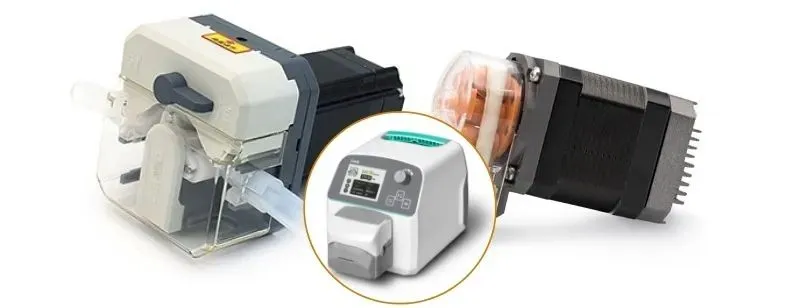
Peristaltic pumps are a very simple and effect device for transferring fluids without said fluid ever coming into contact with any part of the pump mechanism. At their core they involve a mechanism squeezing fluids through compressible tubing, but there are various implementations of such a mechanism that all have their pros and cons. In a recent article by [T. K. Hareendran] over at EDN these types are discussed and when you’d want to pick one over the other.
Also known as a roller pump, these positive displacement pumps have been known since the 19th century, finding uses in industrial, medical, research, agriculture and many other fields. Each of these fields have different requirements with the use of a peristaltic pump as a dosing pump being a specific application whereby e.g. a stepper motor can be used to provide exact dosing.
For industrial settings the typical rollers that compress the tube are replaced with shoes that provide higher pressures and endurance, with overall a bewildering number of motor types and tubing materials available. Depending on what your project needs, you may opt for continuous flow, fine control over dosing, the ability to reverse the flow, etc.
Unless your project is particularly rugged, a roller-based mechanism should be fine, while silicone tubing is great for biocompatibility and PVC is a cheaper tube material option. If you intend to transfer certain kinds of chemicals that will react with each of these there are some more exotic tubing options available as well.
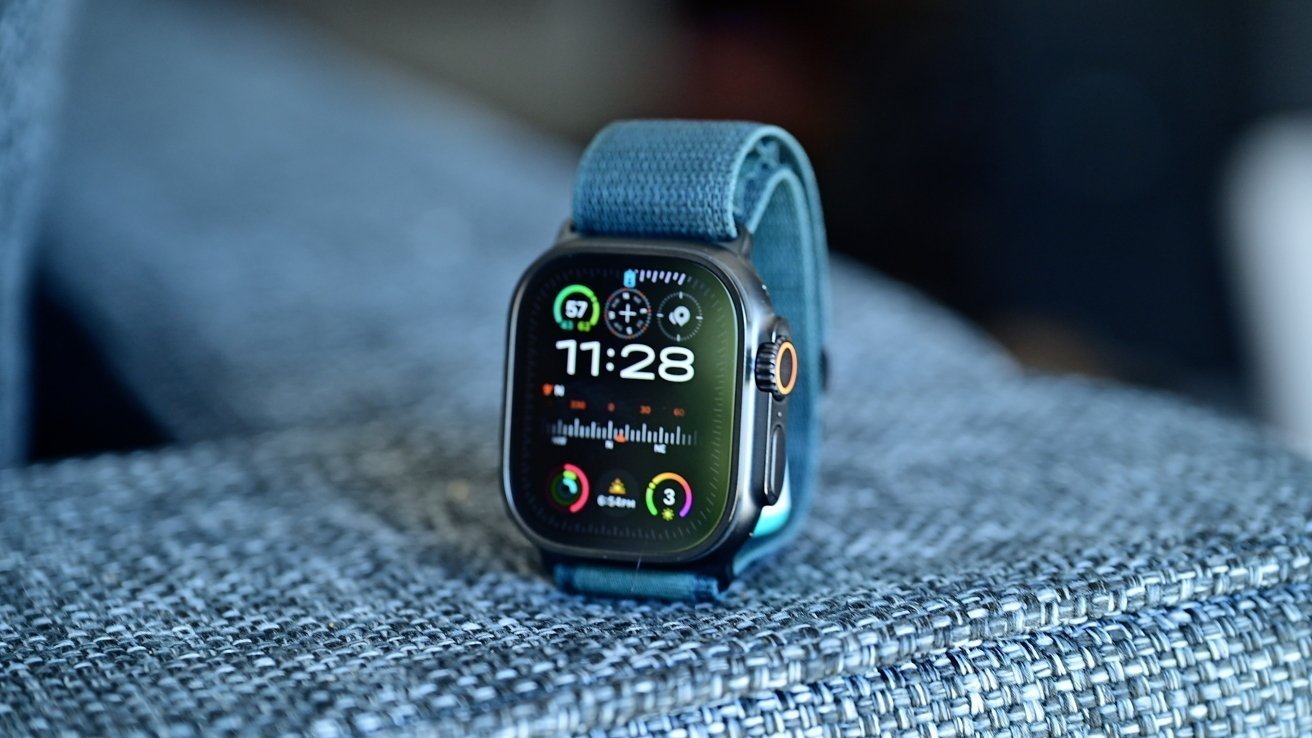
The Apple Watch updates in watchOS 27 includes new watch faces, with Apple testing a new simpler version of the Modular Ultra for the standard model.
In the run-up to WWDC in June, the rumor mill will surface leaks and speculation about Apple’s software changes. One of the more frequent updates to expect is for the Apple Watch, in the form of new faces.
According to Mark Gurman in Sunday’s “Power On” newsletter for Bloomberg, Apple’s update to watchOS 27 will include some watch face changes as usual. Apple is said to be testing multiple new faces for inclusion, but Gurman only discusses one stand-out version.
He writes that Apple is doing a simplified version of the Modular Ultra, the watch face designed for the Apple Watch Ultra. It’s a version that Apple is seemingly trying to rework so it can be used on the smaller face of other Apple Watch models.
Advertisement
The refinements maintain the large clock from the face design, but eliminates the large complication section in the center. It also removes the row of three small complications that appear above the time, and the information that surrounds the bezel.
The change turns into a large clock for the top two thirds of the display. The lower row of three small complications remains under the time, filling out the rest of the design.
The result is a face that is less information-dense but suitable for the standard Series models.
The modular face is not the only one on the way. As part of watchOS 26.5, Apple is bringing out a new Pride Luminance face as part of its annual Pride collection.
Consumer tech has spent the last decade turning the body into a stream of metrics. Heart rate, sleep stages, blood oxygen, recovery, stress, and readiness have all been packaged into dashboards that deliver a clearer picture of your “health”. Now the next frontier may be a little more intimate by moving up to the brain—not literally, thankfully.
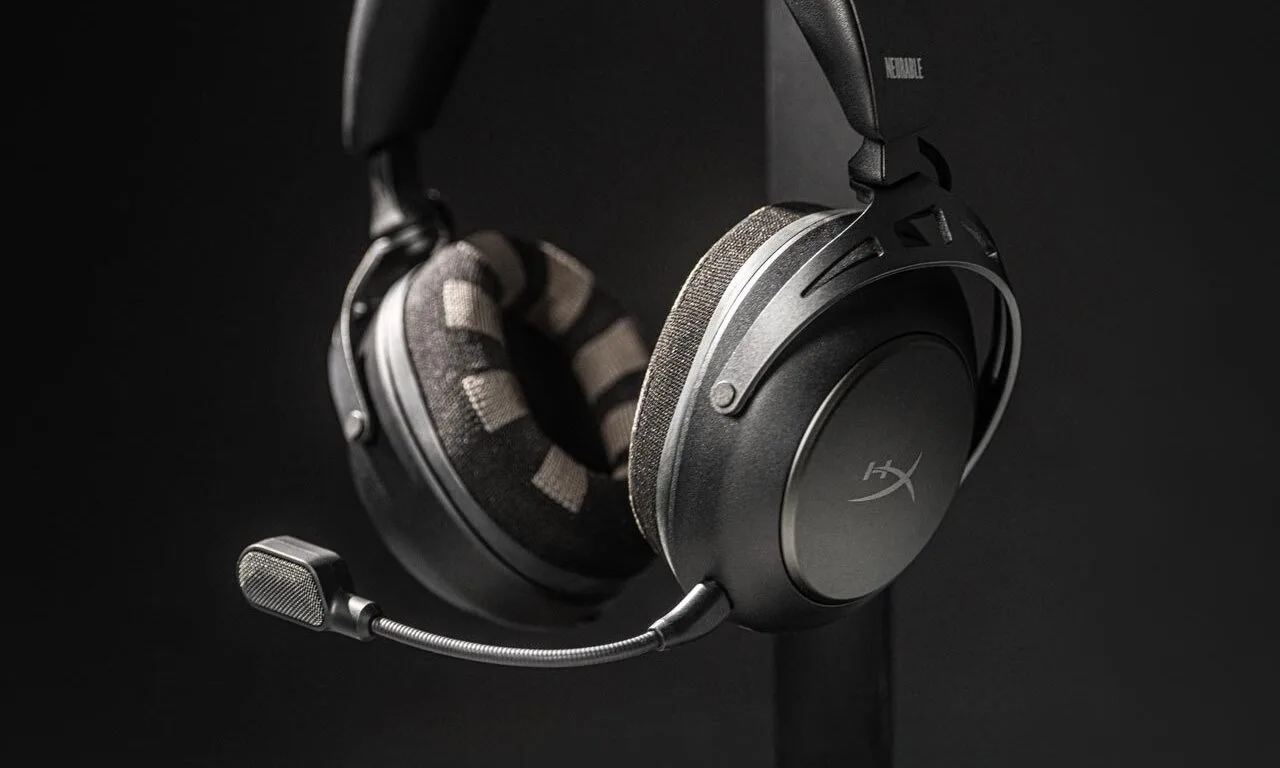
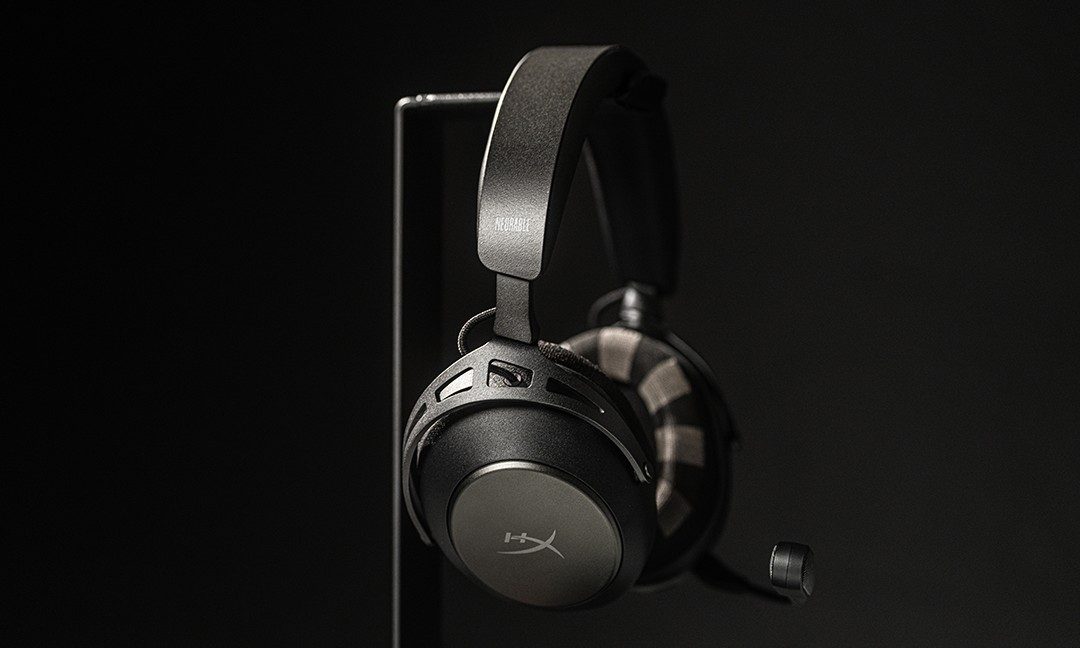
Neurable, a Boston company building noninvasive brain-computer interface tech, is moving to a licensing model, which means its EEG-based system could soon show up in a much wider range of consumer gadgets beyond the company’s own headphones. Other brands may be able to build the tech into familiar products such as gaming headsets, smart glasses, hats, helmets, and other hearables. One of the first products expected to feature it is a gaming headset developed in collaboration with HyperX.
The technology isn’t as sci-fi as it sounds
When most people hear “brain tech,” they probably think of Neuralink-style implants or some dramatic form of mind reading. Neurable’s approach is a lot less dramatic. Its system uses electroencephalography, or EEG, which measures electrical activity in the brain through sensors placed on the head. Those signals are then processed through software models designed to estimate things like focus, cognitive strain, mental recovery, readiness, and anxiety.
Neurable
So rather than decoding thoughts, Neurable is trying to translate broad brain-state signals into consumer-facing scores and prompts that resemble the health insights people already get from smartwatches and fitness bands. That is exactly what the company is betting on—making it feel similar to smartwatches or smart bands like Fitbit.
A headset that claims to monitor concentration or detect mental fatigue can sit much more comfortably next to a wellness device than a lab instrument. Neurable talks about use cases like gaming performance, student focus, workplace fatigue, and recovery from cognitive overload. The language around the product is carefully framed as well. It avoids talk of invasive surveillance and leans instead on self-optimization, routine management, and better day-to-day performance.
Advertisement
Why this could become normal surprisingly fast
The big reason this might stick is the form factor. Consumer neurotech is not arriving as some awkward and medical-looking gadget. The hardware is being tucked into products people already understand and already buy. That is how new categories become socially acceptable. Fitness tracking followed that path on the wrist. Brain-state tracking now seems to be attempting the same move through headphones and other head-worn devices.
Neurable
This philosophy extends to the experience itself. “Brain readiness” starts sounding a lot like the familiar language of health metrics, not unlike sleep scores or heart-rate variability. Once enough products start promising insights into mental workload, fatigue, or focus, a whole new wearable category starts to open up.
There is promise here, but there are also real questions
There is a genuine consumer appeal here. Plenty of people would want better signals around burnout, stress, or cognitive fatigue if those signals are reliable and useful. From students to gamers, anyone whose day depends more on mental sharpness than physical output could see the appeal. A wearable that helps identify when focus is slipping or when recovery is needed fits neatly into a culture already obsessed with “doing better”.
Master & Dynamic MW75-NeuroNeurable/Master & Dynamic
But trust is where things get slippery. Brain metrics sound authoritative by default, and that can become a problem quickly. Privacy concerns feel much sharper once companies begin collecting data that feels more personal than step counts or sleep trends. Neurable says its practices are privacy-conscious and consent-driven, but those assurances are going to face much tougher scrutiny if the technology spreads across more brands and more product categories.
The darker outcome goes beyond privacy. A system built to track focus and cognitive strain could easily attract companies that want more than wellness insights. It could become a way to monitor whether workers look alert enough, engaged enough, or productive enough, which is exactly how consumer neurotech could slide from self-tracking into workplace surveillance.
The real tension is easy to miss because the packaging is so friendly. A headset that promises better focus sounds useful enough. A market full of products trying to score your mental state every day sounds like something people should probably think a lot harder about before it becomes normal.
Affordable phones are bearing the brunt of supply chain constraints, which is reshaping what you can expect from a $500 phone. While midrange phones in 2026 don’t provide the same value as they used to, the latest phones from Google and Samsung are still competing neck-and-neck. The new Pixel 10A and Galaxy A57 remain the most lucrative midrange phones in the market right now. While they aren’t terribly different from their predecessors, each phone has its own distinct appeal.
The Google Pixel 10A didn’t get a lot of upgrades this year, but it has kept the $499 price of the Pixel 9A and has already gotten the occasional discount. On the other hand, Samsung’s Galaxy A57 is one of the lightest phones in this price range, even with a larger screen. I put them head-to-head, and both phones have their own highlights that could be better for different reasons.
Design and build
Advertisement
Samsung Galaxy A57 has a more immersive screen, thanks to its slim bezels.
Prakhar Khanna/CNET
The two Google and Samsung phones are drastically different in terms of design. The Pixel 10A is a small phone with a comparatively compact 6.3-inch screen, whereas the Galaxy A57 is a big phone with a 6.7-inch display. Both are comfortable to hold and use in day-to-day life.
However, the Samsung phone is impressively lightweight this time around. You no longer need to settle for a bulky phone if you want a big screen. At 6.9mm in thickness and 179 grams in weight, the Galaxy A57 is thinner than the smaller Google Pixel 10A (9mm thick and 183 grams in weight).
I liked using the A57 more because of its slimmer bezels, which give it a more modern look. In comparison, Google’s phone looks outdated with its thick borders around the screen. Samsung’s slimmer, albeit asymmetrical, bezels also allow for a more immersive content consumption experience. Both of these displays are visible in direct sunlight, but they’re smudge-prone and highly reflective panels. However, I didn’t have any major issues when navigating on Google Maps outdoors.
Advertisement
Both the Pixel 10A and Galaxy A57 are rated IP68 for dust and water resistance. This means they generally can survive most plunges into shallow water and days at the beach without letting sand inside of them. Google retained the plastic back on its Pixel phone along with an aluminum frame, whereas Samsung gave its device a glass back. The Galaxy A57 is theoretically more durable, thanks to the Gorilla Glass Victus Plus on both the front and back. To compare, the Pixel 10A has a less-scratch-resistant Gorilla Glass 7i on the front.
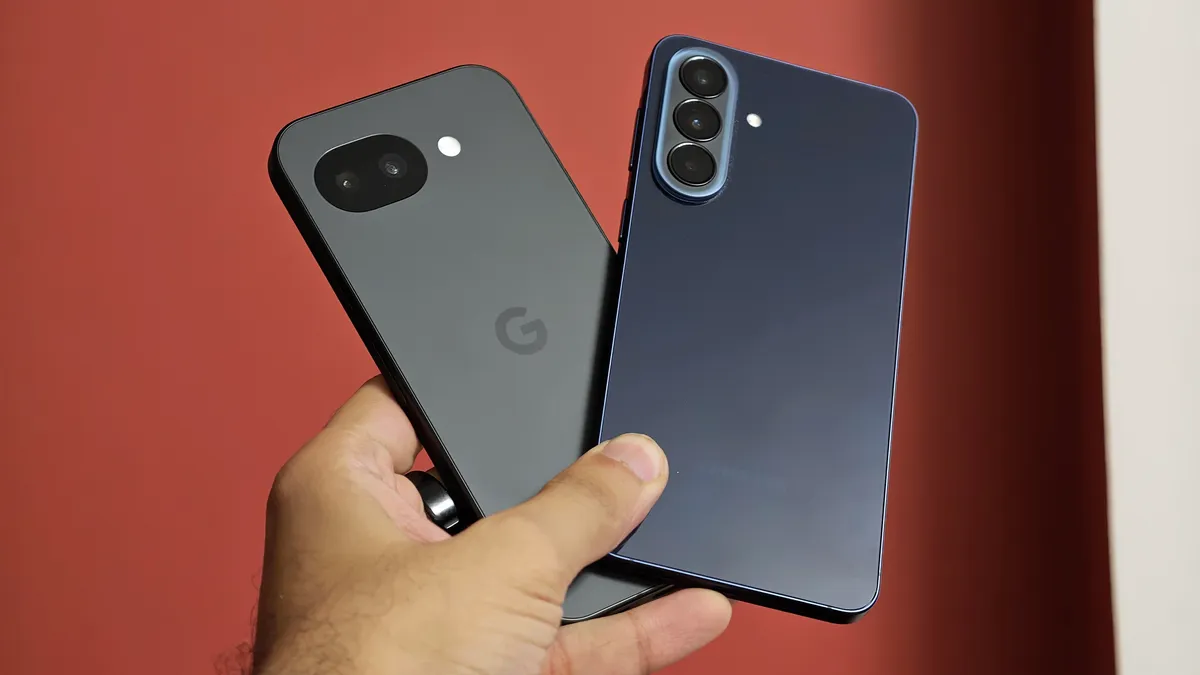
The Google midranger has a unique design, where its dual-camera cover is recessed beneath the plastic back. On the other hand, the Galaxy A57 has three rear cameras, arranged vertically, like the Galaxy S26.
If you’ve ever wished for a phone with no camera bumps, the Pixel 10A is the device to get. However, if you want a more immersive screen in a handy and more premium-feeling design, the Galaxy A57 scores an easy win.
Performance and battery
Advertisement
The Galaxy A57 is more prone to smudges and fingerprints due to its glossy back, especially on the blue variant.
Prakhar Khanna/CNET
Neither phone will deliver flagship-grade performance, but both are powered by capable in-house chips. The Google Pixel 10A has a Tensor G4, paired with 8GB of RAM and 128GB or 256GB of storage, whereas the Galaxy A57 houses an Exynos 1680 processor with the same amount of RAM and storage. However, you can get a 12GB RAM Galaxy A57 variant outside of the US that’s paired up with 256GB or 512GB of storage in some markets.
I used both phones in similar ways: messaging on social apps (WhatsApp, Instagram), navigating on Google Maps, work conversations on Slack and using the cameras when needed. I didn’t face any noticeable stutters or lags on either device. While neither is built for gaming at high graphics settings, the Galaxy A57 is a bit better thanks to its more capable processor.
Both of them lasted me an entire day on a single charge. To compare, the Pixel 10A has a slightly larger battery with a 5,100-mAh capacity (charging at 30 watts), but the Galaxy A57 charges its 5,000-mAh battery faster at 45 watts. The Google phone supports 10-watt wireless charging, while the A57 doesn’t support wireless top-ups.
Advertisement
I’d still say that Google missed out by not including its PixelSnap magnetic technology in the lower-cost 10A after providing it to all of the other Pixel 10 phones. It could’ve been a major selling point, but third-party cases can instead bring support for magnetic accessories to both the 10A and the Galaxy A57.
Both phones run Android 16 with their own versions on top. The Pixel 10A debuted with Pixel UI and Material 3 Expressive, whereas the Galaxy A57 launched with One UI 8.5 onboard. Both devices will give you long-term software support, with Google promising seven years of Android OS updates, while Samsung will give you six years of OS upgrades.
I like One UI better for its customizations and widgets, but the Pixel UI has its own unique capabilities and experience. Both phones support a number of AI features for enhancing photography, including a feature for editing a group photo in case someone is blinking. The Pixel version of this feature is called Auto Best Take, while the Galaxy A57 calls it Best Face. More AI features include AI Eraser to remove unwanted objects from a photo and Gemini for a smart virtual assistant, among others.
The cameras
Advertisement
The Galaxy A57 has more cameras but that doesn’t equate to a more versatile camera system.
Prakhar Khanna/CNET
The Google Pixel 10A has a dual rear camera setup. It has a 48-megapixel main camera, which is accompanied by a 12-megapixel ultrawide-angle lens. On the other hand, the Galaxy A57 has a 50-megapixel main camera, a 13-megapixel ultrawide-angle lens and a 5-megapixel macro sensor.
However, only two of the three Samsung cameras are usable. In my review period, I relied on 4x zoom in 50-megapixel camera mode to get sharper images with natural-looking bokeh rather than using the macro sensor, which outputs noisy results with poor color reproduction. This puts both the mid-rangers head-to-head in camera performance.
Both phones’ main cameras capture a good amount of detail. You get pixel-binned photos by default, but the Galaxy A57 offers a 50-megapixel camera mode that lets you capture higher-resolution photos. As for the ultrawide sensors, there’s no noticeable color shift, but both exhibit the “fishbowl” effect common to ultrawide cameras.
Advertisement
As for the selfie shooters, you get a 13-megapixel front camera on the Pixel 10A and a 12-megapixel sensor on the Galaxy A57. Both offer satisfactory results.
8GB + 128GB, 256GB or 12GB + 256GB, 512GB (in some international markets)
Expandable storage
None
None
Battery
5,100 mAh
5,000mAh
Fingerprint sensor
Under display
Under display
Connector
USB-C
USB-C
Headphone jack
None
None
Special features
7 years of OS, security and Pixel feature drops; Gorilla Glass 7i cover glass; IP68 dust and water resistance; 3,000-nit peak brightness; 2,000,000:1 contrast ratio; 30W fast charging with 45 charging adapter (charger not included); 10W wireless charging Qi certified; Satellite SOS; Wi-Fi 6; NFC; Bluetooth 6; dual-SIM (nano SIM + eSIM); Camera Coach, Add Me; Best Take; Magic Eraser; Magic Editor; Photo Unblur; Circle to Search. Colors: Lavender, berry, fog, obsidian (black)
6 years of OS and security updates; Gorilla Glass Victus+ on the front and back; 1,900 nits peak brightness; IP68 dust and water resistance; Galaxy AI features like AI Select, Live Transcribe etc.; Google Gemini support; Circle to Search; 45W fast charging (adapter not included); Wi-Fi 6; NFC; Bluetooth 6; Colors: navy, gray, icyblue, lilac;
The iPhone 17 is a great all-round phone with strong cameras and performance, a good screen and all-day battery life. It’s not nearly as exciting as the iPhone Air, but it is reasonably priced.
Pros
Great cameras
Solid battery life
Cheaper than the Air
Cons
Not as stylish as the Air
Slightly less powerful than the Air
No telephoto camera
The iPhone Air is built to turn heads, with a slim and light design that comes at the cost of camera versatility and battery life. It’s more powerful than the iPhone 17 but also more expensive.
Of the two, the iPhone Air commands the highest price tag, but it’s actually a worse phone in some ways, with Apple prioritizing its weight and slimness over other specs. In other words, even if money is no object, it might not be the right choice for you.
Advertisement
So, to help you decide whether to buy the iPhone 17 or iPhone Air, we’ve compared them in full, having used both phones extensively since their release in September.
Article continues below
Advertisement
iPhone 17 vs iPhone Air: specs comparison
You’ll find a deep dive into the specs and features of the iPhone 17 and iPhone Air — along with their respective prices — below, but first, here’s a look at how their key specs compare:
Swipe to scroll horizontally
Header Cell – Column 0
iPhone 17
iPhone Air
Weight:
Advertisement
177g
165g
Display:
6.3-inch OLED
Advertisement
6.5-inch OLED
Resolution:
1206 x 2622
1260 x 2736
Advertisement
Refresh rate:
120Hz
120Hz
Peak brightness:
Advertisement
3,000 nits
3,000 nits
Chipset:
A19
Advertisement
A19 Pro
Storage:
256GB, 512GB
256GB, 512GB, 1TB
Advertisement
Rear cameras:
48MP wide (26mm, ƒ/1.6), 48MP ultra-wide (13 mm, ƒ/2.2)
48MP wide (26mm, f/1.6)
Front camera:
Advertisement
18MP (ƒ/1.9)
18MP (f/1.9)
Battery:
3,692mAh
Advertisement
3,149mAh
Charging:
40W wired, 25W wireless
20W wired, 20W wireless
Advertisement
Colors:
Black, White, Mist Blue, Sage, Lavender
Space Black, Cloud White, Light Gold, Sky Blue
Advertisement
iPhone 17 vs iPhone Air: price and availability
Image 1 of 2
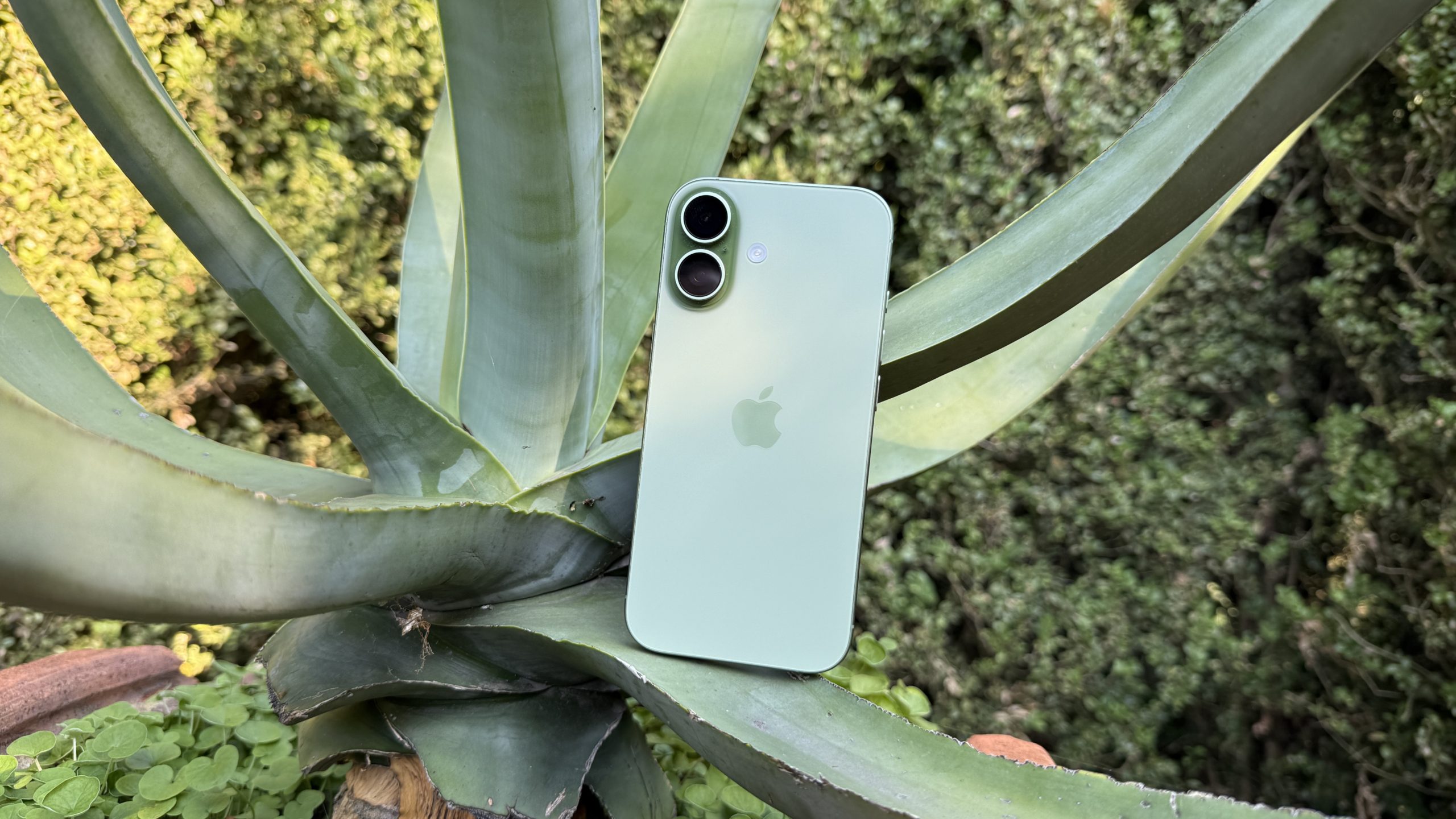
The iPhone 17(Image credit: Jacob Krol/Future)
The iPhone Air(Image credit: Jacob Krol/Future)
The iPhone 17 and iPhone Air were both announced alongside their Pro siblings in September 2025, and they’re both available globally. However, their prices differ.
The iPhone 17 starts at $799 / £799 / AU$1,399, while the iPhone Air starts at $999 / £999 / AU$1,799. For full pricing of every configuration, check out the charts below.
Swipe to scroll horizontally
iPhone 17 pricing
Storage
US price
Advertisement
UK price
AU price
256GB
$799
Advertisement
£799
AU$1,399
512GB
$999
Advertisement
£999
AU$1,799
Swipe to scroll horizontally
iPhone Air pricing
Storage
US price
Advertisement
UK price
AU price
256GB
$999
Advertisement
£999
AU$1,799
512GB
$1,199
Advertisement
£1,199
AU$2,199
1TB
$1,399
Advertisement
£1,399
AU$2,599
So, the iPhone Air is $200 / £200 / AU$400 more expensive than the iPhone 17 in the configurations they’re both available in, and the Air can cost even more if you go for its top 1TB capacity, which isn’t an option with the iPhone 17.
Sign up for breaking news, reviews, opinion, top tech deals, and more.
Advertisement
Winner: iPhone 17
iPhone 17 vs iPhone Air: design
Image 1 of 2
The iPhone 17(Image credit: Jacob Krol/Future)
The iPhone Air(Image credit: Jacob Krol/Future)
While iPhones from the same generation tend to look quite similar, there are actually quite a lot of differences between the iPhone 17 and the iPhone Air.
The iPhone 17 has a dual-lens camera on the back with the lenses arranged vertically, while the iPhone Air has just one rear camera, but there’s a raised camera block running horizontally across the rear.
Advertisement
The iPhone Air is — surprise! — also a lot slimmer and lighter than the iPhone 17, coming in at 156.2 x 74.7 x 5.6mm and 165g, while the latter phone measures 149.6 x 71.5 x 8mm and 177g. This is, of course, the USP of the iPhone Air; it feels better than any iPhone (maybe ever?) in the hand, and we’d recommend going into an Apple Store and picking one up before dismissing its design as gimmicky.
Despite its slim frame and light weight, the iPhone Air is actually taller and wider than the iPhone 17 thanks to its larger screen (more on this in the next section), so you also get more display real estate for that higher price tag.
Plus, the iPhone Air should be slightly tougher, as while both phones have Ceramic Shield 2 on the front, the Air additionally has Ceramic Shield on the back, and it has a titanium frame, while the iPhone 17 uses aluminum.
Advertisement
Their colors differ too, with the iPhone 17 being sold in Black, White, Mist Blue, Sage, and Lavender, while the iPhone Air is available in Space Black, Cloud White, Light Gold, and Sky Blue (beware, though, that Light Gold is very subtle).
Beyond that, most design elements are similar — both phones have flat screens with a Dynamic Island, similar curves to their corners, and the same selection of buttons. They also both have an IP68 rating for water and dust resistance.
However, if you’re outside the US, then the iPhone 17 will likely have a physical SIM card slot, whereas the iPhone Air is eSIM-only in all regions.
So, these are both good-looking phones, but the iPhone Air is undoubtedly the most stylish, with our iPhone Air review describing it as “Apple’s most exciting refresh in years.”
Advertisement
Winner: iPhone Air
iPhone 17 vs iPhone Air: display
Image 1 of 2
The iPhone 17(Image credit: Jacob Krol/Future)
The iPhone Air(Image credit: Jacob Krol/Future)
The iPhone 17 has a 6.3-inch 1206 x 2622 OLED display with a 120Hz refresh rate, a peak brightness of 3,000 nits, and around 460 pixels per inch. The iPhone Air’s display is a bigger 6.5-inch 1260 x 2736 OLED panel with a 120Hz refresh rate, a peak brightness of 3,000 nits, and roughly 460 pixels per inch.
So, the two phones have the same pixel density, the same OLED display technology, the same maximum brightness, and the same maximum refresh rate. They both also support always-on display, and have the same Ceramic Shield 2 protection, with the main difference simply being that the iPhone Air’s screen is a bit bigger.
Advertisement
Our iPhone 17 review described its screen as delivering “excellent visuals”, while our iPhone Air review called its display “punchy, sharp, and smooth.” So you won’t go wrong with either phone.
Winner: Tie
iPhone 17 vs iPhone Air: cameras
Image 1 of 2
Advertisement
The iPhone 17(Image credit: Jacob Krol/Future)
The iPhone Air(Image credit: Jacob Krol/Future)
When it comes to cameras, the iPhone 17 is the clear winner. Not because the iPhone Air’s cameras are bad, but because the phone has just one on the back. Specifically, it has a 48MP f/1.6 wide camera, whereas the iPhone 17 has both that camera and a 48MP f/2.2 ultra-wide with a 120-degree field of view — and both phones have an 18MP f/1.9 camera on the front.
So, with the addition of an ultra-wide lens, the iPhone 17 is the more versatile shooter, and when it comes to video, the iPhone Air doesn’t have an advantage either, as both phones are capable of recording in up to 4K quality at up to 60fps, or in 1080p at up to 240fps.
Still, while the iPhone 17 wins for photos, the iPhone Air isn’t a bad snapper by any means, with our iPhone Air review saying that its camera “delivers sharp, natural photos and impressive portraits”, while we described the iPhone 17 as having “two excellent cameras.”
You’re most likely going to use the wide camera more than the ultra-wide anyway, so the difference between the two phones (in terms of photography) isn’t as dramatic as the Air’s single camera suggests. Still, the iPhone 17 wins here.
Winner: iPhone 17
Advertisement
iPhone 17 camera samples
Image 1 of 23
(Image credit: Jacob Krol/Future)
(Image credit: Jacob Krol/Future)
(Image credit: Jacob Krol/Future)
(Image credit: Jacob Krol/Future)
(Image credit: Jacob Krol/Future)
(Image credit: Jacob Krol/Future)
(Image credit: Jacob Krol/Future)
(Image credit: Jacob Krol/Future)
(Image credit: Jacob Krol/Future)
(Image credit: Jacob Krol/Future)
(Image credit: Jacob Krol/Future)
(Image credit: Jacob Krol/Future)
(Image credit: Jacob Krol/Future)
(Image credit: Jacob Krol/Future)
(Image credit: Jacob Krol/Future)
(Image credit: Jacob Krol/Future)
(Image credit: Jacob Krol/Future)
(Image credit: Jacob Krol/Future)
(Image credit: Jacob Krol/Future)
(Image credit: Jacob Krol/Future)
(Image credit: Jacob Krol/Future)
(Image credit: Jacob Krol/Future)
(Image credit: Jacob Krol/Future)
iPhone Air camera samples
Image 1 of 12
(Image credit: Jacob Krol/Future)
(Image credit: Jacob Krol/Future)
(Image credit: Jacob Krol/Future)
(Image credit: Jacob Krol/Future)
(Image credit: Jacob Krol/Future)
(Image credit: Jacob Krol/Future)
(Image credit: Jacob Krol/Future)
(Image credit: Jacob Krol/Future)
(Image credit: Jacob Krol/Future)
(Image credit: Jacob Krol/Future)
(Image credit: Jacob Krol/Future)
(Image credit: Jacob Krol/Future)
iPhone 17 vs iPhone Air: performance and software
Image 1 of 2
Advertisement
The iPhone 17(Image credit: Jacob Krol/Future)
The iPhone Air(Image credit: Jacob Krol/Future)
On paper, the iPhone Air has a definite performance advantage over the iPhone Air, with this phone having an A19 Pro chipset and 12GB of RAM, whereas the iPhone 17 has a slightly lesser A19 chipset and 8GB of RAM.
But in practice, for most use cases, there’s little noticeable difference, with us finding that the A19 chipset in the iPhone 17 is “plenty fast for now and should last well into the future”, and us similarly noting that the iPhone Air’s A19 Pro chipset “should keep it running smoothly for years.”
So, ultimately, both of these are very powerful phones, and in real terms, there’s little to choose between them. But the iPhone Air’s slight specs edge gives it the performance win.
When it comes to software, there’s even less to differentiate the two phones, with both running iOS 26 out of the box, and both likely to receive the same number of updates.
Winner: iPhone Air
Advertisement
iPhone 17 vs iPhone Air: battery
Image 1 of 2
The iPhone 17(Image credit: Jacob Krol/Future)
The iPhone Air(Image credit: Jacob Krol/Future)
One of the compromises Apple made to get the iPhone Air so slim was the size of its battery, with this phone having just a 3,149mAh cell, while the iPhone 17 — which also has a smaller screen to power — has a 3,692mAh one.
Unsurprisingly, then, the iPhone 17 does have better battery life. According to Apple, you can playback videos for up to 30 hours with the iPhone 17, compared to 27 hours with the iPhone Air. And if you’re streaming those videos, you can do it for up to 27 hours with the iPhone 17 and up to 22 hours with the iPhone Air.
Our own tests yielded similar results, with our iPhone 17 review finding that it delivered all-day life, while the iPhone Air could make it through a workday but not consistently to bedtime.
Advertisement
However, Apple does sell an iPhone Air-specific MagSafe battery, which you can attach to the phone without adding much bulk, and this improves its battery life substantially. But it also means the phone is no longer super-slim, and it’s an extra expense.
The iPhone 17 also charges faster, with Apple claiming it can reach a 50% charge in 20 minutes with a 40W or higher adapter, while the iPhone Air can reach a 50% charge in 30 minutes with a 20W or higher adapter. Though when using wireless charging, both phones can reach 50% in 30 minutes with a 30W or higher adapter.
Winner: iPhone 17
Advertisement
iPhone 17 vs iPhone Air: verdict
Overall, the iPhone 17 is probably the better buy for most people. It’s cheaper, while having an extra camera, better battery life, and a similarly good screen. The iPhone Air is more powerful, but the real-world difference is negligible, so the only major advantage it has is its slim and light design.
So, if aesthetics are of utmost importance to you, then the iPhone Air is the clear choice — and even in the areas where it loses to the iPhone 17, it’s far from terrible.
But if you want a well-rounded phone at a more palatable price, our vote would be for the iPhone 17. It might not turn as many heads, but it’s the more consistent and versatile — if less exciting — option.
Three days of cross-examination in Oakland produced a $130bn lawsuit’s most awkward admissions, including that xAI trains on OpenAI’s models. The judge, not the jury, will decide.
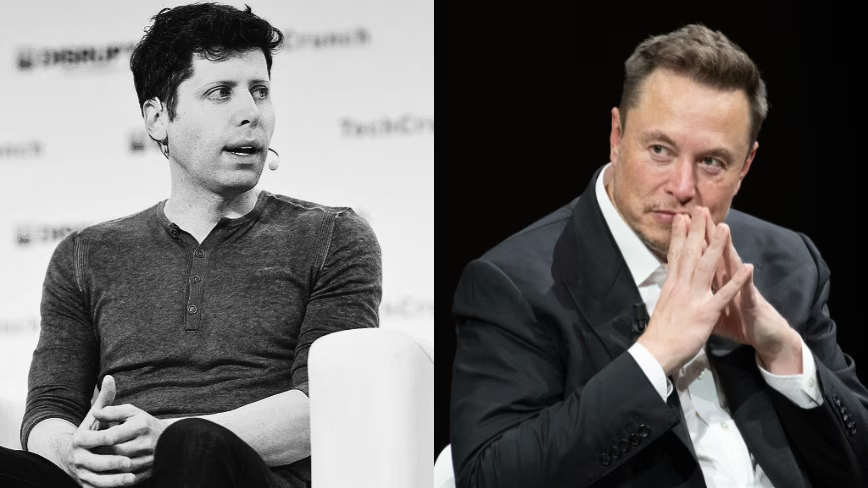
Elon Musk took the stand in Oakland on Tuesday with a story he has been telling for two years. He had founded OpenAI in 2015, he said, to keep advanced artificial intelligence out of the hands of any single company.
Sam Altman and Greg Brockman, his former collaborators, had then quietly turned the lab into a for-profit empire, taken billions from Microsoft, and shut him out. The lawsuit he filed in 2024 was, in his framing, a corrective: a bid to restore the original nonprofit and recover what he says was stolen.
Three days later, that story looked considerably more contested than it had on Monday.
Musk’s case had hit “some rough spots.” Musk’s own admissions on cross-examination, the judge’s repeated warnings about the scope of the dispute, and a series of pre-trial rulings narrowing the legal claims have all combined to make the world’s richest man’s case against the most valuable AI company in the world look, at least at this stage, harder to win than its initial framing implied.
Advertisement
The trial opened on 28 April in the federal courthouse in Oakland, before Judge Yvonne Gonzalez Rogers. A nine-person jury was seated the day before. Musk, his lawyers, OpenAI, Altman, Brockman, and Microsoft are all in the suit.
The headline damages figure is more than $130bn, though some early coverage has cited $150bn; either way the structural remedies Musk is seeking, including a partial unwinding of OpenAI’s for-profit conversion, are arguably the more consequential ask.
The procedural setup is unusual. Although a jury has been impanelled, its verdict is advisory only. Judge Gonzalez Rogers will make the final decision on liability and on remedy, and is expected to rule by mid-May.
The trial is therefore less a contest for the jury’s hearts and minds than a long, public deposition in front of the judge, who has already pruned the case before it began. She dismissed Musk’s fraud claims pre-trial and warned both sides.
Advertisement
Three days, several admissions
Musk was the first witness. He spent parts of three days on the stand, first under questioning from his own counsel, then under sustained cross-examination by William Savitt, OpenAI’s lead lawyer.
The first awkward moment came on the question of nonprofit commitment, the theory at the heart of the case. Savitt produced internal documents and contemporaneous communications that, in his framing, showed Musk had pushed in 2017 and 2018 for OpenAI to convert into a for-profit under his control, and had walked away from the project when that did not happen. “
The second awkward moment, audible from the gallery, was Musk’s acknowledgement that xAI, his own AI company and the maker of the chatbot Grok, distils on OpenAI’s models, in effect training on the outputs of the very system he says was wrongly converted to private gain.
Advertisement
The third was procedural. Savitt argued that Musk had waited too long to sue, and that key claims were filed after the relevant statute of limitations expired. Whether the judge accepts that defence is a separate question, but the timeline becomes part of the record either way.
Even before opening statements, Judge Gonzalez Rogers had reshaped the case. Her pre-trial rulings dropped Musk’s fraud claims and confined the trial to the narrower question of whether OpenAI breached charitable-trust and contract obligations when it restructured.
That makes the case less dramatic in framing, but easier to litigate, and arguably harder for Musk to win on his original theory of grand betrayal.
On day three, Gonzalez Rogers cautioned the lawyers against treating the proceedings as a referendum on AI safety or on Altman’s character. Both sides have been prone to the slippage.
Advertisement
Musk, on the stand, repeated long-running arguments that AI poses existential risk, an answer the judge appeared to find tangential to the legal question of whether OpenAI’s directors breached their fiduciary duties.
What’s coming next?
The trial is expected to run another two to three weeks. Altman is set to testify, as are Brockman, Microsoft chief executive Satya Nadella, and several of OpenAI’s earliest engineers. Musk’s expert witnesses, according to court documents, include the Berkeley AI researcher Stuart Russell and the Columbia Law School tax-and-nonprofit specialist David Schizer.
OpenAI is expected to call its own roster of governance and AI-safety experts, with Axios reporting that the defendants intend to put Grok’s own safety record in front of the jury.
Musk may yet recover ground. Cross-examinations of his founding partners could produce admissions of their own; the documentary record, which neither side disputes runs into thousands of pages, is broad enough to support more than one reading. The judge, not the jury, will decide, and her record so far suggests a willingness to rule on the merits rather than the theatrics.
Advertisement
But the first week, judged on its own, did not go well for the plaintiff. A case that began as a story about a betrayed mission has become, in places, a case about a litigant whose own conduct is now part of the evidence.
If that complicates the verdict or simply colours the coverage is something only Judge Gonzalez Rogers will settle, sometime in the next few weeks.
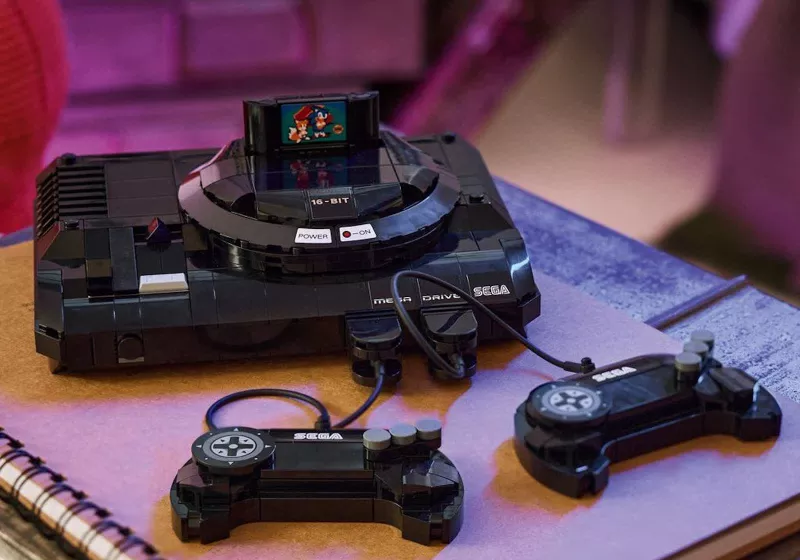
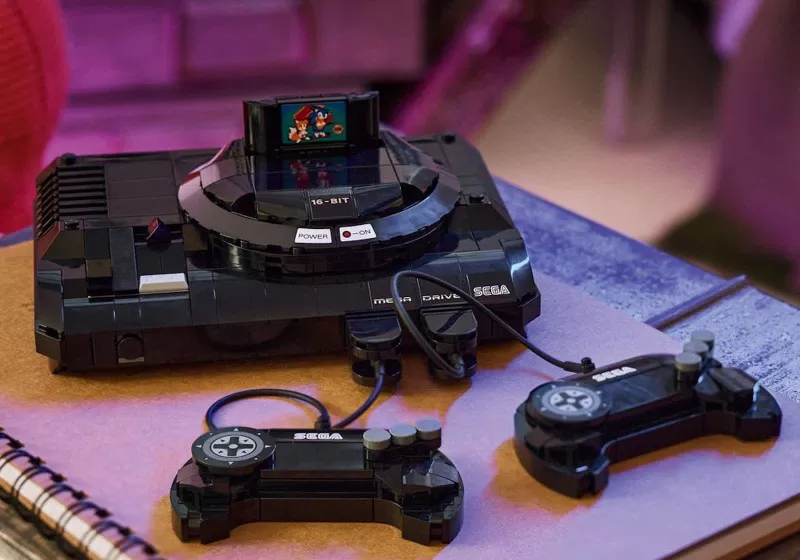
The set launches June 1, priced at $39.99, and comprises 479 pieces. The finished model measures roughly 4.5 inches long and six inches wide, a compact footprint that still leaves room for the details that made the original console recognizable. Read Entire Article Source link
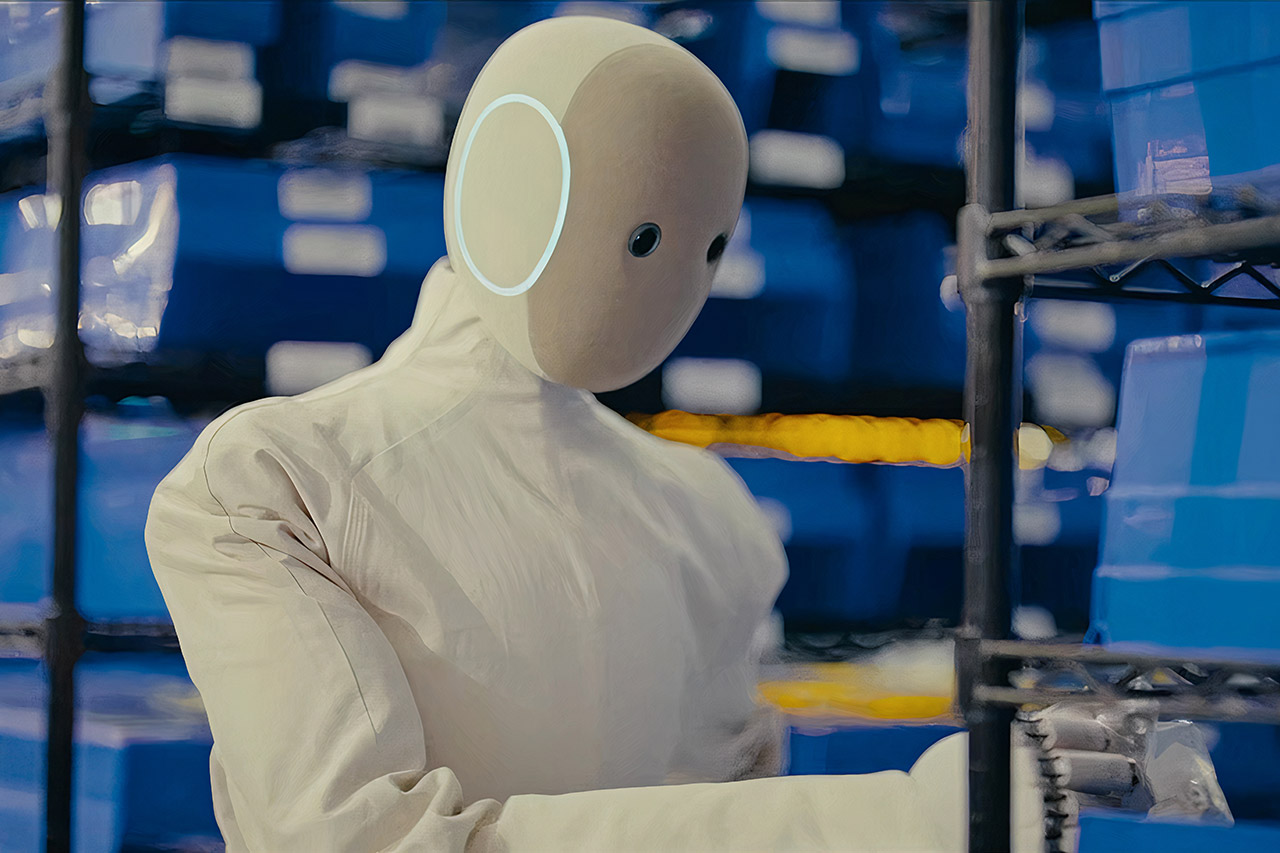
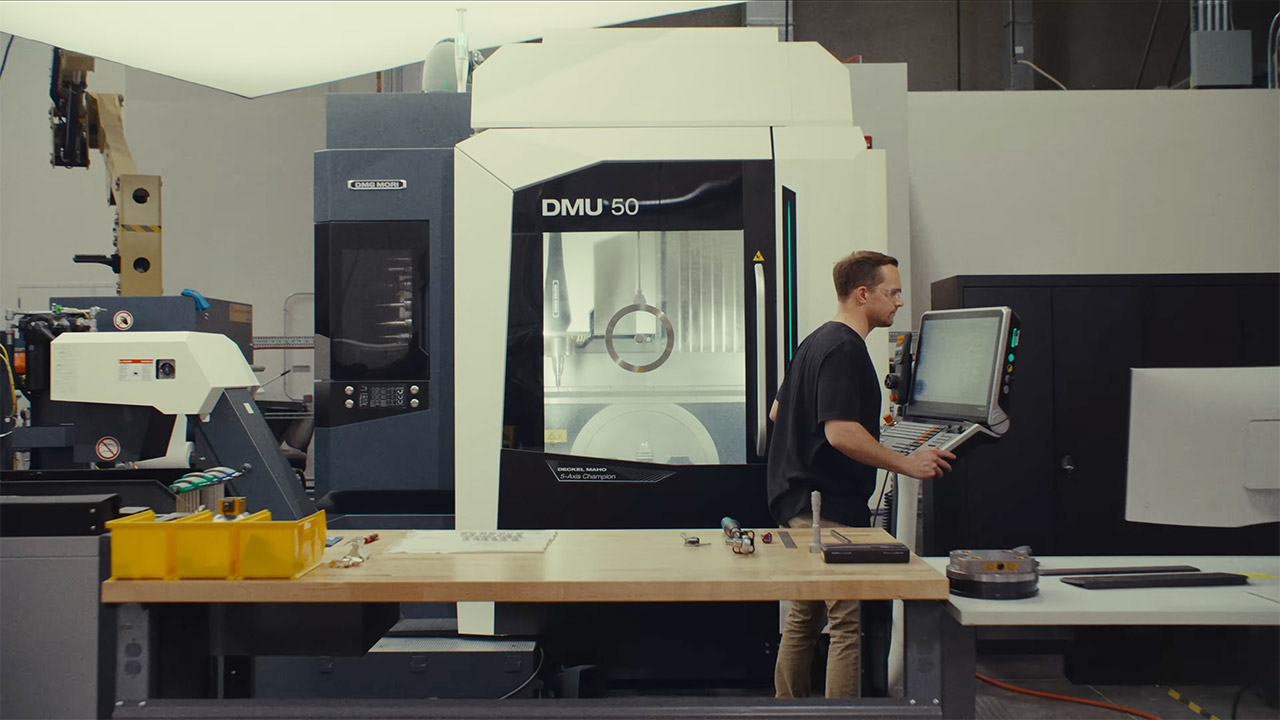
Workers make their way slowly through a 58,000 square-foot facility in Hayward, California, where 1X builds its NEO humanoid robots. A new factory tour takes you through each stage of the process, from beginning to end. Over two hundred people keep the operation running, and the setup already turns out thousands of key parts each month.
Copper spools just roll in and are fed directly into the automated equipment that wind the coils for the Revo 2 motors. These motors power every movement in the NEO. And the factory produces thousands of them each month. Each one goes through a precise set of stages to mold the electrified steel into stators and add some bespoke electronics to give them the extra oomph they require for increased torque. Just down the line, another piece of equipment is being manufactured: carefully braided and treated tendons that will later assist the robot in moving with quiet strength and durability. The hands are created on a specific station where several components are meticulously fitted together, one degree of freedom at a time. The fingers and palms are made up of soft polymer layers, as well as tiny motors and electronic components.
Sleek & Durable Design: Standing at 132cm tall and weighing only approx. 35kg, the G1 is constructed with aerospace-grade aluminum alloy and carbon…
High Flexibility & Safe Movement: Boasting 23 joint degrees of freedom (6 per leg, 5 per arm), it offers an extensive range of motion. For safety, it…
Smart Interaction & Connectivity: Powered by an 8-core high-performance CPU and equipped with a depth camera and 3D LiDAR. It supports Wi-Fi 6 and…
Meanwhile, battery packs are being assembled on an automated line that undergoes a welding procedure every half second. These packs are constructed of aerospace-grade materials, and there’s even a way to monitor their health. It checks in on them 100 times each second to ensure they’re ready to travel. Cooling passages run along the top and bottom of the pack to keep everything steady when utilized at maximum intensity.
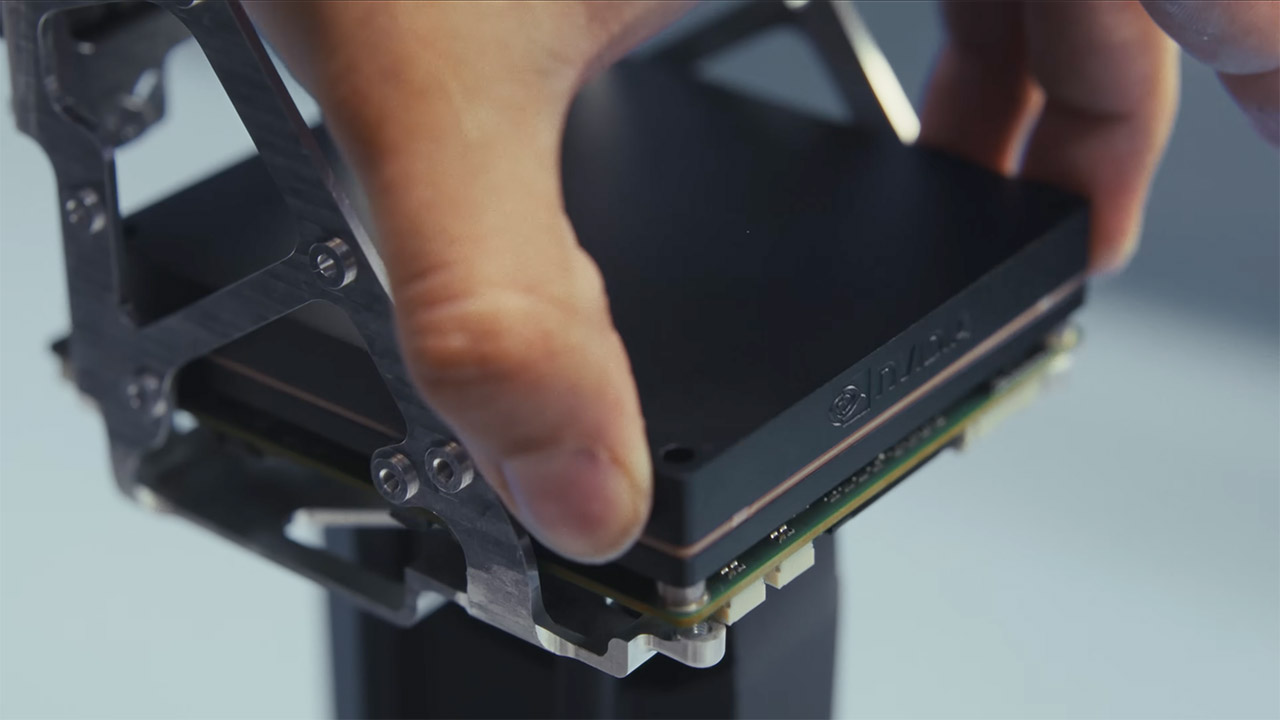
As this is going on, the robot’s main computer, the Cortex, is outfitted with an NVIDIA Jetson Thor board, stereo cameras, microphones, and sensors. All of these modules are pre-kitted and simply slide into each station, wasting no space. Once the joints and limbs are put together, the final components begin to fall into place. The robot takes shape gradually, with each station contributing one more bit of functionality at a time. There is a rapid check for any faults right away, and the tools ensure that parts only fit in the correct way. Tendons are given an early start to avoid future issues. It everything comes together at the end of the line, where the robot stands upright for the first time, looking quite vertical. Covers and the outer soft suit are then carefully placed on, which is a delicate operation, before the last inspection to ensure everything is in order.
Some of the first NEO units are already hard at work on the factory floor. They are transporting bins of gears and pulleys from one location to another, sorting parts, or transferring commodities. It’s odd to watch robots helping out by handling the simple tasks so that humans may focus on the more complex ones. They’ll eventually make their way into households, but for the time being, they’re helping out on the production line by performing simple repeating jobs. More positions, like as general facility duties, will become available shortly, allowing human workers to focus on more difficult tasks. Production is currently in full swing, with plans to produce 10,000 robots per year, a second facility in the pipeline, and a goal of more than 100,000 robots per year by the end of 2027. [Source]
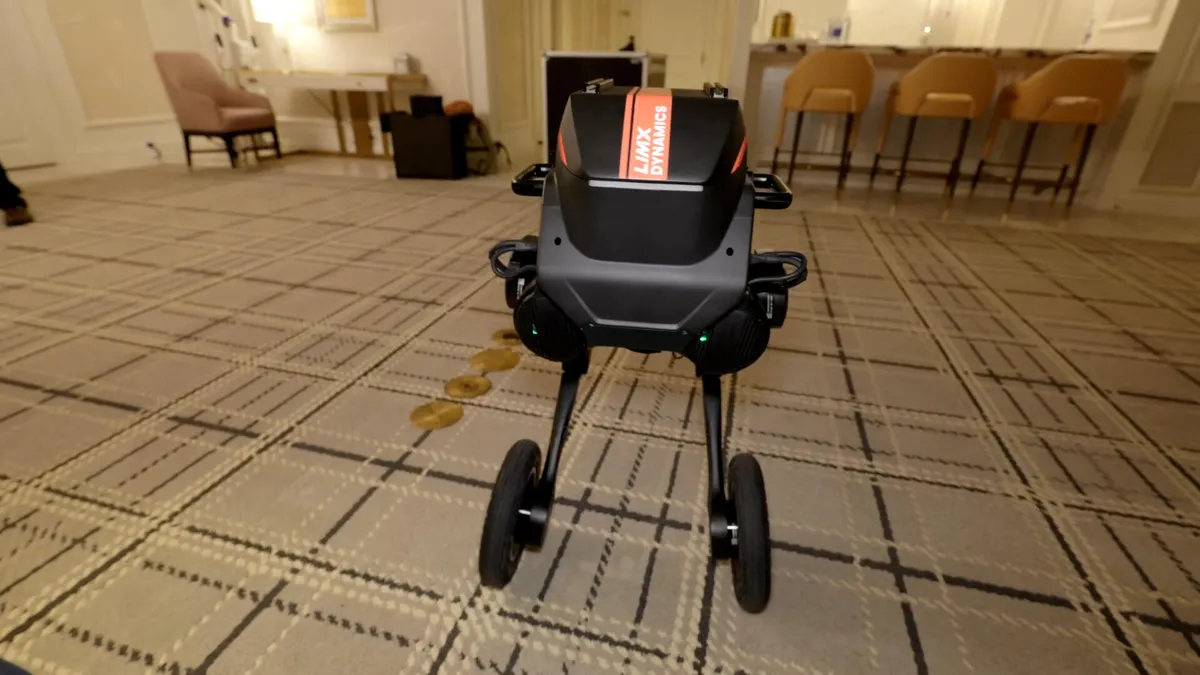
The two-legged Tron 1 robot from LimX Dynamics bears a striking resemblance to the AT-ST walkers from Star Wars, but it’s not made for conquering the galaxy.
Watch this: This $25,000 Robot Looks Like a Mini Star Wars AT-ST
I took the Tron 1 for a spin earlier this year at CES, but right out of the box its abilities were largely limited to preprogrammed movements and remote-control operation. Driving the robot around a Las Vegas hotel room was a lot of fun, but I didn’t scratch the surface of what the robot was capable of until now.
Advertisement
LimX Dynamics has shared some videos of the Tron 1 being put to work in real-world scenarios: as a tour guide, a delivery robot and even a street photographer.
The Tron 1 from LimX Dynamics comes with wheels, pointed feet and flat feet attachments.
Celso Bulgatti/CNET
These demos show what developers can program a robot like the Tron 1 to do. Time will tell what other capabilities are unlocked in this and other robots.
Advertisement
To see the Tron 1 in action, check out the video in this article.
At least a dozen electric vehicle models have been discontinued, paused, or cancelled in the US in 2026, including Tesla’s Model S and Model X, Honda’s entire 0 Series, the Volvo EX30, BMW’s i4 and iX, and multiple Hyundai and Kia EVs. The cause is not technological failure but the compounding effect of 25% import tariffs, 100% tariffs on Chinese-made EVs, and the expiration of the $7,500 federal tax credit, which have made imported EVs uneconomic and forced automakers to build domestically or exit the market.
Advertisement
At least a dozen electric vehicle models have been discontinued, paused, or cancelled in the United States this year. The list includes some of the most recognisable names in the industry: Tesla’s Model S and Model X, Honda’s entire 0 Series, the Volvo EX30, the BMW i4 and iX, the Hyundai Kona Electric and Ioniq 6, the Kia Niro EV and EV6 GT, and the Acura RSX. Some are being replaced by newer models. Some are being killed by tariffs. Some are casualties of a strategic retreat from battery-electric vehicles toward hybrids. And two, Tesla’s oldest and most historically important cars, are being retired to make room for humanoid robots. The common thread is not that the technology failed. Every one of these vehicles works. The common thread is that the economics of selling an electric car in the United States in 2026 have become hostile enough that automakers are choosing not to.
The tariff casualties
The largest category of discontinued EVs consists of models imported from outside the United States that can no longer be sold profitably under the current tariff regime. The Hyundai Kona Electric, which started at approximately $33,000 and was one of the cheapest EVs on the American market, has been paused for the 2026 model year because Hyundai cannot justify shipping it from its Korean plants under a 25 per cent import tariff. The Hyundai Ioniq 6, also built in South Korea, has been dropped from the US lineup entirely, though the high-performance Ioniq 6 N variant may still arrive later this year. The Kia Niro EV, imported from Kia’s Hwaseong plant in South Korea, has been discontinued after the combination of tariffs and slowing EV demand made the model uneconomic for American dealerships. Kia has also delayed the GT trims of its EV6 and EV9 “until further notice” due to what the company called “changing market conditions.”
The 💜 of EU tech
The latest rumblings from the EU tech scene, a story from our wise ol’ founder Boris, and some questionable AI art. It’s free, every week, in your inbox. Sign up now!
Advertisement
The Volvo EX30 is the clearest illustration of how tariff policy can kill a product. Chinese-made EVs face 100 per cent tariffs in the United States, so Volvo moved EX30 production from China to its Ghent plant in Belgium. Then the Trump administration imposed a 25 per cent tariff on all imported vehicles. The EX30, which was supposed to be a breakthrough affordable EV with a starting price under $35,000, now costs $40,345 in the US. Volvo sold 5,409 units in 2025. The company has confirmed the model will not return to the US market after the 2026 model year. The EX30 remains available in Canada, Mexico, and the rest of the world. Only the American market, where the tariff stack made the pricing unworkable, loses access to it.
The strategic retreats
Honda’s cancellation of its 0 Series is the most expensive strategic retreat in the current cycle. In March, the company scrapped the Honda 0 Saloon, the Honda 0 SUV, and the Acura RSX, all three of which were planned for production at Honda’s EV hub in Marysville, Ohio. The cancellation triggered up to $15.7 billion in associated losses, the company’s first annual loss since it listed on the Tokyo Stock Exchange in 1957. Honda is pivoting to hybrids, which set an all-time sales record in February with 30,671 units. The company’s only remaining EV in the US is the Prologue, built in Mexico through a joint venture with General Motors. Honda had unveiled a production-ready version of the Acura RSX just six months before cancelling it.
Tesla’s sales challenges are different in nature but lead to the same outcome. The Model S and Model X, Tesla’s oldest and most expensive vehicles, accounted for less than 3 per cent of the company’s total deliveries in 2025. Elon Musk announced their retirement with the phrase “honourable discharge” and said the Fremont production lines that built them will be converted to manufacture Optimus humanoid robots, with a target of one million units per year. The last Model S and Model X rolled off the line in early April. The Model S started at $94,990 and the Model X at $99,990, prices that placed them in a segment where demand was shrinking. Musk framed the decision as a pivot toward autonomy. The market read it as Tesla choosing robots over sedans because the margin opportunity in humanoids, if it materialises, dwarfs the revenue from low-volume luxury EVs.
The platform transitions
BMW’s discontinuations are the most orderly. The i4 sedan and iX SUV are being phased out not because of tariffs or losses but because BMW is replacing them with next-generation vehicles built on its Neue Klasse platform. The i4, which reached 60 mph in 3.7 seconds and offered up to 333 miles of range, will end production by late 2026. Its replacement, the new i3 sedan, will be built at BMW’s Munich plant starting in August and is expected to offer up to 440 miles of range on the Neue Klasse architecture. The iX is being replaced by the iX3, which features BMW’s Gen6 eDrive technology with improved range, faster charging, and a more integrated electrical system. The iX will continue selling in Europe but has been discontinued in the US.
Advertisement
EVs are still projected to overtake combustion sales globally by the early 2030s, and BMW’s Neue Klasse programme is a bet that the next generation of electric vehicles will be substantially better and cheaper than the current one. The company’s discontinuations are planned obsolescence, not retreat. But they still remove vehicles from the market at a moment when the American EV selection is shrinking. A buyer who wanted a BMW i4 in December will not be able to buy one in January. The i3 replacement may be better, but it is not available yet.
The pattern
The combined effect of these discontinuations is that the number of electric vehicle models available to American consumers is declining at the same time that global EV production and sales are growing. EV startups have struggled for years to release a single car, and now established automakers are pulling models from the US market. The cause is not a single policy. It is the compounding effect of multiple policies: a 25 per cent tariff on imported vehicles, a 100 per cent tariff on Chinese-made EVs, the expiration of the $7,500 federal tax credit that made many EVs price-competitive with combustion alternatives, and the Section 301 investigations that create ongoing uncertainty about future trade conditions. Each policy individually might be absorbed. Together, they have created an environment where the only EVs that make economic sense in the US are the ones built in the US, and even some of those are being cancelled.
The models that survive are instructive. Hyundai’s Ioniq 5, built at its plant in Georgia, remains on sale. Kia’s standard EV6 and EV9 trims, produced at its West Point, Georgia, factory, remain on sale. Tesla’s Model 3, Model Y, and Cybertruck, all built in the United States, continue. Ford’s next-generation EV factory investments are positioning the company for a market where domestic production is the only viable path. The tariff regime is achieving exactly what it was designed to achieve: forcing automakers to build in America or exit the market. The cost is that American consumers have fewer electric vehicles to choose from at a moment when the technology is better, cheaper, and more varied than it has ever been. The vehicles being killed in 2026 are not bad cars. The Volvo EX30 was one of the best-reviewed small EVs in the world. The Honda 0 Saloon was supposed to redefine the company. The Tesla Model S changed the industry. They are casualties not of engineering failure but of trade policy, and the market they leave behind is smaller, more expensive, and more American than the one they entered.
So, what’s not to like? Well, early compatibility problems slowed the initial uptake of Snapdragon X, and the CPU’s integrated graphics performance turned out to be pretty terrible. And to date, powerful onboard AI features just haven’t proven important, as most AI workloads are still being done in the cloud. With the second-generation X2, Qualcomm set out to deliver on the original promise of faster performance.
But what exactly does “faster” mean? As with most claims in the PC computing space, it’s all about the benchmarks. On the Zenbook A16, the tests I ran indeed showcased exemplary performance from the X2 Elite Extreme, in some of the most widely used benchmarking tools, namely Geekbench 6 and Cinebench 2024. (I don’t have enough competitive Cinebench 2026 results to make wide comparisons yet on that benchmark.)
The performance boost on Geekbench is particularly striking, with the A16 scoring 50 to 100 percent faster than competing systems from AMD and Intel. It’s even faster than the Apple MacBook M4 Pro, the last Mac for which I have comparable benchmark scores. However, that Mac did beat the Asus on the Cinebench benchmark, but not by much, and the Asus now stands solidly in second place in my testing archive.
Advertisement
Graphics performance is much better than in previous generations of Snapdragon X chips, with frame rates quadrupling on average, depending on the test. That’s a dramatic and much-needed improvement for the CPU, and while no one will accuse the A16 of being a gaming rig, it does at least make for a workable experience with less taxing games and graphics-heavy workloads.
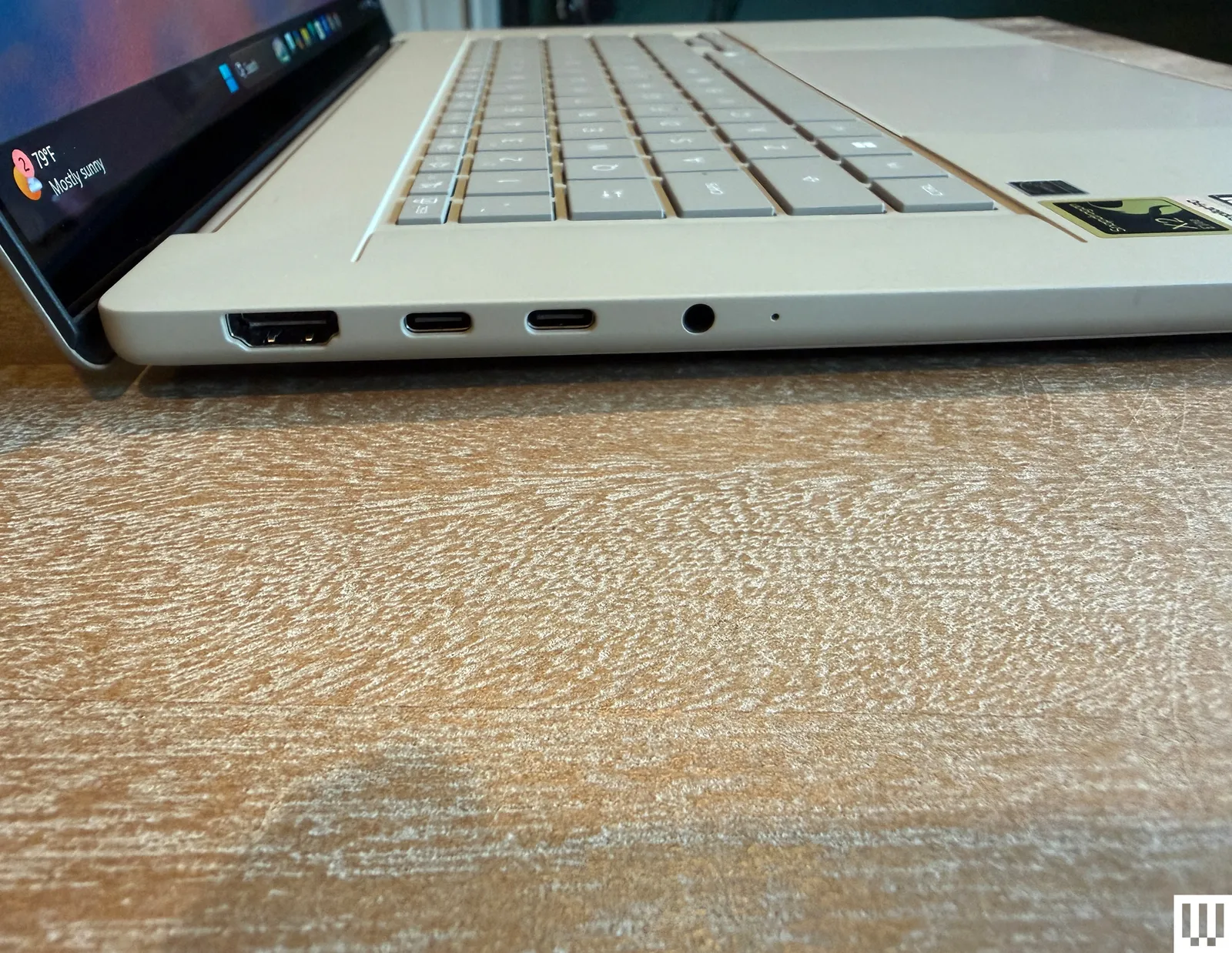
Beige Belies Performance
Photograph: Chris Null
I’m happy enough with how the Snapdragon X2 Elite Extreme performs to sign off on its performance claims, but there’s a lot more to the Zenbook A16 than its CPU.
Under the hood, the Snapdragon X2 Elite Extreme X2E94100 CPU is complemented by 48 GB of RAM and a 1-TB SSD. The 16-inch touchscreen offers a solid resolution of 2880 x 1800 pixels, and it’s incredibly bright. A weight of 2.9 pounds is impressive (if not unheard of) for the 16-inch category, and at 0.65 inches (at its thickest), it has a svelte, quite portable carrying experience. Asus’s Ceraluminum technology (now with added magnesium) is used in the machine’s lid, base, and keyboard frame. That helps keep it thin and light, though when adjusted or touched, the screen shimmied more than I expected.





















































You must be logged in to post a comment Login