




Connect with us
DAPA Banner

Tech

Stranger Things Complete Series 4K UHD Blu-ray Box Sets Arrive in July With Four Collector Editions

Published

on

This is BIG, and we’re not just talking about the box it all arrives in.

Boutique label Arrow Video has announced a Complete Series set collecting all five seasons/42 episodes of streaming giant Netflix’s nostalgic horror show, Stranger Things. It will be available in four different versions–Special or Deluxe, 4K or HD Blu-ray–all available on July 28, just 13 days after the tenth anniversary of the premiere.

A phenomenal worldwide hit, Duffer brothers Matt and Ross’ Stranger Things broke viewership records across all seasons, beloved for its quirky characters, heart, humor, dark frights, and perhaps most of all its painstaking recreation of ‘80s middle America. The Bros. are indisputably old-school, stating, “We always dreamed that Stranger Things could be owned in its entirety, not just as a collector’s set, but as a way to preserve the show for decades to come.”

netflix-stranger-things-special-edition
Special Edition

This is huge news for a couple of reasons. Only Seasons One and Two ever had a physical media release, in 2017 and 2018 respectively, as Target exclusives. Both fetched hundreds of dollars on eBay, even though the first season notoriously disappointed many with its lack of high dynamic range and only Dolby Digital 5.1 audio. Season Two did a bit better, with DTS-HD Master Audio and HDR10, but that was the last disc offering… until now.

Moreover, this drop suggests a continued willingness by the streamer to offer some of its most coveted properties on disc. It comes on the heels of the revelation that Criterion Collection editions of KPop Demon Hunters and Guillermo del Toro’s Frankenstein are on the way, recent Oscar winners both. Theoretically, this strategy would take a nibble out of The Big Red N’s core business, but perhaps this is a major-league endorsement that digital delivery and physical media can happily co-exist?

Advertisement

The 25 discs themselves appear to be identical between the Special and Deluxe editions. The production values of the show were always cinema-quality, and the 4K will be presented in Dolby Vision at its proper 2:1 aspect ratio with the original DTS-HD Master Audio 5.1 surround and two-channel stereo for all episodes plus an upgrade to Dolby Atmos for the final two seasons. The on-disc bonus content includes:

  • Interviews with the cast and crew 
  • Behind-the-scenes featurettes 
  • Set tours 
  • Bloopers
netflix-stranger-things-deluxe-set
Deluxe Edition

The Special Edition arrives with a booklet, whereas the Deluxe Edition exclusively packs quite a bit more, including several in-universe souvenirs:

  • Palace Arcade alloy-zinc token-style coin
  • Self-adhesive Hellfire Club patch
  • Hellfire Club 20-sided die
  • Enhanced packaging including wraparound box artwork by Juan Ramos
  • Twenty-five artcards representing all five seasons
  • Five double-sided posters featuring original artwork by Kyle Lambert
  • Reversible sleeve inserts featuring new artwork by Juan Ramos and original artwork by Kyle Lambert
  • Double-sided foldout map of fictional Hawkins, Indiana
  • A 148-page perfect-bound artbook with design sketches, concept art, storyboards and new writing on the making of the series from the Duffer Brothers, Shawn Levy, Andrew Stanton, Kyle Dixon and more

Price & Availability

All editions are available for pre-order now at Amazon and Arrow Video, but won’t start shipping until July 28, 2026.

Advertisement. Scroll to continue reading.

Source link

Advertisement
Continue Reading
Click to comment

You must be logged in to post a comment Login

Leave a Reply

Tech

Cloudflare CEO warns AI bots could outnumber humans online by 2027

Published

on

The internet you use every day could soon be dominated by artificial intelligence. Cloudflare CEO Matthew Prince says that AI bots may generate more traffic than humans within the next year or two, marking a major shift in how the web works.

Speaking about the current trends with TechCrunch, Prince said bot activity is growing rapidly as AI systems crawl and interact with websites at scale.

Before the rise of generative AI, bots were responsible for only 20% of internet traffic. Most of that traffic came from search engines like Google, and some malicious activity. Now, that number is climbing much faster.

Why is AI bot traffic growing faster?

According to Prince, the key reason behind this surge is how AI systems operate. He explains that a human might visit a handful of websites to complete a task. An AI agent, on the other hand, can hit thousands of pages in seconds to gather information and complete the same task.

This creates a huge spike in traffic. AI systems constantly scan and collect information to function, which means they generate far more requests than human users ever could. That growing demand is what could push bot traffic past human activity in the coming years.

Advertisement

How sandboxing could help manage the AI traffic surge

Prince believes this shift will require entirely new systems built for AI. One idea is creating temporary ‘sandboxes’ where AI agents can run tasks, then shut down once finished.

For example, if you ask an AI to plan a vacation, it could spin up a dedicated environment to browse, compare, and organize information before disappearing.

These sandboxed environments would allow bots to perform tasks without overwhelming websites or infrastructure.

Prince imagines millions of these sandboxes could be created every second. However, handling traffic at this scale would also require major infrastructure, including more data centers and servers to support constant AI activity.

For Prince, this is not just another tech trend. “I think the thing that people don’t appreciate about AI is it’s a platform shift,” he said, comparing it to the move from desktop to mobile. “AI is another platform shift … the way that you’re going to consume information is completely different.”

Advertisement

Source link

Continue Reading

Tech

Elon Musk misled investors during his Twitter takeover, jury finds

Published

on

A group of former Twitter investors have prevailed at a federal civil trial over Elon Musk’s actions amid his $44 billion acquisition of the social platform in 2022. A jury in San Francisco found Friday that tweets made by Musk about fake accounts on the platform had defrauded investors in the company. The jury sided with Musk on other allegations in the case.

It’s not yet clear how much Musk will owe in damages as a result of the case but, as the Associated Press reports, it could amount to billions of dollars. Jurors calculated that shareholders should get “between about $3 and $8 per stock per day.”

The class action lawsuit, one of several brought against Musk in the months following his takeover of the company, cited Musk’s tweets about fake accounts on the platform. Facing a sinking Tesla share price in the days after announcing he would buy Twitter for $54.20 a share, the suit said Musk made tweets and statements that were intentionally meant to drive down Twitter’s share price in an attempt to renegotiate or exit the deal.

The suit called out Musk’s May 13, 2022, tweet that claimed the Twitter deal was “temporarily on hold” due to the number of fake accounts and bots on the platform, as well as one a few days later that suggested fake accounts might account for more than 20 percent of users. Twitter’s stock dropped significantly following the May 13 tweet.

Advertisement

During the trial, Musk said the tweets were him “speaking his mind” and maintained that Twitter executives had “lied” about the number of bots on the platform, according to KQED. Former Twitter shareholders, on the other hand, said “they sold shares at deflated prices amid Musk’s public waffling.”

Musk faced several lawsuits during and after his $44 billion takeover of the company. That includes other shareholder lawsuits related to his delay in disclosing his stake in the company, as well as one from former executives related to unpaid severance benefits (Musk later settled those claims). He also narrowly avoided a trial over his attempts to back out of the deal.

Source link

Advertisement
Continue Reading

Tech

Why shaping company culture needs a focus on opportunity, not fear

Published

on

Liberty IT’s Emma Mullan explores how modern organisations can address workplace transformation and growth.

Emma Mullan is a senior director of talent at Liberty IT, leading the human resources and communications function. Her core focus is on shaping culture and fostering an environment that supports innovation. 

“Transformation is fundamentally about driving and managing change, and my priority is to create as much certainty as possible so people can focus on opportunity rather than fear,” Mullan told SiliconRepublic.com. 

She explained that the organisation approaches large-scale transformation as if it were a collaborative exercise, mapping impact and developing a foundational people-first culture.

Advertisement

She said: “When people feel safe to ask questions, experiment, learn from one another and share insights, capability grows sustainably – which is critical as the pace of change accelerates, especially with AI. To make this culture tangible, we’ve introduced the Culture Playbook and the Culture Stars programme.

“The Culture Playbook defines our purpose and the behaviours that guide how we work together, how we collaborate, share knowledge, support one another and continually raise the bar on quality as skills and technology evolve.”

Can you discuss recent programmes or initiatives introduced at Liberty IT?

A great example is our GenAI Learning Mission, which is a curated collection of events and resources to help everyone at Liberty IT navigate, share and develop in an AI‑augmented workplace. It’s designed to support our transformation in a practical way, by building the capabilities we’ll need for tomorrow, while reinforcing the culture and standards that matter today. It creates clear learning pathways for different roles and starting points and importantly, it’s not just for engineers. With tools like LibertyGPT and Microsoft 365 Copilot, GenAI is critical across the organisation, so our mission starts with foundational capability for everyone to encompass advanced upskilling in emerging technologies for many of our engineers

It also supports a mindset transformation. The biggest shift isn’t learning new tools, it’s about learning and adopting new ways of working. With the rapid advancement of GenAI, skills such as critical thinking, flexibility, curiosity and creativity are more important than ever. That’s why we’re investing in leadership enablement and team conversations, so people feel supported to ask questions, experiment and learn by doing. 

Advertisement
How do culture programmes help build current and future-focused skills?

Culture-focused programmes support positive employee experiences and can make skills development real by shaping what happens day to day. Leaders play a pivotal role in creating the culture of learning within their teams so that they encourage time for learning, sharing and innovating. Over the last year, we have focused on giving our leaders the tools to both manage change themselves and lead their teams through change.

We’ve been leaning into the human aspects of moving through transformation and by supporting our employees in this way, we have created a safe environment for continuous learning and development, setting them up to learn skills that they need for today and the future. As a culture, we encourage mobility as part of supporting skill development. We actively support movement between teams, whether that’s stretching opportunities, cross-team projects or transitioning into emerging areas like GenAI, people can build experience and capability in real contexts. Over time, that creates a workforce that’s more resilient, more engaged and better prepared for whatever skills the future demands.

What’s your advice for tech leaders who want to strengthen culture during transformation?

Leaders shape culture through what they prioritise, what they reward, and the behaviours they role-model every day. During transformation, people need clarity and consistency, clear direction on what’s changing, why it matters, and how teams are expected to work together as priorities and tools evolve. A big part of a positive culture today is enabling future skills development.

Leaders need to create space for learning in the flow of work, encourage knowledge sharing, and invest in the mindsets that enable adaptability, curiosity, critical thinking and confidence to try new approaches, particularly as AI becomes increasingly embedded. It’s also important to recognise the human reality of change. Transformation can bring uncertainty, so actively listening and involving teams in shaping solutions builds trust and resilience. When leaders normalise learning-by-doing, celebrate progress and remove barriers to collaboration, culture becomes a practical support system, not just a set of values.

Advertisement
Over the course of the next 12 months what do you predict for the recruitment landscape?

The industry will continue to be heavily influenced by the rapid acceleration of AI. Organisations across multiple sectors are increasingly seeking talent with experience in these emerging technologies, capability that does not yet exist at scale. This will intensify competition and increasingly require organisations to hire for potential, rather than experience. As roles continue to evolve, greater emphasis will be placed on core, transferrable skills such as problem-solving, communication, collaboration and adaptability. Individuals who demonstrate a growth mindset and curiosity about emerging technologies will remain in high demand, even as job titles and technologies continue to evolve.

In the short term, we also see a risk emerging in the market. Reduced demand for entry-level technical roles, driven by market uncertainty, could create a future shortage of experienced talent, as fewer early-career professionals are given the opportunity to enter and grow within the industry. To respond effectively, organisations will need a balanced approach. At Liberty IT, this means combining targeted hiring for critical skills with sustained investment in developing our people and rethinking how we upskill entry-level talent. 

Don’t miss out on the knowledge you need to succeed. Sign up for the Daily Brief, Silicon Republic’s digest of need-to-know sci-tech news.


Advertisement

Source link

Continue Reading

Tech

Super Micro’s co-founder is charged of smuggling servers to China

Published

on

The indictment of Super Micro’s co-founder exposes not just a $2.5 billion scheme, it exposes a system that was never built to stop one.

Somewhere in a rented warehouse in Southeast Asia, a man was using a hair dryer on a server box. Not to dry it. To loosen the adhesive on a serial-number sticker, so that it could be carefully peeled away and pressed onto a different machine, one that had never been plugged in, never booted, and was never intended to reach its declared destination.

The real servers, the ones containing Nvidia’s most advanced AI accelerator chips, had already been repackaged into unmarked boxes and shipped to China. The dummy, dressed in borrowed labels, was waiting for the auditors.

That scene, reconstructed from surveillance footage cited in a federal indictment unsealed on 19 March 2026, is the most precise image we have yet of how America’s semiconductor export controls actually work in practice. Not in theory, in practice. The answer, it turns out, involves a hair dryer.

Advertisement

The indictment charges three men: Yih-Shyan ‘Wally’ Liaw, 71, co-founder, board member, and Senior Vice President of Business Development of Super Micro Computer; Ruei-Tsang ‘Steven’ Chang, 53, general manager of the company’s Taiwan office; and Ting-Wei ‘Willy’ Sun, 44, a contractor described by prosecutors as a ‘fixer.’

Advertisement

Together, they allegedly orchestrated the diversion of approximately $2.5 billion worth of servers, many assembled in the United States and integrating Nvidia GPUs, to customers in China, via a front company in Southeast Asia, between 2024 and 2025.

During a single six-week window in the spring of 2025, at least $510 million of hardware made the journey. Liaw and Sun were arrested. Chang, a Taiwanese citizen, remains a fugitive.

The charges include conspiracy to violate the Export Controls Reform Act, conspiracy to smuggle goods from the United States, and conspiracy to defraud the government, offences carrying a combined maximum of 30 years in prison.

Super Micro, the publicly traded San Jose company that makes the hardware at the centre of the scheme, has not been named as a defendant. It placed Liaw and Chang on administrative leave and terminated its relationship with Sun. It said it had been cooperating with investigators and maintained a ‘robust compliance programme.’

Advertisement

That phrase deserves to sit with you for a moment.

According to the indictment, the defendants and their co-conspirators communicated through encrypted messaging applications to coordinate which quantities of servers to order, which locations in China to ship them to, and, critically, how to conceal the scheme from the company’s own compliance team.

When an internal audit was scheduled, they staged thousands of non-working server replicas at a warehouse rented by the front company. When a US Department of Commerce inspector arrived to examine the same facility, they deployed the same props, using heat guns to swap labels and serial numbers before the visit.

The inspector, the indictment notes, did not see the actual servers because they had already been sent to China. An auditor from within the company who should have been on-site at a separate inspection was, according to prosecutors, ‘offsite, entertaining himself at the front company’s expense.’

Advertisement

The loophole that was never a secret

The transshipment route through Southeast Asia is not a discovery. It is a known, documented, and repeatedly flagged feature of the export control architecture — one that US trade analysts, think-tanks, and the Department of Commerce itself have been warning about for years. Countries including Malaysia, Singapore, Vietnam, and Thailand have historically, as analysts at the East Asia Forum observed earlier this month, ‘lacked the enforcement infrastructure or political will to rigorously monitor re-exports.’

Between April and July 2025, Vietnamese authorities intercepted more than 2,000 shipments falsely labelled ‘Made in Vietnam’ but traced to Chinese factories, according to an analysis published by The Diplomat. Malaysian tech hubs in Penang and Johor were flagged for similar rerouting practices.

DeepSeek, the Chinese AI lab that became a household name after its January 2025 model release, was accused in reporting by Tom’s Hardware of establishing ‘ghost’ data centres in Southeast Asia to pass audits, then forwarding the GPUs onward.

A Financial Times investigation estimated that China secured roughly $1 billion in advanced AI processors in the three months immediately following the last major tightening of US export controls.

Advertisement

The pattern, in other words, is not aberrant. It is structural. The controls are enforced primarily at the point of sale and first shipment, and they rely, almost entirely, on the declared end use of the buyer and the downstream compliance of every intermediary in the chain. When the incentive to lie is measured in hundreds of millions of dollars, the honour system has limits.

The company that keeps surviving itself

Super Micro’s appearance in this case is, in the mildest possible terms, not a surprise. The company has accumulated a regulatory history that would be remarkable in isolation but begins to suggest something more systemic when viewed in sequence.

In 2018, it was temporarily delisted from Nasdaq for failing to file financial statements. In 2020, it paid a $17.5 million fine to the Securities and Exchange Commission for what the agency described as ‘widespread accounting violations’, more than $200 million in improperly recognised revenue and understated expenses, resulting in artificially elevated sales and profit margins.

Advertisement

The co-founder now facing federal charges, Wally Liaw, resigned from the company during that period. He returned as a consultant in 2021, was named a senior vice president in 2022, and rejoined the board of directors in late 2023.

In 2024, short-seller Hindenburg Research published a report alleging fresh accounting irregularities, undisclosed related-party transactions, and, notably, violations of US export controls.

Ernst & Young, the company’s auditor, resigned shortly after, saying it could no longer vouch for the accuracy of management’s financial representations. Super Micro commissioned an independent special committee review; it found no evidence of fraud. 

Through all of this, Super Micro has remained in the S&P 500. Its revenue for the most recent quarter was $12.7 billion.

Advertisement

There is a reasonable question embedded in that number: at what point does the pattern become the product? The compliance failures keep occurring. The executives implicated keep returning. The stock keeps recovering. The hardware keeps moving.

Whether Super Micro’s board and remaining leadership can provide a credible answer to that question will matter enormously, not just to investors, but to the credibility of the entire export control regime they allegedly helped to circumvent.

Enforcement in a loosening wind

Now, the irony of this week’s indictment is its timing. The Trump administration has, in recent months, been quietly relaxing the export control posture that made the hardware in question illegal to ship.

In December 2025, the White House announced it would permit sales of certain chips directly to approved customers in China.

Advertisement

In January 2026, the Bureau of Industry and Security issued revised licensing rules allowing case-by-case review, rather than a presumption of denial, for exports of earlier-generation AI hardware to mainland China.

A rule known as the Affiliates Rule, designed to close loopholes around Chinese-owned subsidiaries, was suspended for a year almost immediately after it was issued.

This creates a strange political geometry. The Justice Department is prosecuting men for shipping chips that US policy is, in a parallel track, beginning to permit.

There is a version of the story in which that tension resolves cleanly: the administration enforces the current rules while adjusting them for the future, and the two tracks do not contradict each other.

Advertisement

There is another version in which enforcement becomes selective, a tool for signalling toughness while the underlying architecture quietly softens. Which version is actually unfolding is a question worth watching closely.

Congress has been watching, and not quietly. BIS received a 23% budget increase for fiscal year 2026, with bipartisan support and explicit funding earmarked for semiconductor enforcement. Several members have sought congressional control over export licensing, frustrated by what they see as executive branch inconsistency.

What none of that resolves is the fundamental architecture of the problem. Export controls enforced at the point of sale, relying on declared end use, policed by company compliance teams that can be deceived with a hair dryer and a rented warehouse, are not, in the end, a system built for the scale of economic incentive now in play. The chip war has raised the stakes well past what the honour system was designed to hold.

The servers have already arrived. The stickers have been carefully reapplied. The dummy machines stood ready for inspection. And somewhere in a data centre in China, the real hardware is running, training models, refining weights, closing the gap.

Advertisement

The auditors are still on their way.

Source link

Advertisement
Continue Reading

Tech

ChatGPT wants a do-it-all super app, but Apple will probably stand in the way

Published

on

OpenAI is working on a project to consolidate ChatGPT, coding tools, and a browser into one app. Apple’s iOS platform restrictions will prevent it from becoming a true all-in-one platform on the iPhone.

Open MacBook laptop on a light wooden table, displaying a blue abstract radial pattern on its screen, with two larger closed MacBooks positioned in the background.
OpenAI wants its desktop app to have more functions

OpenAI wants to merge ChatGPT, Codex, and a browser into one desktop app centered on agentic AI. Naturally, the focus is on desktop platforms and the ChatGPT app on iPhone will stay the same as a result.
An app like that behaves very differently depending on where it runs. On iPhone and iPad, Apple tightly controls how software accesses the system and interacts with other apps.
Continue Reading on AppleInsider | Discuss on our Forums

Source link

Continue Reading

Tech

Sony could be about to retire one of PlayStation’s most recognisable brands

Published

on

A new report claims the company plans to phase out PlayStation Network (PSN) branding entirely by September 2026. It will replace it with something that better reflects its broader digital services.

According to Insider Gaming, an internal email sent to developers outlines a “strategic” decision to drop both “PlayStation Network” and “PSN” across all Sony Interactive Entertainment platforms.

Crucially, this appears to be a cosmetic change only. Sony reportedly stressed that core features, including multiplayer, cloud gaming, friends lists and trophies, will remain exactly as they are. There are no technical changes planned, just a gradual removal of the PSN name across apps, interfaces and marketing.

Developers have also been told they’ll need to update their own materials to align with the new branding. They will ensure references to PSN are removed from future releases and external services.

Advertisement

Advertisement

What Sony plans to replace the name with is still unclear.

The move would mark the end of a label that’s been around since 2006, when PlayStation Network launched alongside the PlayStation 3. Over time, it’s grown to encompass everything from the PlayStation Store to subscriptions like PlayStation Plus. It has also become shorthand for Sony’s entire online ecosystem.

It also carries some baggage. The 2011 PSN breach, which exposed data from around 77 million users and took the service offline for weeks, remains one of the most significant security incidents in gaming history. More recently, a shorter outage in early 2025 prompted renewed calls for transparency from users.

Advertisement

If the report holds, the PSN name could quietly disappear over the next year. This would close the chapter on a brand that’s been tied to PlayStation for nearly two decades.

Source link

Advertisement
Continue Reading

Tech

Power Grid Attacks Push Utilities to Increase Security

Published

on

In the fictional nation of Beryllia, the 2026 World Chalice Games were set to begin as the country faced an unrelenting heat wave. The grid, already under strain from the circumstances, was dealt a further blow when a coordinated set of attacks including vandalism, drone, and ballistic attacks by an adversary, Crimsonia, crippled the grid’s physical infrastructure.

This scenario, inspired by the upcoming 2026 World Cup and the 2028 Olympic Games in Los Angeles, was an exercise in studying how utilities can prevent and mitigate, among other dangers, physical attacks on power grids. Called GridEx, the exercise was hosted by the Electricity Information Sharing and Analysis Center (E-ISAC) from 18 to 20 November, 2025, and was described in a report released on 2 March. GridEx has been held every two years since 2011.

“We know that threat actors look to exploit certain circumstances,” says Michael Ball, CEO of E-ISAC, which is a program of the North American Electric Reliability Corporation (NERC), about designing the Beryllia scenario. “The Chalice Games became a good example of how we could build a scenario around a threat actor.”

Physical attacks on the grid are rising in the U.S., and GridEx attendance was up in November as utilities grapple with how to prevent and mitigate attacks. Participation in the exercise was at its highest level since 2019, according to the new report. Given the number of organizations present, GridEx estimates that more than 28,000 individual players participated, including utility workers and government partners, an all-time high since the exercise began.

Advertisement

Rising Physical Threats to Power Grids

The U.S. and Canadian grids face growing security issues from physical threats, including vandalism, assault of utility workers, intrusion of property, and theft of components, like copper wiring. NERC’s 2025 E-ISAC end of year report cites more than 3,500 physical security breaches that calendar year, about 3 percent of which disrupted electricity. That’s up from 2,800 events cited in the 2023 report (3 percent of those also resulted in electricity disruptions). Yet despite a number of recent high-profile attacks in the U.S., physical attacks on the grid are happening worldwide.

“They’re not uniquely a U.S. thing,” says Danielle Russo, executive director of the Center for Grid Security at Securing America’s Future Energy, a nonpartisan organization focused on advancing national energy security. Russo says that while attacks are common in places like Ukraine, they’re not limited to wartime scenarios. “Other countries that are not experiencing direct conflict are experiencing increasing amounts of physical attacks on their energy infrastructure,” she says. Take Germany for example: On 3 January, an arson attack by left-wing activists in Berlin caused a five-day blackout impacting 45,000 households. That comes after a suspected arson attack on two pylons in September 2025 left 50,000 Berlin households without power. Some German officials cite domestic extremism and fears of Russian sabotage in recent years as reasons for heightened security concerns over critical infrastructure.

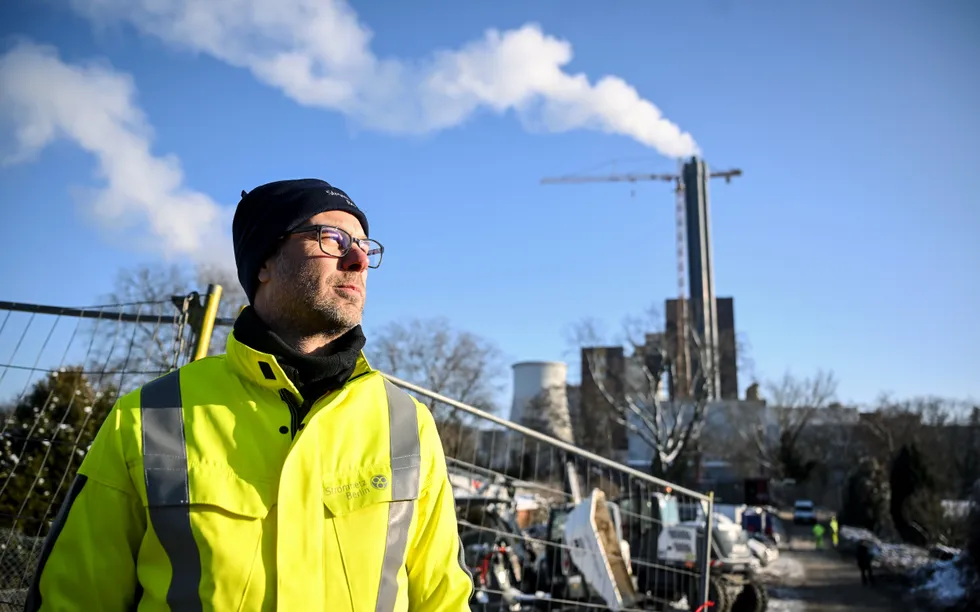
A white adult man in a reflective jacket standing in front of a power plant on a sunny winter day. Henrik Beuster, spokesman for grid operator Stromnetz Berlin, stands in front of the Lichterfelde power plant on 7 January after a suspected attack disrupted power supply in the area. Britta Pedersen/picture alliance/Getty Images

The uptick in attacks on the U.S. grid has been anchored by a number of incidents in recent years. In December 2025, an engineer in San Jose, California was sentenced to 10 years in prison for bombing electric transformers in 2022 and 2023. A Tennessee man was arrested in November 2024 for attempting to attack a Nashville substation using a drone armed with explosives. And in 2023, a neo-Nazi leader was among two arrested in a plot to attack five substations around Baltimore with firearms, part of an increasing trend in white supremacist groups planning to attack the U.S. energy sector.

“Since [E-ISAC] started publishing data back in 2016, we’ve seen a large and consistent increase in the number of reported physical security incidents per year,” says Michael Coe, the vice president of physical and cyber security programs at the American Public Power Association, a trade group that works with E-ISAC to plan GridEx. While not all data is publicly available, Coe says there’s been a “tenfold” increase over the past decade in the number of reported physical attacks on the grid.

Advertisement

Drone Attacks: A Grid Security Challenge

During the fictional World Chalice Games scenario, drone attacks destroyed Beryllia’s substation equipment, highlighting a threat that’s gained traction as more drones enter the airspace.

“The question we get all the time is, how do you tell if it’s a bad actor, or if it’s a 12-year-old kid that got the drone for their birthday?” says Erika Willis, the program manager for the substations team at the Electric Power Research Institute (EPRI).

One strategy to track and alert utilities to potential threats such as drones is called sensor fusion. The system includes a pan-tilt-zoom camera capable of 360-degree motion mounted on top of a tripod or pole with four installed radars. The radars combine with the camera for a dual system that can track drones even if they’re obstructed from view, says Willis. For instance, if a nearby drone flies behind a tree, hidden from the camera, the radars will still pick up on it. The technology is currently being tested at EPRI’s labs in Charlotte, North Carolina and Lenox, Massachusetts.

EPRI is also exploring how robotics and AI can improve security systems, Willis says. One approach involves integrating AI analysis into robotic technology already surveilling substation perimeters. Using AI can improve detection of break-ins and damage to fencing around substations, Willis says. “As opposed to a human having to go through 200 images of a fence, you can have the AI overlays do some of those algorithms…If the robot has done the inspection of the substation 100 times, it can then relay to you that there’s an anomaly,” Willis says.

Advertisement

A fiber sensing technology unit, roughly the size and shape of a filing cabinet. Prisma Photonics deploys fiber sensing technology that uses reflected optical signals to detect perturbations from vehicles and other sources near underground fiber cable.Prisma Photonics

Already, a number of utilities in the U.S. are using AI integrations in their security and monitoring processes. That’s thanks in part to the Tel Aviv, Israel-based Prisma Photonics, a software company that launched in 2017 and has since deployed its fiber sensing technology across thousands of miles of transmission infrastructure in the U.S., Canada, Europe, and Israel. A file-cabinet-sized unit plugs into a substation and sends light pulses down existing fiber optic cables 30 miles in each direction. As the pulses travel down the cables, a tiny fraction of the light is reflected back to the substation unit. An AI model processes the results and can classify events based on patterns in the optical signal as a result of perturbations happening around the fiber cable.

“If we identify an event that we don’t have a classification for, and we get a feedback from a customer saying, ‘oh, this was a car crash,’ then we can classify that in the model to say this is actually what happened,” says Tiffany Menhorn, Prisma Photonics’ vice president of North America.

As preparations get underway for the ninth GridEx in 2027, Ball says participation in the exercises alone isn’t enough to bolster grid security. Instead, he wants utilities to take what they learn from the training and apply it in their own operations. “It’s the action of doing it, versus our statistic of saying, ‘here’s what our growth was.’ That growth should relate to the readiness and capability of the industry.”

Advertisement

I changed the tense on this because the subsequent sentences use past tense. It seemed weird to switch from present tense in the first sentence to past tense in the rest of the paragraph, but I could be mistaken.

From Your Site Articles

Related Articles Around the Web

Source link

Advertisement
Continue Reading

Tech

AI Wheelchair Technology Moves Closer to Reality

Published

on

Wheelchair users with severe disabilities can often navigate tight spaces better than most robotic systems can. A wave of new smart-wheelchair research, including findings presented in Anaheim, Calif., earlier this month, is now testing whether AI-powered systems can, or should, fully close this gap.

Christian Mandel—senior researcher at the German Research Center for Artificial Intelligence (DFKI) in Bremen, Germany—co-led a research team together with his colleague Serge Autexier that developed prototype sensor-equipped electric wheelchairs designed to navigate a roomful of potential obstacles. The researchers also tested a new safety system that integrated sensor data from the wheelchair and from sensors in the room, including from drone-based color and depth cameras.

Mandel says the team’s smart wheelchairs were both semiautonomous and autonomous.

“Semiautonomous is the shared control system where the person sitting in the wheelchair uses the joystick to drive,” Mandel says. “Fully autonomous is controlled by natural-language input. You say, ‘Please drive me to the coffee machine.’ ”

Advertisement

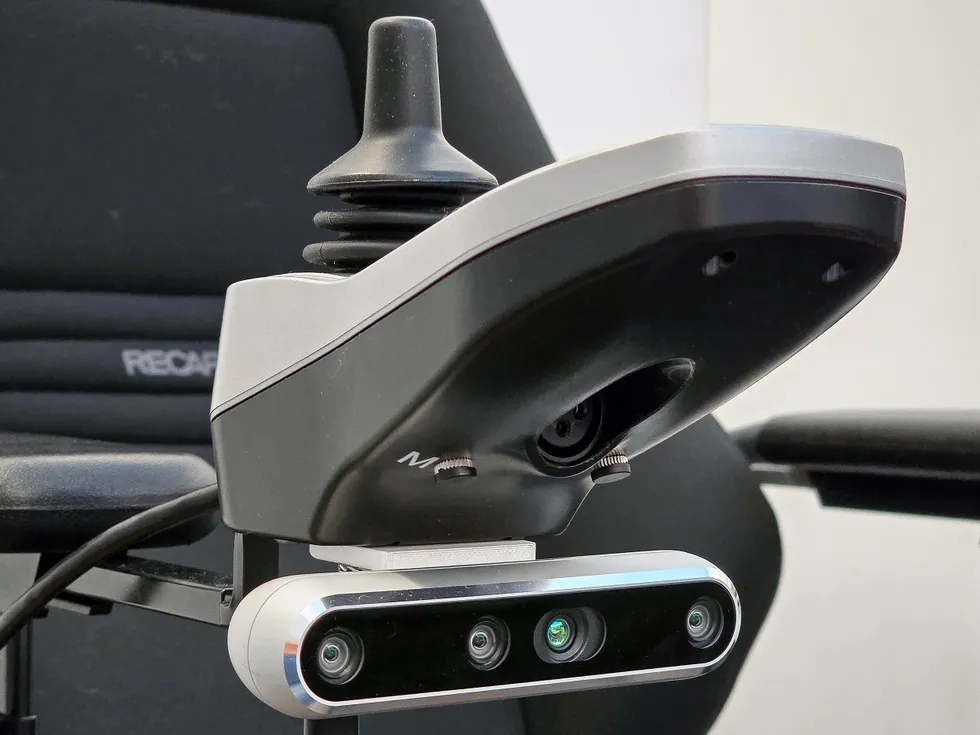
Close-up of a thin rectangular camera installed underneath an electric wheelchair's joystick controller. This is a close-up of the wheelchair’s joystick and camera.DFKI

The researchers conducted experiments (part of a larger project called the Reliable and Explainable Swarm Intelligence for People With Reduced Mobility, or REXASI-PRO) using two identical smart wheelchairs that each contained two lidars, a 3D camera, odometers, user interfaces, and an embedded computer.

In contrast to semiautonomous mode, where the participant controls the wheelchair with a joystick, in autonomous mode, control involves the open-source ROS2 Nav2 navigation system using natural-language input. The wheelchairs also used simultaneous localization and mapping (SLAM) maps and local obstacle-avoidance motion controllers.

One scenario that Mandel and his team tested involved the user pressing a key on the wheelchair’s human-machine interface, speaking a command, then confirming or rejecting the instruction via that same interface. Once the user confirmed the command, the mobility device guided the user along a path to the destination, while sensors attempted to detect obstacles in the way and adjust the mobility device accordingly to avoid them.

When Are Smart Wheelchairs Bad Value?

According to Pooja Viswanathan, CEO & founder of the Toronto-based Braze Mobility, research in the field of mobile assistive technology should also prioritize keeping these devices readily available to everyday consumers.

Advertisement

“Cost remains a major barrier,” she says. “Funding systems are often not designed to support advanced add-on intelligence unless there is very clear evidence of value and safety. Reliability is another barrier. A smart wheelchair has to work not just in ideal conditions, but in the messy, variable conditions of daily life. And there is also the human factors dimension. Users have different cognitive, motor, sensory, and environmental needs, so one solution rarely fits all.”

For its part, Braze makes blind-spot sensors for electric wheelchairs. The sensors detect obstacles in areas that can be difficult for a user to see. The sensors can also be added to any wheelchair to transform it into a smart wheelchair by providing multimodal alerts to the user. This approach attempts to support users rather than replace them.

According to Louise Devinge, a biomedical research engineer from IRISA (Research Institute of Computer Science and Random Systems) in Rennes, France, the increased complexity of smart wheelchairs demands more sensing. And that requires careful management of communication and synchronization within the wheelchair’s system. “The more sensing, computation, and autonomy you add,” she says, “the harder it becomes to ensure robust performance across the full range of real-world environments that wheelchair users encounter.”

In the near term, in other words, the field’s biggest challenge is not about replacing the wheelchair user with AI smarts but rather about designing better partnerships between the user and the technology.

Advertisement

Rendering of an electric wheelchair moving towards a wall. The chair is divided into four ground-parallel quadrants that each represent a different safety zone where intersections with obstacles are checked. At the same height as these quadrants, are four lines on the wall that represent virtual laser scans.  This image shows data representations used by the 3D Driving Assistant. These include immutable sensor percepts such as laser scans and point clouds, as well as derived representations like the virtual laser scans and grid maps. Finally, the robot shape collection describes the wheelchair’s physical borders at different heights.DFKI


Where Will Smart Wheelchairs Go From Here?

Mandel says he expects to see smart wheelchairs ready for the mainstream marketplace within 10 years.

Viswanathan says the REXASI-PRO system, while out of reach of present-day smart wheelchair technologies, is important for the longer term. “It reflects the more ambitious end of the smart wheelchair spectrum,” she says. “Its strengths appear to lie in intelligent navigation, advanced sensing, and the broader effort to build a wheelchair that can interpret and respond to complex environments in a more autonomous way. From a research standpoint, that is exactly the kind of work that pushes the field forward. It also appears to take seriously the importance of trustworthy and explainable AI, which is essential in any mobility technology where safety, reliability, and user confidence are paramount.”

Mandel says he’s ultimately in pursuit of the inspiration that got him into this field years ago. As a young researcher, he says, he helped develop a smart wheelchair system controllable with a head joystick.

However, Mandel says he realized after many trials that the smart wheelchair system he was working on had a long way to go because, as he says, “at that point in time, I realized that even persons that had severe handicaps [traveling through] a narrow passage, they did very, very well.

Advertisement

“And then I realized, okay, there is this need for this technology, but never underestimate what [wheelchair users] can do without it.”

The DFKI researchers presented their work earlier this month at the CSUN Assistive Technology Conference in Anaheim, Calif.

This article was supported by the IEEE Foundation and a Jon C. Taenzer fellowship grant.

From Your Site Articles

Advertisement

Related Articles Around the Web

Source link

Continue Reading

Tech

Rep. Finke Was Right: Age-Gating Isn’t About Kids, It’s About Control

Published

on

from the the-lies-they-tell-for-censorship dept

When Rep. Leigh Finke spoke last month before the Minnesota House Commerce Finance and Policy Committee to testify against HF1434, a broad-sweeping proposal to age-gate the internet, she began with something disarming: agreement.

“I want to support the basic part of this,” she said, the shared goal of protecting young people online. Because that is not controversial: everyone wants kids to be safe. But HF1434, Minnesota’s proposed age-verification bill, simply won’t “protect children.” It mandates that websites hosting speech that is protected by the First Amendment for both adults and young people to verify users’ identities, often through government IDs or biometric data. As we’ve discussed before, the bill’s definition of speech that lawmakers deem “harmful to minors” is notoriously broad—broad enough to sweep in lawful, non-pornographic speech about sexual orientation, sexual health, and gender identity.

Rep. Finke, an openly transgender lawmaker, next raised a point that her critics have since tried to distort: age-verification laws like the Minnesota bill are already being used to block young LGBTQ+ people from exercising their First Amendment rights to access information that may be educational, affirming, or life-saving. Referencing the Supreme Court case Free Speech Coalition v. Paxton, she noted that state attorneys general have been “almost jubilant” about the ability to use these laws to restrict queer youth from accessing content. “We know that ‘prurient interest’ could be for many people, the very existence of transgender kids,” she added, referring to the malleable legal standard that would govern what content must be age-gated under the law. 

But despite years’ worth of evidence to back her up, Finke has faced a wave of attacks from countless media outlets and religious advocacy groups for her statements. Rep. Finke’s testimony was repeatedly mischaracterized as not having young people’s best interests in mind, when really she was accurately describing the lived reality of LGBTQ+ youth and advocating in support of their access to vital resources and community.

Advertisement

In fact, this backlash proves her point. Beyond attempting to silence queer voices and to scare other legislators from speaking up against these laws, it reveals how age-verification mandates are part of a larger effort to give the government much greater control of what young people are allowed to say, read, or see online. 

Rep. Finke was also right that these proposals are bad policy; they prevent all young people from finding community online, and that they violate young people and adults’ First Amendment rights.

Why FSC v. Paxton Matters

Rep. Finke was similarly right to bring up the Paxton case, because beyond the troubling Supreme Court precedent it produced, Texas’s age-verification law also drew eager support from an extraordinary number of amicus briefs from anti-LGBTQ organizations (some even designated hate groups by the Southern Poverty Law Center). 

In FSC v. Paxton, the Supreme Court gave Texas the green light to require age verification for sites where at least one-third of the content is sexual material deemed “harmful to minors,” which generally means explicit sexual content. This ruling, based on how young people do not have a First Amendment right to access explicit sexual content, allows states to enact onerous age-verification rules that will block adults from accessing lawful speech, curtail their ability to be anonymous, and jeopardize their data security and privacy. These are real and immense burdens on adults, and the Court was wrong to ignore them in upholding Texas’ law. 

Advertisement

But laws enacted by other states and Minnesota HF 1434 go further than the Texas statute. Rather than restricting young people from accessing sexual content, these proposals expand what the state deems “harmful to minors” to include any speech that may reference sex, sexuality, gender, and reproductive health. But young people have a First Amendment right to both speak on those topics and to access information online about them.

We will continue to fight against all online age restrictions, but bills like Minnesota’s HF 1434, which seek to restrict young people from accessing speech about their bodies, sexuality, and other truthful information, are especially pernicious.

EFF and Rep. Finke are on the same page here: age verification mandates create immense harm to our First Amendment rights, our right to privacy, as well as our online safety and security. These proposals also fully ignore the reality that LGBTQ young people often rely on the internet for information they cannot get elsewhere. 

But the Paxton case, and the coalition behind it, illustrates exactly how these laws can be weaponized. They weren’t there just to stand up for young people’s privacy online—they were there to argue that the state has a compelling interest in shielding minors from material that, in practice, often includes LGBTQ content. Ultimately, these groups would like to age-gate not just porn sites, but also any content that might discuss sex, sexuality, gender, reproductive health, abortion, and more.

Advertisement

Using Children as Props to Enact Censorship 

The coalition of organizations that filed amicus briefs in support of Texas’s age verification law tells us everything we need to know about the true intentions behind legislating access to information online: censorship, surveillance, and control. After all, if the race to age-gate the internet was purely about child safety, we would expect its strongest supporters to be child-development experts or privacy advocates. Instead, the loudest advocates are organizations dedicated to policing sexuality, attacking LGBTQ+ folks and reproductive rights, and censoring anything that doesn’t fit within their worldview.

Below are some of the harmful platforms that the organizations supporting the age-gating movement are advancing, and how their arguments echo in the attacks on Rep. Finke today:

Policing sexuality, bodily autonomy, and reproductive rights

Many of the organizations backing age-verification laws have spent decades trying to restrict access to accurate sexual health information and reproductive care.

Groups like Exodus Cry, for example, who filed a brief in support of the Texas AG in the SCOTUS case, frame pornography as part of a broader moral crisis. Founded by a “Christian dominionist” activist, Exodus Cry advocates for the criminalization of porn and sex work, and promotes a worldview that defines “sexual immorality” as any sexual activity outside marriage between one man and one woman. Its leadership describes the internet as a battleground in a “pornified world” that has to be reclaimed. Another brief in support of the age-verification law was filed by a group of organizations including the Public Advocate of the United States (an SPLC-designated hate group) and America’s Future. America’s Future is an organization that was formed to “revitalize the role of faith in our society” and fiercely advocates in favor of trans sports bans

Advertisement

These groups see age-verification laws as attractive solutions because they create a legal mechanism to wall off large swaths of content that merely mentions sex from not only young people but millions of adults, too.

Attacking LGBTQ+ Rights

Several of the most prominent legal advocates behind age-verification laws have also led the crusade against LGBTQ+ equality. The internet that these groups envision is one that heavily censors critical and even life-saving LGBTQ+ resources, community, and information. 

The Alliance Defending Freedom (ADF), for instance (which is another SPLC-designated hate group), built its reputation on litigation aimed at rolling back LGBTQ+ protections—including  allowing businesses to refuse service to same-sex couples, criminalizing same-sex relationships abroad, and restricting transgender rights

Then there’s other groups like Them Before Us and Women’s Liberation Front, both of which submitted amici in support of the Texas Attorney General and are devoted to upending LGBTQ+ rights in the United States. Them Before Us says it’s “committed to putting the rights and well-being of children ahead of the desires and agendas of adults.” But it’s also running a campaign to “End Obergefell,” the 2015 Supreme Court case that upheld the right to same-sex marriage, and has been on the cutting edge of transphobic campaigning and pseudoscientific fearmongering about IVF and surrogacy. The Women’s Liberation Front, on the other hand, is an organization that has a long track record of supporting transphobic policies such as bathroom bills, bans on gender-affirming healthcare, and efforts to define “sex” strictly as the biological sex assigned at birth. 

Advertisement

Through cases like FSC v. Paxton, groups like these three continue to advance a vision of society that creates government mandates to enforce their worldviews over personal freedom, while hiding behind a shroud of concern for children’s safety. But when they also describe LGBTQ+ people as “evil” threats to children and run countless campaigns against their human rights, they are being clear about their intentions. This is why we continue to say: the impact of age verification measures goes beyond porn sites.

Expanding censorship beyond the internet into real-life public spaces

As we’ve said for years now, the push to age-gate the internet is part of a broader campaign to control what information people can access in public life both on- and offline. Many of the same organizations advancing these proposals claim to be acting on behalf of young people, but their arguments consistently use children as props to justify giving the government more control over speech and information.

Many of the organizations advocating for online age verification have also supported book bans, attacks on DEI policies and education, and efforts to remove LGBTQ+ materials from schools and libraries. Two of the organizations who supported the Texas Attorney General, Citizens Defending Freedom and Manhattan Institute, have led campaigns around the country to “abolish DEI” and ban classical books like “The Bluest Eye” by Toni Morrison from school libraries. These efforts are not different from the efforts to restrict access to the internet—they reflect a broader strategy to restrict access to ideas or information that these groups find objectionable. And they discourage free thought, inquiry, and the ability for people to decide how to live their lives. 

These campaigns rely on the same core argument, that certain ideas are inherently dangerous to young people and must therefore be restricted. But that framing misrepresents an important reality: if lawmakers genuinely want to address harms that young people experience online, they should start by listening to young people themselves. When EFF spoke directly with young people about their online experiences, they overwhelmingly rejected restrictions on their access to the internet and came back with nuanced and diverse perspectives. Once that principle—that certain ideas are inherently dangerous—is accepted, the internet, once a symbol of free expression, connection, creativity, and innovation, becomes the next logical target. 

Advertisement

This also wouldn’t be the first time a vulnerable group is used as a prop to advance internet censorship laws. We’ve seen this playbook during the debate over FOSTA/SESTA, where many of the same advocates claimed to speak for trafficking victims/survivors and sex workers, while pushing legislation that ultimately censored online speech and harmed the very communities it invoked. It’s a familiar pattern: you invoke a vulnerable group, frame certain speech as a threat, and use that as a way to expand government control over the flow of information. And as we said in the fight against FOSTA: if lawmakers are serious about addressing harms to particular communities, they should start by talking to those communities. This means that lawmakers seeking to address online harms to young people should be talking to young people, not groups who claim their interests. 

Rep. Finke Was Not Radical. She Was Right.

The Paxton case, and the coalition backing age verification laws in the U.S., shows us exactly why the messaging around these laws draws superficial support from parents and lawmakers. But we’ve heard the quiet part said out loud before. Marsha Blackburn, a sponsor of the federal Kids Online Safety Act, has said that her goal with the legislation was to address what she called “the transgender” in society. When lawmakers and advocacy groups frame queer existence itself as a threat to young people, age-verification laws become ideological enforcement instead of regulatory policy.

In defending free speechprivacy, and the right of young people to access truthful information about themselves, Rep. Leigh Finke was not radical—she was right. She was warning that broad, ideologically driven laws will be used to erase, silence, and isolate young people under the banner of child protection. 

What’s at stake in the fight against age verification is not just a single bill in a single state, or even multiple states, for that matter. It’s about whether “protecting children” becomes a legal pretext for embedding government control over the internet to enforce specific moral and religious judgments—judgments that deny marginalized people access to speech, community, history, and truth—into law. 

Advertisement

And more people in public office need the courage of Rep. Finke to call this out.

Republished from the EFF’s Deeplinks blog.

Filed Under: 1st amendment, age verification, censorship, control, free speech, hf1434, leigh finke, lgbtq, minnesota

Advertisement

Source link

Continue Reading

Tech

Travelon Anti-Theft Active Packable Backpack Folds Away in Seconds and Keeps Belongings Secure All Day During Trips

Published

on

Travelon Anti-Theft Active Packable Backpack
Busy airports and crowded city streets have a way of putting your belongings at risk, and summer travel only turns up the volume on both. Most bags promise convenience or security, but rarely both. Seasoned travelers know the value of keeping a spare bag tucked inside their luggage for whenever plans change unexpectedly, and the Travelon Anti-Theft Active Packable Backpack, priced at $25 (was $60), is built exactly for that moment, folding down neatly into its own dedicated pouch until you need it.


Once compressed, the bag is approximately ten and a half inches wide by six inches tall and one inch thick, allowing it to fit neatly into carry-on luggage without weighting you down or adding bulk. When you open that pouch, the backpack expands to ten and a half inches wide by seventeen inches tall and six inches deep, giving you plenty of room to play with, namely eighteen and a half liters of useful area. A single top-loading portion can accommodate a tablet, wallet, camera, spare clothes, and toiletries all at once. On the sides, there are two decent-sized mesh pockets that keep water bottles or tiny umbrellas firmly in place while you walk or jog. An outside pocket is deep enough to hold a map or documents, and the interior contains a zipped area where you can discreetly store your cards and passports behind RFID-blocking fabric to prevent electronic skimming.

Sale


Travelon Anti-Theft Active Packable Backpack
  • Locking main compartment with RFID blocking interior pocket, padded straps are secured at back panel
  • Mesh side pockets hold a water bottle, umbrella, sunglasses or sunblock. 18.5 cubic liters roomy main compartment with interior pocket
  • Packs in its own zip compartment for storage and travel. Slash-resistant bottom and front panels and straps

Travelon Anti-Theft Active Packable Backpack
The fabric is made of water-resistant polyester combined with high-quality 420 denier nylon for further strength and durability. It weighs only eleven point seven ounces and feels amazingly light, but it easily resists dirt and light rain. Reinforced stitching goes along every seam, and the base remains flat thanks to the same zippered pouch that held the folded pack. Adjustable mesh shoulder straps promote airflow and assist to distribute weight properly, keeping your shoulders comfortable even after hours in hot weather.

Travelon Anti-Theft Active Packable Backpack
Security features have been included directly into the design, eliminating the need to carry additional hardware. Slash-resistant panels on the straps, bottom, and lower front panels prevent any rapid slashing or snipping from the back. The hinged clips secure the main zipper pulls as part of a five-point system that covers all possible entry points into the bag. Those clips make it difficult for casual thieves to break in, but they will not deter a serious thief who understands what they are doing.

Advertisement

Source link

Continue Reading

Trending

Copyright © 2025