Connect with us
DAPA Banner

Tech

Tech worker confidence falls faster than any other industry, survey finds

Published

on


Glassdoor’s Employee Confidence Index surveys US workers to discover how many feel positive about their companies’ six-month outlooks.
Read Entire Article
Source link

Continue Reading
Click to comment

You must be logged in to post a comment Login

Leave a Reply

Tech

Burning Wood To Brew Wood To Preserve Wood : Pine Tar

Published

on

Before there was pressure-treated wood, before modern paints, there was pine tar. Everything from tool handles to wagons to ships were made of wood preserved with pine tar, once upon a time, and [woodbrew] wants to show you how to make it, how to use it, and why you might put it on your skin.

It starts with, you guessed it, pine! In the first part of the video, [woodbrew] creates a skin salve with pine resin and food-safe oil. The pine resin–which is the sticky goop that dries around wounds on evergreen trees–is highly antiseptic and has been used in wound salves since the stone age. The process is easy: melt it in a double boiler, then mix with equal parts oil. [woodbrew] also adds a touch of beeswax to firm it up, an a little eucalyptus extract for extra germ-killing power, and a nice smell to boot.

That’ll preserve your hands, but what about preserving wood?  That starts at about 9 minutes in, and for that you’re going to need a lot more resin, so picking it off wounded trees like he does at the start of the video won’t work. [woodbrew] suggests starting with dead-or-dying pines, and harvesting the crooks of their branches for “fatwood” — wood with the highest resin content. He also suggests the center of stumps, again of trees that died or were severely injured before being cut down. Then it’s a matter of cooking those fine organic molecules out. This is where we burn the wood to save the wood. Well, to save other wood. Wood we didn’t burn, obviously.

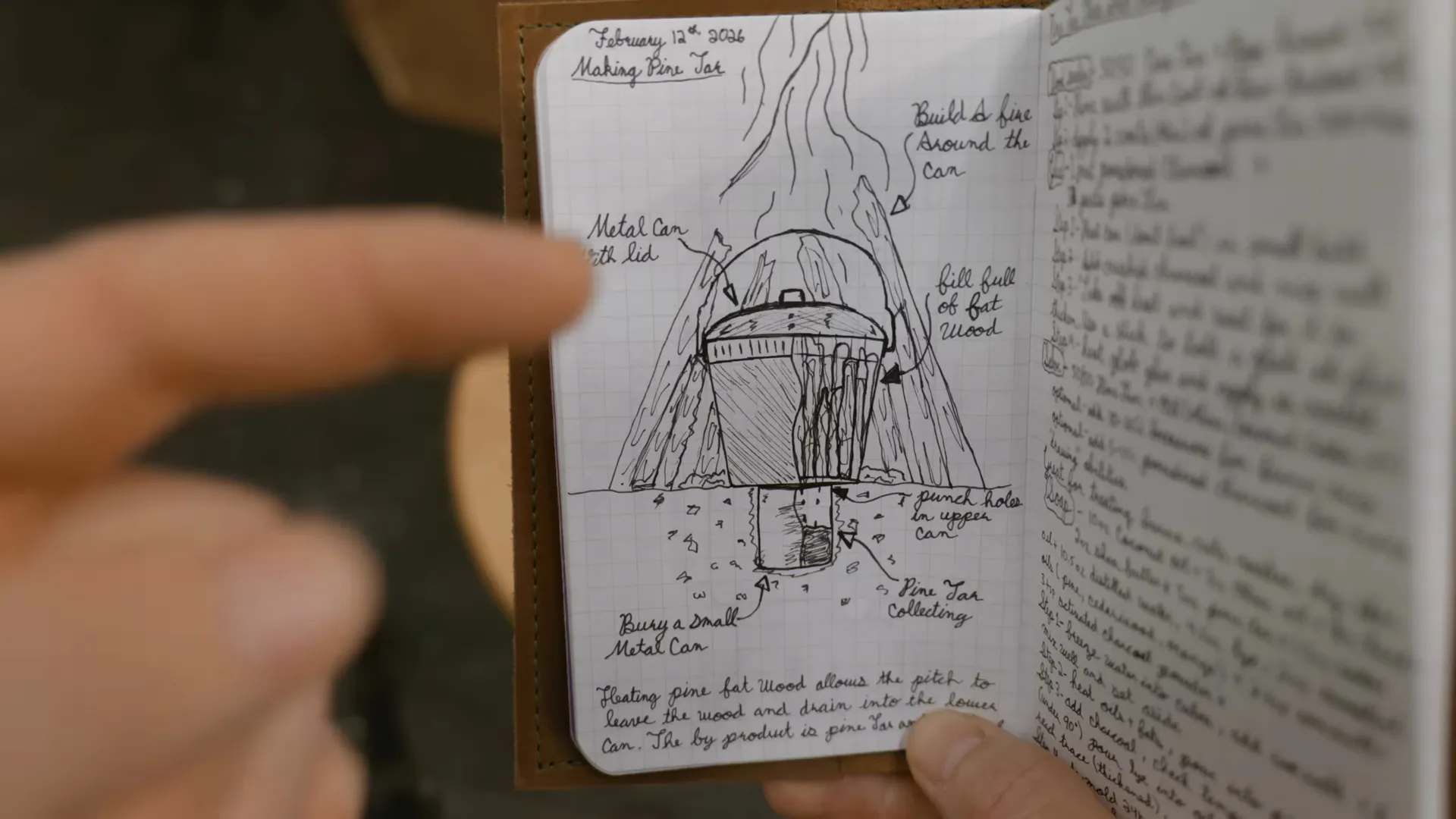
The distillation process [woodbrew] uses it fairly traditional, and consists of a couple of buckets. One bucket is buried and collects the pine tar; the other, with holes in the bottom to allow the tar to drip out, is filled with fatwood and covered tightly before being surrounded by firewood which is set alight. You could use an alternate source of heat here, but if you just cut down a pine tree for its fatwood, well, you’d have the rest of the tree to work with. Inside the fatwood bucket, the heat of the fire cooks off the volatile compounds that make pine tar, while the lack of oxygen from being closed up keeps it from burning. Burying the collection bucket keeps it from getting so hot the volatiles all boil off.

Advertisement

If this sounds like the process for making charcoal or woodgas, that’s because it is! He’s letting the gas fraction flare off here, but you could probably capture it– though a true gasifier brakes the tar down into gaseous compounds as well. The charcoal of course stays in the bucket as a bonus.

To make it usable as a wood finish, [woodbrew] mixes his homemade pine tar 50:50 with linseed oil, thining it to a spreadable consistency that helps it penetrate deep into the wood. By filling the voids in the wood, this mixture will help keep moisture out, and the antiseptic properties of the organic soup that is pine tar will help keep fungi at bay for potentially decades to come.

Thanks to [Keith Olson] for the tip!

Advertisement

Source link

Continue Reading

Tech

Our Favorite iPad Is $50 Off

Published

on

Need a new tablet for your casual couch surfing sessions? There are a variety of options out there, but we think most people will be happy with the standard 11-inch model from 2025. You can grab it right now at Amazon for just $300, a $50 discount from its usual price.

  • Photograph: Brenda Stolyar

  • Photograph: Brenda Stolyar

The outside of the iPad hasn’t changed all that much in the few years since it was updated last, with the screen growing a barely noticeable 0.1 inches, and the standard USB-C port and selfie camera, plus Touch ID built into the power button. Most of the changes affect the inside of the tablet, including a major processor upgrade to the A16 chip and storage that mean this tablet is much snappier and more responsive than the 2022 version. There’s twice as much storage, with 128 GB as a baseline and up to 512GB on the upgraded model, so you won’t need to keep deleting apps to make room for more movies.

While it does have the A16 processor, which is also found in the iPhone 14 Pro, iPhone 15, and iPhone 15 Plus, the reduced RAM means there’s no support for Apple Intelligence. Whether that’s a benefit or a drawback will depend on how much you like or dislike AI. Beyond the lack of Apple Intelligence, you’re really only making a compromise when it comes to the screen, which isn’t laminated, so the Apple Pencil doesn’t feel quite as sharp as it does on other iPads, and it isn’t nano-textured, so glare and bright rooms may be more of an issue.

For most folks, the 2025 A16 iPad will be more than enough tablet for streaming, web browsing, and even some light gaming. You can head over to Amazon to pick up the iPad in either Silver or Blue at the discounted $300 price, with similar discounts on the 256GB and 512GB models too, but availability by color varies as you climb up the storage ladder. If you’re interested in what the other, more premium iPads offer, make sure to check out our guide that covers the entire lineup.

Advertisement

Source link

Continue Reading

Tech

Why ENIAC Was a Loom, Not Just a Calculator

Published

on

This year marks the 80th anniversary of ENIAC, the first general-purpose digital computer. The computer was built during World War II to speed up ballistics calculations, but its contributions to computing extend well beyond military applications.

Two of ENIAC’s key architects—John W. Mauchly, its co-inventor, and Kathleen “Kay” McNulty, one of the six original programmers—married a few years after its completion and raised seven children together. Mauchly and McNulty’s grandchild Naomi Most delivered a talk as part of a celebration in honor of ENIAC’s anniversary on 15 February, which was held online and in-person at the American Helicopter Museum in West Chester, Pa. The following is adapted from that presentation.

There was a library at my grandparents’ farmhouse that felt like it went on forever. September light through the windows, beech leaves rustling outside on the stone porch, the sounds of cousins and aunts and uncles somewhere in the house. And in the corner of that library, an IBM personal computer.

Advertisement

When I spent summers there as a child, I didn’t yet know that the computer was closely tied to my family’s story.

My grandparents are known for their contributions to creating the Electronic Numerical Integrator and Computer, or ENIAC. But both were interested in more than just crunching numbers: My grandfather wanted to predict the weather. My grandmother wanted to be a good storyteller.

In Irish, the first language my grandmother Kathleen “Kay” McNulty ever spoke, a word existed to describe both of these impulses: ríomh.

I began to learn the Irish language myself five years ago, and I was struck by how certain words and phrases had multiple meanings. According to renowned Irish cultural historian Manchán Magan—from whom I took lessons—the word ríomh has at different times been used to mean to compute, but also to weave, to narrate, or to compose a poem. That one word that can tell the story of ENIAC, a machine with wires woven like thread that was built to compute, make predictions, and search for a signal in the noise.

Advertisement

John Mauchly’s Weather-Prediction Ambitions

Before working on ENIAC, John Mauchly spent years collecting rainfall data across the United States. His favorite pastime was meteorology, and he wanted to find patterns in storm systems to predict the weather.

The Army, however, funded ENIAC to make simpler predictions: calculating ballistic trajectory tables. Start there, co-inventors J. Presper Eckert and Mauchly realized, and perhaps the weather would soon be computable.

Black and white 1960s image of two white men in suits looking at a wall of computer controls. Co-inventors John Mauchly [left] and J. Presper Eckert look at a portion of ENIAC on 25 November 1966. Hulton Archive/Getty Images

Weather is a system unfolding through time, and a model of a storm is a story about how that system might unfold. There’s an old Irish saying related to this idea: Is maith an scéalaí an aimsir. Literally, “weather is a good storyteller.” But aimsir also means time. So the usual translation of this phrase into English becomes “time will tell.”

Mauchly wanted to ríomh an aimsire—to weave the weather into pattern, to compute the storm, to narrate the chaos. He realized that complex systems don’t reveal their full purpose at conception. They reveal it through aimsir—through weather, through time, through use.

Advertisement

ENIAC’s First Programmers Were Weavers

Kathleen “Kay” McNulty was born on 12 February 1921, in Creeslough, Ireland, on the night her father—an IRA training officer—was arrested and imprisoned in Derry Gaol.

Family oral history holds that her people were weavers. She spoke only Irish until her family reached Philadelphia when she was 4 years old, entering American school the following year knowing virtually no English. She graduated in 1942 from Chestnut Hill College with a mathematics degree, was recruited to compute artillery firing tables by hand for the U.S. Army, and was then selected—along with five other women—to program ENIAC.

They had no manual. They had only blueprints.

McNulty and her colleagues learned ENIAC and its quirks the way you learn a loom: by touch, by memory, by routing threads of electricity into patterns. They developed embodied knowledge the designers could only approximate. They could narrow a malfunction to a specific failed vacuum tube before any technician could locate it.

Advertisement

McNulty and Mauchly are also credited with conceiving the subroutine, the sequence of instructions that can be repeatedly recalled to perform a task, now essential in any programming. The subroutine was not in ENIAC’s blueprints, nor in the funding proposal. The concept emerged as highly determined people extended their imagination into the machine’s affordances.

The engineers designed the loom. Weavers discovered its true capabilities.

In 1950, four years after ENIAC was switched on, Mauchly’s dream was realized as it was used in the world’s first computer-assisted weather forecast. That was made possible after Klara von Neumann and Nick Metropolis reassembled and upgraded the ENIAC with a small amount of digital program memory. The programmers who transformed the math into operational code for the ENIAC were Norma Gilbarg, Ellen-Kristine Eliassen, and Margaret Smagorinsky. Their names are not as well-known as they should be.

Black and white 1940s image of three women operating a differential analyser in a basement. Before programming ENIAC, Kay McNulty [left] was recruited by the U.S. Army to compute artillery firing tables. Here, she and two other women, Alyse Snyder [center] and Sis Stump, operate a mechanical analog computer designed to solve differential equations in the basement of the University of Pennsylvania’s Moore School of Electrical Engineering.University of Pennsylvania

Kay McNulty, Family Storyteller

Kay married John Mauchly in 1948, describing him as “the greatest delight of my life. He was so intelligent and had so many ideas…. He was not only lovable, he was loving.” She spent the rest of her life ensuring he, Eckert, and the ENIAC programmers would be recognized.

Advertisement

When she died in 2006, I came to her funeral in shock, not fully knowing what I’d lost. As she drifted away, it was said, she had been reciting her prayers in Irish. This understanding made it quickly over to Creeslough, in County Donegal, and awaited me when I visited to honor her memory with the dedication of a plaque right there in the center of town.

In her own memoir, she wrote: “If I am remembered at all, I would like to be remembered as my family storyteller.”

In Irish, the word for computer is ríomhaire. One who ríomhs. One who weaves, computes, and tells. My grandfather wanted to tell the story of the weather through computing. My grandmother wanted to be remembered as a storyteller. The language of her childhood already had a word that contained both of those ambitions.

Computers as Narrative Engines

When it was built, ENIAC looked like the back room of a textile production house. Panels. Switchboards. A room full of wires. Thread.

Advertisement

Thread does not tell you what it will become. We tend to think of computing as calculation—discrete and deterministic. But a model is a structured story about how something behaves.

Weather models, ballistic tables, economic forecasts, neural networks: These are all narrative engines, systems that take raw inputs and produce accounts of how the world might unfold. In complex systems, when parts are woven together through use, new structures arise that no one specified in advance.

Like ENIAC, the machines we are building now—the large models, the autonomous systems—are not merely calculators. They are looms.

Their most important properties will not be specified in advance. They will emerge through use, through the people who learn how to weave with them.

Advertisement

Through imagination.

Through aimsir.

From Your Site Articles

Related Articles Around the Web

Advertisement

Source link

Continue Reading

Tech

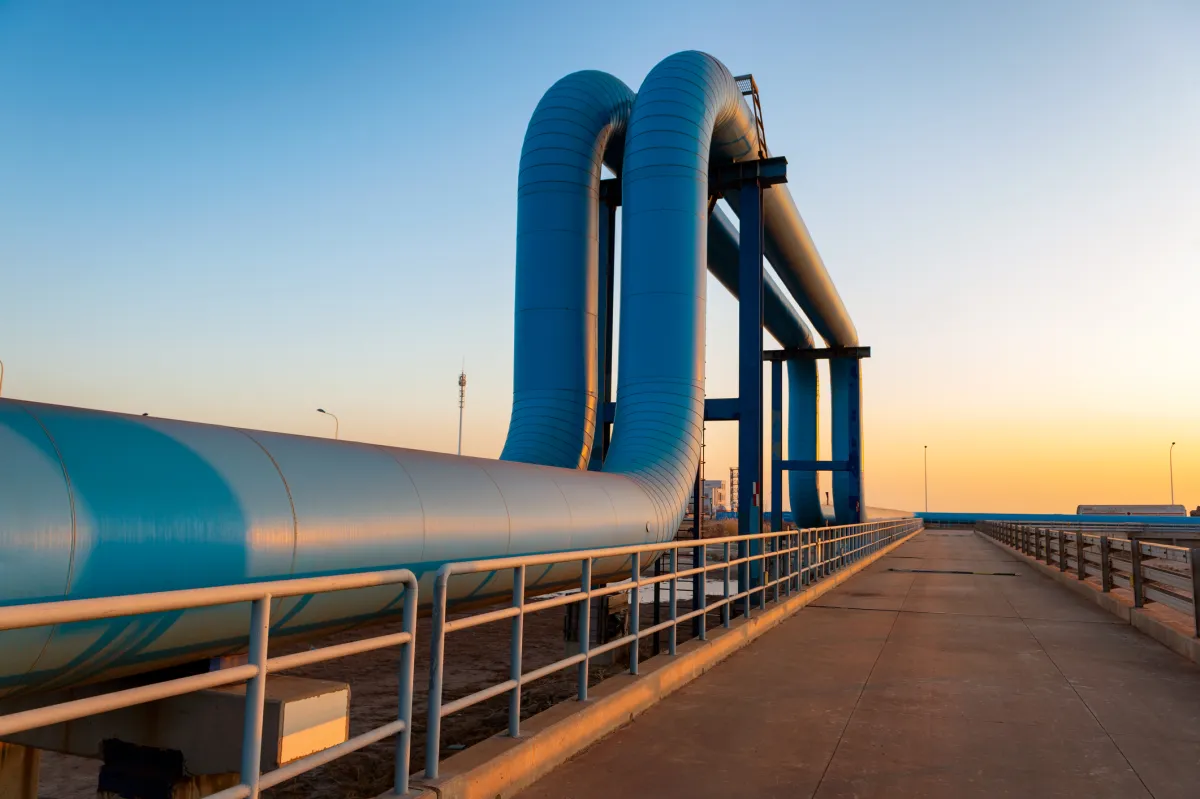
AI companies are building huge natural gas plants to power data centers. What could go wrong?

Published

on

Who doesn’t love a good round of FOMO? From dot-com to Web 2.0, virtual reality to blockchain, the tech industry has had its share of being too afraid to miss out on a trend.

The AI bubble is the big daddy of them all. Its first offspring — the rush to lock down power for data centers — is now begetting a mad dash to secure natural gas supplies and equipment. If FOMOs could have babies, then the AI bubble is already having grandkids.

Microsoft said on Tuesday that it’s working with Chevron and Engine No. 1 to build a natural gas power plant in West Texas that could grow to produce 5 gigawatts of electricity. This week Google confirmed that it’s working with Crusoe to build a 933 MW natural gas power plant in North Texas. And last week, Meta announced that it was adding another seven natural gas power plants to its Hyperion data center in Louisiana, bringing the site to 7.46 GW of capacity — enough to power the entire state of South Dakota.

Are we missing anyone?

Advertisement

The recent investments are concentrated in the southern U.S., home to some of the largest natural gas deposits in the world. Recently, the U.S. Geological Survey estimated that there’s enough in one region to supply energy to the entire United States for 10 months by itself. Every data center operator seems to want a part of it.

The scramble for natural gas has led to a shortage of turbines for the power plants, with prices likely to rise 195% by the end of this year relative to 2019 prices, according to Wood Mackenzie. The equipment contributes 20% to 30% of the cost of a power plant. Companies won’t be able to place new orders until 2028, and it’s taking six years to get turbines delivered, the consultancy notes.

That means tech companies are betting that the AI fever won’t break, that AI will continue to need exponential amounts of power, and that natural gas generation will be necessary for success in the AI era.

Techcrunch event

Advertisement

San Francisco, CA
|
October 13-15, 2026

They may come to regret that third assumption.

Advertisement

Though natural gas supplies in the U.S. are plentiful, and because shipping the fuel isn’t cheap, the country remains somewhat insulated from the turmoil in the Middle East. But supplies aren’t unlimited, and recently, growth in production in the big three regions — responsible for three-quarters of all U.S. shale gas production — has slowed considerably

It’s not clear how insulated tech companies are from price swings since none of them have disclosed specific terms of their agreements. A lot will depend on how firm the price is in those contracts. 

Even if the contracted prices are as firm as can be, the companies could still face repercussions.

Because natural gas generates about 40% of the electricity in the U.S., according to the Energy Information Administration, electricity prices are closely tied to natural gas prices. Tech companies might be able to shield themselves from scrutiny for a bit by moving their gas power plants behind the meter — by skipping the grid and connecting them directly to their data centers. But natural gas isn’t an unlimited resource, and if their ambitions grow too big, even the behind-the-meter operations could drive up power prices for everyone. We’ve all seen how that’s played out.

Advertisement

It won’t just be regular households getting upset either. Other industries, including those that remain much more dependent on natural gas and can’t yet turn to renewables, might balk at data centers grabbing so much of the resource. Powering a data center with wind, solar, and batteries is easy. Running a petrochemical plant? Not so much.

Then there’s the weather. One cold winter could change the calculus by driving up demand among households. Wellheads might freeze off, crimping supplies dramatically, as happened in Texas in 2021. When gas runs short, suppliers will face a choice: keep the AI data centers running or let people heat their homes?

By snapping up natural gas supplies and moving behind-the-meter, tech companies can claim that they’re “bringing their own power” and not straining the electrical grid. But in reality, they’re just shifting their use from one grid to another, the natural gas grid. The AI rush has illustrated just how physically constrained the digital world remains. Does it make sense for them to bet big on a finite resource? Tech companies might regret falling for the FOMO.

Source link

Advertisement
Continue Reading

Tech

For Such A Small Program, ZX81 1K Chess Sure Packs A Lot In

Published

on

The Sinclair ZX81 was hardly the most accomplished of 1980s 8-bit microcomputers, but its ultra-low-budget hardware was certainly pressed into service for some impressive work. Perhaps the most legendary piece of commercial software in this vein was 1K Chess, which packed an entire chess engine into the user-available bytes in the unexpanded 1K ZX’s memory map. [MarquisdeGeek] has taken this vintage piece of code in 2026 and subjected it to a thorough analysis, finding all the tricks along the way.

Though hackers have since found ways to trick the ’81 into displaying bitmap graphics, using it as intended is text-only with some limited block graphics. The chess board then is text-only, and its illusion of “thinking” about moves comes courtesy of the on-screen board doubling as the play area memory. In the GitHub repository you can find decompiled and annotated versions as well as the original ZX binary, with as a bonus a screen capture of the game as it appears as BASIC with the ZX’s odd means of storing Z80 code in REM statements.

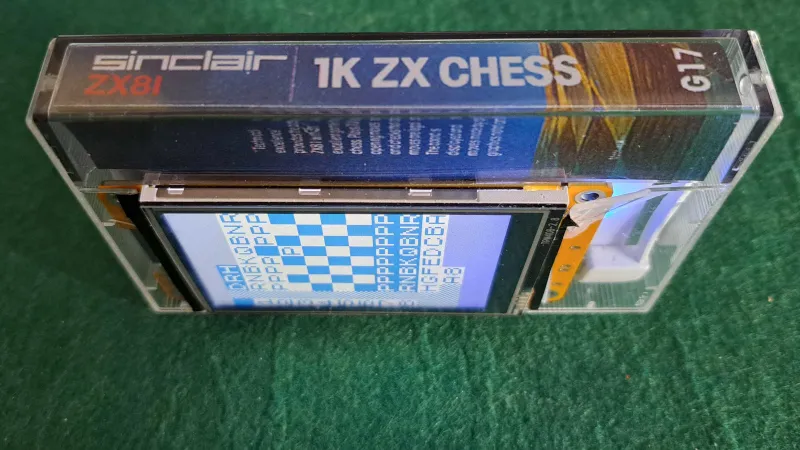
If that wasn’t enough, in his note giving us the tip he reveals that much of the work was done in a ZX emulator running in a Dragon emulator, and gives us a fun glimpse of the game running in an emulator on a Cheap Yellow Display inside 1K Chess cassette box. We like it, a lot!

Advertisement

If you need a greater ZX81 fix, take a look at how this machine chased the beam to make TV graphics on the cheap.

Source link

Advertisement
Continue Reading

Tech

Five Underrated Tire Brands That Can Compete With Goodyear

Published

on


Goodyear is a tire industry institution. Founded in 1898 in Akron, Ohio, it has spent more than a century building a name synonymous with reliability, performance, and American motoring heritage. Our ranking of major tire brands placed Goodyear second overall, highlighting its broad range of strong-performing models across multiple market segments. However, a trusted name does not guarantee a podium finish in every single test.

Tire science advances rapidly, and in the last two years, a cluster of brands — some familiar to enthusiasts, some largely invisible to mainstream buyers — have turned up in credible, independent tests that outperform Goodyear in specific, measurable ways. Consumer Reports‘ 2026 Best Tire Brands rankings placed Goodyear seventh among the brands it evaluated, most notably behind several names that most drivers would not immediately associate with premium performance. Either way, this piece is not a case against Goodyear.

It is more a case of looking beyond just the label and the brand. The five brands profiled below have each demonstrated, in controlled, verifiable testing, that they can stand toe-to-toe with — and in some areas even surpass — one of the world’s most recognized tire companies. Here is what you need to know and where exactly Goodyear has an underdog problem.

Advertisement

1. Nokian

The Nokian Tyres company traces its roots back to Finland in 1898, and is best known in the Nordic markets for its legendary Hakkapeliitta winter tire line, but its all-season range has been making serious noise in European testing circles. In Tyre Reviews‘ 2025 best SUV all-season tire test, the new Nokian SeasonProof 2 delivered the shortest wet braking distance in the entire test. It stopped faster than the Goodyear Vector 4Seasons Gen 3, which finished behind the Nokian in both wet braking and wet handling categories.

The tester noted that the Nokian was the fastest around the handling lap, all while having a superior blend of feedback, traction, and communication. This result is not just a one-off. When Consumer Reports tested top-ranked tires for winter and snow, the Nokian Hakkapeliitta R5 won in both SUV and passenger car/crossover categories, while the Nokian Tyres Remedy WRG5 was also placed number one in the all-season department. In both instances, these ranked higher than many well-known premium brands.

Advertisement

One notable 2025 test by TÜV SÜD, as covered by TyreReviews, compared five premium all-season 205/55 R16 tires. The Nokian Seasonproof 2 took first place, excelling in snow braking and traction (100%) and snow handling (99.6%), while remaining reasonable in wet metrics and rolling resistance. In contrast, Goodyear’s Vector 4Seasons Gen 3 finished last, struggling in dry and wet braking and hydroplaning, though its snow performance and rolling resistance were more than decent.

Advertisement

2. Vredestein

Vredestein is one of Europe’s oldest tire manufacturers, now owned by Apollo Tyres, and it has spent the better part of the last decade quietly compiling an impressive test record. The brand has also seen a strong reception from buyers, to the point that it ranks as Consumer Reports’ 2025 best major tire brand in terms of customer satisfaction. According to TyreReviews‘ direct cross-test comparison of the Goodyear Vector 4Seasons Gen 3 and the Vredestein Quatrac All-Season, both tires were evaluated across 15 shared tests.

In total, the Quatrac won 10 of them, while Goodyear won five. What’s interesting is that the Goodyear tire performed better in the snow, and most of the wins it earned were tied to snow and ice performance. Conversely, in a separate 2024 ADAC test comparing the Vredestein Wintrac Pro and the Goodyear UltraGrip Performance 3, the Goodyear tire won overall, losing to Vredestein in snow and ice conditions.

In the summer segment, the Vredestein Ultrac earned perhaps its most high-profile result when it won the 2024 AutoExpress summer tire test (as covered by WhatTyre), beating the Goodyear Eagle F1 Asymmetric 6 to first place through performance across wet, dry, noise, and comfort categories. Best of all, it did so at a lower price point than most of its rivals.

Advertisement

3. Hankook

Hankook has been making tires since 1941 and operates as one of the world’s largest manufacturers, supplying OEM fitments to major automakers. However, its reputation among everyday buyers has not always kept pace with its test results. So, are Hankook tires better than Goodyear? If you look at Consumer Reports’ Best Tire Brands of 2025 test results, they placed Hankook ahead of Goodyear, which was the direct result of testing 30 brands across handling, braking, snow traction, noise, hydroplaning, and tread life.

The objective test data support this. In AutoBild’s 2025 EV tire test as reported by Hankook, Hankook’s iON evo took the overall test win — ahead of Michelin, Goodyear, and Continental — for the third consecutive year, earning the magazine’s top “Exemplary” rating. In TyreReviews‘ 2025 EV tire test, Hankook led the wet handling results with 74.4 kph (46.2 mph), narrowly beating Continental and finishing ahead of Goodyear, which took third place.

Overall, both Goodyear and Hankook have positioned themselves as strong performers in the market. Brand competitiveness is also reflected in customer feedback. For example, Tyroola, one of Australia’s largest tire retailers, aggregates reviews for both brands, showing Goodyear rated 4.6 out of 5 and Hankook close behind at 4.5 out of 5. This demonstrates that consumers view both brands in a similar fashion and proves that Hankook can indeed trade punches with the industry’s finest.

Advertisement

4. Falken

Falken is owned by Sumitomo Rubber Industries and has historically been viewed as a mid-tier brand. Therefore, the brand sure is credible, but not headline-grabbing in the same way Goodyear is. However, recent testing suggests that perception can point in a bad direction. TyreReviews‘ 2025 best performance summer tire test — a comparison that included the Goodyear Eagle F1 Asymmetric 6 and the Falken Azenis FK520 — showed just how close those two brands can perform.

Goodyear tied for second place with Michelin and Continental, with Falken just behind them. The reviewer noted that the Falken tire was “incredibly grippy, incredibly stable, and very easy to drive fast,” and found the results good enough to have a second driver independently confirm them. Traditionally, Goodyear is known for making some of the quietest tires on the market, but in this regard, the Falken finished just behind Goodyear in overall noise levels.

In the all-terrain segment, Falken has been equally competitive. TyreReviews‘ best all-terrain tire test found the Falken Wildpeak AT3W returning dry braking distances of 43.9 meters (144 feet) against the Goodyear Wrangler All-Terrain’s 44.6 meters (146 feet), while the publication concluded Falken was the best all-terrain tire overall, and Goodyear’s Wrangler ranked third.

Advertisement

5. Kumho

When talking about whether Kumho tires are better than Goodyear, we first need to mention Consumer Reports’ 2026 best tire rankings, where Kumho placed fifth among all brands evaluated — two places above Goodyear, which came seventh. Moreover, the case is sharpened considerably by specific head-to-head performance data.

In the 2026 AutoBild 245/45 R19 summer tire test, the Kumho Ecsta Sport PS72 and Goodyear Eagle F1 Asymmetric 6 traded punches in many categories. Kumho excelled in wet and dry braking and in value, outperforming Goodyear. On the other hand, Goodyear ranked higher overall thanks to its exceptional treadwear and balanced performance. In practical terms, Kumho offers targeted performance advantages, while Goodyear offers better longevity and consistency.

Advertisement

However, in the 2024 ADAC summer tire test, the Kumho Ecsta HS52 earned third place, while the Goodyear EfficientGrip Performance 2 ranked ninth. These brands are closely matched in the eyes of the consumer as well, since many owners on Reddit are quick to point out that Kumho often feels slightly more comfortable and performance-oriented, while Goodyear is considered solid, reliable, and better for mileage and all‑season use.

Advertisement

How we made the list

Comparing tire brands is tricky because there are so many variables—different models, submodels, sizes, and categories. While direct comparisons of specific tires can highlight strengths and weaknesses, judging an entire brand as a whole isn’t realistic. That wasn’t the goal of this article. Instead, we aimed to identify underrated, non-premium tire brands that can compete with — and sometimes even beat — Goodyear. 

Experiences will naturally vary, but there’s enough credible data online to answer the main question. To create this list, we scoured verifiable tests, comparisons, expert analyses, and user reviews from sources like TyreReviews, AutoExpress, Consumer Reports, AutoBild, ADAC, Tyroola, WhatTyre, and TÜV SÜD. We cross-checked performance metrics, test results, and consumer feedback to show both sides of the coin and provide an honest assessment of where these brands stand.


Advertisement

Source link

Continue Reading

Tech

Rubin Observatory team discovers 11,000 new asteroids, with help from University of Washington software

Published

on

A model of the inner solar system shows asteroids discovered by the Rubin Observatory in light teal. Previously known asteroids are dark blue. The model highlights almost 12,700 asteroids that the Rubin team has discovered over the course of a year and a half. (Photo: NSF–DOE Vera C. Rubin Observatory / NOIRLab / SLAC / AURA / R. Proctor. Star map: NASA / GSFC Scientific Visualization Studio. Gaia DR2: ESA / Gaia / DPAC. Image Processing: M. Zamani / NSF NOIRLab)

The Vera C. Rubin Observatory’s science team has discovered more than 11,000 new asteroids — a feat made possible by the Simonyi Survey Telescope’s advanced capabilities and data-crunching software developed at the University of Washington.

Rubin’s deluge of discoveries, based on a million early-stage observations that were collected over the course of a month and a half last summer, includes roughly 380 trans-Neptunian objects, or TNOs, and 33 previously unknown near-Earth objects. (Don’t panic: None of those near-Earth objects poses a threat to Earth.)

The data set also includes more than 80,000 previously known asteroids, some of which had been “lost” to science because of uncertainty about their orbits. The findings were confirmed by the International Astronomical Union’s Minor Planet Center, the global clearinghouse for small solar system objects.

These aren’t the first finds for the $800 million observatory in Chile, which made its “First Look” debut last June. Astronomers previously reported finding more than 1,500 asteroids during earlier test rounds.

“This first large submission after Rubin First Look is just the tip of the iceberg and shows that the observatory is ready,” UW astronomer Mario Jurić, who heads Rubin’s solar system team, said in a news release. “What used to take years or decades to discover, Rubin will unearth in months. We are beginning to deliver on Rubin’s promise to fundamentally reshape our inventory of the solar system and open the door to discoveries we haven’t yet imagined.”

Advertisement
This video highlights the asteroids discovered at the Vera C. Rubin Observatory. The discoveries come in three bursts: 73 were discovered during the first early test observations using Rubin’s Commissioning Camera in late 2024; 1,514 were discovered during First Look observations in April and May 2025; and 11,000 more asteroids were discovered in Rubin’s early optimization surveys last summer.

The observatory’s centerpiece is the Simonyi Survey Telescope, named after the family of Seattle-area software billionaire Charles Simonyi. Equipped with the world’s largest digital camera, it can generate 20 terabytes of raw data per night. That data is analyzed and interpreted by scientific institutions around the world — including UW’s DiRAC Institute. (DiRAC stands for “Data-Intensive Research in Astrophysics and Cosmology.”)

“Rubin’s unique observing cadence required a whole new software architecture for asteroid discovery,” said Ari Heinze, a UW astronomer who worked with graduate student Jacob Kurlander to create the software that detected the asteroids. “We built it, and it works. It seems pretty clear this observatory will revolutionize our knowledge of the asteroid belt.”

Once it ramps up to full operation, the Rubin Observatory is expected to identify almost 90,000 new near-Earth objects, or NEOs, in the zone around our planet’s orbit. Some of those NEOs could be hazardous, and early detection would give scientists, engineers and policymakers a head start on the development of planetary defense strategies.

The trans-Neptunian objects that were found in the broad zone of the solar system beyond the orbit of Neptune include two icy bodies that appear to have extremely elongated orbits. The Rubin team says these two objects — designated 2025 LS2 and 2025 MX348 — reach distances that are roughly 1,000 times farther out from the sun than Earth. That would place them among the 30 most distant known celestial objects of their kind.

Advertisement

If the far reaches of the solar system harbor a large trans-Neptunian object — a hypothetical world known as Planet Nine or Planet X — Rubin should be able to detect it.

The specks of light teal shown in this rendering of the wider solar system represent the roughly 380 trans-Neptunian objects discovered using observations taken during Rubin’s early optimization surveys last summer. i(Photo: NSF–DOE Vera C. Rubin Observatory / NOIRLab / SLAC / AURA / R. Proctor. Star map: NASA / GSFC Scientific Visualization Studio. Gaia DR2: ESA/Gaia/DPAC. Image Processing: M. Zamani / NSF NOIRLab)

“Searching for a TNO is like searching for a needle in a field of haystacks,” said Matthew Holman, a senior astrophysicist at the Harvard & Smithsonian Center for Astrophysics and former director of the Minor Planet Center. “Out of millions of flickering sources in the sky, teaching a computer to sift through billions of combinations and identify those that are likely to be distant worlds in our solar system required novel algorithmic approaches.”

Holman worked with Kevin Napier, a research scientist at the Center for Astrophysics, to develop the algorithms for detecting distant solar system objects with Rubin data.

The Rubin discoveries that have been announced to date are only a prelude to Rubin’s 10-year Legacy Survey of Space and Time. Simulations suggest that over the course of the coming decade, the Rubin Observatory will find millions of previously undetected asteroids.


Operations of the Vera C. Rubin Observatory are funded by the U.S. National Science Foundation and the U.S. Department of Energy’s Office of Science.

Advertisement

This research is available at the Rubin Asteroid Discoveries Dashboard. In addition to Jurić, Heinze, Kurlander, Holman and Napier, the research team members include Pedro Bernardinelli, a former DiRAC postdoctoral fellow at the UW, now at the Institute for Astronomy, Geophysics and Atmospheric Sciences of the University of São Paulo; Joachim Moeyens, a UW research software engineer and B612 Asteroid Institute team member who earned his doctorate in astronomy at the UW; Siegfried Eggl, a former UW postdoctoral researcher in astronomy, now at the University of Illinois Urbana-Champagne; and Erfan Nourbakhsh at Princeton University.

Source link

Continue Reading

Tech

Irish Government approves ‘next-generation sites’ for industry

Published

on

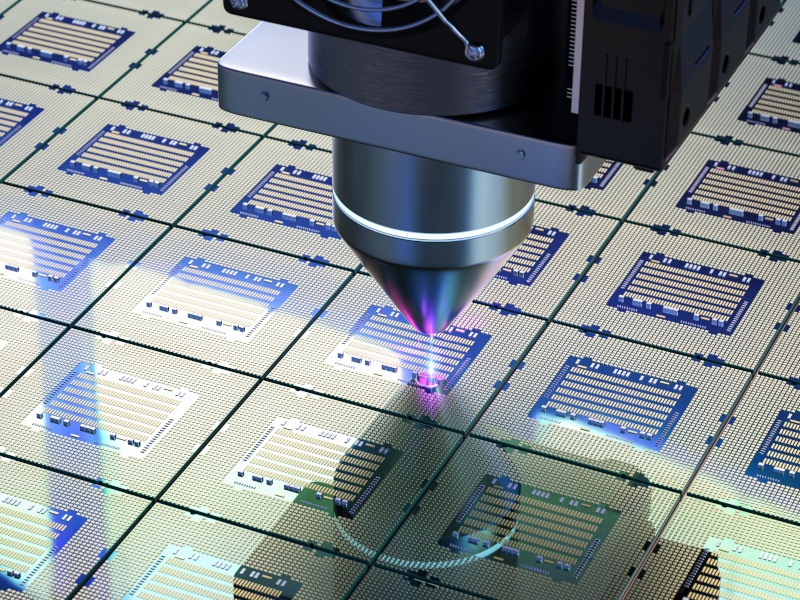
The Government said that the strategy is essential to ensuring Ireland remains competitive in attracting the next wave of large-scale, high-value manufacturing investment opportunities in sectors such as semiconductors, life sciences, and renewables.

The Irish Government has signed off on a strategic approach to developing next-generation sites (NGS) that are considered central to the country’s plans to be industrially competitive in attracting future manufacturing investments.

NGS development is to be led by IDA Ireland and the Department of Enterprise, Tourism and Employment, with collaborative efforts to be made alongside other Government departments, state agencies and utility providers as needed for the preparation and development of each site.

The Government said that the strategy is essential to ensuring Ireland remains competitive in attracting the next wave of large-scale, high-value manufacturing investment opportunities in sectors such as semiconductors, life sciences and renewables.

Advertisement

The goal of the NGS approach is to provide pre-permitted, master-planned landbanks with clear pathways to delivery of required utilities and transport, including public transport, to enable swift development and certainty for investors.

Minister for Enterprise, Tourism and Employment Peter Burke, TD said that the “plan-led” approach to NGS development would help Ireland win “high-value, employment-rich projects in future-focused sectors”, with three sites anticipated for creation in the next 15 years.

Each site is forecast to be between 500 and 1,000 acres, with one each in the west, east and south of the country, although potential locations will not be publicly disclosed to protect the integrity of negotiations and future acquisitions.

The Government said preparing sites in advance would reduce risk and accelerate decision-making for investors, “crucial to competing for large-scale investments in today’s fast moving international environment”.

Advertisement

It said that each site would be chosen by IDA Ireland for its ability to connect efficiently to energy, transport and water networks, and for its proximity to talent, third-level institutions and supply chains.

“The sectors targeted by NGS – semiconductors, life sciences and green energy, in particular – provide quality and skilled employment, pay high salaries and contribute to Ireland’s tax receipts,” said Burke.

He added that “many global companies in the semiconductor and life science sectors located and expanded in Ireland over several decades”, and are now employing tens of thousands in “well-paid jobs, with several now operating across multiple sites”.

The NGS sign-off is in line with the Government’s ‘Silicon Island’ national strategy on semiconductors, which was unveiled last May.

Advertisement

The strategy is a part of the Programme for Government, is aligned with the European Chips Act and the EU Digital Decade, and aims to supercharge the country’s semiconductor industry through skills development, boosting R&D, the development of the domestic semiconductor ecosystem and attracting foreign investment.

The plan also commits to developing large-scale manufacturing sites with the necessary infrastructure, enhance R&D capacity and support businesses working in the semiconductor industry with commercialisation support and access to finance.

Don’t miss out on the knowledge you need to succeed. Sign up for the Daily Brief, Silicon Republic’s digest of need-to-know sci-tech news.

Advertisement

Source link

Continue Reading

Tech

John Perry Barlow, JFK Jr., and a Night of Grief I Can’t Forget

Published

on

Watching the wildly popular television series Love Story took me back to a strange week in my past. One day in April 1994, I was working in a studio apartment that I used as an office. I split the cost with Cynthia Horner, a psychiatrist who’d recently moved out to live with her boyfriend, the songwriter and cyberspace philosopher John Perry Barlow, who was a friend of mine. Late in the afternoon my wife called me with the shocking news that Cynthia, just shy of her 30th birthday, was dead. I called Barlow, who told me that Cymthia had passed away suddenly on a plane. Both of them had suffered from a bad flu the previous week, and the virus had been silently attacking her heart. I dropped everything and headed to Barlow’s place. For the next six hours, Barlow and I cried, drank, and head-banged in the wake of the inexplicable, along with another friend. That friend was no stranger to tragedy. He was John F. Kennedy Jr.

Barlow, who died in 2018 at age 70, was known for many things. He was the self-described junior lyricist of the Grateful Dead, a proselytizer of the Internet, cofounder of the Electronic Frontier Foundation, and a networker nonpareil. Not to mention a key figure in WIRED’s early days. He was also among the closest friends of the so-called American prince, the son of our martyred president. The friendship was no secret—Barlow was an inveterate name-dropper. Still, the pairing was fascinating and said something about both parties.

The connection began in the summer of 1977. Barlow was tending his family ranch in Pinedale, Wyoming, when Jackie Kennedy called at the suggestion of a mutual friend. As Barlow wrote in his posthumously published autobiography, Mother American Night, Jackie wanted her 17-year-old son, JFK Jr., to get a taste of rugged ranch life. Barlow, in his retelling, said yes, and augmented the teen’s ranch chores with LSD. Things they did while dosing included long drives in Barlow’s truck and dropping explosives down gas wells. They became close, and over the years Barlow moved from a reprobate father figure to more of a friend.

It was a lifelong connection. Barlow writes of attending a 1993 Prince concert with Kennedy where both were once again tripping. Kennedy felt that the audience was too restrained, and he urged Barlow to get up and dance. As Barlow writes, all of Radio City Music Hall joined in. Later, after Barlow met Cynthia, the two would double-date with Kennedy and his then-girlfriend, Daryl Hannah. After the night I spent with Barlow and Kennedy, Hannah flew to New York and helped in the postmortem planning for a memorial service. She seemed to be a lovely person.

Advertisement

In 1994, Kennedy moved on from Hannah and wooed the charismatic Carolyn Bessette. Barlow became a confidant of his friend’s new sweetheart—even becoming part of the ceremony at their intimate wedding in 1996. One picture shows Barlow preparing for the formalities with JFK Jr., Ted Kennedy, and the priest. I don’t know what Barlow said to honor the couple, but I’d imagine the lyricist who wrote “Estimated Prophet” delivered trenchant words blending comedy and insight.

In Mother American Night, Barlow provides an alternate explanation for why Kennedy’s Cessna took off at sunset, resulting in a night flight that culminated in the man’s death, along with the deaths of his wife and her sister. Barlow says that he had just sent his 2,500 closest friends the news that his mother had died. Kennedy, he says, was late to the airport because he was composing a long condolence email to Barlow. Reasons for the late takeoff aside, Barlow claims that he had previously given Kennedy a warning that was ultimately ignored: “When you lose sight of the horizon don’t look for it. Just put your eyes on the instrument and believe it.”

Source link

Advertisement
Continue Reading

Tech

Robot Videos: Humanoid Dancing, Robot Learning, More

Published

on

Video Friday is your weekly selection of awesome robotics videos, collected by your friends at IEEE Spectrum robotics. We also post a weekly calendar of upcoming robotics events for the next few months. Please send us your events for inclusion.

ICRA 2026: 1–5 June 2026, VIENNA
RSS 2026: 13–17 July 2026, SYDNEY
Summer School on Multi-Robot Systems: 29 July–4 August 2026, PRAGUE

Enjoy today’s videos!

Getting Digit to dance takes more than putting on some fancy shoes–our AI Team can teach Digit new whole-body control capabilities overnight. Using raw motion data from mocap, animation, and teleop methods, Digit gets new skills through sim-to-real reinforcement training.

[ Agility ]

Advertisement

[ Generalist ]

Unitree open-sources UnifoLM-WBT-Dataset—high-quality real-world humanoid robot whole-body teleoperation (WBT) dataset for open environments. Publicly available since March 5, 2026, the dataset will continue to receive high-frequency rolling updates. It aims to establish the most comprehensive real-world humanoid robot dataset in terms of scenario coverage, task complexity, and manipulation diversity.

[ Hugging Face ]

Advertisement

Autonomous mobile robots operating in human-shared indoor environments often require paths that reflect human spatial intentions, such as avoiding interference with pedestrian flow or maintaining comfortable clearance. This paper presents MRReP, a Mixed Reality-based interface that enables users to draw a Hand-drawn Reference Path (HRP) directly on the physical floor using hand gestures.

[ MRReP ]

Thanks, Masato!

Eye contact, even momentarily between strangers, plays a pivotal role in fostering human connection, promoting happiness, and enhancing belonging. Through autonomous navigation and adaptive mirror control, Mirrorbot facilitates serendipitous, non-verbal interactions by dynamically transitioning reflections from self-focused to mutual recognition, sparking eye contact, shared awareness, and playful engagement.

Advertisement

[ ARL ] via [ Cornell University ]

Experience PAL Robotics’ new teleoperation system for TIAGo Pro, the AI-ready mobile manipulator designed for advanced research. This real-time VR teleoperation setup allows precise control of TIAGo Pro’s dual arms in Cartesian space, ideal for remote manipulation, AI data collection, and robot learning.

[ PAL Robotics ]

Utter brilliance from Robust AI. No notes.

Advertisement

[ Robust AI ]

Come along with our Senior Test Engineer, Nick L., as he takes us on a tour of the Home Test Labs inside the iRobot HQ.

[ iRobot ]

Advertisement

By automating the final “magic 5%” of production—the precise trimming of swim goggles’ silicone gaskets based on individual face scans—UR cobots allow THEMAGIC5 to deliver affordable, custom-fit goggles, enabling the company to scale from a Kickstarter sensation to selling over 400,000 goggles worldwide.

[ Universal Robots ]

Sanctuary AI has once again demonstrated its industry-leading approach to training dexterous manipulation policies for its advanced hydraulic hands. In this video, their proprietary hydraulic hand autonomously manipulates a lettered cube, continuously reorienting it to match a specified goal (displayed in the bottom-left corner of the video).

[ Sanctuary AI ]

Advertisement

China’s Yuxing 3-06 commercial experimental satellite, the first of its kind to be equipped with a flexible robotic arm, has recently completed an in-orbit refueling test and verification of key technologies. The test paves the way for Yuxing 3-06, dubbed a “space refueling station,” to refuel other satellites in orbit, manage space debris, and provide other in-orbit services.

[ Sanyuan Aerospace ] via [ Space News ]

This is a demonstration of natural walking, whole-body teleoperation, and motion tracking with our custom-built humanoid robot. The control policies are trained using large-scale parallel reinforcement learning (RL). By deploying robust policies learned in a physics simulator onto the real hardware, we achieve dynamic and stable whole-body motions.

[ Tokyo Robotics ]

Advertisement

Faced with aging railway infrastructure, a shrinking workforce and rising construction costs, Japan Railway West asked construction innovator Serendix to replace an old wooden building at its Hatsushima railway station using its 3D printing technology. An ABB robot enabled the company to assemble the new building in a single night ready for the first train service the next day.

[ ABB ]

Humanoid, SAP, and Martur Fompak team up to test humanoid robots in automotive manufacturing logistics. This joint proof of concept explores how robots can streamline operations, improve efficiency, and shape the future of smart factories.

[ Humanoid ]

Advertisement

This MIT Robotics Seminar is from Dario Floreano at EPFL, on “Avian Inspired Drones.”

[ MIT ]

This MIT Robotics Seminar is from Ken Goldberg at UC Berkeley, on “Good Old-Fashioned Engineering Can Close the 100,000 Year “Data Gap” in Robotics.”

Advertisement

[ MIT ]

From Your Site Articles

Related Articles Around the Web

Advertisement

Source link

Continue Reading

Trending

Copyright © 2025