When you think of a computer, you probably don’t think of a tube full of motors and mechanics. However, as [Our Own Devices] shows, the Bendix AN5841 API Computer, an air position indicator computer, is exactly that. Using mechanical integrators and data from other analog systems on an airplane to provide key flight data to a pilot. You can see the video below.
These devices were made for military aircraft, including the B-29. It is odd that speed data can be derived from a pump that balances pressures using a fan. The video does a good job of explaining exactly how that works.
The way engineers used mechanics to convert physical measurements into analog computations is nothing short of amazing. You have to wonder how you dream up this kind of stuff. Perhaps mechanical engineers wonder the same thing about electronics. But we sort of doubt it.
Advertisement
We are glad our computer doesn’t have any flexible shafts or rotating disks to do math. But we do love looking at ones that did. Some analog computers used voltages instead of mechanics. This video made us think of the M13A1 ballistic computer and, of course, the Norden.
US factories prepare to manufacture Ukraine’s battle-tested MAGURA naval drones domestically
MAGURA V7 reportedly destroyed an aerial target using Sidewinder missile technology
Oregon and South Carolina will host future MAGURA drone production facilities
Ukrainian defense company UFORCE has signed an agreement with US boatbuilder RECONCRAFT to manufacture the combat-proven MAGURA naval drones domestically.
Reports from The Wall Street Journal has claimed the memorandum of understanding was recently signed at the Embassy of Ukraine in Washington, with production planned at facilities in Oregon and South Carolina.
The project will have the eventual goal of building hundreds, and potentially thousands, of units annually.
Latest Videos FromTechRadar
Advertisement
A combat-tested platform moves to US soil
MAGURA drones gained international recognition after repeated strikes helped push much of Russia’s Black Sea Fleet away from Crimea.
The MAGURA family has since expanded beyond strike missions to include aerial drone launches, mine countermeasures and anti-submarine sonar towing, with the MAGURA V7 variant also capable of engaging helicopters and fixed-wing aircraft.
RECONCRAFT builds combatant craft for US and partner special operations forces, while UFORCE developed the MAGURA program from the outset.
Under the partnership, both companies will contribute manufacturing equipment, materials and personnel to support the new production lines in both states.
Sign up to the TechRadar Pro newsletter to get all the top news, opinion, features and guidance your business needs to succeed!
“Partnering with UFORCE combines our manufacturing expertise and capabilities with the combat-proven autonomy of the MAGURA platform,” said Joe Silkowski, co-founder of RECONCRAFT.
Advertisement
This allows “us to deliver greater capability to American warfighters faster than developing a new system from the ground up.”
The agreement follows increased Pentagon interest in lower-cost autonomous platforms after recent conflicts in Iran revealed how expensive drone warfare can be.
Advertisement
Combat experience drives broader international interest
Ukraine reported what it described as the world’s first successful naval drone strike against an aerial target during late 2024 using a MAGURA V7 armed with AIM-9 Sidewinder missiles.
In April 2026, MAGURA unmanned surface vessels also took part in the US-Philippines Balikatan military exercise, reportedly sinking a target ship during a live-fire demonstration in the Luzon Strait.
“Today’s combat environments show that autonomous warfighting capabilities are a must-have,” said UFORCE CEO Oleg Rogynskyy.
“UFORCE is exceptionally positioned to deliver capabilities already tested by some of the world’s most sophisticated militaries under the most demanding battlefield conditions.”
Advertisement
“Working with RECONCRAFT, we will help ensure these proven autonomous capabilities become available to the US,” Sean Plankey, CEO of UFORCE USA, added.
“It’s exactly the kind of industrial partnership the Arsenal of Democracy is designed to enable.”
As of the time of writing, neither UFORCE nor RECONCRAFT has indicated how US production could influence the price of future MAGURA drones.
Production in the United States is typically costlier than overseas alternatives, a dynamic long observed across industries from electronics to textiles.
Advertisement
It is one reason American companies like Apple choose to build their gadgets outside the country, with lower manufacturing costs and established supply chains.
Whether this same cost pressure will raise the price of American-built MAGURA drones compared to their Ukrainian-made counterparts is not yet known.
The Smart LED Monitor Stand is currently available for $169.99.
Nanoleaf
Nanoleaf has revealed its multi-purpose monitor stand that improves ergonomics, adds adjustable LED lighting and provides space for all your desktop accessories. Called the Smart LED Monitor Stand, Nanoleaf’s latest product goes beyond its typical lighting products by combining it with some extra functionality.
At the heart of it, the monitor stand portion can raise your display by up to four inches so it’s more in line with your natural eye level and promotes better posture during long sessions at your desk. No matter if you have an ultra-wide display or a dual-monitor setup, the Smart LED Monitor Stand can handle displays up to 42 inches long and can support up to 154 lbs. The stand’s base also features 23 mounting holes that allow for setting up stands for your mic, camera or any other accessories.
Nanoleaf
Known for its sleek lighting solutions, Nanoleaf cleverly tucked a dual lighting system into the Smart LED Monitor Stand. A front light bar can generate up to 550 lumens for when you’re trying to get work done, while a rear ambient light can be programmed through 102 individually addressable RGB zones that create a 160-degree wall-washing angle to match the vibe of your game, movie or music. Nanoleaf’s app allows for full color customization of the LED lights, but you can also sync the monitor stand with the company’s other products or set it to Rhythm Mode or Screen Mirror so the lighting can automatically match music or on-screen content.
Like Nanoleaf’s other products, the Smart LED Monitor Stand is Matter compatible so it can easily integrate with smart home ecosystems. The Smart LED Monitor Stand is currently available on Nanoleaf’s website and Amazon for $169.99.
The lease programme, known as Apple Upgrade, will reportedly support most iPhone, Mac, iPad and Apple Watch models.
Apple is set to debut a new leasing programme for its devices next week, according to Bloomberg.
The programme, known as Apple Upgrade, will support most iPhone, Mac, iPad and Apple Watch models, according to the publication, which cited anonymous sources close to the matter.
Apple Upgrade will reportedly work like a subscription and users can pay off the device early during their leasing term, upgrade early to a new model or keep it at the end of the leasing period. These transactions may incur an additional fee in “certain cases”, said Bloomberg.
Advertisement
The leased device can also be returned at the end of the term.
Sources told Bloomberg that Apple plans to advertise Apple Upgrade as “as a way to have lower payments versus current financing programmes”, and that the tech giant is planning to halt new enrolments to its existing iPhone payment programmes.
The lease terms for iPhones and Apple Watches will last for 24 months, according to the report, while Mac and iPad leases will run for 36 months.
The tech giant – which previously considered a subscription service for iPhones a few years ago – is also partnering with Klarna for the service, with the payment provider acting as financial backer for the programme.
Advertisement
Apple Upgrade is set to initially launch in the US on 28 July and will be available in Apple’s physical retail stores and online.
“The rapid expansion of AI data centres has created an extraordinary surge in demand for memory and storage”, a company spokesperson told news publications at the time, adding that Apple has “never seen a component price increase this much, this quickly”.
Apple said that the worsening situation meant that it couldn’t shield customers from the rising component costs any longer.
Advertisement
While last month’s announcement did not include a price hike for iPhones, recent reports indicate that may be about to change.
Yesterday (21 July), publication Nikkei Asia reported that the world’s largest chipmaker TSMC, which makes processors for a number of tech giants including Apple, plans to raise prices for both its advanced and mature chip production services by up to 10pc in 2027.
The price hike for Apple’s smartphones appears to be already happening, at least in one country so far.
This week it was confirmed that iPhone 17 prices had risen on Apple’s official Japan store, jumping by roughly 10pc from $797 to $877. The iPhone 17 Pro also rose in price, jumping by more than 8pc, while Apple Watch and AirPods models also rose by up to 10pc.
Advertisement
Don’t miss out on the knowledge you need to succeed. Sign up for the Daily Brief, Silicon Republic’s digest of need-to-know sci-tech news.
Motorola Edge 2026 for $600: I surprisingly enjoyed my month with the new Motorola Edge. It’s amazingly lightweight at just 160 grams, and the 6.3-inch screen size feels fairly compact. If you hate big, heavy phones and have longed for the days of smaller handsets, the Edge is worth a look; it’s not as small, but it feels great to use one-handed. Performance is more than capable, though you will feel some sluggishness here and there. The cameras are reliable—there’s even a 3X optical zoom telephoto alongside the 50-MP ultrawide and 50-MP primary—but it’s not going to knock your socks off. It will only get two Android OS upgrades and three years of security updates, which is not really acceptable for a $600 phone. Get it on sale!
Motorola Razr+ 2026 for $1,100: The Razr+ is the awkward middle child of the Razr lineup. I’ve never liked it. It doesn’t have all the bells and whistles or top-notch specs of the Ultra, but still costs more than $1,000. You can get very nearly the same experience with the cheaper Razr and save hundreds. Even battery life is the least impressive of the lot, because it has the smallest capacity. The cover glass isn’t the ceramic glass mixture as on the Razr Ultra, and I found out the hard way. I dropped the phone once, roughly a four-foot drop onto asphalt, and the front screen shattered. Get a screen protector!
Moto G 5G
Photograph: Julian Chokkattu
Moto G 5G 2026 for $299: The Moto G 2026 is nearly identical to the Moto G Play 2026 below, except it has double the storage (expandable via microSD), supports slightly faster wired charging, and the front and rear cameras pack more megapixels. It’s a $50 difference, so if you’re eyeing either one, you really should go for the Moto G 5G 2026. Performance is similarly sluggish, though perfectly usable day to day (if you’re patient). Even with more megapixels, don’t expect much from the cameras; they can take passable photos in good lighting, but struggle to do so in low light. I was able to hit nearly two days of battery life with average use, and I like that this phone still has the headphone jack. However, keep in mind that it will receive only two Android OS updates and three years of security updates. I think you’re better off buying the Moto G Power 2026 on sale. It’s worth noting that Motorola suddenly jacked up the prices of this device and the Moto G Play.
Advertisement
Moto G Play 2026
Photograph: Julian Chokkattu
Moto G Play 5G 2026 for $250: Motorola’s cheapest phone always sits in an awkward spot. It was originally under $200, but Motorola increased the price to $250. I don’t think it’s worth it at that price, but for under $200, it’s a serviceable handset that now features 5G connectivity. You get two-day battery life, a headphone jack, expandable storage, and a pretty nice design. But the MediaTek Dimensity 6300 chip with 4 GB of RAM is very sluggish—get ready to wait a second or two, sometimes more, for an app to launch or a webpage to load. Photo quality is passable; most of my images have lackluster colors. I took several calls, and the people on the other end generally complained about my audio quality, which isn’t great. It’s nice that this ultra-budget phone will get two Android OS updates, but I’d wait for the Moto G Power 2026 to eventually dip to $250 during major sale events.
What Motorola Phones to Avoid
Motorola Moto G 2025
Advertisement
Photograph: Julian Chokkattu
Motorola phones diminish in value fairly quickly. You should avoid buying Moto G phones from 2025 or earlier. They likely won’t get any more Android version updates, and the prices aren’t drastically different from the latest models. Last year’s Motorola Edge 2025 or the Razr (2025) series are the oldest I’d go, assuming prices are a good deal lower than the latest models, so don’t consider anything else.
Threat actors are using email addresses exposed in data breaches leaked by the ShinyHunters extortion group to send sextortion emails demanding $2,000 in Bitcoin.
The emails claim to come from ShinyHunters and tell recipients that hackers compromised their devices after obtaining their email addresses from breached company databases.
However, the messages appear to be sent by someone who downloaded data previously leaked by ShinyHunters rather than by the extortion group itself, using the exposed email addresses to make the threats appear more legitimate.
BleepingComputer has seen leaked data from the Amtrak, Hallmark, Substack, Betterment, CarGurus, ADT, Panera Bread, and McGraw Hill breaches used in this sextortion email campaign.
For some recipients, BleepingComputer confirmed that the email addresses targeted by the sextortion emails were actually included in the associated data previously leaked by ShinyHunters.
Advertisement
Extortion gangs often warn victims that refusing to pay will expose their customers and employees to additional abuse once stolen data is published. While those claims are intended to pressure organizations into paying, this campaign illustrates how leaked data can later be repurposed by unrelated threat actors for malicious purposes.
While the use of a recipient’s leaked email address may make these emails appear more convincing, there is no indication that the sender compromised recipients’ devices, installed malware, accessed their cameras, or monitored their activity on adult websites.
BleepingComputer contacted the ShinyHunters extortion group, which denied any involvement in the sextortion email campaign.
Fake ShinyHunters sextortion emails
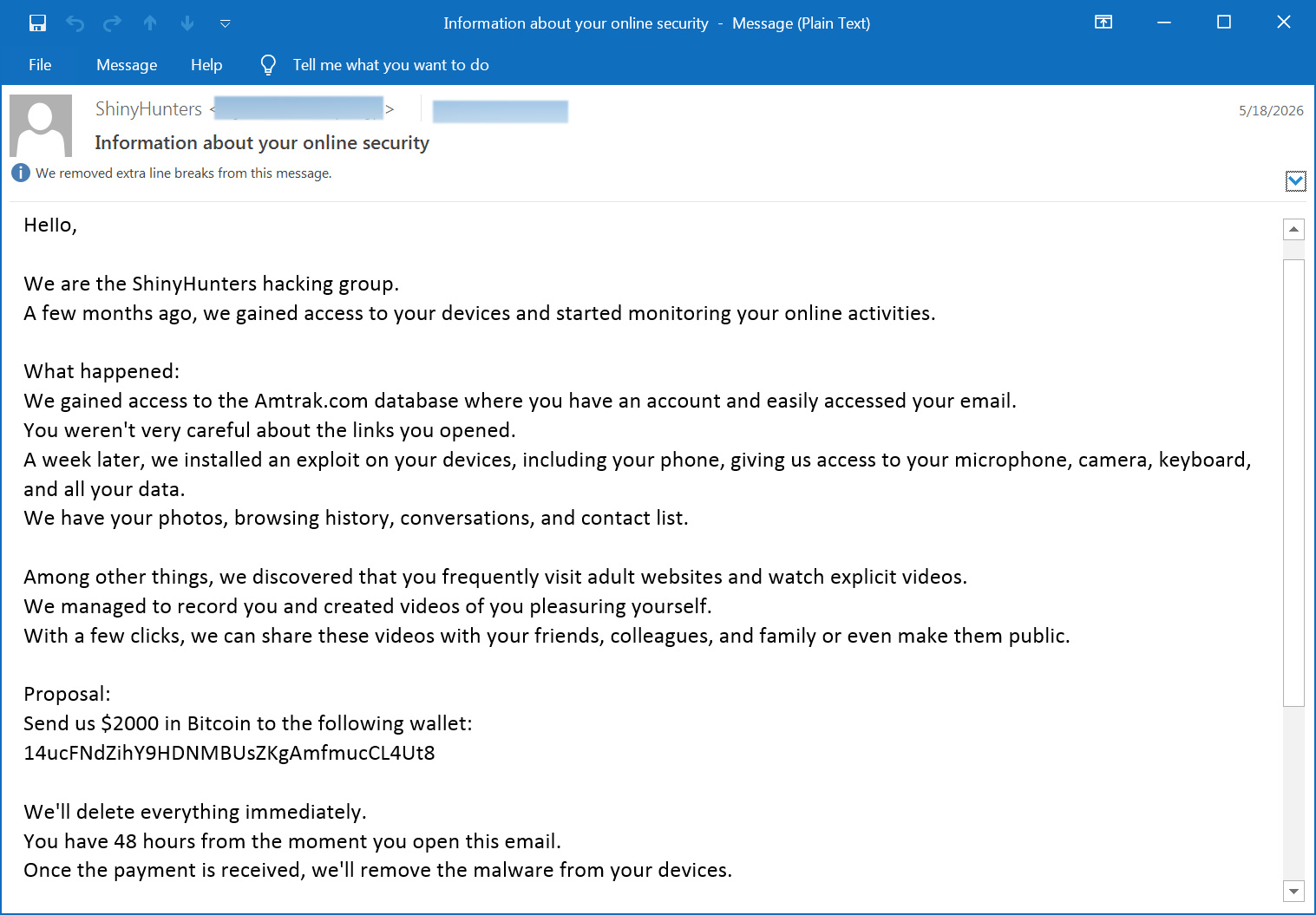
In the emails seen by BleepingComputer, they are sent from random email addresses using the names “ShinyHunters” or “You’ve Been HACKED” and have the subject “Information about your online security.”
Advertisement
The messages claim to be from the ShinyHunters hacking group and state that the attackers gained access to the recipient’s devices several months earlier.
The sender then names a company whose data was previously published by ShinyHunters, claiming that the breach allowed them to access the recipient’s email account.
We are the ShinyHunters hacking group.
A few months ago, we gained access to your devices and started monitoring your online activities.
What happened:
We gained access to the Cargurus.com database where you have an account and easily accessed your email.
You weren’t very careful about the links you opened.
A week later, we installed an exploit on your devices, including your phone, giving us access to your microphone, camera, keyboard, and all your data.
We have your photos, browsing history, conversations, and contact list.
Advertisement
Sextortion email claiming to be from the ShinyHunters extortion group Source: BleepingComputer
The email falsely claims that the attackers later “installed an exploit” on the victim’s computers and phones, allowing them to access the microphone, camera, keyboard, photos, browsing history, conversations, and contact list.
The sender then claims to have recorded the recipient visiting adult websites and threatens to share intimate videos with their friends, colleagues, and family.
To prevent the alleged release of these compromising videos, the victim is told to send $2,000 in Bitcoin within 48 hours.
The email also warns recipients not to contact police, reply to the message, or reset their devices, claiming that the stolen information is stored on remote servers.
These types of emails are known as “sextortion” emails and are designed to frighten recipients into paying a demand out of worry that they will have their reputation hurt with friends, family, and work colleagues.
Advertisement
However, there is nothing to indicate that the sender ever had access to the recipients’ devices or personal activity.
Instead, the attackers use details from published leaked data breaches, such as an email address and the name of the breached company, to make a sextortion scam appear targeted.
The sextortion campaign appears to have started in April, with numerouspeople and organizationsreporting similar messages or warning recipients to ignore them.
One person who received an email referencing the Betterment breach posted about it on the Betterment Reddit.
Betterment responded that it was aware some clients had received threatening emails claiming to come from a hacking group.
“These messages are part of a common extortion scam designed to intimidate recipients,” Betterment said.
Advertisement
“Please note, knowing an email address does not provide the ability to install malware or access someone’s device.”
The company advised recipients not to reply, send payment, click links, or open attachments and to delete the email. Betterment also asked customers who had interacted with the message to contact its fraud team.
Although their email address may have appeared in one of the published data leaks referenced in the email, this does not mean the sender compromised their devices, recorded videos, or obtained any of the other information described in the message.
Recipients of these messages should not pay the ransom or respond to the sender.
Advertisement
Security teams log 54% of successful attacks and alert on just 14%. The rest move through your environment unseen.
The Picus whitepaper shows how breach and attack simulation tests your SIEM and EDR rules so threats stop slipping by detection.
Buying your next Apple device could soon look like leasing a car. Apple is launching its new Apple Upgrade program on Tuesday, July 28, replacing new enrollments in the long-running iPhone Upgrade Program with a lease-based option that covers iPhones, iPads, Macs, and Apple Watches.
Backed by Klarna, the program is designed to lower the upfront cost of Apple’s premium devices, but it is also raising questions about whether you’ll actually own what you’re paying for.
The new program will reportedly launch first in the United States through Apple’s retail stores and online store. Eligible iPhones and Apple Watches will be offered on 24-month leases, while Macs and iPads will be offered on 36-month leases.
You’ll make monthly payments, with the option to pay off the device early, upgrade to a newer model during the lease, or keep or return it when the agreement ends. A soft credit check through Klarna will be required before you can enroll.
Apple Upgrade is expected to replace new signups for the current iPhone Upgrade Program, although existing financing plans will continue for current customers. Unlike the older program, reports suggest that AppleCare will not be included.
Advertisement
The program also excludes the base iPad, iPhone 16, Apple Watch SE, MacBook Neo, and business or education purchases. The timing is interesting because it follows Apple’s recent price increase across much of its hardware and services lineup.
Apple
Why does it matter?
The biggest concern is that Apple Upgrade may work more like a traditional car lease than a financing plan. If that is the case, your monthly payments would mainly cover the device’s depreciation instead of paying off its full value.
At the end of the lease, you could be asked to return the device or make an additional payment to own it outright. Whether this ends up saving you money or just keeps you locked into an endless upgrade cycle will likely depend entirely on how you use it.
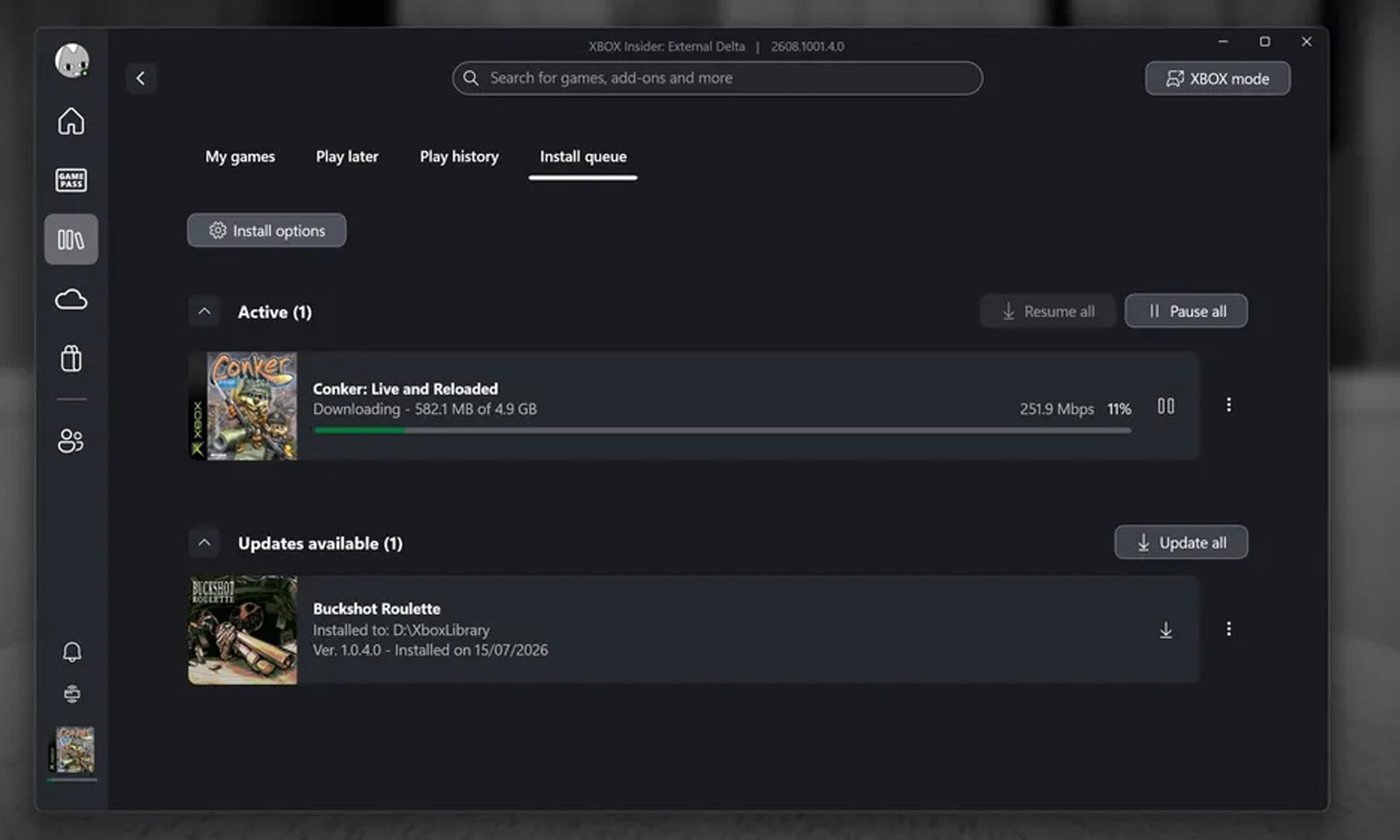
Waiting for a massive Game Pass download to finish could soon become a little less painful. Microsoft has begun testing a new Smart Download Client as part of the latest Xbox Insider Alpha Skip-Ahead update. The feature is designed to speed up game installs and updates by automatically connecting users to the fastest available content server. While it’s currently limited to Xbox Insider testers, early reports suggest the improvements are also making their way to the Xbox PC app, potentially solving one of the platform’s longest-standing frustrations.
How the Smart Download Client works
According to Microsoft’s latest Xbox Insider release notes, the Smart Download Client first checks whether download servers are available before evaluating multiple server pools to identify the fastest connection. Instead of staying connected to a single server for the entire download, it can periodically reassess network performance and seamlessly switch to a better-performing server whenever one becomes available. The feature is designed to optimize both game installations and updates, ensuring users get the best possible download speeds throughout the process.
Xbox
It may sound like a small backend tweak, but it addresses a complaint Xbox users have had for years. Even with high-speed internet connections, downloads through the Xbox app have often struggled to fully utilize the available bandwidth, resulting in slower-than-expected installation speeds. By dynamically selecting the best-performing server throughout a download, Microsoft aims to deliver more consistent performance — especially as modern games continue to grow well beyond the 100GB mark.
More than just faster downloads
The Smart Download Client is one of several additions in the latest Alpha Skip-Ahead build, which also brings improvements to the Xbox Store’s game hub for easier DLC discovery, along with fixes for game installations, system updates, Remote Play, audio, and overall console stability.
Windows Central
For now, the feature is limited to Xbox Insider testers, although early testing by Windows Central suggests the faster download system is already benefiting the Xbox PC app as well. Microsoft hasn’t shared a wider release timeline, but if the results hold up, this could become one of the most impactful quality-of-life upgrades for Game Pass users. With modern games regularly exceeding 100GB, shaving even a few minutes off every download is a win gamers will gladly take.
Facepalm: Grand Theft Auto fans were already upset that GTA 6 will be a digital-only release, with the so-called physical edition containing just a code to download the game. Gamers who purchased the retail box are now expressing even more frustration after it was officially confirmed that PS5 product codes in Japan will expire 170 days after the game’s scheduled launch date of November 19, 2026.
Rockstar clarified that the expiration period is only applicable to the PS5 version of the game in Japan and won’t affect buyers in the rest of the world. The company also confirmed that codes purchased for the Xbox are not region locked and will not expire, but it did not explain why it’s implementing the policy on one platform but not the other.
Explaining the rationale behind the unusual decision, Rockstar said that download codes work differently depending on the platform and country of purchase, and the Japan-specific policy was put in place due to “regulatory restrictions” in the country. The company also recommended that gamers buy from local retailers to avoid potential activation problems.
Advertisement
Following the announcement, many fans took to social media, slamming Rockstar for setting expiration dates on the download codes. While some likened digital gaming to renting rather than owning a product, others wondered whether Rockstar will also introduce a similar policy in other markets. Others joked that the much-hyped digital future looks brighter with every passing day.
It is worth noting that some gamers and social media commentators have speculated that the expiration date may not apply to the actual game, but only to the DLC content, which is available through a separate code in Japan. However, that still does not explain why the policy applies to PS5 but not Xbox. Rockstar has yet to clarify the matter.
GTA VI will launch on November 19, 2026, with the Standard Edition priced at $79.99 and the Ultimate Edition at $99.99. The game will be available only on PlayStation 5 and Xbox Series X/S at launch, with no word on whether there will be a PC version in the future. It is currently available for pre-order on the official Rockstar Store, the PlayStation Store, and the Xbox Store.
We also now know when it will be released: January 22, 2027.
Apple
The Apple TV series based on William Gibson’s genre-defining 1984 cyberpunk novel, Neuromancer, will hit the streaming platform on January 22 of next year. Apple dropped the news at San Diego Comic-Con this weekend alongside the first official teaser. Neuromancer stars Callum Turner, Briana Middleton, Mark Strong, Joseph Lee, Peter Sarsgaard and Clémence Poésy.
“‘Neuromancer’ follows a damaged, top-rung super-hacker named Case (Turner) who is thrust into a web of digital espionage and high-stakes crime with his partner Molly (Middleton), a razor-girl assassin, as they pull off a heist on a corporate dynasty with untold secrets,” Apple says. The series will consist of 10 episodes and follow a weekly release schedule, with the first two dropping on January 22 followed by one per week through March 19. Apple has been killing it with sci-fi lately, so here’s hoping this continues that trend.
Advertisement
It’s a good sign that Gibson, who is one of the show’s executive producers, seems to be happy with how it turned out. Sharing the teaser on Bluesky, the author posted, “Anyone who doesn’t see how very satisfied I’ve been throughout production doesn’t get what I most want out of an adaptatation [sic]. Mind you, that does tend to happen.”
Even as AMD’s GPUs have grown more competitive, the House of Zen has struggled to shake the perception that its chips are less capable because they don’t run CUDA. At its Advancing AI event in San Francisco this week, AMD unveiled ROCm.AI, which promises to let users vibe code their way to faster inference performance.
In reality, the so-called CUDA moat has become considerably shallower over the past few years as frameworks like PyTorch and JAX have made it possible for developers to write once and, for the most part, run anywhere without ever having to touch CUDA or AMD’s ROCm and HIP libraries.
Advertisement
But just because the code runs, it doesn’t necessarily mean it’s performant. Low-level programming interfaces like CUDA and ROCm remain key to unlocking a chip’s true potential.
However, hand tuning GPU kernels and general matrix-matrix multiplication (GEMM) routines to take full advantage of the silicon isn’t exactly something everyone has the experience necessary to do. But as it turns out, many of the same models developers are trying to optimize for are surprisingly good at it.
“For every generation of AMD GPUs, we have published not just the ISA spec. We actually publish the machine-readable ISA,” said AMD corporate VP of AI software and solutions Anush Elangovan, adding that as a result, “the frontier models are very, very capable of programming to AMD’s hardware.”
With ROCm.AI, AMD hopes to streamline this capability. The platform plugs into existing code assistants running on frontier models and provides them with the tools and documentation necessary to deploy, debug, and optimize models and serving frameworks for AMD Instinct hardware.
Advertisement
One of these tools is an automated workload performance optimization system called Hyperloom.
When the tool is called, for example by prompting the code assistant to “optimize MiniMax M3 with Hyperloom,” it might spin up an inference server in a Docker container, run benchmarks to establish baseline performance, profile the workload to identify bottlenecks, and adjust the configuration or even generate custom CPU kernels on the fly, Elangovan explained.
In testing on AMD’s newly launched Helios racks, this process, Elangovan claims, was able to boost model performance by 38 percent over baseline.
“We want to give you the ability to eke out the maximum performance,” he said. “This makes it incredibly easy for anyone to consume, debug, profile, and deploy.”
Advertisement
To further improve this process, AMD says that it’s leaning on its close relationship with AI model houses like OpenAI and Anthropic to ensure their models are trained to better understand the inner workings of both their hardware and software.
“We’re not just using the frontier model to generate a kernel,” Elangovan said. “We’re working deeply with frontier model companies so that they natively speak AMD programming.”
In addition to its built-in command-line interface, ROCm.AI will be offered as a plug-in for popular coding assistants, including Anthropic’s Claude Code, OpenAI’s Codex, Google’s Antigravity, and Cursor. ®













%2520Reviewer%2520Photo%2520SOURCE%2520Julian%2520Chokkattu.jpg)

-Reviewer-Photo-SOURCE-Julian-Chokkattu.jpg)



















































You must be logged in to post a comment Login