Tech
The Boomboxes That Ruled the Streets: The Most Iconic Models Through the Decades

For the uninitiated or anyone who thinks “portable audio” means a waterproof pill clipped to a backpack, the boomboxes that ruled the streets were the original mobile music weapons. Born in the late 1960s and peaking in the late ’70s and ’80s, these weren’t just stereos you carried around; they were cultural battering rams. Think Fab 5 Freddy on your TV, Yo! MTV Raps in full rotation, the Beastie Boys causing trouble in a Brooklyn alley, and breakdancers turning flattened cardboard into battlegrounds.
Boomboxes transformed sidewalks into dance floors and backseats into clubs. These weren’t gadgets. They were attitude, wrapped in metal and plastic, blasting identity at unsafe volume levels.
Back then, a ghetto blaster wasn’t a polite lifestyle accessory with Bluetooth and passive-aggressive EQ presets. It was a war chest with woofers; loud, heavy, unapologetic. Models like the JVC RC-M90, Lasonic TRC-931, Sharp GF-777, and Panasonic RX-5600 didn’t just play music; they announced your presence and dared anyone nearby to argue with your taste. And nobody embodied that energy more than Radio Raheem, hauling his box like a sonic manifesto in Do the Right Thing.

Before playlists were swiped, skipped, and forgotten, there were mixtapes—built in real time, often straight off the radio, finger hovering over the pause button like it mattered. Because it did. A mixtape was intent. Sequencing was personal. A Maxell XLII-S with Sharpie handwriting wasn’t nostalgia; it was proof you cared enough to get it right. Boomboxes carried those tapes into the streets, and for a while, they made the world listen.
What Is a Boombox? The Original Portable Stereo Explained
A boombox is a large, portable, battery-powered audio system with built-in speakers, a radio, and a cassette player and recorder. First appearing in the late 1960s, the format hit its peak in the 1980s and early 1990s. Later versions added CD players and, much more recently, Bluetooth and USB connectivity, but the basic idea never changed. A big box, a solid handle, and enough output to make sure your music was heard whether anyone asked for it or not.
The name boombox came from its integrated stereo speakers and their ability to deliver loud, booming sound. The nickname ghetto blaster came later, born on the streets rather than in a marketing meeting. These things were not polite. They were heavy, power-hungry battery pigs that chewed through D-cells like candy, and carrying one any real distance counted as arm day. Portability was relative. You could move it, but you were going to feel it.
While the ghetto blaster became closely associated with early rap and the rise of hip-hop culture, it was never limited to a single genre. Boomboxes powered block parties, fueled breakdancing battles, and blasted everything from rap and R&B to funk, reggae, pop, and rock. For teens and twenty-somethings, the boombox was more than a way to listen to music. It was a status symbol, a social magnet, and a public declaration of taste delivered at full volume.
Let’s take a look at some of the most notable boomboxes from the era when they ruled the streets.
Norelco 22RL962

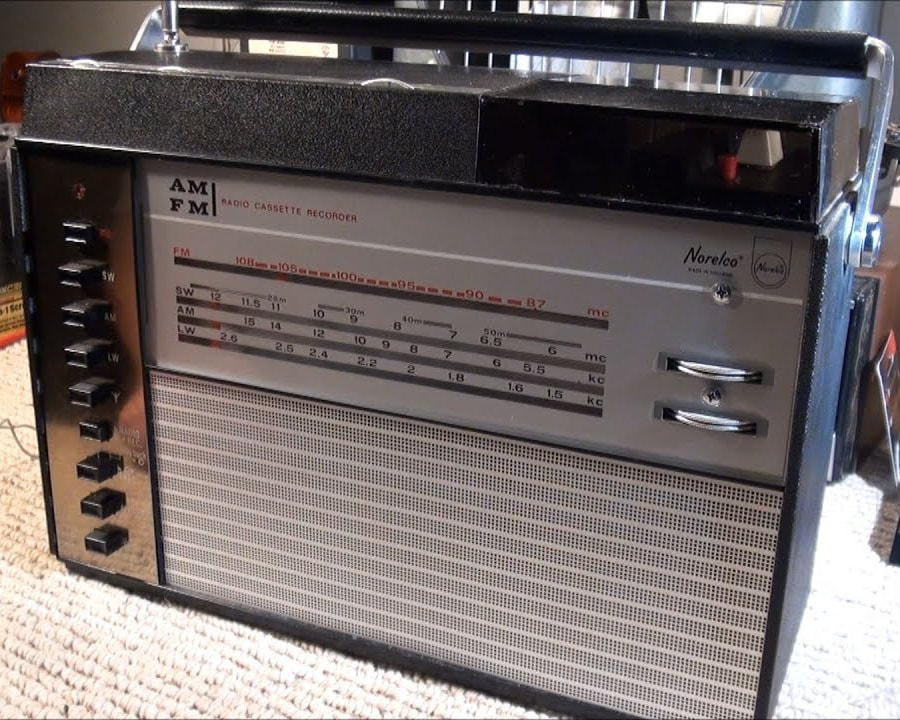
The Norelco 22RL962, made by Netherlands-based Philips (the same company that invented the compact audio cassette), is widely credited as the first true boombox. Introduced in the late 1960s, the 22RL962 established the core formula: portability, battery operation, a built-in speaker, and a single box that combined radio and tape playback.
Equipped with a carrying handle, AM/FM radio, and a compact cassette player and recorder, the 22RL962 delivered a modest 1 watt of output through its integrated speaker. Crucially, it was the first consumer audio product that allowed users to record radio broadcasts directly to cassette tape for later listening, a feature that would become central to mixtape culture in the decades that followed.
Additional connections included inputs for an external power supply, external loudspeaker or earphones, a microphone, and even a wired remote control. None of this came lightly. The 22RL962 weighed nearly 9 pounds, making it a serious haul by today’s standards and a reminder that early portability came with muscle strain included.
The original U.S. price was approximately $500, listed at 5,995 Austrian schillings at the time. Today, value depends heavily on condition, originality, and whether the unit still functions, but demand remains strong among collectors who recognize it as the box that started it all.
Check out more details from the Radio Museum or YouTube demo.
Aiwa TPR-930

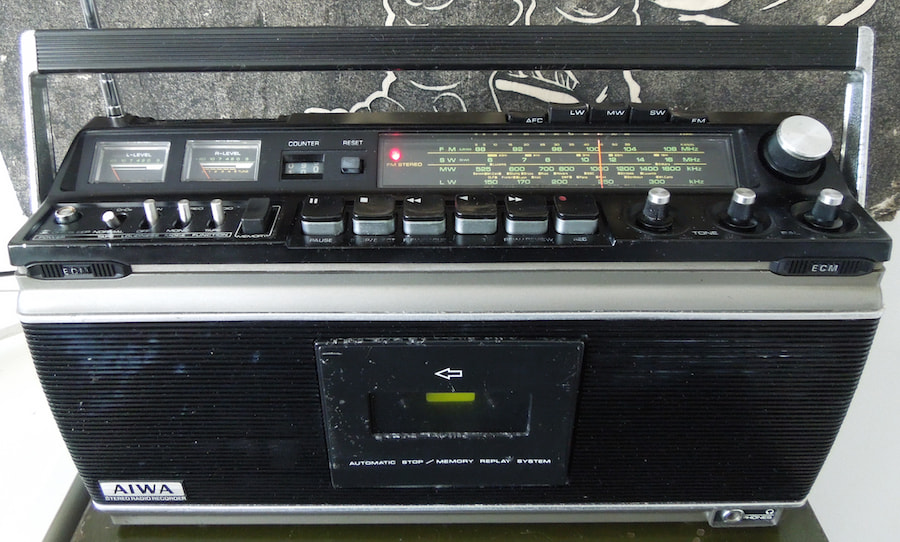
AIWA was one of the most respected audio brands of the last quarter of the 20th century, and in 1974 it entered the emerging boombox market with the TPR-930. Built like a small appliance rather than a toy, the TPR-930 reflected AIWA’s reputation for serious engineering at a time when portability still meant compromise.
Packed with 40 transistors, an integrated circuit, and a four-speaker system, the TPR-930 delivered sound quality that still earns it respect among collectors. Its heavy-duty construction came at a cost. With batteries installed, it tipped the scales at roughly 13.75 pounds, making it a true battery pig and a reminder that early boombox portability required commitment.
The TPR-930 featured a wide-band radio tuner covering SW1, SW2, AM, and FM, along with a single cassette deck. Supporting features included AIWA’s Matrix Sound System, Loudness control, AFC for more accurate radio tuning, Automatic Stop, and a Memory Replay System. It also supported CrO₂ tapes, included a three-digit analog tape counter and a built-in condenser microphone, and offered connections for external 4-ohm speakers.
Originally priced between $150 and $200 during its production run, the TPR-930 reportedly still trades in that same range today depending on condition. For collectors looking for a historically important boombox with legitimate sound quality, it remains one of the better bargains in the category.
Check out more details from the Radio Museum or YouTube demo.
National Panasonic Ambience RX-7000

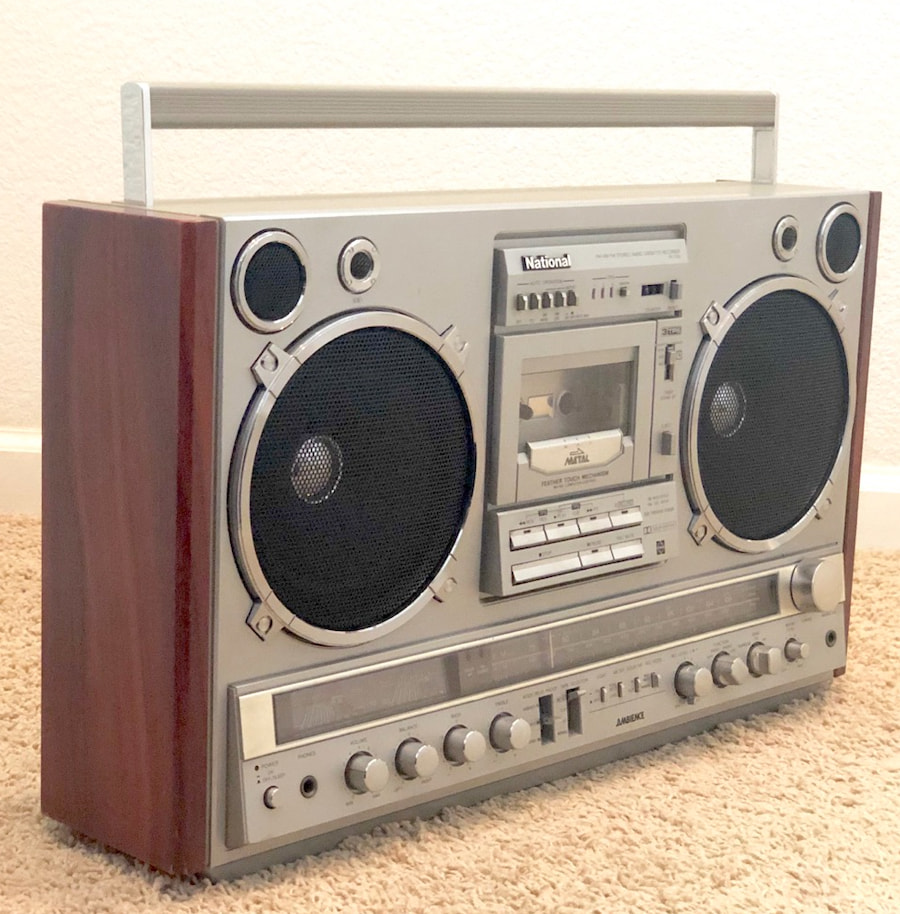
First released in the 1977-1978 timeframe, the National Panasonic Ambience RX-7000 was conceived as a high-end boombox equally comfortable anchoring a living room or making a very loud statement outside. This was not a casual portable. It was Panasonic aiming straight at the top of the category.
At its core, the RX-7000 combined an AM/FM radio with a single cassette deck, but the deck itself was unusually sophisticated for the era. Features included a tape counter, Dolby B noise reduction, Panasonic’s “3 TPS” Tape Program Sensor, a Feather Touch mechanism, microcomputer control, play and record timers, cue and review functions, manual or automatic record level control, support for Normal, FeCr, CrO₂, and Metal tapes, and a Dolby LED indicator.
Supporting features were equally comprehensive. The front panel included VU, tuning, and battery meters, mono, stereo, and Ambience (stereo-wide) listening modes, balance, bass, and treble controls, an FM stereo indicator, and a terminal for a wired remote control. Inputs were generous, with dual microphone jacks featuring mixing level control, an RCA phono input with ground terminal, and a headphone output.
One standout capability was amplification. In addition to its built-in speaker system, the RX-7000’s amplifier delivered 2 x 11 watts RMS and could power modest external speakers via dedicated terminals. The internal speaker array consisted of two 2-inch tweeters and two 6-inch woofers, reinforcing its ambitions as more than a street box.
All of that capability came with mass. The RX-7000 weighed approximately 17.6 pounds, firmly placing it in the “battery pig” category. Original pricing reflected its premium positioning, landing between $850 and $900 at launch. Today, depending on condition and completeness, demand pricing typically ranges from around $500 to well over $1,300, making it one of the most serious and collectible boomboxes of its era.
Check out more info from the Radio Museum.
Sanyo M-9994

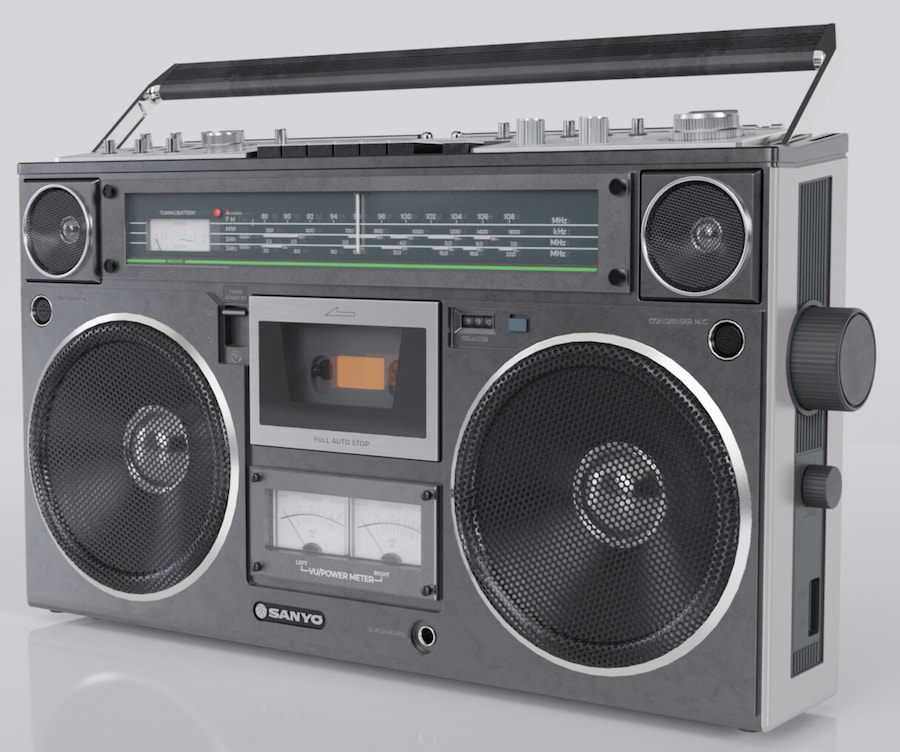
Released in 1978, the Sanyo M-9994 carved out its place in boombox culture by delivering serious sound in a relatively disciplined package. Rated at 2 x 5 watts of output power, it featured a capable speaker system with 6.3-inch woofers and 2-inch cone tweeters. Notably, the tweeters were rotatable, allowing users to improve high-frequency directionality depending on placement and listening position.
Sanyo marketed the M-9994 as a “professional edition,” and it leaned into that claim with included external handheld microphones complete with plastic desk stands. Supporting features included an Input Volume control that allowed attenuation of incoming signals from line-level or phono sources, along with a dedicated headphone output for private listening.
Originally priced between $300 and $350, the Sanyo M-9994 has appreciated significantly over time. Today, demand pricing can reach as high as $1,500 for pristine, fully functional examples, reflecting its reputation as one of Sanyo’s most desirable classic boombox designs.
Check out more info from the Radio Museum and the Sanyo M9994 Wiki Page.
Conion C-100F

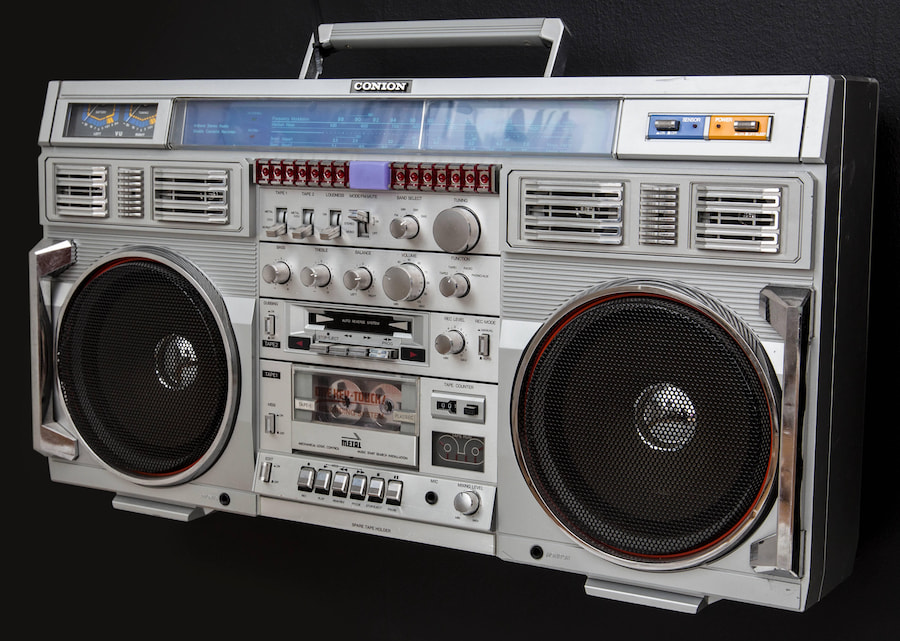
Released around 1984, the Conion C-100F is pure boombox legend and remains one of the most aggressively sought models among collectors. Oversized, overbuilt, and unapologetically loud, this was a statement piece even in an era defined by excess.
Pro Tip: The Conion brand was part of Onkyo, which helps explain why this box leaned harder into features and spectacle than restraint.
The C-100F came loaded. It featured a dual cassette deck configuration with one front-loading deck and one slot-loading deck, a four-band radio covering SW1, SW2, FM, and AM, dual VU meters, twin LED level displays, and two headphone jacks. One standout party trick was a built-in motion sensor that could be activated to trigger a security alarm if the unit was moved, a very on-brand feature for a boombox of this size and value.
The speaker array was equally ambitious, consisting of two woofers, two midrange drivers, and two tweeters. Output power was rated at 30 watts RMS at 10 percent THD, a figure that tells you everything you need to know about how hard this thing was meant to be pushed at its limits.
All of this hardware lived inside a massive 30-inch-wide chassis weighing just over 26 pounds. Portability was theoretical. Running the C-100F off batteries required ten D-cells, firmly placing it in battery-pig territory and guaranteeing that shoulder fatigue was part of the experience.
Depending on the market, the same design was also sold as the Helix HX-4365 and the Clairtone 7980. Original pricing for the Conion C-100F landed between approximately $450 and $475 in the U.S. Today, demand pricing typically ranges from around $750 to as much as $2,000, depending on condition, originality, and whether the alarm still scares the neighbors.
Find out more from the Radio Museum and Audiogon Blog.
Sharp GF-777

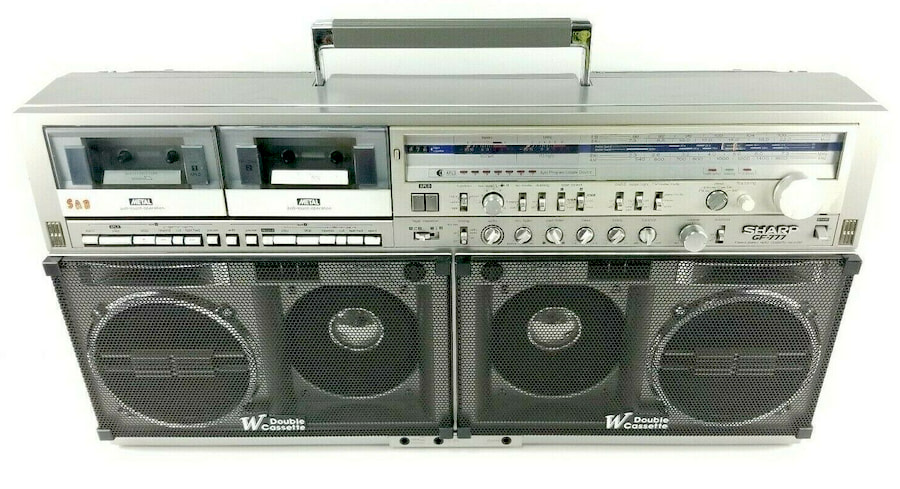
Another highly prized boombox among collectors is the Sharp GF-777, also sold in Japan as the GF-909. This model sits firmly in the heavyweight division, both in reputation and in physical presence.
The GF-777 featured a six-speaker array consisting of two woofers, two dedicated “sub” woofers, and two horn-type tweeters. Output power was rated at approximately 2 x 12 watts RMS, giving it the kind of authority that made it impossible to ignore once the play button was pressed.
Size and weight were part of the appeal. The GF-777 stretched roughly 30 inches wide and tipped the scales at about 27 pounds before batteries were added. Running it as a true portable required ten D-cell batteries, though it could also be operated on AC power for less shoulder strain and fewer trips to the battery aisle.
Originally priced at around $800, the Sharp GF-777 remains surprisingly attainable today. Depending on condition, completeness, and functionality, current demand pricing typically falls between $500 and $700, with exceptional examples commanding higher figures from collectors who know exactly what they are looking at.
Find out more from the Radio Museum and the Sharp GF777 Wiki Page.
Sharp GF-7600

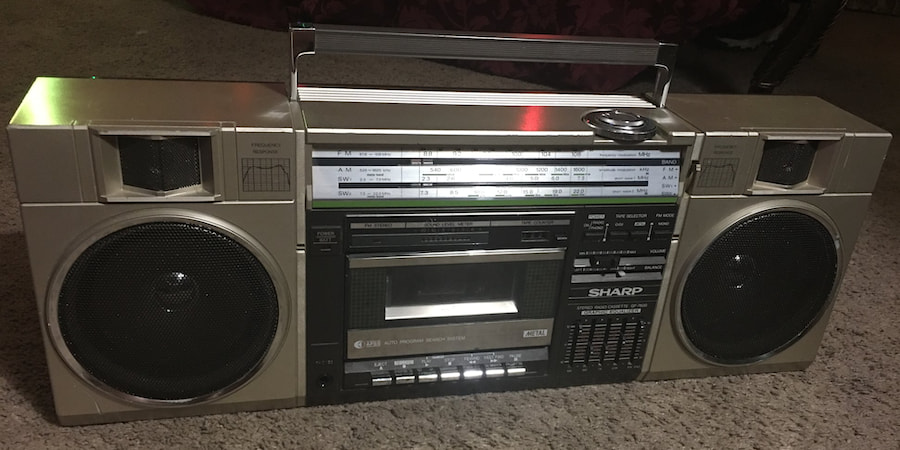
The Sharp GF-7600 is not the biggest, loudest, or most technically ambitious boombox of the 1980s, but it may be the most culturally significant. Released in 1983, it achieved permanent pop-culture status thanks to its starring role in the 1989 film Say Anything. Pity John Cusack didn’t drop it on his head.
Despite its more manageable size, the GF-7600 was surprisingly well equipped. It featured a four-band radio covering SW1, SW2, AM, and FM, a single cassette deck, a five-band graphic equalizer, an LED VU meter, line-in and line-out connections, and external microphone inputs. This was a serious feature set for a box that looked almost polite by Sharp’s usual standards.
The cassette deck supported metal tape, included full auto-stop and APSS track search, and offered a frequency response rated from 50 Hz to 16,000 Hz. Speaker duties were handled by a pair of 4.7-inch woofers and horn tweeters, while output power is generally estimated at around 5 to 6 watts per channel. Not a brute, but loud enough to make a statement—and immortal once held aloft over a rain-soaked lawn.

Original pricing varied by retailer. Today, demand pricing typically ranges from approximately $125 to $500, depending on condition, completeness, and functionality.
Find out more from the Radio Museum, Sharp GF-7600 Wiki Page, or YouTube.
Sony CFS-99

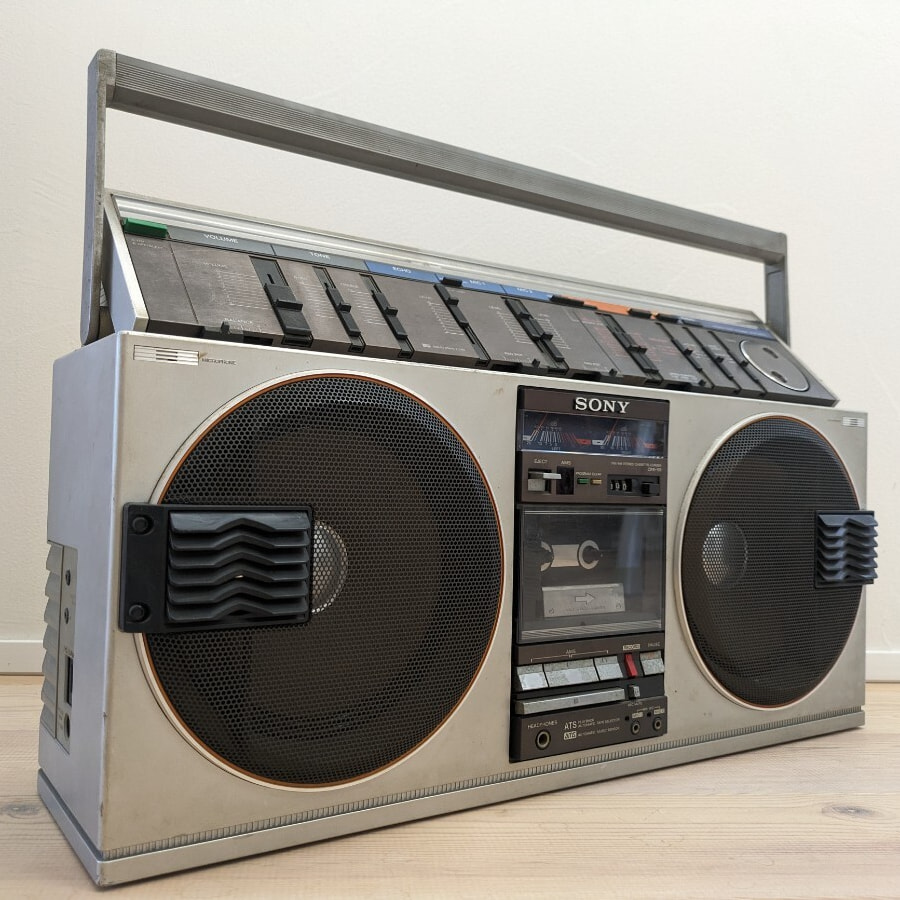
Before Sony upended personal audio with the Walkman, it was already deeply embedded in boombox culture. One of its standout entries was the Sony CFS-99, also known as the Energy 99, released in 1981. Big, loud, and unmistakably ’80s in both sound and styling, the CFS-99 paired a rugged build with serious output. It also weighed in at a back-testing 23 pounds, firmly earning its place in the heavyweight class.
Core features included an AM/FM radio and a cassette deck, with certain variants adding an LED track indicator along with dual microphone inputs featuring pan control and echo effects. Connectivity was unusually flexible for the time, offering RCA line-level inputs and outputs, while some versions also included banana speaker terminals for driving external speakers.
The original retail price is no longer well documented. Today, demand pricing typically starts around $500 and can climb higher depending on condition, originality, and whether the unit has been modified to add Bluetooth connectivity.
Find out more from the Radio Museum.
Tecsonic J-1 Super Jumbo

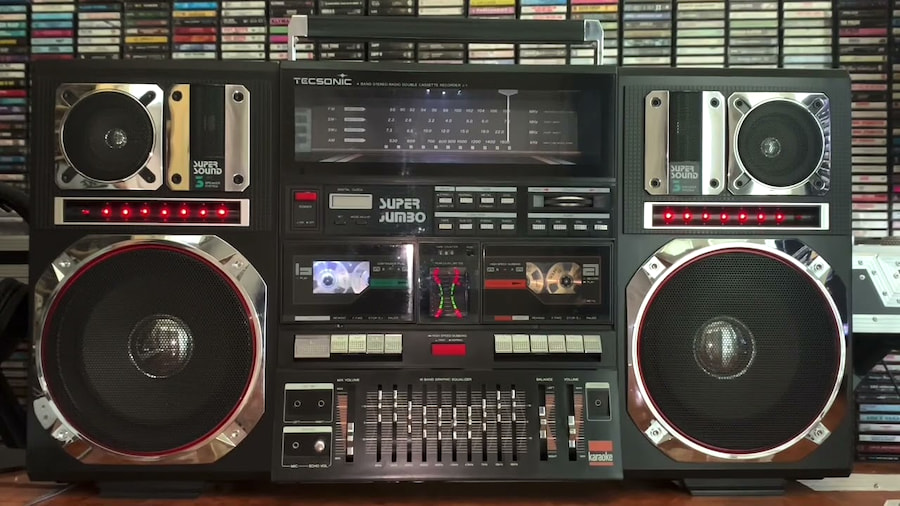
The Tecsonic J-1 Super Jumbo is another culturally significant boombox, cemented in history by its appearance in Do the Right Thing. Released in the 1987-1988 timeframe and manufactured in South Korea, the Super Jumbo wasn’t subtle. It didn’t need to be. This was a box built to be seen, heard, and remembered. Fight the Power.
The J-1 Super Jumbo featured an imposing speaker array with dual 8-inch woofers, a pair of midrange drivers, and twin tweeters. Feature-wise, it came loaded: dual cassette decks, AM/FM radio, karaoke sing-along functions, a 10-band equalizer, balance control, mixing volume, left and right front microphone inputs, a dedicated mix microphone input, phono jack, auxiliary/CD input, peak level meter, high-speed dubbing, tape counter, A/B continuous play, and an LED clock. Excess was the point.
Physically, the J-1 lived up to its name. It measured roughly 31 inches wide and 16.5 inches tall, and weighed in at around 25 pounds. Reported output power is approximately 2 x 20 watts, more than enough to back up its visual presence with real authority.
Original pricing for the Tecsonic J-1 Super Jumbo is no longer well documented. Today, demand pricing typically hovers around $1,000, depending on condition, completeness, and whether it still looks ready to be hoisted over someone’s head as a very loud act of defiance.
More details at the Radio Museum, Classic Boom Box page or YouTube.
JVC RC-M90

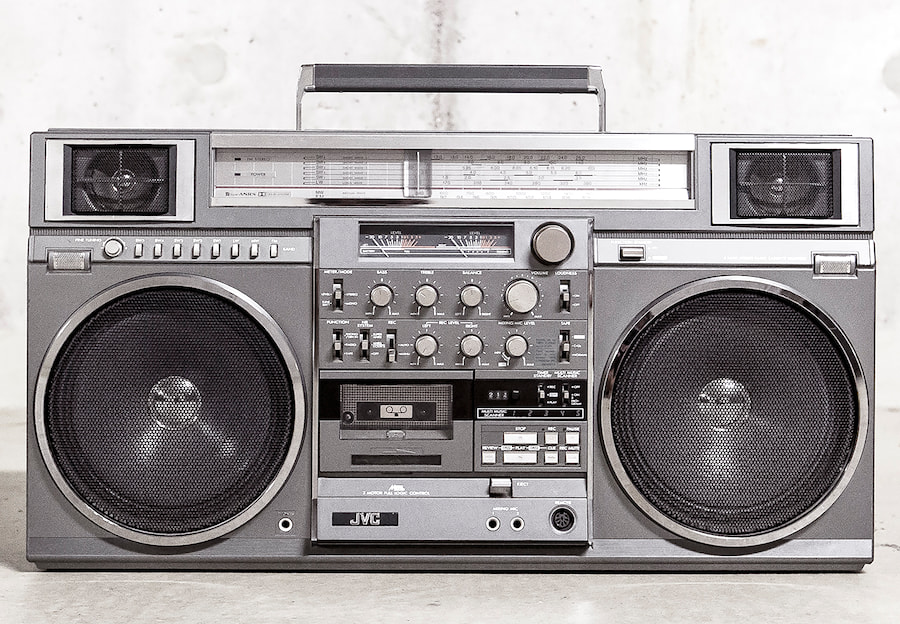
Some regard the JVC RC-M90 as the “King of Boomboxes,” and it’s not an argument without merit. Released in 1981, this was a no-compromise design that combined brute force with an unusually deep feature set.
The built-in speaker system used a two-way, four-speaker layout consisting of dual 8-inch woofers and two 2.5-inch tweeters, driven by amplification rated at approximately 2 x 20 watts. It was designed to move real air, not just make noise.
Operational features were extensive. The RC-M90 included an eight-band tuner with AM and FM coverage plus six shortwave bands, all supported by fine tuning. The cassette deck featured a tape counter, dual-motor full-logic transport, Normal, CrO₂, and Metal tape bias and EQ, JVC’s Multi Music Scanner, record and playback timers, and Dolby NR or Super ANRS noise reduction. With metal tape, cassette frequency response was rated at roughly 30 Hz to 17,000 Hz, impressive for a portable system.
Additional features included two built-in microphones, independent left and right recording level controls, microphone mixing level control, dual meters for VU, battery, and tuning, bass, treble, and balance controls, a loudness switch, and mono or stereo selection. Nothing about this box was casual.
Original pricing is documented at approximately £333 in the UK, with U.S. pricing from 1981 remaining elusive. Today, demand pricing for the JVC RC-M90 routinely exceeds $1,000, with top-condition examples commanding significantly more. For many collectors, this is the mountain every other boombox is measured against.
Find out more details from the Radio Museum.
Lasonic TRC-975

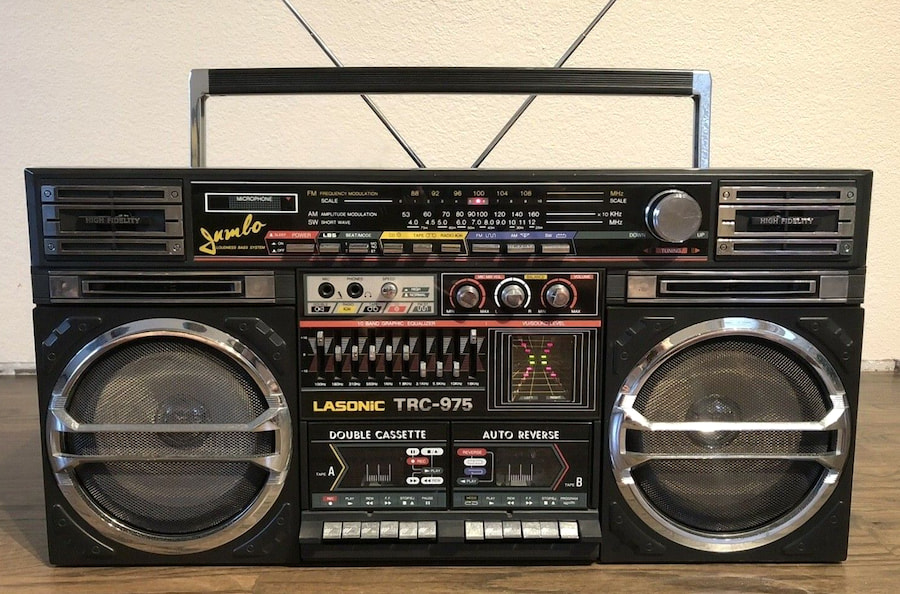
Jumping ahead to 1993, the Lasonic TRC-975 arrived as a genuine value play, originally selling for around $179. While the decade had shifted, its design was pure late-’80s muscle, and the sound followed suit. The TRC-975 earned a reputation for serious output thanks to its “Jumbo” Extra Bass system and a 10-band graphic equalizer that encouraged aggressive tweaking rather than restraint.
The speaker system consisted of dual 8-inch woofers paired with two 2-inch tweeters, a configuration aimed squarely at loud, physical sound. Feature-wise, the TRC-975 included dual cassette decks for recording and dubbing, AM/FM/SW radio, auto-reverse playback, and both normal- and high-speed dubbing. Connectivity was basic but practical, with an auxiliary input for external sources.
Some units on the secondary market have since been modified to add Bluetooth or MP3 playback, though purists tend to prefer unaltered examples. Closely associated with hip-hop culture, the Lasonic TRC-975 has become one of the most aggressively sought boomboxes of the 1990s era. Current demand pricing typically ranges from around $700 to as high as $2,300 for pristine, original-condition units, while modified versions with Bluetooth often trade closer to the lower end of that range.
Find out more from the Radio Museum.
Sharp VZ-2000


Just as CDs were beginning to reshape how people listened to music in the early 1980s, Sharp responded with one of the strangest boombox designs ever put into production: the VZ-2000, released around 1982-1983.
What made the VZ-2000 truly weird was its ambition. In addition to a radio and cassette deck, it incorporated a vertical turntable capable of playing both sides of a record at 33 or 45 rpm without flipping. To pull that off, Sharp employed dual linear-tracking tonearms controlled by a microcomputer, enabling fully automatic playback. Each arm was fitted with a Sharp 118 phono cartridge and STY-118 stylus, turning this boombox into a portable record player in the most literal sense of the word.
Beyond the vinyl trickery, the VZ-2000 featured a two-way speaker system, easy-touch controls, an auto program pause system, and metal tape compatibility for the cassette deck. On paper, it checked an absurd number of boxes for a single portable unit.
Portability, however, was relative. The VZ-2000 weighed over 35 pounds, which severely limited how far anyone was realistically carrying it. Original pricing was approximately $550, and today a fully operational example typically commands between $1,000 and $1,500 or more, depending on condition. It remains one of the clearest examples of early-’80s audio excess, when engineers still believed anything was portable if you added a handle.
Find out more details from the Radio Museum or YouTube.
The Bottom Line
These 12 boomboxes barely scratch the surface of what flooded streets, stoops, and backseats throughout the 1970s and 1980s, when portable audio was as much about presence as playback. Today’s Bluetooth speakers and smartphones are lighter, cleaner, and infinitely more convenient, but they’ve traded shared experience for private consumption. Boomboxes weren’t just how people listened to music. They were how music forced its way into the room—and made everyone deal with it together.
You must be logged in to post a comment Login