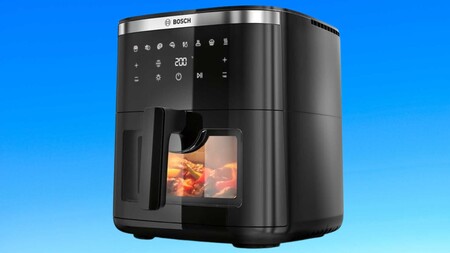








The Bosch Series 6 Air Fryer XXL is an incredibly versatile piece of kit that can make meal prep a breeze, and it’s on offer today.
While it might seem like a great idea to fill your kitchen cupboards with as many different appliances as possible, it’s far more sensible to make use of a single great device that can save you a lot of time, cooking a wide array of dishes.
It was just £5 less on Black Friday, so if you missed out back then, the £50.26 saving today will be most welcome.
Advertisement
The Bosch Series 6 7.2L air fryer is now priced just shy of its Black Friday low
The Bosch Series 7.2L air fryer has dropped to a price that’s edging remarkably close to its Black Friday low, making it a strong moment to upgrade your kitchen setup.
Not only is it perfect for whipping up some crispy chips with a steak to the side, but it’s also great for frying off some burgers or grilling a few skewers for a more traditional barbecue feel when the summer hits.
Advertisement
Advertisement
It can even roast a whole chicken, so you can indulge in a hearty Sunday roast without having to rely on the oven all weekend.
Beyond the multifunctionality, Bosch’s air fryer also has a gigantic 7.2-liter capacity, which is more than enough to cater for larger families.
There are a total of seven preset programmes to make things even easier, plus features like an illuminated viewing window and a shake alarm (let’s just say, it’s best not to read too deeply into this one).
You can toggle between functions via the appliance’s intuitive digital touchscreen, but for a quick look at what’s going on inside the fryer, Bosch has included a handy illuminated viewing window, so you don’t even need to open anything up mid-cycle to know whether or not your food is looking good.
It’s also worth mentioning that when compared to an oven, air fryers can cook your food up to 65% faster, meaning you save on time and potentially energy costs in the process.
Advertisement
For those who would prefer to peruse some other options for the time being, here are the best air fryers we’ve tested and tracked for ourselves.
Quantum computing will not be replacing supercomputers in 2026, let alone reaching industrial scale. And yet, investor appetite for companies pursuing the elusive quantum advantage hasn’t dwindled — it has increased.
Quantonation Ventures, a venture firm investing in quantum and physics-based startups, has closed its oversubscribed second fund at €220 million, or approximately $260 million. That’s more than twice the size of its inaugural fund, and comes in addition to other signals that the quantum winter isn’t coming yet.
While some warned that too much quantum hype and not enough tangible outcomes would eventually cause funding to collapse, the opposite has happened. Take the prediction that quantum will eventually crack modern encryption: that moment has no clear timeline, and yet governments have joined Big Tech in the race.
In the years since Quantonation’s launch in 2018, the quantum technology sector has become less incipient, with both technological breakthroughs and early demand from academic and industrial labs. As a result, there has also been “a shift in the types of investment opportunities that are available” to its second fund, Quantonation partner Will Zeng told TechCrunch.
Advertisement
One example is what Zeng describes as the “picks and shovels” opportunity, with companies developing technologies that support the quantum industry. He cited the example of Dutch startup Qblox, a long-boostrapped company that was selling quantum control hardware and software to Quantonation portfolio companies before the VC firm co-led its Series A.
This growing ecosystem also explains why backers are doubling down on Quantonation, and why other dedicated quantum funds such as QDNL and 55 North have emerged.
“VCs recognize that this is not an easy area to invest in at the early stage. The technology is very specific and complex, the markets are often new, and the teams as well,” Zeng said.
Techcrunch event
Advertisement
Boston, MA | June 9, 2026
The firm’s thesis is to invest early to capture more value; but a handful of quantum companies have already gone public, and their shares have surged in recent months. According to Bloomberg, this “quantum frenzy” is partly stocked by Nvidia, whose CEO Jensen Huang declared in June 2025 that “quantum computing is reaching an inflection point.”
Advertisement
Despite the fact that quantum chips have yet to outperform classical computers outside of purpose-built benchmarks, consensus is growing that real-life applications are only a few years away, from life sciences to new materials. That’s in part thanks to advancements in error correction — the ability to fix the mistakes that quantum systems are prone to.
Google’s Willow chip was a landmark for error correction in 2024, but no architecture has won yet, and smaller players are still in the race. Zeng noted that a surprising number of companies have entered DARPA’s Quantum Benchmarking Initiative. He also believes that beyond the public market excitement, “there are more exciting technologies that are currently private.”
For Quantonation, those private opportunities span a wider canvas than quantum chips alone. Fund two has already invested in 12 startups, with a target portfolio of around 25, covering not just the software and industrial layers needed to make quantum advantage real, but also adjacent physics-based technologies such as photonics and lasers.
This expanded thesis is backed by investors old and new. According to the firm, major investors from its first vintage, including Singapore’s Vertex Holdings and Bpifrance’s Fonds National d’Amorçage 2, have returned for the second fund, with new limited partners including the European Investment Fund, Grupo ACS, Novo Holdings, Planet First Partners, and Toshiba.
Advertisement
Quantonation’s geographic scope is equally international. With dual headquarters in Paris and New York City, the firm has backed French quantum companies including Pasqal and Quandela, but also placed bets in Asia and North America — and will continue doing so.
“In a lot of the areas we invest in, there’s not yet a clear regional winner, […] and a lot of the research has come from universities in many places,” Zeng said.
AWS describes the campaign as an ‘AI-powered assembly line for cybercrime’.
Commercial AI services are lowering the technical barrier needed to commit cybercrimes, and Amazon warns that this trend will continue.
Amazon Web Services (AWS) says it has observed what it describes as a Russian-speaking financially motivated threat actor that leveraged multiple commercial generative AI (GenAI) services to compromise more than 600 FortiGate devices across more than 55 countries over the past month.
FortiGate is a newer generation firewall that provides advanced network protection when compared to more traditional ones.
Advertisement
AWS describes the hacker as an “unsophisticated” individual or small group armed with AI tools that helps them achieve operational scale to commit crime, something that would have previously required a significantly larger and more skilled team.
The campaign struck out to AWS because of the hacker group’s use of multiple commercial GenAI services. AWS describes the campaign as an “AI-powered assembly line for cybercrime, helping less skilled workers produce at scale,” according to a blog authored by CJ Moses, who leads security engineering and operations at Amazon.
The threat actor compromised globally dispersed FortiGate appliances, accessing credentials and device configuration information. They then used these stolen credentials to connect to the victim’s internal networks to access more credentials, and attempts to access backup infrastructure.
According to AWS’ observations, FortiGate vulnerabilities were not exploited by the hacker. Instead, the campaign exploited exposed management ports and weak credentials with single-factor authentication.
Advertisement
Moreover, when the group encountered more secure environments, they moved on to softer targets, rather than persisting. Meaning, their power lies in AI-augmented efficiency and scale, not deeper technical skills.
The group’s targeting seemed opportunistic rather than sector-specific, targeting vulnerable appliances via mass scanning using AI tools, AWS adds.
The threat actor in this campaign is not known to be associated with any advanced persistent threat group with state-sponsored resources, the blog explains. Amazon says it was not compromised in this incident.
AWS recommends that organisations running FortiGate appliances should ensure management interfaces are not exposed to the internet. It advices that organisations change all default and common credentials on FortiGate appliances, including administrative and VPN user accounts. In addition, AWS recommends organisations enforce unique, complex passwords for all accounts.
Advertisement
Don’t miss out on the knowledge you need to succeed. Sign up for the Daily Brief, Silicon Republic’s digest of need-to-know sci-tech news.

In Singapore, few snack brands are as ubiquitous as Old Chang Kee. Chances are, you’ve grabbed a curry puff, sotong head, or fried chicken wing from them at some point.
After all, the brand operates more than 80 outlets across Singapore, and nearly 30 more overseas—a scale that cements its status as one of the country’s most recognisable homegrown F&B brands.
But what many might not know is that the company’s international ambitions haven’t always gone according to plan. After tasting failure in its earlier overseas push, it took years before Old Chang Kee decided to venture out again—this time, more careful and far more calculated.

So what went wrong the first time around? And what is it doing differently now to avoid repeating history?
Advertisement
An aggressive expansion push
Old Chang Kee initially began modestly in 1956, when Hainanese immigrant Chang Chuan Boon set up a small curry puff stall at Koek Road. After stints at Albert Street and later Mackenzie Road near Rex Cinema, its puffs, sold at S$0.35 each, became affectionately known as the “Rex curry puffs.”
Old Chang Kee stall in the ’50s vs its flagship coffee house at Rex today./ Image Credit: Old Chang Kee
The turning point for the business came in 1986, when Chang retired and sold the business to Han Keen Juan. With S$70,000 pooled from investors, Han took over the Mackenzie Road stall and set about modernising what had been a humble hawker operation.
He rebranded the business with a new logo and the tagline “Old Chang Kee—it’s a better puff,” standardised recipes, mechanised production, and slowly expanded across Singapore.
By 1991, the company had 12 outlets and revenue had more than doubled to S$1.6 million. A factory in Ubi was also set up, churning out over 10,000 curry puffs a day.
Then came the brand’s aggressive overseas push.
Advertisement
Between 1993 and 1997, Old Chang Kee rapidly expanded through franchises into eight countries, including Malaysia, Indonesia, China, Japan, India and even South Africa. Sales in Indonesia and Malaysia alone surpassed S$1 million by 1994.
Declining sales & mounting quality complaints
While the growth was rapid, it was unfortunately difficult to sustain.
Overseas franchisees began facing declining sales and mounting complaints over product quality and consistency.
Image Credit: Old Chang Kee
The brand’s CFO, Song Yeow Chung, told Vulcan Post that during its first overseas push, Old Chang Kee exported only curry powder, leaving franchisees to prepare the rest of the spice mix on their own, a model that led to variations in taste across markets.
Brand familiarity was another challenge.
Advertisement
Song noted that in the 1990s, international travel was far less common than it is today. Consumers in overseas markets were largely unfamiliar with Old Chang Kee and had little prior exposure to its products or brand identity.
By 2002, the overseas outlets had eventually become unprofitable. Han made the decision to terminate all 24 franchises, incurring losses of around S$50,000.
Doubling down on Singapore
Image Credit: Old Chang Kee
While its international ventures faltered, Old Chang Kee doubled down on its Singapore growth, recording S$14 million in sales that year.
Today, the brand operates 77 Old Chang Kee outlets, alongside two sub-brands, including Curry Times, a curry‑themed restaurant concept, and Dip N Go, a grab‑and‑go concept focused on snack items paired with sauces, bringing its total footprint in Singapore to around 82 outlets.
Image Credit: Dewi Abiha, Anderson Ooi via Google Reviews
Consistency is at the heart of its strategy. The curry puff recipe—a core trademark—has remained unchanged over the years, so much so that it is locked in a safe, inaccessible even to the CFO.
While the curry puff remains the brand’s flagship product, Old Chang Kee has also gradually diversified its offerings and expanded its menu.
Advertisement
“We have products like the steamed curry bao, big curry buns, and we’ve collaborated with other players to introduce a curry sandwich. We’re trying to innovate beyond the core product, but not moving too far away from it,” explained Song.
Seasonal ranges, like the chicken mushroom puff, are tested in small batches. If they resonate with customers, they are added permanently to the menu.The brand leverages its large central kitchen, capable of producing up to 50,000 curry puffs daily, to run these experiments.
“It is a constant series of small experiments,” Song said. “The experiments don’t cost us a lot, and are easily reversible in case they don’t work out.”
These efforts earned Old Chang Kee the Overall Winner Award in the Product Excellence category at the Singapore Manufacturing Federation’s inaugural Singapore Innovation and Manufacturing Excellence Awards (SIMEA) 2026, recognising its commitment to quality, innovation, and pushing boundaries in the manufacturing sector.
Advertisement
A more measured overseas strategy
The same approach now guides the brand’s overseas strategy.
When the company officially re‑entered international markets in 2005, it prioritised strict quality control, establishing regional factories to ensure its curry puffs tasted consistent across borders.
Instead of shipping curry powder, the company now sends ready-made curry paste, reducing preparation steps for franchisees. Products are also adapted for local tastes, with roughly 70% of offerings maintaining the core identity and 30% customised.
Old Chang Kee outlets in Indonesia./ Image Credit: RnC Studio via Shutterstock.com
Markets are also chosen more strategically, with a focus on countries like Malaysia and Indonesia, where fried foods are popular, and curry flavours resonate with local palates. The company operates around 30 outlets in Indonesia, run by a master franchisee, and three in Malaysia.
London is another market the company has targeted. While it may seem unconventional, the move into the country in 2017 is part of Old Chang Kee’s strategy to experiment internationally while leveraging Singapore’s culinary reputation.
Advertisement
The move seems to have worked out: the company has been in London for nearly a decade, appealing to consumers with a taste for curry.
Old Chang Kee’s London outlet./ Image Credit: Tripadvisor
But not all international experiments have been as successful for Old Chang Kee, such as its expansion into Perth.
While the market was initially chosen for its large population of Malaysians and Singaporeans, the specific outlet location—a suburban shopping centre with limited footfall—ultimately failed to attract enough customers, leading to its closure.
The company is now exploring whether relocating to a city-centre location could make the venture viable.
Growing in the retail & non-retail space
Image Credit: Michelin Guide/ United Square
As a homegrown F&B brand with decades of experience, these lessons have played an important role in shaping Old Chang Kee’s strategy, guiding its decisions both at home and abroad.
When asked about future overseas ventures, the company remains open to new opportunities—albeit with a more careful and calculated approach.
Advertisement
At the same time, maintaining and growing its Singapore footprint remains just as important, particularly in a competitive and ever-changing F&B landscape.
“Currently, we have 82 outlets in Singapore,” Song said. “For comparison, Starbucks has around 140 outlets and McDonald’s, over 150. So there’s still leeway for us to grow to 140 or 150 outlets—there’s promise in Singapore for further expansion.”
Beyond just retail, Old Chang Kee is also exploring other revenue streams to drive growth.
While over 90% of revenue still comes from its stores, the brand’s non-retail segments, including delivery, catering, and event services, are expanding “much faster,” and are seen as key areas for future growth.
Advertisement
Delivery and packaged meals allow the company to reach more customers without the constraints of storefront manpower, while catering ranges from small office orders to full-scale corporate events. The brand’s O’ My Darling food truck also participates in national initiatives, such as the National Day Parade, offering free snacks to participants while boosting brand visibility.
Song noted that these non-retail initiatives are supported by Old Chang Kee’s strong brand recognition and Halal certification.
“Businesses already know and trust Old Chang Kee, so they’re willing to order our bento meals or catered snacks. Being Halal-certified also means our products can be served to everyone, which is a big advantage for corporate clients.”
Read other articles we’ve written on Singaporean businesses here.
Featured Image Credit: Old Chang Kee/ @eileen_eats_alotvia Instagram
When one company asked job applicants to submit a video where they answer a question, most of the 300 responses were “eerily similar,” reports the Washington Post (with a company executive saying it was “abundantly clear” they’d used AI.)
Job seekers are turning to AI to help them land jobs more quickly in a tough labor market…. Employers say that’s having an unintended consequence: Many applications are looking and sounding the same…
It’s easy to spot when candidates over-rely on AI, some employers said. Oftentimes, executive summaries will look eerily similar to each other, odd phrases that people wouldn’t normally use in conversation creep into descriptions, fancy vocabulary appears, and someone with entry-level experience uses language that indicates they are much more senior, they added. It’s worse when they use auto-apply AI tools, which will find jobs, fill out applications and submit résumés on the candidate’s behalf, some employers said. Those tend to misinterpret some of the application questions and fill in the wrong information in inappropriate spots. If these applications were evaluated alone, employers say they’d have a harder time identifying AI usage. But when hundreds of applications all have the same issue, they said, AI’s role in it becomes obvious. The article acknowledges that some employers could be using AI tools to screen resumes too. One job-seeker in Texas even says he’ll stop submitting an AI-written résumé when the recruiter stops using AI to evaluate them. “You’re saying, ‘You shouldn’t be doing this’ when I know a good chunk of them do this!”
As well as being simply places to fill up your tank, some gas stations have become destinations in their own right. The biggest gas station in the world is a Buc-ee’s in Texas, and it features more than 100 pumps alongside a huge store that functions as a convenience store, souvenir shop, and BBQ outlet all in one. Whether it’s a big or a small location, you might think you know everything worth knowing about your local gas station, but many people don’t think about who actually owns the place that they visit so frequently.
It hasn’t always been this way: Circle K can trace its roots back to 1950s Texas, when businessman Fred Hervey bought a small chain of food stores. After expanding into the burgeoning gasoline business, Circle K grew rapidly and opened or acquired locations all over the U.S. Its first international location opened in Japan in 1979, and today Circle K operates in 23 countries. By 2020, there were around 9,800 Circle K locations in North America alone.
Advertisement
The history of Alimentation Couche-Tard
Gregory Clifford/Getty Images
Despite Alimentation Couche-Tard owning Circle K today, the Canadian company hasn’t been around for as long as the gas station chain. Alimentation Couche-Tard was founded in 1980 as a single convenience store in Laval, Quebec and, much like Circle K, it grew rapidly over its first couple of decades of operation. A key part of that growth was acquisition — rather than open its own locations, Alimentation Couche-Tard would take over existing chains and take advantage of their existing network and customer bases.
These acquisitions continued until Alimentation Couche-Tard had absorbed enough of its competition to become the largest convenience store operator in Canada. It reached that milestone in 1999, and just four years later, it made a major move into the U.S. market by purchasing Circle K. The company’s original founder, Alain Bouchard, remains with the company today as executive chairman.
Advertisement
Circle K hasn’t changed hands for more than two decades, but not every foreign-owned gas station chain has enjoyed such stability. Lukoil has a string of locations on the U.S. East Coast, but its future has been uncertain since 2022, as it’s owned by a Russian company. Negotiations surrounding the chain are still ongoing at the time of writing, but the American Carlyle Group has provisionally agreed to buy most of Lukoil’s U.S. assets.
While there are a ton of OLED screens to choose from, gamers have a different set of needs when it comes to their TVs. For those weeknight warriors, we recommend the Samsung S90F QD-OLED, and the 65-inch model is currently marked down to $1,298 at Amazon. That’s a big discount from its list price and about $100 below the price where it’s been sitting for a few months.
What the Samsung S90F lacks in top-level brightness it more than makes up for with its impressive detail and clear image quality. The colors are bold and flashy while also staying nice and accurate across the panel, and the contrast is incredible, thanks to the OLED panel’s ability to reach basically blacked-out levels in the darkest corners of your favorite RPG. It has excellent glare-reduction in bright rooms, which is perfect for those Saturday-afternoon gaming sessions. Add in support for HDR10/10+, and you’ve got a screen that’s just as good for movies as it is for first-person shooters.
Gamers can look forward to the Samsung Gaming Hub, which has a great set of features for both cloud and local gaming. Unlike some of our other favorite TVs that aren’t as considerate towards gaming, the S90F also boasts a full set of four HDMI 2.1 ports, so you won’t have to pick a favorite console or swap cables every time you switch games. The gaming bar lets you quickly adjust settings to suit your favorite genre, and it has super-fast input response times to help keep your character alive in-game. While capable consoles will happily run the 4K S90F at 120 Hz, PC gamers with compatible GPUs can push that all the way to 144 Hz at 4K.
You can play classic computer games from the comfort of your couch by using RetroArch with the Apple TV. Here’s how to get retro gaming on Apple’s streaming box.
RetroArch works on the Apple TV
Retro gaming on Apple’s ecosystem enjoyed a revival in 2024, as Apple updated its App Store Review Guidelines to allow emulators into the App Store. The change led to a gold rush of emulators arriving in the digital storefront, providing ways to play classic titles on your iPhone or iPad. The change also made it possible to do the same on the Apple TV. The set-top box in the living room seems like the perfect bit of kit to play retro games on, being connected to a large TV and in the comfiest chairs of the home. Continue Reading on AppleInsider | Discuss on our Forums
Investment firms are on track for an enormous payday after the Supreme Court of the United States (SCOTUS) struck down President Donald Trump’s signature tariff policy on Friday.
When Trump introduced sweeping tariffs on foreign goods last April, hedge funds and specialist investment firms began to bet on the possibility that the courts might rule that he had violated the law. They did that by purchasing the right to theoretical tariff refunds at cents on the dollar from struggling importers who wanted to swap the possibility of a future refund for an immediate cash payment.
“We were like, [Trump] is capriciously applying the law,” says Thomas Braziel, founder of investment firm 117 Partners, who says he purchased $925,000 worth of tariff refund claims with his own money. “That was the play.”
This trade was brokered by a variety of Wall Street firms. Though only a select few hedge funds engaged in the trade, those that did generally bought tens of millions of dollars worth of claims, says Neil Seiden, president at Asset Enhancement Solutions, one of the brokerages. “They didn’t want to deal with anything small,” says Seiden.
Advertisement
After SCOTUS ruled that it was illegal for Trump to impose tariffs under the International Emergency Economic Powers Act (IEEPA)—the law used to justify the extensive Liberation Day tariffs—traders who bet against him are on track to multiply their stake. Braziel says he stands to make a more than eight-fold return.
However, though SCOTUS ruled that the IEEPA tariffs were illegal, it did not explicitly address whether the government will be required to issue refunds. “That’s the billion-dollar question,” says Seiden. “Everybody is in a state of flux.”
The question of refunds will be kicked back to the lower courts, says Lawrence Friedman, partner at law firm Barnes Richardson. Even then, he says, the administration may choose to challenge any lower court ruling that requires the government to refund tariff payments. “The President does not like district courts making nationwide injunctions,” claims Friedman.
Asked about the possibility of tariff refunds on Friday, Trump said, “I guess it has to get litigated.” The White House did not respond to a further request for comment.
Advertisement
The prevailing uncertainty leaves the investment firms holding refund claims with a dilemma: Should they bank some winnings by flipping the claims to another buyer, or wait out the legal wrangling? “Trump is Trump is Trump, man,” says Braziel. “I’m not sure if you want to be on the other side of him, no matter how good the legal arguments are.”
Ultimately, though, “it’s a much better day than it was yesterday,” says Friedman, for any hedge funds who took up the trade and importers who chose not to sell their refund claims. “I think it’s extremely unlikely that refunds won’t get granted.”
“A surprisingly ravenous black hole from the dawn of the universe is breaking two big rules,” reports Live Science. “It’s not only exceeding the ‘speed limit’ of black hole growth but also generating extreme X-ray and radio wave emissions — two features that are not predicted to coexist…”
“How is this rule-breaking behavior even possible? In a paper published Jan. 21 in The Astrophysical Journal, an international team of researchers observed ID830 in multiple wavelengths to find an answer….”
As they attract gas and dust, this material accumulates in a swirling accretion disk. Gravity pulls the material from the disk into the black hole, but the infalling material generates radiation pressure that pushes outward and prevents more stuff from falling in. As a result, black holes are muzzled by a self-regulating process called the Eddington limit… Its X-ray brightness suggests that ID830 is accreting mass at about 13 times the Eddington limit, due to a sudden burst of inflowing gas that may have occurred as ID830 shredded and engulfed a celestial body that wandered too close. “For a supermassive black hole (SMBH) as massive as ID830, this would require not a normal (main-sequence) star, but a more massive giant star or a huge gas cloud,” study co-author Sakiko Obuchi, an observational astronomer at Waseda University in Tokyo, told Live Science via email. Such super-Eddington phases may be incredibly brief, as “this transitional phase is expected to last for roughly 300 years,” Obuchi added.
ID830 also simultaneously displays radio and X-ray emissions. These two features are not expected to coexist, especially because super-Eddington accretion is thought to suppress such emissions. “This unexpected combination hints at physical mechanisms not yet fully captured by current models of extreme accretion and jet launching,” the researchers said in a statement. So while ID830 is launching massive radio jets, its X-ray emissions appear to originate from a structure called a corona, produced as intense magnetic fields from the accretion disk create a thin but turbulent billion-degree cloud of turbocharged particles. These particles orbit the black hole at nearly the speed of light, in what NASA calls “one of the most extreme physical environments in the universe.” Altogether, ID830’s rule-breaking behaviors suggest that it is in a rare transitional phase of excessive consumption — and excretion. This incredible feeding burst has energized both its jets and its corona, making ID830 shine brightly across multiple wavelengths as it spews out excess radiation.
Advertisement
Additionally, based on UV-brightness analysis, quasars like ID830 may be unexpectedly common, the researchers said. Models predict that only around 10% of quasars have spectacular radio jets, but these energetic objects could be significantly more abundant in the early universe than previously suggested. Most importantly, ID830 also shows how SMBHs can regulate galaxy growth in the early universe. As a black hole gobbles matter at the super-Eddington limit, the energy from its resultant emissions can heat and disperse matter throughout the interstellar medium — the gas between stars — to suppress star formation. As a result, ancient SMBHs like ID830 may have grown massive at the expense of their host galaxies.
Looking for the most recent Mini Crossword answer? Click here for today’s Mini Crossword hints, as well as our daily answers and hints for The New York Times Wordle, Strands, Connections and Connections: Sports Edition puzzles.
Need some help with today’s Mini Crossword? I had to read through some of the clues several times to figure them out. Read on for all the answers. And if you could use some hints and guidance for daily solving, check out our Mini Crossword tips.
If you’re looking for today’s Wordle, Connections, Connections: Sports Edition and Strands answers, you can visit CNET’s NYT puzzle hints page.