Connect with us

Tech

The Complicated Legacy Of Mind Controlled Toys

Published

on

Imagine a line of affordable toys controlled by the player’s brainwaves. By interpreting biosignals picked up by the dry electroencephalogram (EEG) electrodes in an included headset, the game could infer the wearer’s level of concentration, through which it would be possible to move physical objects or interact with virtual characters. You might naturally assume such devices would be on the cutting-edge of modern technology, perhaps even a spin-off from one of the startups currently investigating brain-computer interfaces (BCIs).
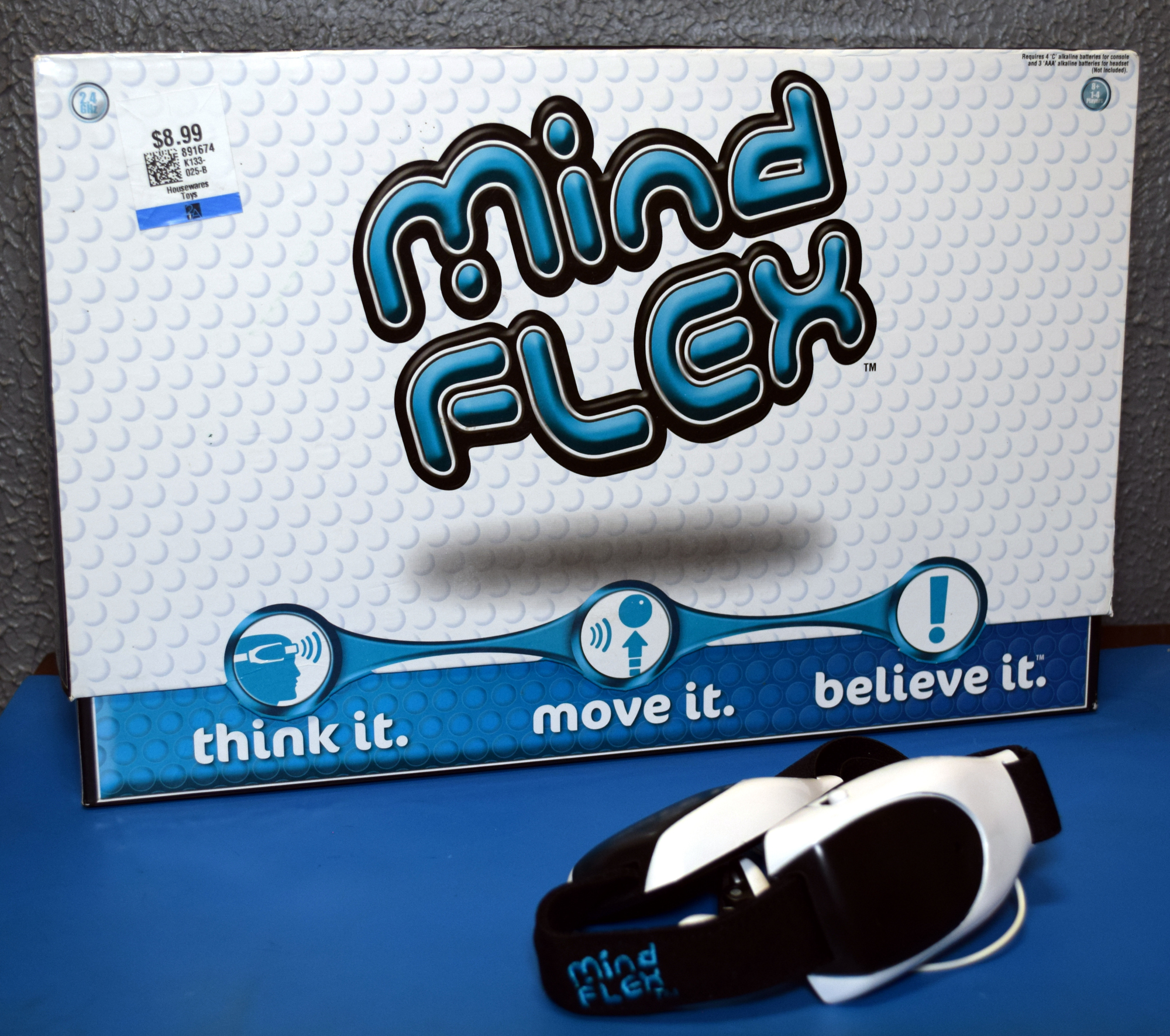
But the toys in question weren’t the talk of 2025’s Consumer Electronics Show, nor 2024, or even 2020. In actual fact, the earliest model is now nearly as old as the original iPhone. Such is the fascinating story of a line of high-tech toys based on the neural sensor technology developed by a company called Neurosky, the first of which was released all the way back in 2009.

Yet despite considerable interest leading up to their release — fueled at least in part by the fact that one of the models featured Star Wars branding and gave players the illusion of Force powers — the devices failed to make any lasting impact, and have today largely fallen into obscurity. The last toy based on Neurosky’s technology was released in 2015, and disappeared from the market only a few years later.

I had all but forgotten about them myself, until I recently came across a complete Mattel Mindflex at a thrift store for $8.99. It seemed a perfect opportunity to not only examine the nearly 20 year old toy, but to take a look at the origins of the product, and find out what ultimately became of Neurosky’s EEG technology. Was the concept simply ahead of its time? In an era when most people still had flip phones, perhaps consumers simply weren’t ready for this type of BCI. Or was the real problem that the technology simply didn’t work as advertised?

Shall We Play a Game?

NeuroSky was founded in 1999 to explore commercial applications for BCIs, and as such, they identified two key areas where they thought they could improve upon hardware that was already on the market: cost, and ease of use.

Advertisement

Cost is an easy enough metric to understand and optimize for in this context — if you’re trying to incorporate your technology into games and consumer gadgets, cheaper is better. To reduce costs, their hardware wasn’t as sensitive or as capable as what was available in the medical and research fields, but that wasn’t necessarily a problem for the sort of applications they had in mind.

Of course, it doesn’t matter how cheap you make the hardware if manufacturers can’t figure out how to integrate it into their products, or users can’t make any sense of the information. The average person certainly wouldn’t be able to make heads or tails of the raw data coming from electroencephalography or electromyography sensors, and the engineers looking to graft BCI features into their consumer products weren’t likely to do much better.
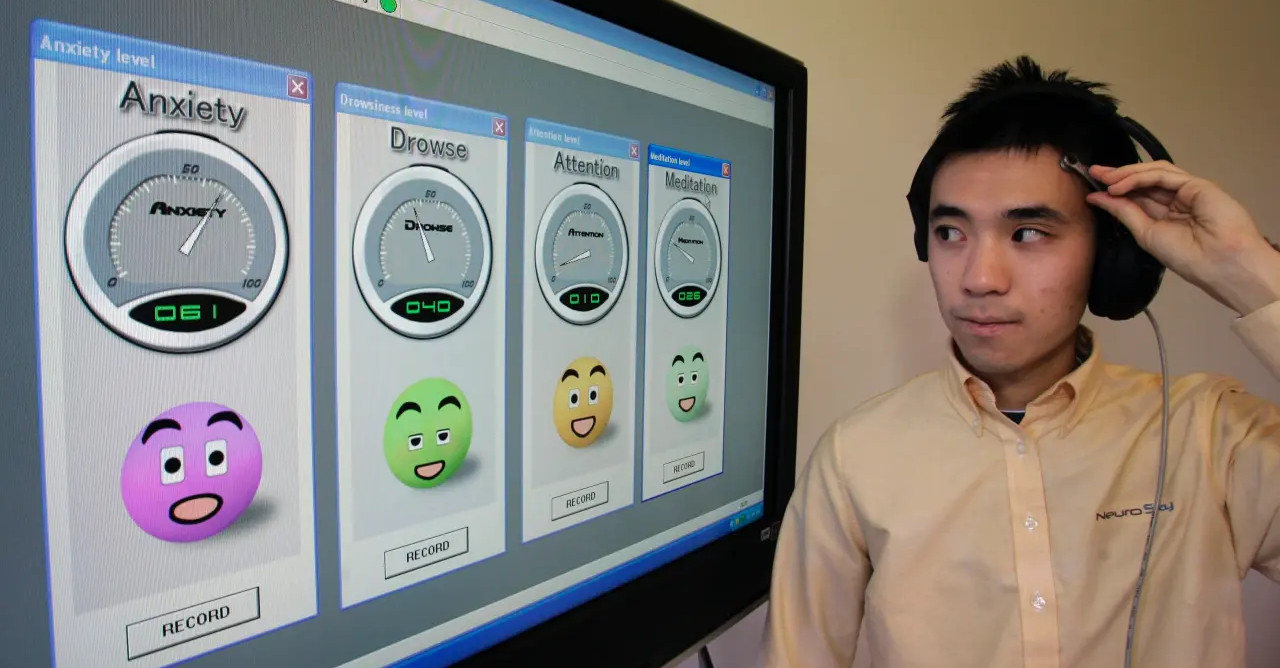
NeuroSky engineer Horance Ko demonstrates a prototype headset in 2007.

To address this, NeuroSky’s technology presented the user with simple 0 to 100 values for more easily conceptualized parameters like concentration and anxiety based on their alpha and beta brainwaves. This made integration into consumer devices far simpler, albeit at the expense of accuracy and flexibility. The user could easily see when values were going up and down, but whether or not those values actually corresponded with a given mental state was entirely up to the interpretation being done inside the hardware.

These values were easy to work with, and with some practice, NeuroSky claimed the user could manipulate them by simply focusing their thoughts. So in theory, a home automation system could watch one of these mental parameters and switch on the lights when the value hit a certain threshold. But the NeuroSky BCI could never actually sense what the user was thinking — at best, it could potentially determine how hard an individual was concentrating on a specific thought. Although in the end, even that was debatable.

The Force Awakens

After a few attempted partnerships that never went anywhere, NeuroSky finally got Mattel interested in 2009. The result was the Mindflex, which tasked the player with maneuvering a floating ball though different openings. The height of the ball, controlled by the speed of the blower motor in the base of the unit, was controlled by the output of the NeuroSky headset. Trying to get two actionable data points out of the hardware was asking a bit much, so moving the ball left and right must be done by hand with a knob.

Advertisement

But while the Mindflex was first, the better known application for NeuroSky’s hardware in the entertainment space is certainly the Star Wars Jedi Force Trainer released by Uncle Milton a few months later. Fundimentally, the game worked the same way as the Mindflex, with the user again tasked with controlling the speed of a blower motor that would raise and lower a ball.

But this time, the obstacles were gone, as was the need for a physical control. It was a simpler game in all respects. Even the ball was constrained in a clear plastic tube, rather than being held in place by the Coandă effect as in the Mindflex. In theory, this made for a less distracting experience, allowing the user to more fully focus on trying to control the height of the ball with their mental state.

But the real hook, of course, was Star Wars. Uncle Milton cleverly wrapped the whole experience around the lore from the films, putting the player in the role of a young Jedi Padawan that’s using the Force Trainer to develop their telekinetic abilities. As the player attempted to accurately control the movement of the ball, voice clips of Yoda would play to encourage them to concentrate harder and focus their minds on the task at hand. Even the ball itself was modeled after the floating “Training Remote” that Luke uses to practice his lightsaber skills in the original film.

Advertisement

The Force Trainer enjoyed enough commercial success that Uncle Milton produced the Force Trainer II in 2015. This version used a newer NeuroSky headset which featured Bluetooth capability, and paired it with an application running on a user-supplied Android or Apple tablet. The tablet was inserted into a base unit which was able to display “holograms” using the classic Pepper’s Ghost illusion. Rather than simply moving a ball up and down, the young Jedi in training would have to focus their thoughts to virtually lift a 3D model of an X-Wing out of the muck or knock over groups of battle droids.

Unfortunately, Force Trainer II didn’t end up being as successful as its predecessor, and was discontinued a few years later. Even though the core technology was the same as in 2009, the reviews I can still find online for this version of the game are scathing. It seems like most of the technical problems came from the fact that users had to connect the headset to their own device, which introduced all manner of compatibility issues. Others claimed that the game doesn’t actually read the player’s mental state at all, and that the challenges can be beaten even if you don’t wear the headset.

Headset Hacking

The headsets for both the Mindflex and the original Force Trainer use the same core hardware, and NeuroSky even released their own “developer version” of the headset not long after the games hit the market which could connect to the computer and offered a free SDK.

Advertisement

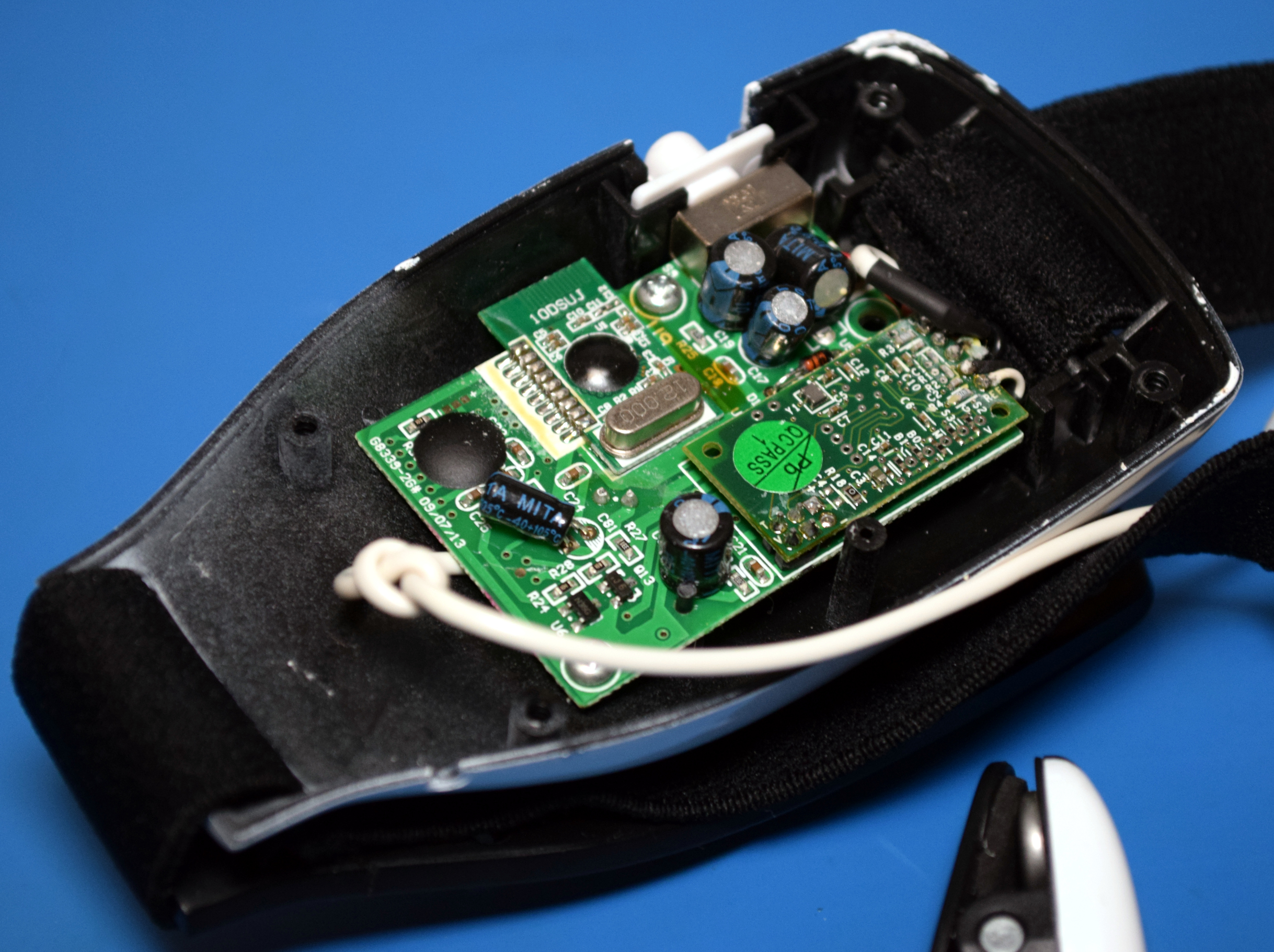
Over the years, there have been hacks to use the cheaper Mindflex and Force Trainer headsets in place of NeuroSky’s developer version, some of which have graced these very pages. But somehow we missed what seems to be the best source of information: How to Hack Toy EEGs. This page not only features a teardown of the Mindflex headset, but shows how it can be interfaced with the Arduino so brainwave data can be read and processed on the computer.
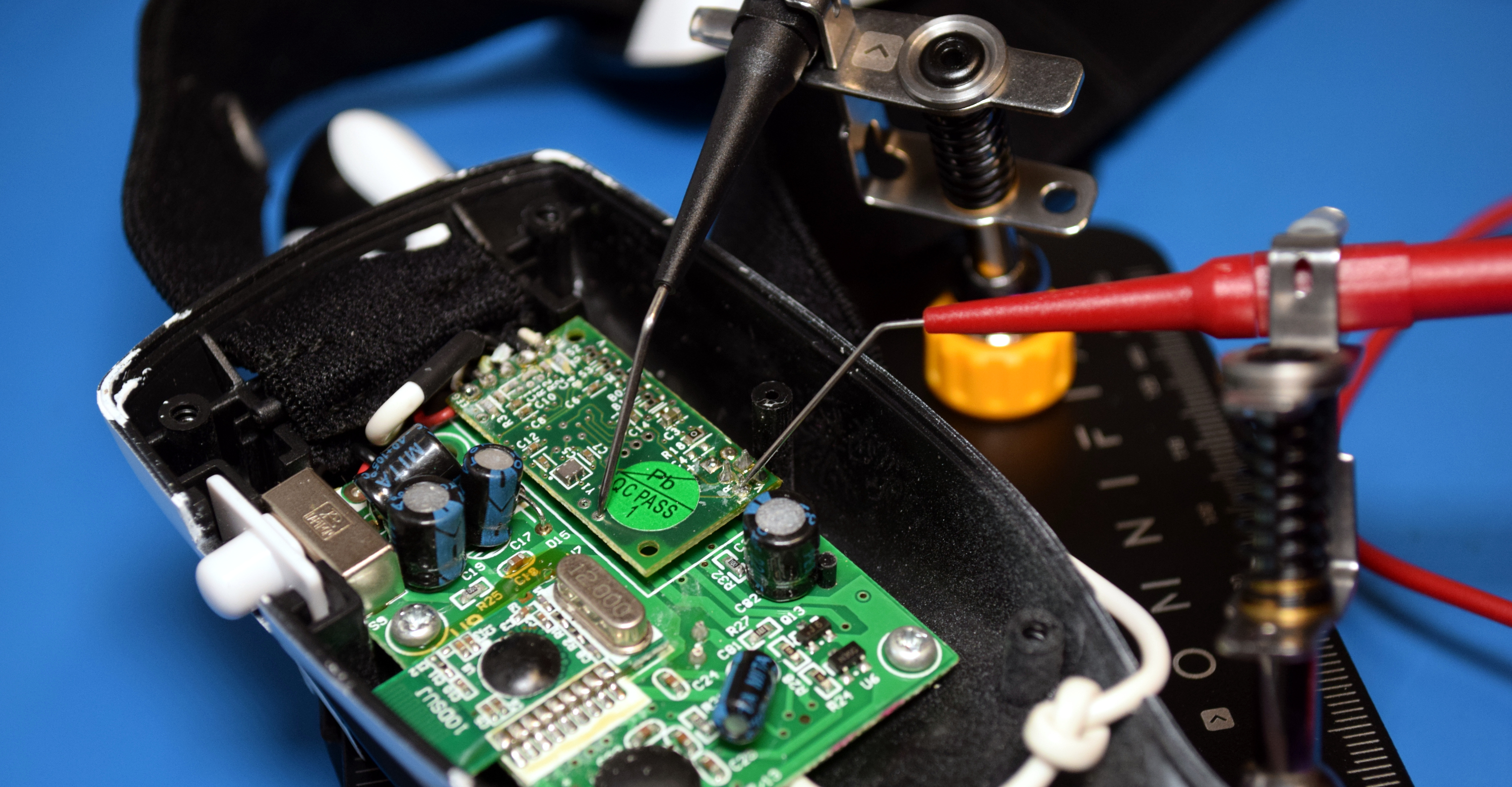
I haven’t gone too far down this particular rabbit hole, but I did connect the headset up to my trusty Bus Pirate 5 and could indeed see it spewing out serial data. Paired with a modern wireless microcontroller, the Mindflex could still be an interesting device for BCI experimentation all these years later. Though if you can pick up the Bluetooth Force Trainer II headset for cheap on eBay, it sounds like it would save you the trouble of having to hack it yourself.

My Mind to Your Mind

So the big question: does the Mindflex, and by extension NeuroSky’s 2009-era BCI technology, actually work?

Advertisement

Before writing this article, I spent the better part of an hour wearing the Mindflex headset and trying to control the LEDs on the front of the device that are supposed to indicate your focus level. I can confidently say that it’s doing something, but it’s hard to say what. I found that getting the focus indicator to drop down to zero was relatively easy (story of my life) and nearly 100% repeatable, but getting it to go in the other direction was not as consistent. Sometimes I could make the top LEDs blink on and off several times in a row, but then seconds later I would lose it and struggle to light up even half of them.

Some critics have said that the NeuroSky is really just detecting muscle movement in the face — picking up not the wearer’s focus level so much as a twitch of the eye or a furrowed brow which makes it seem like the device is responding to mental effort. For what it’s worth, the manual specifically says to try and keep your face as still as possible, and I couldn’t seem to influence the focus indicator by blinking or making different facial expressions. Although if it actually was just detecting the movement of facial muscles, that would still be a neat trick that offered plenty of potential applications.
I also think that a lot of the bad experiences people have reported with the technology is probably rooted in their own unrealistic expectations. If you tell a child that a toy can read their mind and that they can move an object just by thinking about it, they’re going to take that literally. So when they put on the headset and the game doesn’t respond to their mental image of the ball moving or the LEDs lighting up, it’s only natural they would get frustrated.

So what about the claims that the Force Trainer II could be played without even wearing the headset? If I had to guess, I would say that if there’s any fakery going on, it’s in the game itself and not the actual NeuroSky hardware. Perhaps somebody was worried the experience would be too frustrating for kids, and goosed the numbers so the game could be beaten no matter what.

Advertisement

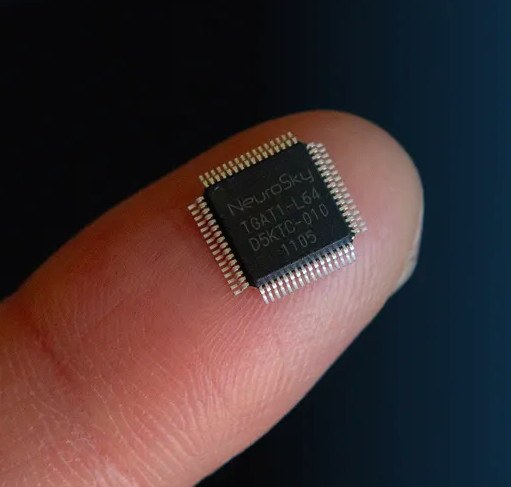
As for NeuroSky, they’re still making BCI headsets and offer a free SDK for them. You can buy their MindWave Mobile 2 on Amazon right now for $130, though the reviews aren’t exactly stellar. They continue to offer a single chip EEG sensor (datasheet, PDF) that you can integrate into your projects as well, the daughterboard for which looks remarkably similar to what’s in the Mindflex headset. Despite the shaky response to the devices that have hit the market so far, it seems that NeuroSky hasn’t given up on the dream of bringing affordable brain-computer interfaces to the masses.


Source link

Advertisement
Continue Reading
Click to comment

Leave a Reply

Your email address will not be published. Required fields are marked *

Tech

Europe’s top 10 funding rounds this week (9 -15 March)

Published

on

From a record-breaking AI seed in Paris to Croatian drones and Lithuanian food tech, Europe’s startup ecosystem had a busy week.

The week of 9-15 March was, by any measure, an exceptional one for European venture capital. Two deals alone, one in London, one in Paris,accounted for nearly three billion dollars.

But beyond the headline figures, what the week really illustrated was the texture of where European investor confidence now sits: AI infrastructure, cybersecurity, health tech, defence, and cross-border commerce all secured meaningful rounds.

The geography stretched from Vilnius to Zagreb to the Swiss Alps. The themes, however, felt unmistakably of this moment.

Advertisement

The 💜 of EU tech

The latest rumblings from the EU tech scene, a story from our wise ol’ founder Boris, and some questionable AI art. It’s free, every week, in your inbox. Sign up now!

Here are the ten most significant funding rounds in Europe this week.


1. Nscale – €1.7 billion Series C  |  London, UK

Start with the number: €1.7 billion, or $2 billion. That is not just the largest European funding round of the week, it is, according to the company itself, the largest equity round ever raised by a European startup.

Advertisement

The investor list alone communicates the scale of ambition: Nvidia, Citadel, Dell, Nokia, Jane Street, and Point72, alongside lead backers Aker ASA and 8090 Industries.

Founded in 2024, a year ago, to underscore how fast this has moved, Nscale builds vertically integrated AI infrastructure, from GPU compute and networking to data services and orchestration software.

The Series C values the company at $14.6 billion, a more than fourfold jump from the $3.1 billion valuation it achieved at its Series B in September 2025. That September round was itself described as record-breaking.

This round follows a €1.1 billion debt facility Nscale signed in February. The company is building at a speed that has few precedents in the European tech ecosystem.

Advertisement

2. AMI Labs – $1.03 billion seed  |  Paris, France

The largest seed round ever raised by a European company, and quite possibly anywhere. Advanced Machine Intelligence, AMI, pronounced the French word for “friend”, announced its $1.03 billion raise on 10 March, just four months after it was founded.

The company is chaired by Yann LeCun, the Turing Award-winning computer scientist who spent 12 years at Meta before departing in November 2025 to build something he believes the wider AI industry is unwilling to build.

The founding team includes former Meta AI researchers Saining Xie, Pascale Fung, and Michael Rabbat. Strategic investors include Nvidia, Samsung, Toyota Ventures, Jeff Bezos, and former Google CEO Eric Schmidt. 

AMI has no product and no revenue. LeCun said the first year will be devoted entirely to research. That investors handed over a billion dollars on those terms reflects both the credibility of the team and the sheer amount of capital now looking for the next paradigm shift in AI.

Advertisement

3. Isembard – £37.5 million Series A  |  London, UK

Less than a year after its seed round, London-based Isembard raised £37.5 million ($50 million) to expand its network of AI-powered factories focused on high-precision manufacturing for the aerospace and defence sectors.

The round was led by Union Square Ventures, with participation from Tamarack Global, IQ Capital, Notion Capital, and CIV. Angel investors included Deel founder Alex Bouaziz and former Wise CFO Matt Briers.

Isembard’s model is unusual in the manufacturing space: it owns and operates its own facilities and also runs a network of franchise-operated sites built around MasonOS, its proprietary agentic operating system for factory management.

4. Waiv – $33 million  |  Paris, France

Waiv is a spinout from Owkin, the French-American biotech company, launched as an independent entity this week alongside a $33 million funding round.

Advertisement

The company, previously operating as Owkin Dx, develops AI-powered precision testing tools for oncology: analysing routine pathology slides and multimodal patient data to identify biomarkers and predict treatment response.

What distinguishes Waiv from the broader AI health cluster is its focus on making tests that already exist in the clinical workflow,  routine slide analysis, dramatically more informative. Its products include RlapsRisk BC (breast cancer relapse prediction), MSIntuit, and BRCAura.

The company has existing partnerships with pharmaceutical groups and counts leading hospital systems among its customers. Spinning out as an independent entity is intended to accelerate commercial development without the constraints of a parent company’s strategic priorities.

5. Qevlar AI – $30 million Series A  |  Paris, France

Security operations centres face a problem that is, by now, well understood: too many alerts, too few analysts, too much time per investigation.

Advertisement

The average alert at a major enterprise takes between 32 and 61 minutes to investigate manually. Qevlar AI claims its platform does it in under three minutes. On 10 March, investors decided that was worth $30 million.

The Paris-based startup, founded in 2022 by Ahmed Achchak, has built an agentic AI platform that connects to existing security tooling (SIEM, EDR, CTI) and automates the full investigation workflow at Tier-2 and Tier-3 depth. Rather than simply triaging alerts, the system builds a graph-based understanding of the attack surface. 

The round was co-led by Partech and Forgepoint Capital International, with EQT Ventures also participating. Forgepoint had led the company’s previous $14 million raise, a show of continued conviction.

The new capital will fund geographic expansion into EMEA and Asia-Pacific, and product development toward predictive threat hunting.

Advertisement

 6. Saltz – €20 million Series A  |  Vilnius, Lithuania

The food distribution sector in Europe is fragmented, largely offline, and resistant to modernisation. Saltz, founded in 2022 by Andrius Šlimas, Tomas Šlimas, and Reinis Štrodahs, veterans of Oberlo and Shopify, is attempting to do for professional kitchens what those platforms did for e-commerce merchants. It secured €20 million in Series A funding on 9 March.

The platform connects restaurants and professional kitchens with food suppliers, aggregating catalogues, orders, payments, and logistics into a single interface. It operates in roughly 20 countries, with clients including Hilton, Marriott International, and independent restaurant operators. 

The company plans to hire more than 100 people by the end of 2026 across engineering, product, sales, and operations. It is targeting fresh and frozen food products, specifically meat and seafood,  where supply chains are most complex and margins for improvement are largest.

 7. Outpost – $17.5 million Series A  |  London, UK

Cross-border selling has always been theoretically appealing and practically complicated: VAT registrations, payment infrastructure that does not travel, and tax liability in jurisdictions a merchant has never visited.

Advertisement

Outpost, a London-based platform built by former Revolut executives, raised $17.5 million on 10 March to solve those problems at the infrastructure layer.

The round was led by Ribbit Capital, the venture firm behind Revolut, Coinbase, and Stripe. Outpost’s platform handles payments and tax compliance for merchants selling internationally, creating local legal entities and payment rails in the markets they enter so the merchant carries no direct liability. 

The context matters here: 2026’s trade tariff environment has made cross-border commerce simultaneously more attractive and more legally treacherous. Outpost is building for exactly that tension. 

8. Orqa – €12.7 million Series A  |  Osijek, Croatia

Croatian drone maker Orqa has been building first-person-view drone systems since 2018, first for the enthusiast market, increasingly for defence.

Advertisement

On 10 March, it raised €12.7 million in a Series A led by Expeditions, the early-stage investor focused on European security, with Lightspeed Venture Partners, Taiwania Capital, Aymo, and Radius Capital also participating.

What distinguishes Orqa in an increasingly crowded drone landscape is its level of vertical integration: it designs and manufactures its own flight controllers, radios, motors, cameras, and printed circuit boards, with no Chinese-made components. Its facility in Osijek currently produces up to 280,000 NDAA-compliant drones annually. 

The Pentagon’s Drone Dominance Programme is planning to procure up to 300,000 small attack drones by 2027. Orqa’s CEO Srdjan Kovacevic has made clear that the company is positioning itself to compete for those contracts.

9. Seprify – €13.4 million Series A  |  Fribourg, Switzerland

Seprify develops high-performance cellulose-based ingredients for industrial applications, targeting markets where synthetic materials face regulatory pressure or sustainability scrutiny.

Advertisement

Its €13.4 million Series A, which closed this week, counts Inter IKEA Group among its backers,  a notable strategic investor for a materials company working on sustainable alternatives to petroleum-derived inputs.

The Swiss deep-tech sector has been producing a steady stream of university spinouts in materials science, and Seprify fits that pattern: founded with roots in academic research, now moving toward commercial scale. The round will fund production capacity expansion and customer development.

10. Lemrock – €6 million seed  |  Paris, France

If Nscale and AMI represent the week’s largest bets, Lemrock represents one of its most interesting ones. The Paris-based startup, founded in 2025, is building infrastructure that allows brands to sell directly within conversational AI environments, ChatGPT, Claude, Perplexity and their equivalents.

On 11 March, it announced a €6 million seed round led by Galion.exe, with Criteo founder Jean-Baptiste Rudelle joining the board.

Advertisement

 The company already works with more than 60 brands across Europe and the United States, including Maisons du Monde, Cdiscount, and Engie, and processes over 100 million interactions monthly.

The round is small relative to the others on this list. But the question Lemrock is answering, what happens to commerce when AI agents become the primary product-discovery interface, is large, and it has barely been asked yet.

Source link

Advertisement
Continue Reading

Tech

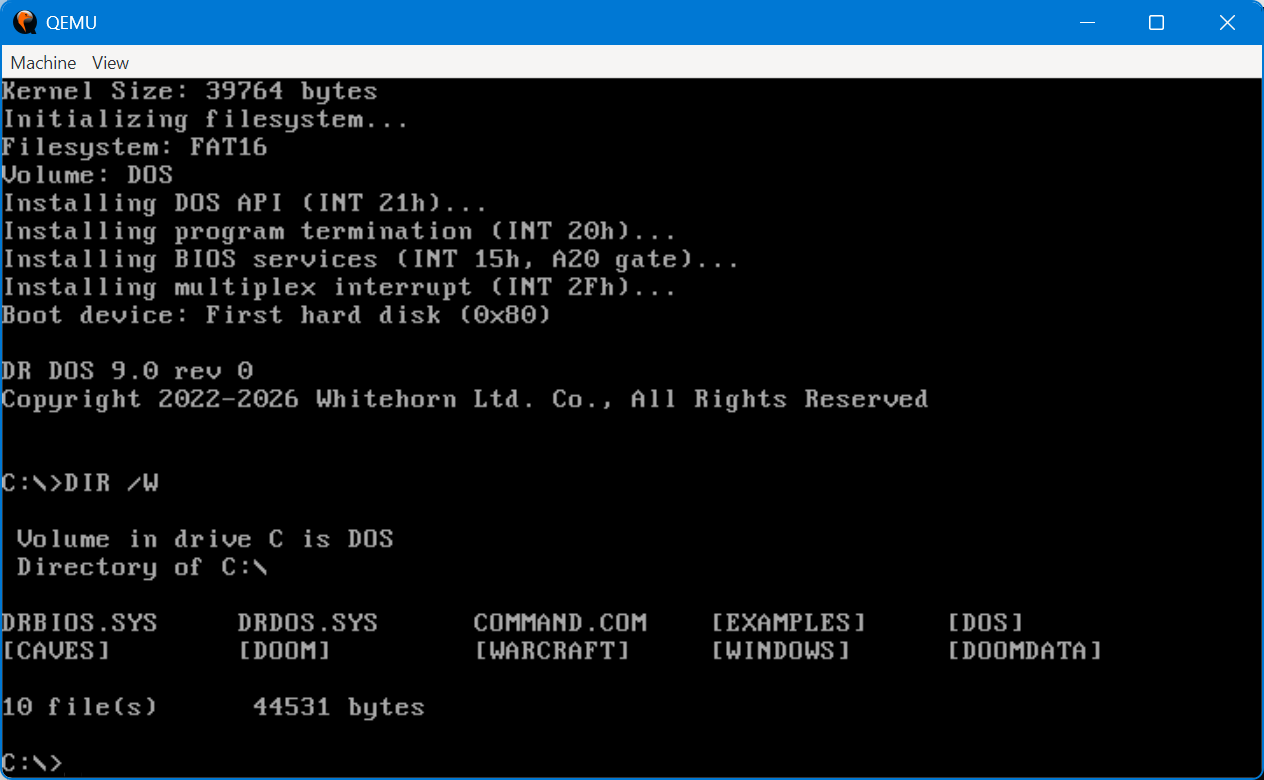
DR-DOS Is Back, But Not Quite As We Knew It

Published

on

If you weren’t around for the early PC era, or were a little more casual about operating systems, you could perhaps be forgiven for not knowing that DOS is not synonymous with MS-DOS. MS-DOS was just Microsoft’s implementation — or rather, an implementation they purchased — of a Disk Operating System, one that was…let’s just say “inspired by” Digital Research’s CP/M.

Digital Research shot back with DR-DOS, an operating system that was both compatible with and much superior in some ways to MS-DOS. The last version was released in 1991, after Novell bought the struggling Digital Research. Now it’s back, or at least, it’s on its way back with a fully clean-room implementation by a fellow who calls himself [CheeseWeezel] on Reddit.

He’s gone so far as to purchase the trademark, so this re-creation is the official DR-DOS. In any case [CheeseWeezel]’s DR-DOS is considered version 9.0, and is currently in Beta. The clean-sheet re-implementation of DR-DOS’s API was sadly necessary due to the rather tortured history of the IP after DR was bought by Novel, who sold DR-DOS to Caldera, who briefly open-sourced the code before retracting the license and selling on. Some of you may remember a controversy where a previous rights holder, DR DOS INC, was found purloining FreeDOS code in violation of the GPL. Perhaps because of that, [CheeseWeezel] isn’t using any old code, and isn’t open-sourcing what he’s done. Right now, the beta of DR-DOS 9 is free for non-commercial use, but as is standard for EULAs, that could change at any time without warning. [CheeseWeezel] is still working full compatibility, but at this point it at least runs DOOM.

Still, given the origins of DOS in Digital Research’s early work on CP/M, it warms the heart to see what many of us thought of as the “true” DOS survive in some form in the 21st century. Arguably it already had, in the form of SvarDOS, but you can’t use that to make smug jokes about your operating system having PhD instead of a measly master’s. If you did not like DOS, we recall the joke from Mac users was that those were the degrees needed to operate the PC. Speaking of DOS, you don’t necessarily need a retrocomputer to run it.

Advertisement

Thanks to [OldDOSMan] for the tip!

Source link

Advertisement
Continue Reading

Tech

Week in Review: Most popular stories on GeekWire for the week of March 8, 2026

Published

on

Get caught up on the latest technology and startup news from the past week. Here are the most popular stories on GeekWire for the week of March 8, 2026.

Sign up to receive these updates every Sunday in your inbox by subscribing to our GeekWire Weekly email newsletter.

Most popular stories on GeekWire

Source link

Continue Reading

Tech

With 2 factories in the Amazon, this biz sells 1 bil Brazil nuts/yr to 45 countries

Published

on

Brazil nuts are nearly impossible to farm, but White Lion Foods has cracked the challenge 

The fitness and health industry has been growing rapidly around the world, including in Singapore. Alongside this shift, consumers are increasingly seeking out nutrient-dense foods that can support healthier lifestyles.

Among the most nutrient-dense foods on the planet is the Brazil nut, widely recognised as the richest natural dietary source of selenium.

Despite its nutritional benefits, however, producing Brazil nuts is far from straightforward. Unlike most nuts, they are not cultivated on plantations but are wild-harvested from trees deep within the Amazon rainforest.

Even when producers manage to source them, most Brazil nuts are sold either raw or coated in chocolate. This is because seasoning them has historically been difficult—the nut’s natural structure prevents flavours from sticking well.

Advertisement

But Singapore-based Truly Nuts! has taken on that challenge. In 2024, it launched what it claims to be the world’s first savoury-flavoured Brazil nuts to local supermarkets.

Behind the brand is Singapore-headquartered agri-tech company White Lion Foods, which sources and processes Brazil nuts directly in the Amazon rainforest. The company operates two factories there—nearly 18,000 kilometres from the city-state—that can process up to one billion Brazil nuts each year.

We spoke with Gareth Lloyd, 48 and Greg Vickers, 46, the co-founders behind the business, to learn more about their entrepreneurial journey and how they managed to turn a nut that’s nearly impossible to farm into a global business.

They went from DJ tours to farming crops

Gareth and Greg’s path into the food industry was far from conventional.

Advertisement
(Left to Right): Gareth Lloyd and Greg Vickers./ Image Credit: White Lion Foods

They first met during university in the United Kingdom and spent years working as electronic music DJs, performing across more than 15 countries and touring extensively throughout Latin America.

It was during these travels that they became familiar with the region’s agricultural exports. Countries like Peru were producing high-quality foods, such as avocados and blueberries, that were increasingly appearing in global supermarkets.

When Gareth moved to Singapore in 2012, he noticed many of these products were starting to be stocked locally, sparking the idea that other lesser-known exports could also find a market.

And thus, White Lion Foods was born. That same year, Gareth roped in Greg, who had been living in Brazil since 2010, and the duo invested about £60,000 each (about S$102,000 each) to start the Singapore-based agri-tech venture.

Andean purple garlic./ Image Credit: White Lion Foods

They first chose to focus on purple garlic. After extensive research, the duo discovered that these varieties were rare outside Peru, prompting them to concentrate on harvesting, processing, and exporting this unique crop grown high in the Andean mountains.

Over time, their business expanded globally, supplying purple garlic to markets “around the world,” and today, White Lion Foods claims to be the number one exporter of Andean purple garlic.

Advertisement

It was a milestone for the business, but focusing solely on Peruvian garlic soon revealed a major challenge.

We were basically investing all year, and the garlic harvest would come around Sept. We’d sell until Dec, and then we had no revenue for the rest of the year.

Gareth Lloyd

In other words, the company had year-round operating costs but only a few months of income.

To solve the seasonal revenue problem, the founders began experimenting with other crops that could complement the garlic harvest cycle.

Advertisement

Over the next few years, they experimented with a variety of crops—potatoes, onions, tomatoes, and even raisins—while exploring different supply chains. Many of these ventures, however, ended up as costly lessons.

truly nuts white lion foods brazil nuttruly nuts white lion foods brazil nut
The Brazil nut fruit, also called a pod, typically contains 10 to 25 individual nuts./ Image Credit: White Lion Foods

Eventually, in 2016, the duo discovered Brazil nuts.

Unlike purple garlic, Brazil nuts are harvested between Jan and May, creating a complementary revenue cycle. “We suddenly had this brilliant cycle,” Gareth said. “Brazil nuts collected during Q1 and Q2, and garlic in Q4.”

Hence, the founders decided to focus entirely on these two products: garlic and Brazil nuts, which are now known to be their signature offerings.

An “unusual” nut

brazil nut tree white lion foods worker crack open truly nutsbrazil nut tree white lion foods worker crack open truly nuts
The Brazil nut tree often tower over 50m in height and is a highly protected species of the Amazon./ Image Credit: White Lion Foods

But harvesting Brazil nuts came with its own set of challenges.

They are unusual when compared to most other nuts found in supermarkets. Attempts to farm them commercially have failed, making their production entirely dependent on natural, wild ecosystems deep within the Amazon rainforest.

Advertisement

The Brazil nut tree itself can live for hundreds of years, producing large, coconut-like fruits that fall naturally to the forest floor when ripe during the rainy season. Local collectors, many from communities living in Amazon regions, gather the fallen fruits, crack them open, and transport the in-shell nuts back to processing facilities—it is largely a manual process.

As such, alongside the factory it had established in the Peruvian Amazon for purple garlic, White Lion Foods built another facility deep in the Brazilian Amazon in 2016 to manage Brazil nut processing, hiring a workforce capable of handling the labour-intensive work.

Currently, the company employs more than 10,000 local and indigenous harvesters to collect the fallen fruits, along with over 3,000 staff across both its factories. Gareth claimed that his workers are paid more than 50% higher than the regional market rate because he believes in supporting the local communities.

truly nuts white lion foods processing brazil peru factoriestruly nuts white lion foods processing brazil peru factories
Brazil nuts are collected and processed mostly by hand, and shipped in bulk to across the world./ Image Credit: White Lion Foods

At White Lion Foods’ factories, the Brazil nuts are carefully cleaned and dried in controlled environments until their moisture content drops to around 2–3%, ensuring optimal quality and long shelf life.

The nuts are then sorted into different sizes and packed before being exported to retailers and supermarkets such as Aldi and Hyundai department stores under white-label arrangements.

Advertisement

Today, Gareth shared that White Lion Foods controls roughly 16% of the global Brazil nut market. The company also processes both Brazil nuts and purple garlic for partners and retailers across more than 45 countries.

Creating their own consumer brand

After years of supplying Brazil nuts as a white-label manufacturer, the founders decided to create their own consumer brand, with a focus on highlighting the Brazil nut itself.

For decades, these nuts had been sold mostly raw or coated in chocolate, so the duo set out to develop a way to introduce new flavours, particularly savoury ones, that the market had never seen before.

truly nuts white lion foods processing retailtruly nuts white lion foods processing retail
Truly Nuts! offers raw Brazil nuts that can be enjoyed on their own or in various flavours with or without other nuts./ Image Credit: White Lion Foods, Vulcan Post

But savoury seasoning was difficult to apply because of the natural structure of Brazil nuts, which prevented flavours from sticking well.

After months of trial and error—and collaboration with confectionery flavouring experts in the UK—the company finally developed a process that allows savoury seasonings to adhere properly, unlocking a whole new way to enjoy this nutrient-dense superfood.

Advertisement

That led to the launch of Truly Nuts! in the UK in December 2023 through British travel retailer WHSmith’s outlets across the country and e-commerce platform, Amazon.

The brand started out with four Brazil nut flavours, including chilli, smoked, and chocolate variants.

truly nuts white lion foods worker retail singapore cold storage supermarkettruly nuts white lion foods worker retail singapore cold storage supermarket
White Lion Foods manages the entire Brazil nut journey—from harvesting the nuts off the forest floor to packing them for retail shelves./ Image Credit: White Lion Foods

Since March 2024, White Lion Foods begun selling Truly Nuts! products in Singapore. Its products are now stocked in retailers such as FairPrice, Cold Storage, and Guardian, with a 120g bag of Brazil nuts starting from S$8.50.

“The Brazil nut was such an undermarketed nut,” Gareth said. “People don’t know about it, they don’t know about the health benefits, and they don’t know that it supports the Amazon.”

Singapore was chosen as one of the brand’s early markets partly because of its growing appetite for healthier snacks. Moreover, that lack of awareness is precisely what the brand hopes to change.

Advertisement

The healthy snack market here has been on the rise and is projected to grow by about 70% to US$890 million (S$1.14 billion) by 2033, driven by consumers seeking convenient options amid increasingly busy lifestyles.

That said, the brand has also had to adjust some flavours to suit Asian taste preferences. Local consumers, Gareth noted, tend to prefer slightly lower salt levels but stronger flavour profiles in certain variants.

And of course, maintaining product quality has also led to tradeoffs, which the duo is willing to make.

Chocolate-coated nuts, for instance, are sensitive to heat—especially in tropical climates like Singapore. Instead of using stabilising chemicals often found in confectionery products, Gareth shared that the company transports its chocolate variants in refrigerated conditions to prevent melting.

Advertisement

While this incurs additional logistics costs, he believes it is necessary to keep the products free from additives.

Targeted expansion through travel retail

As White Lion Food and its Truly Nuts! brand grows, the company expects its facilities to process more than one billion Brazil nuts this year—equivalent to roughly 3,500 tonnes.

Revenue from its Brazil nut segment alone is projected to reach between US$40 million and US$45 million, with about US$2 million coming from Truly Nuts!. Gareth envisions White Lion Foods expanding to supply a third of the world’s Brazil nuts in the future.

Considering the brand is still relatively young, Gareth sees this as just the beginning. Rather than expanding into new countries all at once, the company plans to grow through travel retail first.

Advertisement
truly nuts white lion foods workers whsmith united kingdomtruly nuts white lion foods workers whsmith united kingdom
(Left): Some members of the White Lion Foods team behind Truly Nuts!; (Right): Truly Nuts! is expanding through travel retailers like WHSmith./ Image Credit: White Lion Foods

It might sound surprising, but his reasoning is simple: airports give the brand direct access to international travellers, helping build awareness and demand before moving into broader retail markets.

By May, Truly Nuts! aims to go live in about 80 more WHSmith airport outlets across the globe, including Europe and Singapore.

The company is also developing new product lines, with Brazil nut butter seen as having particularly high potential.

Reflecting on the company’s unconventional journey—from DJ tours to running processing facilities in the Amazon—Gareth says entrepreneurship rarely follows a linear path.

“You’ve just got to get going with it,” he said. “As I like to say, you should build the plane while you’re flying.”

Advertisement
  • Learn more about Truly Nuts! here and White Lion Foods here.
  • Read more stories we’ve written on Singaporean businesses here.

Featured Image Credit: Truly Nuts!

Source link

Advertisement
Continue Reading

Tech

Premier League Soccer: Stream Liverpool vs. Spurs Live From Anywhere

Published

on

When to watch Liverpool vs. Tottenham

  • Sunday, March 15, at 12:30 p.m. ET (9:30 a.m. PT).

Where to watch

  • Liverpool vs. Tottenham will air in the US on Peacock Premium.
73% off with 2yr plan (+4 free months). Now only $3.49/month


See more details

See at Fubo
Advertisement
Fubo logo

Watch the Premier League in Canada

Fubo Canada

Advertisement

After an embarrassing midweek defeat in Europe, woeful Tottenham Hotspur will be hoping to avoid further humiliation on Sunday as they travel to Anfield to face top-four-chasing Liverpool in the English Premier League.

Spurs continued their dire run of form with a 5-2 loss away to Atletico Madrid in the UEFA Champions League on Tuesday. Interim boss Igor Tudor came under fierce criticism in the aftermath of that defeat, following his controversial decision to substitute young goalkeeper Antonin Kinsky after just 17 minutes at 3-0 down.

Tudor remains in charge for today’s game, but after four defeats from each of his four games in charge, and with his side just a point above the relegation zone, this game could prove to be his last chance to save his brief tenure.

Liverpool’s midweek Champions League defeat to Galatasaray was not quite as disastrous as Tottenham’s. Nevertheless, the Reds’ 1-0 midweek loss in Istanbul will have boss Arne Slot determined to get his side back to winning ways as they look to climb back into the UCL qualification places. 

Advertisement

Liverpool hosts Tottenham Hotspur on Sunday, March 15, at Anfield, with kickoff set for 4:30 p.m. GMT. That makes it a 12:30 p.m. ET or 9:30 a.m. PT start in the US and Canada, and a 3:30 a.m. AEDT kickoff in Australia on Monday morning. 

Igor Tudor, head coach of Tottenham Hotspur, wearing a cap, looking onwards from a dugout.

Under-fire Tottenham boss Igor Tudor faces a defensive selection issue for this crucial game, with center back Micky van de Ven suspended following his red card in last week’s EPL defeat to Crystal Palace. 

Dennis Agyeman/Europa Press/Getty Images

How to watch Liverpool vs. Tottenham in the US without cable

Advertisement

This match at Anfield will be broadcast on streaming service Peacock. To catch the game live, you’ll need a Peacock Premium or Premium Plus subscription.

Peacock offers two Premium plans, and after recent price increases, the ad-supported Premium plan costs $11 a month and the ad-free Premium Plus plan costs $17 a month.

Advertisement

How to watch the Premier League 2025-26 from anywhere with a VPN

If you’re traveling abroad and want to keep up with Premier League action while away from home, a VPN can help enhance your privacy and security when streaming.

It encrypts your traffic and prevents your internet service provider from throttling your speeds, and can also be helpful when connecting to public Wi-Fi networks while traveling, adding an extra layer of protection for your devices and logins. VPNs are legal in many countries, including the US and Canada, and can be used for legitimate purposes such as improving online privacy and security. 

However, some streaming services may have policies that restrict VPN use to access region-specific content. If you’re considering a VPN for streaming, check the platform’s terms of service to ensure compliance.

If you choose to use a VPN, follow the provider’s installation instructions, ensuring you’re connected securely and in compliance with applicable laws and service agreements. Some streaming platforms may block access when a VPN is detected, so verify whether your streaming subscription allows VPN use. 

Advertisement

James Martin/CNET

Price $13 per month, $75 for the first year or $98 total for the first two years (one- and two-year plans renew at $100 per year)Latest Tests No DNS leaks detected, 18% speed loss in 2025 testsJurisdiction British Virgin IslandsNetwork 3,000 plus servers in 105 countries

Advertisement

ExpressVPN is our current best VPN pick for people who want a reliable and safe VPN, and it works on a variety of devices. Prices start at $3.49 a month on a two-year plan for the service’s Basic tier.

Note that ExpressVPN offers a 30-day money-back guarantee.

Advertisement
73% off with 2yr plan (+4 free months). Now only $3.49/month

Livestream Liverpool vs. Tottenham in the UK 

This Sunday afternoon clash is exclusive to Sky Sports and will be shown on its Sky Sports Main Event channel. If you already have Sky Sports as part of your TV package, you can stream the game via its Sky Go app. Cord-cutters will want to set up a Now account and a Now Sports membership to stream the game.

Now TV

Sky’s standalone streaming service Now offers access to Sky Sports channels with a Now Sports membership. You can get a day of access for £15 or sign up to a monthly plan from £35 a month right now.

Advertisement

Livestream Liverpool vs. Tottenham in Canada 

If you want to livestream EPL games in Canada this season, you’ll need to subscribe to Fubo. The service has once again secured exclusive rights to the Premier League and is broadcasting all 380 matches live. 

Fubo

Fubo is the go-to destination for Canadians looking to watch the EPL, with exclusive streaming rights to every match. It currently costs CA$27 for the first month, then CA$31.50 per month from then on.

Advertisement

Livestream Liverpool vs. Tottenham in Australia 

Livestreaming rights for the EPL are now with Stan Sport, which is showing all 380 matches live, including this game.

Stan

Stan Sport will set you back AU$20 a month (on top of a Stan subscription, which starts at AU$12). It’s also worth noting that the streaming service is currently offering a seven-day free trial.

Advertisement

A subscription will also give you access to Premier League, Champions League and Europa League action, as well as international rugby and Formula E.

Source link

Advertisement
Continue Reading

Tech

‘Marshals’: When Does Episode 3 Premiere on Paramount Plus?

Published

on

Marshals, a new Yellowstone spinoff starring Luke Grimes as Kayce Dutton, is currently airing on CBS. You can also tune in with Paramount Plus.

The Yellowstone sequel series sees Grimes’ former Navy SEAL join an elite unit of US Marshals to bring range justice to Montana, according to a synopsis from CBS. The show also includes Yellowstone actors Gil Birmingham as Thomas Rainwater, Mo Brings Plenty as Mo and Brecken Merrill as Tate. Spencer Hudnut is the showrunner of Marshals — formerly known as Y: Marshals — and Taylor Sheridan is an executive producer.

Advertisement

When to watch new Marshals episodes on Paramount Plus

Episode 3 of Marshals airs on CBS on Sunday, March 15. Viewing options for Paramount Plus customers vary by subscription tier. You can watch the episode live if you have Paramount Plus Premium, which includes your local CBS station. If you subscribe to Paramount Plus Essential, you can watch the installment on demand the following Monday, but not live on Sunday. 

Here’s how to watch the next two episodes of Marshals.

  • Episode 3, Road to Nowhere: Premieres on CBS/Paramount Plus Premium on March 15 at 8 p.m. ET/8 p.m. PT/7 p.m. CT. Streams on Paramount Plus Essential on March 16.
  • Episode 4, The Gathering Storm: Premieres on CBS/Paramount Plus Premium on March 22 at 8 p.m. ET/8 p.m. PT/7 p.m. CT. Streams on Paramount Plus Essential on March 23.

You can also watch CBS and the third episode of Marshals without cable with a live TV streaming service such as YouTube TV, Hulu Plus Live TV or the DirecTV MyNews skinny bundle. In addition to offering a lower-cost option, Paramount Plus lets you watch the other two Yellowstone spinoffs: the prequels 1883 and 1923.

Advertisement

James Martin/CNET

After a price increase in early 2026, the ad-supported Essential version runs $9 per month or $90 per year. The ad-free Premium version runs $14 per month or $140 per year. Paying more for Premium gives you downloads, the ability to watch more Showtime programming than Essential and access to your live, local CBS station.

Source link

Advertisement
Continue Reading

Tech

ByteDance will reportedly buy NVIDIA’s latest AI chips to use outside of China

Published

on

TikTok’s Chinese parent company ByteDance has figured out a way to access NVIDIA’s latest AI chips despite export restrictions, according to a report by . The company is working with a firm called Aolani Cloud and building out Blackwell computing systems in Malaysia.

This should give ByteDance access to around 36,000 B200 chips. That’s NVIDIA’s most powerful processor. The hardware buildout will reportedly cost more than $2.5 billion. The company says it plans on using this new computing power for AI research and development outside of China.

The country has been unable to access the B200 chip, as it was designed in California and, as such, subject to US export controls. This has led to do what ByteDance is doing with Aolani Cloud. The Singapore-based firm will buy up the components from NVIDIA and will operate exclusively in Malaysia, giving ByteDance access in the process.

“By design, the export rules allow clouds to be built and operated ​outside controlled ​countries,” an NVIDIA spokesperson said. They also said that all of the company’s cloud partners go through review before being approved to receive its products.

Advertisement

A representative from Aolani Cloud ‌that the company adheres to all applicable export control regulations and that ByteDance will be just one of many customers. It plans on providing cloud-computing services to multiple companies across Asia and the globe. However, it’s worth noting that Aolani currently operates ‌with just $100 million worth ⁠of hardware and ByteDance is planning to inject a whopping $2.5 billion.

The US did recently , but they’ve been slapped with a 25 percent tariff. Additionally, the US government mandated that the export license would only be approved if NVIDIA accepted a Know-Your-Customer requirement, which is an attempt to ensure that China’s military can’t access the chips. NVIDIA .

Source link

Advertisement
Continue Reading

Tech

Protecting data during hypervisor migration

Published

on

Vmware

Broadcom’s acquisition of VMware in 2023 set off a wave of migrations that shows no signs of subsiding. But moving from VMware to another hypervisor may introduce significant technical and operational risks.

IT teams must prepare for challenges that are not always apparent at the start of a migration.

Price hikes, licensing changes and shifts in customer support have driven VMware customers to look for alternatives. Recent operational problems haven’t helped.

Last year, VMware Workstation auto-updates failed due to a Broadcom URL redirect. In 2026, the migration continues. Gartner research VP Julia Palmer recently predicted that VMware would lose 35% of its workloads by 2028.

Advertisement

Many of those workloads will shift to platforms such as Microsoft Hyper‑V, Azure Stack HCI, Nutanix AHV, Proxmox VE or KVM. Unfortunately, the journey comes with challenges. Switching hypervisors is a high-stakes infrastructure change.

IT professionals need to focus on completing a successful migration with their data intact and available.

Why hypervisor migration is technically risky

It sounds simple: Export data, convert it to a new format and then import it into a new hypervisor. But that process is far riskier than it sounds.

That’s because hypervisors don’t interoperate. Multiple technical variables increase the risk of failed or unstable migrations. Hypervisors differ in disk formats, hardware abstractions, driver stacks and networking models.

Advertisement

Virtual hardware versions, storage controllers, chipset emulation and network virtualization layers don’t always translate cleanly.

Snapshots and templates behave differently. Even subtle configuration differences can create instability that only surfaces once workloads are under real production pressure.

Migrating from VMware can increase cost, risk and operational drag, while limiting strategic options.

Acronis Cyber Protect gives IT leaders control with a flexible, AI‑powered cyber protection platform that cuts migration time by up to 60% and keeps the business secure and responsive throughout change.

Advertisement

See how Acronis delivers control

Backup is essential to a successful hypervisor migration

The most important prerequisite for any platform migration is not a conversion tool. It is verified, restorable backup.

Organizations need to protect workloads with full-image, application-consistent backups that IT pros can restore not only to the same hypervisor but to dissimilar hardware or an entirely different virtualization platform.

IT teams need to perform recovery drills before they start migration, not just after cutover.

A platform-agnostic backup architecture provides a necessary safety net. It enables restoration from the source environment to the destination environment, and it allows rapid reversion to the original platform if compatibility or performance issues arise.

Advertisement

The bottom line is that data remains safe and accessible.

Any-to-any hypervisor recovery — restoration from physical, virtual or cloud environments to any other destination — reduces migration risk and has the added advantage of reducing long-term vendor lock-in.

How to avoid three risks most teams underestimate during migration

Even the most carefully planned and executed migrations can fail for predictable reasons.

1. Teams often underestimate planned downtime

Advertisement

Too many teams plan for an ideal level of downtime as opposed to a worst-case scenario. Unfortunately, migrations frequently stretch beyond maintenance windows. If a window closes when systems are not stable, organizations can suffer missed transactions, stalled operations, SLA violations and reputational damage.

That’s why migration planning must include a formal business continuity strategy, Ask in advance:

  • How long can each workload realistically be offline?
  • What happens if rollback is required?
  • Who makes the go or no-go decision?
  • What is the communication plan if restoration time exceeds expectations?

Backup and recovery are critical. The ability to quickly restore workloads to their original platform can mean the difference between a short delay and a multi-day outage.

2. Backup and recovery gaps can plague transitions

Migration creates a dangerous gray zone for backup and disaster recovery, with environments are often split between old and new platforms. That is when recoverability must be strongest. The time it takes to restore backups from either environment is critical.

Advertisement

Common gaps appear when:

  • Backup chains are broken during VM exports.
  • Incremental backup jobs may fail after platform conversion.
  • Application-consistent snapshots are not validated on the new hypervisor.
  • DR replication targets are not synchronized during phased cutovers.

Backup and recovery must function continuously throughout the migration. IT teams need to maintain parallel protection during overlap periods so that workloads are recoverable from both the legacy and target platforms until the transition is finished.

3. An expanding attack surface means backup images need protection

Migration also expands your attack surface.

With two hypervisor stacks running, complexity spikes. Backup repositories, an image-level backups in particular, can become high-value targets. If attackers compromise them during migration, your rollback and recovery options disappear.

Advertisement

Immutability is essential during this phase. IT teams need to protect backup images against modification or deletion, even by privileged accounts. They need to tighten role-based access controls and limit administrative access.

Equally important is adherence to the 3-2-1 principle: At least three copies of data, on two different media types, with one copy stored off-site or offline. During migration, that third copy becomes critical insurance.

If both production and primary backup infrastructure are affected, an isolated copy preserves your recovery path.

The value of a natively integrated platform

Maintaining parallel protection is essential because it lowers operational risk. However, it also increases management complexity. Two hypervisor stacks, multiple storage systems and parallel protection policies must coexist without creating gaps.

Advertisement

A unified cyber protection platform can simplify this process for IT teams. A unified cyber protection platform can reduce complexity by delivering consistent backup, recovery and security controls across physical servers, hypervisors and cloud workloads through a single point of control.

Natively integrated protection and migration capabilities in Acronis Cyber Protect can reduce transition timelines while maintaining rollback readiness and continuous synchronization.

Migration as a resilience opportunity

The shift away from VMware has made one concept clear: Migration planning is a long-term competency, not a one-time project.

Teams that succeed treat hypervisor transitions as resilience exercises. They validate backups in advance, ensure cross-platform recovery capability, maintain rollback paths, harden backup storage against ransomware and verify data integrity after cutover.

Advertisement

With these safeguards in place, migration becomes more predictable and significantly more likely to succeed.

VMware migrations don’t have to be slow, risky or disruptive.

With Acronis Cyber Protect, IT teams gain a flexible, responsive platform that accelerates migration while delivering AI‑powered security, backup and recovery in one natively integrated solution.

If you’re planning a move away from VMware, see how Acronis helps organizations migrate faster and stay protected at every step.

Advertisement

Learn how Acronis Cyber Protect accelerates VMware migration.

Sponsored and written by Acronis.

Source link

Advertisement
Continue Reading

Tech

The Luxury Car Brand With The Highest Customer Satisfaction Score Isn’t Mercedes-Benz

Published

on


With newer car brands like Tesla gaining prominence, along with the broader rise of electric powertrains, and other formerly high-end technology becoming common on even the most basic new cars, it often feels that the line between luxury automakers and mainstream car brands is blurrier than ever.

Still, no matter what type of powertrain is under the hood, there are lots of car buyers who desire the prestige, performance, and extra amenities that come with these luxury brands, and they’re happy to pay the additional cost to own them. This market position is distinct enough for luxury brands to have their own separate category when it comes to ranking things like reliability and customer satisfaction. When it comes to the top-ranked luxury brand for customer satisfaction, the winner shouldn’t be too surprising for anyone who has followed the industry for a while. 

In the 2025 American Customer Satisfaction Index Automobile Study, it was the Toyota-owned Lexus that ranked highest among luxury automakers, jumping up two spots and overtaking both Mercedes-Benz and Tesla when compared to the previous year’s rankings. A big part of of that is the wide-ranging and high-quality Lexus hybrid vehicle lineup, with hybrids in general earning higher satisfaction rankings across all brands, especially when compared to electric vehicles.

Advertisement

Hybrid is the way

ACSI conducted its automobile satisfaction survey between 2024 and 2025, surveying a little under 10,000 vehicle owners on a variety of different categories that summarize the ownership experience. The list includes traditional satisfaction categories like driving performance, efficiency, comfort, and reliability, along with two new categories added for 2025, total range on a fuel tank or electric charge, and expected resale value.

Advertisement

Lexus took the top spot among all luxury brands with a total score of 87 on a scale of 100, five points ahead of second-place Mercedes-Benz. The result isn’t shocking, as the brand’s corporate parent, Toyota, is also ranked highly when it comes to customer satisfaction. What especially drove Lexus’ rise in this year’s rankings is its hybrid vehicles. Hybrid and plug-in hybrid vehicles like the popular Lexus RX 500h crossover make up a big part of the brand’s volume, with the vast majority of the Lexus lineup offering some form of hybrid powertrain.

When separated by powertrain type across all luxury brands, hybrids earned the highest satisfaction score with an 83 out of 100, followed by gasoline at 80, and electric at 78. While Lexus does have EV offerings in its lineup, the brand has largely gone the way of parent company Toyota in focusing heavily on hybrid models over pure electric vehicles.  Right now, that decision seems to be paying dividends, especially when compared to the European luxury brands that have pursued EVs more aggressively. 

Advertisement

Other findings in the luxury car market

Overall, across the luxury segment, customer satisfaction scores were down slightly in 2025 from the previous year, with most of that decline attributed to poor performance from electric vehicles, particularly those from Audi and BMW. In its findings, ACSI points out that high driver frustration with those German EVs not only drags down an individual brand’s rankings, but aggregates customer satisfaction across all brands.

One of the new customer satisfaction categories added for 2025, which looks at the driving distance on a full charge or full tank of gas is especially interesting to look at, as it represents a real-world interpretation of driving range that can differ from official specs or EPA ratings. It’s here where luxury hybrids win once again, with a score of 76, compared to 74 for gasoline, and 71 for electric vehicles.

As for the future, with EV sales on a downward trend in America, it’s possible that brands like Audi, BMW, and Mercedes could regain some of their lost ground if EVs represent a smaller slice of their sales going forward, but for now, Lexus seems to be in the catbird seat. Along with luxury brand rankings, ACSI’s study also covers mass market brands, and in the 2025 mass market car customer satisfaction rankings, it was another Japanese automaker that earned the number one spot.

Advertisement


Source link

Advertisement
Continue Reading

Tech

Siri and refined Liquid Glass controls on the docket for WWDC 2026

Published

on

Apple introduction of its late Siri overhaul is expected to finally arrive during WWDC, as part of a trend by the company to improve the quality of the software it ships.

Close-up of a modern iPhone's triple camera and flash, set against a dark background with glowing, multicolored, overlapping loop shapes in orange, blue, and pink.
We’re still waiting for New Siri…

Apple was thought to be preparing its big update to Siri for a developer beta of iOS 26.4, as well as similar betas for macOS Tahoe and iPadOS 26.4. With it not visible in the developer beta builds at this late stage, the next probable launch time for it will be during WWDC in June.
However, Siri faces being only a part of a number of areas Apple will improve during its annual developer showcase.
Continue Reading on AppleInsider | Discuss on our Forums

Source link

Continue Reading

Trending

Copyright © 2025