Tech
The FTC is suing Hims & Hers for sharing patients’ health data with Meta and Snap

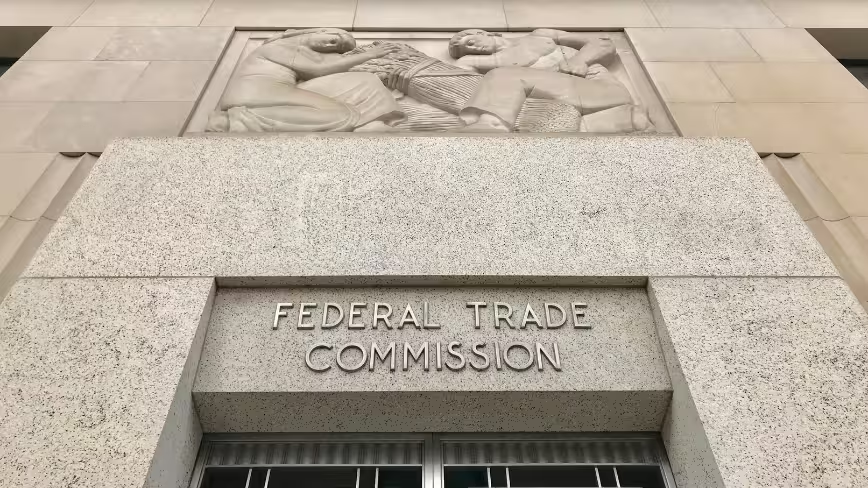

The Federal Trade Commission is suing Hims & Hers, accusing the telehealth company of sharing customers’ sensitive health information with advertising platforms including Meta and Snap.
The complaint, filed on 29 July and joined by Utah and California, also alleges the company charged people without proper consent and made subscriptions deliberately hard to cancel.
The privacy claim is the most serious. The FTC says Hims & Hers passed customers’ health details to third-party advertisers, through uploaded customer lists and automatic tracking that fired off user actions to the platforms, echoing how hospital websites have leaked patient data despite promises to protect it.
The data at issue is not trivial. Hims & Hers sells treatments for conditions people rarely discuss in public, from hair loss to erectile dysfunction to mental health, which makes an alleged leak to ad platforms unusually sensitive.
Hims & Hers has grown into a telehealth giant on exactly these categories. It expanded into weight-loss drugs and built a subscription model that turned stigmatised prescriptions into a mass-market online business, which is why the data it holds is so revealing.
The billing allegations run alongside. The FTC says customers were charged the moment they submitted an intake form, even though the company implied they could speak to a provider first, and were enrolled in recurring subscriptions without a clear chance to review their options.
Then came the hard part: leaving. Before 2023, cancelling required contacting customer service by phone, email, or chat, and even after Hims added an online option, the FTC says it buried the cancel button behind multiple steps, a textbook dark pattern of the sort the agency has been chasing across the web.
The agency’s language was unsparing. Consumers were “unknowingly locked into recurring subscriptions” while their “most private health information” was disclosed to third parties, said Christopher Mufarrige, the FTC’s consumer-protection director.
The legal basis spans several laws. The complaint leans on the FTC Act, the Restore Online Shoppers’ Confidence Act, and consumer-protection and false-advertising laws in Utah and California, a multi-front case rather than a single charge.
The market reacted at once. Hims & Hers shares fell about 10% on the news, a sign investors read the suit as a real threat to a company whose growth has been built on frictionless online sign-ups.
The case is part of a wider reckoning. Regulators have spent the past few years pursuing health and wellness services that quietly fed sensitive data to ad platforms, and Hims & Hers, with its scale and its intimate categories, is a high-profile target.
Meta and Snap are not the defendants, but they hover over the case. The tracking tools at issue are the advertising pixels and data pipelines that power much of the online ad economy, and health data flowing into them has become a recurring legal flashpoint.
The legal gap is part of the problem. Federal health-privacy law was written for hospitals and insurers, not for ad-funded apps, which has let sensitive data flow to platforms in ways patients rarely understand.
The dark-pattern allegations may resonate more widely. Hard-to-cancel subscriptions are a familiar consumer grievance, and the FTC has made them a priority, so a case pairing privacy breaches with a buried cancel button is one it will want to win in public.
Hims & Hers did not comment in the FTC’s announcement. The company has grown fast by making telehealth feel as easy as ordering anything else online, and the suit argues that some of that ease came at the customer’s expense.
The commission voted 2-0 to file. The case now heads to federal court in northern California, where the questions will be whether the data sharing broke the law and whether the sign-up and cancellation flows crossed from aggressive into deceptive.
For a sector built on convenience, the message is pointed. Telehealth promised to strip the friction out of getting care, and the FTC is now testing how much of that friction was removed from the company’s side and quietly added to the customer’s.
You must be logged in to post a comment Login