Tech
The Reason Air Force One Needs Nearly Twice The Wiring Of A Regular 747


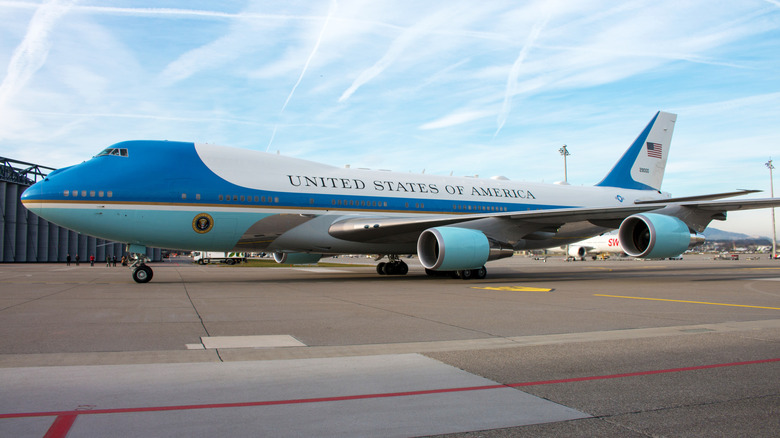
Both of the current Boeing 747-200Bs, which carry the military designation VC-25A and are known as “Air Force One,” have some truly amazing features. They’ve been in use since 1990, and are maintained and operated by the Presidential Airlift Group, part of the White House Military Office. They boast 4,000 square feet of floor space, divvied up across three levels, and (among other things) include a large office, bathrooms, a small gym, a conference room, a state-of-the-art emergency medical bay, and two fully equipped food galleys.
It also has a world-class communication center that includes dozens upon dozens of telephones, televisions, an array of multi-frequency radios, computers, and other communication and data-gathering equipment — all of which require a whole lot of wires. In fact, there are 238 miles worth of wiring running through the walls, floors, and ceilings, double what you’d find in a standard jumbo jet. The two new VC-25B’s replacing the old VC-25A’s will have 250 miles of wiring.
Additionally, every inch of that cabling is wrapped and hardened with heavy shielding to protect it and the sensitive electronics it supports from electromagnetic pulses or nuclear attacks. In fact, the Presidential plane is one big flying Faraday Cage. In simplest terms, creating a continuous capacitor that fully encapsulates any given electronic device will shield it from the devastating effects of an electromagnetic pulse. “Air Force One” has, in effect, two layers of cages, just in case the outer layer becomes damaged and lets a signal leak through. The second level of protection operates internally, encasing all critical systems in their own cages.
There are many layers to Air Force One
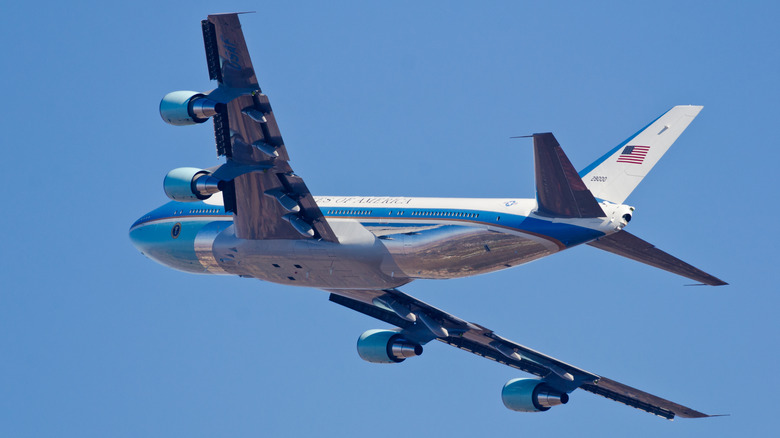
The current “Air Force One” is powered by four General Electric CF6-80C2B1 jet engines, each producing 56,700 pounds of thrust. It’s almost 232 feet long and 63 feet high, with a wingspan of 195 feet. These Boeing 747-200Bs have a top speed of 630 mph, a ceiling of 45,100 feet, and a range of 7,800 statute miles (6,800 nautical miles). It takes a crew of 30 people to operate and can carry up to 71 people.
While exact details of its advanced avionics and defenses are classified, the Air Force considers it a military aircraft because it’s designed to withstand an air attack. Not only does it have electronic countermeasures (ECM) to jam enemy radar, but also mirror-ball defenses to blind infrared guidance systems. It can also fire both chaff and flares to disrupt enemy missiles, including heat-seekers. A standard passenger plane doesn’t have to worry about such things, which is why “Air Force One” has twice the wiring of a conventional Boeing 747.
In 1943, Franklin Roosevelt became the first President to fly while in office. He hopped aboard a Boeing 314 flying boat named the “Dixie Clipper” and flew 5,500 miles across the Atlantic Ocean to meet with British Prime Minister Winston Churchill about the events of World War II. The “Air Force One” moniker didn’t come into use until Dwight D. Eisenhower was President in 1953, and even then, it was only considered a nickname. It didn’t become the official call sign until almost a decade later, in 1962, when John F. Kennedy became the first President to fly aboard the first purpose-built Boeing 707 “Air Force One.”
You must be logged in to post a comment Login