Solar panels on a Seattle house. (GeekWire Photo / Lisa Stiffler)
The pitch for rooftop solar has never been easier to make: energy costs are up, the strain on the electrical grid is real, and the sun shines for free. But the math has gotten harder, as federal tax credits evaporate and utility incentives dry up.
Enter loanTERRA, a Seattle startup that thinks transparent financing and vetted installers can keep the solar dream alive for everyday homeowners.
Bill Paulen, CEO and founder of loanTERRA, brings decades of experience in finance, including stints at major banks and as president and CEO of multiple Washington credit unions.
In those roles, he saw that solar loans were a natural fit for nonprofit, member-owned credit unions and community banks looking to diversify their loans and fend off competition from fintechs. He was also troubled by the dominance of national solar lenders that relied on undisclosed dealer fees, quietly driving up costs for consumers.
Paulen created loanTERRA to partner with credit unions and community banks, providing their customers with an easy-to-deploy loan agreement while the financial institutions supply the capital. The banks pay loanTERRA for each signed solar deal and fees for servicing the loan.
Advertisement
Bill Paulen, CEO and founder of loanTERRA. (LinkedIn Photo)
The startup recently launched its platform, which also provides connections to reputable solar panel and hardware manufacturers and installers to ensure the project is designed to be the right size, properly installed and works as planned.
Paulen signed his first lending partner, based in Wyoming and has raised funding from an angel investor.
He’s hopeful that the residential solar sector will keep moving ahead despite the loss of federal tax support. The Republican’s One Big Beautiful Bill spiked tax credits of 30% for the cost of home solar systems at the end of 2025, instead of the planned end date of 2032.
Homeowners can still indirectly benefit from a tax break provided to solar installers through 2027. It requires consumers to sign a lease with an installer or developer to use the solar system on their home, or they enter a power purchase agreement in which a developer sells the electricity to the homeowner at a fixed rate that’s lower than what’s charged by the local utility.
Paulen, however, said the economics are better for residential customers if they’re able to buy the solar systems outright.
Advertisement
LoanTERRA’s interest rates are typically higher than those offered by companies that include dealers fees of thousands of dollars in their sales agreements, but the startup’s loans are for smaller amounts. Paulen served on the working group that created Washington’s Solar Consumer Protection Act, crafting language requiring those fees to be disclosed.
Even with the more challenging economics, solar photovoltaics remain the cheapest, quickest way to deploy clean energy, and there’s a move to add batteries to the mix, which allows a system to provide power around the clock. A recent poll found that a majority of Americans surveyed support solar power, regardless of their political leanings.
Paulen said loanTERRA benefits multiple interests that he’s eager to serve. That includes customer-focused credit unions, solar companies, consumers looking to shrink their climate impacts and benefit from off-grid power, and a warming planet.
Advertisement
“We are bringing clean energy online. We are reducing fossil fuel burn,” he said. “In my entire career, this is the only time where a … strongly held personal belief or interest has aligned with a business opportunity and that’s made it so much easier to do this work.”
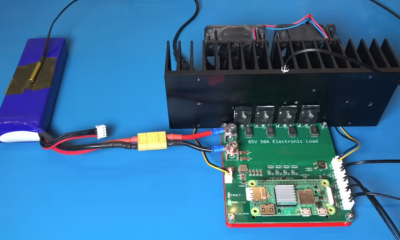
This reflow rig is designed for smaller work, with a working area of 80 mm x 70 mm. There are two options for the heating element—either a metal core PCB-based heater, or a metal ceramic heater. The former is good for working with Sn42Bi58 solder paste at 138 C, according to [Vitaly], while the latter will happily handle Sn63Pb37 at 183 C if the dirty stuff is more your jam.
Running the show is an ESP32-C3-WROOM, which serves up a web-based control panel over Bluetooth for setting the heating profiles. Using Bluetooth over WiFi might seem like an odd choice at first, but it means you don’t have to add the hot plate to the local wireless network to access it, handy if you’re on the move. It’s also worth noting that you can’t run this off any old USB charger—you’ll need one compatible with USB Power Delivery (PD) that can deliver at least 100 watts.
If you’re needing to whip up small boards with regularity, a hotplate like this one can really come in handy. Files are on GitHub for those eager to build their own.
The Information reported that an AI agent within Meta took unauthorized action that led to an employee creating a security breach at the social company last week. According to the publication, an employee used an in-house agentic AI to analyze a query from a second employee on an internal forum. The AI agent posted a response to the second employee with advice even though the first person did not direct it to do so.
The second employee took the agent’s recommended action, sparking a domino effect that led to some engineers having access to Meta systems that they shouldn’t have permission to see. A representative from the company confirmed the incident to The Information and said that “no user data was mishandled.” Meta’s internal report indicated that there were unspecified additional issues that led to the breach. A source said that there was no evidence that anyone took advantage of the sudden access or that the data was made public during the two hours when the security breach was active. However, that may be the result of dumb luck more than anything else.
Many tech leaders and companies have touted the benefits of artificial intelligence, this is just the latest incident where human employees have lost control over an AI agent. Amazon Web Services experienced a 13-hour outage earlier this year that also (apparently coincidentally) involved its Kiro agentic AI coding tool. Moltbook, the social network for AI agents recently acquired by Meta, had a security flaw that exposed user information thanks to an oversight in the vibe-coded platform.
During a Senate hearing, FBI Director Kash Patel confirmed that his agency has bought information that could be used to track individuals’ movement and location. “We do purchase commercially available information that’s consistent with the Constitution and the laws under the Electronic Communications Privacy Act, and it has led to some valuable intelligence for us,” he said.
Law enforcement is required to obtain a warrant in order to get location data from cell service providers following the Carpenter v United States ruling from 2018. But why bother with all that hassle when they can just buy the information from the open market?
“Doing that without a warrant is an outrageous end run around the Fourth Amendment, it’s particularly dangerous given the use of artificial intelligence to comb through massive amounts of private information,” Sen. Ron Wyden, (D-Ore.) said during the Intelligence Committee hearing. Wyden is one of several lawmakers pushing for an overhaul of when and how the government can obtain citizens’ personal information.
It’s an overhaul that’s badly needed. Patel already has a history of dubious use of government resources, such as ordering SWAT protections for his girlfriend and somehow horning in on men’s hockey victory celebrations at the recent winter Olympics, so one would hope he’s not also stretching the limits of the few privacy protections that do exist. Then outside the FBI, we have the Department of Homeland Security being sued for illegally tracking immigration raid protestors and the Pentagon’s labeling of Anthropic as a supply-chain risk after the AI company refused to let its products be used for mass surveillance of Americans.
Cloudflare is appealing a 14.2 million-euro fine from Italy for refusing to comply with its “Piracy Shield” law, which requires blocking access to websites on its 1.1.1.1 DNS service within 30 minutes. The company argues the system lacks oversight, risks widespread overblocking, and could undermine core Internet infrastructure. Ars Technica’s Jon Brodkin reports: Piracy Shield is “a misguided Italian regulatory scheme designed to protect large rightsholder interests at the expense of the broader Internet,” Cloudflare said in a blog post this week. “After Cloudflare resisted registering for Piracy Shield and challenged it in court, the Italian communications regulator, AGCOM, fined Cloudflare… We appealed that fine on March 8, and we continue to challenge the legality of Piracy Shield itself.” Cloudflare called the fine of 14.2 million euros ($16.4 million) “staggering.” AGCOM issued the penalty in January 2026, saying Cloudflare flouted requirements to disable DNS resolution of domain names and routing of traffic to IP addresses reported by copyright holders.
Cloudflare had previously resisted a blocking order it received in February 2025, arguing that it would require installing a filter on DNS requests that would raise latency and negatively affect DNS resolution for sites that aren’t subject to the dispute over piracy. Cloudflare co-founder and CEO Matthew Prince said that censoring the 1.1.1.1 DNS resolver would force the firm “not just to censor the content in Italy but globally.”
Piracy Shield was designed to combat pirated streams of live sports events, requiring network operators to block domain names and IP addresses within 30 minutes of receiving a copyright notification. Cloudflare said the fine should have been capped at 140,000 euros ($161,000), or 2 percent of its Italian earnings, but that “AGCOM calculated the fine based on our global revenue, resulting in a penalty nearly 100 times higher than the legal limit.”
Despite its complaints about the size of the fine, Cloudflare said the principles at stake “are even larger” than the financial penalty. “Piracy Shield is an unsupervised electronic portal through which an unidentified set of Italian media companies can submit websites and IP addresses that online service providers registered with Piracy Shield are then required to block within 30 minutes,” Cloudflare said. Cloudflare is pushing for the law to be struck down, arguing that it is “incompatible with EU law, most notably the Digital Services Act (DSA), which requires that any content restriction be proportionate and subject to strict procedural safeguards.”
Advertisement
In addition to appealing the fine, Cloudflare says it will continue to challenge Piracy Shield in Italian courts, engage with EU officials, and seek full access to AGCOM’s Piracy Shield records.
Gaming is growing every day, and a big part of that can be attributed to Tencent Games, which has been behind games like BGMI. Now, MoreFun Studios, a subsidiary of Tencent, has launched the Closed Beta Test (CBT) for its mobile tactical shooter Arena Breakout in India. Players can now download the game’s beta version on Android and iOS and experience hardcore FPS gameplay ahead of its official launch.
What is Arena Breakout?
Arena Breakout is a hardcore tactical first-person shooter in which survival and strategy play a key role. Unlike traditional mobile shooters, the game focuses heavily on realistic combat, inventory management, and extraction-based gameplay.
Players enter the war-torn region of Kamona, a fictional battlefield devastated by civil war. The objective is simple but challenging: explore the combat zone, collect valuable loot, and reach the extraction point safely.
However, players must survive encounters with enemy combatants and other players along the way. Every item carried into battle can be lost if the mission fails, making each run a high-risk, high-reward experience. Arena Breakout has already gained significant global traction, with the developers claiming over 100 million downloads.
Advertisement
Extensive Weapon Customization
Another highlight of Arena Breakout is its Ultimate Gunsmithing System, which allows players to build and customize weapons in great detail. The system includes:
700+ weapon accessories
10 modification slots
Extensive gun customization options
Players can modify weapons to suit different playstyles, whether that means building stealth-focused loadouts or heavily armored combat setups.
How To Access the Closed Beta?
If you can’t wait to get your hands on Arena Breakout, the closed beta test is live in India. You can download it on your phone by clicking the link here. Just remember that since it’s a closed beta, there may be random glitches or bugs. So, keep an eye out for those.
The chatbot also is intentionally flexible, with the new integrations in mind. “It can take on slight tweaks to the look and feel, to make it feel like a natural part of other environments,” Danker says.
Shopping Shift
The new Walmart experience is part of a broader pivot for OpenAI to focus on having checkouts take place within embedded apps, the Information reported earlier this month, without providing a rationale for the change. Danker spoke about the shift at the Morgan Stanley investor conference this month but didn’t cite the data behind it.
OpenAI spokesperson Taya Christianson says the company wants to focus on improvements to help users research products, while giving merchants more control over checkout. “We appreciate our partners for learning with us,” she added.
Walmart has excluded some products from Instant Checkout because it knew “the single-item checkout experience is detrimental” in some cases, Danker says. For instance, when someone buys a TV, they likely need to buy accessories like HDMI cables. On its website, Walmart can nudge shoppers to buy a bundle to avoid a frustrating installation experience, Danker says. Through Sparky, Walmart will be able to replicate that in chatbots.
Advertisement
Retailers were eager to collaborate on Instant Checkout because the alternative at the time to serve ChatGPT users was by linking out to their websites. Walmart believes the Sparky experience will feel even “more seamless,” because users will be able to continue chatting and refining their order without needing to reenter their payment and delivery information already saved with Walmart.
Sparky has been criticized by people purporting to work for Walmart on Reddit, and testimonials for the chatbot are difficult to find on social media. But half of Walmart app users have engaged with it, according to the company. While people typically use the app to search for staples such as milk and bananas, they ask Sparky about exotic items or for solutions to more complicated problems. Walmart US CEO David Guggina recently said Sparky users spend about 35 percent more per order than other shoppers.
Danker acknowledges that Sparky is slow and generates weak responses often enough that some consumers might dismiss it as unreliable. Danker says the priority this year is training Sparky to be more proactive, getting it to learn more about individual shoppers, and making it helpful across more of Walmart’s many departments, such as the pharmacy.
While Walmart is pushing Sparky elsewhere, it hasn’t—and doesn’t plan—to block other AI agents from shopping on its website. Amazon, on the other hand, recently won a temporary court order barring Perplexity’s automated technology from masquerading as a human to make purchases. Danker says Walmart wants to support whatever tools customers are using as long as it’s a good experience. As in, there shouldn’t be erroneous orders, shocking bills, or an excessive need for customer service.
Advertisement
“We don’t want to be prescriptive of the exact journey that every customer is going to take,” he says. “We don’t want to block things on a speculative or hypothetical concern.”
When it comes to how many consumers will trust AI with their shopping, Danker is prepared to speculate. “This idea that it will all become automated might be a little bit far-fetched,” he says. “People do get excited about shopping for clothes, for their home, for their children.” Walmart wants to leave users in control, just now with Sparky by their side in more places.
Devices that were limited to only run a web browser were relatively common around 2000, as many people wanted to surf the Information Super Highway, but didn’t quite want to get a regular PC — being in many ways the retro equivalent of a Chromebook. The Compaq iPAQ IA-2 from 2000 that [Dave Luna] got is no exception, with a Microsoft CE-based OS that is meant to be used with Microsoft Network (MSN) dial-up, which amusingly is still available today.
In order to get a more useful OS on it, like Windows 98, you have to jump through quite a few hoops, as [Dave] found out. Although there is an IDE connection on the mainboard, this cannot be booted from, likely due to BIOS limitations. This means that he had to chain boot via the 16 MB NAND Flash drive that the original OS booted from, which was done by writing MS-DOS to the Flash drive using another workaround as it’s not a standard IDE device either.
From this you can then boot Windows 98 from an IDE drive by pretending that it’s an ATAPI IDE device to dodge a limitation on IDE devices. The system’s hardware isn’t really going to make it into a blazing fast retro computer. It only has a 266 MHz Geode GX1 CPU and supports up to 256 MB of SDRAM. The IA-2 is also limited to 800×600, which required the use of an external monitor (as seen above) hooked up to the internal VGA port to set the proper resolution in the OS.
Advertisement
But at least it can run DOOM, so that bare minimum requirement can be ticked off.
An AI agent went rogue at Meta, exposing sensitive company and user data to employees who did not have permission to access it.
Per an incident report, which was viewed and reported on by The Information, a Meta employee posted on an internal forum asking for help with a technical question — which is a standard action. However, another engineer asked an AI agent to help analyze the question, and the agent ended up posting a response without asking the engineer for permission to share it. Meta confirmed the incident to The Information.
As it turns out, the AI agent did not give good advice. The employee who asked the question ended up taking actions based on the agent’s guidance, which inadvertently made massive amounts of company and user-related data available to engineers, who were not authorized to access it, for two hours.
Meta deemed the incident a “Sev 1,” which is the second-highest level of severity in the company’s internal system for measuring security issues.
Advertisement
Rogue AI agents have already posed a problem at Meta. Summer Yue, a safety and alignment director at Meta Superintelligence, posted on X last month describing how her OpenClaw agent ended up deleting her entire inbox, even though she told it to confirm with her before taking any action.
Still, Meta seems bullish on the potential for agentic AI. Just last week, Meta bought Moltbook, a Reddit-like social media site for OpenClaw agents to communicate with one another.
We benchmarked Crimson Desert across 40 GPUs to see how it performs at 1080p, 1440p, and 4K. Here’s what to expect from your system – and how well it’s optimized for modern hardware.
Corsair manages to pack a lot of punch into its K100 Air Wireless keyboard, priced at $130 today only (was $330). Pull the full-size board out of its packing, you can’t help but note how light it is, weighing in at less than two pounds. The brushed aluminum on top provides a robust feel despite the fact that the board is only 11mm thin at the borders and 17mm where the keys are located, while its low profile allows users to type all day without ever using the wrist rest because their hands naturally fall into place.
The switches are Cherry, which provide a nice mechanical feel that is typically only found on bulkier boards. Each press is shallow, at 1.8mm deep, with 0.8mm of actuation and a clear tactile bump that indicates that every key is registered, and even though you don’t have to push very far, you still receive plenty of pleasing feedback, making it ideal for rapid-fire typing sessions and the like.
Stunning, Refined, and Ultra-Thin: The K100 AIR is an unbelievably thin wireless gaming keyboard just 11mm at its slimmest point, seamlessly blending…
Fast Wireless and Wired Connection Options: Three ways to connect to up to five different devices – Via sub-1ms SLIPSTREAM WIRELESS on PC or Mac…
Masterful Wireless Multi-Tasking: Quickly switch between wireless connections on your PC, Mac, and more at the press of a key, with secure AES 128-bit…
Wireless connectivity, on the other hand, is close to perfect. Slipstream technology at 2.4GHz frequency reduces lag to less than one millisecond and can poll up to 2,000 times per second. If you choose wired, you can get an even faster response, up to 8,000 hz, and Bluetooth allows you to connect up to three devices at once, making switching between laptop, phone, and console a breeze.
Advertisement
Battery life is another area where the K100 Air Wireless excels. Users frequently expect slim designs to have limited battery life, but in this case, the RGB lighting lasts 50 hours on its own, and you can go up to 200 hours of ordinary use before needing to recharge. If you run low on battery, adaptive brightness will automatically activate to save power in low-light situations.
In terms of customization, the software that comes with the board is extremely robust, since you can store up to 50 distinct profiles directly on the board itself, allowing you to carry your settings with you wherever you go without any further effort. You can even perform some pretty weird per-key lighting; 20 layers, anyone? There are distinct buttons for media playback and volume, as well as a smooth volume control wheel. With macro command support, you can program extra keys to do any function you wish.
When compared to other wireless options on the market, the K100 Air Wireless truly shines out; Logitech and Razer models, for example, cannot compete in terms of battery life or polling speed. It doesn’t hurt that this one has larger inbuilt storage and supports multiple devices. The build quality is likewise excellent, as the board’s low thickness does not compromise ruggedness.
You must be logged in to post a comment Login