




We take a look back at the official launch last week of Ireland’s first European Space Agency ‘Phi-Lab’ – a big step in Ireland’s ambitions in space-tech development.
There was a remarkable buzz at the oversubscribed official launch last Friday (13 February) of Ireland’s first European Space Agency (ESA) Phi-Lab headquartered at Irish Manufacturing Research (IMR) in Mullingar, run in collaboration with the AMBER Centre at Trinity College Dublin.
One of 10 European Phi-Labs, it is designed to be Ireland’s national platform for space technology development, and to anchor the country’s ambitions within Europe and the world’s rapidly-expanding space economy.
Philip Thomas, head of the ScaleUp programme division at ESA, was one of several senior agency representatives that travelled to Mullingar for the launch and he was excited about the particular focus of Ireland’s Phi-Lab on additive manufacturing.
“This is a really important Phi-Lab because it actually helps develop technologies and translate them quite quickly into commercial solutions, in an increasingly competitive space market globally, which is why it’s quite critical that we take these activities forward,” said Thomas.
“We’ve seen real success in Irish companies winning contracts with the European Space Agency, and over the last nine or 10 years, we’ve had 50 start-ups come through there,” said Joe Healy, head of research and innovation at Enterprise Ireland. “And what’s great about that is they’re already employing over 200 people and have raised almost €50m.
“So we would be optimistic that we can build on the success to date. The competition is very, very strong internationally, but we have very good, innovative companies these days.”
Healy also strongly advised companies in this space to diversify and ensure they find wider applications for their technologies, and to also look beyond Europe.
“Today marks a major milestone in our journey on the Phi Lab Ireland programme,” said Ken Horan, who leads the Ireland Phi-Lab in Mullingar. “For IMR, this is a major step into the space ecosystem where we are trying to advance Ireland’s position within the space innovation ecosystem and ultimately make Ireland leaders within this emerging market.”
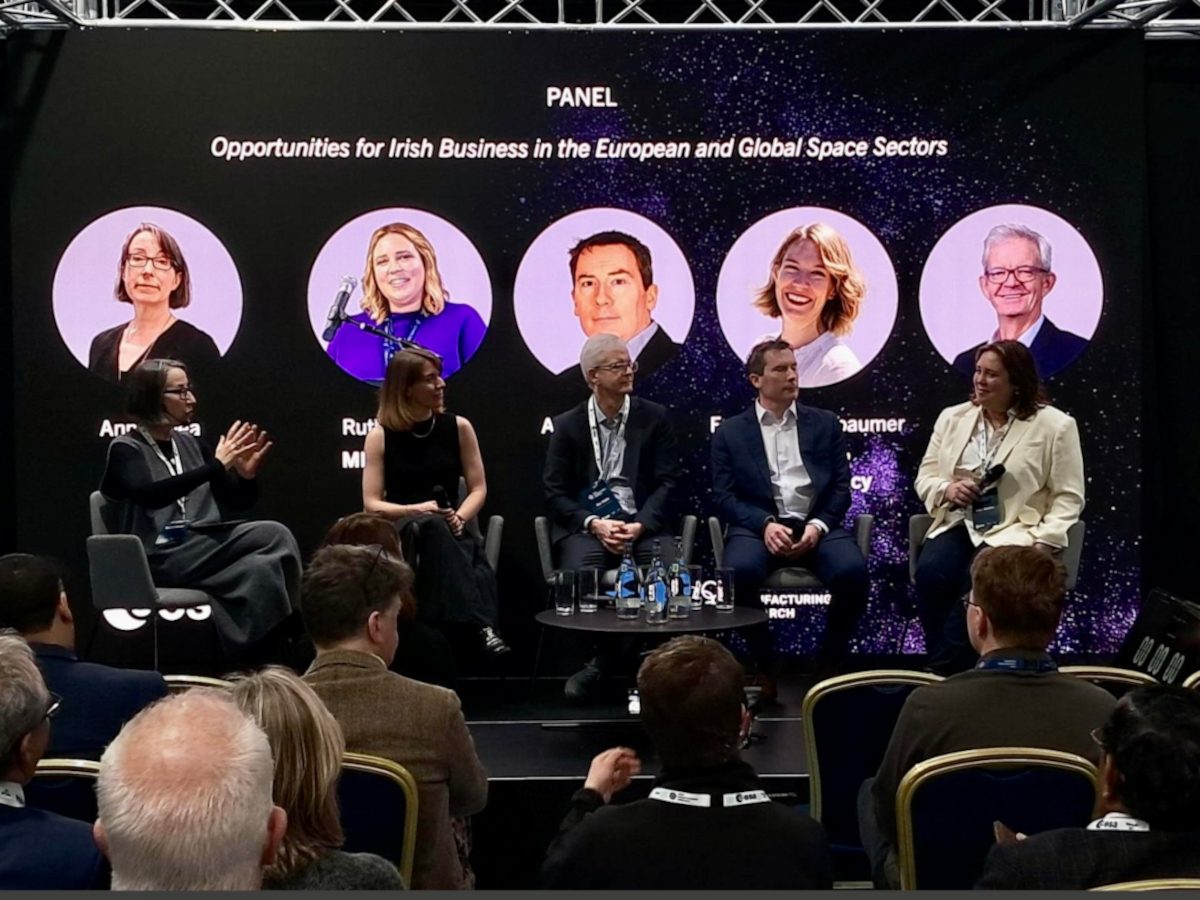
A lively panel discussion included the co-founders of the two Irish companies selected from a highly-competitive first ‘Open Call’ last year – Ubotica Technologies and Mbryonics.
“We’re really delighted to be pioneering through this first call in Phi-Labs to bring additive manufacturing to what we’re doing,” said Ruth Mackey, CSO and co-founder of Mbryonics. “And that’s being enabled through the Phi-Labs programme here at the IMR. Bringing that space sector manufacturing is a key enabler, we think, for the next generation of jobs in Ireland.”
“We don’t necessarily have access to this capability and this expertise in-house,” said Aubrey Dunne, CTO and co-founder of Ubotica Technologies. “And so through the Phi-Lab project, we are partnering with the IMR, who have these skills in abundance. And they’re going to help us to design effectively solutions that are thermally well managed.”
Minister for Enterprise, Tourism and Employment Peter Burke, TD officially launched the new lab last Friday, and said the Irish Government was determined to support innovation and innovative companies in the space sector, pointing to the excellence of the two successful first call companies.
“I know that the next competitive call will take place during the first half of this year,” he said. “And I’m sure listening to our two successful applicants here today, that will spark plenty of interest for the future in this regard.”
“This facility positions Ireland at the forefront of European space-enabled innovation, where advanced manufacturing, AI and data-driven technologies can be developed, tested and commercialised for global impact,” said Barry Kennedy, CEO of IMR. “Ultimately, this is about translating world-class research into real economic and societal value.”
The launch forms part of a wider national commitment to the ESA, with the Department of Enterprise, Tourism and Employment committing €170m in investment to ESA over the next five years. The establishment of ESA Phi-Lab Ireland in Mullingar is a flagship element of that investment.
All the speakers agreed that Ireland’s space and space-enabled innovation sector is on the rise. Since the publication of Ireland’s ‘National Space Strategy for Enterprise’ in 2019, there are now 120 space-active companies working with ESA in Ireland in one way or another, and many Irish companies are today providing technologies and solutions to the commercial space sector globally.
Don’t miss out on the knowledge you need to succeed. Sign up for the Daily Brief, Silicon Republic’s digest of need-to-know sci-tech news.