
Connect with us

Tech

The “Tin Blimp” Was A Neither Tin Nor A Blimp: The Detroit ZMC-2 Story

Published

on

That fireball was LZ37. Nobody wanted to see repeats post-war.
Image: “The great exploit of lieutenant Warnefort 1916 England” by Gordon Crosby, public domain.

After all the crashing and burning of Imperial Germany’s Zeppelins in the later part of WWI – once the Brits managed to build interceptors that could hit their lofty altitude, and figured out the trick of using incendiary rounds to set off the hydrogen lift gas – there was a certain desire in airship circles to avoid fires. In the USA, that mostly took the form of substituting hydrogen for helium. Sure, it didn’t lift quite as well, but it also didn’t explode.

Still, supplies of helium were– and are– very much limited, and at least on a rigid Zeppelin, the hydrogen wasn’t even the most flammable part. As has become widely known, thanks in large part to the Mythbusters episode about the Hindenburg disaster, the doped cotton skin in use in those days was more flammable than some firestarters you can buy these days.

That’s a problem, because, as came up in the comments of our last airship article, rigid airships beat blimps largely on Rule of Cool. Who invented the blimp? Well, arguably it was Henri Griffard with his steam-driven balloon in 1857, but not many people have ever heard his name. Who invented the rigid airship? You know his name: Ferdinand Adolf Heinrich August Graf von Zeppelin. No relation. Probably. Well, admittedly most people don’t know the full name, but Count Zeppelin is still practically a household name over a century after his death. His invention was just that much cooler.

That unavoidable draw of coolness led to the Detroit Airship Company and their amazing tin blimp. The idea was the brainchild of a man named Ralph Upton, and is startling in its simplicity: why not take the all-metal, monocoque design that was just then being so successfully applied to heavier-than-air flight, and use it to build an airship?

Of course everyone’s initial reaction to the idea is that it’s absurd: metal is too heavy to fly! They said that about airplanes once, too, but airships are surely a different matter. Airships must be lighter than air. Could a skin of aluminum really hold enough lift gas to keep itself in the air? Upton convinced no lesser lights than Henry Ford to back him, and the Detroit Aircraft Company ultimately found a customer for the design in the US Navy.

Advertisement
Schwartz’s unsuccessful airship, shortly before its crash.
Image credit: unknown, public domain.

It helped that Upton wasn’t exactly the first to come up with this idea: David Schwarz had tried to build a metal airship at the end of the 19th century. Arguably it is he who invented the rigid airship, not my aura farming not-ancestor. His design had metal skin over an internal framework, rather than the lighter monocoque construction Upton was exploring. While it was by no means a success, being destroyed on its maiden flight, the fact that it had a maiden flight at all at least proved that metal structures could be made light enough to get off the ground.

The Detroit Airship Company’s first– and only, as it turned out– prototype was much more successful, as we will see. It was immediately nicknamed the “tin blimp” by the press after it was unveiled in 1929, that name was incorrect in every particular. It wasn’t tin, and it wasn’t a blimp. Well, not exactly, anyway. More on that later.

How To Make a Metal Balloon

Compared to the various frames, longitudinal girders, bracing wires and fabric-backed gas bags of a Zeppelin-type airship, the ZMC-2’s balloon was simplicity itself. The balloon–if you can call it that–was a hollow spheroid built up of strips of 0.0095” (0.24 mm) Alclad sheeting. Alclad is a sort of metallic composite material: a sheet of duraluminum coated with a very thin protective layer of pure aluminum to provide corrosion resistance. The ZMC-2 was actually the first major use of Alclad, but hardly the last. At least for skins, most aircraft aluminum is actually alclad, as alloys with the desired strength-to-weight ratio are generally too vulnerable to corrosion to be exposed to the elements.

The cavernous interior of the ZPG-2’s gas ‘bag’, looking forwards. The ballonets have not yet been installed. Image credit unknown, via Aviation Rapture

So, contrary to popular belief, no tin was involved. And the sturdy aluminum spheroid was not at all flexible, so the ZMC-2 was not really any kind of blimp. It also was not, technically, a Zeppelin. It was a whole new beast: a metalclad airship.

There is a film of the ship being built, and it’s rather fascinating. The strips of alclad are rolled into conical sections and riveted together, with a bituminous material serving as sealant. Even today, you would not want to weld this material, so instead three and a half million 0.035” (0.89 mm) rivets hold the plates together. A special automated riveting machine was invented for the construction of the metalclad airship, which “sewed” three rows simultaneously at a rate of five thousand rivets per hour.

Just like most monocoque airplanes, then and now, the skin doesn’t hold the entire load: there were five circular frames, flanged and full of lightening holes just like the ribs of an aeroplane fuselage, of various diameters to help the ‘gas bag’ hold shape. The gondola would attach to two of these.

Advertisement

Amazingly, with all of those rivets and the low-tech sealant, the metalclad held helium much better than its rivals. Yes, helium. While more expensive than hydrogen, the US Navy had already transitioned away from that more volatile gas and had no interest in going back. All of their groundside infrastructure was centered around helium. If that meant that the fireproof metalclad would not be able to lift quite so much as it otherwise might, well, too bad.

By the time the ZMC-2 got to Lakehurst as pictured here, only helium was on tap.
Image: Navy History and Heritage Command

OK, It’s a Bit Like a Blimp

Aside from outward appearance, the metalclad airship is similar to a blimp in some respects. For one, like the blimps that would go on to serve into and well past WWII, and unlike every Zeppelin ever built, the metalclad design had no internal subdivisions. The great metal balloon, 52 ‘8 ” in diameter (16 m) and 149’ 5” (45.5m) long, held two air bladders, one fore, and one aft, but was otherwise cavernously empty.

Just like the blimps, those air bladders were used for trim: by pressurizing the fore bladder, the nose becomes heavy and trims the blimp down; likewise pressurizing the rear bladder trims the nose upwards. With both under pressure, the overall excess lift of the gasbag is reduced slightly, though the hull was not designed to withstand enough pressure for that to be notably useful at affecting overall buoyancy. The maximum the ZMC-2’s hull could take was said to be about two inches of water, or 0.07 PSIg (0.5 kPa).

Also like a blimp, that pressure was required to resist the force of aerodynamic drag, at least at high speeds. The aluminum skin could hold its own shape, obviously, and even at low speeds it was safe to fly at atmospheric pressure, but at speeds above about half velocity never exceed (VNE) there was a risk of buckling the nose. So, like a blimp–or the balloon tanks on the much later Atlas rockets–gas pressure was used as reinforcement. For that reason, there was much consternation at the time–and since–whether to count the metalclad as a rigid or non-rigid airship. Ultimately the US Navy, whose code was “Z” for airship and “R” for rigid or “S” for non-rigid, called it ZMC– z-airship, metal clad. That dodged the issue well enough.

A larger ship might have been able to afford the weight of stronger aluminum to take the buffeting of high-speed flight, thanks to the square-cube law, but the comparatively tiny ZMC-2 lacked that lift capacity. Even larger ships were always intended to use pressure-reinforcement; it’s a key part of the metalclad concept. Why waste lift capacity on metal when the gas can do it for you? As it was, the useful load of the prototype ZMC-2 was only 750 lbs (340 kg). The ZMC-2 wasn’t designed for useful load, though; it was only ever meant as a testbed.

Advertisement

Flying the Tin Blimp

As a testbed, the ZMC-2 was reasonably successful, and also a complete failure. It was reasonably successful in that its logbooks recorded 2,265 incident-free hours over 725 flights between its debut in August 1929 and its grounding in August 1939. In those ten years, it was found to fly well, in spite of its oddities.

The control car, with its crew of two or three–plus four passengers–and a pair of 220 HP Wright Whirlwind engines, would not have looked out of place on a blimp of similar size. Its overall size was not unlike blimps Goodyear was flying. Nor was the ZMC-2 particularly speedy, or unusually slow with a top speed of 70 mph (113 km/h). Aside from the metal-clad construction, two things made the ZMC-2 stand out amongst its contemporaries. The empennage — the “tail” — was perhaps unique in airship history– as near as I can tell, the Detroit Airship Company was the only one to ever fit eight equally-spaced fins to the rear of an airship. All had control surfaces, and in practice, there was no control mixing: four acted as elevators, and four as rudders. It worked well enough, as the ship was apparently quite maneuverable.

The only thing normal in this photo is the gondola. Note the four visible tail surfaces– there are four more on the other side. Image: Screenshot from “Tin Balloon” (Silent) by zrsmovie.com

The other oddity helped with this maneuverability: the airship’s fineness ratio. It was oddly squat, at only 2.83. Like much in the world of airships, the concept of a fineness ratio is borrowed from the naval world– there, it is the ratio between a ship’s length and its beam, or width. For a flying ship, it’s the length to diameter of the gas bag, but the effect is the same. Picture a racing skiff vs a coracle, or a whitewater kayak. The racing skiff has a very high fineness ratio, which gives it high speed and low maneuverability as it cuts through the water. A coracle or whitewater kayak, on the other hand, has a low fineness ratio, often less than two, so that they can turn on a dime. They’re also incredibly difficult to keep going in a straight line. The ZMC-2 wasn’t quite that squat, but from the boating analogy I can only imagine it was a handful to keep on a straight course at times.

ZMC-2 looks positively squat at top-right, compared to ZR-3 Los Angeles at center and the J-2 blimp on the left. That has pros and cons but was not an inherent characteristic of the metalclad concept.
Image: Naval History and Heritage Command

The only reason I dare call the fabulous tin blimp a failure is because there was no ZMC-3, or -4, or N≠2. It was indeed the only metalclad to ever fly.

One of a Kind

It wasn’t the cute little prototype’s fault; it was the timing. The Detroit Aircraft Company launched the ZMC-2 with big plans– Upton’s first design was for a larger express passenger/cargo airship of 1,600,000 cu.ft. (45,307 m³) gas volume, compared to the meager 200,000 cu.ft. (5,663 m³) of the prototype. There was interest in the bigger designs, but the ZMC-2 would need to prove the concept– which it did, in August 1929. Then in October, the stock market crashed, the Great Depression hit, and there was a lot less money available for pie-in-the-sky ideas like metalclad airships.

The interest was there, mind you. The U.S. Army liked what they saw, and went hat-in-hand in 1931 to Congress asking for 4.5 million to buy a 20-ton-lift model that would have been larger than the Graf Zeppelin. At that point, Congress felt there were other priorities. Later on, Detroit’s metalclad design was The Navy’s preferred choice to replace the ill-fated Akron and Macon, but there were problems with funding and the Detroit Aircraft Company didn’t have a hangar big enough to build the thing in anyway.

Advertisement
The Army’s large metalclad might have looked like this, according to Popular Mechanics
Image: Popular Mechanics April 1931, via lynceans.org

That was the end of it. Though there was no notable metal fatigue or corrosion, the ZMC-2 flew less and less as the odds of a successor dropped. Some accounts claim it was grounded completely in 1939; others imply a handful of flights until US entry into WWII. With the war on, aluminum was in short supply and the ZMC-2 was broken up for scrap in 1941. It was simply too small for the antisubmarine duty the Navy’s blimps were being put to, and too weird to use as a training ship. Though the gondola was kept for a time as a learning aide for ground school, it was not preserved. It is likely that no physical trace of the fabulous tin blimp remains.

Legacy

Ultimately, the ZMC-2 was successful in proving that a metalclad airship could fly. During the various aborted attempts at an ‘airship renaissance’, various proposals for metalclads or similarly-built composite ships have been put forth, but as with Ralph Upton’s larger designs, no capital sufficient for construction ever materialized.

In spite of my praise of the non-rigid airship’s ability to shift with the winds– going so far as to say “Blimps win” in my last article, based on the historical record, I for one would love to see a metalclad fly again. Maybe it’s just the Rule of Cool– rigids are cooler, and metalclads are cooler yet. Maybe the image of the doughty ZMC-2 buzzing about like a giant, clumsy bumble bee has made me sentimental for the design. Maybe it’s just that there’s potential there. Thanks to the great Nan ships, we’ve got a pretty idea of what non-rigid airships are capable of. ZMC-2 only scratches the surface of what a metalclad could do; perhaps someday we’ll find out. With modern lithium-aluminum alloys being that much lighter, or the ‘black’ aluminum of carbon composites, we could probably build something exceeding Ralph Upton’s wildest dreams… if there was money to pay for it.

12 years was a good run for a prototype. So long, and thanks for all the AvGas.
Image: Naval History and Heritage Command

Source link

Advertisement
Continue Reading
Click to comment

Leave a Reply

Your email address will not be published. Required fields are marked *

Tech

YouTube surpasses Disney, Paramount, WBD in 2025 ad revenue

Published

on

YouTube has hit some impressive numbers in 2025.

According to new estimates from research firm MoffettNathanson— as reported by The Hollywood Reporter— the platform pulled in a staggering $40.4 billion in ad revenue, which is more than Disney, NBC, Paramount, and Warner Bros. Discovery (WBD)’s combined ad revenue, whose total came to $37.8 billion. 

This shift is a clear sign of just how much content consumption has changed over the years and how advertisers have adapted their strategies.

YouTube’s ad revenue for 2025 not only topped the combined haul from the four major Hollywood studios, but also marked a huge turnaround from the previous year. In 2024, YouTube’s ad revenue of $36.1 billion fell short of the $41.8 billion in ad revenue collectively earned by Disney, NBCU, Paramount, and WBD. The tables have now turned.

Advertisement

For decades, these studios have been the kings of entertainment, captivating audiences with big-budget films and hit TV shows. But as traditional studios struggle with shrinking linear TV audiences and the ever-rising costs of productions, YouTube is speeding ahead. Even as these companies pour millions into their own streaming platforms, it’s getting harder to keep up with YouTube’s momentum. 

Last month, parent company Alphabet reported that YouTube’s total revenue in 2025 soared to $60 billion. A big portion of YouTube’s revenue now comes from subscriptions, which include services like YouTube TV, YouTube Premium, YouTube Music, and NFL Sunday Ticket. (For context, that’s well above Netflix’s reported $45.2 billion for the full year.)

Disney, NBC, Paramount, and Warner Bros. Discovery (WBD) are also heavily subscription-dependent businesses; Disney’s media business pulled in a total of $60.9 billion in revenue last year, when you include subscriptions, for instance.

Techcrunch event

Advertisement

San Francisco, CA
|
October 13-15, 2026

That said, YouTube’s ad revenue still trails behind tech giants like Meta, which pulled in $196.2 billion in ad revenue in 2025. Still, advertisers are flocking to YouTube because that’s where audiences (especially younger viewers) are spending their time. YouTube’s ad revenue reached $11.4 billion in the fourth quarter.

Advertisement

YouTube is also stepping up its investment in AI. This week, the company announced that it’s expanding its likeness detection technology to a pilot group of government officials, politicians, and journalists. The tech identifies AI-generated deepfakes and lets users request the removal if they believe it violates YouTube policy.

Source link

Continue Reading

Tech

Barco Acquisition of VerVent Audio Holdings Puts Focal and Naim Under New Ownership

Published

on

The high-end audio industry is entering a new phase of consolidation, and the latest move could reshape the competitive landscape. Belgium-based technology company Barco has reached an agreement in principle to acquire 100 percent of VerVent Audio Holding, the parent company behind premium hi-fi brands Focal and Naim Audio. The deal places two of the most respected French and British names in high-end audio under the control of a global visualization and professional AV powerhouse best known for cinema projection, medical imaging displays, and enterprise collaboration systems.

This is not happening in isolation. In 2024, Bose stunned the industry by acquiring the McIntosh Group, bringing legendary brands McIntosh and Sonus faber into its orbit and signaling that premium audio heritage brands have become strategic assets for much larger technology companies.

Barco’s proposed purchase of VerVent raises a more uncomfortable question: were two of the most successful and respected hi-fi brands acquired because they are thriving and poised to capture even more global market share, or is there pressure beneath the surface that outsiders simply haven’t seen yet?

The answer likely lies in a shifting market where high-end audio is no longer viewed as a niche enthusiast category, but as a critical component of integrated audiovisual ecosystems spanning luxury residential installations, automotive audio systems, immersive entertainment spaces, and premium lifestyle technology.

Advertisement

According to An Steegen, CEO of Barco: “Today marks an important step in Barco’s ambition to shape the future of immersive audiovisual experiences. By welcoming VerVent Audio Holding and its iconic Focal and Naim brands into the Barco family, we accelerate our strategy to deliver fully integrated solutions where image and sound reinforce each other seamlessly. Building on our leadership in visualization, we go all in on entertainment. The addition of high fidelity audio strengthens the overall experience of our offering across high end residential and broader consumer home entertainment environments, as well as in professional markets. This combination expands our reach, deepens our technology capabilities, and positions us to capture new opportunities across the audiovisual value chain. We are excited to embark on this next chapter together.”

Focal and Naim were contacted for comment regarding the acquisition, but representatives for VerVent Audio Holdingindicated that they are unable to comment publicly at this time.

Barco Series 4 Projectors

Who Is Barco?

Founded in 1934 in Poperinge, Belgium by Lucien de Puydt, Barco began as the Belgian American Radio Corporation, assembling radios from components imported from the United States. Over the decades, the company evolved into a global technology leader focused on visualization, collaboration, and immersive audiovisual systems.

Today, Barco is best known for its digital cinema projection technology, supplying high performance projectors used in commercial theaters around the world. The company also develops visualization systems for live events, museums, simulation, aviation training, and defense applications.

Advertisement

Beyond entertainment and visualization, Barco operates in two additional sectors. In the enterprise space, its ClickShare wireless collaboration platform has become a widely adopted solution for meeting rooms and hybrid work environments. In healthcare, Barco manufactures diagnostic imaging displays and surgical monitors used by radiologists and medical professionals.

For most of its history, Barco’s expertise has been centered on visual technologies rather than audio. Its acquisition of VerVent Audio Holding—and with it premium audio brands Focal and Naim—signals a strategic move to expand into fully integrated audiovisual systems that combine both image and high fidelity sound.

Focal Powered by Naim Timonium

Who Is VerVent Audio Holding?

Headquartered in Saint Étienne, France, VerVent Audio Holding is the premium audio group that oversees two of the most respected brands in high-end audio: Focal and Naim. Together, the French and British companies represent decades of engineering expertise across loudspeakers, headphones, amplification, streaming audio, and custom installation systems.

Advertisement. Scroll to continue reading.
Advertisement

Focal

Founded in 1979 in Saint Étienne, Focal has built a global reputation for high-end loudspeaker design and driver engineering. The company develops and manufactures a wide range of products including audiophile loudspeakers, reference studio monitors, premium headphones, and automotive audio systems.

Some of Focal’s most recognizable products include the Focal Utopia reference headphones, the Focal Sopra No2 loudspeakers, and the flagship Focal Grande Utopia EM Evo, which represent the company’s expertise in driver technology and cabinet design. Focal is also a major supplier of OEM audio systems for automotive brands, extending its reach well beyond traditional hi-fi.

Related Podcast: The Focal Revolution: How a French Hi-Fi Manufacturer is Revolutionizing Your Music Listening Experience (July 2023)

Naim

Founded in 1973 in Salisbury, England, Naim is known for high-performance audio electronics, including integrated amplifiers, preamplifiers, power amplifiers, network streamers, and all-in-one music systems.

Advertisement

Among its most successful products are the Naim Uniti Atom streaming amplifier, the Naim Uniti Nova Power Edition, and the flagship Naim Statement amplifier system, which represents the company’s ultimate expression of high-end audio engineering.

Related Podcast: Say My Naim: How a Quirky British Hi-Fi Company is Quietly Conquering the Globe (July 2023)

Shared Ecosystem and Global Retail Network

Together, Focal and Naim collaborate extensively on custom installation, luxury residential audio, and high-performance home theater systems. Their combined expertise in loudspeaker design and electronics allows the brands to offer fully integrated solutions across two-channel hi-fi, immersive home cinema, and architectural audio.

Through VerVent, the two companies have also built a significant global retail presence with more than 80 dedicated boutiques and thousands of sales points worldwide, including the rapidly expanding Focal Powered by Naim retail network. These flagship stores showcase complete systems built around Focal loudspeakers and Naim electronics and have become a key part of the group’s global brand strategy.

Advertisement

This established retail and distribution infrastructure provides Barco with an immediate platform to expand into premium consumer audio and accelerate its presence in luxury residential and experiential entertainment markets.

Focal Grand Utopia EM Evo Loudspeakers in white with Naim Statement Preamplifier and Amplifiers at Casa HiFi Focal Powered By Naim Store in Miami, FL
Focal Grand Utopia EM Evo Loudspeakers in white with Naim Statement Preamplifier and Amplifiers at Casa HiFi (Focal Powered By Naim Store) in Miami, FL

What Barco Is Paying and What Happens Next

Barco has agreed in principle to acquire 100 percent of VerVent Audio Holding for an enterprise value of approximately €135 million (~$157.2 USD), with the transaction expected to be financed using Barco’s existing funds. VerVent currently generates annual revenues of roughly €110 million, and Barco anticipates operational and technology synergies over the coming years as the companies integrate.

Once the transaction closes, VerVent will be incorporated into Barco’s Entertainment division, where the company plans to support the existing strategy built around premium high end audio positioning, continued development of digital and connected products, and further expansion of its global sales network. Barco has also reaffirmed its long term financial outlook, maintaining a target EBITDA margin of 15 percent by 2028.

The acquisition has not yet been finalized. Completion remains subject to consultation with employee representative bodies and regulatory approvals, with a closing date still to be determined.

Advertisement
Advertisement. Scroll to continue reading.

The Bottom Line 

Barco’s acquisition of VerVent Audio Holding brings two of the most recognizable and technically capable brands in premium audio, Focal and Naim, into a company that has spent decades dominating the visual side of the AV industry. On paper, the strategic logic is clear. Barco gains immediate access to world class audio engineering while Focal and Naim gain a partner with deep experience in cinema, enterprise visualization, and professional installations.

The potential synergy is significant. Focal and Naim already operate a powerful global retail and distribution network that includes more than 80 Focal Powered by Naim stores, hundreds of specialty dealers, and online retailers across nearly every major market. Combined with Barco’s reach in cinema, simulation, enterprise collaboration, and medical imaging, the acquisition creates the possibility of delivering fully integrated audiovisual systems for luxury residential, immersive entertainment, and professional environments.

The strength of the brands themselves is also a major factor. Both Focal and Naim sit at the very top of their respective product categories with advanced research and development programs, modern manufacturing facilities, and strong global brand recognition among audiophiles and luxury buyers.

Advertisement

The €135 million enterprise value inevitably raises questions about timing. Was Barco motivated by the continued success and growth potential of Focal and Naim, or does the relatively modest purchase price suggest underlying pressures that are not immediately visible from the outside? What is clear is that Barco gains instant credibility in premium audio, while Focal and Naim gain access to the resources and global reach of a technology company that has long dominated the visual side of the AV industry.

Source link

Advertisement
Continue Reading

Tech

Microsoft releases Windows 10 KB5078885 extended security update

Published

on

Windows 10

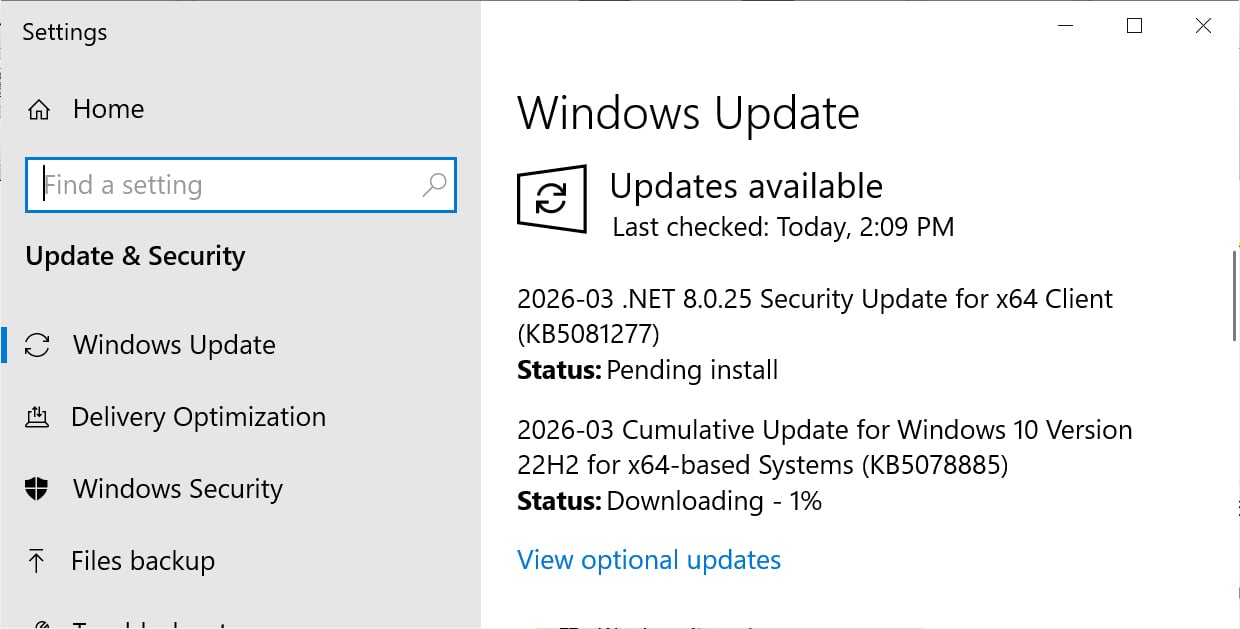
Microsoft has released the Windows 10 KB5078885 extended security update to fix the March 2026 Patch Tuesday vulnerabilities, including 2 zero-days and an issue that prevents some devices from shutting down.

If you are running Windows 10 Enterprise LTSC or are enrolled in the ESU program, you can install this update like normal by going into Settings, clicking on Windows Update, and manually performing a ‘Check for Updates.’

Windows 10 KB5078885 update
Windows 10 KB5078885 update
Source: BleepingComputer

After installing this update, Windows 10 will be updated to build 19045.7058, and Windows 10 Enterprise LTSC 2021 will be updated to build 19044.7058.

What’s new in Windows 10 KB5078885

Microsoft is no longer releasing new features for Windows 10, and the KB5078885 update contains only security fixes and bug fixes introduced by previous security updates.

With today’s March 2026 Patch Tuesday, Microsoft has fixed 79 vulnerabilities, including two actively exploited zero-day flaws.

Advertisement

The complete list of fixes is below:

  • [Windows System Image Manager] This update adds a warning dialog to help users confirm that the selected catalog file comes from a trusted source.

  • [File History] Improved: File History in Control Panel when backing up files. New files with names containing some Chinese and Private Use Area characters can now be backed up.

  • [Graphics] Improved: A stability issue affecting certain GPU configurations.

  • Advertisement
  • [Secure Boot] With this update, Windows quality updates include additional high-confidence device targeting data, increasing coverage of devices eligible to automatically receive new Secure Boot certificates. This targeting is based primarily on client device diagnostic data; due to limited data, servers are unlikely to qualify, though not explicitly excluded. Devices receive new certificates only after demonstrating sufficient successful update signals, maintaining a controlled and phased rollout.

  • [Fonts] This update includes changes to Chinese fonts to meet GB18030-2022A compliance.

  • [OS Security (known issue)] Fixed: After installing the Windows security update released on or after January 13, 2026, some Secure Launch-capable PCs with Virtual Secure Mode (VSM) enabled are unable to shut down or enter hibernation. Instead, the device restarts.

  • [Folders] Fixed: This update fixes an issue that affects folder renaming with desktop.ini files in File Explorer. The LocalizedResourceName setting was ignored, so custom folder names did not show. Now, custom folder names appear as expected.

This update also fixes a known issue that prevented Windows 10 devices from shutting down or hibernating if System Guard Secure Launch is enabled.

Advertisement

Microsoft is also continuing to roll out new Secure Boot certificates to replace older 2011 certificates that expire in June 2026.

These certificates are used to validate Windows boot components, third-party bootloaders, and Secure Boot revocation updates, and if expired, could allow threat actors to bypass security protections.

Microsoft states that there are no known issues with this update.

Malware is getting smarter. The Red Report 2026 reveals how new threats use math to detect sandboxes and hide in plain sight.

Download our analysis of 1.1 million malicious samples to uncover the top 10 techniques and see if your security stack is blinded.

Advertisement

Source link

Continue Reading

Tech

Trump Kicks Kristi Noem To The Curb For Being Exactly The Sort Of Person Trump Wanted Her To Be

Published

on

from the maga-is-the-stripper-that-doesn’t-love-you-back dept

I come here to celebrate the apparently permanent sidelining of former DHS head, Kristi Noem. I know the adage usually does some hedging before damning with faint praise, but I’m not interested in praise, faint or otherwise, much less pretending this isn’t worth celebrating.

Noem openly pined for the VP position, but shot herself in the foot by shooting a dog in her gravel pit and then telling the world about it in her incredibly premature memoirs. What was meant to be a self-congratulatory anecdote about doing what needs to be done was correctly read by pretty much everyone as little more than a person gloating about inflicting misery on animals and her own children.

Kristi Noem spent most of her time as the DHS Secretary making sure she showed up front and center in social media posts. She also was always the first to portray anyone killed or wounded by federal officers as “terrorists,” and refused to walk back those comments after the facts proved otherwise.

She gifted herself with an expensive private jet so she could arrive at the next photo op in style. She moved into an expensive taxpayer-funded residence despite already living in another expensive taxpayer-funded residence. She blew $220 million on an ad campaign featuring her blown-dry looks and vapid statements that apparently also funneled some of that windfall back into her own pockets.

Advertisement

She continued to stay the course even as the national winds shifted in response to oppressive, blue state-targeting “immigration enforcement” efforts. She stood idly by while her officers violated rights, physically assaulted peaceful protesters, and literally murdered two people in one US city alone.

Realizing this putsch was hurting him more than helping him, Trump first sent Nazi-cosplayer Border Patrol commander Gregory Bovino back to the actual border, forcing him out of the spotlight and back into the necessary but not-at-all-glamorous job of actually securing the border.

Noem was next. In a somewhat surprising move, Trump booted a true MAGA believer into irrelevance, taking Noem from an “is” to a “was” while she was engaged in a press briefing. She’s now the Special Envoy to the Shield of the Americas, which is exactly the sort of made-up position you’d shunt someone into if you didn’t want to be blamed for their hiring, but also didn’t want them to do any more damage to your administration.

Now that Noem’s been turfed, the knives are out. It’s not just leading GOP members now pretending she’s this administration’s Nikolai Yezhov. It’s also pro-Trump outlets like Fox News smelling the blood in the water but, of course, only speaking out now that the water’s more red than blue:

Advertisement

We can now openly admit what has been unfolding before our eyes for a year: that Kristi Noem was an utter, complete, total catastrophe, her tenure in charge of the Department of Homeland Security (DHS) little more than a self-promoting crusade.

She was unqualified for the job from day one, and largely responsible for the awful excesses of ICE and the frustrating failures of FEMA

President Donald Trump’s decision to fire her, which took way too long, liberates many Republicans to acknowledge what many in the media, including me, along with Democrats and outside critics, have been saying all along: Noem was a slow-motion train wreck. 

Walk into the ocean, Howard Kurtz. You pretend like you’re a journalist and analyst and yet you state — openly! — that you weren’t willing to speak out against Kristi Noem (an apparent “utter, complete, total catastrophe”) until after Trump fired her. If you had any spine or ethics, you would have made your opinions known months ago and been hailed as a savvy insider. Now you just look like a practice squad Monday morning quarterback.

But enough about Kurtz. Here’s more about Noem, who was a spectacular failure on every level. Here’s another lowlight of Noem’s short federal career, as reported by The New Republic:

Advertisement

ICE’s former deputy director, Madison Sheahan, wasted millions of taxpayer dollars on 2,500 vehicles custom-wrapped to say “ICE” on the side, three sources told the Washington Examiner. The gaudy cars feature massive ICE logos, red stripes, and a golden decal of President Donald Trump’s name on the back window.

The vehicles first appeared in a DHS video intended to make ICE look cool. But a fleet of ostentatious cars are useless to Trump’s masked militia, which typically disappears people using unmarked vehicles.

Noem stans might want to pretend this doesn’t have anything to do with her since it was a former deputy director handling this purchase. No dice, weirdos. Noem has made it clear since day one that she’s the only one who can approve spending like this, which is something she used to defend refusing to send FEMA aid to places that weren’t sufficiently Trumpish.

That’s on top of other things that may have forced Trump to dump a die-hard ally. The first was the $220 million-worth of masturbation Noem performed, which came in the form of Noem-focused DHS ads featuring her sitting on a horse in front of Mt. Rushmore in South Dakota. Noem claimed the ad campaign was approved by Trump while testifying to Congress. Trump immediately said otherwise when questioned by reporters.

Then there were the three jets (two Gulfstreams and a remodeled 737) Noem wanted for her own personal use as DHS Secretary. On top of that, there were the rumors that Noem and her de facto chief of staff, Corey Lewandowski (another ridiculous MAGA asshat) were having an extramarital affair.

Advertisement

All of this was piled on top of a rapidly disintegrating “surge” in Minneapolis, which single-handedly managed to turn public opinion against Trump, at least in terms of immigration enforcement. Noem insisted on being the public face of this, competing with fellow sadists like the previously-mentioned (and similarly demoted) Gregory Bovino.

We should all dance on the professional grave of Kristi Noem, who sold out entirely to MAGA just to be stuck in a Special Envoy cubicle until she either gets demoted again or decides she’s better off back in South Dakota. Noem made her own bed. Now she gets to lay in it, along with her killed dog, which means she’s not only having to deal with her own shittily-made bed, but the fleas that come with it.

She couldn’t even make it 18 months. That’s heartening. That means a bunch more people who sold their souls for MAGA rock and roll are likely to find their loyalty repaid with GTFO orders from the boss man who won’t tolerate anything that doesn’t immediately look like a win. They deserve everything that’s coming to them, including the possibility of criminal or contempt charges for playing fast and loose with the laws and the US Constitution while holding, however briefly, their positions of power.

We won’t miss you, Kristi. You were the epitome of everything people hate about political appointees. The most you can hope for is that your swift defenestration will be somehow instructive for those following in your shady, subordinate footsteps. If not, you’ll be nothing more than a foul breeze, remembered only for the odor you created while passing through the political system. But you were exactly what Trump wanted, right up until he decided he didn’t.

Advertisement

Filed Under: border patrol, cbp, kristi noem, mass deportation, trump administration

Source link

Advertisement
Continue Reading

Tech

Sonos Unveils Play and Era 100 SL Wireless Speakers Designed for Music That Moves With You

Published

on

After a relatively quiet stretch on the product front, Sonos appears ready to reset the conversation in 2026. The wireless audio pioneer spent much of the past year refining its ecosystem and taking stock of a market that has become far more competitive than when it first defined the multiroom category. Now, with the introduction of the Sonos Play and Sonos Era 100 SL, the company is returning to the core idea that built its reputation: simple speakers powered by a deeply capable whole home audio platform.

The timing matters. While Sonos has been recalibrating, the wireless speaker space has grown crowded with credible alternatives from established rivals like Denon, Bluesound, and Klipsch, along with fast rising streaming focused brands such as WiiM. Each has taken aim at the same promise Sonos popularized two decades ago: music that follows you effortlessly from room to room.

With Sonos Play and Sonos Era 100 SL, Sonos is clearly signaling that 2026 will look very different from the past year. Both speakers focus on flexibility and ease of expansion, reinforcing the company’s long standing philosophy that great sound should move with you throughout the home and beyond it.

What Sonos Play & Era 100 SL Actually Add to the Sonos Ecosystem

The new Sonos Play and Era 100 SL target two different entry points into the Sonos ecosystem, but both are built around the same goal: making it easier to start a system and expand it over time without replacing what you already own. Rather than introducing a completely new category, these speakers focus on practical flexibility that works within the broader Sonos platform.

Advertisement
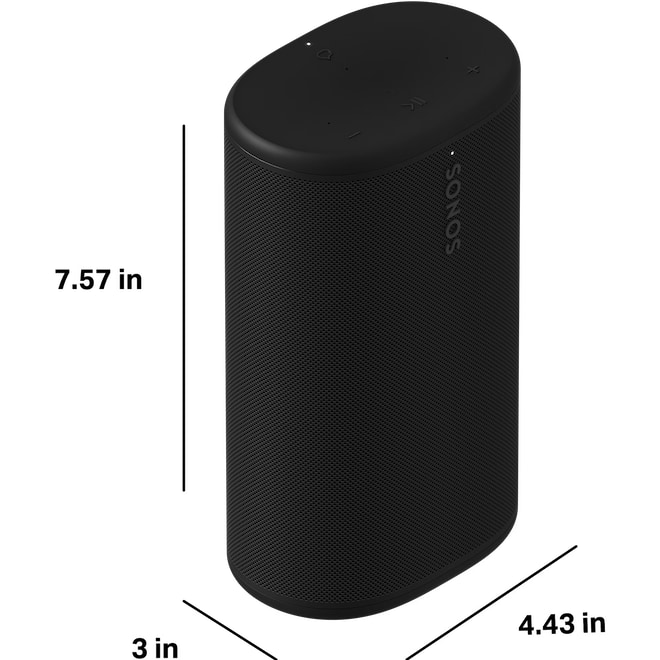
sonos-play-dimensions
Sonos Play

Sonos Play is designed as a hybrid speaker that works both inside and outside the home. When connected over Wi-Fi, it functions like a traditional Sonos speaker that can be grouped across rooms or paired in stereo. It can also operate as a portable Bluetooth speaker with up to 24 hours of battery life and an IP67-rated design for outdoor use. A charging base keeps it ready at home, while a removable utility loop and built-in power bank allow it to double as a mobile device charger when you’re away from an outlet. The speaker also supports multi-speaker grouping from a Bluetooth source, allowing multiple compatible Sonos speakers to sync together even when away from a home network.

sonos-era-100-sl-dimensions
Sonos Era 100 SL

Era 100 SL takes a more straightforward approach focused on system expansion. It’s a simplified version of the Era 100 platform with a microphone-free design and a streamlined feature set aimed at users who want a dedicated Wi-Fi speaker that integrates easily into the Sonos ecosystem. It works as a standalone speaker in a single room but can also be paired for stereo sound, grouped across multiple rooms, or used as part of a home theater setup.

Together, the two speakers reinforce the core idea behind the Sonos platform: products that work well individually but become more useful as more rooms and devices are added to the system. Instead of replacing existing gear, they are meant to build on it.

Sonos Play: Portable Speaker With WiFi, Bluetooth, and All Day Battery Life

Sonos Play is designed to serve as both a portable Bluetooth speaker and a full member of the Sonos multiroom ecosystem. At home, it connects over WiFi and integrates with other Sonos products for multiroom playback or stereo pairing. When you leave the house, it can switch to Bluetooth operation so it functions like a traditional portable speaker without relying on your home network.

sonos-play-pool-lifestyle
Sonos Play

Under the hood, Sonos Play uses three Class H digital amplifiers tuned specifically for the enclosure. The acoustic design combines two angled tweeters for stereo separation and detailed high frequencies with a single midwooferresponsible for midrange clarity and bass output. To reinforce low frequencies without increasing cabinet size, Sonos adds dual force cancelling passive radiators, which help extend bass performance while minimizing cabinet vibration.

The speaker also includes a far field microphone array with beamforming and multichannel echo cancellation for voice control and Trueplay tuning. Users can toggle the microphones off with a physical hardware switch. Through the Sonos app, listeners can adjust bass, treble, and loudness settings, while Automatic Trueplay software continuously adapts the speaker’s sound profile based on its surroundings and the content being played.

From a portability standpoint, Sonos Play is built for outdoor use with an IP67 dust and water resistant enclosure, meaning it can survive temporary submersion in up to one meter of water for 30 minutes. The cabinet measures 7.56 inches high, 4.43 inches wide, and 3.02 inches deep, and weighs 2.87 pounds (1.3 kg). It is available in black or white with a matte finish and includes physical controls for playback, volume, grouping, and voice assistant muting, along with LED indicators that display connection status, battery level, and microphone activity.

Advertisement
Advertisement. Scroll to continue reading.

Power and connectivity options reflect the hybrid nature of the speaker. Sonos Play supports WiFi 6 and works with 2.4 GHz and 5 GHz networks using 802.11a/b/g/n/ac/ax standards. For portable listening, it includes Bluetooth 5.3 for wireless audio streaming from phones, tablets, and laptops.

A 35Wh battery delivers up to 24 hours of playback, and the speaker includes a USB Type-C port that can charge a phone or connect to an external audio source using the optional Sonos Line In Adapter. Ethernet connectivity is also possible through the optional Sonos Combo Adapter.

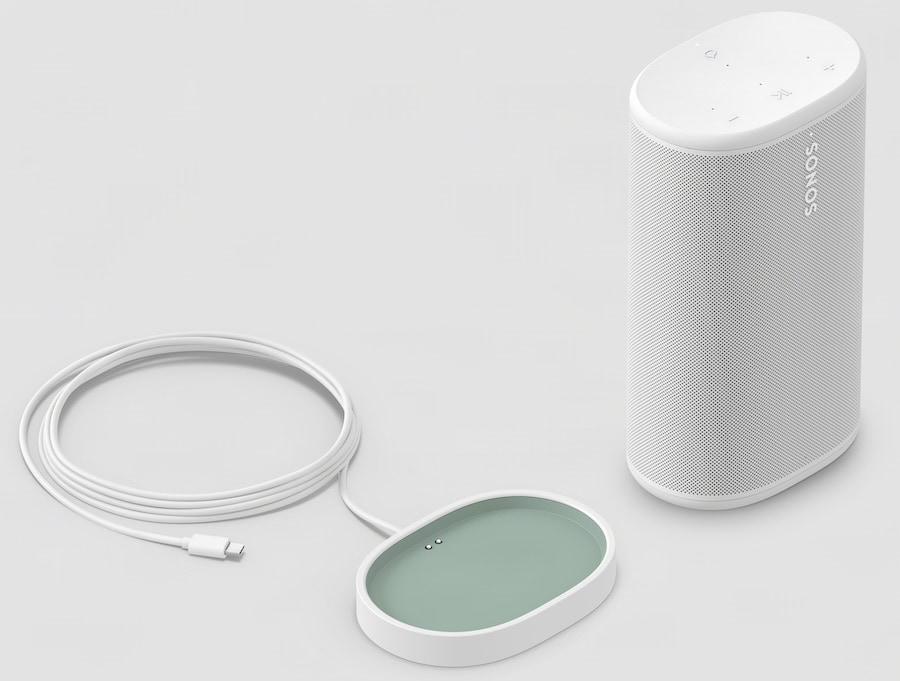
sonos-play-white-charging-base
Sonos Play with Charging Base

At home, Sonos Play rests on the included Charging Base, which keeps the speaker powered and ready for use as part of a stationary multiroom system. The base requires a USB C PD compatible power adapter rated at 18 watts or higher, which is sold separately.

Advertisement

For Apple users, the speaker also supports Apple AirPlay 2 on devices running iOS 11.4 or later, alongside compatibility with the Sonos app, voice services, and streaming integrations such as Spotify Connect.

Era 100 SL: A Simpler Sonos Speaker Built for Everyday Listening

Era 100 SL is positioned as a more streamlined entry point into the Sonos ecosystem, aimed at listeners who want the core Sonos experience without extra hardware they may never use. It is based on the same general acoustic platform as the Era 100, but removes the built in microphones and keeps the focus on music playback, system expansion, and straightforward wireless connectivity.

sonos-era-100-sl-with-turntable
Stereo pair of Sonos Era 100 SL speakers with turntable

Inside, the speaker uses three Class D digital amplifiers tuned for its cabinet and driver layout. Its acoustic system includes two angled tweeters for stereo separation and high frequency detail, along with one midwoofer that handles vocals, midrange information, and bass. Through the Sonos app, users can adjust bass, treble, and loudness, while Trueplay room tuning can fine tune the speaker’s EQ based on the acoustics of the room, although that feature requires WiFi and a compatible iOS device.

The feature set is clearly aimed at consumers who want flexibility without overcomplication. Era 100 SL can function as a standalone speaker, but it can also be paired with a second unit for stereo sound, grouped with other Sonos speakers in a multiroom setup, or used as rear surrounds in a Sonos home theater system.

Advertisement

It supports streaming over Wi-Fi through the Sonos app, along with Bluetooth 5.3, Apple AirPlay 2, and Spotify Connect. There is also a USB Type-C connection for adding an external source such as a turntable or other audio component through the optional Sonos Line In Adapter, and Ethernet connectivity is available through the optional Sonos Combo Adapter.

sonos-era-100-sl-white-rear-speakers
Sonos Era 100 SL can be used as rear speakers in a Sonos surround sound system.

Physically, the speaker remains compact enough for shelves, desks, and smaller rooms. It measures 7.2 inches high, 4.72 inches wide, and 5.14 inches deep, and weighs 4.31 pounds (1.95 kg). It is offered in black or white with a matte finish, and uses capacitive touch controls on the top panel for playback, volume, and grouping functions. An LED indicator shows connection and mute status, while a dedicated Bluetooth button handles wireless pairing.

On the power and networking side, Era 100 SL supports Wi-Fi 6 and works with 2.4 GHz and 5 GHz networks using 802.11a/b/g/n/ac/ax standards. It uses an internal 100 to 240V, 50/60Hz power supply, so unlike Sonos Play, this is a speaker intended to remain plugged in rather than travel with you. Sonos also says the model is built with recycled plasticand ships in recyclable FSC certified paper packaging, which may matter to buyers paying closer attention to sustainability.

The Bottom Line

The Sonos Play and Era 100 SL focus on what Sonos has historically done best: simple speakers that become more capable as part of a larger multiroom system. Play is the more distinctive of the two, functioning as both a portable Bluetooth speaker and a WiFi Sonos speaker when docked at home, while Era 100 SL offers a more affordable, microphone free version of the Era platform for expanding a room, stereo pair, or surround system.

Advertisement

At $299 , Sonos Play sits in the premium portable category but adds deeper integration with the Sonos ecosystem. Era 100 SL at $189 is priced competitively for buyers looking to build a multiroom system one room at a time.

Advertisement. Scroll to continue reading.

What feels missing will depend on the buyer. Some may want native Ethernet, built in line input without adapters, or broader high resolution audio support, especially as competitors push those features. Still, these speakers are clearly aimed at first time Sonos buyers and existing users adding more rooms, reinforcing the platform rather than reinventing it.

Where to buy:

Source link

Advertisement
Continue Reading

Tech

Champions League Playoff Soccer: Stream Newcastle vs. Barcelona Live From Anywhere

Published

on

When to watch Newcastle vs. Barcelona

  • Tuesday at 4 p.m. ET (1 p.m. PT).

Where to watch

  • Newcastle vs. Barcelona will air in the US on Paramount Plus.
73% off with 2yr plan (+4 free months). Now only $3.49/month


See more details

See at Amazon
Advertisement
Amazon Prime Video

Showing select Champions League games weekly in the UK

Prime Video

Advertisement

It’s a huge test of Newcastle’s “big club” credentials on Tuesday as Eddie Howe’s men welcome La Liga leaders Barcelona to northeast England for this UEFA Champions League round-of-16 clash.

The Magpies’ hopes of becoming genuine Champions League title contenders have yet to fully materialize since the $410 million Saudi-led consortium’s takeover of the club back in 2021, but Eddie Howe’s team has a chance here to prove it has finally emerged as a major force in European football’s premier club competition.

They face a Barcelona team which saw their hopes of an historic quadruple this season disappear following last week’s Copa del Rey semifinal loss to Atlético Madrid. Hansi Flick’s men nevertheless remain among the favorites to lift the Champions League trophy for a sixth time, with the Blaugrana coming into the match off the back of a gritty 1-0 away win over Athletic Club on Saturday to stay four points clear at the top of La Liga.

Newcastle United takes on F.C. Barcelona at St. James’ Park, on Tuesday, March 10. Kickoff is set for 8 p.m. GMT local time in the UK, making it a 4 p.m. ET or 12 p.m. PT start in the US, a 9 p.m. CET kickoff in Europe and a 7 a.m. AEDT kickoff in Australia on Wednesday.

Advertisement
Barcelona soccer star Lamine Yamal smiling, celebrating, making hand gestures.

Teenage sensation Lamine Yamal scored his 14th La Liga goal of the season on Saturday to give Barcelona a 0-1 away win over Athletic Club. 

Cesar Ortiz/Soccrates/Getty Images

Livestream Newcastle vs. Barcelona in the US without cable

American soccer fans can stream this game along with every game of this season’s tournament via Paramount Plus, which has exclusive live English-language broadcast rights in the US for the UEFA Champions League. 

Advertisement

This season introduces a multiview option that lets you watch up to four matches simultaneously and choose your preferred in-game audio. 

Sarah Tew/CNET

Paramount Plus has two main subscription plans in the US: Essential for $8 a month and Premium for $13 a month. Both offer coverage of the Champions League.

Advertisement

The cheaper Essential option has ads for on-demand streaming and lacks live CBS feeds as well as the ability to download shows to watch offline later. Newcomers to the service can take advantage of a 30-day free trial, while students may qualify for a 25% discount.

Read our Paramount Plus review.

How to watch every UEFA Champions League 2025-26 game online from anywhere using a VPN

If you find yourself unable to view the game locally due to incorrectly applied blackout restrictions, you may need a different way to watch the game, and that’s where using a VPN can come in handy. A VPN is also the best way to stop your ISP from throttling your speeds on game day by encrypting your traffic, and it’s a great idea when you’re traveling and find yourself connected to a Wi-Fi network, or when you want to add an extra layer of privacy for your devices and logins.  

With a VPN, you’re able to virtually change your location on your phone, tablet or laptop to get access to the game. So, if your internet provider or mobile carrier has assigned you an IP address that incorrectly indicates your location in a blackout zone, a VPN can resolve this issue by providing you with an IP address in your correct, non-blackout area. Most VPNs, like our Editors’ Choice, ExpressVPN, make it really easy to do this.  

Advertisement

Using a VPN to watch or stream sports is legal in any country where VPNs are legal, including the US and Canada, as long as you’ve got a legitimate subscription to the service you’re streaming. You should ensure your VPN is set up correctly to prevent leaks. Even where VPNs are legal, the streaming service may terminate the account of anyone it deems to be circumventing correctly applied blackout restrictions.  

Looking for other options? Be sure to check out some of the other great VPN deals taking place right now.  

James Martin/CNET

Price $13 per month, $75 for the first year or $98 total for the first two years (one- and two-year plans renew at $100 per year)Latest Tests No DNS leaks detected, 18% speed loss in 2025 testsJurisdiction British Virgin IslandsNetwork 3,000 plus servers in 105 countries

Advertisement

ExpressVPN is our current best VPN pick for people who want a reliable and safe VPN, and it works on a variety of devices. Prices start at $3.49 a month on a two-year plan for the service’s Basic tier.

Note that ExpressVPN offers a 30-day money-back guarantee.

Advertisement

73% off with 2yr plan (+4 free months). Now only $3.49/month

Livestream Newcastle vs. Barcelona in the UK

While TNT Sports will once again broadcast the lion’s share of Champions League games, Prime Video has first pick of Tuesday games and will show one match per week live exclusively on the platform. 

Advertisement

James Martin/CNET

Amazon Prime Video standalone subscriptions start at £9 a month or £95 per year in the UK and include access to the Prime Video library of shows such as The Boys, Reacher and Fallout. The service is also included with an Amazon Prime membership.

Livestream Newcastle vs. Barcelona in Canada

If you want to stream Champions League games live in Canada, you’ll need to subscribe to DAZN Canada. The service has exclusive broadcast rights to every match this season, including this one.

A DAZN subscription currently costs CA$35 a month or CA$250 a year and will also give you access to Europa League and EFL Championship soccer, Six Nations rugby and WTA tennis.

As well as dedicated apps for iOS and Android, there’s a wide range of support for set-top boxes and smart TVs.

Livestream Newcastle vs. Barcelona in Australia

Soccer fans Down Under can watch UCL games on streaming service Stan Sport, which once again has exclusive rights to show all Champions League matches live in Australia this season.

Advertisement

Stan

Stan Sport will set you back AU$20 a month (on top of a Stan subscription, which starts at AU$12). It’s also worth noting that the streaming service is currently offering a seven-day free trial.

A subscription will also give you access to Premier League and Europa League action, as well as international rugby and Formula E.

Advertisement

Source link

Continue Reading

Tech

Claude AI Finds Bugs In Microsoft CTO’s 40-Year-Old Apple II Code

Published

on

An anonymous reader quotes a report from The Register: AI can reverse engineer machine code and find vulnerabilities in ancient legacy architectures, says Microsoft Azure CTO Mark Russinovich, who used his own Apple II code from 40 years ago as an example. Russinovich wrote: “We are entering an era of automated, AI-accelerated vulnerability discovery that will be leveraged by both defenders and attackers.”

In May 1986, Russinovich wrote a utility called Enhancer for the Apple II personal computer. The utility, written in 6502 machine language, added the ability to use a variable or BASIC expression for the destination of a GOTO, GOSUB, or RESTORE command, whereas without modification Applesoft BASIC would only accept a line number. Russinovich had Claude Opus 4.6, released early last month, look over the code. It decompiled the machine language and found several security issues, including a case of “silent incorrect behavior” where, if the destination line was not found, the program would set the pointer to the following line or past the end of the program, instead of reporting an error. The fix would be to check the carry flag, which is set if the line is not found, and branch to an error.

The existence of the vulnerability in Apple II type-in code has only amusement value, but the ability of AI to decompile embedded code and find vulnerabilities is a concern. “Billions of legacy microcontrollers exist globally, many likely running fragile or poorly audited firmware like this,” said one comment to Russinovich’s post.

Source link

Advertisement
Continue Reading

Tech

Philo Shakes Up Its Plan Offerings With New Essential Tier

Published

on

Less than six months after raising the price of its Core plan, live TV streaming service Philo is expanding its subscription options. On Tuesday, the company announced a new Essential tier with live TV channels but without access to HBO Max and Discovery Plus, which it added to Core alongside the recent price hike.

Philo’s plans now include Essential, which costs $25 per month, and Bundle Plus — a rebranded $33 per month Core plan. The Essential tier comes with more than 70 channels, a week-long free trial, 80,000 on-demand titles and an unlimited DVR with content kept for one year. 

With Bundle Plus, you get all of that in addition to ad-supported AMC Plus, HBO Max and Discovery Plus. Philo said the option to upgrade to ad-free tiers is available now for AMC Plus and will be available for Discovery Plus and HBO Max in the future. Unlike Essential, you can’t try Bundle Plus for free.

Advertisement

The company said it aims to provide more flexibility with the addition of Essential. At $8 less than Bundle Plus, it’s a cheaper option for live TV viewers who may not want Bundle Plus’ extra entertainment offerings. Philo’s lineup continues to include free, ad-supported channels. Here’s more on how Philo compares to live TV streaming services such as YouTube TV and Sling.

Source link

Advertisement
Continue Reading

Tech

ChatGPT will now generate interactive visuals to help you with math and science concepts

Published

on

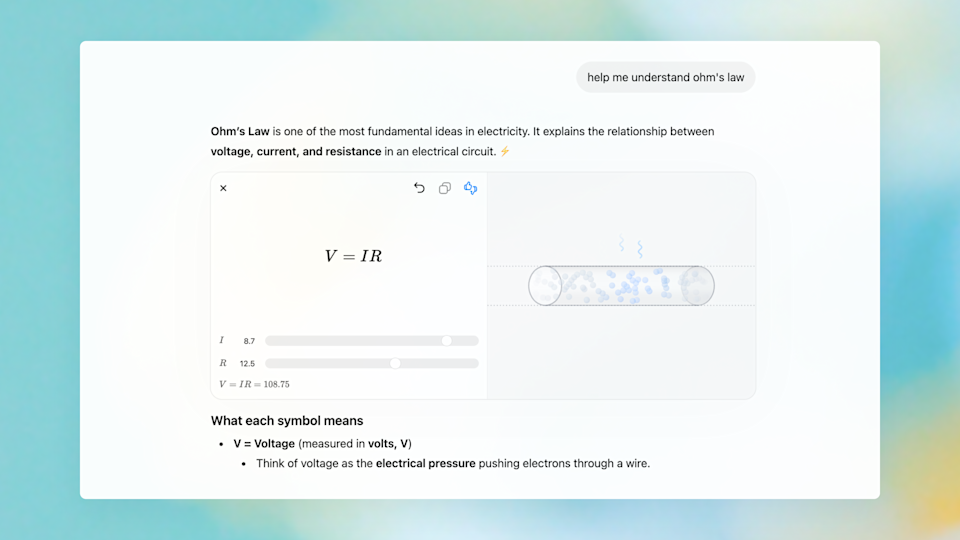
OpenAI is rolling out new interactive responses in ChatGPT it says are designed to make the chatbot more useful for learners. Starting today, ChatGPT will generate dynamic visuals when you ask it to explain select scientific and mathematical concepts, including the Pythagorean theorem, Coulomb’s law and lens equations. When ChatGPT responds with an interactive visual, you’ll be able to tweak any variables and the equation itself, allowing you to see how those changes affect the solution.

With today’s release, OpenAI says ChatGPT will respond with interactive visuals when asked about more than 70 concepts, with support for additional topics to come down the line. The visuals are available to all ChatGPT users, regardless of subscription status. However, OpenAI notes high school- and college-aged students are likely to get the most out of the new feature.

ChatGPT explains Ohm's law.

ChatGPT explains Ohm’s law. (OpenAI)

The more interactive responses from ChatGPT follow the release of Study Mode last summer. Released in response to the sheer amount of students using chatbots to complete their coursework, that feature guides the user toward finding an answer themselves, rather than provide an outright solution. “This is just the beginning,” OpenAI says of its latest feature. “Over time, we plan to expand interactive learning with additional subjects and continue building tools that strengthen learning with ChatGPT.”

Source link

Advertisement
Continue Reading

Tech

Hackers are selling a critical Windows zero-day exploit for $220,000 on the dark web

Published

on


According to X user Dark Web Informer, a cybercriminal known as Kamirmassabi recently posted an ad on an underground hacking forum, offering to sell a zero-day exploit for a critical elevation of privilege vulnerability in Windows 10 and 11. The steep $220,000 asking price suggests the exploit is aimed primarily…
Read Entire Article
Source link

Continue Reading

Trending

Copyright © 2025