Ryobi is a Japanese manufacturer of everything from cars to printers and, of course, power tools. The company got its start in the 1940s, making die-cast products in a modified soy sauce factory. It wasn’t until the 1960s that the company started making the power tools it’s known for today.
In the United States, Ryobi power tools and related products are manufactured and distributed by Techtronic Industries (TTI), under an agreement with Ryobi, beginning in 2000. TTI also owns Milwaukee, Hoover, Dirt Devil, and other popular brands. Ryobi holds a decent chunk of the power tools market share, nipping at the heels of other brands like Craftsman and DeWalt.
Sometimes, when you’re window shopping for new tools, toys, or anything else, it’s worth considering the wisdom of the crowd. If consumer choice is any indicator, Ryobi tools are a safe choice for your everyday power tool needs. If you’re not even sure what you need, or if you need anything at all, the crowd can help with that, too. These are the 10 most popular Ryobi products (at least right now), according to the company’s own ratings. The top 10 products can and will change as new products are released and consumer preferences evolve, but this is what Ryobi consumers are buying in February 2026.
Advertisement
USB Lithium 3-Port Charger and Power Source
If you’re lucky, you’ll get through the entire day without your phone, tools, and other electronic devices dying on you. For everyone else, a portable power source can make a huge difference. Ryobi’s most popular tool is the USB Lithium 3-Port Charger and Power Source.
Advertisement
It’s a portable two-in-one power source that can recharge your phone and tools at the same time. You can use a cable to charge your mobile phone and other small electronic devices, and to charge up to three rechargeable USB lithium batteries. It’s compatible with a belt clip (sold separately), has a carabiner, and features a battery indicator light to let you know when the power source needs to be recharged.
It’s designed for use with Ryobi’s USB lithium batteries, which can power any of the tools and gadgets in Ryobi’s USB Lithium System. Each 3Ah battery can power handheld drivers, work lights, powered pruning shears, glue guns, misting fans, and more. The batteries can be charged individually using a USB-C cable, but this power source can charge up to three of them at the same time, giving you up to 9Ah of portable power. User reviews call it a “game changer,” saying it’s an excellent portable power solution, and “super useful” for anyone who has at least a couple of Ryobi’s lithium devices.
Advertisement
18V ONE+ HP Brushless Hybrid Forced Air Propane Heater
Cold fingers lose dexterity and become less responsive, so staying warm in a drafty garage or cold worksite can make a big difference in productivity, especially during the winter. Maybe that’s why Ryobi’s 18-Volt ONE+ HP Brushless Hybrid Forced Air Propane Heater is so popular.
A forced air heater works by heating air with gas or electricity (in this case, it’s propane gas) and then distributing that air with a blower fan. It’s essentially the same technology in your home’s furnace, except this blows warm air out into the environment instead of through your ductwork. It comes with a 15-foot hose and regulator to connect the heater to a propane tank and has an attached carrying handle for easier transportation.
It can run either on a ONE+ battery or plugged in with an extension cord. A temperature control dial on the outside lets you set the heater output between 75,000 and 125,000 BTUs (British Thermal Unit, the amount of energy needed to raise the temperature of a pound of water by one degree), so you can heat an area up to 3,125 square feet. You can keep the heater running for nearly three hours with a 4Ah battery and over eight hours with a 12Ah battery, provided you’ve got enough propane.
Advertisement
40V Battery Topper Light
It’s difficult to get anything done if you can’t see, but construction jobs, home renovations, and other hands-on projects often require working in poor lighting. That’s where work lights come in. This 40-Volt Battery Topper Light is powered by Ryobi’s 40-volt batteries. It clicks right on top of the battery and provides between 100 and 1,000 lumens of light.
Advertisement
Using a fully charged 40-volt 12Ah battery, this light can run for up to 11 days in ultra-low mode (100 lumens). With the same battery, it can operate on low (300 lumens) for roughly 5.6 days, on medium (600 lumens) for 2.9 days, and on high (1,000 lumens) for 1.9 days. If you’re using a battery with a smaller capacity, your runtime will be affected.
The light has a customizable head that can be oriented in nearly any direction, pivoting up and down 120 degrees and rotating 300 degrees side to side. It has an attached metal hook so you can hang the light onto wooden studs and other anchor points and it has a USB-C port for charging your phone and other small electronics. It basically turns your Ryobi 40-volt battery into a portable battery bank with an attached spotlight.
Advertisement
18V ONE+ 3-Tool Light Combo
Keeping the lights on is an important part of keeping any project or worksite running smoothly. The Ryobi 18-Volt ONE+ 3-Tool Light Combo is an all-in-one lighting solution powered by Ryobi’s 18-volt ONE+ batteries. The lighting combo includes one 18-volt ONE+ Hybrid LED Panel Light, one 18-volt ONE+ LED Spotlight, and one 18-volt ONE+ Flexible LED Clamp Light.
The panel light is compatible with a tripod and has three LED panels. The middle panel pivots 150 degrees, and the side panels rotate 360 degrees so you can direct light exactly where you need it. There are low, medium, and high settings and it’s capable of delivering up to 3,000 lumens. The panel light is also capable of getting power from an extension cord if you need a more permanent lighting solution.
The spotlight has low, medium, and high settings and puts out 3,000 lumens in a 650-yard beam. It also has a hanging loop for hands-free lighting. Lastly, the clamp light emits up to 400 lumens, can be set to high or low, and it can be oriented in pretty much any direction thanks to its 16-inch flexible neck. The light also rotates at the base and features a clamp that can grip objects up to 1.75 inches thick.
Advertisement
80V 1000W Power Source
Between power tools, mobile phones, tablets, and other portable electronic devices, sometimes you need a way to take power with you on the go. A pocket-sized portable battery bank is good for phones and other small devices, but if you need to charge your power tools and other heavy-duty devices you’ll need a more robust power source.
Advertisement
The 80-Volt, 1,000-Watt Power Source connects to Ryobi’s 80-volt batteries, transforming them into a mobile power solution. It delivers 1,800 watts of starting power and 1,000 watts of running power, enough to power large devices like televisions and refrigerators. The power station has two 120-volt AC outlets, two USB-A ports, and one USB-C port so you can plug in your large devices and power your smartphone and other small devices at the same time.
It serves as a portable power source but can also be used as emergency power during a power outage. Using a 10Ah battery, this power station can charge your phone more than 60 times or power your refrigerator for 12 hours. The power station can also connect to the Ryobi 80-volt Riding Lawn Tractor and utilize the power from all three of its 80V batteries, tripling your runtime.
It’s a string trimmer much like your conventional gas-powered weed eaters, except it’s powered by Ryobi’s 40-volt batteries. You can get about an hour of runtime from a 40-volt 4Ah battery and if you have a bigger yard, you can get longer runtime out of a battery with greater capacity. It features a variable speed trigger and a quick-change coupler so you can attach and detach the string trimmer from the power head with ease.
The string trimmer comes in a kit with a 40-volt power head, a straight shaft trimmer attachment, one 40-volt 4Ah battery, and a 40-volt battery charger. The handle is compatible with Ryobi’s Expand-It line of products. You can detach the string trimmer and replace it with an eight-inch cultivator, eight-inch edger, sweeper, pole saw, snow thrower, and more.
Advertisement
18V ONE+ 3/8 Inch Drill Kit
A power drill is a common part of your basic tool collection. Once you’ve selected a hammer, a tape measure, and a collection of drivers and wrenches, a drill is usually the first power tool most people add to their collection. There are low-power drills for everyday at-home use and more robust power drills capable of drilling hundreds of holes into concrete with relative ease.
Advertisement
The Ryobi 18V ONE+ ⅜ Inch Drill is on the lower end of the power drill spectrum. It’s an affordable option with relatively low power. It’s probably not the drill professionals are likely to reach for before heading to the construction site, but it’s a popular choice for day-to-day drilling at home.
It’s a fairly basic drill with a ⅜ inch keyless chuck. It gets up to 600 RPMs, which isn’t the most powerful, but is enough to drill through drywall and wooden studs to hang a picture or mount a TV. It’s lightweight at just 2.8 pounds, so you can hold it overhead without fatigue. It has a built-in LED light for illuminating your workspace and a variable speed trigger. It comes in a kit with one 18-volt ONE+ 1.5Ah lithium battery and an 18-volt ONE+ battery charger.
Advertisement
40V 550 CFM Blower Kit
Ideally, a power tool should take a difficult or tedious manual job and turn it into an easier and faster task through the introduction of mechanical help. The leaf blower is a perfect example of this relationship. When autumn comes and the leaves change colors and fall, people often need a way to clear their yard of leaves and debris. You could do it the old fashioned way with a rake and a little elbow grease or you can do it with a battery powered blower.
Ryobi’s 40-Volt 550 CFM Blower moves as much as 550 cubic feet of air per minute and can generate wind speeds of up to 120 miles per hour. It’s more powerful than a 25cc gas powered leaf blower, according to Ryobi. On high, you’ll get about 15 minutes of runtime with a 4Ah battery and 31 minutes with 8Ah battery. On low, that same 8Ah battery could last you up to 158 minutes. The smaller 4Ah battery more commonly paired with the blower can still get 75 minutes on low, more than enough time to clean up your average yard.
The blower comes in a kit with a 4Ah battery and a 40-Volt battery charger. Users describe it as a good value for the money and say it has plenty of power to handle regular yard cleanup.
Advertisement
18V ONE+ 1800-Watt Power Station Kit
Ryobi customers love a portable power station, and the 18-Volt ONE+ 1800-Watt Power Station is no exception. It’s built on the foundation of Ryobi’s 18-volt ONE+ battery platform, so it’s broadly compatible with your other Ryobi tools.
Advertisement
This power station uses Ryobi’s 18-Volt ONE+ batteries to deliver enough power to keep your refrigerator, televisions, and other electronics, both large and small, running for hours. You can also pull individual batteries to power your tools while you’re out in the field. It comes in a kit with four 18V ONE+ 6Ah lithium high-performance batteries and a charging adapter.
It only comes with four batteries but it’s capable of holding up to eight 18-volt ONE+ batteries at a time and the higher their capacity, the more you’ll be able to power. The station delivers 3,000 starting watts and 1,800 running watts, enough energy to power energy-hungry devices. With the four included 6Ah batteries you could charge your phone more than 45 times or run a refrigerator for up to four hours. With eight 12Ah batteries, you could power a refrigerator for up to 28 hours. You can monitor the power station with the Ryobi GenControl app, and when you get home for the day, you can recharge your 18V ONE+ batteries with the included charging adapter.
Advertisement
Tripower Tripod LED Light
If you’re serious about lighting, this is arguably the best option that Ryobi has to offer. The TriPower Tripod LED Light delivers 3,800 lumens, making it the brightest Ryobi light to date, according to the company. The TriPower part of the name refers to the light’s ability to be powered in three different ways. It’s compatible with any 18-volt ONE+ battery, and Ryobi 40-volt battery, or an extension cord and a wall outlet.
It has four brightness modes (high, medium, low, and single-panel) and you can get over 25 hours of lighting on single-panel mode using a 40V 6Ah battery. The light is mounted to a telescoping tripod stand, which extends up to seven feet into the air. The light can also be disconnected and placed wherever you look using the attached metal hook.
Using a 40V 12Ah battery you can get 13.5 hours on high. By contrast, an 18-volt 12Ah battery will run for about 7.5 hours on high with a full charge. The light’s head pivots 135 degrees, and the adjustable panels let you shine light in 360 degrees. The stand is compatible with other Ryobi ONE+ products like fans or speakers and it collapses down into a compact package for transportation and storage when not in use.
OpenAI said the purchase will be part of its strategy to further the conversation on the changes brought about by artificial intelligence.
OpenAI, in what is being described as an unusual move, is set to purchase the Technology Business Programming Network (TBPN), a daily, live tech talk show hosted by Jordi Hays and John Coogan, that often features high-profile tech leaders and entrepreneurs. OpenAI
OpenAI’s chief executive officer of applications Fidji Simo said: “As I’ve been thinking about the future of how we communicate at OpenAI, one thing that’s become clear is that the standard communications playbook just doesn’t apply to us. We’re not a typical company.
“We’re driving a really big technological shift. And with our mission to ensure artificial general intelligence benefits all of humanity comes a responsibility to help create a space for a real, constructive conversation about the changes AI creates, with builders and people using the technology at the centre.”
Advertisement
While the full details of the deal have yet to be disclosed, OpenAI said the TBPN team will maintain editorial independence and make decisions on their guests and programming. According to the Wall Street Journal, TBPN stated that it generated $5m in advertising revenue last year and is on track to exceed $30m in revenue in 2026.
However, an OpenAI spokesperson told Bloomberg that the platform is not aiming to make TBPN a money-making enterprise.
In a statement, Hays expressed excitement at the venture, while making note of the importance of a strong partnership where both parties work as a team to communicate change and innovation in the AI and tech spaces.
He said: “While we’ve been critical of the industry at times, after getting to know Sam and the OpenAI team, what stood out most was their openness to feedback and commitment to getting this right. Moving from commentary to real impact in how this technology is distributed and understood globally is incredibly important to us.”
Advertisement
Earlier this week OpenAI closed a larger than expected funding round in which it raised $122bn, exceeding the projected figure of $110bn. Part of that funding is expected to be put towards the scale and growth of the platform’s AI technologies and research, in line with current global demands.
Don’t miss out on the knowledge you need to succeed. Sign up for the Daily Brief, Silicon Republic’s digest of need-to-know sci-tech news.
The best thing about retail warehouse stores is obviously the selection. After all, where else can you buy a new T-shirt, birthday cake, and a set of tires on the same day? But the ability to fill up with gas before leaving the parking lot is a plus as well. That’s why stores like Costco, where you can use these tips to save time at the pump, are so convenient. But now the company is moving forward with standalone gas stations, and the company’s first in California is members-only.
Members will need to insert or scan their membership card to refuel, just as they would at Costco’s attached gas stations. However, non-members may be able to access the pumps using a Costco Shop card, as they currently can at on-site locations. Costco’s new gas station is located in Mission Viejo, California, and it’s a 17,000 square foot facility operated by company employees. It has 40 pumps covered by a large canopy, and it will run from 5 a.m. to 10 p.m. daily, Sunday through Saturday.
The station is expected to open by the end of June 2026. But if you don’t live in California, you may not have to wait long. Costco is planning to build more standalone gas stations, beginning in Honolulu, Hawaii. As of this writing, the company hasn’t publicly addressed this new program. But the belief is that stand alone stations can help reduce the heavy traffic flow that currently plagues many on-site locations.
Advertisement
Costco’s gas boom and competitive pricing strategy
Gary Hershorn/Getty Images
Costco’s first standalone gas station (which will also strategically stay cheaper than most) was initially announced in the summer of 2025. The facility is located off Interstate 5 in Mission Viejo, California, at the site where a Bed Bath & Beyond once stood. At the time of the announcement, the company’s gas stations were experiencing a boom in business, thanks mostly to extended operating hours. The decision to move forward with a new test store may have been influenced by this positive reaction.
Costco members get access to gas prices that can often beat other competitors by anywhere from 10 to 25 cents per gallon. This is possible because of the company’s warehouse approach, which includes buying fuel in large quantities. Costco also works directly with suppliers to get the best cost and then passes that savings on to its members.
Advertisement
Costco’s first gas station opened in 1995 and since then, their fuel business has grown. The company currently has over 700 stations around the world, serving millions of paid members every day. Those members can use the Costco app to check fuel prices in real time, as well as store hours, and locations near them.
Getting a lush, green lawn sometimes requires a bit of help. This is where a lawn sprinkler system, be it an energy-saving smart sprinkler system or a more traditional setup, comes into the picture by providing a yard with sufficient moisture for sustained growth. Installing such a system is just the start, though, and it’s also crucial to know how to use it to the fullest. That means knowing the right time of year to power it up, which isn’t necessarily a specific day or month. Instead, it’s a decision that’s largely predicated on environmental factors that make it clear winter has come and gone, and that spring is finally in bloom.
First and foremost is the temperature. It’s recommended that a sprinkler system only be activated in spring once daily temperatures are higher than 40 degrees Fahrenheit for 10 days or longer. This way, you know for certain spring is here and you’re not experiencing a random warmer day within an overall cold period. In a similar vein, the ground itself should be completely thawed and free of frost, further indicating that sprinkler season has arrived. No matter where you live, you should also refer to previous years’ weather patterns to get a rough idea of when the final snowfalls and freezes usually happen. Some news outlets may also offer estimated dates for these, so be sure to check around.
If all else fails and you’re unsure whether it’s a good time to turn on your sprinklers, there’s no shame in playing it safe and waiting until temperatures are consistently warm and the last vestiges of winter are long gone. After all, erring on the side of caution is preferred to activating your system too early and suffering the consequences.
Advertisement
Why lawn sprinkler timing is so important
Bilanol/Shutterstock
Turning on your lawn sprinkler system is anything but an arbitrary decision. It needs to happen when the environment is just right, or else there could be serious consequences. For one, it’s no secret that running and leaving water through unprepared pipes in freezing conditions can lead to damage. This water freezes, expands, and cracks pipes and fittings. If you manage to avoid pipe or sprinkler damage, you’re still at risk of shortening the lifespan of the system by running it when it’s not necessary. The longer you run your system, the more wear and tear it endures, potentially leading to it failing sooner than it should.
The consequences of activating a sprinkler system early go beyond the health of the system itself. Ice and snow melt takes time to soak into the ground, so any excess water from a sprinkler system may lead to sogginess and puddles at best, or leave your grass susceptible to disease at worst. Not to mention, running your sprinklers more than necessary will, of course, lead to a higher water bill. Thus, don’t be afraid to show some restraint, even if it looks like your lawn is in need of watering right out of winter.
Advertisement
Lawn care can very easily go wrong. There are many mistakes everyone makes with lawn mowers, for instance, and homeowners can also turn on their lawn sprinklers at the wrong time of year. That’s why it’s key to keep an eye on the weather and sustained temperatures before officially beginning your spring watering.
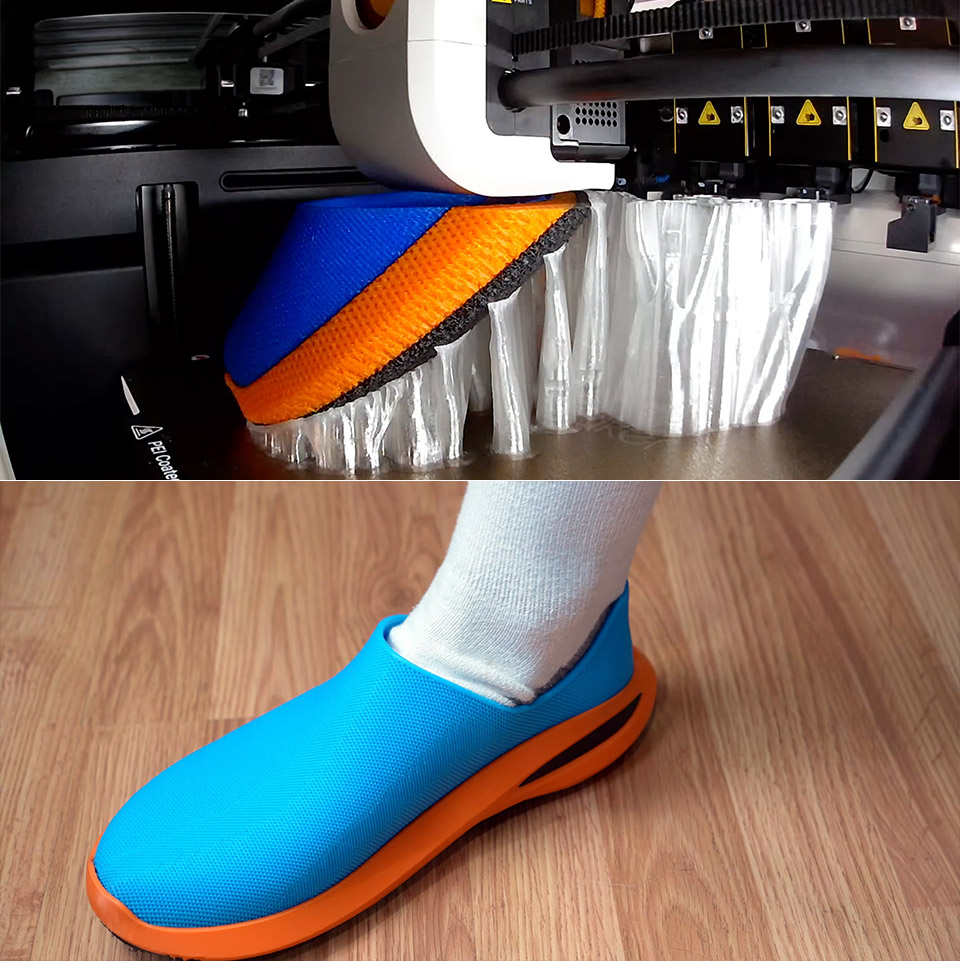
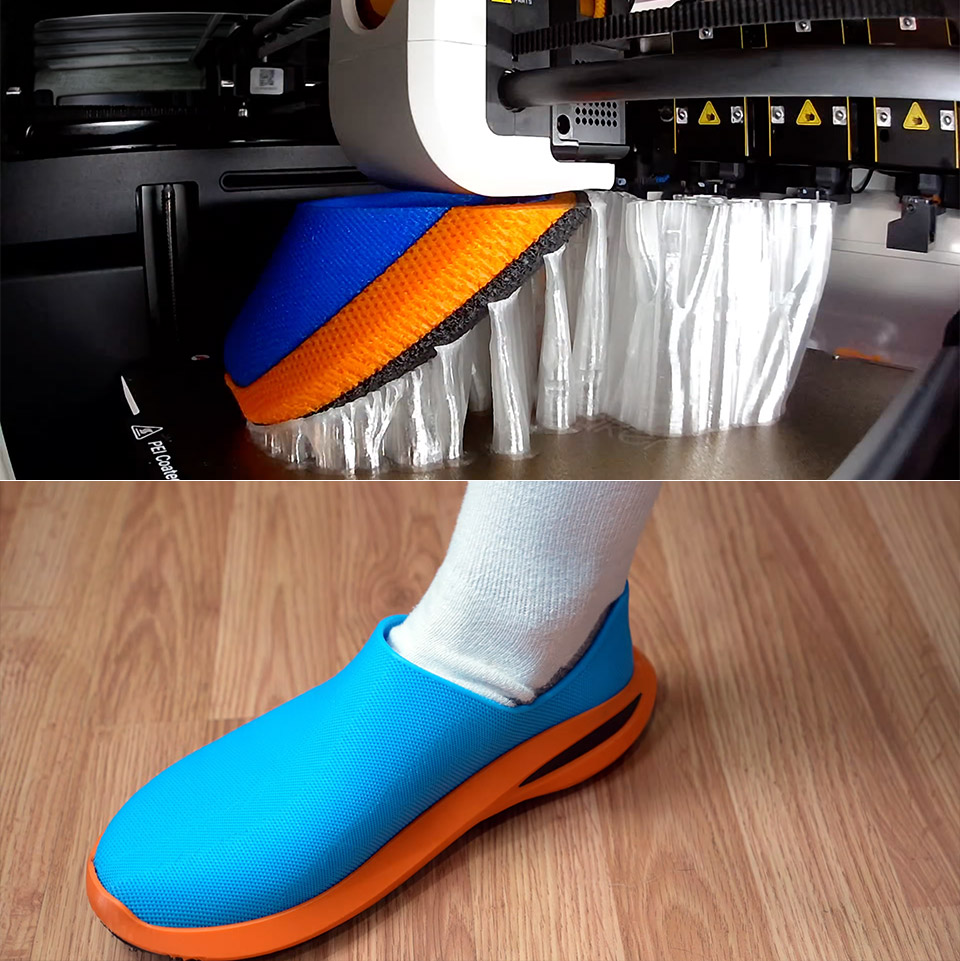
People are constantly pushing the boundaries of 3D printing, but shoes have long been the holy grail, or rather the holy nightmare, of the technology. They must be able to bend with each step, provide traction on a variety of surfaces, and withstand regular use without falling apart at the seams. DaveRig Design took on this exact task in a recent project, resulting in a pair of casual shoes that look and feel right at home on the street.
He started with the CityStep casual everyday sneaker design, which you can get at MakerWorld. This design features a slip-on form with a contoured profile that wraps around your foot snugly at the back and sides, while leaving the top of the shoe open and breathable. The design features a dense infill pattern on top to give it a knit fabric look and feel; there are no separate parts or glue jobs necessary, and the greatest part is that each shoe prints upright in one piece with a tiny heel stand to protect it from tumbling over while printing. Print times on typical machines are roughly sixty-six hours each pair, so you’re looking at around seventy-six hours on some machines due to the fine details and support structures.
High-Speed Precision: Experience unparalleled speed and precision with the Bambu Lab A1 3D Printer. With an impressive acceleration of 10,000 mm/s…
Multi-Color Printing with AMS lite: Unlock your creativity with vibrant and multi-colored 3D prints. The Bambu Lab A1 3D printers make multi-color…
Full-Auto Calibration: Say goodbye to manual calibration hassles. The A1 3D printer takes care of all the calibration processes automatically…
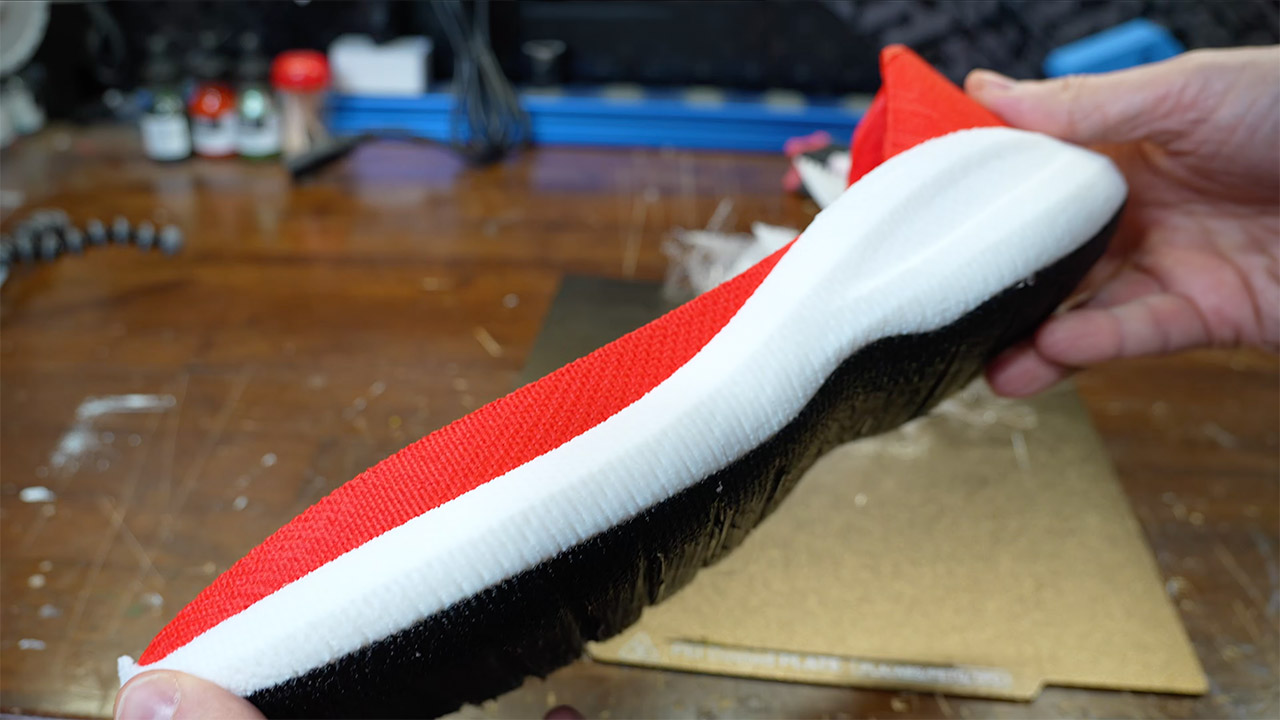
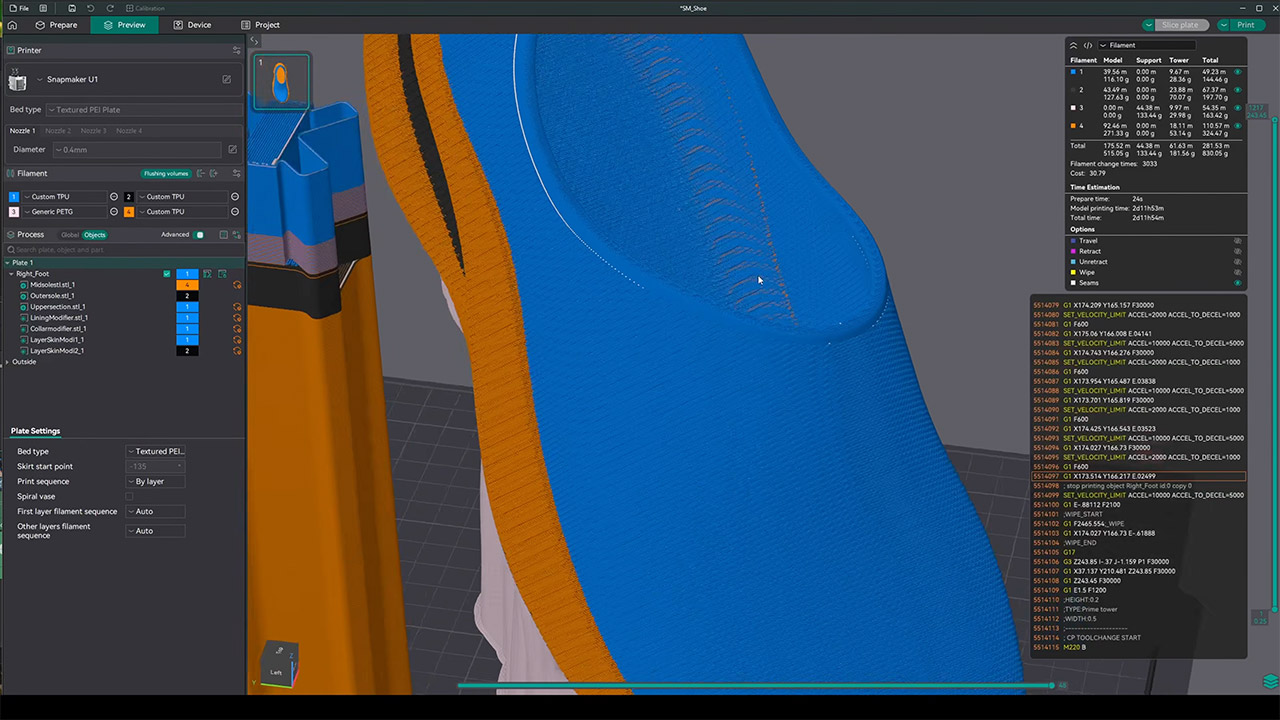
The actual game changer was the material he chose. DaveRig chose BIQU MorPhlex filament, a flexible choice that handles like ordinary TPU out of the spool, with a hardness of roughly 90 A, which is rigid enough to keep the printer from stringing and jamming, which is a common problem with softer filaments. Once the print is completed and the material has cooled, it transitions to a considerably softer seventy-five A rubber-like feel that provides cushioning and traction without the need for any additional post-processing gimmicks. He was using a Snapmaker U1 tool changer, a machine designed to automatically swap between four separate extruders, which came in handy for a project that required over three thousand swaps to blend colors and hardness levels across different parts of the shoe, ensuring that the sole remained grippy, the midsection flexed naturally, and the upper remained light and airy all at once.
Before sending it to the printer, he spent some time in Blender fine-tuning the model, making subtle changes to get the layer bonding just perfect so the finished shoes wouldn’t split when stretched over your foot. Supports were made with a combination of flexible filament and conventional PLA to make them easy to remove when the print was completed, and he strengthened them to keep them from shifting around during the long print. To ensure perfect colour consistency, he ran both shoes side by side on the same build plate.
When the print was finally completed and the supports were removed without a hitch, the results were a pleasant surprise, nearly factory-fresh polished. The upper has a nice textured surface that smoothes over the layer lines so they are scarcely noticeable, and they appear to have come off a production line rather than a homemade work. The sole provides just enough traction, the MorPhlex’s post-print softness makes it easy to grab surfaces, and the heel cup keeps everything held in place without slipping around during normal walking.
The US Commodity Futures Trading Commission is suing Illinois, Arizona and Connecticut for attempting to outlaw or regulate prediction markets like Kalshi and Polymarket. The CFTC believes it has sole jurisdiction to regulate these platforms, and that states attempting to classify them as illegal gambling are overstepping their authority.
CFTC defines prediction markets as “designated contract markets” where futures contracts are traded, essentially letting people bet on the outcome of events (for example, who will be the Democratic nominee for president in 2028). And because futures contracts are financial instruments distinct from traditional bets, they arguably fall under the supervision of the CFTC rather than the sports gambling authorities of individual states.
Multiple states, including the three the CFTC is suing, have challenged that interpretation of what prediction markets are and how they operate. Nevada sued Kalshi in February for operating a sports gambling market without proper licenses, a lawsuit made possible because a federal appeals court declined to prevent Nevada from pursuing its case. Arizona’s attorney general filed a lawsuit against Kalshi in March along similar illegal sports gambling lines, and because the platform let people bet on Arizona elections, which violates state law. Both Illinois and Connecticut have also sent Kalshi and other prediction markets cease-and-desist letters, ordering them to stop advertising and offering their services in their respective states.
“The CFTC will continue to safeguard its exclusive regulatory authority over these markets and defend market participants against overzealous state regulators,” CFTC Chairman Michael S. Selig said in a statement. “This is not the first time states have tried to impose inconsistent and contrary obligations on market participants, but Congress specifically rejected such a fragmented patchwork of state regulations because it resulted in poorer consumer protection and increased risk of fraud and manipulation.”
Advertisement
Attempts to regulate, or in this case, stave off regulation of predication markets are complicated by the fact that President Donald Trump’s family has ties to the industry. Donald Trump Jr. is a paid advisor for Kalshi and investor in Polymarket. Major transactions made before recent US military actions in Iran have also suggested that people close to the government might be trading on prediction markets with insider knowledge. Some prediction markets have implemented new rules to prevent insider trading, but given the circumstances, it makes sense that states wouldn’t be satisfied with companies policing themselves.
Ahead of its premiere, Dave Filoni has revealed that the Star Wars animated series Maul: Shadow Lord will return for a second season. The Lucasfilm co-president revealed that season 2 is already in the works, telling Esquire that “at the end of the day, people like that character.”
Filoni didn’t reveal any other details about the plot or release date for season 2. However, the news isn’t a great surprise given Lucasfilm’s past history with its animated series — The Clone Wars ran seven seasons, Star Wars Rebels four seasons, Star Wars Resistance two seasons and Star Wars: The Bad Batch three seasons.
Maul: Shadow Lord explores the Zebrak Sith Lord’s story about a year after the time of the Clone Wars. Season 1’s 10 seasons will stream twice a week on Disney+ starting on April 6 and run through May 6. It covers Maul’s plot to rebuild his criminal syndicate “on a planet untouched by the Empire,” according to Lucasfilm. “There, he crosses paths with a disillusioned young Jedi Padawan who may just be the apprentice he is seeking to aid him in his relentless pursuit for revenge.”
Microsoft has been pushing AI on consumers whether they wanted it or not. Given the ferocity with which the company has been pushing AI into its products, you might be surprised to learn that it didn’t use its own AI. It took OpenAI’s technology, wrapped it into Copilot and Teams, and called it a day.
But things are changing. Whether the company noticed the public’s negative reaction to its bloated Windows 11 operating system or saw Linux gaining market share in gaming, Microsoft is finally working to introduce a calmer Windows 11 and focus on developing its own AI models.
As reported by Bloomberg, Mustafa Suleiman, CEO of Microsoft AI, made the ambition clear: “Certainly by 2027, the objective is to really get to state-of-the-art,” covering models that can handle text, images, and audio.
What was stopping Microsoft from doing this sooner?
A contract. Microsoft’s deal with OpenAI previously prevented the company from building its own broadly capable AI models. That clause was removed as part of a renegotiated agreement last year, giving Microsoft the freedom to operate independently.
Advertisement
Nadeem Sarwar / Digital Trends
The company isn’t starting from zero, either. In October, Microsoft began using a cluster of Nvidia GB200 chips to build the computing power needed for frontier-level AI development. Regarding the timeline, “we’re sort of ramping over the next sort of 12 to 18 months to get to frontier-scale compute,” Suleyman said.
What does this mean for you?
The first sign of this push is here. Microsoft has released a speech transcription model that outperforms rival products in 11 of the 25 most widely spoken languages. It’s built to handle noisy environments and will soon be rolling out to Teams and other Microsoft apps.
Microsoft
The bigger picture is that Microsoft wants long-term AI self-sufficiency. CEO Satya Nadella reinforced the message this week, emphasizing the importance of building state-of-the-art models over the next three to five years.
For everyday users, more competition in AI means better, smarter tools built into the apps you use. On the other hand, it also means another big company exponentially ramping up purchases of GPUs and RAM, which will drive prices for consumer RAM, GPUs, and SSDs even further.
The path from successful startup to industry heavyweight is often marked by the ability to solve massive, complex problems at scale — whether those challenges are on a farm, battlefield or in low-Earth orbit.
This GeekWire Award, presented by Baird, takes notice of the next dominant force in Pacific Northwest tech. The Next Tech Titan finalists are: Overland AI, Carbon Robotics, Stoke Space, Chainguard and MotherDuck.
Now in its 18th year, the GeekWire Awards is the premier event recognizing the top leaders, companies and breakthroughs in Pacific Northwest tech, bringing together hundreds of people to celebrate innovation and the entrepreneurial spirit. It takes place May 7 at the Showbox SoDo in Seattle.
Last year’s Next Tech Titan winner was Truveta, a Bellevue, Wash.-based company that aims to aggregate medical records data from partner institutions to link treatments with outcomes and underlying health. Truveta raised $320 million in fresh funding in 2025 to push its valuation above $1 billion.
Continue reading for information on the 2026 Next Tech Titan finalists, who were chosen by a panel of independent judges from community nominations. You can help pick the winner: Cast your ballot here or in the embedded form at the bottom. Voting runs through April 10.
Overland AI develops autonomous vehicle software and hardware designed specifically for complex, off-road environments. The company’s platform allows robotic vehicles to navigate high-speed, unpredictable terrain where GPS and cellular signals are often unavailable. Overland is focused on operational integration with the U.S. Army and Marine Corps, and is a key player in the emerging defense-tech corridor of the Pacific Northwest.
Advertisement
GeekWire first covered Overland AI in 2022 when it was a small, stealthy group of researchers spinning out of the University of Washington’s Robot Learning Laboratory. The company, No. 12 on the GeekWire 200, has grown to more than 100 employees, raised more than $140 million, and opened a 22,000 square-foot production facility in Seattle since then.
Ag-tech startup Carbon Robotics builds AI-powered machinery designed to eliminate weeds without the use of chemical herbicides. Its flagship LaserWeeder uses computer vision to identify and zap weeds with lasers, a process powered by the company’s “Large Plant Model.” This AI model, trained on 150 million labeled plants, allows the machines to adapt to new crops and environments in minutes. The company is also expanding into autonomous farm equipment with its Carbon ATK platform and an unrevealed new AI robot.
Founded in 2018 by Isilon Systems co-founder Paul Mikesell, the Seattle-based company has raised $177 million to date and employs about 260 people. Its LaserWeeders are now active on hundreds of farms across 15 countries, helping growers significantly reduce labor and pesticide costs. Carbon is No. 10 on the GeekWire 200.
Stoke Space is developing Nova, a medium-lift rocket designed for 100% reusability and rapid turnaround between flights. Unlike competitors that focus on heavy-lift vehicles, the Kent, Wash.-based company is targeting the medium-lift market with a unique second-stage design featuring an actively cooled heatshield for atmospheric reentry. The goal is to provide a more flexible and cost-effective launch platform that can be reused as seamlessly as an aircraft.
Advertisement
Founded by former Blue Origin and SpaceX engineers, Stoke Space has raised $1.34 billion to date, including a massive $860 million Series D round concluded in early 2026. The company, No. 8 on the GeekWire 200, is currently preparing for its first orbital launch from Cape Canaveral later this year and has already been selected by the U.S. Space Force for national security launches.
Chainguard secures the “software supply chain” by protecting the open-source components and container images used in modern cloud applications. The company’s tools allow developers to use verified, vulnerability-free code, automating the process of keeping foundational software secure. By focusing on the root of software production, Chainguard helps engineering teams eliminate security risks without slowing down development cycles.
Founded in 2021 and based in Kirkland, Wash., the startup has raised $892 million to date, reaching a $3.5 billion valuation. In fiscal year 2025, the company grew its annual recurring revenue sevenfold to $40 million. Now employing more than 500 people and serving over 200 customers — including GitLab and Hewlett Packard Enterprise — Chainguard is No. 2 on the GeekWire 200.
MotherDuck provides a serverless analytics platform built on the open-source DuckDB database engine. Designed for “small data” that doesn’t reach petabyte scale, the technology allows users to run fast SQL queries locally in a browser or in the cloud without the complexity of distributed architectures. By merging local processing speed with cloud scalability, the platform aims to make data analysis more cost-effective and accessible.
Advertisement
Founded in 2022 by former Google BigQuery founding engineer Jordan Tigani, the Seattle startup has raised more than $100 million and is No. 25 on the GeekWire 200.
The event will feature a VIP reception, sit-down dinner and fun entertainment mixed in. Tickets go fast. A limited number of half-table and full-table sponsorships available. Contact events@geekwire.com to reserve a spot for your team today.
(function(t,e,s,n){var o,a,c;t.SMCX=t.SMCX||[],e.getElementById(n)||(o=e.getElementsByTagName(s),a=o[o.length-1],c=e.createElement(s),c.type=”text/javascript”,c.async=!0,c.id=n,c.src=”https://widget.surveymonkey.com/collect/website/js/tRaiETqnLgj758hTBazgd5M58tggxeII7bOlSeQcq8A_2FgMSV6oauwlPEL4WBj_2Fnb.js”,a.parentNode.insertBefore(c,a))})(window,document,”script”,”smcx-sdk”); Create your own user feedback survey
There was a time when upgrading to a new flagship phone felt like stepping into something noticeably better. Bigger batteries, sharper cameras, faster charging – real, tangible upgrades that justified both the hype and the price.
The Galaxy S26 Ultra doesn’t quite feel like that moment. It feels like refinement masquerading as reinvention.
On paper, Samsung has done what it always does. The S26 Ultra comes with Qualcomm’s latest Snapdragon 8 Elite Gen 5 chip, delivering roughly a 10% CPU and 15% GPU improvement over last year’s model. It now supports up to 60W wired charging, up from 45W, and introduces features like a privacy display and new AI-powered tools layered across the system.
Individually, these upgrades sound meaningful. Collectively, they don’t feel transformative. Because the fundamentals – the things users actually notice – haven’t really moved.
Advertisement
The battery is still 5,000mAh. That’s the same capacity Samsung has used across multiple generations, from the S23 Ultra to the S25 Ultra. Charging is faster, yes, but not dramatically so. In real-world terms, you’re saving minutes, not changing behavior. And in some tests, battery performance is only marginally better, largely due to efficiency gains from the new chip rather than any hardware leap.
The camera story is even more telling
The S26 Ultra retains a triple 200-10-50MP setup, with slight tweaks like a wider f/1.4 aperture on the main sensor. But the sensor size remains largely unchanged, and that matters. Competitors like Xiaomi and Vivo have pushed into 1-inch-type sensors, which physically capture more light and detail, especially in low-light conditions. The difference isn’t just technical – it’s visible in depth, dynamic range, and natural detail.
Tom Bedford / Digital Trends
Samsung’s approach, meanwhile, continues to rely heavily on computational photography. The results are still excellent, but they’re also familiar. Bright, sharp, slightly processed images that look good on social media but don’t necessarily push the envelope.
And that’s the recurring theme here: nothing is worse, but nothing is meaningfully better.
So Samsung leans into AI
The S26 Ultra is packed with AI features – image generation, object insertion, real-time editing, writing tools, contextual suggestions. Some of these are genuinely impressive. You can take a photo, remove objects, change lighting conditions, or even insert entirely new elements using generative AI. You can rewrite messages in different tones or generate content directly from prompts.
Because most of these features fall into two categories. The first is automation – things like translation, smart suggestions, or contextual actions. These are useful, but still inconsistent. Voice assistants like Bixby have improved, but they struggle with context and reliability. Ask a complex question, and you might still get an irrelevant answer.
The second category is generative AI – the flashy stuff. Image edits, creative tools, content generation. These are fun, but rarely essential. And there are trade-offs. Many of these tools reduce image resolution, sometimes by as much as 20–30%, or output content that doesn’t match the device’s native display ratio. In some cases, a generated image might come out at 1024×1024 resolution on a phone that has a 2K display.
It’s impressive tech, but it doesn’t always hold up in real use
Which leads to a bigger question. If the most noticeable upgrades are software features that could theoretically roll out to older devices, what exactly are you upgrading for?
Advertisement
This is where the S26 Ultra starts to feel less like a new phone and more like a software update packaged as hardware. And it’s not just Samsung. This is becoming the direction of the entire industry.
Tom Bedford / Digital Trends
Flagship phones are no longer defined by massive hardware leaps. They’re defined by balance.
The S26 Ultra is arguably the most complete Android phone you can buy. It has a great display, strong battery life, versatile cameras, long-term software support (up to seven years), and one of the most customizable software experiences through One UI. It even includes features no one else offers, like the integrated S Pen.
But in trying to be the perfect all-rounder, it avoids taking risks. It doesn’t have the largest battery. It doesn’t have the biggest camera sensor. It doesn’t have the fastest charging. It doesn’t push any single category to its limit.
Instead, it plays it safe. And safe is starting to feel predictable. Other brands are experimenting more aggressively. Some are pushing camera hardware, others are pushing battery tech or charging speeds. Not all of it works, but it creates a sense of momentum – of progress.
Advertisement
A Samsung Galaxy S26 Ultra in a man’s hand.Tom Bedford / Digital Trends
Samsung, on the other hand, is optimizing rather than reinventing. That makes the S26 Ultra an excellent phone for most people. It does everything well, and for the average user, that’s exactly what matters. The camera is more than good enough. The battery lasts a full day. The performance is smooth. The experience is reliable.
But for anyone looking for something new – something that feels like a leap – it falls short. The irony is that the S26 Ultra proves just how mature smartphones have become. The gaps between generations are shrinking. The need to upgrade every year is disappearing.
And maybe that’s the real takeaway
The Galaxy S26 Ultra isn’t a bad upgrade. It’s just not a necessary one. Because when your biggest innovations feel like features that could have been a software update, it’s a sign that the flagship race isn’t about breakthroughs anymore.
It’s about maintaining perfection. And perfection, as it turns out, can be a little boring.
Looking for the most recent Connections answers? Click here for today’s Connections hints, as well as our daily answers and hints for The New York Times Mini Crossword, Wordle, Connections: Sports Edition and Strands puzzles.
Today’s NYT Connections puzzle is kind of tricky, though the blue category is fun. Read on for clues and today’s Connections answers.
The Times has a Connections Bot, like the one for Wordle. Go there after you play to receive a numeric score and to have the program analyze your answers. Players who are registered with the Times Games section can now nerd out by following their progress, including the number of puzzles completed, win rate, number of times they nabbed a perfect score and their win streak.
Here are four hints for the groupings in today’s Connections puzzle, ranked from the easiest yellow group to the tough (and sometimes bizarre) purple group.































































You must be logged in to post a comment Login