Tech
These Cheap Iranian Drones Keep Getting Shot Down, And That’s The Whole Point


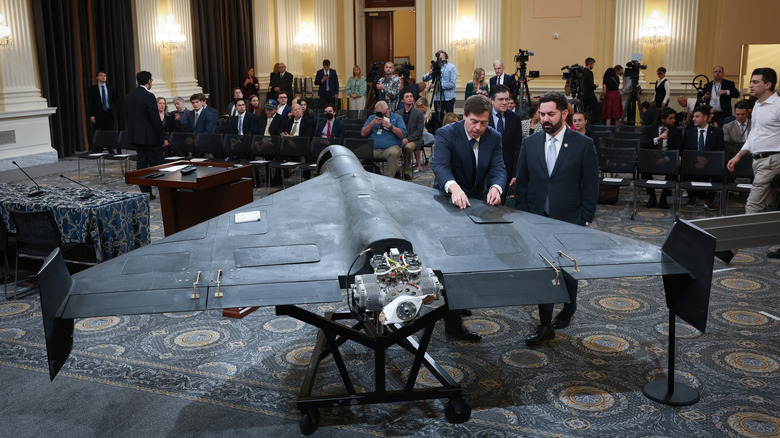
The current war between Iran, the United States, Israel, and other Gulf countries has seen a huge spike in drone warfare, particularly from Iran. Iran’s use of drones in warfare is quite different from what Western countries do. The United States might use big surveillance drones like the RQ-4 Global Hawk or attack drones like the MQ-9 Reaper. Such drones are expensive and meant to come back to base after the mission is done.
A lot of Iranian drones, on the other hand, take a different approach. The Shahed-136 is a kamikaze drone that’s supposed to expend its payload by running into a target. As opposed to a Reaper drone, where the system to control it and the aircraft itself costs over $56 million, a Shahed-136 can cost anywhere between $20,000 and $50,000.
A Shahed, as reported by the US Army, has a wingspan of 8.2 feet and carries an 88-pound warhead. It’s powered by a small aircraft engine mounted in the “tail.” It’s also described as a “loitering” munition meaning that it can stay in the air and hunt for targets. It has a range of a little over 1,200 miles (or 2,000 kilometers).
Drones are cheap, interceptors are expensive
While an individual Shahed-136 is certainly effective, it can be intercepted easily. As such, it’s mostly used in a swarm configuration. A swarm of Shaheds can saturate air defense systems, forcing Western forces to “waste” interceptor missiles on targets that cost a fraction as much. The Terminal High Altitude Area Defense system, also called THAAD uses a network of radar installations and sensors to intercept airborne threats with missiles. Each interceptor missile costs approximately $12.7 million, according to U.S. Congress reports.
The THAAD has a reported successful intercept rate of 90%. That’s good for forces and civilians on the ground, but the cost is skyrocketing and the amount of missiles in stock is dwindling. Congress reports: “Another reported concern is that the usage rate of THAAD interceptors during Operation Fury has further depleted limited interceptor stocks.”
Each THAAD battery consists of six launcher trucks, each supplied with 48 missiles. Those trucks and missiles are guided by a TPY-2 radar station and a communications station. It requires 90 soldiers to run and a single battery costs $2.73 billion. Lockheed Martin, the developer of the THAAD, says that between the United States, United Arab Emirates, and Saudi Arabia, there are 10 active batteries.
You must be logged in to post a comment Login