Tech
This Airport Was One Of The Most Important Locations In US Navy History


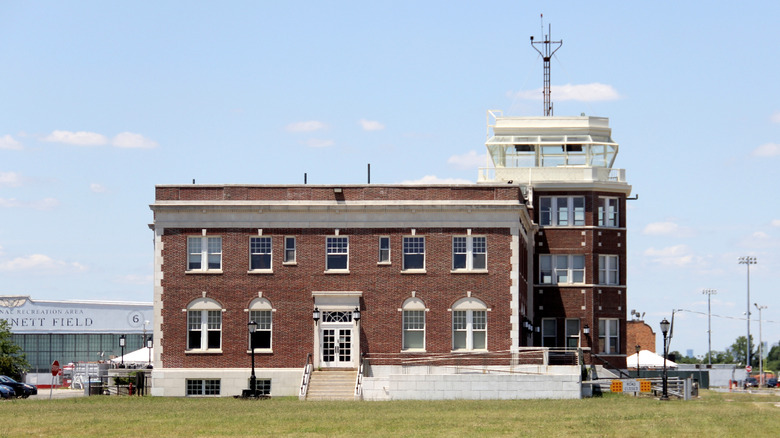
Before LaGuardia and JFK, New York City had Floyd Bennett Field, its first dedicated airport. From the moment it opened in 1931, it served as the location in Brooklyn for modern aviation to get off the ground (literally and figuratively). Eventually, the aforementioned LaGuardia Airport was built in 1939 and became the global hub for travel that it is today. That didn’t mean the Floyd Bennett Field no longer served a purpose, however.
Floyd Bennett Field was purchased by the United States Navy in 1941 as World War II kicked into high gear in Europe. Even before the United States formally entered the war after the attacks on Pearl Harbor in December 1941, the U.S. Navy was using the space to train ground crews. Later, the Navy flew anti-submarine patrols from Floyd Bennett to protect American and British ships that were crossing the Atlantic. This old airport was also home to aircraft like the PBY Catalina seaplane that were hugely instrumental to the Allied war effort.
The Catalina was essentially a flying gunboat and patrol platform with four total machine guns and the ability to carry upwards of four bombs totaling 4,000 pounds for taking out German U-boats. That kind of firepower flying out of a convenient location like New York City was instrumental to the Allies in the early stages of the war.
Floyd Bennet Field’s role in WW2 and beyond
While patrols were ongoing in the North Atlantic, Floyd Bennett Field was also instrumental to carrier operations in the Pacific theater. A number of aircraft manufacturers had factories in New York City, including Grumman. This company was responsible for making planes like the F6F Hellcat, one of the top World War II fighter aircraft. The Hellcat pummeled the Imperial Japanese Navy, scoring a total of 5,155 air “kills” over the span of just two years. Hellcats were flown and tested at Floyd Bennett Field and then transferred to the West Coast for deployment to carrier groups.
Just being the home of the PBY Catalina and F6F Hellcat would cement the airport’s place in U.S. Navy history. However, it also served as the first ever testing and training ground for the then-bleeding edge helicopter in 1943. After the war, operations at the park slowed down, and it was closed entirely as a military airport in 1971. It is now preserved as part of the National Park Service.
You must be logged in to post a comment Login