Connect with us

Tech

This smart device stops sneaky AI gadgets from listening to your conversations

Published

on

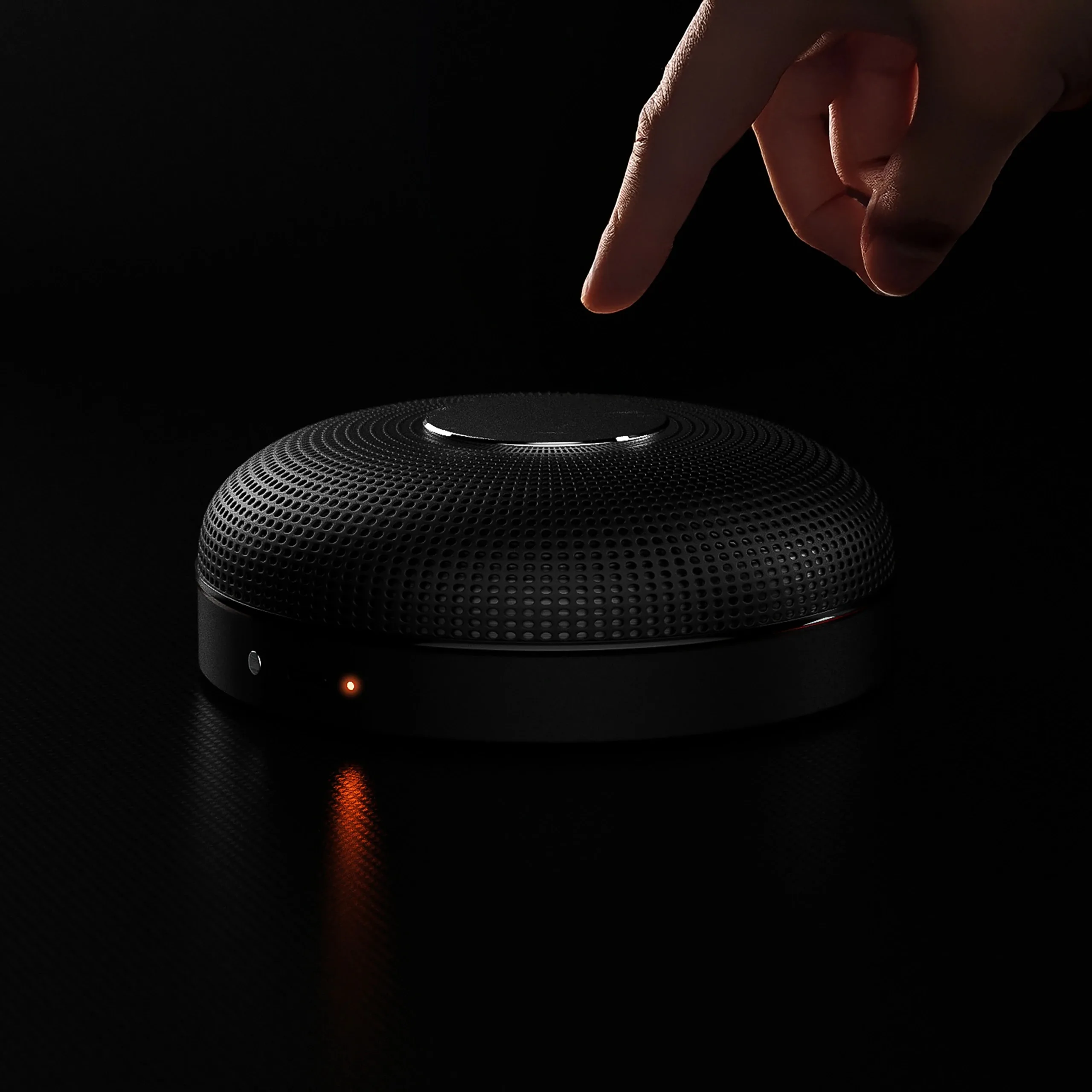
A new device aims to give people control over who can hear them in a world filled with gadgets that are always listening and capturing your conversations. A startup called Deveillance has introduced Spectre I, a portable device designed to stop microphones in nearby devices from recording your voice.

Today, we’re introducing Spectre I, the first smart device to stop unwanted audio recordings.

We live in a world of always-on listening devices.

Smart devices and AI dominate our world in business and private conversations.

With Deveillance, you will @be_inaudible. pic.twitter.com/WdxmnyFq1I

Advertisement

— Aida Baradari (@aidaxbaradari) March 3, 2026

The company says the device can make conversations unintelligible to phones, smart speakers, laptops, and other gadgets that constantly listen for audio. The idea addresses a growing concern around always-on devices.

According to the company, about 14.4 billion devices worldwide are continuously listening for voice input. These recordings often become valuable data sources used for data mining, training artificial intelligence systems, influencing our buying behaviours or deepest opinions.

Even a short sample of speech can reveal sensitive personal details. Around 30 seconds of voice data can help determine traits such as age, weight, income level, and even health information.

Advertisement

A device that creates a privacy bubble around your voice

Spectre I works by creating a two meter protection zone around the user. When activated, it scans for nearby microphones and emits signals that humans cannot hear, but microphones can detect.

These signals overlay your speech so that recording devices receive distorted audio that cannot be understood.

Unlike traditional signal jammers that rely on strong radio interference, the device uses artificial intelligence, signal processing, and physics based research to target microphones directly.

The system operates locally on the device and does not send any data to the cloud. The portable design of Spectre I makes it easy to carry anywhere.

Deveillance says this makes it useful in business meetings, personal conversations, or any situation where people want to keep discussions private.

The company has opened pre-orders for Spectre I with a refundable deposit of $1,199. The device is currently in development, with the first shipments expected in the second half of 2026.

Advertisement

Privacy groups like the Electronic Frontier Foundation have long warned about the risks of always-on surveillance. Deveillance says Spectre I is only the beginning of its effort to give users more control over how their data is collected and shared.

Source link

Advertisement
Continue Reading
Click to comment

Leave a Reply

Your email address will not be published. Required fields are marked *

Tech

Vape-powered Car Isn’t Just Blowing Smoke

Published

on

Disposable vapes aren’t quite the problem/resource stream they once were, with many jurisdictions moving to ban the absurdly wasteful little devices, but there are still a lot of slightly-smelly lithium batteries in the wild. You might be forgiven for thinking that most of them seem to be in [Chris Doel]’s UK workshop, given that he’s now cruising around what has to be the world’s only vape-powered car.

Technically, anyway; some motorheads might object to calling donor vehicle [Chris] starts with a car, but the venerable G-Wiz has four wheels, four seats, lights and a windscreen, so what more do you want? Horsepower in excess of 17 ponies (12.6 kW)? Top speeds in excess of 50 Mph (80 km/h)? Something other than the dead weight of 20-year-old lead-acid batteries? Well, [Chris] at least fixes that last part.

The conversion is amazingly simple: he just straps his 500 disposable vape battery pack into the back seat– the same one that was powering his shop–into the GWiz, and it’s off to the races. Not quickly, mind you, but with 500 lightly-used lithium cells in the back seat, how fast would you want to go? Hopefully the power bank goes back on the wall after the test drive, or he finds a better mounting solution. To [Chris]’s credit, he did renovate his pack with extra support and insulation, and put all the cells in an insulated aluminum box. Still, the low speed has to count as a safety feature at this point.

Charging isn’t fast either, as [Chris] has made the probably-controversial decision to use USB-C. We usually approve of USB-Cing all the things, but a car might be taking things too far, even one with such a comparatively tiny battery. Perhaps his earlier (equally nicotine-soaked) e-bike project would have been a better fit for USB charging.

Advertisement

Thanks to [Vaughna] for the tip!


Advertisement

Source link

Continue Reading

Tech

Schools Keep Facing the Same Challenges. Students and Educators Know What Needs to Change.

Published

on

Educators have seen wave after wave of “innovative” solutions promise to address long-standing challenges — from personalization and engagement to college- and career-readiness — yet many issues remain stubbornly unresolved. Too often, solutions are developed and scaled without a clear understanding of how challenges show up in daily classroom experiences or how students, families and educators define the problems.

Understanding the everyday barriers that students, families, practitioners and administrators identify ensures that potential solutions — whether technological, instructional or relational — are grounded in real needs rather than assumptions.

What These Challenges Look Like in Classrooms and Systems

In Digital Promise’s co-research and co-design work with communities across the country, students and educators describe challenges that are neither new nor isolated, but reflect enduring gaps in how learning environments are designed and supported. Looking closely at how these challenges surface through our Challenge Map reveals the deep connections between instructional practice, student engagement and systems-level supports — and why tackling one without the others often falls short.

Together, these experiences shape whether students feel their learning opportunities are future-forward, adaptable to their goals, needs and circumstances, and equip them to exercise agency in their education and career journeys.

Advertisement

Supporting individualized learning, for example, requires systems that give educators the time, tools and structures to understand and respond to each learner’s growth. Without those conditions, personalization requires extraordinary effort — making it difficult to sustain as a routine part of instructional practice.

Similar structural challenges constrain college- and career-readiness efforts. Educators consistently pointed to the need for more holistic, student-centered pathways. One educator described the importance of a “multi-tiered career program in which students engage in self-exploration of their skills, abilities and interests” to connect learning to concrete opportunities and transferable skills they can use after high school.

Engagement, Agency and the Conditions for Learning

At the crux of learning lies student engagement — shaped by both classroom practices and the broader systems in which learning occurs. Community members and educators both highlighted that academic success depends on students’ well-being.

Students shared that learning is most meaningful when it connects to their interests and allows them to have a voice in shaping their educational experiences. Educators echoed this perspective, underscoring the importance of agency in fostering meaningful learning. As one educator reflected, ensuring educational excellence requires continually redefining educational systems in ways that “give every student access to their own version of success.”

Advertisement

Engagement is not simply a matter of student effort or teacher technique, but a product of the environments and systems that shape learning opportunities.

Learning Does Not Stop at the Schoolhouse Door

Students, families and educators who contributed to Digital Promise’s Challenge Map identified supports that go beyond the schoolhouse, offering insight into the social conditions shaping learning. Suggestions for home stability, physical and emotional safety, and balancing responsibilities inside and outside of school highlight how deeply schooling is intertwined with young people’s lives beyond the classroom.

Other insights were deceptively simple yet profound: One group of students suggested creating regular feedback loops in schools so they could share concerns, inform changes to physical spaces and course offerings, and shape how resources are used. Even these straightforward ideas, however, call for systemic shifts in how schools operate and how student voices are embedded in decision-making.


The transformative power of co-research, co-design and student voice in education.

What It Means to Put People at the Center of Innovation

Education remains a fundamentally human endeavor. As long as the goal is to prepare young people to navigate their futures with skill, agency and well-being, the conditions and relationships that shape students’ opportunity and engagement remain essential.

Advertisement

At a time when education research and development (R&D) is often synonymous with emerging technologies, shifting the focus to problem-solving — driven by the perspectives of those living the challenges — expands what counts as innovation. Existing technologies may play an important role, but they should not be scaled simply because they are novel.

Rather, the starting point for innovation should be: What is the central problem that needs to be solved, for and with whom, and what are the resulting outcomes if the problem is addressed successfully? Only then should existing tools or new solution development enter into the equation. Addressing these challenges requires shifts in mindsets and power dynamics so that both students and educators learn how student voice should shape learning and curriculum.

Why Education Research and Development Needs a Systems Lens

As education R&D evolves, the field is increasingly recognizing that local district systems and community engagement have often been missing from innovation efforts. In policy and education leadership circles, there is a growing call for education R&D that strengthens young people’s futures and, by extension, the nation’s long-term economic and civic well-being.

When schools and local communities are meaningfully engaged in R&D, their perspectives consistently point to persistent challenges that require a systems-level response. These challenges are not isolated problems to be solved with standalone interventions, but signals of deeper misalignments in policies, incentives and assumptions across the education ecosystem.

Advertisement

Questions for Building Lasting Change

Solution developers, policymakers and funders drive change through their respective products and investments. Recognizing these challenges as persistent problems and indicators of necessary systems change, they might consider:

  • How well do solutions capture the actual problems they aim to solve, rather than the technological possibilities they allow?
  • To what extent do local policies and incentives support the development of solutions that center students, families, communities and educators experiencing the challenge?
  • How are the perspectives of those living the challenges incorporated throughout the research, solution design and implementation process?
  • How do technological solutions reflect the relational and mindset shifts required across the system?
  • How can the evaluation of challenges in education take a systems approach that not only accounts for easily identifiable policies, resources, and practices but also for underlying relationships and assumptions?

Above all, lasting educational innovation depends on a shared conviction: The voices and experiences of students, families, community members and educators must shape how problems are defined and solutions are developed.

Source link

Continue Reading

Tech

Gemini can now find stuff inside your house with a new Google Home update

Published

on

Google is rolling out a sizeable update to Gemini for Home, bringing smarter voice controls and a long list of fixes. This update aims at making your smart home feel, well, smarter.

Announced by Google’s Home Chief Product Officer Anish Kattukaran, the update focuses on improving how Gemini understands context — both in what you say and where you say it.

One of the more practical changes is improved device isolation. Now, saying “Turn off the kitchen” will target just the lights. It will not accidentally switch off plugs or unrelated devices. Likewise, “Turn off all the lights” will stay within your home. It will not mistakenly affect other linked locations.

Gemini is also getting better at understanding what a device actually is, even if its name isn’t crystal clear. It now strictly uses your home address from the Google Home app for location context, reducing cross-home mix-ups. Google says it has also “significantly reduced” those awkward moments where Gemini cuts you off mid-command.

Advertisement

Daily reliability is another focus. Notes, reminders and timers should respond more consistently, while user-created routines are expected to trigger more reliably. There’s also improved handling of general questions and music playback, including better support for newly released tracks.

Advertisement

For Google Home Premium Advanced subscribers, a new “Live Search” feature lets Gemini answer questions about what’s happening in your home via Nest cameras. Effectively, this allows you to ask what it sees in real time.

The update also brings broader support for the Nest x Yale Lock. It adds new automation starters like “When the security system is armed…”. Additionally, a March 2026 firmware update for Nest Wifi Pro promises improved mesh performance.

Advertisement

It’s not a headline-grabbing redesign. However, it’s the kind of refinement that could make day-to-day smart home control feel far less frustrating.

Source link

Advertisement
Continue Reading

Tech

Grell OAE2 Open-Back Headphones to Premiere at CanJam NYC 2026 with Newly Optimized Driver and Forward Projecting Soundstage

Published

on

Veteran headphone engineer Axel Grell, best known for developing many of Sennheiser’s most advanced and commercially successful high-end models before launching his own brand, is bringing his latest design to North America. The Grell OAE2 open-back headphone will make its U.S. public debut at CanJam NYC 2026 on March 7–8, marking the model’s first appearance on this side of the Atlantic following its initial German release.

Building on the foundation of the original OAE1, the $599 OAE2 reflects Grell’s continued focus on tonal accuracy, mechanical precision, and long-term listening comfort. The open-back over-ear design incorporates a newly optimized dynamic driver and acoustically refined housing intended to improve airflow and deliver a more speaker-like soundstage presentation in front of the listener.

Grell describes the tuning as natural and neutral, with controlled low frequencies, a lifelike midrange, and extended detail up top without fatigue. Global availability is scheduled for March 31, 2026, priced at $599 / £499 / €499.

Recreating a More Speaker Like Listening Perspective

Designed and engineered in Germany, the OAE2 is built around a clear objective: reducing the “in-head” effect common to many headphones and moving the listening perspective closer to what listeners experience with loudspeakers. Rather than simply creating a wider soundstage, the focus is on reproducing depth, placement, and spatial stability in a way that feels more natural over long listening sessions.

Advertisement
Drop + Grell prototype headphone at CanJam SoCal 2023
Grell OAE1 prototype headphone with forward mounted driver at CanJam SoCal 2023. This design continues in the OAE2.

Instead of following the typical open-back headphone layout where the driver fires directly into the ear canal, Axel Grell’s design positions the acoustic output to interact more deliberately with the outer ear. This allows the pinna and surrounding structures to contribute to spatial cues before the sound reaches the ear canal.

The idea mirrors what happens when listening to loudspeakers. Sound reaches the ears only after interacting with the head, outer ear, and upper body, creating subtle timing, phase, and tonal variations that the brain uses to interpret direction and distance. The OAE2 attempts to preserve more of those cues within a headphone format so that the perceived soundstage feels more externalised and stable.

This design philosophy is informed in part by Grell’s ongoing research into spatial hearing and headphone perception in collaboration with Leibniz University Hannover. The research helps guide practical design decisions such as driver positioning, acoustic structure, and overall tuning, with the goal of maintaining coherent imaging, natural treble perception, and controlled low-frequency behaviour.

The intention is not to create exaggerated width or artificial spatial effects. Instead, the OAE2 aims to present music in a way that resembles nearfield loudspeaker listening, where instruments and voices appear positioned in front of the listener rather than inside the head. For listeners accustomed to traditional headphone presentation, the perspective may initially feel different, but the design is intended to become more intuitive as the brain adapts to the spatial cues over time.

Grell OAE2 Open-Back Headphones side
Grell OAE2

Engineering and Build Designed for Long Term Ownership

Beyond its acoustic design, the OAE2 reflects Axel Grell’s view that premium headphones should be durable, serviceable, and built for long-term ownership rather than short product cycles.

Advertisement

At the core of the design is a 40 mm wideband dynamic driver using a bio cellulose diaphragm. The driver works alongside a carefully developed damping system that includes a precision manufactured stainless steel mesh produced in Germany. This combination is intended to maintain controlled airflow and consistent driver behavior while supporting the headphone’s spatial presentation goals.

The physical construction follows a modular approach. The OAE2 uses a fully metal frame and replaceable components that allow the headphone to be maintained and serviced over time. Key parts can be removed or replaced if necessary, extending the usable life of the product and reducing the likelihood that the headphone becomes disposable when individual components wear out.

Advertisement. Scroll to continue reading.

This design philosophy reflects a broader trend in the high end headphone market. Manufacturers including Meze Audio have helped popularize modular construction, where headphones are designed with replaceable parts and serviceability in mind so they can remain in use for many years rather than being replaced entirely.

Advertisement

Even the packaging follows the same thinking. The OAE2 ships in largely plastic free packaging designed to reduce unnecessary waste while aligning with Grell’s emphasis on sustainability and long term value.

grell-oae2-gimbal
grell-oae2-headband

Connectivity, Accessories, and Technical Specifications

The OAE2 is supplied with both balanced and single ended connectivity options, allowing it to work with a wide range of headphone amplifiers, portable players, and desktop audio systems. In the box, listeners will find two detachable cables: a 1.8 metre (5.9 ft) single ended cable terminated with a 3.5 mm plug and a 1.8 metre (5.9 ft) balanced cable with a 4.4 mm connector. A screw on 3.5 mm to 6.3 mm adapter is also included for compatibility with traditional headphone amplifier outputs, along with a protective carry case for storage and transport.

Technically, the OAE2 is a circumaural open-back headphone built around a dynamic transducer. Although specifications are nearly identical to the OAE1, the OAE2 are 3 grams heavier with an even wider frequency response rated from 12 Hz to 34 kHz within a ±3 dB window, extending from 6 Hz to 46 kHz at -10 dB. Nominal impedance is the same at 38 ohms with a sensitivity of 100 dB at 1 kHz (1 VRMS), suggesting that the headphone can be driven by a variety of modern sources while still benefiting from a capable headphone amplifier. Total harmonic distortion is rated at 0.05 percent at 1 kHz and 100 dB. The headphone weighs 378 grams (13.3 oz) without the cable attached.

grell-oae2-headphones-wired

The Bottom Line

The OAE2 represents the next step in Axel Grell’s effort to rethink how headphones present space. Rather than chasing exaggerated width or DSP tricks, the design focuses on repositioning the driver and shaping the acoustics so the sound appears more in front of the listener, and closer to how nearfield speakers behave. It’s a concept Grell has been refining for several years, and we first heard an early prototype of this approach at CanJam SoCal in 2023, where the forward projecting presentation immediately stood out from the usual “inside your head” headphone experience.

The new model builds on the earlier OAE1 concept but arrives with a more mature design and a higher price point at $599, compared to the roughly $300 launch price of the original. That shift reflects a more fully developed product with revised acoustics, upgraded construction, and a clearer articulation of Grell’s spatial listening philosophy.

Advertisement
grell-oae2-name

Listeners who prioritize tonal balance, realistic imaging, and long term listening comfort are the most likely audience here. Those expecting the traditional wide but internalized headphone stage may find the presentation different at first, but the goal is a more natural spatial perspective that resembles listening to speakers at close range.

We’ll have the chance to spend more time with the OAE2 during its North American debut at CanJam NYC 2026, where Grell will be demonstrating the headphone publicly for the first time in the U.S. If all goes according to plan, we expect to have a full review ready before the end of March once production units become available.

For more information: grellaudio.com

Advertisement

Source link

Continue Reading

Tech

Windows 10 KB5075039 update fixes broken Recovery Environment

Published

on

Windows 10

Microsoft has released the KB5075039 Windows Recovery Environment update for Windows 10 to fix a long-standing issue that prevented some users from accessing the Recovery environment.

The Windows Recovery Environment (WinRE) is a minimal troubleshooting environment used to repair or restore the operating system after it fails to start, to diagnose crashes, or to remove malware.

Windows Recovery Environment
Source: BleepingComputer
 

In October 2025, Microsoft confirmed that the KB5066835 Patch Tuesday updates broke USB mouse and keyboard input when using the Windows 11 Recovery Environment, making it difficult for many to use the troubleshooting tool.

While they quickly rolled out a fix for this flaw, they didn’t disclose until February that the Windows 10 KB5068164 update released in October also broke WinRE.

“This update contains an issue that prevents the Windows Recovery Environment from starting successfully,” reads the February update to the change log.

Advertisement

Yesterday, Microsoft released the “KB5075039: Windows Recovery Environment update for Windows 10” to fix the WinRE issue introduced last year.

“[Windows Recovery Environment (WinRE)] Fixed: WinRE would not start after installing the October 14, 2025 update KB5068164,” reads the change log.

To install the update, your WinRE partition must be at least 256MB in size. If not, you will need to increase the partition size using these instructions.

Before resizing any partition, including the WinRE partition, it is always advisable to back up the data on the drive whose partitions are being resized.

Advertisement

Malware is getting smarter. The Red Report 2026 reveals how new threats use math to detect sandboxes and hide in plain sight.

Download our analysis of 1.1 million malicious samples to uncover the top 10 techniques and see if your security stack is blinded.

Source link

Continue Reading

Tech

Apple’s budget MacBook Neo is here to take on the best cheap laptops and Chromebooks

Published

on

It’s been rumoured for a long time, but Apple has finally taken the wraps off arguably its most exciting laptop in years.

The $599 MacBook Neo arrives as the most affordable entry in Apple’s laptop range, with a price that’s more in line with the brand’s iPad range – including the new iPad Air M4 – than the MacBook Air or MacBook Pro.

This is the first MacBook to be powered by the A18 Pro chip originally made for an iPhone, and, like the iMac, it also comes in a range of fun colours – Silver, Indigo, Blush, and Citrus – that are also a first for a MacBook. Apple has colour-matched the keyboard and feet, giving it a very distinct look.

The A18 Pro chip has a 6-core CPU (with 2 performance cores and 4 efficiency cores) and a 5-core GPU, along with ray-tracing support and a 16-core neural engine. Apple will only offer a single 8GB memory option, with storage sizes of either 256GB or 512GB.

Advertisement
macbook neo (1)macbook neo (1)

Advertisement

Battery life is stated at 16 hours for video streaming and 11 hours of web browsing, and there’s a 1080p camera on the front. Unlike the other MacBook models, there’s no notch, but a bezel similar to that of an iPad. The display is 13 inches, with a 2408 x 1506 resolution and a reported 500 nits of brightness.

The base model ships without Touch ID, although you can pay a little more and get a version with the fingerprint unlock embedded into the keyboard.

Connectivity comes from two USB-C (one is a USB 2 and the other USB 3) ports and a headphone jack, so no MagSafe charging. There is Wi-Fi 6E and Bluetooth 6 though, which is welcome.

MacBook Air Neo Price and Release Date

Prices start at £599/$599 for a model with 256GB storage and £699/$699 for a Touch ID-toting 512GB variant. It can only be selected with 8GB memory, and there’s no 1TB storage option.

Advertisement

This is a breaking news story. We’ll update it as we get more information

Advertisement

Source link

Advertisement
Continue Reading

Tech

Black Forest Labs’ new Self-Flow technique makes training multimodal AI models 2.8x more efficient

Published

on

To create coherent images or videos, generative AI diffusion models like Stable Diffusion or FLUX have typically relied on external “teachers”—frozen encoders like CLIP or DINOv2—to provide the semantic understanding they couldn’t learn on their own.

But this reliance has come at a cost: a “bottleneck” where scaling up the model no longer yields better results because the external teacher has hit its limit.

Today, German AI startup Black Forest Labs (maker of the FLUX series of AI image models) has announced a potential end to this era of academic borrowing with the release of Self-Flow, a self-supervised flow matching framework that allows models to learn representation and generation simultaneously.

By integrating a novel Dual-Timestep Scheduling mechanism, Black Forest Labs has demonstrated that a single model can achieve state-of-the-art results across images, video, and audio without any external supervision.

Advertisement

The technology: breaking the “semantic gap”

The fundamental problem with traditional generative training is that it’s a “denoising” task. The model is shown noise and asked to find an image; it has very little incentive to understand what the image is, only what it looks like.

To fix this, researchers have previously “aligned” generative features with external discriminative models. However, Black Forest Labs argues this is fundamentally flawed: these external models often operate on misaligned objectives and fail to generalize across different modalities like audio or robotics.

The Labs’ new technique, Self-Flow, introduces an “information asymmetry” to solve this. Using a technique called Dual-Timestep Scheduling, the system applies different levels of noise to different parts of the input. The student receives a heavily corrupted version of the data, while the teacher—an Exponential Moving Average (EMA) version of the model itself—sees a “cleaner” version of the same data.

The student is then tasked not just with generating the final output, but with predicting what its “cleaner” self is seeing—a process of self-distillation where the teacher is at layer 20 and the student is at layer 8. This “Dual-Pass” approach forces the model to develop a deep, internal semantic understanding, effectively teaching itself how to see while it learns how to create.

Advertisement

Product implications: faster, sharper, and multi-modal

The practical results of this shift are stark. According to the research paper, Self-Flow converges approximately 2.8x faster than the REpresentation Alignment (REPA) method, the current industry standard for feature alignment. Perhaps more importantly, it doesn’t plateau; as compute and parameters increase, Self-Flow continues to improve while older methods show diminishing returns.

The leap in training efficiency is best understood through the lens of raw computational steps: while standard “vanilla” training traditionally requires 7 million steps to reach a baseline performance level, REPA shortened that journey to just 400,000 steps, representing a 17.5x speedup.

Black Forest Labs’ Self-Flow framework pushes this frontier even further, operating 2.8x faster than REPA to hit the same performance milestone in roughly 143,000 steps.

Taken together, this evolution represents a nearly 50x reduction in the total number of training steps required to achieve high-quality results, effectively collapsing what was once a massive resource requirement into a significantly more accessible and streamlined process.

Advertisement

Black Forest Labs showcased these gains through a 4B parameter multi-modal model. Trained on a massive dataset of 200M images, 6M videos, and 2M audio-video pairs, the model demonstrated significant leaps in three key areas:

  1. Typography and text rendering: One of the most persistent “tells” of AI images has been garbled text. Self-Flow significantly outperforms vanilla flow matching in rendering complex, legible signs and labels, such as a neon sign correctly spelling “FLUX is multimodal”.

  2. Temporal consistency: In video generation, Self-Flow eliminates many of the “hallucinated” artifacts common in current models, such as limbs that spontaneously disappear during motion.

  3. Joint video-audio synthesis: Because the model learns representations natively, it can generate synchronized video and audio from a single prompt, a task where external “borrowed” representations often fail because an image-encoder doesn’t understand sound.

In terms of quantitative metrics, Self-Flow achieved superior results over competitive baselines. On Image FID, the model scored 3.61 compared to REPA’s 3.92. For video (FVD), it reached 47.81 compared to REPA’s 49.59, and in audio (FAD), it scored 145.65 against the vanilla baseline’s 148.87.

From pixels to planning: the path to world models

The announcement concludes with a look toward world models—AI that doesn’t just generate pretty pictures but understands the underlying physics and logic of a scene for planning and robotics.

By fine-tuning a 675M parameter version of Self-Flow on the RT-1 robotics dataset, researchers achieved significantly higher success rates in complex, multi-step tasks in the SIMPLER simulator. While standard flow matching struggled with complex “Open and Place” tasks, often failing entirely, the Self-Flow model maintained a steady success rate, suggesting that its internal representations are robust enough for real-world visual reasoning.

Advertisement

Implementation and engineering details

For researchers looking to verify these claims, Black Forest Labs has released an inference suite on GitHub specifically for ImageNet 256×256 generation. The project, primarily written in Python, provides the SelfFlowPerTokenDiT model architecture based on SiT-XL/2.

Engineers can utilize the provided sample.py script to generate 50,000 images for standard FID evaluation. The repository highlights that a key architectural modification in this implementation is per-token timestep conditioning, which allows each token in a sequence to be conditioned on its specific noising timestep. During training, the model utilized BFloat16 mixed precision and the AdamW optimizer with gradient clipping to maintain stability.

Licensing and availability

Black Forest Labs has made the research paper and official inference code available via GitHub and their research portal. While this is currently a research preview, the company’s track record with the FLUX model family suggests these innovations will likely find their way into their commercial API and open-weights offerings in the near future.

For developers, the move away from external encoders is a massive win for efficiency. It eliminates the need to manage separate, heavy models like DINOv2 during training, simplifying the stack and allowing for more specialized, domain-specific training that isn’t beholden to someone else’s “frozen” understanding of the world.

Advertisement

Takeaways for enterprise technical decision-makers and adopters

For enterprises, the arrival of Self-Flow represents a significant shift in the cost-benefit analysis of developing proprietary AI.

While the most immediate beneficiaries are organizations training large-scale models from scratch, the research demonstrates that the technology is equally potent for high-resolution fine-tuning. Because the method converges nearly three times faster than current standards, companies can achieve state-of-the-art results with a fraction of the traditional compute budget.

This efficiency makes it viable for enterprises to move beyond generic off-the-shelf solutions and develop specialized models that are deeply aligned with their specific data domains, whether that involves niche medical imaging or proprietary industrial sensor data.

The practical applications for this technology extend into high-stakes industrial sectors, most notably robotics and autonomous systems. By leveraging the framework’s ability to learn “world models,” enterprises in manufacturing and logistics can develop vision-language-action (VLA) models that possess a superior understanding of physical space and sequential reasoning.

Advertisement

In simulation tests, Self-Flow allowed robotic controllers to successfully execute complex, multi-object tasks—such as opening a drawer to place an item inside—where traditional generative models failed. This suggests that the technology is a foundational tool for any enterprise seeking to bridge the gap between digital content generation and real-world physical automation.

Beyond performance gains, Self-Flow offers enterprises a strategic advantage by simplifying the underlying AI infrastructure. Most current generative systems are “Frankenstein” models that require complex, external semantic encoders often owned and licensed by third parties.

By unifying representation and generation into a single architecture, Self-Flow allows enterprises to eliminate these external dependencies, reducing technical debt and removing the “bottlenecks” associated with scaling third-party teachers. This self-contained nature ensures that as an enterprise scales its compute and data, the model’s performance scales predictably in lockstep, providing a clearer ROI for long-term AI investments.

Source link

Advertisement
Continue Reading

Tech

Vehicle Tire Pressure Sensors Enable Silent Tracking

Published

on

Longtime Slashdot reader linuxwrangler writes: Dark Reading reports that a team of researchers has determined that signals from tire pressure monitoring systems (TPMSs), required in U.S. cars since 2007, can be used to track the presence, type, weight, and driving pattern of vehicles. The researchers report (PDF) that the TPMS data, which includes unique sensor IDs, is sent in clear text without authentication and can be intercepted 40-50 meters from a vehicle using devices costing $100. “Researchers have discovered that most TPMS sensors transmit a unique identifier in clear text that never changes during the lifetime of the tire,” the researchers pointed out. “This unencrypted wireless communication makes the signals susceptible to eavesdropping and potential tracking by any third party in proximity to the car.”

Source link

Continue Reading

Tech

Spotify and Liquid Death Launch Eternal Playlist Urn So the Music Never Dies Even If You Do

Published

on

Spotify has partnered with beverage brand Liquid Death to launch one of the stranger marketing ideas to crawl out of the modern streaming era: the Liquid Death x Spotify Eternal Playlist Urn, a cremation urn paired with a tool that generates a personalized Spotify playlist meant to live on after you’re gone. The concept blends memorial products with algorithmic music discovery, allowing users to create what the companies call a “forever soundtrack” based on their listening history. It’s part branding stunt, part commentary on how deeply streaming has embedded itself into daily life and identity.

Of course, it raises a perfectly reasonable question: how macabre can a marketing campaign get? Memorializing someone with their favorite songs might sound touching in theory, but it also assumes your loved ones actually enjoy your music. Speaking personally, my family already rolls their eyes at half the things I play. The last thing they need is the possibility of being haunted by my eternal playlist from beyond the grave.

Liquid Death x Spotify Eternal Playlist Urn

A Real Urn With a Bluetooth Speaker…And Apparently a Five Per Customer Limit 

The Liquid Death x Spotify Eternal Playlist Urn is exactly what it sounds like: a limited edition cremation urn designed to hold human ashes while also functioning as a Bluetooth speaker that plays a custom Spotify playlist. Priced at $495 and limited to just 150 units, the urn is made from 100% polyester resin, stands nearly a foot tall (29 cm). Each unit is produced in small batches and marketed as a one of a kind piece, meaning small cosmetic imperfections are considered part of the design rather than defects.

The unusual twist is built directly into the lid. A wireless Bluetooth speaker is embedded at the top of the urn and powered by a rechargeable battery that charges via USB-C. Once connected to a phone, users can stream a personalized Spotify Eternal Playlist, which is generated through Spotify’s playlist tool based on a listener’s music history and preferences. In theory, the result is a curated soundtrack that reflects the music someone loved while they were alive and can continue playing long after they’re gone.

Advertisement

Of course, this is where the concept gets a little…unsettling. Unlike novelty memorial products or decorative keepsakes, this is an actual urn designed to hold cremated remains. That means the person whose playlist is blasting through the Bluetooth speaker could literally be inside the box producing the music. Whether that feels like a touching tribute or the world’s most awkward living room accessory probably depends on how much your family enjoyed your taste in music.

In my case, this isn’t likely to become a problem. Judaism traditionally prohibits cremation, so the Eternal Playlist Urn probably won’t be part of my exit strategy. If my kids stick to tradition, I’ll end up buried somewhere outdoors instead. Knowing New Jersey, that likely means the backyard under the big weeping willow. The space under the pine and oak trees is already spoken for. Jersey. You really don’t want to know.

The Bottom Line

And if all of that wasn’t strange enough, there’s the line in the product description that really makes you stop mid scroll and stare: “Limited to 5 per customer.”

Advertisement

Five.

Not to be weird. Because this whole thing clearly hasn’t crossed that line yet.

But five urns? Who exactly is buying five cremation urns with Bluetooth speakers? Are these supposed to be Christmas gifts? A subtle 100th birthday present for Grandma that comes with a note reading, “It’s time to move on old lady. My 9 to 5 job isn’t paying for that new F-150 and fishing boat, but my inheritance might.” Maybe it’s for the dog, so he can sit in the living room listening to Dad’s eternal yacht rock playlist while contemplating the existential horror of Bluetooth connectivity from beyond the grave.

Or maybe the idea is that your entire family can go out together, each with their own urn blasting their personal soundtrack like some kind of posthumous silent disco.

Advertisement
Advertisement. Scroll to continue reading.

And because nothing ever truly tops American commercialism and our endless appetite for things we probably don’t need, all 150 urns sold out in a single day.

Yes, the entire run of Bluetooth enabled afterlife sound systems disappeared almost instantly. Somewhere out there, people are proudly displaying a cremation urn that doubles as a wireless speaker while a Spotify playlist hums away on eternal repeat.

And if you missed the first batch of algorithmic immortality, don’t worry. More are coming. Because in America, even death apparently comes with a restock notification.

Advertisement

Where to order: $495 at Liquid Death or Create Your Eternal Playlist on Spotify.

Source link

Advertisement
Continue Reading

Tech

Apple updates iOS, macOS Tahoe to 26.3.1 to support new Studio Displays

Published

on

Right after concluding its week of product launches, Apple has rolled out iOS 26.3.1, iPadOS 26.3.1, and macOS 26.3.1 updates, adding support for its updated Studio Display and the new Studio Display XDR.

Two sleek, silver Apple desktop monitors side by side, each showing vibrant abstract artwork with bold colors and geometric shapes on a clean white background
Apple’s two new Studio Displays — image credit: Apple

Apple periodically releases smaller updates for its operating systems, fixing bugs and adding support for new products. Wednesday’s updates firmly fall into the latter category.
The updates, rolling out to iPhone and Mac, brings macOS Tahoe up to version 26.3.1, with iOS 26.3.1 and iPadOS 26.3.1 also released at the same time.
Continue Reading on AppleInsider | Discuss on our Forums

Source link

Continue Reading

Trending

Copyright © 2025