Tech
Thrive Capital’s first investor letter shows how completely OpenAI has come to define it

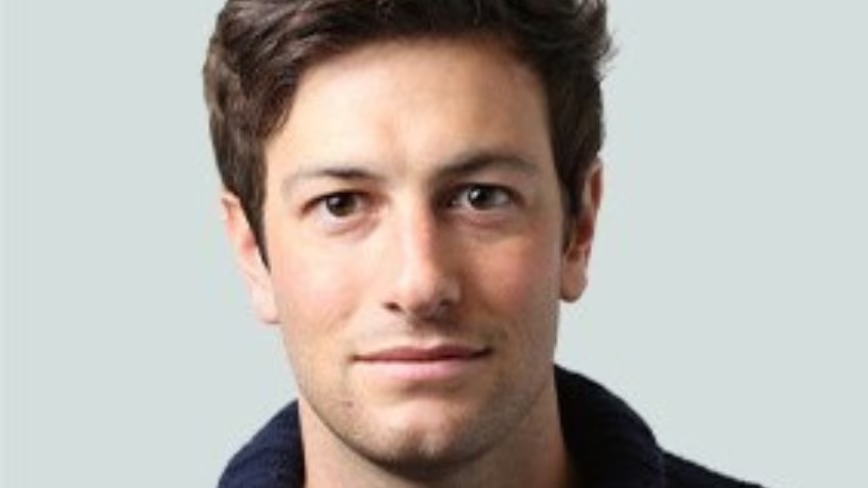

Joshua Kushner’s Thrive Capital has sent its first formal letter to investors, and the standout figure captures the AI era in miniature.
One of its funds has swelled to about $3.7bn in value, driven overwhelmingly by early bets on OpenAI and SpaceX. The letter, reported by Bloomberg, reads as a victory lap and a quiet hedge at the same time.
That Thrive is writing to its backers at all is notable in itself. Kushner has built one of the most secretive and sought-after firms in venture capital, so a formal letter, complete with hard marks and a candid line on concentration, is a departure that doubles as a statement of confidence.
It also lands at a moment when the whole industry is arguing about whether AI valuations reflect real value or collective hope, which makes a firm this exposed to a single name showing its workings all the more striking.
Thrive’s OpenAI position is practically a chronicle of the boom. The firm first backed the company in 2022 at a $29bn valuation, led a tender the following year at $86bn, and has since committed around a billion dollars more across rounds that valued OpenAI at $150bn and then $285bn.
With the company now lining up a trillion-dollar listing, those early entries have multiplied many times over, at least on paper.
That $3.7bn mark also owes a great deal to Thrive’s stake in Elon Musk’s SpaceX, another private giant whose valuation has climbed relentlessly.
Between them, two holdings now account for the bulk of the fund’s gains, a concentration most portfolio managers would flinch at and Thrive is presenting as vindication.
There is a large asterisk, though. Almost none of that value has actually been banked. The gains are unrealised marks, dependent on OpenAI’s and SpaceX’s private valuations continuing to rise, and a growing share of Thrive’s paper returns now rests on OpenAI alone.
On paper, the firm is having a spectacular decade, but in cash, far less has been settled, and paper fortunes have a habit of shrinking the moment the market that created them turns.
Which is what makes the other disclosure in the letter so telling. Thrive is selling part of its OpenAI stake, taking some chips off the table even as it insists the story is only beginning.
Trimming a winner is textbook risk management, yet it also quietly concedes the oldest truth in venture capital, which is that a mark is not money until someone else pays for it.
Thrive has grown into a heavyweight on the strength of these wagers. The firm now manages roughly $25bn and this year closed a record $10bn fund, its largest yet and reportedly oversubscribed, a sign that limited partners are content to keep feeding a strategy built on a handful of enormous private positions.
Kushner has also spun up a separate vehicle, Thrive Holdings, to buy up traditional services firms and rewire them with AI.
The letter arrives at a jittery moment for that whole model. As doubts grow about whether AI revenues can ever justify the valuations, and about whether much of the sector is a bubble waiting to deflate, funds whose fortunes hinge on a single soaring private mark start to look exposed rather than clever.
Thrive’s numbers dazzle precisely because OpenAI’s have never stopped climbing.
For now, it stands as one of the great venture bets of the age. Kushner backed OpenAI when it was still a curiosity and rode it to the centre of the economy.
What the letter cannot answer is what happens to a fund like this on the day OpenAI’s private valuation finally stops rising, because a return that exists only as a mark can evaporate almost as fast as it appeared.
You must be logged in to post a comment Login