TikTok is developing a feature that would allow users to send each other money via direct messages, according to a new report from Bloomberg. If rolled out, the feature would use the social media service’s TikTok Pay offering, which is already available in Southeast Asia for TikTok Shop purchases.
References to the potential feature were found in code hidden within the current version of TikTok’s U.S. iPhone app, according to the report. The code indicates that recipients would be able to “tap to accept” payments, while senders could include messages with their payments, similar to Venmo.
TikTok told Bloomberg that the feature is not being tested, which suggests that it’s in early development. Given that the feature is still under development, it’s unknown when or if TikTok plans to widely release peer-to-peer payments.
TikTok did not immediately respond to TechCrunch’s request for comment.
Advertisement
It’s worth noting that this isn’t the first time TikTok has tried to push further into financial services. Reuters reported earlier this year that TikTok had applied to Brazil’s central bank for approval to operate as a financial technology company offering lending and payment services.
Although TikTok is widely described as a social media giant, it has gradually expanded beyond that category thanks to additions such as robust search, TikTok Shop, a local discovery map, games, hotel bookings, and more. By introducing peer-to-peer payments, TikTok would be competing with services like Venmo and Zelle.
TikTok isn’t the only social network pushing into financial services, as X, formerly known as Twitter, recently launched X Money to allow users to send each other money.
Microsoft announced that it removed the Windows Management Instrumentation Command-line (WMIC) tool from Windows 11 24H2 and 25H2, as well as from Windows 11 beta builds released this week.
WMIC is a legacy built-in Windows command-line utility that helps interact with the Windows Management Instrumentation (WMI) system using text commands.
This move is part of a process announced in September, when the company said that WMIC will be removed after upgrading to Windows 11 25H2 and later.
Microsoft deprecated WMIC in Windows Server 2012 (in 2016) and Windows 10 21H1 (in 2021), and it converted it into a Feature on Demand (FoD) starting with Windows 11 22H2 (in 2022), and announced in January 2024 that it would be removed altogether after first disabling it by default.
“Windows Management Instrumentation Command-line (WMIC) has been removed in this release. This change is part of the ongoing deprecation and removal of WMIC from Windows,” Microsoft noted on Monday.
Advertisement
Three days earlier, on Friday, it also revealed that the tool is “already removed by default in new installations of Windows 11, versions 24H2 and 25H2, and is no longer available as a Feature on Demand (FoD).”
However, these changes apply only to the legacy WMIC component, as Windows Management Instrumentation (WMI) itself remains unaffected. Further guidance for IT administrators who use WMIC is available in this support document, which recommends using PowerShell and other modern tools (e.g., WMI’s COM API, .NET libraries, or scripting languages) for tasks previously done with WMIC.
WMIC’s removal aims to improve the operating system’s overall security by thwarting a wide range of malware and attack tactics that will no longer work.
The tool has long been considered a LOLBIN (living-off-the-land binary), a built-in Microsoft-signed executable that threat actors have abused for a wide range of malicious activities during attacks targeting Windows devices.
It seems like Nvidia’s not getting back into the Middle Kingdom anytime soon
Chinese web giant Baidu yesterday told investors it sees good days ahead for its Kunlunxin chip biz, because local buyers won’t have alternatives.
Baidu has previously said it plans to spin out and float Kunlunxin, which makes CUDA-compliant inferencing chips that it uses for its own cloud services and has sold to the likes of Huawei and ZTE, who use them in kit they sell to Chinese telcos.
Advertisement
Speaking on the company’s Q2 earnings call, Dou Shen, executive veep of Baidu’s AI Cloud Group, said Baidu is working to list Kunlunxin and will have concrete info to share soon.
“From a business perspective, we remain very confident in Kunlunxin’s long-term growth and commercial potential for a few reasons,” he said. One of those reasons is that demand for inferencing continues to rise, and Baidu thinks that trend will continue for the long term.
His second reason was that China’s domestic market has “significant growth potential” because supply of AI chips is “likely to remain constrained for some time.”
“Against this backdrop, customers are increasingly seeking high performance, reliable, and cost-efficient domestic AI chips.”
Advertisement
Those remarks are notable in the context of the US government’s policy to allow Nvidia to resume sales of its products into China, and Beijing’s response of giving itself a veto over any purchases by local companies.
After Washington banned Nvidia from selling its products in China, the company said that decision cost it $10.5 billion in six months. In its most recent results announcement the GPU giant said it had not won any revenue in China after the USA’s policy reversal, and is “uncertain whether any imports will be allowed into the country.”
And now Baidu is saying Chinese buyers are looking to local chips due to supply challenges.
Nvidia CEO Jensen Huang has argued that the Trump administration should encourage chip sales to China, to cement the USA’s dominance of AI. Beijing has encouraged adoption of local tech, in part to reduce dependence on US products.
Advertisement
Baidu’s earnings included strong growth for its AI business, which saw revenue from cloud infrastructure rental rise 50 percent year over year to almost $1.1 billion, and revenue from the company’s GPU cloud surge 283 percent year-over-year, trumping the 184 percent growth in the last quarter.
Those numbers are modest compared to the likes of AWS, Google, and Microsoft – and also a fair way down the charts among Baidu’s Chinese competitors. The company believes owning its own stack of models, infrastructure, and chips will mean it can deliver AI services at keen prices and give it a market advantage. Alibaba makes similar claims and is arguably far ahead of Baidu in terms of model-making capabilities.
But Baidu has the robo-cab field to itself with the Apollo Go service, which execs said provided over one million fully autonomous rides around the world in Q2.
Back on the web, execs enthused about low hallucination rates for the company’s consumer-AI services, and an 83 percent year-over-year increase in the number of daily active users for Baidu’s ERNIE assistant – which saw the number of conversations users stage daily more than triple.
Advertisement
Overall revenue grew just four percent year-over-year to $3.9 billion, meaning Baidu’s AI cloud is the company’s growth engine. ®
I haven’t played Pokemon since I was a kid. I remember it being fun, playing on the floor at my local video game store. I remember all of the original 151 Pokemon — blade-armed mantis Scyther was my favorite. I played Pokemon Snap on my N64. That is about where my current knowledge ends.
I don’t know how many Pokemon exist now. But I do know Pikachu. More importantly, Polaroid knows I know Pikachu — and that you know Pikachu.
The main attraction is a bright yellow Pikachu version of the compact Polaroid Go Generation 3 instant camera. It costs $100 and includes a hand strap shaped like Pikachu’s lightning-bolt tail.
Advertisement
A pink, white and blue Sylveon camera is also available for the same price. I couldn’t tell you what a Sylveon was, so I looked it up. It debuted in Pokemon X and Y in 2013, meaning this collection is apparently designed to exploit several generations of childhood memories at once.
The final camera is a larger $140 Polaroid Now Generation 3, designed to look like a Poke Ball. All three cameras have Poke Ball-shaped shutter buttons, just in case the bright colors and familiar characters weren’t already doing enough.
None of this is new camera technology. These are existing Polaroid cameras wearing Pokemon costumes. And honestly, that’s probably all it takes.
Plenty of adults are still into Pokemon because they play the games, collect the cards and genuinely enjoy the community around it. But companies know there’s another audience too: people like me, who moved on years ago but can still be pulled back by wrapping a product in a memory from when we were too young to have bills.
Advertisement
Nostalgia is bad for your wallet
A 2014 study published in the Journal of Consumer Research examined whether nostalgia makes people more willing to part with their money. Across six experiments, researchers found that people who felt nostalgic were willing to pay more for products and valued money less than people in a neutral emotional state.
The researchers concluded that nostalgia may often appear in marketing because it encourages consumers to spend.
In other words, thinking about your childhood can make you financially stupid.
That doesn’t mean Polaroid assembled a team of psychologists in a dark room and ordered them to weaponize Pikachu. Pokemon is celebrating a major anniversary, and branded merchandise is inevitable. But this collection does feel like a particularly clean demonstration of how nostalgia marketing works.
Advertisement
The target isn’t necessarily someone currently obsessed with Pokemon. It can also be someone like me, an adult who hasn’t played in years but still immediately recognizes that yellow face and remembers when Pokemon was a game instead of a multibillion-dollar machine designed to appear on every object I own.
Kids will probably want these cameras too. But kids generally don’t have $100. Adults do, and adults are increasingly spending that money on toys, collectibles and other products connected to the things they loved growing up.
An instant camera isn’t technically a toy, but it lives in that same world — it’s a familiar character, and there’s limited availability. It’s a collectible, and its price is just low enough to make an unnecessary purchase feel defensible.
It checks all the boxes.
Advertisement
The camera is only the beginning
The Pikachu and Sylveon cameras are versions of the Polaroid Go Gen 3, a small analog camera that takes pocket-size instant photos. It has a selfie mirror, built-in flash, self-timer and double-exposure mode.
The Poké Ball model is on the larger Polaroid Now Gen 3, which shoots full-size Polaroid pictures and has a two-lens autofocus system.
Polaroid isn’t just selling the cameras, though.
There are also $25 double packs of Pikachu and Sylveon film, along with $23 i-Type film featuring Pokemon designs around the borders of each printed photo. Even the darkslide, which is the protective card ejected when you insert a fresh pack of film, comes printed with a Pokemon silhouette.
Advertisement
Beginning Sept. 29, Polaroid will let customers log in and track which darkslides they have collected. So even the piece of plastic you would normally throw away has now become a collectible.
Add in a $25 Poke Ball camera case, a $25 photo album and a $15 shoulder strap, and buying one of every item in the nine-piece collection would cost $477.91 before tax.
Apparently, you really can catch them all. You just need a credit card.
Preorders open Aug. 25 through the Polaroid website, while supplies last, followed by a general release on Oct. 5. The collection will also be available through the Pokemon Center website in the US, the UK and Canada. Polaroid says everything will be sold in limited quantities, adding a little artificial urgency to the childhood memories it’s already dangling in front of us.
Advertisement
I’m probably not going to buy one. I haven’t played Pokemon in years. But I did look through every picture of the Pikachu model. And there’s a Snorlax film pack? It’s kinda cute…
So yes, this nostalgia shit is as catchy as a well-thrown Poke Ball.
With more than a decade of experience, Nelson covers Apple and Google and writes about iPhone and Android features, privacy and security settings, and more.
See full bio
In iOS 27, Apple is bringing a welcomed set of changes to the stock Camera app. Here’s how it has evolved, what you can now do, and what we didn’t see.
There are hundreds of changes throughout iOS 27, and the Camera app has its fair share. It’s both easier to use and more powerful than before, so let’s walk through it.
Jumping into the app, it still looks very familiar. The general layout, color scheme, and functionality have all remained.
The shutter button is centered at the bottom, with the gallery button to the lower-left and one to flip the camera around on the right. Along the top you have all of your current settings, such as resolution, exposure, and more.
Advertisement
Updated controls
The first big change has to do with those controls. With iOS 27, Apple is making it easier to find and adjust them.
The stock Camera app looks very similar to before
Instead of hiding them at the top of the app in a little icon, there is a new grid icon for in-app controls just to the right of the shutter.
This opens a popover at the bottom with all the various controls you can change. These are relative to your current shooting mode, so you’ll see different options when you’re in video versus photo mode.
Advertisement
Controls have been moved into a redesigned popover
Because Apple is surfacing these controls more, it seems it is also trying to simplify things. Some of these controls, like resolution, have been removed from the Camera section within Settings.
So, if you’re looking for something, be sure to check first in the Camera app itself before digging into the Settings app.
Dedicated Siri mode
The second big change is a new shooting mode. Swipe left in the app to go to Video mode and swipe right to go to the new Siri mode.
Advertisement
A new Siri mode has been added to the Camera app
Siri mode is both new and old. It’s new in the sense that the Camera app didn’t have a dedicated mode in the past, but it’s old because the functionality just lived in a different place.
Prior to iOS 27, you could long-hold the Camera Control to launch Visual Intelligence. This is an AI mode to perform all sorts of different visual tasks, like translating text, looking up an outfit you like, and more.
Siri mode, or Visual Intelligence, can do many things, including looking up what type of tomatoes these are randomly growing in my garden. I did not plant them!
Advertisement
Siri mode, is just Visual Intelligence baked into the Camera app. This will make it far easier for users to find and take advantage of the newfound AI abilities in iOS 27.
Some other tasks we’ve used it for recently including looking up the variety of tomatoes that was growing in our garden, calculating the number of calories in an entire container of raspberries, and scanning a wedding invite to add it to our calendar.
Visual Intelligence in the new Siri mode can tell you how many calories in this container of raspberries
To be clear, the Camera Control can still be used to launch Visual Intelligence. A long-hold of the Camera Control in iOS 27 just launches the Camera app straight into Siri mode.
Advertisement
More changes
In other changes, Apple is introducing RAW 9. This is its RAW processing pipeline that will apply to RAW images taken with both iPhone and other cameras.
The new version of RAW has much better definition and its easier to make out the colors
Apple is calling this its biggest update yet for RAW support and drastically improves the rendering of RAW files. It uses a new CoreML model and combines demosaic with denoise for the best image quality and runs entirely on device using the Apple Neural Engine cores.
The new version of RAW has much better definition
Advertisement
In a developer session, Apple highlighted a few images to show the improvement in both color separation and noise reduction. Compared to RAW 8, which was excellent, RAW 9 is significantly better.
In the fifth developer beta of iOS 27, it was leaked that Apple is working on a new reference mode. It’s essentially a way to authenticate where images came from, which is increasingly important with the prevalence of generative AI.
A new Reference Image setting may be coming to iOS 27
Code shows that iOS 27 would use unique camera hardware information to verify an image is real. This would leverage Apple’s Private Cloud Compute architecture.
Advertisement
The feature will be user-enabled and an uncovered splash screen provides some details on how the feature works. Apple is clear that if you enable it, your photo and its metadata will be sent to Private Cloud Compute, though nothing sent there is ever saved.
What we didn’t see
Surprisingly, what we didn’t see was a more drastic change to the Camera app. Early rumors pointed to a new Camera app with a completely customizable layout.
Instead, we got the more modest design change that Apple previewed at WWDC. Even though the changes seem largely positive, it’s disappointing Apple didn’t do more.
As is often the case, camera upgrades sound like they may be a big focus of the new iPhone 18 announcement
Advertisement
One possibility is that Apple will highlight the new Camera app alongside the iPhone 18 Pro and iPhone 18 Pro Max. It could then theoretically bring the app to the older models as well, similar to how it has launched Apple Watch faces in the past.
It could lean into the camera hardware changes with a big app upgrade to match. This may just be wishful thinking, and fortunately there are a lot of great third-party camera apps like Moment Pro Camera or Halide.
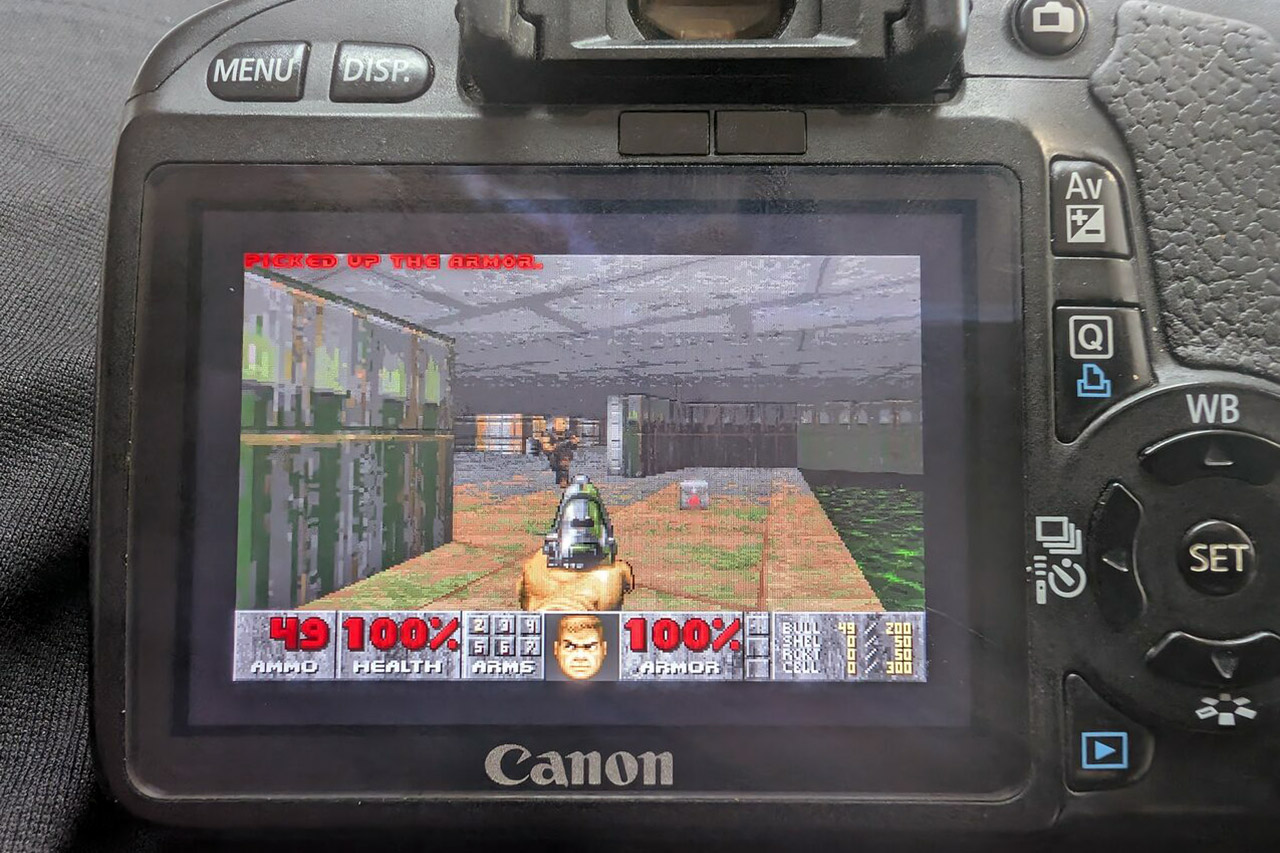
Canon owners who once pointed their EOS 550D at landscapes or family gatherings can now point it at the forces of Hell. A new software module lets the 2010 Rebel T2i (known as the Kiss X4 in some markets) run the original Doom, complete with movement, shooting, sound, and save files, all controlled by the camera’s own buttons and dials.
キャノンの一眼レフデジカメ『EOS Kiss X4』(EOS 550D)に、あの「Doom」が勝手移植!!
Bas Lichtjaar, using the alias lauris-nl, created the DOOM port as a Magic Lantern Module. Magic Lantern is a long-running open firmware add-on that allows users to unlock additional capabilities on specific Canon bodies. The Doom module simply happens to function on the 550D running firmware 1.0.9; it appears in the camera’s Games menu, and everything is fine. Users must supply their own IWAD files, such as DOOM, DOOM II, or Freedoom, and store them on the SD card. The game then begins to load directly on the camera.
DOOM 2099 COMICS-INSPIRED: Thrust into a strange alternate future seemingly devoid of the Fantastic Four, this Doctor Doom 2099 is inspired by the…
ASSEMBLE EARTH’S MIGHTIEST HEROES: Magic: The Gathering | Marvel Super Heroes has arrived in full force! Discover an exciting new way to experience…
PREMIUM DESIGN, DECO, & ARTICULATION: This officially licensed Hasbro Marvel Legends action figure set features comics-inspired design and deco. with…
The directional pad controls movement and aim. Pressing the zoom in button causes the player to run. Pressing zoom out while pressing left or right allows you to strafe. The SET button launches the weapon and confirms menu options. The PLAY button opens doors and triggers switches. The back control wheel allows you to cycle through your weaponry. DISP displays the automap or exits menus, whereas MENU brings you directly to the main choices screen. If you click the delete button three times quickly, you will be sent to a hidden menu where you can enable several old-school cheats as well as select your favorite music and level warp choices. The ISO, depth-of-field preview, and shutter controls are set to the sidelines to avoid interfering with the camera’s typical overlays.
The rear LCD displays at the proper 720 by 480 resolution. If you want a larger view, you can choose the alternative mode that scales the image into larger 2-by-2 pixel blocks. The audio comes from a homemade synthesizer that plays the original song and incorporates classic 8-bit sound effects. It outputs 48 kHz mono through the camera’s built-in speaker or headphone jack. You have distinct save slots for each WAD file, and the system saves all of your configuration settings so that when you turn it off and back on, your volume levels and preferences remain unchanged.
The performance is actually rather good, since it remains fluid enough for you to actually play. The audio engine is hardly used, thus there is plenty of processing power available for game logic. They appear to have eliminated the music dropouts that plagued previous editions. Changing WAD files still requires a camera restart, therefore the port is still limited to the 550D with the appropriate Magic Lantern build. Multiplayer, external mods, and DEHACKED fixes will all have to wait a bit longer.
The source code and modules are all available on Github under the name doom550d. Installation is the standard Magic Lantern procedure: copy the files to the card, load the module, then select your game from the menu. Anyone who has previously used Magic Lantern on a 550D can try it again after backing up their card.
The U.S. Cybersecurity and Infrastructure Security Agency (CISA) has confirmed that ransomware gangs are also exploiting a high-severity Windows Task Host vulnerability that was flagged as actively exploited in April.
Task Host is a core Windows system component that allows DLL-based processes to run in the background and prevents data corruption by ensuring they close properly during shutdown.
Tracked as CVE-2025-60710, this Windows privilege escalation security flaw was patched by Microsoft in November 2025 and stems from a link following weakness that affects Windows 11 and Windows Server 2025 devices.
Following successful exploitation, local attackers with basic user permissions can gain SYSTEM privileges and take full control of unpatched devices.
While it didn’t share any details regarding ongoing attacks and Microsoft has yet to update its security advisory to confirm in-the-wild exploitation, CISA added CVE-2025-60710 to its list of actively exploited vulnerabilities on April 13 and gave Federal Civilian Executive Branch (FCEB) agencies two weeks to secure their systems.
Advertisement
On Friday, CISA updated its Known Exploited Vulnerabilities Catalog (KEV) again, flagging the security vulnerability as being abused by ransomware gangs.
The U.S. cybersecurity agency has not yet shared any information about attacks targeting CVE-2025-60710, and a Microsoft spokesperson was not immediately available for comment when BleepingComputer reached out earlier today.
“This type of vulnerability is a frequent attack vector for malicious cyber actors and poses significant risks to the federal enterprise,” CISA warned. “Apply mitigations per vendor instructions, follow applicable BOD 22-01 guidance for cloud services, or discontinue use of the product if mitigations are unavailable.”
Microsoft has started testing a faster File Explorer and a less cluttered and more customizable context menu in Windows 11 preview builds rolling out to Insiders this week.
As the File Explorer team explained in a Monday blog post, the changes focus on improving File Explorer speed, performance, and reliability and addressing customer-reported issues.
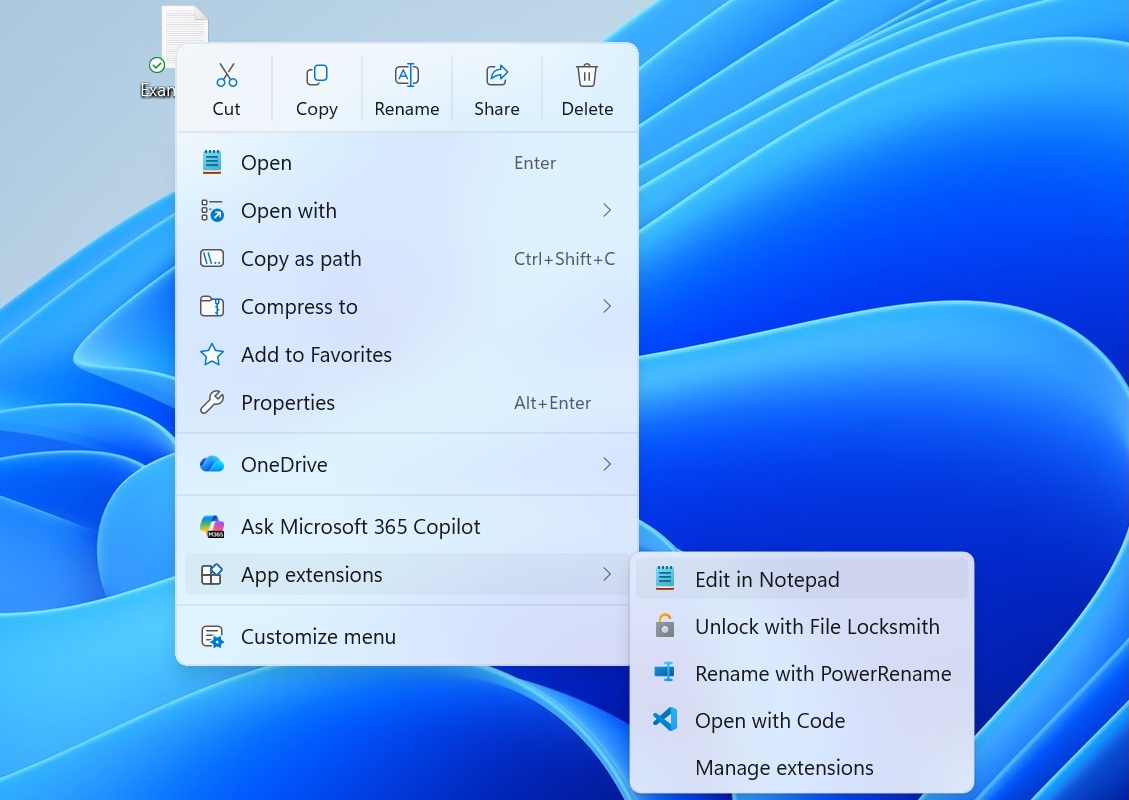
The redesigned context menu experience also aims to make it faster, reduce clutter, and make it more customizable than ever before.
At the bottom of the new right-click menu, Microsoft also added a “Customize menu” shortcut to the Settings page, where users can tweak the context menu to suit their preferences.
“We’ve continued refining File Explorer based on that feedback, removing friction and improving the details that help make everyday tasks feel more natural and predictable. For example, file renames no longer get interrupted by background file synchronization, and case-only filename changes now appear immediately,” Microsoft said.
Advertisement
“Today, we’re [also] excited to announce an updated context menu that delivers a faster, simpler, and more customizable experience. The new design reduces top-level clutter, keeps commonly used actions easy to access, and introduces a new Settings experience that gives you more control over what appears in the menu.”
New Windows 11 context menu (Microsoft)
These changes follow a broader effort to improve Windows Explorer speed and performance for Windows 11 users, with the most recent changes including another set of File Explorer improvements that rolled out in April.
However, that was optional, allowing users who wanted to disable preloading to uncheck “Enable window preloading for faster launch times” in File Explorer’s Folder Options under the View tab.
These File Explorer changes follow the May 2025 rollout of Startup Boost, a similar optional feature for Microsoft Office apps that launches a Windows scheduled task in the background during system logon to help launch Office apps faster.
Advertisement
On Monday, Microsoft also announced that it is removing the Windows Management Instrumentation Command-line (WMIC) tool, a known LOLBIN (living-off-the-land binary) abused by cybercriminals, starting with Windows 11 24H2 and 25H2, as well as the Windows 11 beta builds released this week.
Overall prevention scores can hide what happens after initial access. Once attackers are using valid credentials, prevention drops sharply.
The Blue Report 2026 measures defenses technique by technique across 338 million simulations run in customer production environments.
Earlier this month, Google announced multiple new devices at its Made by Google event, including Pixel 11 phones and the Pixel Watch 5. Back in May, the company also released its screenless Fitbit Air health tracker.
But we still haven’t heard anything about the new mystery product that’s appeared in recent Google ads.
A Reddit thread posted on Saturday revealed a Google Pixel ad on YouTube featuring the new Pixel 11 series, the Pixel Watch 5 and an unknown wearable that looks like a cross between the Fitbit Charge 6 and the Watch 5, standing out with its oblong screen with rounded edges in fog white. Sponsored by Google Australia, the ad’s caption reads: “The ultimate power trio for your wrist, ears and hands. Preorder Pixel devices now.”
Some speculate that the product may be the Fitbit Charge 7 or a rebranded Pixel Watch series. Or maybe it’s an entirely new fitness tracker?
Advertisement
A Google representative didn’t immediately respond to a request for comment.
That wasn’t the only Google Australia ad featuring the surprise device. The mystery wearable appears in another ad displaying the Pixel 11 phones, Watch 5, Pixel Buds Pro 2, Pixelsnap phone cases and Watch loop bands in the new olive green color.
Real or fake?
Some Reddit commenters wondered whether this mystery product was a mistake caused by an AI hallucination — an error caused by generative artificial intelligence.
But this also wouldn’t be the first time Google sneaked an unreleased product into its promotional content. Back in March, two months before its release, the Fitbit Air was spotted in a paid partnership video with NBA star Steph Curry, who is also a Google performance adviser.
Advertisement
It would seem that Google is releasing a new wearable, potentially as part of its Pixel line, in both fog and olive colors. If the time between these ad leaks and the device’s release follows the same pattern as the Fitbit Air’s appearance in Curry’s video, we should know more in the coming weeks.
Anna Gragert
Senior Editor, Health and Home
Anna Gragert (she/her/hers) was previously the lifestyle editor at HelloGiggles, the deputy editor at So Yummy and the senior lifestyle editor at Hunker. Over the past 12 years, Anna has also written for the LA Times, Elle, Bust Magazine, Dazed, Apartment Therapy, Well+Good and more. At CNET, she’s a senior editor on the Healthy Home team, and her coverage includes health, wellness tech, meal kits and home and kitchen tech with a focus on the technology that aims to help us live our healthiest, happiest lives.
See full bio
Block, the technology company founded by former Twitter CEO Jack Dorsey that owns Square, Cash App and the music streaming service Tidal, is open-sourcing Berd, a desktop application it originally built to give its own employees a single environment for working with AI agents across different models, tools and projects.
Berd is a locally installed graphical desktop application rather than a browser-based workspace. It is available now on GitHub under a permissive Apache 2.0 license — meaning anyone can use, modify and redistribute it, including commercially — with free downloadable builds for macOS, Windows and Linux. The repository reached version 0.6.2 on Aug. 18, its seventh public release, and lists 91 contributors.
“Berd is desktop-first because much of its value comes from working directly with projects, local files, tools, repositories, and agents running on or connected to the user’s computer,” Brad Axen, Head of AI Capabilities at Block, told VentureBeat in emailed responses.
A daily work surface for AI agents
Block positions Berd as a “daily AI work surface”: a single place where users can start chats, attach files or folders, choose agents and models, work inside persistent projects, configure AI providers, manage skills and extensions, review session history and build automations.
Advertisement
The design goal is not merely convenience. According to Berd’s product specification, users should always be able to tell which project, files, agent, model, provider and session state are actively shaping a conversation. That emphasis on visible operational state is what Block says separates Berd from a generic chatbot wrapper. Configuration — providers, extensions, skills, automations, projects — is treated as part of the workflow rather than buried in an administrative layer, and the interface is designed to expose failures, unavailable providers, and loading and streaming states plainly rather than smoothing them over with assistant-style friendliness.
Berd grew out of a practical problem inside Block. Employees were already working with capable agents — Block’s own Goose, Anthropic’s Claude Code and OpenAI’s Codex — but the experience around them had become fragmented.
“We had capable agents through goose, Claude Code, and Codex, but working across them meant navigating different interfaces, configuration systems, and ways of managing context,” Lucinda Bell, Technology Communications at Block, said in an email. Berd, she said, gives Block teams “one consistent desktop application across models and harnesses.”
For enterprises, that layer may matter as much as another incremental gain in model capability. Persistent projects mean users can return to an established collection of files, instructions and agent configurations instead of reconstructing context for each task. Block also explicitly designed Berd to make agentic work accessible beyond engineering, letting people start with a conversation and add tools, context and structure as the work requires.
Advertisement
Block is not positioning Berd as a mobile product. Axen said the company’s open source collaboration platform Buzz already provides a mobile experience and is Block’s preferred environment for work on the go.
Block thinks agents should look different when they are different
Berd takes an unusual approach to a problem most enterprise AI products leave implicit: how users tell one configured agent apart from another.
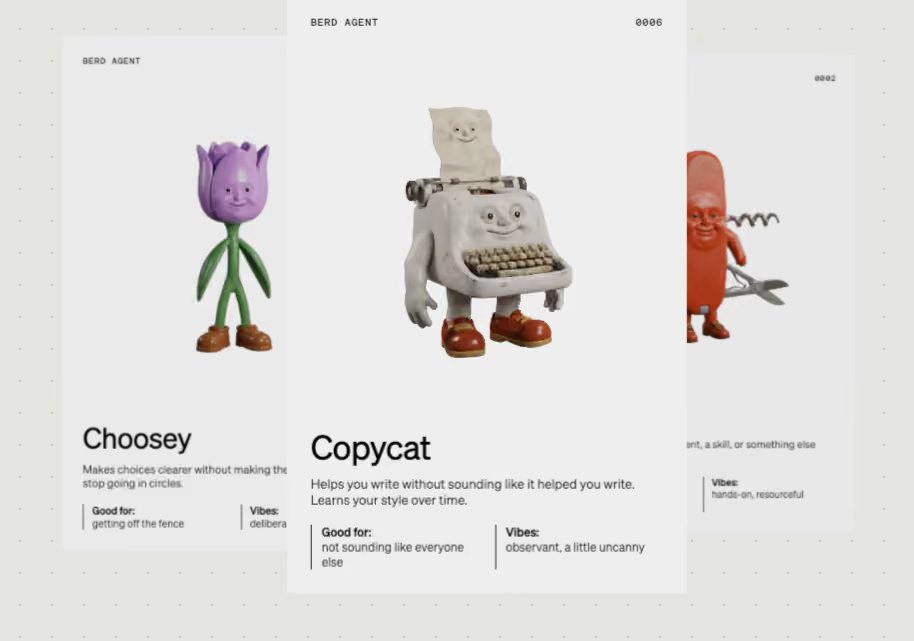
Instead of treating every agent as another blank chat window, Berd gives agents roles, instructions, skills, tools and recognizable visual identities. Block created collections of animated characters — its flagship designs are called “Gloopies” — and Berd’s public site showcases predefined personas such as Berdy, Pushback, Choosey, Copycat, Tinker and Wildcard, each built around a different style of work: Pushback plays devil’s advocate on drafts, Choosey helps narrow decisions, Copycat learns to write in the user’s style.
The visual layer is not meant to substitute personality for substance. Block’s own formulation, from a company blog post on Berd’s design, is functional: “The avatars make the agent recognizable. Its role, skills, and tools make it useful.”
Advertisement
Screenshot of Berd Gloopies. Credit: Block
That distinction could grow more important as workers juggle several specialized agents at once. A recognizable identity serves as visible shorthand for an otherwise invisible package of instructions, tools and permissions — agents appear on the workspace as distinct animated characters rather than identical entries in a chat list, so users can tell them apart before opening a conversation.
The product specification guards against the characters turning Berd into a novelty. It describes the intended personality as “focused, capable, companionable,” while explicitly rejecting toy-like presentation, oversized decorative UI and interfaces that hide operational state behind friendliness.
An orchestration layer, not another model or agent runtime
Architecturally, Berd is neither a new foundation model nor a new agent runtime. The application is built with Tauri 2 and React 19 — frameworks for building lightweight desktop apps with web technologies — and communicates with Goose, the open source agent framework Block introduced in January 2025, through a standard called the Agent Client Protocol (ACP). Goose runs quietly alongside Berd as a bundled “sidecar” process and handles the underlying agent loop; Berd handles projects, sessions, context, agents and configuration on top.
Advertisement
For readers unfamiliar with it, Goose is a model-agnostic agent framework and runtime, originally focused on software development workflows. It connects large language models to files, commands and outside systems — including through the Model Context Protocol (MCP), an open standard for wiring AI systems to external tools and data — so agents can take actions rather than merely generate text.
Goose works with proprietary model providers as well as locally run open models. Block has since contributed Goose to the Agentic AI Foundation, the Linux Foundation body it helped establish with Anthropic, OpenAI and others in December 2025, giving the framework a vendor-neutral home alongside MCP.
Axen drew the boundary explicitly: agent harnesses such as Goose, Claude Code and Codex manage the loop between a model, its context and its tools, while Berd provides the consistent desktop environment around those harnesses. In the public release, users configure whichever providers and harnesses they want rather than inheriting a Block-selected model stack.
The project’s README adds an operational detail that matters for anyone evaluating the software: Berd does not simply pull whatever Goose build happens to be current. Its build process pins a specific Goose backend version through a lockfile, verifies the cached binary matches that pinned version, and packages it with the app. Developers can explicitly substitute another Goose binary for local testing. For organizations inspecting Berd, that creates a defined version boundary between the desktop application and its default agent backend rather than letting the backend silently drift.
Advertisement
How Berd compares to Codex, Claude Code, Cursor and Goose
That separation matters because the agent-tooling market is already converging on products that manage increasingly autonomous AI workers. OpenAI describes its Codex app as a “command center” for agents, with separate project threads and multiple agents operating in parallel.
Claude Code, Anthropic’s agent for reading codebases, editing files and executing commands, now spans the terminal, IDEs and a desktop app. Cursor describes its latest release, Cursor 3, as a unified workspace for software development with agents, including handoffs between local and cloud agents and multi-repository workflows. And Goose itself remains available directly, as a free command-line tool and desktop app for technically comfortable users.
Berd’s differentiation is therefore less about inventing the agent workspace than about making that workspace open source, multi-harness and potentially useful outside coding. Every other product in the table below is either tied to a single vendor’s models, priced as a subscription, or aimed squarely at developers — and in most cases all three.
Product
Advertisement
Maker
Pricing
Model support
Distinguishing features
Advertisement
Berd
Block
Free and open source (Apache 2.0); users pay only their own model provider costs
Any provider the user configures, across multiple agent harnesses
Advertisement
Desktop workspace over agent harnesses rather than a harness itself; local-first data storage; visual agent identities; persistent projects; enterprise custom distributions; designed for non-engineers as well as developers
Codex app
OpenAI
Included with paid ChatGPT plans, from Plus at $20/month to Pro at $200/month
Advertisement
OpenAI models only
“Command center” for coding agents; multiple agents running in parallel across separate project threads; cloud and local execution
Claude Code
Anthropic
Advertisement
Included with paid Claude plans, from Pro at $20/month to Max at $100–$200/month; also usage-based via API
Anthropic Claude models only
Deep autonomous coding — reads codebases, edits files, runs commands; available in terminal, IDEs, desktop and web; usage caps have drawn developer criticism
Cursor
Advertisement
Anysphere
Pro at $20/month; Ultra at $200/month
Multiple frontier models
AI-native code editor; Cursor 3 adds a unified agent workspace with local-to-cloud agent handoffs and multi-repository workflows; developer-focused
Advertisement
Goose
Block / Agentic AI Foundation
Free and open source (Apache 2.0); bring your own model, including free local models
Any provider, or fully local models via tools like Ollama
Advertisement
The model-agnostic agent framework and runtime underneath Berd; CLI and desktop versions; can run entirely offline with no data leaving the machine
Portability is part of Block’s pitch. Axen said much of the underlying work in Berd is deliberately kept portable: folders, Git repositories, files and plain-text instructions remain accessible outside the application; skills are file-based; and Berd agents can be exported and shared between Berd users with their instructions and settings intact.
He pointed to ACP and MCP as part of Block’s direction toward “clear, user-owned formats and open protocols wherever possible.” That does not make every piece of state interchangeable across every harness, but it makes portability an explicit architectural goal rather than a side effect of using local files.
Local-first data, telemetry and enterprise distributions
Berd is designed around a local-first data model. Axen said conversation history is stored on the user’s device in the local Goose session database, while credentials live in the operating system keychain by default.
Advertisement
That does not mean all AI processing happens locally. “Local-first does not mean that no data ever leaves the device,” Axen said. When a user asks a configured model to work on particular context, the relevant prompt and material are sent to that model’s provider — so the actual data path, and the contractual terms governing it, depend on which provider an organization chooses.
Telemetry — the usage data software sends back to its maker — is disabled by default in official Berd distributions. If a user opts in, Block says it collects a random installation identifier and a limited set of predefined usage events, while excluding prompts, messages, files, source code, credentials, names, email addresses and IP addresses from the telemetry payload itself (Block and its service providers still process IP addresses for transmission, security and rate limiting). Users can switch telemetry off again in settings. Block cautions that third-party forks can modify or redirect the telemetry system, so enterprises evaluating a customized build need to review that build’s actual behavior rather than assume Block’s defaults carry over.
The public repository builds a self-contained, general-purpose distribution that does not depend on private package registries or enterprise credentials — technical teams can build and evaluate it without access to Block’s infrastructure. But Block has also created what it calls “distribution seams”: defined points where organizations can overlay managed provider settings, private agents, runtime configuration, optional companion tools, their own update channels and their own signing and publishing infrastructure, all without adding private material to the public source tree.
Block’s own deployment shows how an enterprise can put governance around that architecture. Axen said Block runs its managed distribution on approved devices using approved model-provider infrastructure, managed configuration and governed tool connections. “The application can remain open and inspectable, while an organization decides which models, tools, permissions, and policies are appropriate for its environment,” he said.
Advertisement
One caveat: “enterprise distribution” should not be read as a complete enterprise management plane. The README does not describe capabilities such as single sign-on, centrally enforced administrator policies, organization-wide permission controls, data-retention rules or audit logs. It establishes that companies can customize and distribute Berd; it does not by itself explain how those installations are centrally governed after deployment. Berd should be understood as endpoint software installed on users’ computers, not a centrally hosted SaaS product.
Pricing, models and a closed contribution model
Block has not announced a subscription price for Berd, and there is no indication one is coming. That does not make agent usage costless: organizations still pay whatever model, API or provider charges they incur. The economic pitch on Berd’s site is flexibility — users can match the model to the job rather than paying for an expensive frontier model on every task. As the site puts it: “Some tasks need the big brain. Most don’t.”
Neither Block’s announcement nor the README provides a definitive matrix of supported model providers or recommends particular models. Internally, Block does not treat any one model as a permanent default: Axen said the company’s managed distribution exposes employees to “a curated mix of frontier and open-weight models,” with the catalog changing as models improve. “The best choice depends on the work,” he said.
There is also a governance distinction developers should note. Although Berd’s source is public and Block solicits issues and feedback, the repository does not accept outside pull requests — external code contributions are automatically closed.
Advertisement
The README says Berd is built by “a small team at Block” and directs outside participants toward well-formed, reproducible bug reports instead. Users are free to inspect, build and fork the code, but Block retains a tightly controlled upstream. For companies considering Berd as infrastructure rather than an experiment, that makes Block’s long-term maintenance and support plans worth clarifying.
Block is not presenting Berd as a revenue product today. Axen said the first return on investment comes from Block’s own use of the software — making internal agent work more consistent while teaching the company how employees actually use agents — and that open-sourcing it adds leverage by letting outsiders inspect, adapt and give feedback on the architecture. A commercial layer around enterprise deployment may eventually follow.
“Supporting organizations that want to deploy agents at work is an area of interest for us,” Axen said, adding that Block will share more when there is more to share.
From private agent work to multiplayer workflows
Berd supplies the individual desktop experience; another Block project, Buzz, focuses on shared rooms where people and agents collaborate against a common, searchable record.
Advertisement
Buzz is Block’s free, Apache 2.0-licensed collaboration workspace for humans and AI agents. Built on the decentralized Nostr protocol, it combines familiar team features — channels, threads, direct messages, voice and media sharing — with agents that hold their own cryptographic identities and defined permissions, and that can participate in conversations, code review and approved automated workflows. Unlike Berd’s local, single-user focus, Buzz is explicitly multiplayer, and can be self-hosted or used through Block-hosted infrastructure. It is likewise model- and harness-agnostic: teams can bring agents powered by Goose, Claude Code, Codex or others.
Axen framed the split between the two products partly as a question of trust boundaries. “A local agent may have access to your filesystem and credentials,” he said. “An agent in a shared Buzz room has its own identity and access scoped through the relay.” Berd begins with one person and comparatively privileged access to that person’s machine; Buzz begins with multiple participants, explicit identities and shared-workspace permissions.
The more consequential roadmap detail is that Block does not intend the two products to remain separate. “Going forward, our focus is Buzz, and we plan to bring the best parts of Berd’s single-player experience into it,” Axen said. Block wants work to begin privately and become collaborative without users switching tools or rebuilding context, with cross-device continuity — including mobile via Buzz — part of that ambition. In the meantime, Axen said, Berd remains available as an open source desktop application, but Buzz is the product Block encourages people to download and adapt.
What enterprise adopters should take away
The short version for IT and security teams: conversation history stays local by default; credentials use the operating system keychain; context sent to a model leaves the machine on whatever terms the configured provider offers; official telemetry is off by default and excludes prompts, files and source code; and organizations can package their own governed distribution — though central management tooling is not yet documented.
Advertisement
The larger idea behind the release may matter more. Models and coding agents are becoming increasingly interchangeable components inside larger workflows. Berd is Block’s bet that the surrounding context — the projects, skills, tools, identities and persistent working environment — becomes the stable layer instead.
An anonymous reader quotes a report from The Guardian: The release of a new album by Taylor Swift might be a cause for celebration among her fans, but such events have also been linked to a more sombre phenomenon: an increase in fatal car crashes. The team behind a new study say it sheds light on the impact of distracted driving. Writing in the journal Jama Network Open, [Vishal Patel, first author of the study based at Harvard Medical School] and colleagues report how they focused on the release of 10 major albums, launched between 2017 and 2022, selected for having the highest number of Spotify streams over a single day. […] The team found streaming volume for the top 200 songs in the US was 43% higher on the date of major album releases compared with the days surrounding the releases — although such data does not reveal whether the music was being streamed in a car.
[…] The researchers used data from a population-based registry of fatal US motor vehicle crashes to look at the number of traffic fatalities on the dates these albums were released, as well as for the 10 days either side. After taking into account the day of the week upon which the album was released, as well as federal holidays, and time of year, the researchers found the number of US traffic fatalities showed a relative increase of 15.1% on the date of major album releases, compared with similar days either side. “This is equivalent to approximately 182 fatalities in the US attributable to the release days of the 10 included albums,” the team writes.
Patel said the release of a new album could distract drivers because accessing music is a search task, not a single button press. “You unlock the phone, open the app, find the release, read down a tracklist, tap the right song. That’s several seconds of looking at a screen,” he said, adding unfamiliar music also demands more attention, while research has suggested listening to new, high-energy music measurably degrades driving performance. The researchers add the rise in traffic fatalities was greater among certain groups — such as younger drivers, male drivers, people who were driving alone, and people driving cars with a built-in infotainment platform. The authors say the results suggest that “online music streaming through smartphones may significantly contribute to distracted driving and traffic fatalities.”




























































You must be logged in to post a comment Login