Connect with us
DAPA Banner

Tech

Today’s NYT Connections: Sports Edition Hints, Answers for March 28 #551

Published

on

Looking for the most recent regular Connections answers? Click here for today’s Connections hints, as well as our daily answers and hints for The New York Times Mini Crossword, Wordle and Strands puzzles.


Michiganders, today’s Connections: Sports Edition is calling your name. Players will also notice a certain primary color showing up a lot. If you’re struggling with today’s puzzle but still want to solve it, read on for hints and the answers.

Connections: Sports Edition is published by The Athletic, the subscription-based sports journalism site owned by The Times. It doesn’t appear in the NYT Games app, but it does in The Athletic’s own app. Or you can play it for free online.

Advertisement

Read more: NYT Connections: Sports Edition Puzzle Comes Out of Beta

Hints for today’s Connections: Sports Edition groups

Here are four hints for the groupings in today’s Connections: Sports Edition puzzle, ranked from the easiest yellow group to the tough (and sometimes bizarre) purple group.

Yellow group hint: The Great Lakes State.

Advertisement

Green group hint: What happens when you’re at the plate.

Blue group hint: Not yellow or blue.

Purple group hint: Hallmark makes these.

Answers for today’s Connections: Sports Edition groups

Yellow group: Michigan teams.

Advertisement

Green group: Outcomes in an at-bat.

Blue group: “Red” teams.

Purple group: ____ card.

Read more: Wordle Cheat Sheet: Here Are the Most Popular Letters Used in English Words

Advertisement

What are today’s Connections: Sports Edition answers?

completed NYT Connections: Sports Edition puzzle for March 28, 2026

The completed NYT Connections: Sports Edition puzzle for March 28, 2026.

NYT/Screenshot by CNET

The yellow words in today’s Connections

The theme is Michigan teams. The four answers are Lions, Pistons, Spartans and Tigers.

The green words in today’s Connections

The theme is outcomes in an at-bat. The four answers are fielder’s choice, hit, strikeout and walk.

Advertisement

The blue words in today’s Connections

The theme is “red” teams. The four answers are Red Bulls, Red Sox, Red Storm and Red Wings.

The purple words in today’s Connections

The theme is ____ card. The four answers are baseball, lineup, red and wild.

Source link

Advertisement
Continue Reading
Click to comment

You must be logged in to post a comment Login

Leave a Reply

Tech

MOM releases list of entry-level vacancies paying up to S$10,000

Published

on

Disclaimer: Unless otherwise stated, any opinions expressed below belong solely to the author.

Since last year, Singapore’s Ministry of Manpower has been trying to help fresh graduates in their job search by periodically publishing a list of entry-level vacancies available in the country, and what the expected pay brackets are for each job.

While this list lags the market by about three months, with Dec figures only published in Mar, it still serves as a good indicator of where the openings appear, what jobs are worth looking at and how much they pay—both at the bottom and top end.

This data is collected from companies employing at least 25 people—so not micro businesses—and the figures are rounded up to the nearest 10.

Advertisement

Here are the latest findings:

List of entry-level PMET job opportunities for fresh graduates (Dec 2025)

Industry Job Title Vacancies Median Min. Salary ($) Median Max Salary ($)
Transportation & Storage Computer engineer 20 S$5,000 S$10,000
Arts, Entertainment & Recreation Sports coach 10 S$4,250 S$8,250
Financial & Insurance Services Financial/Investment adviser 70 S$5,000 S$8,000
Financial & Insurance Services Operations officer 30 S$4,000 S$8,000
Public Admin & Education Research and development manager 190 S$4,500 S$7,000
Public Admin & Education Secondary school teacher 40 S$4,000 S$7,000
Information & Communications Software developer 240 S$4,500 S$6,550
Manufacturing Process engineer 70 S$4,000 S$6,000
Manufacturing Mechanical engineer 60 S$3,800 S$6,000
Wholesale Trade Sales manager 30 S$3,800 S$6,000
Financial & Insurance Services Financial compliance officer/Risk analyst 50 S$4,000 S$6,000
Public Admin & Education Research officer 220 S$4,000 S$6,000
Arts, Entertainment & Recreation Film, stage and related directors and producers 10 S$4,200 S$6,000
Professional Services Resident technical officer 70 S$4,800 S$5,800
Construction Building construction engineer 280 S$3,500 S$5,500
Information & Communications Systems designer/analyst 110 S$4,000 S$5,500
Real Estate Services Premises and facilities maintenance manager 50 S$4,000 S$5,200
Construction Quantity surveyor 340 S$3,500 S$5,000
Construction Civil/Structural engineering draughtsman 140 S$3,500 S$5,000
Professional Services Auditor 80 S$4,000 S$5,000
Health & Social Services Registered nurse and other nursing professionals 200 S$3,000 S$5,000
Manufacturing Quality control/assurance engineer 70 S$3,500 S$4,800
Wholesale Trade Electrical engineer 10 S$3,500 S$4,800
Transportation & Storage Assistant mechanical engineer 10 S$2,400 S$4,800
Accommodation Sales manager 30 S$4,000 S$4,800
Retail Trade Retail manager 30 S$3,500 S$4,550
Transportation & Storage Logistics/production planner 40 S$3,000 S$4,500
Real Estate Services Quantity surveyor 20 S$3,500 S$4,500
Administrative & Support Services Management executive 60 S$2,800 S$4,500
Administrative & Support Services After sales adviser/Client account service executive 40 S$3,500 S$4,500
Health & Social Services Social worker 180 S$3,820 S$4,500
Health & Social Services Pre-primary education teacher 120 S$3,000 S$4,500
Food & Beverage Services Food and beverage operations manager 40 S$3,150 S$4,350
Food & Beverage Services Retail manager 10 S$3,100 S$4,150
Accommodation Hotel operations/Lodging services manager 30 S$3,500 S$4,100
Accommodation Customer service manager 10 S$3,450 S$4,000
Real Estate Services Premises and facilities maintenance officer 90 S$3,100 S$4,000
Information & Communications IT support technician 120 S$2,800 S$3,800
Administrative & Support Services Business development executive 30 S$2,900 S$3,800
Arts, Entertainment & Recreation Exhibition/Conference/Event planner 10 S$3,200 S$3,800
Food & Beverage Services Management executive 60 S$2,800 S$3,700
Wholesale Trade IT support technician 20 S$2,800 S$3,500
Retail Trade Merchandising/Category executive 30 S$2,800 S$3,500
Retail Trade IT support technician 20 S$2,800 S$3,300
Professional Services IT support technician 80 S$2,600 S$3,200

Right off the bat, you can see a surprising entry at the very top of the list—a computer engineer—not in the IT industry but in Transportation & Storage.

This could be a good tip, since most computer science graduates may be looking for a job in tech when there might be a more attractive position available in a different sector.

In second place, we have another unexpected profession: a sports coach. Unfortunately, MOM doesn’t say specifically what kind of “sport” we’re talking about here and what the expectations are, but it is still quite informative that fresh entrants could see offers paying over S$8,000 per month.

Advertisement

Further down the list, we have more predictable vacancies in Finance, but, as it turns out, S$7,000 could be earned in Public Administration jobs under Research & Development and as a Secondary School Teacher.

Then, at the very bottom, we have IT support technicians in non-tech industries and other support roles.

When it comes to the quantity of openings, by far the most are still in construction, with a few hundred Quantity Surveyors and Construction Engineers needed. There are also shortages in Nursing, Teaching, Social Work, and, despite murmurs of a crisis, Software Development.

Youth unemployment in Singapore among the lowest in the world

The vacancy list coincided with the release of a MOM report dedicated to the employment situation of Singapore youths (that is, people aged 15 to 24). While most in this age bracket still pursue education, the ones who have already completed it and joined the labour force have mostly found employment.

Advertisement

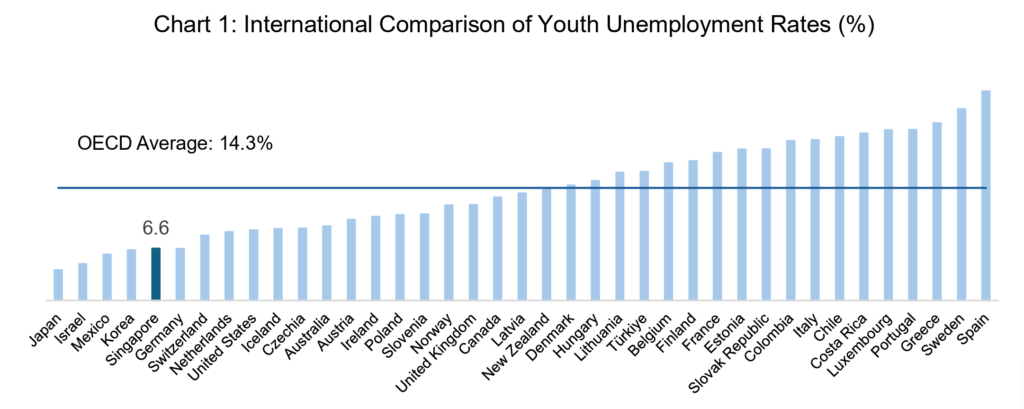
While the unemployment rate among them is 6.6%—so, a bit more than twice the 3.0% for the entire country—it is considerably below the 14.3% average reported by OECD, and would place Singapore among the best performing countries:

Source: Youths in the Labour Market 2025/ Singapore Ministry of Manpower

This figure has largely stayed at the same level over the years, with the exception of the pandemic period:

Source: Youths in the Labour Market 2025 / Singapore Ministry of Manpower

What’s more, Singapore also does very well in long-term unemployment statistics, as only 1.1% of local youths looking for work are out of a job for six months or longer.

Source: Youths in the Labour Market 2025 / Singapore Ministry of Manpower

The labour market may be becoming more competitive as companies invest in AI and offload unnecessary workers, but compared to other developed economies, Singapore still seems to be doing very well.

  • Read other articles we’ve written on Singapore’s current affairs here.

Featured Image Credit: kandal stock/ Shutterstock.com

Source link

Advertisement
Continue Reading

Tech

10 Things You Can Do While Waiting in the TSA Line

Published

on

For more than 40 days and 40 nights, the US Congress failed to come to a deal that would restart paychecks for many Department of Homeland Security employees. The evidence is all over the country’s airports, in the form of hours-long waits to go through security.

Workers with the Transportation Security Administration have been forced to call out as they struggle to pay for gas, rent, childcare, and groceries, according to officials from the American Federation of Government Employees, which represents some 47,000 TSA agents. Nearly 12 percent of agents called out on Thursday, compared to a usual average of 4 percent.

On Friday, President Donald Trump signed an executive order directing DHS to pay TSA workers; the department said employees could see paychecks “as early as Monday,” though union representatives said it could take longer than a week for agents to receive back pay. (Congress still hasn’t voted to fund the department and fully reopen the government.) But it’s unclear whether airports can avert disaster over the upcoming spring holiday weekend. Record-setting long lines still snake around some of the nation’s largest airports.

So if you’re flying, show up early and be prepared to wait. Emphasis on “prepare.” WIRED’s got some especially WIRED-y ideas to pass the time.

Advertisement

Consider TSA PreCheck

Image may contain Airport and Terminal

Photograph: The Washington Post/Getty Images

Think of a line as a sort of ritual liminal space, a threshold specially made for contemplation. Ponder, perhaps, your mistakes. Top of the list: Not signing up for TSA PreCheck. If you’re already in line, it’s too late right now, but it need not always be so. Those who can swing the $80 fee—good for five years—get expedited boarding, and therefore the right to stand in the security lines that seem to be moving the quickest right now. The online sign-up process takes just a few minutes. What a great way to kill some time!

Applicants then have to sign up for (or walk into) 10-minute in-person document check meetings at local Enrollment Centers, which are located everywhere from airports to local Office Depot and Staples locations. After that, actual enrollment can take anywhere from three to 60 days, the TSA says.

Read WIRED

You’re here already! Nose around. Check out our latest magazine package, The War Machine, which examines how technology has changed how the world fights and then tries to recover. Or head to the Gear homepage to read about the latest in gadgets and gadget trends. If you’re feeling more nostalgic, check out this list of some of WIRED’s best stories from the past 30 years.

Breathe Easy

Just because you’re nice and calm right now doesn’t mean that everyone around you is acting the same way. Escape with some deep breathing, your headphones, and, perhaps, a meditation app. Some options are right here.

Advertisement

While You’ve Got Those Headphones Out

Turn on a podcast! WIRED just updated its list of top ones. Best tech- and science-related recommendations include Flesh and Code, about the dark side of AI love; Your Undivided Attention, a pod hosted by tech-industry veterans about the downsides to living online and how we might make it better; and Ologies, which delights in taking listeners down various scientific rabbit holes. Oh, and Uncanny Valley, WIRED’s insider look at the people, power, and influence of Silicon Valley.

Organize Your Photos

Is your photos folder a hellscape? Us, too. What a great time to tackle the task of deleting what no longer serves you. Going through pictures one-by-one is always an option, but WIRED has also tested—and liked!—two apps to help phone users declutter. Rodeo organizes screenshots by location, and helps you organize reminders and lists to share with friends and family. Swipewipe is the Tinder for photos: Just swipe left to remove images from your phone forever ever.

Finally Figure Out How to Solve a Rubik’s Cube

Image may contain Toy and Rubix Cube

Photograph: Getty Images

This one requires some forethought, but a Rubik’s Cube might be the perfect line-waiting companion. No flailing limbs, loud noises, or even screens. It’s just you, your fingers, and sheer geometric logic. Here’s our step-by-step guide.

Belatedly Hear the Gospel of Horizon Worlds (on Mobile!)

Meta’s Horizon Worlds is going through some weirdness, as the tech giant shifts away from its (titular) metaverse and VR bets to focus on AI. After announcing Horizon Worlds would be sunset in virtual reality, Meta reversed course just a day later. Whatever: It’s definitely around on mobile! Visit a comedy club! Make some friends! Avoid the children (unless you yourself are a child)!

Advertisement

Ski (Digitally)

There are plenty of mobile gaming options. WIRED senior writer Jeremy White especially loves Grand Mountain Adventure and Grand Mountain Adventure 2 (Android, iOS), open-world skiing and snowboarding games that take you to the most beautiful mountains and ski resorts to cliff hop, slalom, or even cruise the backcountry. We have more mobile game recs here.

Ponder the Line

Image may contain Airport Terminal Silhouette Adult Person Clothing Footwear Shoe Sitting Pants and Aircraft

Photograph: Vital Pictures/Getty Images

If you’d rather spend your time contemplating the world in front of you, there has perhaps never been a better time to learn about the theory behind perfect queues. There’s a whole cottage industry of crowd-science consultants and scientists working out the math and psychology behind the most efficient way to get a bunch of people from here to there. Learn about them here, then consider how your own airport could be doing this better.

Disavow Airport Theory

Last year, TikTokers fell for “airport theory,” the idea that life could be better (?) and more relaxing (??) if flyers arrived at the airport as late as possible, rolling right through security to the boarding line. This gives us angina, and—look around!—feels like an especially bad idea right now. Here are other airport hacks to consider on your next trip, hopefully after Congress has decided to pay federal employees for their work.

Source link

Advertisement
Continue Reading

Tech

Verizon waives late fees for federal workers affected by partial DHS shutdown

Published

on

Verizon will waive late fees and offer flexible payment arrangements for workers affected by the partial government shutdown. The carrier has made similar offers in the past, like during the COVID-19 pandemic when it gave customers extra mobile data at no additional cost.

The Department of Homeland Security has been hit the hardest by the partial shutdown, but Verizon’s offer covers any federal worker who’s able to offer employment verification. Verizon says employees can call 1-800-Verizon (1-800-922-0204) to get their late fees waived and set up a payment plan.

The partial government shutdown started in February after Congress failed to pass a new DHS funding bill. The lack of funding has not affected all of DHS’ sprawling organizations equally, however. While the Transportation Security Administration is no longer able to pay its employees — leading to significant delays in airport security lines over the last week — both Immigration and Customs Enforcement and Customs and Border Protection have been spared thanks to a separate funding pool established by a previous bill.

Lawmakers continued inability to fund DHS also happens to hinge on both agencies. Democratic senators and congresspeople are demanding ICE agents wear body cams and remove masks before making arrests, among other restrictions, and refusing to fund DHS until those restrictions are worked into the bill. Both Republicans and Democrats have also separately proposed funding the entire department except for ICE and CBP, but while that bill passed in the Senate, it hasn’t been taken up in the House.

Advertisement

Source link

Continue Reading

Tech

Plans for new Irish supercomputer CASPIR moves to next stage

Published

on

CASPIR is expected to significantly enhance Ireland’s high-performance computing capacity.

Ireland is getting a new supercomputer called Computational Analysis and Simulation Platform for Ireland (CASPIR).

The computer is currently being procured by the University of Galway and the European High-Performance Computing (EuroHPC) joint undertaking (JU), and will be managed by the Irish Centre for High-End Computing (ICHEC). A hosting agreement for the supercomputer was signed last October.

Once operational, the CASPIR supercomputer is expected to significantly enhance national high-performance computing capacity and benefit the country’s research and innovation ecosystem.

Advertisement

Commenting on the procurement, Minister for Further and Higher Education, Research, Innovation and Science James Lawless, TD said: “Ireland’s new supercomputer will provide the technological means for researchers and innovators to tackle key scientific and societal challenges in areas including health, environment and climate, artificial intelligence, materials science and transport.

“Procuring a supercomputer will be a landmark moment for research and innovation in our country.”

The EuroHPC JU is a funding entity which enables EU countries, European countries associated with the Horizon Europe programme, as well as private organisations to coordinate efforts and pool resources to build a supercomputing ecosystem.

Established in 2018, EuroHPC JU promotes the development of high-performance computing, quantum and AI innovation in involved countries. Ireland is a founding member of the funding entity.

Advertisement

The Government announced last year it received European funding for a €10m AI Factory Antenna. The Antenna will be implemented by ICHEC, CeADAR – Ireland’s centre for AI – alongside enterprise accelerators, including PorterShed, Dogpatch Labs, RDI Hub and Republic of Works, as well as digital skills networks, including Innovation Technology AtlanTec Gateway and Digital Technology Skills.

Meanwhile, CloudCIX’s Cork data centre launched the ‘Boole supercomputer’ in late January this year. The Cork-based supercomputer, a joint venture between CloudCIX and AlloComp, is reportedly one of Europe’s first liquid-cooled Nvidia B200 GPU deployments in Europe – and the first in Ireland.

Months earlier, University College Dublin (UCD) announced that it was procuring a new nearly €724,000 Nvidia supercomputer expected to perform 50-times faster than UCD’s existing high-performance compute cluster.

Don’t miss out on the knowledge you need to succeed. Sign up for the Daily Brief, Silicon Republic’s digest of need-to-know sci-tech news.

Advertisement

Source link

Continue Reading

Tech

What is USB-C? The USB technology explained

Published

on

If you own any modern gadget, be it a smartphone, laptop, headphones or even a game controller, there’s a good chance that it will sport a USB-C port.

USB-C is quickly becoming the universal port of choice in the technology world, both for power delivery and data transfer. This universal adoption means you won’t need to worry about stocking multiple cable types, being able to use a single charger for multiple devices, which is not only more sustainable but also more convenient.

The initial universal adoption of USB-C was a slow process, especially as Apple took its time to ditch the iPhone Lightning port for USB-C, only doing so back in 2023 with the iPhone 15 series.

But what exactly is USB-C, and how does it compare to alternative connection types such as USB-A, HDMI and Lightning? Why was Apple under pressure to adopt the port in the first place? We’ve created this guide to explain everything you need to know about USB-C.

Advertisement

What is USB-C?

USB-C is an industry-standard connector that can charge a device as well as transmit data, making it one of the most convenient and versatile port options currently available.

Advertisement

One of the most appealing aspects about USB-C is that it offers multiple functions beyond charging up the battery. For example, the Nintendo Switch and the Nintendo Switch 2 use USB-C to output their display to an external TV, while USB-C can also be used to transfer data (such as documents, photos and videos) between devices.

iPad Pro USB CiPad Pro USB C
The iPad Pro packs a useful USB-C port

Its popularity and benefits have also seen it accepted by PC manufacturers since it can transfer data at high speeds, which we’ll go into more detail with later. This is useful for transferring large video files and the like. However, because USB-C currently has restrictions on how much power can be transferred through it, the port connection is generally not used for power delivery on high-end systems like gaming laptops.

How fast is USB-C?

It’s important to note that not all USB-C connections are the same. This means the power delivery and data transfer speeds will differ between devices, depending on which iteration of USB-C is being used.

Advertisement

It’s best to think of USB-C as the physical connector, while the likes of USB 2.0, USB 3.1, USB 3.2, USB4, USB4 v2, Thunderbolt 3, Thunderbolt 4 and Thunderbolt 5 will determine the level of performance instead.

Thunderbolt 5 is currently the most powerful version of USB-C, allowing up to 120Gbps speeds for data transmission, as well as up to 240W charging.

Advertisement

Although it’s been available for some, time Thunderbolt 5 still seems reserved for more premium devices, such as the MacBook Pro M5 Pro or M5 Max. Instead, many more devices offer Thunderbolt 4 support instead. Just make sure to check the performance speeds of the USB-C connector for each individual device.

Advertisement

If you’re not sure how the Gbps speed metric relates to real-world performance, Belkin claims that 10Gb/s translates to transferring a high definition feature-length film over to another device in just 30 seconds when working at peak performance.

Wallpaper of a Thunderbolt 3 USB-C cableWallpaper of a Thunderbolt 3 USB-C cable

Looking at the charging front, USB-C can go up to 240 watts. For comparison, Apple’s Lightning charger capped out at just 30W.

So while it is convenient to use the same charger between your tablet, laptop and phone, it’s also the more powerful option, which should result in less time waiting around waiting for your phone’s battery to be fully replenished.

Is USB-C the same as Thunderbolt?

USB-C and Thunderbolt are not the same thing, and so shouldn’t be mixed up.

Advertisement

Advertisement

USB-C is just the name of the physical oval-shaped port. This means that all Thunderbolt technology uses the USB-C connector, but this isn’t true vice versa as there are other compatible connectivity standards such as USB 3.2 Gen 1 etc.

Thunderbolt has its own features and max speeds, with new iterations intermittently released as the technology improves.

Thunderbolt 5 is the latest iteration, supporting up to 120Gb/s, making data transfer even faster. Thunderbolt can also move as much as 240W of power over an interface, which further adds to its impressive speed and overall benefits.

iMac 24-inch braided USB-C to Lightning cableiMac 24-inch braided USB-C to Lightning cable
Lightning to USB-C cable

Thunderbolt can be used to transfer large data or media files (such as 4K video) over to a computer or PC without long waiting times.

It can be seen as the supercharger version of a USB-C connector, with Intel deciding to stick to the universal connector to ensure cables are backwards compatible and can work with a large range of devices.

Advertisement

Advertisement

What’s the difference between USB and USB-C?

We’ll start by explaining what USB actually is. Short for Universal Serial Bus, USB is a technology that’s used to connect computers to external devices such as printers, keyboards or controllers. USB is also used for charging devices via an adaptor or power bank, and transferring files from one device to another.

Most computers and peripherals will sport some kind of USB port, whether that’s USB-A, USB-B (usually reserved for printers and scanners) or a USB-C connection.

With the above in mind, the “difference” between USB and USB-C is just that the latter is a type of the former. Both are designed to connect two devices together, but USB is the umbrella term for the different types of ports, such as USB-C for example. 

Advertisement

Does the iPhone use USB-C?

Since the launch of the iPhone 15 back in September 2023, all iPhones have sported a USB-C port in lieu of the rather dated Lightning alternative. Apple was seemingly reluctant to move ahead with this change, however an EU court ruling essentially forced the brand, alongside other smartphone manufacturers, to opt for the USB-C port as standard.

It’s a welcome move too, as it means regardless of whether you’re an iOS or Android user, you’ll be able to use the same cables.

Advertisement

iPhone 15 Pro Max back and USB-CiPhone 15 Pro Max back and USB-C
USB-C port plugged into iPhone 15 Pro Max. Image Credit (Trusted Reviews)

How can I tell if my USB cable is A or C?

The easiest way to determine whether you have a USB-A or USB-C port is simply by looking at the shape. USB-A has a rectangular shape that can only plug into a port one way, whereas USB-C is more of an oval and can be plugged in either way round. While some devices do still sport USB-As, USB-C is undoubtedly more of an industry standard now.

Even so, if you have an older computer or other device with USB-A ports, it is still possible to connect your USB-C device, with the help of an external adapter.

Advertisement

Source link

Continue Reading

Tech

Google sets 2029 deadline for quantum-safe encryption, years ahead of government targets

Published

on


The announcement came this week in a blog post detailing Google’s migration plan to post-quantum cryptography, a new generation of algorithms designed to withstand attacks from quantum computers.
Read Entire Article
Source link

Continue Reading

Tech

Why the Apple Watch SE 3 is the Everyday Smartwatch That Finally Gets It Right

Published

on

Apple Watch SE 3 Smartwatch 2026
Conversations about smartwatches recently took an unexpected turn. People who already own one, as well as those who are new to the scene, generally agree that the Apple Watch SE 3,priced at $219 (was $249), is a reliable model that does not break the bank or overcomplicate matters.


The S10 chip featured in higher-end watches easily performs all of the regular duties including as apps, notifications, and voice commands, ensuring rapid replies whether you’re reading your messages or starting a workout. Because processing occurs directly on the watch, you can still use Siri to get answers to quick questions like the weather or your reminders while offline, and gestures like double tapping or a flick of the wrist allow you to answer calls or scroll through apps with one hand free as needed.

Sale


Apple Watch SE 3 [GPS 40mm] Smartwatch with Midnight Aluminum Case with Midnight Sport Band – S/M…
  • HEALTH ESSENTIALS — Temperature sensing enables richer insights in the Vitals app* and retrospective ovulation estimates.* You’ll also get a daily…
  • GREAT BATTERY LIFE — Enjoy all-day, 18-hour battery life. Then charge up to twice as fast as SE 2* and get up to 8 hours of battery in just…
  • ALWAYS-ON DISPLAY — Now you can read the time and see the watch face without raising your wrist to wake the display.

Glances become completely effortless with this device because the display remains active while dimming its brightness just enough to save battery. You can quickly check the time, weather, and what’s on your calendar without having to raise your wrist every five seconds, which is a huge advantage during meetings or lengthy hikes. The display itself is no slouch, as it can remain bright enough to see clearly outside, and the glass is far more scratch resistant than previous entry-level models.

Advertisement


The health monitoring runs quietly in the background without demanding your attention. Heart rate is tracked continuously with alerts for anything unusual, sleep tracking now delivers nightly scores with breathing pause detection, and wrist temperature data helps with cycle estimation over time. A daily vitals summary pulls all of your trends together in one place so you are never hunting through multiple screens for answers. Everything surfaces when it is relevant and stays out of the way when it is not.

Fitness tracking is equally straightforward. Built in GPS logs runs and bike rides accurately, activity rings update in real time so you always know where you stand against your daily goals, and swim tracking holds up well in the pool. Workout suggestions are tailored to your history, making the SE 3 a genuinely practical companion for anyone looking to move more or build a consistent routine without wading through complicated menus or investing in dedicated gear.


Battery life just plain holds up through a typical day of use – with notifications, workouts, and the occasional call. You can top off the charge in about 15 minutes and get a few hours of life out of it. And when you need to really stretch it out, theres low power mode to fall back on – but more often than not you’ll still have plenty left over when the day winds down, so you dont have to worry about it running out mid-afternoon.

Advertisement

Source link

Continue Reading

Tech

AI Research Is Getting Harder to Separate From Geopolitics

Published

on

The world’s top AI research conference, the Conference on Neural Information Processing Systems—better known as NeurIPS—became the latest organization this week to become embroiled in a growing clash between geopolitics and global scientific collaboration. The conference’s organizers announced and then quickly reversed controversial new restrictions for international participants after Chinese AI researchers threatened to boycott the event.

“This is a potential watershed moment,” says Paul Triolo, a partner at the advisory firm DGA-Albright Stonebridge who studies US-China relations. Triolo argues that attracting Chinese researchers to NeurIPS is beneficial to US interests, but some American officials have pushed for American and Chinese scientists to decouple their work—especially in AI, which has become a particularly sensitive topic in Washington.

The incident could deepen political tensions around AI research, as well as dissuade Chinese scientists from working at US universities and tech companies in the future. “At some level now it is going to be hard to keep basic AI research out of the [political] picture,” Triolo says.

In its annual handbook for paper submissions, issued in mid-March, NeurIPS organizers announced updated restrictions for participation. The rules stated that the event could not provide services including “peer review, editing, and publishing” to any organizations subject to US sanctions, and linked to a database of sanctioned entities. It included companies and organizations on the Bureau of Industry and Security’s entity list and those on another list with alleged ties to the Chinese military.

Advertisement

The new rules would have affected researchers at Chinese companies like Tencent and Huawei who regularly present work at NeurIPS. The database also includes entities from other countries such as Russia and Iran. The US places limits on doing business with these organizations, but there are no rules around academic publishing or conference participation.

The NeurIPS handbook has since been updated to specify that the restrictions apply only to Specially Designated Nationals and Blocked Persons, a list used primarily for terrorist groups and criminal organizations.

“In preparing the NeurIPS 2026 handbook, we included a link to a US government sanctions tool that covers a significantly broader set of restrictions than those NeurIPS is actually required to follow,” the event’s organizers said in a statement issued Friday. “This error was due to miscommunication between the NeurIPS Foundation and our legal team.”

Before they reversed course, the conference organizers initially said that the new rule was “about legal requirements that apply to the NeurIPS Foundation, which is responsible for complying with sanctions,” adding that it was seeking legal consultation on the issue.

Advertisement

Immediate Backlash

The new rule drew swift backlash from AI researchers around the world, particularly in China, which produces a large quantity of cutting-edge machine learning papers and is home to a growing share of the world’s top AI talent. Several academic groups there issued statements condemning the measure and, more importantly, discouraging Chinese academics from attending NeurIPS in the future. Some urged Chinese academics to contribute instead to domestic research conferences, potentially helping increase the country’s influence in relevant science and tech fields.

The China Association of Science and Technology (CAST), an influential government-affiliated organization for scientists and engineers, said Thursday that it would stop providing funding for Chinese scholars traveling to attend NeurIPS and would use the money instead to support domestic and international conferences that “respect the rights of Chinese scholars.”

CAST also said it will no longer count publications at the 2026 NeurIPS conference as academic achievements when evaluating future research funding. It’s unclear if the organization will reverse course now that NeurIPS has walked back the new rule.

Source link

Advertisement
Continue Reading

Tech

Why SoftBank’s new $40B loan points to a 2026 OpenAI IPO

Published

on

SoftBank has taken on a new $40 billion loan to help it cover its $30 billion commitment to invest in OpenAI as part of the AI model maker’s record-breaking $110 billion raise last month, the Japanese conglomerate said on Friday.

Most striking is that the loan is unsecured and has a 12-month term, meaning it must be repaid or refinanced by next year. This could be a signal that the lenders believe OpenAI’s highly anticipated public listing will indeed come later this year, as some outlets, like CNBC, have reported. The loan is provided by JPMorgan Chase, Goldman Sachs, and four Japanese banks.

Since OpenAI’s IPO is bound to be one of the largest listings ever, if it does happen this year, that would presumably give SoftBank the liquidity to settle the debt in such a short time span. SoftBank’s new $30 billion investment in OpenAI brings its total bet on ChatGPT’s maker to over $60 billion.

Source link

Advertisement
Continue Reading

Tech

Hegseth’s War On Anthropic Encounters The First Amendment

Published

on

from the yet-another-unanticipated-defense dept

The expression, “to make a federal case out of something” usually describes making a bigger deal out of something than it should be. But in the case of Anthropic and Hegseth, Trump, and the Department of Defense*, this federal case is actually quite simple: what the government defendants did to Anthropic is beyond the bounds of anything the law or Constitution would allow. It didn’t require some complicated analytical parsing to see the problem with the Administration’s behavior, and the remedy is straightfoward: there’s now an injunction depriving that behavior of any effect (albeit stayed for seven days).

But the government is only restrained as to what it did that was actually illegal. Importantly, the injunction clarifies that to the extent that the government could lawfully stop working with Anthropic, it remained fully able to divorce itself. From the full paragraph on the last page of the preliminary injunction order itself articulating what has been restrained:

This Order restores the status quo. It does not bar any Defendant from taking any lawful action that would have been available to it on February 27, 2026, prior to the issuances of the Presidential Directive and the Hegseth Directive and entry of the Supply Chain Designation. For example, this Order does not require the Department of War to use Anthropic’s products or services and does not prevent the Department of War from transitioning to other artificial intelligence providers, so long as those actions are consistent with applicable regulations, statutes, and constitutional provisions.

As the decision justifying the injunction explains, this case wasn’t about whether and how DOD could use Anthropic and whether Anthropic could have a say in how it was used, which was the issue underpinning the contract dispute between the two. Had it been, then the DOD could have simply walked away from the product. The problem is that the government didn’t just stop doing business with Anthropic; it went further, and it is those actions that broke the law.

The question here is whether the government violated the law when it went further. After Anthropic went public with its disagreement with the Department of War, Defendants reacted with three significant measures that are the subject of this lawsuit. First, the President announced that every federal agency (not just the Department of War) would immediately ban Anthropic from ever having another government contract. That would include, for example, the National Endowment for the Arts using Claude to design its website. Second, Secretary Hegseth announced that anyone who wants to do business with the U.S. military must sever any commercial relationship with Anthropic. That would mean a company that used Claude to power its customer service chatbot could not serve as a defense contractor. Third, the Department of War designated Anthropic a “supply chain risk,” a label that applies to adversaries of the U.S. government who may sabotage its technology systems. That designation has never been applied to a domestic company and is directed principally at foreign intelligence agencies, terrorists, and other hostile actors. [p.1-2]

And the court counts several ways that the government’s actions were likely illegal. At minimum, Anthropic suffered a due process violation for not having notice and an opportunity to respond to the government’s sudden supply chain risk designation, which threatened a cognizable liberty interest the Fifth Amendment protects. (“The record shows that the Challenged Actions threaten to cripple Anthropic by not only stripping it of billions of dollars in federal contracts and subcontracts but also by labeling it as an adversary to the United States and ending its ability to have any commercial relationship with any company that might want to do business with DoW.”) [fuller analysis p.24-29]

Advertisement

The “supply chain risk” designation was also likely “both contrary to law and arbitrary and capricious.” On the first point, there are two statutory paths for designating a vendor a supply chain risk, and this case addressed just one of them—the other will be addressed by the DC Circuit. But it found the government’s claim it was using the statutory authority properly to be wanting: First, Anthropic’s conduct did not meet the statutory definition of a supply chain risk.

On the record before the Court, Anthropic’s conduct does not appear to be within the definition of “supply chain risk” in Section 3252. Section 3252 defines a supply chain risk as limited to “the risk that an adversary may sabotage, maliciously introduce unwanted function, or otherwise subvert . . . a covered system.” 10 U.S.C. § 3252(d)(4). Assuming without deciding that a domestic company can be an “adversary,” the plain text of the statute is directed at covert acts or hacks, not overt positions taken during contract negotiations. Indeed, it is difficult to understand how one could sabotage, maliciously introduce an unwanted function, or subvert an information technology system by publicly announcing usage restrictions or insisting on such restrictions in conversations with DoW. Defendants appear to be taking the position that any vendor who “push[es] back” on or “question[s]” DoW becomes its “adversary.” (Dkt. No. 128 at 41.) That position is deeply troubling and inconsistent with the statutory text. [p.30-32]

And second, those procedural rules the government blew off to invoke the statute, such as the need to notify Congress first, actually mattered. Despite what the government argued at oral argument, that the Congressional notification requirements were only for the benefit of Congress, the court found that they were important safeguards Congress had built into the statute to prevent its abuse and therefore non-optional. (“Section 3252 and its enabling regulations create institutional safeguards—which the Secretary must complete before making a designation—to ensure that its designation is applied properly. The Supply Chain Designation failed to comply with these mandated procedural safeguards.”) [see analysis p.32-34].

In addition, the designation itself was likely arbitrary and capricious. As the court noted early in its decision (emphasis added):

The Department of War provides no legitimate basis to infer from Anthropic’s forthright insistence on usage restrictions that it might become a saboteur. At oral argument, government counsel suggested that Anthropic showed its subversive tendencies by “questioning” the use of its technology, “raising concerns” about it, and criticizing the government’s position in the press. Nothing in the governing statute supports the Orwellian notion that an American company may be branded a potential adversary and saboteur of the U.S. for expressing disagreement with the government.[p. 2; further analysis p.35-37 (“In sum, the contradictory positions, the procedural defects, and the rushed process following a public declaration of the foreordained conclusion all indicate that the actions were arbitrary and capricious.”)]

And then there is the problem at the heart of the matter: that it appears the government is trying to punish Anthropic for daring to criticize it, and that sort of retaliation for speech violates the First Amendment.

Advertisement

The record supports an inference that Anthropic is being punished for criticizing the government’s contracting position in the press. In their announcements, the President and Secretary Hegseth called Anthropic “out of control” and “arrogant,” describing its “sanctimonious rhetoric” as an attempt to “strong-arm” the government. The Department of War’s records show that it designated Anthropic as a supply chain risk because of its “hostile manner through the press.” Punishing Anthropic for bringing public scrutiny to the government’s contracting position is classic illegal First Amendment retaliation. [p.2]

And it violates the First Amendment not only by impinging on Anthropic’s right to speak, but everyone else, who is now deterred from speaking out as well, even on matters of public concern like ethical use of AI, given that the government is now inflicting consequences on those who speak in ways it doesn’t like. To the court, the government’s action looks clearly retaliatory. (“The record shows that Defendants’ conduct appears to be driven not by a desire to maintain operational control when using AI in the military but by a desire to make an example of Anthropic for its public stance on the weighty issues at stake in the contracting dispute.”) [p.19]. A retaliation claim can succeed when (1) the plaintiff was engaged in constitutionally protected activity, (2) the defendant’s actions would “chill a person of ordinary firmness” from continuing to engage in the protected activity, and (3) the protected activity was a substantial motivating factor in the defendant’s conduct—in other words, that what the defendant did was intended to chill speech, and here the court found all these prongs met. [p.20].

On the first, Anthropic was publicly staking out a position on what deployments of Claude are currently unsafe and what rights Anthropic has to allow Claude’s use by the government only with certain safety restrictions, which the court found to be a matter of public concern and thus protected by the First Amendment. (“[T]he record shows that Anthropic and its CEO, Dario Amodei, are a loud and influential voice regarding the capabilities, risks, and safe uses of AI technology.”) [p.20]. As to the second, there was plenty of evidence of speech being chilled:

Anthropic has submitted evidence that the Challenged Actions threaten to cripple the company and chill public debate. See supra Section II.G. Several amicus briefs support this conclusion. A group of 37 individuals working on AI technology assert that the Challenged Actions “chill[] professional debate on the benefits and risks of frontier AI systems and various ways that risks can be addressed to optimize the technology’s deployment.” (Dkt. No. 24-1 at 8.) An industry group of “values-led investors” warns that the Challenged Actions chill speech necessary to allow them to direct their investments to support the “principles and values” they care about. (Dkt. No. 77-1 at 12.) In short, the Challenged Actions easily qualify as ones which would chill a person of ordinary firmness from continuing to engage in further protected speech amici in the case showed how everyone’s speech was being chilled by what the government had done.[p.21]

And as for the third, the government’s behavior clearly resulted from displeasure with Anthropic’s views and the desire to relinquish them.

Secretary Hegseth expressly tied Anthropic’s punishment to its attitude and rhetoric in the press. He stated that “Anthropic delivered a master class in arrogance.” (Dkt. No. 6-21 at 2.) Referring to Anthropic and Amodei, he further stated: “Cloaked in the sanctimonious rhetoric of ‘effective altruism,’ they have attempted to strong-arm the United States military” through their “corporate virtue-signaling” and “Silicon Valley ideology.” (Id.) “Anthropic’s stance is fundamentally incompatible with American principles.” (Id.) The President described Anthropic as “radical left, woke company” and its employees as “leftwing nut jobs,” who “made a DISASTROUS MISTAKE trying to STRONG-ARM the Department of War.” (Dkt. No. 6-20 at 2.) Read in context of these repeated references to rhetoric and ideology, the term “strong-arm” in the Presidential Directive and the Hegseth Directive appears to be characterizing Anthropic as applying public pressure. […] These specific references to Anthropic’s viewpoint and public stance are direct evidence of what motivated Defendants’ decision-making.[p.21-22]

And the government’s defense—that Anthropic’s “contracting position” is conduct, not speech entitled to First Amendment protection, and that Anthropic’s refusal to accept DOD’s terms was what prompted the government’s actions—was unavailing.

Advertisement

First, without reaching the question of whether private contract negotiations alone could constitute protected activity under the First Amendment, the record shows that Anthropic engaged in protected speech when it took public the parties’ contracting impasse and the reasons behind its refusal to agree to DoW’s terms. (See, e.g., Dkt. Nos. 6-7, 6-18.) As already explained, Anthropic’s views on this matter fall within the heart of what the First Amendment protects: “subject[s] of general interest and of value and concern to the public” and “of legitimate news interests.” See Snyder, 562 U.S. at 452–53 (citation omitted). Therefore, to the extent Anthropic publicly discussed its “contracting position,” that speech is protected by the First Amendment.

Next, Defendants argue that even if Anthropic’s public statements constitute protected speech, the contract dispute—not Anthropic’s speech—was the motive and “but for” cause of the Challenged Actions. (Dkt. No. 96 at 22–24.) They point out that although Anthropic and Amodei have long advocated for AI safety, Defendants took the Challenged Actions only after Anthropic refused to remove its usage restrictions. But Defendants’ own actions belie the notion that Anthropic’s contracting position is what drove the Challenged Actions. Anthropic had imposed its usage restrictions from the beginning of DoW’s use of Claude Gov, and no one had ever suggested that this indicated that Anthropic was untrustworthy or a potential saboteur. To the contrary, Anthropic passed extensive vetting at that time and was praised by the government, which had made arrangements to expand the company’s role. It was only when Anthropic publicly discussed its dispute with DoW that Defendants criticized its rhetoric and ideology and adopted the punitive measures at issue.[p.22-23]

Throughout the decision the court observes that if the dispute here were just over the contract, then surely the government would have just stopped using Claude. But it didn’t just do that; it did more. And that more is now enjoined. The February 27 Presidential Directive from Trump “ordering all federal agencies to cease use of Anthropic’s technology” is to have no effect, nor is any agency action (by any agency,** not just the DOD), taken in response to it. No one in the Trump Administration (Anthropic had named pretty much every agency as defendants, so that’s basically how it boils down) may “issu[e] or maintain[] any guidance, directive, communication, or instruction to any officer, employee, contractor, or agent, in furtherance of or implementing the Presidential Directive” or “tak[e] any other action to implement, effectuate, or further the purposes of the Presidential Directive.”

Meanwhile, Hegseth and the DOD are also enjoined from “implementing, applying, or enforcing in any manner” what the court referred to as the Hegseth Directive, issued later on February 27, designating Anthropic a “Supply-Chain Risk to National Security” and “directing that no contractor, supplier, or partner doing business with the United States military may conduct commercial activity with Anthropic.” Nor can it implement, apply, or enforce anything in the March 3 letter DOD sent notifying Anthropic of the supply chain designation and the associated determination formalizing that designation under 10 U.S.C. § 3252. Hegseth and the DOD are also enjoined from “[f]rom issuing or maintaining any guidance, directive, communication, or instruction to any officer, employee, contractor, or agent, in furtherance of or implementing the Hegseth Directive or the Supply Chain Designation [and from] taking any other action to implement, effectuate, or further the purposes of the Hegseth Directive or the Supply Chain Designation.”

* No, it’s not the “Department of War” as unfortunately both parties and even the court called it, for reasons that elude. Perhaps Anthropic feared it would pull a Trump-friendly judge and need to speak the Administration’s language in order to be treated fairly, but such was not the case, at least in this piece of the case in the Northern District of California—maybe it will be different in the second piece of the case in the DC Circuit. But it’s not clear why the court had to humor them; it applies law, and the law, as passed by Congress to create, name, and fund the agency, calls it the Department of Defense, with Hegseth having been appointed to a specific job called the “Secretary of Defense.” If Congress wanted it to be called the “Department of War” it could have named it thus, but it found there were tangible policy reasons not to when it in fact changed its name to the DOD instead. It typifies the Trump Administration’s typical indifference to any law that might happen to govern any of its behavior to ignore it and Congress’s authority to pass it by unilaterally trumping Congress’s wishes and rename it, but no one else needs to indulge yet another of their abuses of power by humoring their choice.

** The Executive Office of the President is not bound by the injunction directly, despite being a named defendant. Nevertheless, “[l]ike all other persons, EOP is barred from acting for, with, by, through, or under authority from any enjoined Defendant, or in concert or participation with any enjoined Defendant, in any manner inconsistent with the preliminary injunction order.” [p.42]

Advertisement

Filed Under: 1st amendment, defense department, dod, free speech, pete hegseth, supply chain risk

Companies: anthropic

Source link

Advertisement
Continue Reading

Trending

Copyright © 2025