
Tech
Today’s NYT Mini Crossword Answers for March 26


Looking for the most recent Mini Crossword answer? Click here for today’s Mini Crossword hints, as well as our daily answers and hints for The New York Times Wordle, Strands, Connections and Connections: Sports Edition puzzles.
Baseball is back! You’ll see baseball images patterned throughout today’s Mini Crossword grid, and when you solve the puzzle, they’ll spell out a certain word. Play ball! Er, read on for all the answers. And if you could use some hints and guidance for daily solving, check out our Mini Crossword tips.
If you’re looking for today’s Wordle, Connections, Connections: Sports Edition and Strands answers, you can visit CNET’s NYT puzzle hints page.
Read more: Tips and Tricks for Solving The New York Times Mini Crossword
Let’s get to those Mini Crossword clues and answers.
The completed NYT Mini Crossword puzzle for March 26, 2026.
Mini across clues and answers
1A clue: Degrees for boardroom execs
Answer: MBAS
5A clue: “___ want for Christmas …”
Answer: ALLI
6A clue: What Hamlet holds while giving his “Alas, poor Yorick!” speech
Answer: SKULL
7A clue: Wild, as an animal
Answer: FERAL
8A clue: Sphere
Answer: ORB
Mini down clues and answers
1D clue: Word after “match” or “mischief”
Answer: MAKER
2D clue: Bit of writing on a book jacket
Answer: BLURB
3D clue: Penne ___ vodka
Answer: ALLA
4D clue: Window ledge
Answer: SILL
6D clue: Bay Area airport, for short
Answer: SFO

Pepper, a New York-based technology platform for independent food distributors, has acquired Alima, a Y Combinator-backed startup that built ordering and procurement software for small food distributors in Latin America. The deal, announced on Tuesday with no disclosed financial terms, brings Alima’s two cofounders into Pepper’s leadership team and extends the company’s push into AI-driven product content and data infrastructure for an industry that still runs largely on phone calls, faxes, and personal relationships.
Jorge Vizcayno, Alima’s chief executive, will lead Pepper’s product content platform and data infrastructure, which uses AI to match and enrich product catalogues at scale. Blanca Espinosa, Alima’s chief marketing officer and cofounder, will head customer implementation, applying AI tooling to the onboarding process that has historically been one of the most friction-heavy parts of selling software to food distributors.
Two companies, one thesis
The acquisition is small in isolation but revealing in what it says about where vertical software for food distribution is heading. Pepper and Alima were built on the same premise: that independent food distributors, who collectively account for more than two-thirds of food distribution in North America and handle over $1.4 trillion in annual sales, are woefully underserved by technology.
Alima, founded in 2021, tackled the problem from the Latin American side, where the gap is even wider. More than 85 per cent of B2B food suppliers and distributors in the region lack digital sales capabilities, according to the company’s own estimates. Alima built an ordering platform for small and mid-sized distributors, focusing initially on fresh produce procurement in Mexico. The company went through Y Combinator’s Winter 2022 batch and raised $1.5 million in seed funding from Soma Capital, YC, The Dorm Room Fund, and angel investors.

The 💜 of EU tech
The latest rumblings from the EU tech scene, a story from our wise ol’ founder Boris, and some questionable AI art. It’s free, every week, in your inbox. Sign up now!
Pepper, meanwhile, has grown into a broader platform covering ordering, sales and marketing, accounts receivable, and embedded payments for US-based food distributors. The company has raised $99 million across three rounds, most recently a $50 million Series C in February led by Lead Edge Capital, with participation from ICONIQ, Index Ventures, Greylock, Harmony Partners, and Interplay. It now serves more than 500 distributors representing approximately $30 billion in annual gross merchandise volume.
The AI angle
The strategic logic of the deal centres on product content, the sprawling, fragmented catalogues that food distributors must manage across thousands of SKUs from hundreds of suppliers. In food distribution, product data is notoriously messy: item descriptions vary between suppliers, packaging formats differ by region, and pricing changes frequently. Pepper has been building AI systems to match and enrich this data automatically, and Vizcayno’s experience building similar infrastructure for Latin American distributors makes the acquisition a talent and technology play as much as a market expansion one.
Espinosa’s role is equally telling. Customer implementation, the process of getting a distributor onto a new technology platform, is where many vertical SaaS companies lose deals. Distributors often have limited technical staff, legacy systems that resist integration, and operations that cannot afford downtime during a migration. Pepper is betting that AI-assisted onboarding can compress what has traditionally been a months-long process, and Espinosa’s background in customer acquisition at Alima positions her to lead that effort.
This is Pepper’s second acquisition in seven months. In August 2025, it acquired Kimelo, a distribution toolset that included a restaurant supply ordering app. The pace suggests Pepper is consolidating a fragmented market of small vertical tools into a single platform, a playbook familiar from other industries but still relatively early in food distribution.
A $1.4 trillion market, still on paper
The broader context is that food distribution technology remains in its early innings despite its enormous addressable market. Independent distributors are the backbone of the food supply chain, connecting farms and manufacturers to the restaurants, grocery stores, and institutions that feed people. Yet the industry’s technology adoption lags far behind comparable sectors like logistics, retail, and financial services.
Pepper’s investor list, which includes Index Ventures and Greylock, signals that serious venture capital is flowing into the space. The $50 million Series C in February valued the company at an undisclosed figure but positioned it as the category leader in a market where no dominant platform has yet emerged. The Alima acquisition adds Latin American domain expertise and a bilingual founding team to a company that will likely need to expand beyond the US to justify its funding trajectory.
For Alima’s founders, the framing is pragmatic. Vizcayno described the acquisition as the most honest continuation of Alima’s journey. Whether that honesty reflects strategic alignment or the practical reality that a $1.5 million seed-stage startup in a difficult Latin American market found a faster path to impact inside a better-funded platform is, ultimately, the same thing said two different ways.
A startup called Friending has launched a social platform built around a premise that sounds almost quaint in 2026: helping people make friends by meeting in person. The app, based in Raleigh, North Carolina, connects users by shared interests and geographic proximity, then deliberately limits chat functionality to push them toward face-to-face meetings rather than prolonged online conversations. Every user is verified through a third-party identity service, and the platform can confirm when two users’ phones are physically near each other, a feature designed to validate that meetings actually happen.
The timing is deliberate. In 2023, US Surgeon General Vivek Murthy issued an 82-page advisory declaring loneliness and social isolation a public health epidemic, finding that lacking social connection carries health risks comparable to smoking up to 15 cigarettes per day. Social isolation increases the risk of premature death by 29 per cent, heart disease by 29 per cent, and stroke by 32 per cent. Among older adults, chronic loneliness raises the risk of dementia by approximately 50 per cent. Half of American adults reported experiencing loneliness even before the pandemic.
Friending is far from the first app to try to address this. Bumble BFF launched in 2016 and saw a 16 per cent increase in time spent on its parent platform after adding the feature. Peanut, which connects mothers, has raised $17 million. Yubo, aimed at young adults, has raised $65.7 million. The friendship app category as a whole has attracted more than $84 million in venture capital. Yet none of these platforms has achieved the scale or cultural penetration of dating apps, which suggests either that the market is harder to crack or that the product designs have not yet found the right formula.
What Friending does differently
Friending’s distinguishing feature is its insistence on brevity in online interaction. Where most social platforms optimise for engagement time, measuring success by how long users stay on their screens, Friending treats extended chat as a failure state. The app is designed so that the valuable action is not the conversation but the meeting that follows it. The proximity verification feature, which registers when two users’ phones are physically close, serves as both a safety mechanism and a behavioural nudge: it confirms the meeting happened and reinforces the platform’s core proposition.
The 💜 of EU tech
The latest rumblings from the EU tech scene, a story from our wise ol’ founder Boris, and some questionable AI art. It’s free, every week, in your inbox. Sign up now!
The identity verification layer is worth noting in a market where catfishing and fake profiles have eroded trust across social platforms. Friending uses a third-party verification system, though the company has not disclosed which provider it uses or what level of identity confirmation is required.
Gabor Kadas, the company’s founder, has described the app as a response to a paradox he experienced personally: moving between countries and accumulating thousands of online connections while feeling increasingly isolated. The company is currently raising venture capital to fund development and expansion, though it has not disclosed the size of the round or any committed investors.
The harder question
The challenge for any friendship app is not getting people to download it but getting them to use it more than once. Dating apps benefit from a powerful, specific motivation: the desire for romantic connection is urgent enough to overcome the friction of meeting strangers. Friendship is different. The need is real but diffuse, and the social cost of admitting you need an app to make friends remains higher than the cost of admitting you need one to find a date.
There is also the question of whether limiting online interaction actually helps. Research from the New York Academy of Sciences suggests that the relationship between social media and loneliness depends on the type of platform and the nature of the engagement. Active participation, such as responding to posts and sending messages, is associated with reduced loneliness. Passive use, such as scrolling without interacting, is not. By restricting chat, Friending may be removing one of the mechanisms through which users build the comfort and trust necessary to meet a stranger in person.
None of this means the idea lacks merit. The Surgeon General’s advisory was not a passing observation; it was a formal declaration that the country’s social fabric is fraying in ways that produce measurable harm. If Friending can convert even a fraction of the lonely half of America into regular users, it will have found something the larger platforms have not. The question is whether an app that asks people to put down their phones is fighting the problem or fighting human nature at the same time.

Samsung is expanding its already crowded TV lineup for 2026 with a new range of Mini LED 4K UHD models, alongside an updated Neo QLED series that pushes further into premium territory. The strategy is familiar but effective: take the core advantages of Mini LED backlighting; better contrast control, higher brightness, and more precise local dimming, and pair them with a deeper layer of AI-driven processing and smart platform refinements.
There’s a lot to unpack across both categories, so we’re keeping this focused. This article breaks down Samsung’s 2026 Mini LED 4K lineup; where the company is clearly trying to hit the sweet spot between performance and price, while the Neo QLED models, which lean more heavily into flagship features and higher-end positioning, are covered separately.
What Are Samsung Mini LED TVs?
Samsung’s Mini LED TVs are still LCD-based displays, but they use a more advanced form of full-array LED backlighting. The difference comes down to scale: the LEDs are significantly smaller, which allows for far more precise local dimming and better control of light across the screen—especially when rendering bright objects against darker backgrounds.
When paired with HDR formats like HDR10+, this improved backlight control translates into higher peak brightness, better contrast, and expanded color volume. In practical terms, that means a more dynamic and accurate picture without abandoning the proven strengths of LCD technology.
Samsung 2026 Mini LED TV Lineup
For 2026, Samsung is introducing two Mini LED TV series so far: the M80H and M70H. Both models feature 4K UHD resolution, the Tizen smart TV platform, gaming-focused features, and Samsung’s Vision AI Companion for enhanced picture and usability.

The M80H series is available in screen sizes from 55 to 85 inches, while the M70H series spans a broader range from 43 to 85 inches. Between the two, there’s enough flexibility to match just about any viewing distance or room size without forcing a compromise on features.

Key Features
Both series are built to deliver a strong 4K UHD viewing experience, with AI-driven processing handling upscaling and scene optimization. The M80H uses Samsung’s NQ4 AI Gen2 Processor, while the M70H relies on the Mini LED Processor 4K, with both designed to enhance clarity and detail on a scene-by-scene basis.
Samsung’s Real Depth Enhancer is included on both models, improving foreground definition and helping key on-screen elements stand out more clearly. The M80H adds AI Customization Mode, which learns your preferred picture settings by genre during setup and then automatically adjusts image quality based on what you’re watching.
For audio, the M80H also includes Active Voice Amplifier, which boosts dialogue and important sound effects to improve clarity—especially useful when background noise tries to steal the scene.
Also, with Q Symphony, the M80H and M70H can be combined with compatible Samsung soundbars and Wi-Fi speakers to operate as a single, coordinated sound system rather than isolated components.
Gaming support for both models includes Samsung’s Gaming Hub, Cloud Gaming, and VRR (Variable Refresh Rate) in both series. However, the M80H also provides AI Auto Game Mode, Gaming Motion Plus, and AMD Freesync Premium Pro support
Samsung’s Vision AI experience is included in both Mini LED TV series. Anchored by the Perplexity TV App, Vision AI on TVs goes beyond simple voice commands or video enhancements by combining AI audio/video processing, Bixby voice control, Tizen Smart TV integration, and Knox Security into a single, seamless ecosystem.
Comparison
There’s a fair amount of feature overlap between the M80H and M70H models, but key differences remain. We’ve included a detailed comparison chart below to make it easier to see where they separate.
(55″) $699.99
Samsung Model
M80H
M70H
Product Type
Mini-LED TV
Mini-LED TV
Screen Size (diagonal inches)
55, 65, 75, 85
43, 50, 55, 65, 75, 85
Price
(65″) $799.99
(75″) $1,199.99
(85″) $1,799.99
(43″) $349.99
(50″) $399.99
(55″) $449.99
(65″) $529.99
(75″) $729.99
(85″) $1,199.99
Refresh Rate:
144Hz (VRR Support)
60Hz
Lighting Technology
Mini LED
Mini LED
Display Resolution
4K (3840 x 2160)
4K (3840 x 2160)
Anti Reflection
–
–
Dimming Technology
Supreme Mini LED Dimming
Supreme Mini LED Dimming
Processor
NQ4 AI Gen2 Processor
Mini LED Processor 4K
Upscaling
4K AI Upscaling
4K Upscaling
Variable Refresh Rate (VRR)
Yes
Yes
Motion Handling
Motion Xcelerator 144Hz
Motion Xcelerator
DLG (Dual Line Gate)
240Hz
85″ – 55″: 120Hz
50″ – 43″”: N/A
Contrast Enhancer
Real Depth Enhancer
Yes
Color
Pure Spectrum Color
Pure Spectrum Color
Color Booster
Pro
Yes
HDR (High Dynamic Range)
Mini LED HDR
Mini LED HDR
HDR10+
Yes
Yes
Auto HDR Remastering
Yes
–
Adaptive Picture
AI Customization
–
Supersize Picture Enhancer
–
–
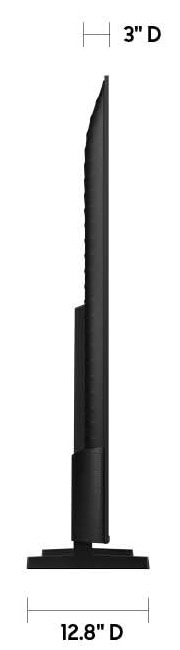
TV Depth
3″
3″
Front Color
Black
Titan Black
Stand Type
Basic Feet
Basic Feet
Stand Color
Titan Gray
Black
Adjustable Stand:
75-inch only
–
Wi-Fi
Yes (Wi-Fi 6E)
Yes (Wi-Fi 6E)
Bluetooth Version
5.3
5.3
HDMI Inputs
3
3
HDMI Maximum Input Rate
4K 144Hz (for HDMI 1/2/3)
4K 60Hz (for HDMI 1/2/3)
HDMI Audio Return Channel
eARC
eARC
HDMI-CEC
Yes
Yes
USB Ports
1 x USB-A
1 x USB-A
Ethernet (LAN)
Yes
Yes
Digital Audio Out (Optical):
–
–
RF Connection:
Yes
Yes
RS-232C Input
–
–
Samsung Vision AI
Yes
Yes
Gaming Support
Gaming Hub
Cloud Gaming- Xbox, NVIDIA GeForce Now, Luna, Blacknut, Antstream, Boosteroid
ALLM (Auto Low Latency Mode)
HGIG
AI Auto Game Mode
Gaming Motion Plus
Super Ultra Wide Game View
Game Bar
Mini Map Zoom
AMD FreeSync: Freesync Premium™ Pro
Hue SyncGaming Hub
Cloud Gaming: – Xbox, NVIDIA GeForce Now, Luna, Blacknut, Antstream, Boosteroid
ALLM (Auto Low Latency Mode)
HGIG
TV Art Features
Art Mode: NA
Art Store: YesArt Mode: NA
Art Store: Yes
Operating System
One UI Tizen
One UI Tizen
Free Ad Supported TV
Samsung TV Plus
Samsung TV Plus
Smart Home Connectivity:
SmartThings, Matter, IoT-Sensor Functionality
Quick Remote Only
Smart Assistants (Built-In)
Bixby, Alexa
Bixby, Alexa
Smart Assistants (Works with)
Google Assistant
Google Assistant
Far-Field Voice Interactions
Yes
–
Web Browser:
Yes
Yes
Samsung Health
Yes
Yes
Multi-Device Experience
Mobile to TV
Sound Mirroring
Wireless TV On
TV initiates mirroringMobile to TV
Sound Mirroring
Wireless TV On
Multi-View
Up to 2 videos
–
Buds Auto Switch
Yes
–
Works with Apple AirPlay
Yes
Yes
Works with Google Cast
Yes
Yes
Daily+
Yes
–
Now Brief
Yes Voice/User Detection
–
Workout Tracker
Yes
–
Audio
2 Channel speaker system
20 Watts Output Power
Object Tracking Sound
(OTS) Lite\Q-Symphony
Active Voice Amplifier (AVA) Pro
Adaptive Sound Plus2 Channel speaker system
20 Watts Output Power
Object Tracking Sound (OTS) Lite\Q-Symphony
Karaoke Mic:
Yes
Yes
Multi-Control
Yes
–
Storage Share:
Yes
–
Security
Knox Vault: N/A
Knox Security: YesKnox Vault: N/A
Knox Security: Yes
Remote Control
Bluetooth Simple Remote TM2280A with batteries
IR Simple Remote TM2240A with batteries

The Bottom Line
Samsung’s 2026 Mini LED lineup sits in a very calculated middle ground. You’re getting the core benefit that actually matters; Mini LED backlighting for better contrast, brightness control, and more consistent HDR performance without paying Neo QLED prices. Add in Tizen, Vision AI, and solid gaming support, and these don’t feel stripped down in daily use. For a lot of buyers, this is where the real value is.
What’s missing is just as important. No Quantum Dot layer means color accuracy and color volume won’t match Samsung’s Neo QLED models, and you’re not getting the full processing and refinement stack reserved for the higher tier. These are for buyers who want a meaningful step up from basic LED TVs without drifting into premium pricing. If you’re chasing reference-level performance, keep walking. If you want a well-equipped 4K Mini LED TV that covers the essentials and then some, this is the safer—and smarter—place to land.
Availability & Pricing
Samsung’s 2026 Mini LED 4K TVs are available now:
M80H Series
M70H Series
For more information: Samsung Product Page
Related Reading:
Reddit is stepping up its fight against bots, and now your account could be asked to prove it is human if the platform detects fishy behaviour.
Reddit CEO Steve Huffman says these checks will be rare, but they are meant to protect what makes Reddit work in the first place – real people talking to real people.
As AI-generated content spreads, Reddit admits it is getting harder to tell who is behind a post. So instead of broad crackdowns, it is focusing on suspicious behavior and adding clearer signals across the platform.
How Reddit plans to separate humans from bots

If Reddit detects signs of automation or unusual behavior, it may trigger a human verification check. This could involve simple actions like passkeys or FaceID that confirm a human is present.
In some cases, third-party biometric systems like Sam Altman’s World ID may be used. The platform may also use government-issued IDs in regions where laws require them. However, Reddit says that your identity will stay separate from your account.
The company is also standardizing labels for automated accounts. Approved bots will carry an [APP] tag, making it obvious you are interacting with software. Developers will need to register their tools to get this label, which adds a layer of transparency.
What does this mean for your Reddit experience?

Since Reddit says this is not a sitewide verification system, most users might never be asked to prove anything. Even when such checks take place, the focus will be on confirming a human exists, not identifying who that person is.
At the same time, the platform will continue removing harmful bots at scale, already taking down around 100,000 accounts daily. It is also improving reporting tools so users can flag suspicious activity more easily.
Reddit is not banning AI-written posts outright, but it is drawing a firm line. For now, the platform cares less about how content is written and more about who is behind it.


A new info-stealing malware called Torg Grabber is stealing sensitive data from 850 browser extensions, more than 700 of them for cryptocurrency wallets.
Initial access is obtained through the ClickFix technique by hijacking the clipboard and tricking the user into executing a malicious PowerShell command.
According to researchers at cybersecurity company Gen Digital, Torg Grabber is actively developed, with 334 unique samples compiled in three months (between December 2025 and February 2026) and new command-and-control (C2) servers registered every week.
Apart from cryptocurrency wallets, Torg Grabber steals data from 103 password managers and two-factor authentication tools, and 19 note-taking apps.
Rapid evolution
In a technical report this week, Gen Digital researchers say that Torg Grabber’s initial builds used a Telegram-based and then a custom, encrypted TCP protocol for data exfiltration.
On December 18, 2025, the two mechanisms were abandoned in favor of an HTTPS connection routed through Cloudflare infrastructure. The method supports chunked data uploads and payload delivery.
.jpg)
Source: Gen Digital
The malware features several anti-analysis mechanisms, multi-layered obfuscation, and uses direct syscalls and reflective loading for evasion, running the final payload entirely in memory.
On December 22, 2025, Torg Grabber added App-Bound Encryption (ABE) bypass to beat Chrome’s (and Brave’s, Edge’s, Vivaldi’s, and Opera’s) cookie protection system, like many other information stealers.
However, the researchers also discovered a standalone tool called Underground, used for extracting browser data.
It injects a DLL reflectively into the browser to access Chrome’s COM Elevation Service and extract the master encryption key, a method also recently seen in VoidStealer.
Extensive data theft capabilities
Gen Digital found that Torg Grabber targets 25 Chromium-based browsers and 8 Firefox variants, trying to steal credentials, cookies, and autofill data.
Of the 850 browser extensions it targets, 728 are for cryptocurrency wallets, covering “essentially every crypto wallet ever conceived by human optimism.”
“The marquee names are all there – MetaMask, Phantom, TrustWallet, Coinbase, Binance, Exodus, TronLink, Ronin, OKX, Keplr, Rabby, Sui, Solflare,” the researchers say.
“But the list doesn’t stop at the big names. It keeps going, deep into the long tail, past projects with install counts you could fit in a phone booth.”
Apart from wallets, the malware also targets a large list of 103 extensions for passwords, tokens, and authenticators: LastPass, 1Password, Bitwarden, KeePass, NordPass, Dashlane, ProtonPass, Enpass, Psono, Pleasant Password Server, heylogin, 2FAAuth, GAuth, TOTP Authenticator, and Akamai MFA.
Torg Grabber also targets information from Discord, Telegram, Steam, VPN apps, FTP apps, email clients, password managers, and desktop cryptocurrency wallet apps.
The malware can also profile the host, create a hardware fingerprint, document installed software (including 24 antivirus tools), take screenshots of the user’s desktop, and steal files from the Desktop/Documents folders.
Also notable is its capability to execute shellcode on the compromised device, delivered in ChaCha-encrypted zlib-compressed form from the C2.
Gen Digital cautions that Torg Grabber continues to develop rapidly, registering new C2 domains weekly, and that its operator base is expanding, with 40 tags documented by the time of analysis.

Malware is getting smarter. The Red Report 2026 reveals how new threats use math to detect sandboxes and hide in plain sight.
Download our analysis of 1.1 million malicious samples to uncover the top 10 techniques and see if your security stack is blinded.

Trials will start in Marina Bay and one-north
The first of six autonomous public buses has reached Singapore and will be tested on routes 400 in Marina Bay and 191 in one-north from the second half of 2026 as part of a three-year pilot programme.
In a Facebook video on Mar 25, the Singapore Land Transport Authority (LTA) said that the six buses will be rigorously tested to ensure that they meet all safety and operating requirements before they hit the roads.
When ready, the self-driving public buses will operate alongside existing manned buses, allowing LTA to maintain routes with lower ridership or introduce new services that are currently difficult to introduce due to manpower constraints.

The video from LTA revealed a 16-seater bus with features that resemble those of existing public buses. It also showed a space designated for a wheelchair.
Cameras and sensors are seen mounted on the front, rear and top of the autonomous bus, providing operators with a 360-degree view of the surroundings.
LTA noted that further preparation is needed before testing begins.
The tests will include LTA’s closed-circuit assessment, consisting of basic manoeuvres and safe passenger boarding and alighting at all designated stops.
Service 400 connects Marina Bay and Shenton Way, stopping at Marina Bay Cruise Centre, Gardens by the Bay, Shenton Way and Downtown MRT stations.
Whereas service 191 loops through one-north, with stops at Buona Vista bus terminal, one-north MRT, and Buona Vista MRT.
Following this deployment, LTA may procure up to 14 additional autonomous buses and expand the pilot to more public bus services.
LTA first teased the launch of driverless public buses last Oct, where it awarded a contract for the pilot deployment of autonomous buses to a consortium of MKX Technologies Pte Ltd, Zhidao Network Technology (Beijing) Co. Ltd and BYD (Singapore) Pte Ltd for a contract sum of around S$8.14 million to pilot autonomous buses.
The consortium will also work with the Singapore Bus Academy to train existing bus captains to take on new roles as safety operators, so that they are equipped to operate the autonomous buses competently and confidently.
- Read other articles we’ve written on Singaporean businesses here.

New submitter haroldbasset writes: Canada’s Immigration Department rejected an applicant because the duties of her current job did not match the Canadian work experience she had claimed, but the Department’s AI assistant had invented that work experience. She has been working in Canada as a health scientist — she has a Ph.D. in the immunology of aging — but the AI genius instead described her as “wiring and assembling control circuits, building control and robot panels, programming and troubleshooting.” “It’s believed to be the first time that the department explicitly referred to the use of generative AI to support application processing in immigration refusals,” reports the Toronto Star. “The disclaimer also noted that all generated content was verified by an officer and that generative AI was not used to make or recommend a decision.”
The applicant’s lawyer was shocked “how any human being could make this decision.” “Somehow, it hallucinated my client’s job description,” he said. “I would love to see what the officer saw. Something seriously went wrong here.”
The applicant’s refusal came just as Canada’s Immigration Department released its first AI strategy, which frames artificial intelligence as a way to improve efficiency, service delivery, and program integrity. The department says it has long used digital tools like analytics and automation to flag fraud risks and triage applications, and is now also experimenting with generative AI for tasks such as research, summarizing, and analysis. In this case, however, the department insisted the decision was made by a human officer and that generative AI was not involved in the final decision.

Thirty years after the alleged 1996 “ET of Varginha” encounter, debate continues to rage over the events that happened in Brazil’s self-styled UFO capital. An anonymous reader quotes an excerpt from the Guardian: The skies over this far-flung coffee-growing hub went charcoal black, the heavens opened and one of Brazil’s greatest mysteries was born. “It really was something unique,” recalls Marco Antonio Reis, a zoo director, who was at his ranch outside Varginha one stormy day in January 1996 when, he says, an otherworldly creature came to town. Reis and other locals claim the unusually ferocious downpour heralded a series of disturbing and seemingly paranormal events. At least six of the zoo’s animals, including a spider monkey, a tapir and a raccoon, died mysteriously after a horned interloper with bulging red eyes was spotted in the vicinity by a woman who had gone out for a smoke. When a vet examined their corpses, “they were all black inside,” Reis claims.
On a nearby wasteland, three young women spotted a peculiar and malodorous being with a heart-shaped face and three lumps on its head cowering beside a wall. “I’ve seen the devil,” one of those witnesses would later tell her mum. Soon afterwards, an unexplained infection was rumored to have killed a strapping police intelligence officer who was said to have grappled with the oleaginous unidentified being. Three decades later, Reis says he is convinced Varginha received a non-human visit. His only doubt was from where it came.
“We don’t know if it was extraterrestrial or intraterrestrial,” the 71-year-old says as he climbs a staircase to the veranda where the smoker claims to have seen what, in reference to Steven Spielberg’s 1982 film, became known as the “ET of Varginha”. A 2ft statue of a two-toed alien now marks the spot. “It’s possible it was an intraterrestrial, from inside the Earth They don’t just come from space,” Reis says. “It might have come from the depths of the Earth, too. We don’t even know what it’s like at the bottom of the sea, do we?”

HBO released a teaser trailer and premiere date for its take on Harry Potter and the Philosopher’s Stone. The show will premiere on the HBO Max streaming network this December 25. It’s a rare case where a big-ticket project is coming out earlier than anticipated instead of later; the series wasn’t expected to arrive until 2027.
HBO has already proved its bona fides with lush adaptations of fantastical stories several times over, and this trailer looks like more of the same. The team behind the camera includes notable names who have worked on series such as Succession, Game of Thrones, The Last of Us and Killing Eve. Harry Potter creator J.K. Rowling, who alienated many fans after outing herself as transphobic, is also one of the show’s executive producers.
Engadget’s Jess Conditt has already written eloquently on the struggle of when and how to engage with the Harry Potter franchise while rejecting Rowling’s worldview, although the author’s involvement at the top level may make this adaptation a harder sell to the disillusioned community than, say, the Hogwarts Legacy video game where Rowling was barely involved and the studios took a more proactive approach toward presenting many types of diversity, including gender expression. If you’re hyped for this particular show, seems you’ll have a shorter time to wait for it.


On Tuesday, tipster Yogesh Brar reiterated earlier rumors that OnePlus will soon shut down in the US, the UK, the EU, and most other global markets while continuing to operate in a handful of Asian countries, including China and India. Although the post has since been deleted, 9to5Google reports that…
Read Entire Article
Source link

Baltimore/Washington International Airport TSA Wait Times Stabilize Near Normal Levels

Texas Judge throws out crypto software liability case
What happened to the cast of “Magnum, P.I.”? See the stars over 45 years after making waves in Hawaii


-
 Crypto World5 days ago
NIO (NIO) Stock Plunges 6.5% as Shelf Registration Sparks Dilution Worries
-

 Fashion6 days ago
Weekend Open Thread: Adidas – Corporette.com
-
 NewsBeat22 hours ago
Manchester United reach agreement with Casemiro over contract clause amid transfer speculation
-

 Politics6 days ago
Jenni Murray, Long-Serving Woman’s Hour Presenter, Dies Aged 75
-

 Crypto World4 days ago
Best Crypto to Buy Now: Strategy Just Spent $1.57 Billion on Bitcoin During Fear While Early Investors Quietly Enter Pepeto for 150x Potential
-

 Crypto World4 days ago
Bitcoin Price News: Bhutan Sells $72 Million in BTC Under Fiscal Pressure, but the Smart Money Entering Pepeto Sees What the Market Does Not
-

 Tech6 days ago
inKONBINI Lets You Spend Summer Days Behind the Register
-

 News Videos6 hours ago
Parliament publishes latest register of MPs’ financial interests
-

 Sports3 days ago
Remo Stars and Kano Pillars Strengthen Survival Hopes in NPFL
-

 Politics7 days ago
Gender equality discussions at UN face pushbacks and US resistance
-

 Business4 days ago
No Winner in March 21 Drawing as Prize Rolls to $133 Million for Next
-

 Sports3 days ago
Gary Kirsten Accuses Pakistan Cricket Board Of ‘Interference’, Mohsin Naqvi Responds
-

 Tech3 days ago
Give Your Phone a Huge (and Free) Upgrade by Switching to Another Keyboard
-

 Sports6 days ago
2026 Kentucky Derby horses, odds, futures, preview, date: Expert who nailed 12 Derby-Oaks Doubles enters picks
-
Sports7 days ago
Vikings Free Agency Enters Phase 2 with Key Questions
-

 Tech3 days ago
AI enters the chat: New Seattle dating app relies on tech to facilitate meaningful human connections
-

 Politics7 days ago
Scotland’s rejection of assisted dying is a victory for humanity
-

 Business6 days ago
DLocal: Entering 2026 At Escape Velocity
-
Business5 days ago
Columbia Sportswear enters $500 million credit agreement with JPMorgan Chase
-

 NewsBeat7 days ago
Missile lands next to presenter during live report
You must be logged in to post a comment Login