Target’s Floor Care promotion is in its second week, and ECOVACS is going deep, with discounts of up to 60% on some of the most capable Deebot robot vacuums on the market, plus its Winbot window cleaner lineup and the GOAT robotic lawn mower on sale alongside them.
Headlining the deals is the Ecovacs Deebot X11 OmniCyclone, a high-end powerhouse packed with top-of-the-line features like nearly 20,000Pa of suction courtesy of BLAST engineering and the self-washing Ozmo Roller 2.0 mop. The Ozmo is a different beast than most mops because it utilizes a horizontally mounted scrubbing sponge instead of the rotating or vibrating pads normally found on robot mops. Make no mistake, the X11 OmniCyclone is a luxury-class robot vacuum — but at an impressive of around 50% discount, it makes premium autonomous cleaning available to more households than ever.
Of course, that’s far from the only great Ecovacs deal you can snag right now at Target. The Deebot X9S Pro Omni offers a similarly high-end finish and feature set to the X11, and it boasts additional suction power to pick up especially big messes and free stubborn particles from high-pile carpet. The X9S Pro Omni also sports the Ozmo Roller mop and luxury finish, and it’s $300 off for a final sale price of $699.99.
The remaining Deebot robot vacuum-mop combos on sale during the Target Floor Care promotion feature even bigger percentage cuts without sacrificing much performance. The Deebot T80 Omni essentially bridges the gap between midrange and high-end, featuring anti-tangle technology, high suction, and an Ozmo Roller comparable to the flagships, plus a whopping $600 off for a grand total of $399.99. For the duration of the sale, Ecovacs’ Deebot T50 Omni punches well above its temporary entry-level price of $298.99, and the inclusion of the Omni base station makes it arguably the most well-rounded choice in this price range. For just $16 more at $314.99, you can opt for the Deebot T50 Omni Care bundle, which includes spare rollers, mops, filters, edge brushes, and an extra bag—getting necessary component purchases out of the way early at a discount.
Advertisement
Ecovacs Winbot Window Cleaners Are Also on Sale
Even though Target is billing this explicitly as a Floor Care promotion, Ecovacs is offering price reductions on advanced, time-saving devices that aren’t meant for floors. The Ecovacs Winbot W2S Omni window cleaner robot can do more than save time and effort — it cleans out-of-reach windows that would otherwise require hiring a costly professional service. As an industry standard in automated window cleaning, it features impressive edge-to-edge coverage, convenient control scheduling, and multifaceted safety features — all for 25% off at $449.99.
If you don’t need the added support of the portable Omni base station, the standard Ecovacs Winbot W2S checks in at $299.99 (25% off) for the sale week, offering the same high-performing triple-nozzle array and Win-SLAM 4.0 navigation as its costlier sibling. Finally, the Ecovacs Winbot Mini gets a 29% reduction down to $170, making it especially useful for homes with just a few out-of-reach windows where investing in a longer-range model would be overkill.
It’s not every day that one of the world’s most effective, user-friendly automated cleaning lineups sees discounts this significant. You can easily snag a flagship-level Ecovacs robot vacuum and mop combo at midrange prices, or opt for a near-flagship model for what you’d normally pay for a run-of-the-mill competitor. These discounts also make it a great time to join the Winbot family — if you haven’t considered an automated window cleaner before, these reduced prices make them hard to pass up.
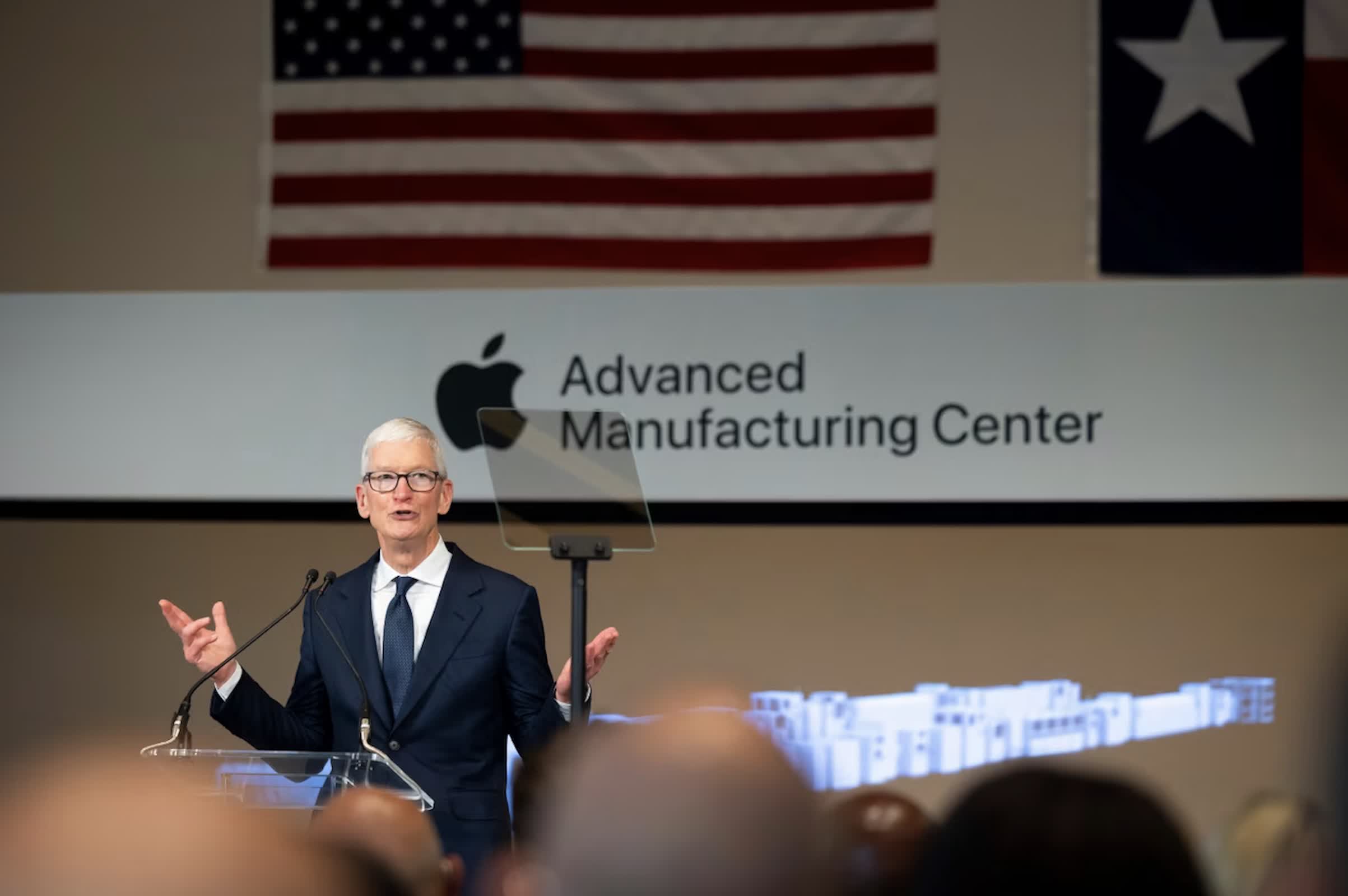
In context: A new Mac Mini assembly line at Foxconn’s Houston facility is expected to begin production later this year, expanding Apple’s US manufacturing footprint for AI-related hardware. The project is part of Apple’s effort to increase domestic production while continuing to rely on contract manufacturers and an international supply chain.
The line will operate in a new 170,000-square-foot space at the plant, which already makes AI servers for Apple. Foxconn is funding the assembly-line buildout, while Apple has committed to purchasing the products made there.
The Mac Mini has seen stronger demand over the past year, particularly among customers using the compact desktop to run AI models at home. Its planned Houston production also comes after Apple discontinued the Mac Pro, which was assembled in the US at a Flextronics plant that President Trump visited with Apple CEO Tim Cook in 2019.
Cook and Commerce Secretary Howard Lutnick toured the Houston site last week. The visit included a new manufacturing school that Apple is opening to provide hands-on training for small and midsize US companies. Apple previously launched a classroom-based manufacturing program in Detroit.
Advertisement
“Advanced manufacturing is where the puck is going,” Lutnick told workers taking an Apple manufacturing course. “The problem is we need to train Americans.”
Cook said Apple’s US investment plans reflect its broader commitment to domestic production. “We believe in the promise of this nation and we’re proud to put our money where our mouth is,” he said in a speech.
Apple’s investment strategy relies heavily on its purchasing power rather than on building and owning factories. The company’s capital spending remains far below that of Amazon, Microsoft, and Google, which have made major investments in AI infrastructure and semiconductor capacity. Apple’s total capital expenditures since 2023 are less than what each of those companies spent in its most recent quarter.
That model is evident in Houston. Foxconn is paying to build the production lines, while Apple is supporting the project through product orders. The arrangement preserves Apple’s long-standing reliance on manufacturing partners while allowing it to use its supply-chain scale to influence where production and component sourcing take place.
Advertisement
Apple has made similar commitments in semiconductors. The company is among the businesses that have agreed to buy chip wafers from TSMC’s Arizona plant, a project expected to cost more than $200 billion. Apple has also reached a preliminary agreement for Intel to manufacture some of its device chips and said it plans to spend $30 billion on US-made chips from Broadcom.
The company has pledged to invest $600 billion in the US over four years. The total includes spending already planned for its American business, including employee pay, retail and corporate operations, and purchases from domestic suppliers.
The administration has encouraged Apple to expand its US manufacturing operations. President Trump has pressed the company to make iPhones domestically, but Apple has not announced such plans. Instead, it is expanding iPhone assembly in India.
The Houston event was among Cook’s final public appearances as Apple’s chief executive. He is expected to become chairman next month, with John Ternus, Apple’s longtime hardware engineering chief, expected to succeed him as CEO.
Microsoft says some users are experiencing issues searching in Microsoft 365 apps, including Outlook on the web, Outlook desktop, SharePoint Online, and OneDrive.
According to an incident report seen by BleepingComputer and tracked under MO1456424 in the Microsoft 365 Admin Center, the root cause is what Microsoft describes as a recent deployment that causes resource utilization problems.
“Impact is specific to some users served through the affected infrastructure who are attempting to search for content in SharePoint Online, OneDrive, Outlook on the web, or Outlook desktop,” Microsoft said.
“Our investigation identified that a recent deployment introduced a resource utilization inefficiency issue, leading to impact.”
Microsoft says it has already developed a fix and deployed it to reduce resource pressure and restore service for all affected Microsoft 365 users.
Advertisement
While the company has yet to share which regions were impacted by this outage, it tagged it as an incident, which usually describes a critical service issue with noticeable user impact.
On Monday, Microsoft resolved another incident that brought down GitHub, its website, the API, and many other services for more than eight hours, with users reporting server errors when trying to access GitHub, while others encountered problems loading commits, repositories, and Pull Request pages.
Advertisement
Overall prevention scores can hide what happens after initial access. Once attackers are using valid credentials, prevention drops sharply.
The Blue Report 2026 measures defenses technique by technique across 338 million simulations run in customer production environments.
Samsung could be planning an even wider Galaxy Z Fold for 2027. A new report suggests the company is working on a foldable specifically designed to make video viewing more comfortable.
According to ETNews, Samsung has expanded its planned 2027 foldable lineup to five devices. Alongside the expected Galaxy Z Fold 9, Galaxy Z Fold 9 Ultra, Galaxy Z Flip 9 and a new Galaxy Z TriFold, the company is reportedly developing a second wide-format foldable.
Details are still thin, but the key difference could be its display. The report says Samsung is working on a screen aspect ratio specifically optimised for watching video instead of sticking with the 4:3 ratio used by the Galaxy Z Fold 8.
That could mean a noticeably wider display when the phone is unfolded. Samsung hasn’t revealed the exact ratio, so 16:9 or 16:10 are only possibilities at this stage, rather than confirmed specifications.
Advertisement
The idea makes some sense for a foldable. The Galaxy Z Fold 8’s large internal screen is useful for everything from multitasking to watching films. However, its squarer 4:3 shape isn’t an especially natural fit for most widescreen video. A wider panel could reduce the amount of unused space around 16:9 content.
Advertisement
It’s worth stressing that this isn’t necessarily the Galaxy Z Fold 9 itself. ETNews describes the device as a second wide-format model in Samsung’s 2027 range. Meanwhile, specifications and even the final positioning remain unclear. The report does, however, suggest Samsung is looking beyond simply repeating the current Fold formula.
The wider foldable is expected to launch in the second half of 2027 alongside the rest of Samsung’s next-generation foldable lineup.
Advertisement
For now, the Galaxy Z Fold 8 is the device to watch. However, Samsung’s reported plans suggest its foldable strategy could get considerably more interesting next year.
As global supply chains remain exposed to geopolitical and climate uncertainty, retail and consumer packaged goods (CPG) businesses face challenges of fluctuating prices and demand. In the United Kingdom, supply chain volatility is adding to uncertainty in raw material and packaging costs to impact CPG companies’ production economics.
Research has found that a huge majority of British retailers were not confident of scaling up their supply chain operations to meet the expected increase in consumer demand. In fact, 43% of retail leaders ranked supply chain issues among their top three business challenges in 2025, highlighting widespread concern over operational capacity in the face of rising demand and cost uncertainty.
Ambeshwar Nath
EVP & Industry Head (EMEA) for Consumer Goods, Retail & Logistics at Infosys.
Retail and CPG businesses can address these problems by modernizing fragmented and often inflexible systems to improve data visibility, analysis and automation across their supply chains.
Latest Videos FromTechRadar
Advertisement
Artificial Intelligence (AI) and Machine Learning (ML) technologies are imperative to this agenda: packing powerful capabilities – including data integration, automation, demand sensing and intelligence – AI and ML are redefining retail and CPG operations by enabling seamless, autonomous ecosystems.
Connected platform to satisfied customer
Connected supply chains provide transparency to allow organizations to manage operations and inventories in real-time to improve stock allocation and ordering efficiency.
Intelligent algorithms also analyze vast and varied data – from historical sales and seasonality to weather, social media trends and local events – to accurately forecast demand, preparing supply chains for changing ordering patterns.
Forewarned, businesses can rapidly adapt production and distribution strategies in case of a surge in demand or supply disruption. AI and ML automate a variety of supply chain tasks to speed up processes, reduce errors and save costs. Ensuring product availability at all times, retailers and CPG companies in the U.K. can look forward to greater customer satisfaction and loyalty.
Sign up to the TechRadar Pro newsletter to get all the top news, opinion, features and guidance your business needs to succeed!
Advertisement
Real-time, for responsiveness and resilience
Real-time insights are critical to supply chain operations. Live data from Point of Sale systems, ecommerce platforms, etc. provide up-to-date insights into customer preferences and behaviors to improve demand forecasting and also allow companies to dynamically adjust stock levels across warehouses and stores to meet sudden demand.
Real-time analytics solutions highlight product performance by region, channel and even outlet, enabling retailers to optimize assortments and launch targeted promotions. By providing continuous visibility into the supply chain, AI allows CPG companies to anticipate demand shifts and disruptions to curtail risk and maintain supply chain resilience.
Precise prediction drives product fulfilment
AI and ML platforms have superior predictive capabilities: they go beyond general demand forecasting to predict exactly what customers want, and when, and can even proactively trigger replenishment orders before stocks run out. Algorithms are not only more efficient at spotting patterns and making projections than traditional analysis, but are even capable of adjusting forecasts based on micro-trends.
Advertisement
By enabling CPG and retail companies to ensure that the right product is at the right place at the right time, AI and ML mitigate loss of sales due to stockout; save labor, warehousing and other costs; and improve product availability across physical and digital channels, leading to superior customer experience.
The future is autonomous
Agentic AI-powered autonomous supply chains are taking operational efficiency and customer engagement to new heights by anticipating demand, optimizing inventory, and orchestrating various tasks with little or no human intervention.
Advertisement
Autonomous systems meet the digital consumer’s expectation of frictionless, enjoyable experiences by personalizing product and delivery options and continuously optimizing logistics and transportation routes to allow faster/ on-time delivery.
Upon anticipating a delay, AI agents can take proactive measures – rerouting a shipment or suggesting an alternative supplier, and updating customers about the status of their orders to avoid frustration. By enabling full traceability to allow customers to track their orders any time, autonomous supply chains build trust and engagement.
Last but not least, by optimizing inventory and logistics operations, autonomous supply chains reduce waste and energy consumption, and support ethical sourcing through clear visibility. Agile, proactive, and sustainable – that is what the future of retail and CPG supply chains looks like.
This article was produced as part of TechRadar Pro Perspectives, our channel to feature the best and brightest minds in the technology industry today.
The views expressed here are those of the author and are not necessarily those of TechRadarPro or Future plc. If you are interested in contributing find out more here: https://www.techradar.com/pro/perspectives-how-to-submit
Facepalm: Over the weekend, many Australian shoppers found their Mastercard payments declined mid-purchase. The US-based company confirmed the issue Saturday and says its network is now back to normal. While the disruption technically hit Mastercard’s global network, it was felt most acutely by shoppers in Australia.
An undisclosed number of Australian customers were unable to pay with their cards during Saturday’s shopping trips. As reported by ABC, Mastercard quickly identified the cause of the new outage: a scheduled system update that went wrong, triggering declined transactions for a period of several hours.
The situation was resolved by the end of the day, Mastercard said, though the company hasn’t shared specifics about what the update was actually meant to do.
During the outage, many shoppers found themselves unable to complete purchases with a Mastercard-issued credit card. ABC reports that some shoppers tried backup cards without luck, and were ultimately forced to leave their carts behind and head home for cash. By the time they returned, the outage had already cleared and payments were working normally again.
Advertisement
According to Downdetector data, the outage left a clear mark on Saturday’s shopping activity. Reports of card issues climbed past 1,700 by 3 pm, then fell back to 173 a couple of hours later. Most complaints centered on fund transfers and mobile banking, though cash withdrawals and Apple Pay were affected, too.
Anyone living inside a digital, networked economy knows all too well how disruptive a systemic outage can be. Payment processors like Mastercard and Visa sit at the center of that infrastructure, and they’re routinely criticized for becoming unreliable at the exact moment people need them most.
In light of the infamous CrowdStrike incident a couple of years ago, banking organizations warned that total dependence on “digital money” and payment processors is a disaster waiting to happen. Another massive CrowdStrike-scale event could bring a cashless society to a standstill, they argued, which is why physical cash should still play a meaningful role in today’s economy.
This weekend’s Mastercard incident lends some weight to those warnings. In a worst-case scenario, the next global outage could carry far heavier consequences. And honestly, I’d almost forgotten what cash is even like.
If you’re still talking about ‘DirSync’ or ‘Active Directory’ instead of ‘Entra’, and need to explain why, this is the site for you
If you’re struggling to stay up to date with Redmond’s regular product re-branding exercises, here’s the site for you: The Microsoft Rebrand Registry.
Microsoft Most Valuable Professional (MVP) Loryan Strant created the site because he thinks it’s a valuable resource, and also in the hope it makes visitors “chuckle.”
Advertisement
Readers may remember that Strant has also created the site Let Me Correct That For You, which lists the exact names of Microsoft products – an effort he told The Register he thinks is useful because Microsoft in its wisdom uses Camel Case for names like PowerPoint but went with conventional capitalization for Copilot.
Strant told The Register that the Rebrand Registry came about after some banter between himself and other MVPs, during which the topic of Microsoft’s many product name changes came up. He decided to do something about it.
The site lists 72 Microsoft products and 158 names they’ve had over the years.
Advertisement
It also includes some analysis of Microsoft’s branding, which sees a product’s name survive for an average of two years and eleven months.
The site lists eight products that have gone through three name changes:
· Azure AI Search
· Azure App Service
Advertisement
· Azure DevOps
· Azure SQL Database
· Foundry Tools
· Microsoft 365 Copilot app
Advertisement
· Microsoft Configuration Manager
· Microsoft Defender for Endpoint
Strant has even had a go at predicting which Microsoft products are likely to get a new name soon, by considering the amount of time the current name has applied, prior names, and the frequency with which Microsoft changes names of products in the same family.
That methodology led him to suggest an “elevated” likelihood of name changes for the Azure App Service, Azure SQL Database, Azure DevOps, and Microsoft Dynamics 365 Field Service.
Advertisement
The site considers surviving products only, and Strant admits his analysis is therefore biased towards product Microsoft still publishes. He also pointed out that he’s not decided how to handle successor products, for example when Microsoft discontinued Skype for Business and put similar functions into Teams.
Strant said he created Let Me Correct That For You using WordPress, while his Microsoft logo library grew out of a OneDrive folder and relies on a GitHub repo.
For the Rebrand Registry, he used vibe coding tools.
“I have my own harness that lets me custom-build things,” he explained, adding that he rigorously validates data rather than relying on AI tools to get facts right.
Advertisement
Strant said most of the feedback he gets about his sites is positive, either on LinkedIn or during face-to-face meetings at events. He’s heard that Microsoft people appreciate his efforts because Redmond hasn’t preserved the same data his sites record.
“I hope that people find them useful, and get a chuckle,” he said. ®
The reality for many organizations is that their employees are already being deceived. So, probably are their customers, their investors, and their board.
For years, the warnings have focused on the impact of deepfakes, such as fake CEOs on video calls, cloned voices authorizing payments, and fraudulent emails.
The tactics themselves are not new, but over the past few years, AI has made them cheaper to produce, harder to spot, and far more convincing within the ordinary flow of business.
Advertisement
Latest Videos FromTechRadar
Tony Fergusson
CISO in Residence, Zscaler.
Advertisement
It’s this trend that means that the principle of Zero Trust is becoming as relevant to how information is treated as it has been to access.
In cybersecurity, Zero Trust starts from a simple assumption: no user, device, application or request should be trusted by default.
In the age of AI-generated misinformation, businesses need to apply that same mindset to the information that moves throughout their organization.
Advertisement
The new trust crisis
Employees, customers, investors and partners are all making decisions based on what they see, read and hear. If that information is false, manipulated or stripped of context, the consequences can move quickly from confusion to commercial damage. Which is why misinformation, disinformation, and malinformation need to be treated as business risks.
Sign up to the TechRadar Pro newsletter to get all the top news, opinion, features and guidance your business needs to succeed!
Misinformation – the false content that spreads without deliberate intent – has always been an issue. Disinformation, constructed specifically to deceive, is now easier to manufacture at scale than ever before. And malinformation – true information, often deliberately stripped of context and weaponized – might be the most insidious of the three. A competitor, a criminal group, or an activist campaign no longer needs to breach a network to cause serious damage. They can influence those associated and concerned with an organization simply by shaping what those people see and believe.
Advertisement
What makes this particularly difficult for businesses is that it mirrors something individuals are already struggling with. In an environment saturated with AI-generated content, the habits that people must employ to protect themselves – pause before reacting, questioning the source, verifying before acting – are the same habits that organizations must build into how they operate.
Essentially, the instinct to trust has become a vulnerability. And addressing that requires something closer to a structural response than an awareness campaign.
Advertisement
The importance of verified trust
This is where Zero Trust becomes the strategy. Traditionally, organizations have thought about Zero Trust through the lens of least privilege, ensuring that the right users have access to the right applications, and nothing more. But in an AI-driven information environment, that principle needs to evolve. Businesses can no longer focus just on who is requesting access. They also need to interrogate what information is being used, what action is being taken, and whether the intent behind the action can be trusted.
The next stage is going beyond authentication and investigating authenticity, and asking questions such as “Is this information verified?”, “Is this image real or AI-generated?”, and “Has this content been edited?”. Zero Trust gives businesses a framework for answering those questions. It forces organizations to verify before they act, limit exposure where they can, and reduce the risk of false, manipulated, or decontextualised information moving unchecked through the business.
Standards bodies such as the C2PA (Coalition for Content Provenance and Authenticity) show the direction that this is heading: a future where provenance and integrity are embedded in digital content itself, the same way a padlock in a browser indicates that the connection is secure. Essentially trust won’t be something that businesses need to check for, rather it will be something that travels with the information as provenance feeds verifications. Every piece of content therefore becomes a signal in a continuous trust decision.
Advertisement
Developing Trust in the agentic era
The need to trust intent has become even more pressing as AI agents enter the workplace. These agents will increasingly operate like another person working alongside us, mirroring our behaviors, such as reading documents, interpreting data, making decisions, and acting. The difference, however, is that these non-human identities are moving at machine speed, where human-speed verification has no hope of keeping up.
That means AI agents must be governed through a Zero Trust model from the outset. An agent should not be trusted just because it sits inside the enterprise, has been approved by a user, or is connected to corporate systems. Its identity, permissions, behavior and outputs all need to be continuously validated. Just as importantly, agents should be governed by least privilege, the principle of least information, and least function, granting only the minimum access, data, and capability required for a specific task.
However, these agents create a trust challenge that identity management alone can’t solve. Businesses will need to know whether they are dealing with a human or a machine, whether an agent is behaving responsibly, and whether its actions reflect an organization’s values and boundaries. Effectively, businesses will need to adopt an operating constitution that agents are continuously measured against.
And in this AI era, enterprises must interrogate information, content, intent, behavior, and action in realtime and continuously as identity is generally just checked as front door access. However, given the scale of the task at hand, it will take AI to audit, flag, and govern as needed and keep the chain of trust intact.
Advertisement
Engineering trust into the business
The organizations that succeed will be those that treat trust as something to be engineered, rather than assumed. Misinformation, disinformation, malinformation are security, resilience, and leadership challenges, and AI is making them harder to ignore.
As technology continues to shape how information is created, shared, and acted upon, businesses need to build the same discipline around authenticity that they’ve always applied to access. That means verifying content, questioning intent, and limiting what AI systems can do to what they actually need to do.
Trust can no longer be the default setting. Instead, in today’s operating environment, it must be a decision that’s made continuously, at machine speed, across information, intent, behavior, and action. The good news is that the framework already exists in Zero Trust. What needs to change however is how organizations apply it, broadening the scope to include information, intent, behavior, and action.
This article was produced as part of TechRadar Pro Perspectives, our channel to feature the best and brightest minds in the technology industry today.
The views expressed here are those of the author and are not necessarily those of TechRadarPro or Future plc. If you are interested in contributing find out more here: https://www.techradar.com/pro/perspectives-how-to-submit
In 1963 a kit of red and white polystyrene plates, stiff metal rods, rubber bands, and short plastic tubes sold for $4.99 ($54.45 today) and assembled into a working digital computer. Three small windows on the front face displayed binary digits as either 0 or 1. A white lever marked “Clock” stuck out from the right side. Pushing that lever fully inward and then drawing it back out advanced every calculation by one step. No batteries or power cord were required. All motion came from the user’s hand and the tension stored in the rubber bands.
E.S.R. Inc., a small company founded by three engineers who originally intended to produce electronic computing equipment, release the kit as a side project to create quick cash. Instead of being a one-hit wonder, the Digi-Comp 1 sold out faster than anyone could keep up. Over 100,000 units were sold, with some estimating it could have been as many as 250,000. For a period, the number of Digi-Comp 1s was actually greater than the number of true electronic computers in use. At least in the middle of the 1960s. Eventually, the business chose to move its focus to more… traditional toys, and Digi-Comp 1 would remain in production for a little longer. It remained in production until the early 1970s.
[Ultra-Compact Mini PC: 25% Faster Single-Core] Measuring just 4.6 x 4.4 x 1.35 inches, this space-saving small pc fits seamlessly into any office…
[Dual-Channel RAM & NVMe SSD Expandability] Pre-equipped with 8GB DDR4 RAM and a fast 256GB NVMe SSD to supercharge your daily productivity. Unlike…
[48EU Intel UHD Graphics: Double the EUs of N5095/N95] Features Intel UHD Graphics with 48 Execution Units (EUs)—double the graphics cores of…
You assemble the device by slapping the base plate down and joining the upright supports in one seamless action, with no tools required. Then you add three horizontal bars that can move in any way because they can lock into either of two spots that you’d intuitively associate with binary 0 or binary 1, and those three bars may represent any number between 000 and 111, or, in more common terms, 0 to 7. Six thin rods now run along the front of the machine, with another six going along the back. Along the front, there are little tubes that you put onto tabs, and on the back, there are tubes that you fit onto the appropriate tabs. The arrangement of the back tubes dictates which rods can move and which cannot during a single clock cycle.
Now, the front rods serve as logic sensors, and depending on the condition of those three sliding bars, they will either drop or remain held up. The back rods are your actuators. So, if a rear rod swings free, it can push the bar from 0 to 1 or 1 to 0, as long as the right tube is in place. The rear rods with odd numbers reset to zero, while those with even numbers reset to one. Rubber bands keep the rods taut, allowing them to snap back into position as soon as an obstructing tube is relocated or a passage opens.
When you draw the lever all the way in and secure the logic rods, you complete a full clock cycle. Any rod that is not blocked by a front tube then connects to the corresponding rod on the back. Then, on the way back out, those free rear rods spring into action, shifting the sliding bars to whatever position is required by where you’ve placed the tubes. By the time the bars have set, the overall pattern of what is blocked and what is not has changed, making it ready for the next cycle. That’s all there is to it, because the machine’s current state totally controls its next state. In other words, it is a three-bit finite-state machine.
Users rummaged through the large instruction booklet to find tube arrangements that really worked. One fairly conventional configuration transformed the machine into a binary counter that counted up from 000 in a smooth, step-by-step manner, 000 to 001, then 010, 011, and so on all the way up to 111 until eventually counting down to 000 again. Other layouts became more fascinating, as you could combine two numbers, subtract one from another, move bits left or right, or just flip the entire value on its head. You could also use it for simple multiplication and comparisons. The kit featured a clever little plastic bit that allowed you to create “or” situations and solve some interesting challenges. People were able to encode games like Nim so that the machine would enforce the rules and vary the outcome depending on the starting position.
The results appeared immediately in the three front windows when the bars were clicked into place. The documentation that came with the tube layouts included not only the charts for how to set up the tubes, but also the fundamentals of binary counting and Boolean logic, all explained in a way that a 12-year-old could grasp. Many people who received a Digi-Comp 1 as a present later claimed that it was the first gadget to make abstract rules feel real and concrete. The tangible “click” of the bars moving and the rods shifting in front of you was extremely effective in demonstrating cause and consequence in a manner that a simple diagram cannot.
American luxury EV builder Lucid Motors announced and unveiled the Lucid Gravity GT-S this weekend during Monterey Car Week in California. The new performance variant of the brand’s three-row electric SUV inherits the upgraded three-motor powertrain from the 1,070-horsepower Lucid Air Sapphire, seats up to seven and features a 3.1-second 0-60 sprint.
Lucid calls the new GT-S trim level “America’s most powerful three-row SUV,” backing up the claim with that stated 1,070 hp from the EV’s three-motor (one front, two rear) setup. That sort of oomph is enough to propel the SUV to 60 mph in just 3.1 seconds — a tick behind its sibling, the lighter Air Sapphire sedan’s 1.89-second blitz, but still an impressive feat for a luxury SUV with three rows for passengers and a large cargo capacity.
Lucid’s top-of-the-line Gravity shaves about a half-second off the Grand Touring model’s 0-60 time.
Amazingly, while the Gravity GT-S may be the most powerful vehicle in its class, it’s not the quickest. Rivian’s range-topping R1S Quad-Motor keeps pace with 1,025 hp and an estimated 2.6 seconds to 60 mph, though Edmunds’ instrumented testing clocked it closer to 3 seconds flat. Tesla’s Model X Plaid packs 1,020 hp and a Tesla-claimed 2.5-second run — the Falcon-doored three-row EV was recently discontinued, but new and low-mileage examples are still relatively easy to find. Drivers with a half-second more patience can also consider the Cadillac Vistiq, which gets the job done in its 3.7-second Velocity Max mode with only 615 ponies. The level of speed on offer for luxury EV buyers these days is, frankly, absurd.
In addition to straight-line acceleration, Lucid has also boosted the GT-S handling. The spec comes standard with the automaker’s Dynamic Handling Package, which includes an adaptive air suspension that automatically lowers the SUV for efficiency at speed and hunkers down during dynamic driving. Independent rear-wheel steering is also standard, boosting low-speed agility and high-speed stability.
Lucid estimates the focus shift to performance will cost the GT-S trim a bit of efficiency. Range is projected to drop to around 373 miles, versus the 450 miles of the Gravity Grand Touring trim level, though that estimate has not yet been confirmed by the EPA.
Advertisement
Like the Sapphire, the GT-S distinguishes itself with blue trim inside and out.Lucid Motors
Sapphire styling, inside and out
Along with the performance chops, the Gravity GT-S gets a Sapphire-inspired makeover inside and out. Exterior touches include blue accents and blue brake calipers, plus GT-S badging complete with a blue S that looks identical to the Sapphire’s branding.
Inside, the GT-S is upholstered in Lucid’s Mojave PurLuxe interior — a synthetic, animal-free leather alternative — finished with blue stitching and piping. Buyers who prefer real leather can opt for the Tahoe leather interior, which adds $1,300 to the bottom line. Either way, the blue theme carries through to the steering wheel and armrest stitching, plus blue seatbelts, a blue steering wheel badge, and blue embossing on the Lucid Bear headrest logos.
This level of performance and luxury doesn’t come cheap. The Lucid Gravity GT-S will be available exclusively in the US, priced starting at an eye-watering $125,900, excluding tax, options and the $1,850 destination fees.
Antuan Goodwin
Senior Writer, Electrified Cars
Antuan has nearly 20 years of expertise and experience testing hundreds of cars, including electric, hybrid, plug-in hybrid, hydrogen, and traditional combustion vehicles.
See full bio
Artificial intelligence is entering a new phase, one defined not by experimentation, but by operational deployment in environments where the stakes are high and the margin for error is narrow.
Nowhere is this shift more visible than in critical services such as healthcare, where organizations are beginning to rely on AI not just for efficiency gains, but for decisions that directly affect lives, outcomes and public trust.
As a result, the conversation around AI capability is expanding, and there’s a real need for AI systems to be sovereign, trusted and aligned to the legal, ethical and operational frameworks of the jurisdictions they serve.
Advertisement
Latest Videos FromTechRadar
Andrew Henderson
Chief Technology Officer, OneAdvanced.
Advertisement
Sovereign AI is emerging as a response to this need.
It is not a marketing term or a technical preference; it is a structural requirement for organizations that operate under strict regulatory oversight and handle sensitive citizen data.
For these sectors, sovereignty is the mechanism that ensures AI systems remain under the control of the people and institutions accountable for their outcomes.
Advertisement
Data residency
The distinction between data residency and true sovereignty is central to this shift. Data residency simply describes where data is stored or processed. It is a geographical statement, not a legal one. Data sovereignty, by contrast, defines who controls the data, who can access it and which laws apply. It is a statement of legal authority and operational control.
Sign up to the TechRadar Pro newsletter to get all the top news, opinion, features and guidance your business needs to succeed!
Sovereign AI goes further still. A sovereign by design AI system ensures that every stage of the AI lifecycle, from training and fine tuning to inference, deployment and monitoring, sits entirely within the sovereign perimeter. This includes the IT infrastructure, the data pipelines, the model governance processes and the personnel who operate and maintain the system. Nothing crosses borders, and nothing falls under the jurisdiction of external authorities.
Advertisement
For critical services such as national healthcare systems, this level of assurance is not optional. These organizations must protect patient confidentiality, maintain public trust and comply with regulatory frameworks that are among the most stringent in the world. They cannot rely on AI systems whose training data is opaque, whose operational footprint spans multiple jurisdictions or whose governance structures are not aligned to local laws.
They need systems that are transparent, explainable and auditable, systems that can demonstrate not only what they do, but how and why they do it.
Advertisement
Regulated sectors
This is one of the reasons why organizations in regulated sectors are increasingly looking beyond general purpose AI models. These models have driven much of the recent excitement around AI, but they are not always suitable for environments where accuracy, safety and accountability are paramount.
Their training data is broad and often scraped from the open internet. Their provenance is difficult to verify. Their operational controls vary widely. And their governance frameworks are not always designed with regulatory compliance in mind. In contrast, domain specific AI models built on trusted, curated datasets offer a level of precision and contextual understanding that general purpose models struggle to match.
They can be aligned to clinical workflows, diagnostic pathways and sector specific terminology. They can be governed with the level of transparency and auditability that regulators increasingly expect. And when built within a sovereign architecture, they can operate entirely within the legal and ethical boundaries required by critical services.
The rise of sovereign AI signals a broader transformation in how regulated sectors will adopt and govern AI over the next decade. AI architectures will become more localized, with sovereign cloud regions, isolated compute environments and jurisdiction specific MLOps pipelines becoming the norm. Governance will become as important as model performance, with explainability, auditability and lifecycle control treated as first class requirements.
Advertisement
Regulators will demand greater transparency around model provenance, training data lineage and operational controls. And AI supply chains, from data ingestion to model deployment, will be scrutinized with the same rigor applied to other critical infrastructure.
What this future looks like
Healthcare offers a clear illustration of what this future looks like. When deployed responsibly, sovereign AI can automate clinical workflows while maintaining strict data protection, support diagnostic decision making with transparent and explainable models, improve patient flow through predictive analytics and optimize resource allocation across hospitals and care pathways.
By reducing administrative burden and helping ensure patients are directed to the most appropriate care pathway more efficiently, it also has the potential to improve productivity and support better use of constrained healthcare resources.
Advertisement
It can also enable population level insights without compromising privacy, allowing healthcare systems to plan more effectively and respond more rapidly to emerging challenges. These benefits are only achievable when the underlying AI systems are trusted, transparent and sovereign.
Sovereign AI represents a turning point in how critical services approach digital transformation. It acknowledges that trust, governance and domain expertise are just as important as model capability.
It recognizes that AI must be built to serve the needs, values and legal frameworks of the communities it supports. And it reflects a broader truth: as AI becomes more deeply embedded in essential services, sovereignty will not be a niche requirement. It will be the standard.
This article was produced as part of TechRadar Pro Perspectives, our channel to feature the best and brightest minds in the technology industry today.
The views expressed here are those of the author and are not necessarily those of TechRadarPro or Future plc. If you are interested in contributing find out more here: https://www.techradar.com/pro/perspectives-how-to-submit































































You must be logged in to post a comment Login