Tech
Triangle Borea BR03 vs. BR04 Review: An Upgrade or a Different Beast Entirely?

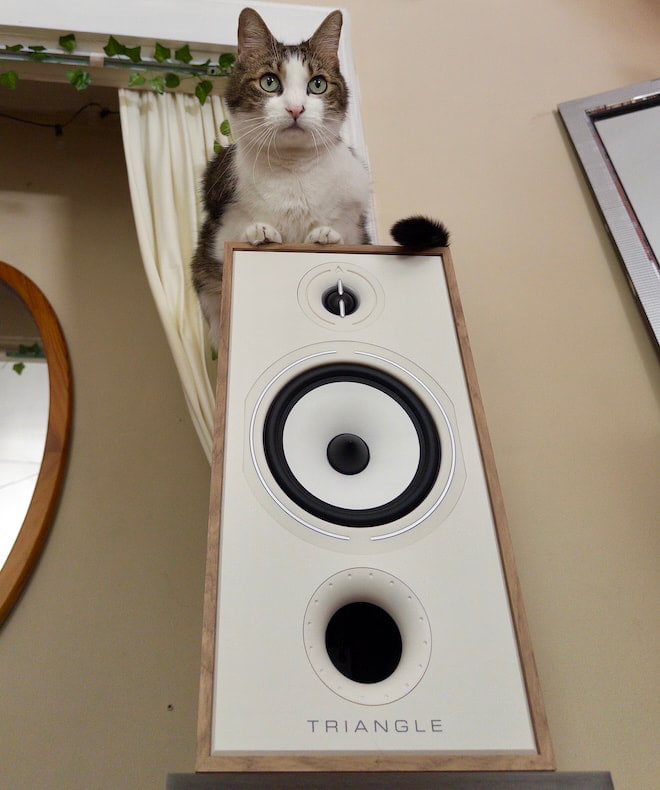
I purchased the Triangle Borea BR03 in 2020 to replace a pair of ELAC Debut 2.0 B6.2s in our living room. This was partly about upgrading the sound quality and mostly about the way the BR03 looked. Fortunately, they sounded great, too. I was immediately surprised and delighted by how much livelier and more detailed the BR03 sounded compared with the ELACs they replaced. Six years, multiple apartments, and two daring and adventurous cats later, that same pair of BR03s remains the centerpiece of our home theater setup.
That history meant I had a pretty good idea of what to expect when Triangle sent over the new, larger Borea BR04 for review. On paper, it seemed like a straightforward proposition: take what worked about the BR03, extend the frequency response, increase its sense of scale, and create a more capable version of essentially the same speaker.
The BR04 is clearly the more capable loudspeaker. It is more dynamic, extends lower in the bass and higher in the treble, creates a larger and more immersive soundstage, and does a substantially better job of separating individual elements within a dense mix. It also disappears into the room in a way the BR03 never quite manages.
Related Reviews:
The Case for the BR03

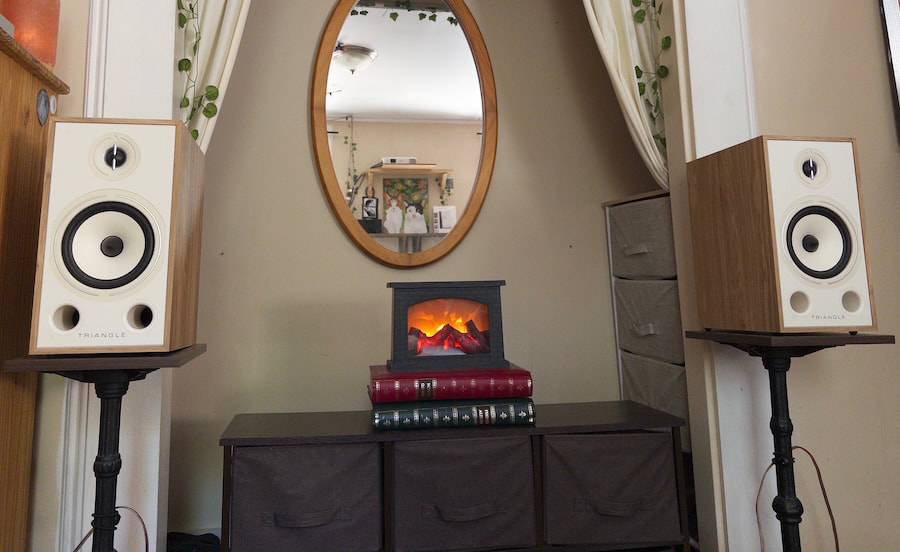
And yet… after six years of living with the BR03, I’m not ready to call the BR04 the better speaker without qualification. The BR03 sounds smaller, more colored, and less technically accomplished by comparison. But some of those same characteristics are also part of what made it such an easy speaker to live with in as many different arrangements as we have.
What I expected to be a simple question of how much Triangle had improved the BR03 became a more interesting one: Is the BR04 really an upgrade to one of my favorite affordable bookshelf speakers, or is it a different beast entirely?
What I wasn’t expecting was how difficult it would be to declare the BR04 the better speaker without qualification. The BR04 is clearly the more capable loudspeaker. It is more dynamic, extends lower in the bass and higher in the treble, creates a larger and more immersive soundstage, and does a substantially better job of separating individual elements within a dense mix. It also disappears into the room in a way the BR03 never quite manages.
The BR03 sounds smaller and more contained by comparison. Its presentation is more rolled off at both ends, its frequency response sounds less even, and it fails to render the same degree of resolution or spatial definition.
But I don’t necessarily prefer the BR04 for everything.
In my listening space, and without any equalization applied, the BR03’s relatively elevated lower midrange and upper bass give it a fuller, arguably more cohesive presentation, while its less prominent upper midrange makes it considerably more forgiving. The BR04 can occasionally become a little jarring with dense, loud mixes that have a lot of energy around 2 kHz. The BR03 smooths over some of that information, but this coloration can work in its favor.
Bigger Cabinet, Same Basic Formula

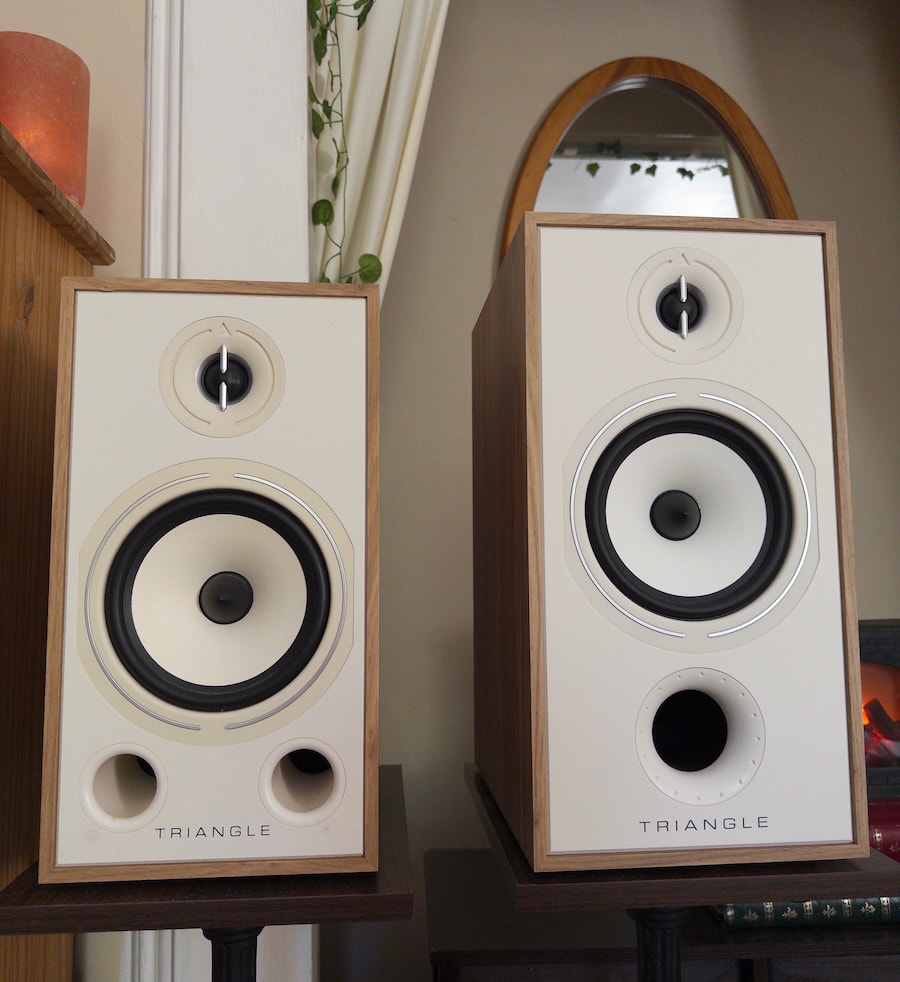
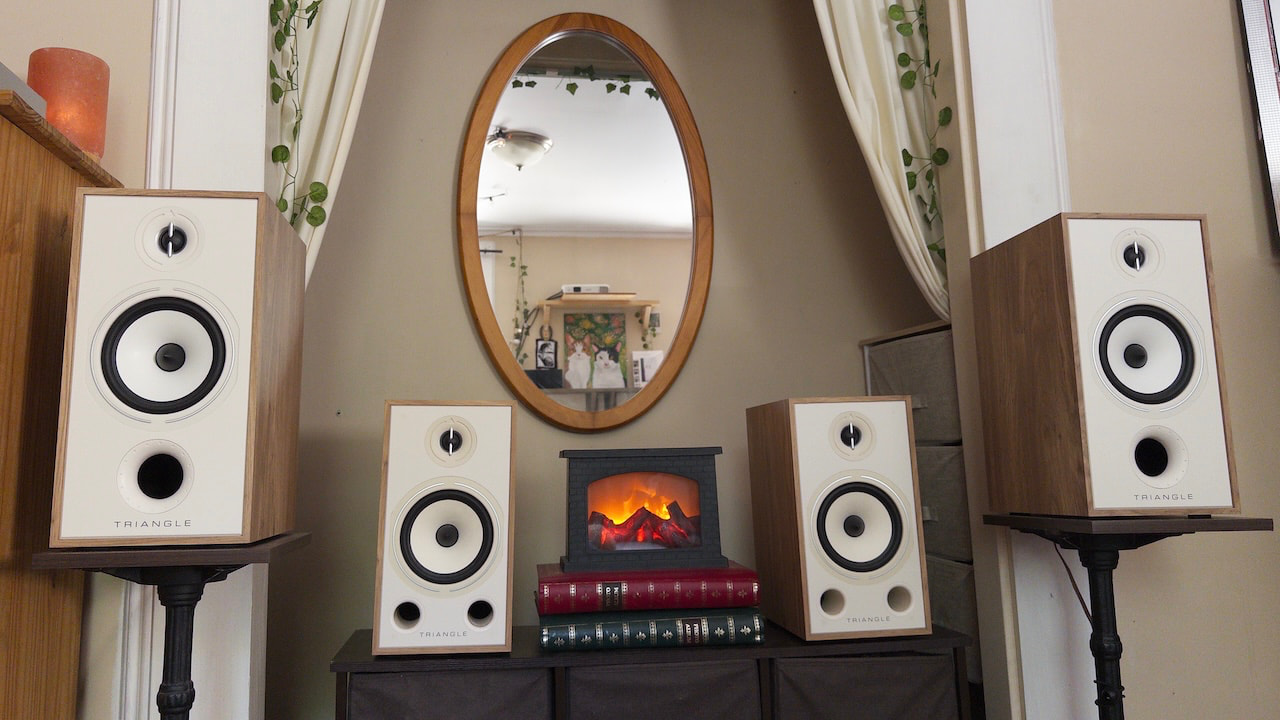
The BR03 and BR04 share the same basic two-way design, with Triangle’s 25mm EFS silk-dome tweeter and a 16cm cellulose midrange/bass driver, but the BR04 is physically larger. The BR03 measures 8.1 x 15.0 x 12.4 inches, while the BR04 grows to 8.7 x 16.7 x 12.4 inches. The extra height and width give the BR04 a larger cabinet volume without increasing depth, which helps explain some of the added scale and low-frequency extension I heard.
Triangle rates both speakers at 90dB sensitivity with a nominal 8-ohm impedance, so the BR04 is not easier to drive. The BR03 is rated down to 46Hz, while the BR04 reaches 44Hz and also uses a revised 16cm driver, redesigned front port, and a lower 3.2kHz crossover point compared with 3.6kHz for the BR03. The BR04 also adds dual binding posts for bi-wiring or bi-amping.
The BR03 is offered in Light Oak, Black Ash, Walnut, and White. The BR04 expands the palette to Light Oak, Black Ash, White, Chestnut, Green, and Blue. It is still recognizably a Borea, but it looks and feels like the more substantial loudspeaker before you even turn it on.
Specifications: BR03 vs. BR04
| Specification | Borea BR03 | Borea BR04 |
|---|---|---|
| Speaker type | 2-way bookshelf speaker, front bass reflex | 2-way bookshelf speaker, front bass reflex |
| Price per pair | $599 | $649 |
| Recommended room size | 10–35 m² | 10–40 m² |
| Tweeter | 25 mm silk-dome EFS tweeter | 25 mm silk-dome EFS tweeter with EFS waveguide |
| Midwoofer | 16 cm natural-cellulose-pulp membrane | 16 cm natural-cellulose-pulp membrane |
| Frequency response, ±3 dB | 46 Hz–22 kHz | 44 Hz–22 kHz |
| Sensitivity | 90 dB | 90 dB |
| Nominal impedance | 8 Ω | 8 Ω |
| Minimum impedance | 4.2 Ω | 4.6 Ω |
| Crossover frequency | 3,600 Hz | 3,200 Hz |
| Recommended amplifier power | 80–500 W | 25–130 W |
| Bi-wiring / bi-amping | – | Yes; double binding posts |
| Cabinet dimensions, per speaker (WxHxD) | 206 x 380 x 314 mm | 220 x 425 x 314 mm |
| Net weight, per speaker | 6.3 kg | 8.6 kg |
| Bass port | Front-facing | Font-facing (Redesigned) |
| Vibration-control technology | – | DVAS driver-vibration absorption system |
| Included accessories | Magnetic grille, rubber feet | Magnetic grille, rubber feet |
| Finishes listed | Black Ash, Light Oak, Blue, Green, White, Walnut | Light Oak, Black Ash, Blue, White, Chestnut Oak, Green |
Listening

For this review, I put together a Reference Playlist featuring the tracks I used to evaluate the Triangle Borea BR03 and BR04, so you can enjoy the music that helped shape my listening impressions.
Caroline Polachek’s “I Give Up” makes the BR04’s technical advantages easily apparent. The BR04 is simply much better at disappearing within the room. Instead of hearing the speaker reproducing the recording, I feel closer to listening directly to the mix.
The BR03 doesn’t sound bad in comparison, but it does sound decidedly more colored and contained.
When the chorus enters at 2:20, the difference becomes particularly obvious. The BR03 takes on an almost lo-fi quality compared with the BR04, which keeps the individual elements of the production tighter and more distinct while allowing the overall presentation of the song to expand beyond the physical boundaries of the speakers.
This ability to scale with a recording is one of the BR04’s biggest improvements over the BR03. The tradeoff is that its additional upper-midrange presence can occasionally work against it. With recordings that are particularly dense, or even aggressive, in that region, I sometimes want the BR04 to settle down to the point where it’s worth breaking out the parametric EQ.
There’s a lot happening in Madison Cunningham and Remi Wolf’s “Hospital (One Man Down),” and it provides an even better demonstration of the BR04’s improved separation capabilities.
Multiple layers of vocals and distorted harmonies compete with an intricate, plodding rhythm section and baritone guitar that sometimes doubles the vocal melody an octave beneath it. The BR04 does a far better job of keeping all of these elements present and distinct.
Through the BR03, the same mix becomes noticeably more congested and less defined due to unevenness in the frequency response and the resulting audio masking.
But there’s an important distinction between congestion and unpleasantness.
The BR03 mushes these elements together somewhat, but it does so over a relatively full lower-midrange foundation that results in a balanced and listenable rendition of the song. The BR03 offers up less access to the intricacies of the mix, but the vibe and spirit of the production still come through in a way that feels satisfying.
That, and the speaker’s retro-futurist MCM aesthetic, continue to make the BR03 an astounding value for the money.
The differences become considerably less pronounced with a more sparsely arranged recording. On Ethan Gruska’s “Reoccurring Dream,” the BR04 still creates a clearer distinction between the vocal and the double-tracked acoustic guitars, but the BR03 doesn’t sound especially lacking in detail. In fact, its more subdued upper midrange can make the presentation feel a bit smoother.
It’s when the arrangement begins expanding that the BR04 pulls ahead again.
At around 2:00, as the twinkly guitars and deeper, reedier instrument enter, the BR04 seems to grow along with the arrangement. The soundstage stretches out wider, taller, and deeper as the additional elements occupy their own spaces.
The BR03 doesn’t have the same ability to expand. Its presentation remains comparatively fixed between the speakers even as the recording itself gets larger.
The string build around 2:00 in Andy Shauf’s “Early to the Party” might be my favorite demonstration of that difference. Played back at approximately the same level, the crescendo feels considerably more dynamic through the BR04. The arrangement progressively grows wider, taller, and deeper before giving way to Shauf’s characteristically dry vocal, which feels all the more intimate because of the contrast conveyed.
Through the BR03, the build largely feels like it is taking place between the speakers from start to finish. Through the BR04, it begins between the speakers but gradually expands to take over the room, making the crescendo feel considerably more exciting and impactful.
That distinction gets at what I think the BR04 does best. It isn’t simply providing more detail; it is preserving and reproducing more of the scale and dynamic structure of the mix.
Listening With WiiM RoomFit
Running WiiM RoomFit on both pairs of speakers improved their overall tonal balance, but it didn’t erase their fundamental differences. With correction engaged, the BR04 still sounds considerably more refined and immersive. Its stronger separation, larger soundstage, and greater sense of depth remain intact, suggesting that the differences between these speakers extend beyond simple variations in raw frequency response.
Room correction makes the BR03 sound like a better-balanced BR03. It doesn’t turn it into a BR04.
Fabric Speaker Grilles & Bass Extension
One thing I would avoid with the BR04 is its included magnetic fabric grille. To my ears, the speaker sounds noticeably more rolled off with the grille attached — enough that I preferred listening with it removed. It also negates the MCM look of the speakers that I love.
Neither speaker eliminates the need for a subwoofer if you’re looking for convincing reproduction of sustained sub-bass frequencies. The BR04 digs noticeably deeper than the BR03, but there are still limits to what either bookshelf speaker can reproduce in the bottom octave.

The Bottom Line
For music playback, the BR04 is not a subtle upgrade. It offers stronger dynamics, deeper bass extension, greater treble extension, better separation, and a much larger spatial presentation. Most importantly, it creates a clearer window into a mix with considerably less masking. On dense arrangements, that difference is often dramatic.
But the BR03 remains unusually easy to recommend. Its presentation is more colored, less extended, and less technically impressive, but its relatively relaxed upper midrange makes it an extremely versatile loudspeaker. It’s a bit more forgiving of mediocre recordings and mixes, which makes it well-suited for general-purpose living-room duty, and it’s every bit as attractive as the more expensive BR04.
If I were primarily building a system for critical music listening, I would want the BR04. If I wanted an affordable pair of attractive speakers for casual music, television, and movies, the BR03 continues to make an awfully strong case for itself.
The BR04 shows just how much more Triangle can extract from the Borea platform. The more surprising takeaway might be how little that diminishes what made the BR03 such an exceptional value in the first place.
Triangle Borea BR03
Pros:
- Fuller, warmer, and more forgiving presentation
- Relaxed upper midrange works well with a wide variety of recordings
- Easy to live with for music, television, and movies
- Still delivers satisfying musicality despite being less technically accomplished
- Attractive retro-modern styling
- Remains an exceptional value
- Room correction improves tonal balance without stripping away its character
Triangle Borea BR04
Pros:
- More dynamic and authoritative presentation
- Deeper bass and greater treble extension
- Much larger, more immersive soundstage
- Better separation on dense mixes
- Stronger sense of depth and spatial scale
- Disappears into the room more convincingly
- Reveals more low-level detail and reduces masking
- Scales more effectively as arrangements become larger and more complex
Cons:
- Smaller and more contained soundstage
- Less bass and treble extension
- Noticeably lower resolution and separation
- More congestion and masking with dense arrangements
- Less precise spatial definition
- Does not scale dynamically with complex recordings as well as the BR04
- More colored and less even through the frequency range
Cons:
- Can sound a little aggressive around the upper midrange with dense or hot recordings
- Less forgiving of mediocre recordings and mixes
- Benefits more from EQ in difficult rooms or with challenging material
- Magnetic fabric grille noticeably rolls off the sound
- Still benefits from a subwoofer for convincing deep sub-bass
Our Ratings:
★★★★★★★★★★ Sound Quality
★★★★★★★★★★ Build Quality
★★★★★★★★★★ Value
Our Ratings:
★★★★★★★★★★ Sound Quality
★★★★★★★★★★ Build Quality
★★★★★★★★★★ Value
You must be logged in to post a comment Login