from the never-wrong-prez-just-dying-to-be-wrong-again dept
This is why having a case dismissed with prejudice is important.
Trump’s cronies/donors — who were paid millions to do a job they’d never done before — failed to bring the Lincoln Reflecting Pool up to spec by July 4th, preventing Trump from taking sole credit for everyone else’s hard work while turning the nation’s 250th birthday into a celebration of himself.
When the “American flag blue” undercoating began floating to the surface and the rest of the pool turned green due to the completely expected explosion in algae growth, Trump decided it would be better to arrest people for “vandalism” than throw his financial supporters under the bus.
Former Olympian David Hearn was the big catch. Trump, Interior Department Secretary Doug Burgum, and US Attorney Jeanine Pirro all claimed they had tons of evidence to support felony vandalism charges against their star defendant. Another handful of people were arrested and hit with misdemeanor charges, solely for the purpose of propping up Trump’s “it was vandals!” lies.
Advertisement
But the whole thing fell apart when the cases moved forward. In Hearn’s case, a government witness testified the damage was due to faulty repair work by the contractors, rather than anything Hearn or anyone else had done to the pool. This undercut Trump’s 350-foot vandal attack narrative. It also tanked the case for US Attorney Jeanine Pirro, who moved to dismiss the case due to being misled by the Interior Department, which apparently buried details of the faulty fix in hopes of making Trump’s revenge convictions a reality.
Shortly after dropping the case, Pirro went toe-to-toe with Trump and DOI head Burgum, laying out all the evidence that contradicted Trump’s concocted narrative. Trump responded by attacking Pirro publicly in press comments and Truth Social posts. These attacks included some off-the-cuff remarks that seemed to have teleported in from a 1930s gangster b-movie script:
“Instead of going after the people that did it, the judge went after her and went after her department,” he continued. “And I guess she choked. I don’t know what the hell happened.”
[…]
Trump exclaimed minutes later that Pirro “folded like an umbrella.”
Advertisement
I only bring this up again because Trump has clearly demonstrated that umbrellas are impossible to “fold.”
Anyway, back to the point of the post: having a prosecution dismissed with prejudice means the government doesn’t get a second chance to do the wrong thing. The DOJ in general never does this because… who knows? Maybe some precedent will get handed down that revives a case. Maybe the cold case kids will find some sort of unidentifiable powder in the evidence locker. Or maybe the fucking president of the United States will just start ordering people to do the same thing again, only harder.
White House officials have asked the Justice Department to consider a new prosecution of a man accused of vandalizing the Lincoln Memorial Reflecting Pool, according to people familiar with the discussions, as President Trump fumes over U.S. Attorney Jeanine Pirro’s decision to drop the case.
[…]
Advertisement
After White House outreach, Justice Department officials are exploring whether another type of case—likely based on misdemeanor allegations—is even possible.
And we’re right back where we started: with Trump trying to punish a US citizen because Trump embarrassed himself.
This isn’t going to end well for Trump. I mean, I would hope. The presiding judge is still trying to find out why the DOJ didn’t dismiss the charges against Hearn with prejudice, given that it had admitted in court that there was no evidence to support them.
And Hearn himself isn’t letting this go. If the DOJ decides to try again, this will vastly increase the chances the presiding judge will give his lawyers access to the grand jury materials he’s been requesting ever since the government’s witness testified (before the grand jury) that any so-called “vandalism” was actually just the side effects of a botched rush-job performed by under-qualified contractors better known for their loyalty to Trump than their specific set of skills.
Advertisement
Trump is too stupid to recognize this will only result in more damning evidence of his self-serving hubris. Pirro knows this case is fucked so it’s highly unlikely she’ll be willing to do what Trump is demanding. And no one in the administration with the intelligence to recognize why this is a terrible idea is willing to do anything but appease the madman they’ve chosen to serve at the expense of their own credibility and future employment opportunities. Let’s hope this all goes as badly as it should for Trump. After all, he’s earned it.
You’re not just imagining things: today’s engines are using much thinner motor oil than they used to. In fact, more than 70% of new vehicles sold in 2024 specified 0W-20 or thinner oil from the factory… and even lower-viscosity formulations are expected to arrive in the coming years. It’s recommended because modern engines have their internal components manufactured with tighter clearances, more advanced materials and coatings, and lubrication systems designed specifically around low-viscosity fluids.
But that might be concerning to those used to using thicker motor oils. Rest assured, oils such as 0W-16 and 0W-20 are not a compromise in engine protection… so long as they’re what’s recommended. It’s part of a larger engineering shift intended to improve fuel economy and help modern vehicles meet contemporary emissions requirements. Modern manufacturing can make engine parts with tolerances measured in microns. That leaves significantly smaller gaps than those found in older engines, and that means significantly thinner oil. Advanced coatings and hardened bearing surfaces also come with greater resistance to wear, meaning there’s less of a need for thick oil to prevent metal-to-metal contact. Overall, today’s thinner oil comes with a 2% to 4% improvement in fuel economy over something thicker like 5W-30, not to mention faster lubrication during cold starts.
Advertisement
Not sure what viscosity rating to use? Look to the manual
Jag_cz/Shutterstock
It seems the age-old assumption that thicker oil means greater protection simply doesn’t account for how modern engines are designed. In fact, using thicker oil can come with downsides such as increasing viscous friction and making the oil harder to pump through tight passages. That additional resistance could increase fuel consumption, raise operating temperatures, slow the delivery of oil during startup, even interfere with internal systems such as variable valve timing.
That doesn’t mean thinner oil is always better, though. Older engines might still need thicker oil to maintain an adequate protective film because that’s how they were designed. Your best bet is to just follow the viscosity specified by the manufacturer.
Of course, it helps to understand motor oil viscosity ratings. The first number in a designation (such as 0W-20) describes cold-temperature flow. The lower number indicates that the oil moves more readily in cold conditions. Meanwhile, the second number describes viscosity at normal operating temperature. So, with that in mind, 0W-16 would be thinner than 0W-20, while 0W-20 would be thinner than 5W-30. This should help you get a better idea what you need.
‘Shall I compare thee to a summer’s afternoon’ is the sort of thing this will make, and others look likely to adopt it
In an effort to “watermark” text that Claude has generated and comply with the EU AI Act, Anthropic ib Friday unveiled a plan on Friday to modify its bots’ choice of words in a way that would be detectable as the product of an AI.
Traditional watermarks are patterns or images overlaid on currency, postage, or official documents as an assertion of authenticity. In the digital realm, the term is more flexible and can refer to a variety of techniques for applying an identifier to electronic data.
Advertisement
Anthropic’s approach involves influencing inconsequential word choices made by its models, a technique introduced in Google DeepMind’s SynthID-Text paper.
To oversimply things, large language models are fancy autocomplete engines which work by predicting the next word in a sequence of words. Anthropic explains that while composing sentence output like “The weather today was cold and…” a model like Claude might respond with words like “cold” or “gray” and would be unlikely to respond with a word like “sugary.”
That’s the theory, but when actually asked to complete that sentence, Claude Opus 4.8 went a bit overboard: “…crisp, the kind of cold that nips at your fingertips and turns your breath to little clouds. The sky was a pale, washed-out blue, and everything felt sharp and clear.”
And then it checked to see if users thought that was useful, asking “Want me to take it somewhere specific — cozy, gloomy, cheerful? Or keep going with the same tone?”
Advertisement
But remove whatever training has been applied to promote engagement and simulate literary style, and that’s basically what Claude is doing here – predicting the next word in a sequence.
Anthropic asserts that in most cases, the example sentence could be completed by either “cold” or “gray” and “the meaning of the sentence is largely the same either way.”
The watermark gets generated by deviating from the predicted word to something else. A different source of randomness is used and that can be detected with a digital key.
As Google DeepMind researchers explain in their paper: “Generative watermarking works by carefully modifying the next-token sampling procedure to inject subtle, context-specific modifications into the generated text distribution. Such modifications introduce a statistical signature into the generated text; during the watermark detection phase, the signature can be measured to determine whether the text was indeed generated by the watermarked LLM.”
Advertisement
Anthropic insists this will be done with low-stakes passages in a way that won’t alter the meaning. “In internal testing, we’ve seen no impact of watermarking on the content, level of creativity, or readability of Claude’s text,” the company said, adding that in a controlled study, human raters saw no difference in quality between watermarked and unwatermarked answers.
That assumption hinges on not applying the watermark to any consequential text. As Anthropic puts it, “Watermarking is sparser on factual passages where there are fewer choices that can be made without decreasing the accuracy of the text.” The biz goes on to say that the situation is similar with code – the watermarking algorithm can’t simply start swapping method names.
In the context of literature, the notion that some words are interchangeable is likely to raise a few hackles. While it may be a satisfying thought experiment to imagine Claude emitting, “It was the best of times, it was the least of times…” or “Telephone me Ishmael”, anyone trying to pass off generated text as serious writing probably should face whatever social backlash watermarking may entail.
On the plus side, Anthropic’s flavor of watermarking isn’t excessively intrusive. It doesn’t involve any personally identifying information and only serves to indicate that Claude was probably involved at some stage of the creation of the marked text.
Advertisement
What’s more, the technique is expected to be only semi-effective. In its FAQs, Anthropic points out that some amount of editing should erase the watermark.
“Light editing probably won’t remove the watermark completely; a complete rewrite where every word is replaced will,” the company said. “In the latter case, of course, it’s arguable whether the text can any longer be described as AI-generated.”
In all likelihood, Anthropic doesn’t care if its watermarking scheme can be defeated. The company’s post makes clear that it is implementing it to demonstrate its attempts at compliance and has chosen a solution that doesn’t raise costs.
“Watermarking has a negligible impact on the speed of models, and because it produces no extra tokens, the model is the same price to serve and use,” the biz said.
Advertisement
Hey Claude, what’s another word for performative compliance? ®
[The Modern Rouge] found an old childhood friend in a closet: a Radio Shack 200-in-1 electronic kit. Along with [Josh Nass], he put it through its paces and made a few repairs along the way. As you might expect, the batteries had long ago leaked out their magic juice.
If you missed these, they were a host of real electronic components with springs connected to the leads. To make a circuit, you bend the spring over, insert a wire, and let go of the spring. By changing the wiring, you could make radios, alarms, computer circuits, and more
There were dozens of these kits, some more capable than others. This was a particularly nice one with a loaded front panel and several exotic components. In the end, they made a code practice oscillator, and it worked.
Advertisement
While you can’t find kits exactly like these anymore, you can make your own. Or try Snap Circuits and print your own modules. You take solderless breadboards for granted today, but they haven’t always been around or affordable.
Volume and spend on tokens for Anthropic’s AI solutions made it more revenue than any of its competitors in July 2026, cementing its position as the top LLM provider
This success is despite Anthropic’s tokens being more expensive than its competitors
The data was collated by Vercel’s AI Gateway, an API service that routes LLMs for easy AI provider swapping
Monthly analysis of the AI industry has revealed a number of surprises for July 2026, not least the continued growth of Anthropic both in terms of revenue and token use.
This is despite the company charging a higher rate for tokens, AI’s computational data currency.
The data was compiled by agentic infrastructure company Vercel, whose AI Gateway is used by many major companies and developers, and found the price-per-token average across all analysed platforms fell following two months of growth in May and June. Despite the overall 37% increase in spend across the industry, the cost per token rate dropped.
Latest Videos FromTechRadar
Advertisement
Anthropic growth
Vercel’s analysis of transactions through its APIs has repeatedly demonstrated a dominance for Anthropic. Its reporting on gateway spend started in December 2025 and in every month since, Anthropic has had over 60% of the spend share, and in July that figure sat at 65.1% with 30% of the total volume (of all tokens sent through the Vercel AI Gateway).
Yet the average price per token was on 4.4 times higher than the overall average across all AI labs. Token prices have rarely proved to be steady, with Vercel’s data reporting an average price drop of 13.6% after a 20% rise in May and little change in June.
(For reference, the report’s definition of the price per token is the total spend divided by the total volume.)
Despite a higher price per token, however, Anthropic’s price per token was lower in July, a change attributed to the return to public access of Claude Fable 5 after its temporary suspension.
Sign up to the TechRadar Pro newsletter to get all the top news, opinion, features and guidance your business needs to succeed!
Advertisement
Monthly data collection
Vercel’s monthly look at the data that flows through its API paints a fascinating picture not just of Anthropic’s growth, but of the performance (or otherwise) of its competitors.
For example, it charts Chinese AI company DeepSeek’s surprise growth from May, through June; the report notes that “we said an open-weight lab would soon be second by volume. In July, DeepSeek surpassed Google to take that place.”
DeepSeek’s growth over Google has proved to be a surprise, one that puts it in second place on volume. The real story is Anthropic’s gradual cementing of its strong position over the rest of the LLM makers. Its larger revenue pull despite higher token price indicates that the recent iterations of Claude and anticipation over the gradual release of Mythos 5 are giving the company a strong reputation – much like Apple.
Bought the wrong game or want your money back for an Xbox subscription? Here’s what to do.
Digital buyer’s remorse can arrive remarkably quickly. Maybe a game looked much better in the trailer, you bought the wrong edition or you finally noticed that subscription quietly renewing in the background.
Fortunately, an Xbox purchase isn’t always a one-way trip. Microsoft accepts refund requests for eligible digital games, apps, add-ons and some other purchases, while Xbox subscriptions have their own cancellation and refund process. There are conditions, though, and buying something by accident doesn’t automatically put the money back in your bank account.
Advertisement
How to refund a game on Xbox
Engadget
You don’t need to hunt around your Xbox dashboard for a hidden refund menu. Digital game refund requests are handled through Xbox Support online.
Select the game or other eligible purchase you want refunded.
Choose Request a refund.
Give Microsoft the reason for the request, then select Next.
Check that everything is correct and select Submit.
If Xbox approves the refund and starts processing it, you’ll also lose access to the digital game product.
Advertisement
What Xbox purchases are eligible for refunds?
Now, this is where things get less automatic.
Xbox says refunds for digital games are typically issued if the request is made within 14 days of purchase and the player hasn’t accumulated a “significant amount” of playtime. Microsoft does not specify exactly what qualifies as significant, so there is no published hour count that guarantees your refund will sail through.
The 14-day guideline also isn’t the absolute end of the road. Xbox allows game refund requests to be submitted within 90 days of purchase, although Microsoft makes clear that not every request will be accepted, and it can impose limits on the number, type or monetary value of refunds granted to an individual purchaser during a year.
The policy covers Microsoft Store digital game offers, Xbox apps (excluding movie and TV apps), digital gaming bundles, durable game content and some consumable content. Most in-game consumables and virtual currency stop being refundable once they’ve been purchased or used.
Advertisement
Pre-orders get their own small escape hatch. Xbox says you can cancel a digital game pre-order through your order history up to 10 days before launch; once billing has taken place, you may need to request a refund instead.
How to get a refund for an Xbox subscription
Bangla press/Shutterstock
Microsoft makes this slightly more fiddly than it needs to be. Turning off recurring billing stops the next charge, but your subscription stays active until the paid period runs out. If that’s all you’re after, you can cancel or downgrade your Xbox Game Pass subscription to prevent future payments.
Getting a refund for the last payment that processed has a few more rules. Under Microsoft’s standard policy, a subscription may qualify for a refund within 30 days of the initial purchase or before the first recurring billing date, whichever comes first. The most recent recurring charge may also qualify if you cancel within 30 days of payment, though Microsoft limits that refund right to one time per account for each Xbox subscription product.
Advertisement
If you’re eligible, Microsoft will offer the option to cancel immediately with a refund. But remember, prepaid codes follow the retailer’s return policy, while some countries have additional prorated refund rights.
How long does an Xbox refund take?
Xbox refunds aren’t instant. Microsoft says the request itself can take up to 72 hours to process. If the refund is issued, the money is generally returned to the original payment method within another three to five business days, although the bank or payment provider can take longer to post it.
Advertisement
So if Microsoft already shows the refund as issued and your balance still looks stubbornly unchanged, the bank is the next place to check rather than firing off another refund request. Microsoft specifically tells customers to allow a few days for the payment provider to process an issued refund.
A denied request works differently. Xbox says you can appeal by replying to the email containing its decision, but you cannot submit the exact same refund request again through the refund page.
On March 13, Nine PBS reportedly sent a letter to Iron Mountain stating that it would “pay any reasonable costs associated with” accessing the data.
After allegedly being unable to communicate with OSS, Nine PBS eventually won a default judgment against the company in the St. Louis Circuit Court, which found that Nine PBS had the “immediate right to possess the data,” according to the complaint. The court also ruled that OSS must return the data “and/or facilitate its transfer to a new vendor,” the complaint says.
However, Iron Mountain refused to give Nine PBS the data because it only has a contract with OSS and, according to Nine PBS’ complaint, because OSS owns “the physical services housing the data.”
Iron Mountain’s spokesperson told Ars that the company only provides physical infrastructure, such as the building, network connectivity, power, and environmental controls.
Advertisement
“Our customers rent space for their servers and other hardware. These are the client’s assets. We don’t have access to the data on the hardware/servers because they belong to our customers,” the company said.
Iron Mountain said the company would violate basic data privacy protocols, breach its contract with OSS, and “potentially [expose] confidential data belonging to other clients of OSS” if it granted “unauthorized access to third-party hardware without a court order.”
Ars asked Nine PBS if it had any backups of the data and what the station would do to prevent this from happening again, but we didn’t receive answers as of publication time.
Nine PBS VP and chief communications officer Leah Freeman shared a statement reading:
Advertisement
We appreciate the Court’s thoughtful decision establishing a path forward to access and recover our archival materials, which the Court confirmed that Nine PBS rightfully owns. These archives represent an important part of our region’s history, and we look forward to ensuring their preservation and protection through the Court-approved process.
As I’m writing this review, I’m surrounded by an abundance of glowing red stars decorated all over my desk. It’s hard not to feel relaxed here, thanks to the beautiful desktop, which can be activated in specific areas by your touch, or turned onto a setting that allows them to twinkle manually all across the glass panel.
When it comes to the best gaming desks or best standing desks, the Eureka Ergonomic Wonder Glowing Glass Desk is suitable for both categories. This makes it a good all-rounder for those wanting to effortlessly move between office work and gaming.
Advertisement
This is my first time using one of Eureka Ergonomic’s desks, and I am impressed. The Wonder Glowing Glass Desk has been my daily companion for the past two months as I’ve written reviews, played games, and completed life admin. It’s survived all of this effortlessly, with enough space for me to have both my work laptop and my gaming laptop side by side for those days when I need to switch between the two.
Latest Videos FromTechRadar
It also has enough room for me to decorate it with personal items to make it look more like “me”. I hate having a boring workspace, after all. So aesthetically and functionally, it does tick a lot of boxes.
Advertisement
My main problem is that the desk does feel quite high, even when it’s on the lowest setting. This isn’t necessarily a fault of Eureka’s, but it’s a word of warning if you are short and you’re looking for a desk to suit your needs. I’m 5ft 4in, and I think anyone under that would struggle with this desk.
I tested the desk with my partner, who is taller than me at around 6ft 3in, and he was able to comfortably use the desk at its lowest setting. If you are on the shorter side, it’s worth choosing your chair well to make sure you can work comfortably based on this.
Advertisement
Eureka Ergonomic Wonder Glowing Glass Desk: Price and availability
Prices start at $899 (around £665)
Only available in the US, but does ship to the UK
Available in one size with a black, oak, or black walnut finish
Eureka Ergonomic’s Wonder Glowing Glass Desk only comes in one size, but there are price differences when it comes to the materials used on it. The black one (pictured throughout this review) is priced at $899, whereas the oak or black walnut versions are $999.
Sign up for breaking news, reviews, opinion, top tech deals, and more.
It’s a very well-made and sturdy desk, and has a classic design which means it’s right at home in most office spaces. It’s also not as large and imposing as other desks of its kind, so it’s a good choice if you want a smaller desk that’s also under $1,000.
However, it’s important to note that the Eureka Ergonomic Wonder Glowing Glass Desk’s price tag puts it at the premium end of the market. This pricing is in line with the $949 / £829 Secretlab Magnus Pro XL, depending on which material you choose.
The Wonder Glowing Glass Desk’s finish makes it ~$50 more expensive if you go for oak or black walnut, but it works out ~$50 cheaper than Secretlab if you opt for the standard black model.
Advertisement
Ultimately, you are paying for the unique and responsive lighting design across the desk, as well as the materials used. So if you’re not really bothered by the glowing features of the desk, you might want to choose a cheaper option. I think this is worth the price given its unique selling point and overall quality.
The Eureka Ergonomic GTG Wave has a similar RGB vibe at a much smaller price of $599.99, without the touch-sensitivity that the Wonder Glowing Glass Desk has. It is also not a standing desk, so it does not boast that additional feature.
If both Eureka Ergonomic and Secretlab are out of budget, however, we recommend the $340 / £360 / AU$420 Flexispot E7, a 5-star rated standing desk which is budget-friendly but does not skimp on the quality.
Eureka Ergonomic primarily sells to the United States, though they do have retail partners in the UK and select European countries; however, our Aussie readers won’t be able to get their hands on any of Eureka’s products right now, as they currently don’t ship to Australia.
Advertisement
Eureka Ergonomic Wonder Glowing Glass Desk: Specs
Swipe to scroll horizontally
Row 0 – Cell 0
Eureka Ergonomic Wonder Glowing Glass Desk
Price
$899 – $999
Advertisement
Height
29.5in ~ 47.25in / 74.93cm ~ 120cm
Load capacity
220lbs / 100kg
Advertisement
Material
Frosted Glass /Thermofoil top frame, Alloy Steel, Carbon Steel base frame
Dimensions (H x W x D)
29.5in ~ 47.25in x 23.625in x 47.25in / 74.93cm ~ 120 cm x 60 cm x 120 cm
Advertisement
Eureka Ergonomic Wonder Glowing Glass Desk: Design and features
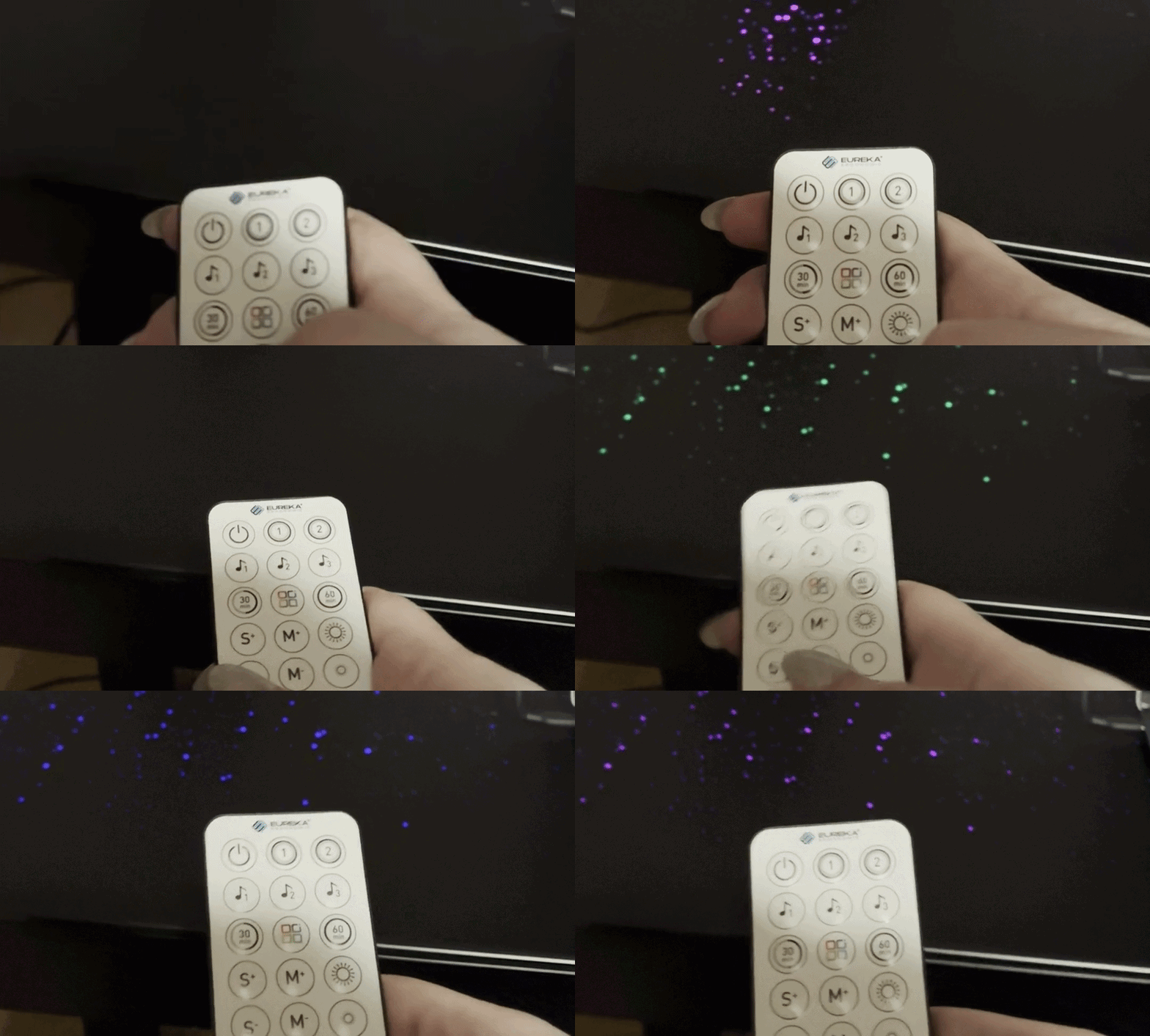
Remote control allows you to adjust the light color and patterns
Dual-motor frame that adjusts from 29.5” to 47.2”, great for converting to a standing desk
Beautiful star-like lighting covers the entire desk
By far the biggest selling point of the Eureka Ergonomic Wonder Glowing Desk is the starry lighting across the entire thing. It makes it a unique choice and really pretty to look at.
Eureka describes the desk as being an “industry-first luminous desktop that reacts to your touch”, and it is seriously cool. It feels more special than your standard RGB setup as it covers the entirety of the desktop and responds to your touch instantly, without any delay. You can draw patterns, drum on the desk, and do other wonderfully distracting things whilst you’re meant to be working.
The lighting setup is a fun addition which livens up your workspace whilst still keeping a sleek and polished aesthetic, and you can easily turn the desk lights off to switch between fun and serious. The touch-activated lighting does not make it any less of a professional standing desk; it merely adds to it.
(Image credit: Future / Lucy Buglass)
You do need to plug the desk into a socket, of course, but as long as you have one nearby, you can play around with the lights til your heart’s content.
Advertisement
If you like, you can also choose to have twinkling lights on the desk without you needing to touch the material. This is a good option if you want to get on with things whilst being surrounded by a starry backdrop that manually moves without needing your input.
It’s easy to cycle between the different colors and light patterns thanks to an included remote control, which I’ll demonstrate below.
I have been using the desk for both everyday work and gaming. Even though it is a fairly compact desk and fits nicely into my attic, I should warn you that it is a heavy and also very fragile desk with glass elements. I would strongly suggest you ask someone to help you if you want to take the boxes upstairs, as even before assembly they are cumbersome.
The same can be said for building the desk. This is very much a two-person job, and you need to be extremely careful not to shatter the glass panel on the desktop. Once it is built, however, it is very robust, and I am confident that it will stay stable due to weeks of regular use. It is also easy to build thanks to printed instructions that clearly outline what you need to do.
Advertisement
If you have a bigger setup than me and require cable management, the desk does feature some. Underneath the desk are five slots for you to organize your cables, securely fastened in when you assemble the desk. It’s hidden away. Due to my minimal setup, I only have one cable running through this, the one that’s connected to the desk itself, but it can handle the wiring associated with a more complex PC setup.
(Image credit: Future / Lucy Buglass)
The desk also easily converts to a standing one thanks to a touchscreen console on the front of the desk. It is easy to use, and there wasn’t any stiffness or delay in converting the desk between the seated and standing positions.
I really can’t fault the performance, and in my experience, this is a solid desk that’s very nice to use every day. It feels professional and well put together, and everything operates as it should.
(Image credit: Future / Lucy Buglass)
Advertisement
Should I buy the Eureka Ergonomic Wonder Glowing Glass Desk?
Buy it if…
Don’t buy it if…
Also consider
Not keen on the Eureka Ergonomic Wonder Glowing Glass Desk? Here’s one cheaper gaming desk (without standing conversion) to consider and a much more budget-friendly standing desk.
Advertisement
Swipe to scroll horizontally
Row 0 – Cell 0
Eureka Ergonomic Wonder Glowing Glass Desk
Eureka Ergonomic GTG Wave
Flexispot E7
Price
Advertisement
$899 – $999 /
$599.99 /
$340 / £360 / AU$420
Height
Advertisement
29.5in ~ 47.25in / 74.93cm ~ 120cm
30in / 76cm
22.8-48.4in / 58-123cm
Load capacity
Advertisement
220lbs / 100kg
200lbs / 90kg
275lbs / 125kg
Material
Advertisement
Frosted Glass /Thermofoil top frame, Alloy Steel, Carbon Steel base frame
Steel, tempered glass
Steel
Dimensions
Advertisement
29.5in ~ 47.25in x 23.625in x 47.25in / 74.93cm ~ 120 cm x 60cm x 120cm
60 x 40in / 152 x 102cm
43.3-74.8 x 26.7 x 22.8-48.4in / 110-190 x 68 x 58-123cm
Advertisement
How I tested the Eureka Ergonomic Wonder Glowing Glass Desk
Used as my main desk
Tested over multiple weeks
Extensive work and play
I used the Eureka Ergonomic Wonder Glowing Glass Desk as my main desk for two months for this review. In that time, I played a huge variety of games on my gaming laptop, and I also did everyday work on my MacBook Air while sitting adn standing at it.
I spent a lot of time playing around with the lights and trying out the different settings, as well as testing it out in both its seated and standing modes.
– Already deep into its development cycle – Set to be released in 2027 – No trailer available to watch yet – Vast majority of its main voice cast set to return – Other characters due to join its ensemble – Season 2 finale drops big clue about the direction of its plot – Season 4 already in the works
Rejoice, Marvel fans, because X-Men ’97 season 3 is already deep into its development cycle. That means we’ll see it sometime in 2027, which is a welcome change from the two-year gap we had to endure between the animated show’s first two seasons.
Of course, we don’t know its actual return date on Disney+, but other things have been revealed and teased about X-Men ’97‘s third outing. Luckily for you, I’ve rounded up the most important details below, so don’t delay — scroll on to learn all there is to know about the series’ third season.
Advertisement
X-Men ’97 season 3 release date: what we know
We’ll be reunited with Rogue and company sometime next year (Image credit: Marvel Animation/Disney+)
As I mentioned, X-Men ’97 season 3 is set to arrive sometime next year.
Latest Videos FromTechRadar
Advertisement
Brad Winderbaum, aka Marvel’s Head of Television, Animation, Streaming, and Comics, confirmed it’ll premiere in 2027 during a chat with comicbook.com. Winderbaum recently doubled down on those comments in a separate interview with Collider.
As for when exactly season 3 will air, I predict it’ll follow in last season’s footsteps and land a mid-year release. Currently, Daredevil: Born Again season 3 is the only other Marvel TV show that’ll drop next year, and rumors abound that it’s eyeing a March 2027 launch. Should that be the case, I doubt we’ll see the X-Men‘s animated series again until June or July 2027.
Advertisement
X-Men ’97 season 3 trailer: is there one?
Me and who as we wait for season 3’s first footage to arrive? (Image credit: Marvel Animation/Disney+)
Nope. However, Marvel is deep into post-production on season 3, so it’s possible that a trailer could be unveiled at New York Comic Con (NYCC) 2026.
Traditionally, Marvel has debuted teasers for new Disney+ shows during past editions of that fan expo. However, those trailers have been shown exclusively to attendees, meaning the rest of us had to wait a long time for them to become publicly available.
Advertisement
Sign up for breaking news, reviews, opinion, top tech deals, and more.
If X-Men ’97 season 3’s first footage is unveiled in October at NYCC 2026, it’ll be a while before the rest of us see it. Regardless, once a trailer is released, I’ll update this section.
X-Men ’97 season 3 cast: confirmed and rumored
You can expect to see almost every member of the eponymous mutant team again next season (Image credit: Marvel Animation/Disney+)
Full spoilers follow for X-Men ’97 season 2.
Advertisement
Based on how last season ended, here’s who I expect to see (and hear) again in X-Men ’97 season 3:
Ray Chase as Scott Summers/Cyclops
Jennifer Hale as Jean Grey
Alison Sealy-Smith as Ororo Munroe/Storm
Cal Dodd as James ‘Logan’ Howlett/Wolverine
J.P. Marliak as Morph
Lenore Zann as Rogue
George Buza as Hank McCoy/Beast
A.J. Locascio as Remy LeBeau/Gambit
Holly Chou as Jubilation Lee/Jubilee
Isaac Robinson-Smith as Lucas Bishop
Ross Marquand as Charles Xavier/Professor X
Chris Potter as Nathan Summers/Cable
Gui Agustini as Roberto de Costa/Sunspot
Gil Birmingham as Forge
Teddy Sears as Havok
Adrian Hough as Strong Guy
Ron Rubin as Multiple Man
Carolina Ravassa as Lorna Dane/Polaris
Naoko Mori as Psylocke
Christopher Barger as Warren Worthington III/Archangel
Randall Carpenter as Mystique
Catherine Disher as Valerie Cooper
Donna Jay Fulks as Trish Tilby
There could be other returning faces/voices from the past two seasons as well.
Will Matthew Waterson’s Erik ‘Magnus’ Lehnsherr/Magneto be among them despite his death in X-Men ’97 season 2, episode 4? And will Waterson also be back to play the Celestial known as Eson the Searcher? Furthermore, will Hough and Marquand also voice Kurt Wagner/Nightcrawler and Apocalypse, respectively, after what happened to them in the season 2 finale? We’ll have to wait and see.
The Marvel Phase 6 TV show’s ensemble is going to grow next season, too.
Advertisement
At San Diego Comic-Con (SDCC) 2026, Winderbaum revealed the Brotherhood of Mutants — Toad, Pyro, Blob, Avalanche, and Surge — will return in season 3. This group was last seen in X-Men ’97‘s forebear, X-Men: The Animated Series, so this will mark their debut in the sequel series. There’s no word on who’ll voice this quintet yet, though, or whether they’ll be officially led by Carpenter’s Mystique, who appeared in season 2, episode 9’s post-credits scene.
X-Men ’97 season 3 story speculation
Is Mystique being lined up as season 3’s primary villain-in-chief? (Image credit: Marvel Animation/Disney+)
X-Men ’97 season 3’s story synopsis hasn’t been revealed yet, but its predecessor’s final episode offered some clues about where the plot will go next.
My X-Men ’97 season 2 ending explained article covers the events of last season’s finale and includes a couple of predictions for the Marvel Cinematic Universe (MCU) adjacent project’s forthcoming season. That should be your starting point for all story-based information on season 3.
Advertisement
As for what else we know about next season’s narrative, very little has been publicly revealed, so it’s difficult to say which Marvel comic book storylines it could pull from. Hopefully, the comic titan will shed some light on next season’s plot at D23 Expo 2026, which runs 14-16 August, and/or NYCC 2026.
Is Marvel working on X-Men ’97 season 4 yet?
The future of X-Men ’97 is just getting started. Brad Winderbaum teases two more seasons of Marvel Animation’s #XMen97 at Tribeca Festival alongside executive producers Julia Lewald, Eric Lewald, and Larry Houston. pic.twitter.com/8Qfnz2fvESJune 14, 2026
Yes. Even better, it’s currently scheduled to be released in 2028 — Winderbaum stated as much in the Collider and comicbook.com articles I linked to in this guide’s release date section.
Where the show’s overall future is concerned, Marvel hasn’t said how many seasons it’ll run for. Larry Houston, who’s worked on X-Men ’97 and X-Men: The Animated Series, told The Direct that five or six seasons feels like the optimal amount. Speaking to POC Culture, though, Houston’s fellow producer Eric Lewald suggested Winderbaum wants to make up to 10 seasons.
Advertisement
With so many X-Men comic book stories ripe for adaptation, there’s plenty more narrative ground for X-Men ’97 to cover. I guess we’ll see how invested audiences are in it with each season that passes before we find its natural endpoint, though.
Apple’s memory woes are continuing, as Commerce Secretary Howard Lutnick has urged Apple not to buy Mac memory chips from Chinese suppliers, despite the continuing supply crisis.
Apple has been testing memory chips from the controversial CXMT as a way to ease the current global chip shortage. However, the politically sensitive move has now led to a warning from the Trump administration, delivered by Commerce Secretary Howard Lutnick.
The Wall Street Journalreported on Friday about the warning to avoid purchasing Chinese chips. Following a tour of the new Apple Advanced Manufacturing Center in Houston, Lutnick told the media, “The Trump administration is not in favor of that.”
Lutnick added there must be other ways to fix the problem, but stressed “It’s not great American companies using Chinese memory.”
Advertisement
When asked if the message was provided to Apple, Lutnick was curt but affirmative, stating “Plainly.”
Releasing the strain
Lutnick’s warning is about Apple’s attempt to work around the high prices and tight supplies of memory affecting the whole tech industry. As part of this, Apple has explored the possibility of securing supplies from Chinese memory suppliers such as CXMT.
The problem is that CXMT is on the Chinese Military Company Blacklist, or 1260H list. The list is a collection of companies that the Pentagon believes have links to the People’s Liberation Army and could be considered a risk to U.S. national security.
While the list doesn’t stop Apple from buying chips from CXMT, it will affect sales. The Defense Department is not able to make agreements with companies on the list, nor use products or services from third parties that use their components.
Advertisement
There’s also the problem of murmurs that CXMT would be put onto the “Entity List,” which would block all trade with the company completely. Even if Apple gained supplies from CXMT and ignored the 1260H list’s consequences, a shift of CXMT onto the Entity List would cut off that supply line once more.
That would put Apple back at square one.
A lot of backlash
Apple petitioned the Trump administration to allow it to buy Mac RAM chips from CXMT on June 27. Since then, it has secured chips for testing and has put them through their paces.
However, there has been considerable pushback against the plan. In July, U.S. memory maker Micron lobbied the White House, alleging that a move permitting the sales from blacklisted Chinese companies would be incredibly harmful.
Advertisement
To Micron, doing so would harm the U.S. tech manufacturing industry in the same way that China decimated U.S. steel and manufacturing plants.
The Republican chair of the House China Committee, John Moolenaar, said it would be a “grave mistake” for Apple to make the deal back in June.
In July, Apple was sent a letter from U.S. senators attempting to convince the iPhone maker to back away from the proposal.
On CXMT’s side, it has rejected a demand from Apple for a discount. It wants to be paid what Apple pays Samsung for memory, reducing Apple’s benefit of securing the new supply line.
Advertisement
To Apple, though, it can at least point to a need for fairness from the U.S. government on the matter.
On August 10, it was reported that rivals HP and Acer already use CXMT memory for hardware sold outside the United States. While it is unclear if HP or Acer asked permission before doing so, they both carried on without penalty.
Modern 5th-generation fighter jets are impressive machines with numerous capabilities that set them apart from prior-generation aircraft. One fighter that tends to get a lot of attention is the F-35 Lightning II, which makes sense. They’re not only operated by the U.S. Air Force, Navy, and Marine Corps, but they’re also flown by many allied nations to the United States. Yet while an F-35 is fast without afterburners, it’s not the fastest U.S. fighter jet in the inventory.
The F-22 Raptor beats the F-35 (and every other fighter) as the fastest without using an afterburner. Afterburners are additional combustion sections of an aircraft’s jet engine. They’re used to directly inject fuel via a controllable nozzle into the exhaust gases, which gives the plane a significant speed advantage for a short time. When an F-35 or F-22 ignites its afterburners, they move through the air at incredibly high speed, but it costs a lot of fuel, so it’s used in short bursts. For regular flight, a fighter typically flies at their cruising speed, which is different for every aircraft.
Advertisement
The F-35’s cruise speed is subsonic, so it cannot achieve supersonic flight without afterburners. With them engaged, the aircraft’s top speed jumps to Mach 1.6 (1,200 mph). The F-22’s cruising speed is Mach 1.5+ (1,151+ mph) and its maximum speed is Mach 2.25 (1,500 mph). The secret of the F-22’s speed is something called “Supercruise,” which is different from afterburners and is where it distinguishes itself from other U.S. fighters. With supercruise, the F-22 can cruise without afterburners much faster than its peers.
Advertisement
Supercruise makes the F-22 special but not unique
Supercruise is one of the things that makes the F-22 Raptor a special aircraft, but it’s not unique — it’s just the best fighter jet at traveling further, faster while burning less fuel. Other aircraft have supercruise capabilities, including the Eurofighter Typhoon and the Dassault Rafale. China’s Chengdu J-20 is rumored to possess the ability as well. Supercruise is defined as a period of sustained supersonic flight without the use of afterburners.
Essentially, the jet engine needs to provide enough thrust to achieve Mach 1 (767 mph), which is difficult due to transonic drag. This is the aerodynamic drag on the aircraft’s forward momentum provided by the atmosphere as it moves through the air at speeds exceeding the speed of sound. The F-22’s Pratt & Whitney F119-PW-100 is one of the most powerful engines used in a production fighter, thanks to its 26,000 lbs. of dry thrust. That number rises to 35,000 with afterburners, which is a lot of power packed into a single airframe.
For comparison, the F-35 uses variations of the Pratt & Whitney F-135 engine with a dry thrust of 25,000 and 40,000 lbs. when afterburners are engaged. That makes the F135 is the most powerful engine used in a production fighter at time of writing. While those dry thrust numbers are close to what the F-22’s engine provides, the F-35 weighs 70,000 lbs., while the F-22 weighs in at 43,340 lbs. Weight and other aspects of each aircraft’s design and shape affect their top speed, and at the end of the day, the F-22 can cruise faster, further, and longer than the F-35, thanks to its superior supercruise ability.

































































You must be logged in to post a comment Login