Tech
Underwater solar power sounds impossible, these new perovskite cells make it work anyway

Sunlight from the Deep: A team of Chinese researchers has developed a novel approach to solar power generation in environments where sunlight is scarce. Perovskite solar cells can be treated to operate underwater, with surprisingly good results in terms of reliability and endurance.
A newly published study describes a “robust” strategy for reliably generating power underwater. Several Chinese researchers developed a new type of submerged perovskite solar cell that can operate a few meters below sea level and harvest solar energy for years while retaining high efficiency.
In recent years, perovskite-based cells have essentially hijacked research efforts focused on new solar power breakthroughs. First discovered in 1839 beneath the Ural Mountains in Russia, perovskite is a highly flexible class of compounds that is used in ultrasound machines, memory chips, solar cells, and more.
Moisture can have a destructive impact on perovskite cells, but the Chinese researchers have apparently found a way to make their underwater setup run reliably and efficiently for years. The team “tweaked” the chemical mixture of the perovskite cells, producing a material that can both absorb the dim wavelengths reaching the seafloor and withstand degradation in seawater.
The tweaked perovskite cells are also covered by a water-repelling layer, which should help keep moisture-related degradation in check. By using larger crystal configurations, the perovskite compound can also limit the material’s breakdown and improve electricity production.
The researchers first tested the new material at a simulated ocean depth of 10 meters, where it was able to convert around 35% of the dim light into electricity. Meanwhile, silicon-based solar panels can usually convert around 20% of surface sunlight into electricity. According to the in-lab tests, the new panels could retain most of their original efficiency for more than five years.
After the lab tests, the team brought the new perovskite panel to the South China Sea. The cells were mounted on a small submarine device designed to reach and maintain a specific depth. The device also included some coin-cell batteries to test the panel’s ability to actually generate electricity.
The researchers tested the perovskite compound at two meters, six meters, and 10 meters below sea level. They discovered that power generation fluctuated significantly at around two meters but became more consistent at greater depths. At 10 meters, the panel was able to generate less than a quarter of the electricity it generated eight meters above.
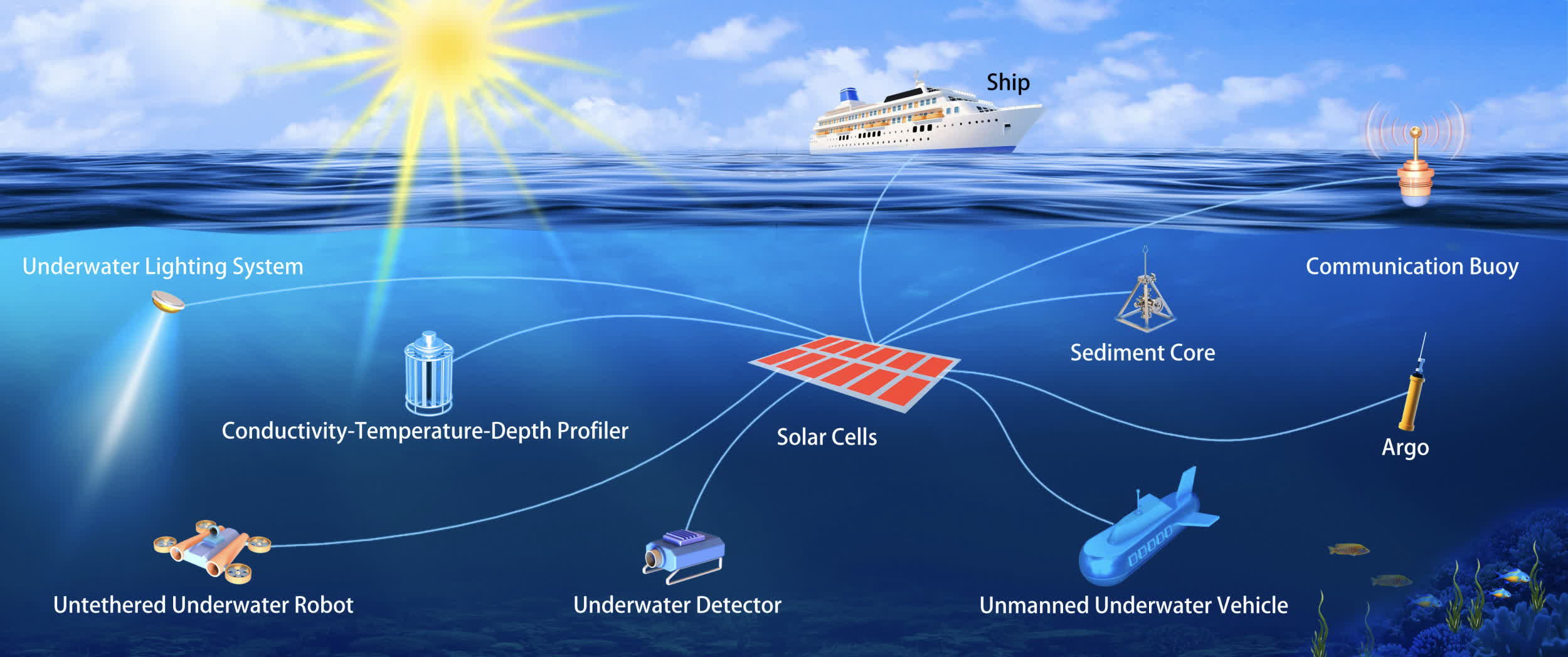
Despite the harsh environment and dim light conditions, the researchers think their new perovskite cells could one day solve the “challenge” of harvesting solar energy underwater. The study describes some hypothetical scenarios where this kind of power generation could be useful, including autonomous marine power systems and submerged Internet of Things infrastructure.
You must be logged in to post a comment Login