Tech
Videos: Bipedal Robot, NASA Robots, Aibo app, and More


Video Friday is your weekly selection of awesome robotics videos, collected by your friends at IEEE Spectrum robotics. We also post a weekly calendar of upcoming robotics events for the next few months. Please send us your events for inclusion.
ICRA 2026: 1–5 June 2026, VIENNA
RSS 2026: 13–17 July 2026, SYDNEY
Summer School on Multi-Robot Systems: 29 July–4 August 2026, PRAGUE
Enjoy today’s videos!
“Roadrunner” is a new bipedal wheeled robot prototype designed for multi-modal locomotion. It weighs around 15 kg (33 lb) and can seamlessly switch between its side-by-side and in-line wheel modes and stepping configurations depending on what is required for navigating its environment. The robot’s legs are entirely symmetric, allowing it to point its knees forward or backward, which can be used to avoid obstacles or manage specific movements. A single control policy was trained to handle both side-by-side and in-line driving. Several behaviors, including standing up from various ground configurations and balancing on one wheel, were successfully deployed zero-shot on the hardware.

Incredibly (INCREDIBLY!) NASA says that this is actually happening.

NASA’s SkyFall mission will build on the success of the Ingenuity Mars helicopter, which achieved the first powered, controlled flight on another planet. Using a daring mid-air deployment, SkyFall will deliver a team of next-gen Mars helicopters to scout human landing sites and map subsurface water ice.
[ NASA ]
NASA’s MoonFall mission will blaze a path for future Artemis missions by sending four highly mobile drones to survey the lunar surface around the Moon’s South Pole ahead of astronauts’ arrival there. MoonFall is built on the legacy of NASA’s Ingenuity Mars Helicopter. The drones will be launched together and released during descent to the surface. They will land and operate independently over the course of a lunar day (14 Earth days) and will be able to explore hard-to-reach areas, including permanently shadowed regions (PSRs), surveying terrain with high-definition optical cameras and other potential instruments.
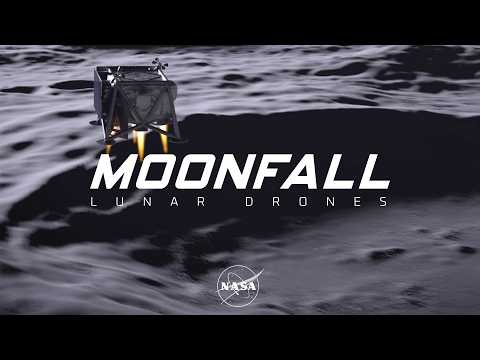
For what it’s worth, Moon landings have a success rate well under 50%. So let’s send some robots there to land over and over!
[ NASA ]
In Science Robotics, researchers from the Tangible Media group led by Professor Hiroshi Ishii, together with colleagues from Politecnico di Bari, present Electrofluidic Fiber Muscles: a new class of artificial muscle fibers for robots and wearables. Unlike the rigid servo motors used in most robots, these fiber-shaped muscles are soft and flexible. They combine electrohydrodynamic (EHD) fiber pumps — slender tubes that move liquid using electric fields to generate pressure silently, with no moving parts — with fluid-filled fiber actuators. These artificial muscles could enable more agile untethered robots, as well as wearable assistive systems with compact actuation integrated directly into textiles.

[ MIT Media Lab ]
In this study, we developed MEVIUS2, an open-source quadruped robot. It is comparable in size to Boston Dynamics Spot, equipped with two LiDARs and a C1 camera, and can freely climb stairs and steep slopes! All hardware, software, and learning environments are released as open source.

[ MEVIUS2 ]
Thanks, Kento!
What goes into preparing for a live performance? Arun highlights the reliability testing that goes into trying a new behavior for Spot.

[ Boston Dynamics ]
In this work, a multi-robot planning and control framework is presented and demonstrated with a team of 40 indoor robots, including both ground and aerial robots.

That soundtrack though.
[ GitHub ]
Thanks, Keisuke!
Quadrupedal robots can navigate cluttered environments like their animal counterparts, but their floating-base configuration makes them vulnerable to real-world uncertainties. Controllers that rely only on proprioception (body sensing) must physically collide with obstacles to detect them. Those that add exteroception (vision) need precisely modeled terrain maps that are hard to maintain in the wild. DreamWaQ++ bridges this gap by fusing both modalities through a resilient multi-modal reinforcement learning framework. The result: a single controller that handles rough terrains, steep slopes, and high-rise stairs—while gracefully recovering from sensor failures and situations it has never seen before.

That cliff behavior is slightly uncanny.
[ DreamWaQ++ ]
I take issue with this from iRobot:

While the pyramid exploration that iRobot did was very cool, they did it with a custom made robot designed for a very specific environment. Cleaning your floors is way, way harder. Here’s a bit more detail on the pyramids thing:

[ iRobot ]
More robots in circus please!

[ Daniel Simu ]
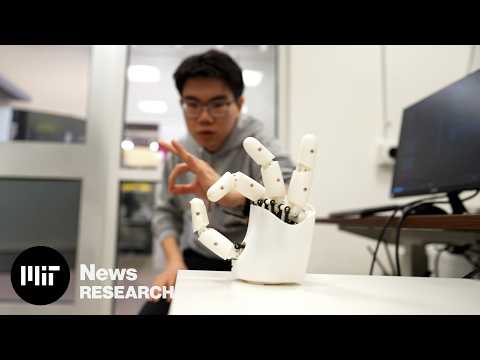
MIT engineers have designed a wristband that lets wearers control a robotic hand with their own movements. By moving their hands and fingers, users can direct a robot to perform specific tasks, or they can manipulate objects in a virtual environment with high-dexterity control.
[ MIT ]
At NVIDIA GTC 2026, we showcased how AI is moving into the physical world. Visitors interacted with robots using voice commands, watching them interpret intent and act in real time — powered by our KinetIQ AI brain.

[ Humanoid ]
Props to Sony for their continued support and updates for Aibo!

[ Aibo ]
This robot looks like it could be a little curvier than normal?

[ LimX Dynamics ]
Developed by Zhejiang Humanoid Robot Innovation Center Co., Ltd., the Naviai Robot is an intelligent cooking device. It can autonomously process ingredients, perform cooking tasks with high accuracy, adjust smart kitchen equipment in real time, and complete post-cooking cleaning. Equipped with multi-modal perception technology, it adapts to daily kitchen environments and ensures safe and stable operation.

That 7x is doing some heavy lifting.
[ Zhejiang Lab ]
This CMU RI Seminar is by Hadas Kress-Gazit from Cornell, on “Formal Methods for Robotics in the Age of Big Data.”

Formal methods – mathematical techniques for describing systems, capturing requirements, and providing guarantees – have been used to synthesize robot control from high-level specification, and to verify robot behavior. Given the recent advances in robot learning and data-driven models, what role can, and should, formal methods play in advancing robotics? In this talk I will give a few examples for what we can do with formal methods, discuss their promise and challenges, and describe the synergies I see with data-driven approaches.
[ Carnegie Mellon University Robotics Institute ]
From Your Site Articles
Related Articles Around the Web
You must be logged in to post a comment Login