Tech
Videos: Farming Robots, Humanoid Robots, and More


Video Friday is your weekly selection of awesome robotics videos, collected by your friends at IEEE Spectrum robotics. We also post a weekly calendar of upcoming robotics events for the next few months. Please send us your events for inclusion.
ICRA 2026: 1–5 June 2026, VIENNA
Enjoy today’s videos!
Our robots Lynx M20 help transport harvested crops in mountainous farmland—tackling the rural “last mile” logistics challenge.

[ DEEP Robotics ]
Once again, I would point out that now that we are reaching peak humanoid robots doing humanoid things, we are inevitably about to see humanoid robots doing non-humanoid things.

[ Unitree ]
In a study, a team of researchers from the Max Planck Institute for Intelligent Systems, the University of Michigan, and Cornell University show that groups of magnetic microrobots can generate fluidic forces strong enough to rotate objects in different directions without touching them. These microrobot swarms can turn gear systems, rotate objects much larger than the robots themselves, assemble structures on their own, and even pull in or push away many small objects.

[ Science ] via [ Max Planck Institute ]
Bipedal—or two-legged—autonomous robots can be quite agile. This makes them useful for performing tasks on uneven terrain, such as carrying equipment through outdoor environments or performing maintenance on an ocean-going ship. However, unstable or unpredictable conditions also increase the possibility of a robot wipeout. Until now, there’s been a significant lack of research into how a robot recovers when its direction shifts—for example, a robot losing balance when a truck makes a quick turn. The team aims to fix this research gap.

[ Georgia Tech ]
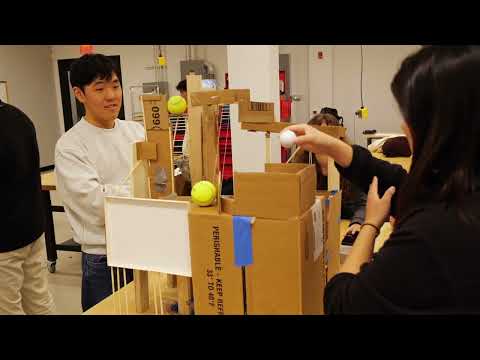
Robotics is about controlling energy, motion, and uncertainty in the real world.
[ Carnegie Mellon University ]
Delicious dinner cooked by our robot Robody. We’ve asked our investors to speak about why they’re along for the ride.

[ Devanthro ]
Tilt-rotor aerial robots enable omnidirectional maneuvering through thrust vectoring, but introduce significant control challenges due to the strong coupling between joint and rotor dynamics. This work investigates reinforcement learning for omnidirectional aerial motion control on over-actuated tiltable quadrotors that prioritizes robustness and agility.

[ DRAGON Lab ]
At the CMU Robotic Innovation Center’s 75,000-gallon water tank, members of the TartanAUV student group worked to further develop their autonomous underwater vehicle (AUV) called Osprey. The team, which takes part in the annual RoboSub competition sponsored by the U.S. Office of Naval Research, is comprised primarily of undergraduate engineering and robotics students.

[ Carnegie Mellon University ]
Sure seems like the only person who would want a robot dog is a person who does not in fact want a dog.

Compact size, industrial capability. Maximum torque of 90N·m, over 4 hours of no-load runtime, IP54 rainproof design. With a 15 kg payload, range exceeds 13 km. Open secondary development, empowering industry applications.
[ Unitree ]
If your robot video includes tasty baked goods it WILL be included in Video Friday.

[ QB Robotics ]
Astorino is a 6-axis educational robot created for practical and affordable teaching of robotics in schools and beyond. It has been created with 3D printing, so it allows for experimentation and the possible addition of parts. With its design and programming, it replicates the actions of industrial robots giving students the necessary skills for future work.

We need more autonomous driving datasets that accurately reflect how sucky driving can be a lot of the time.

[ ASRL ]
This Carnegie Mellon University Robotics Institute Seminar is by CMU’s own Victoria Webster-Wood, on “Robots as Models for Biology and Biology and Materials for Robots.”

In the last century, it was common to envision robots as shining metal structures with rigid and halting motion. This imagery is in contrast to the fluid and organic motion of living organisms that inhabit our natural world. The adaptability, complex control, and advanced learning capabilities observed in animals are not yet fully understood, and therefore have not been fully captured by current robotic systems. Furthermore, many of the mechanical properties and control capabilities seen in animals have yet to be achieved in robotic platforms. In this talk, I will share an interdisciplinary research vision for robots as models for neuroscience and biology as materials for robots.
[ CMU RI ]
From Your Site Articles
Related Articles Around the Web