Tech
Vinyl Sales Top $1 Billion as RIAA Data Confirms the Record Revival Is No Nostalgia Act

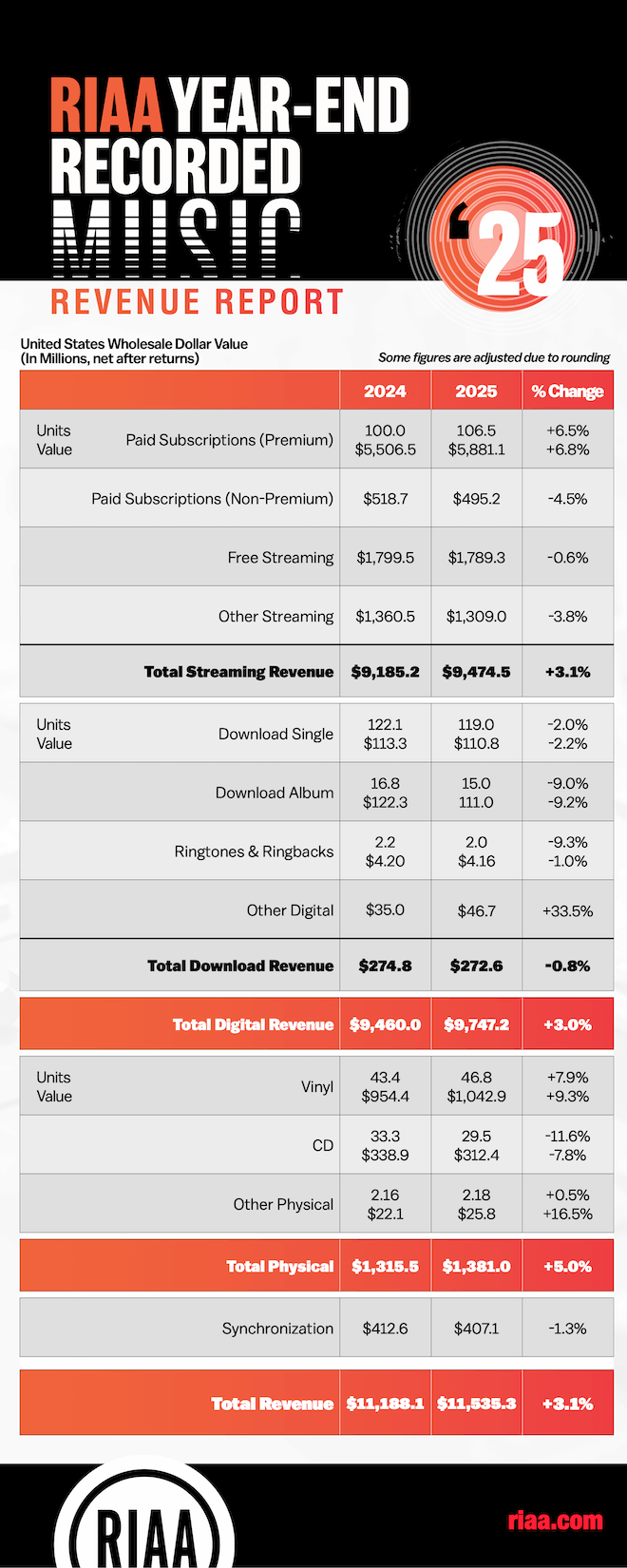
The RIAA’s 2025 year end revenue report gives us a pretty clear look at where the music business stands right now. The recorded music industry in the United States generated $11.535 billion in wholesale revenue, a 3.1% increase over 2024. Streaming continues to dominate the market, vinyl remains the strongest part of the physical media business, and CDs keep drifting further into legacy territory.
Strip away the nostalgia and the usual industry hype and the story becomes pretty straightforward. Streaming pays most of the bills, vinyl still attracts buyers who want something tangible, and the rest of the formats are slowly losing ground. The numbers don’t argue. They just show how people are choosing to listen to music in 2025.
Before anyone starts comparing every figure to older headlines, one detail matters: RIAA says its reports are now based on wholesale data to align with global reporting standards. That means accuracy requires using the 2024 and 2025 figures shown inside the new report itself, not mixing them with older retail based totals from prior annual summaries.

Streaming Still Owns the Block
Streaming generated $9.4745 billion in 2025, up 3.1%, and accounted for roughly 82% of total U.S. recorded music revenue. Paid subscriptions were the engine inside the engine: 106.5 million premium accounts produced $5.881 billion, up 6.8% in revenue, while the broader paid subscription category represented 55.3% of all U.S. music revenue. That is the part of the business paying the rent, keeping the lights on, and making the rest of the machine possible. Spotify and Apple Music still dominate the landscape, but streaming’s share of total U.S. recorded music revenue has not pushed past the mid-80% range, which suggests something important: physical media’s double-digit share of the market has stabilized rather than disappearing.
There is a second story tucked inside those streaming numbers. Not every digital segment is moving in lockstep. Free streaming slipped 0.6% to $1.789 billion, and other streaming fell 3.8% to $1.309 billion. So yes, streaming is still the dominant format by a mile, but the healthiest part of it is clearly the paid side.
That tells us consumers are still willing to pay for access when the experience is frictionless and the catalog feels essentially infinite; though it does raise a fair question about how much of that catalog is genuine music versus the growing volume of AI-generated content now flooding streaming platforms.
Vinyl Is Not a Gimmick Anymore

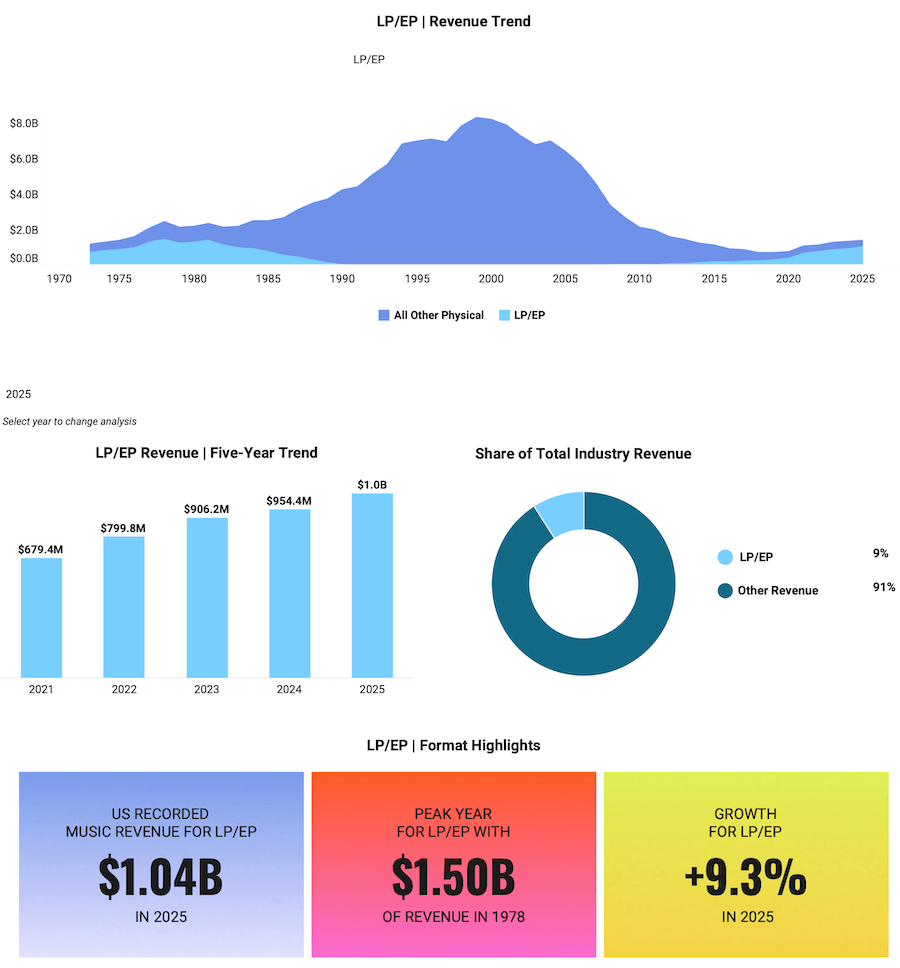
Vinyl was the headline physical format again, and this time the number has real swagger: $1.0429 billion in U.S. revenue on 46.8 million units, up 9.3% in revenue and 7.9% in units year over year. According to the RIAA, 2025 marked vinyl’s 19th consecutive year of growth, and U.S. vinyl accounted for nearly 50% of global vinyl revenue.
This is no longer a boutique side hustle for crate diggers and weekend collectors. Vinyl has grown well beyond the small group of audiophiles who kept the format alive after CDs, downloads, and eventually streaming pushed it to the margins. Today it is a serious commercial format with real momentum.
Record Store Day alone tells part of the story. What started as a niche celebration has evolved into two major annual events, with collectors and music fans lining up before sunrise for a shot at limited pressings. Independent record stores are also seeing renewed life in college towns and major cities across North America. Many have adapted by turning themselves into community spaces selling coffee, food, turntables, record accessories, and entry level hi-fi gear alongside vinyl. The format is no longer surviving on nostalgia. It has rebuilt an ecosystem around it.
The more revealing point is not merely that vinyl grew. It is how decisively it beat the rest of physical media. Vinyl generated more than three times the revenue of CDs in 2025 and outsold them by a wide margin in units as well. The format has moved beyond novelty because it offers something streaming cannot: ownership, ritual, display value, collectibility, and a direct emotional transaction between listener and music. Streaming gives you access to everything. Vinyl gives you a reason to care about something. Different drug. Different high. Same customer wallet, sometimes.
CDs Are Not Dead, But They Are Bleeding Out Slowly

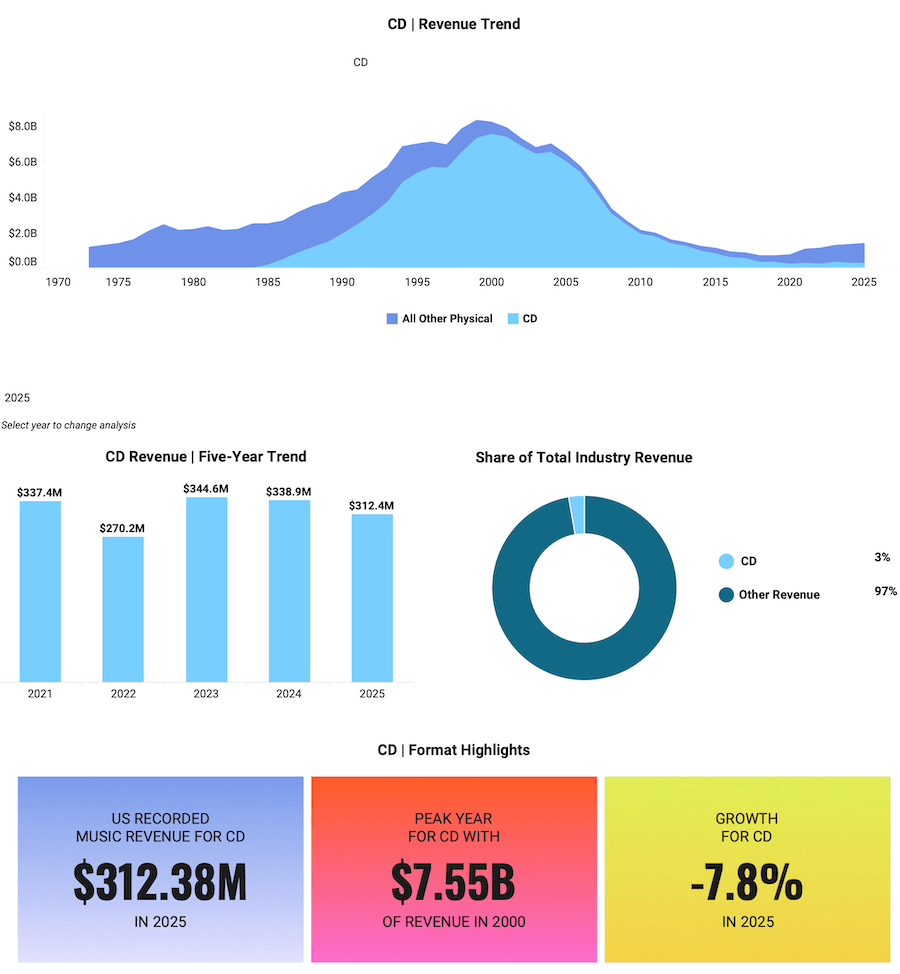
CDs brought in $312.4 million on 29.5 million units in 2025. That represented a 7.8% decline in revenue and an 11.6% drop in units compared with the prior year. The compact disc has not disappeared. It still sells in meaningful numbers, and there are niches where it remains relevant, including collectors, catalog buyers, K-pop fans, box set purchasers, and listeners who want a physical copy without paying vinyl prices. But the long-term direction is clear. CDs are no longer the center of the physical media market.
The biggest remaining advantage for CDs is price. New releases on CD are usually far cheaper than new vinyl, and the used market is enormous. Walk into almost any record store and you will still find large CD bins with thousands of titles selling for $1 to $5. For listeners building a music library, it is still one of the most affordable ways to own albums.
There is also continued support from the hardware side of the industry. A number of hi-fi manufacturers still produce portable CD players, traditional CD players, transports, and SACD machines, aimed at listeners who value physical playback and the potential for higher quality sound through a dedicated system.
But it would be a mistake to frame this as a revival similar to vinyl. The data does not support that narrative. CD sales continue to decline year after year, even if the format maintains a loyal audience. On a good player, a well-mastered CD can absolutely outperform most streaming playback, but that alone is not enough to drive a broad market comeback. Vinyl has turned collecting into an event. CDs have not. Nobody is lining up outside record stores before sunrise waiting for Compact Disc Day. Not in 2025, and not anytime soon.
Downloads Continue Their Slow Walk to the Exit
Permanent digital downloads kept shrinking. Total download revenue fell 0.8% to $272.6 million. Download singles dropped 2.2% in value, while download albums fell 9.2%. The category still exists, but mostly as a residue of older buying habits and edge cases where ownership of files still matters. In the larger picture, downloads now look like a transitional format that has already served its purpose. They were once the escape car from the CD era. Now they are just parked outside with a flat tire.
What the Data Actually Tells Us

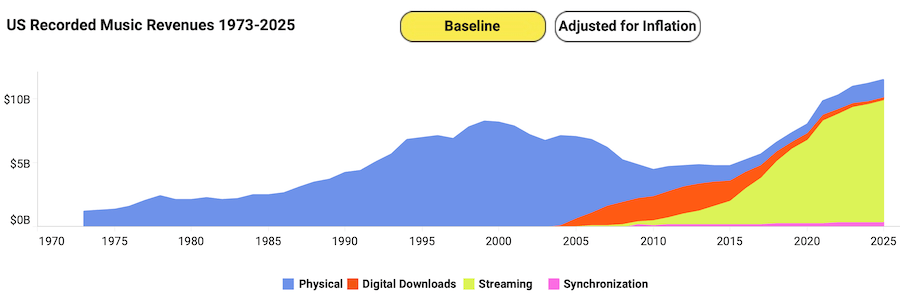
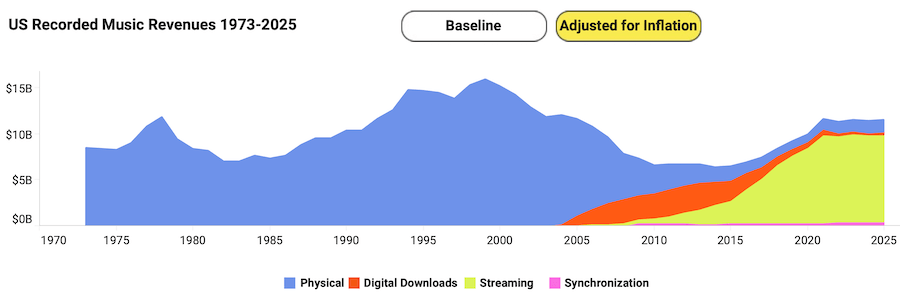

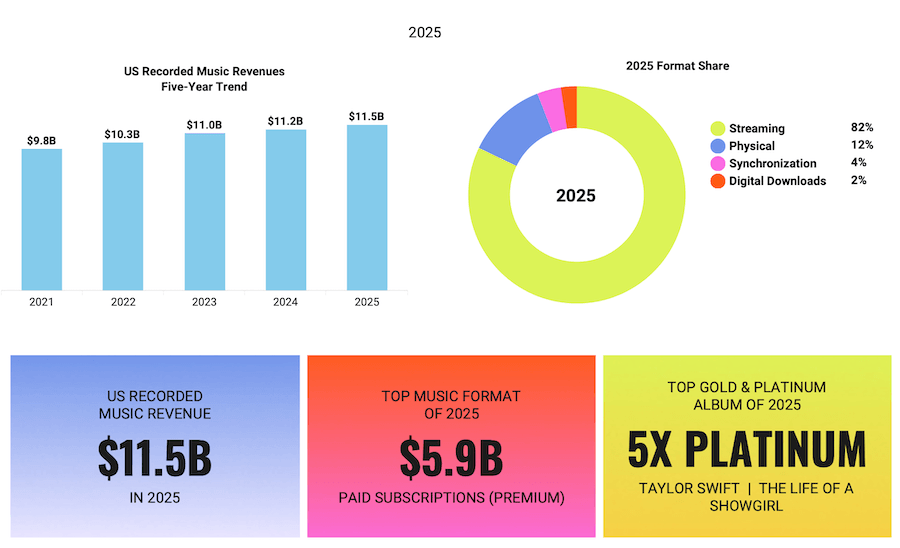
The 2025 RIAA numbers show a music business that is healthier than the doom merchants want to admit and more complicated than the vinyl evangelists sometimes pretend. Streaming is the mass market utility. Vinyl is the premium physical object. Everything else is fighting for leftovers. Paid subscriptions are where the financial strength sits, vinyl is where the emotional and collectible upside sits, and CDs are losing relevance even though they still matter in absolute dollars.
That also means the industry has stopped being a simple format war. Streaming and vinyl are not really enemies. They represent different behaviors. One is about access, portability, and habit. The other is about ownership, fandom, and intent. Consumers are using both because they solve different problems.
The 2025 numbers make that clear: digital revenue climbed to about $9.7 billion while physical formats generated roughly $1.38 billion, and both categories grew at the same time. In other words, the market can support subscriptions and collecting when consumers see value in both.
There is also a broader context that is easy to overlook. Music consumption in the United States now generates billions more in revenue than the theatrical movie business, with recorded music alone clearing $11.5 billion in 2025. People simply spend more time listening to music than watching films. It happens everywhere: at home, in the car, on the train, at the gym, and on airplanes. That constant presence makes music one of the most durable forms of media consumption, and it is likely that the gap between music and movies will continue to widen as streaming subscriptions and mobile listening keep expanding.
When you compare it with other physical media categories, the contrast is interesting. Print books remain remarkably resilient, with roughly 762 million copies sold in the United States in 2025, a small increase over the previous year. But the growth is modest and largely flat compared with the pandemic peak earlier in the decade.
Taken together, the numbers show something simple. Streaming dominates music access. Vinyl anchors the physical collector market. CDs remain a niche but affordable ownership format. And across all of it, music continues to be one of the most consistent and pervasive forms of entertainment people consume every day.
You must be logged in to post a comment Login