Tech
Webb Peels Back the Layers of the Cranium Nebula

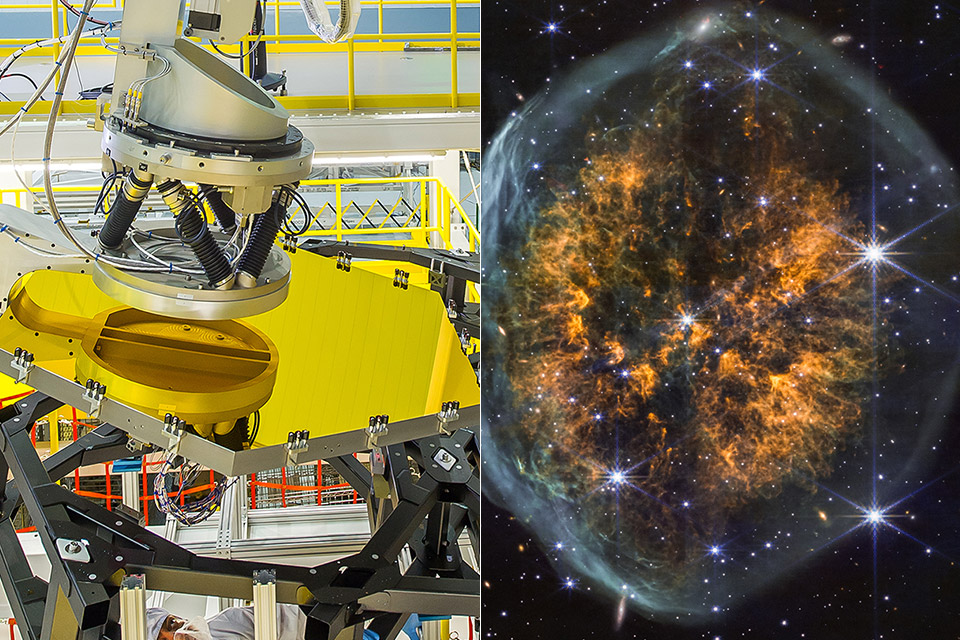
Photo credit: NASA/Chris Gunn
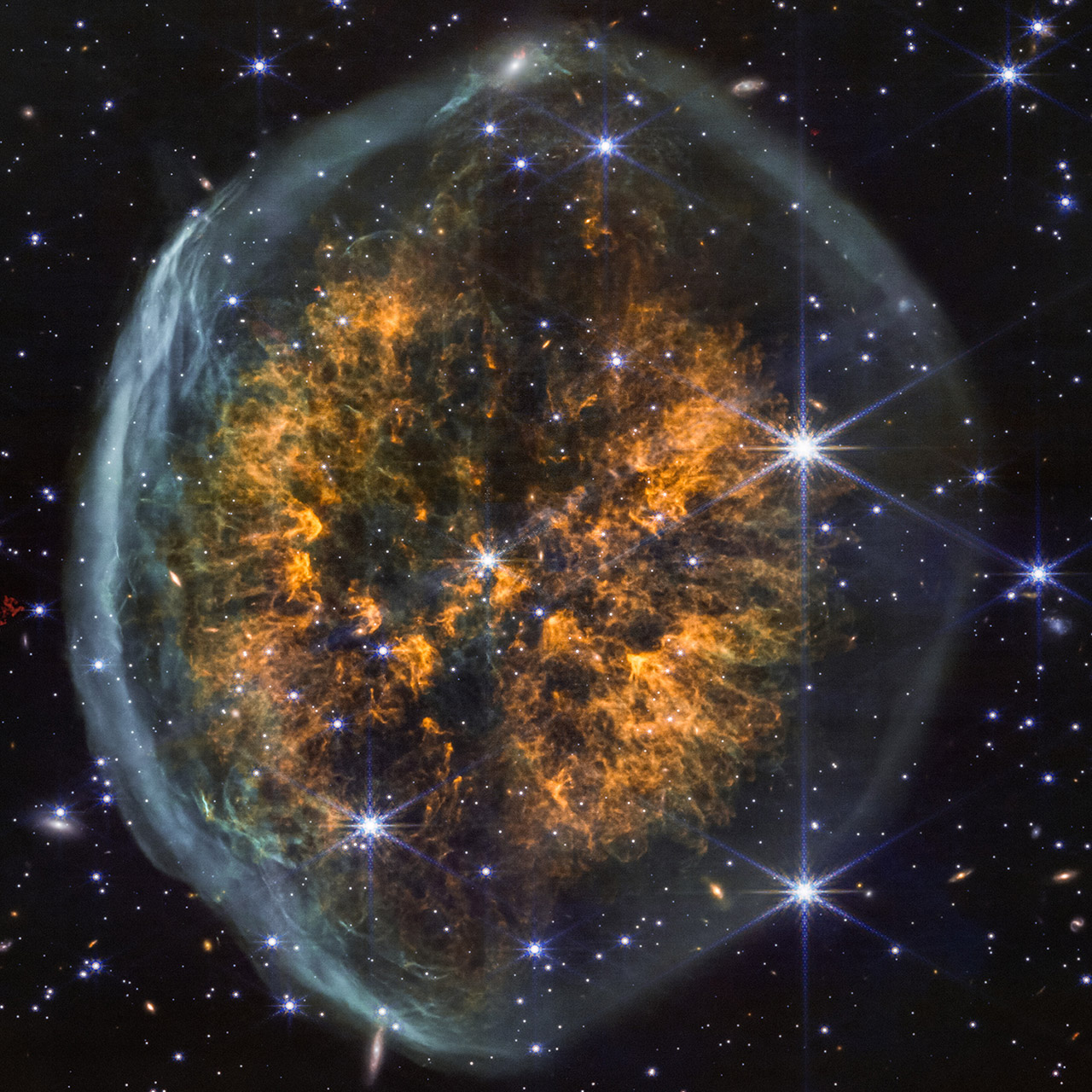
The Cranium Nebula has piqued astronomers’ interest, due to some stunning new images from NASA’s James Webb Space Telescope. These photos reveal the layers of a faraway cloud of gas and dust wrapped tightly around a star as it begins to die. This planetary nebula, officially known as PMR 1 and informally known as the exposed Cranium due to its uncanny appearance to a brain tucked inside a phantom skull, sits quietly in a backwater area of space that has only recently gained attention.


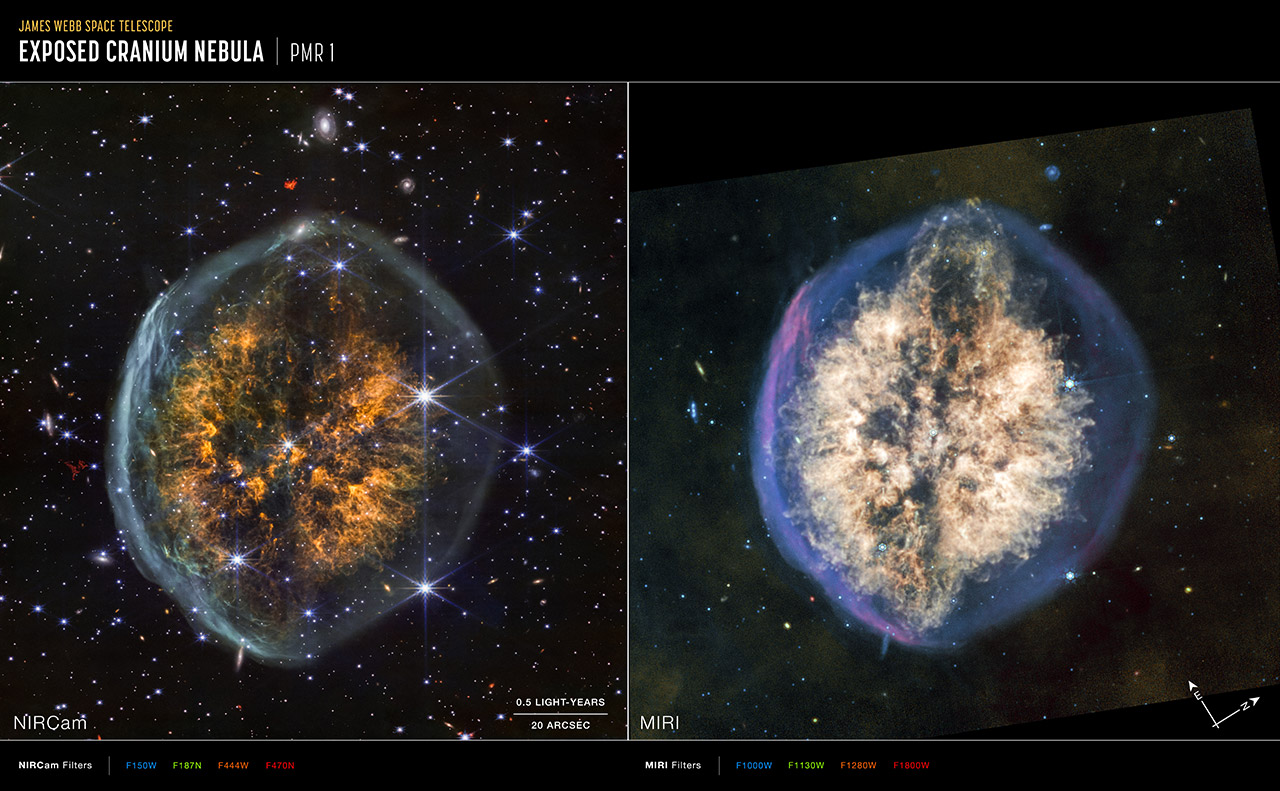
Webb captured the entire scene with two of its most powerful tools, beginning with its Near-Infrared Camera, or NIRCam, which produces a crystal clear image with innumerable background stars and distant galaxies piercing the nebula’s veil like tiny needles. A prominent dark channel runs vertically down the center, plainly dividing the entire image into left and right parts that resemble cerebral hemispheres. The outer edge has a faint, almost white glow, while the middle is a deep orange, with clouds that appear to be pushed outwards from the center in a sequence of waves, as if they were colliding in midair.


LEGO Icons Project Hail Mary Collectible Building Set for Adults – Room or Office Decor for Men & Women…
- PROJECT HAIL MARY SCI-FI MODEL – Launch into the world of cinematic science fiction with the LEGO Icons Project Hail Mary (11389) microscale…
- WHAT’S IN THE BOX – Includes everything you need to build a microscale replica of the Hail Mary spacecraft, a functional display stand, plus a…
- FUNCTIONAL SPACE MODEL – Turn the crank on the display stand to send the crew module into orbit, simulating the spaceship’s centrifugal gravity…

When you switch to the Mid-Infrared Instrument (MIRI), the entire picture changes. The cosmic dust blazes brightly in a variety of tones that can make you just feel the texture. The same center black lane remains visible, of course, but you can now see where all of the material being emitted by the central star is heading. Stuff is rushing out at the top and bottom, probably in two large opposing jets that chisel their way through the inner gas, providing intricacy to the nebula’s overall shape.
That level of information is a significant improvement over what the Spitzer Space Telescope was capable of more than a decade ago. Spitzer was the first to reveal the brain-like shape, but it was like gazing at the Cranium from a distance; all you could see was the overall outline. The Webb, on the other hand, allows you can see the fine features much more clearly and demonstrates how different wavelengths of light can highlight different parts of the nebula. The near-infrared shows the dust getting blown away, while in the mid-infrared, the dust itself is lit up like a stage.

With its rapid-fire bursts, this nebula tells the story of a star that is running out of fuel and beginning to shed its outer layers. The inner area is a jumble of heavier gases and more intriguing patterns, whereas the outside shell is primarily composed of hydrogen that was expelled early. Things are becoming quite crazy in there, as evidenced by the central dark channel, which is most likely the result of a big outburst or couple of jets. It could finish up as a tiny, slowly cooling white dwarf or explode as a supernova, depending on the star’s initial characteristics, size, and other factors.
