Tech
Western Electric Revives U.S. Vacuum Tube Manufacturing, Unveils New Amplifier Designs at AXPONA 2026

Western Electric didn’t just show up at AXPONA 2026 with new amplifier designs. It tapped into something a lot of us have been thinking about for years.
I’ve had a thing for tubes since I was a kid, learning the basics with my grandfather before I was ten. Decades later, that interest hasn’t faded. It has just gotten more expensive and harder to justify shelf space. I’ve owned just about every type of tube amplifier you can name and built a few along the way. My wife would argue the collection peaked years ago, but I’m still not walking past a good 6922 or KT88 without at least thinking about it.
The bigger issue hasn’t been the gear. It has been the tubes themselves. Options have thinned out to the point where “choice” often feels like theater. I remember standing in a large musician supply shop staring at five different brands of 12AX7. Different logos, different boxes, different prices. Same factory in Russia. Same tube.
That’s a long way from where things used to be. There was a time when American manufacturing alone offered a deep bench. RCA, GE, Sylvania, Tung Sol. All building serious product, alongside a strong European presence from Mullard, Telefunken, Philips, and others. Today, new production is concentrated in a handful of places: Slovakia, China, Russia, and yes, Rossville, GA, USA. Which is why what Western Electric is doing right now actually matters.
The operation in Rossville, GA, USA belongs to Western Electric, one of the most storied names in American tube manufacturing. For a long stretch, that name carried more history than output. Western Electric was not producing tubes at all. Even now, the lineup coming out of that factory is focused and limited. Two tubes. The 300B and the 308B.

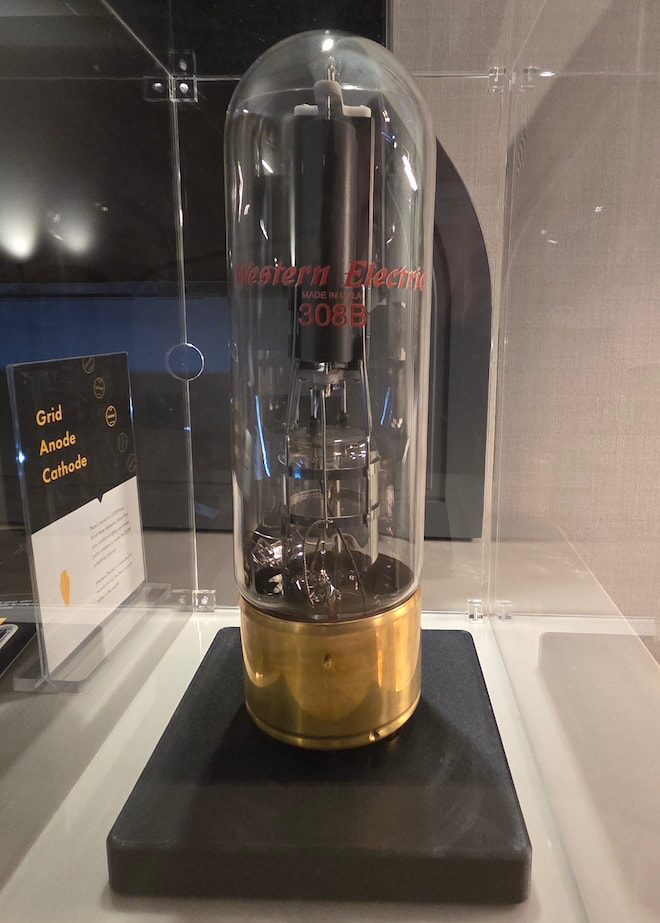
The 300B remains the centerpiece. It powers Western Electric’s Type 91E integrated amplifier and continues to define what the brand does best. The 308B is a different story. Production is being ramped back up to support the new 100E monoblock amplifiers, which signals a broader push beyond a single legacy tube.
Both amplifiers were on display in Western Electric’s room at AXPONA 2026. And yes, they deliver exactly what you think they will. If you have even a passing interest in tubes, this is the kind of gear that stops you mid sentence and makes you reconsider your financial priorities.
The 300B Reality
The 300B has been around since the 1930s and, during the golden age of tubes, it powered everything from PA systems to theater installations and clubs around the world. It wasn’t boutique back then. It was the workhorse.
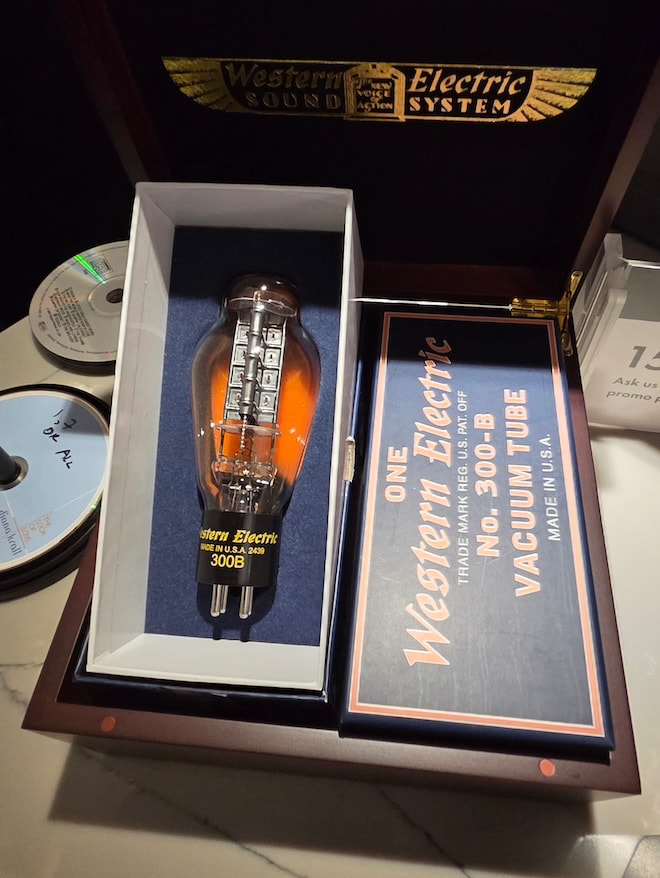
Today, it sits on the other end of the spectrum. Among the most coveted tubes in the new old stock market, with prices that can start just under a thousand dollars and climb into several thousand for early examples. Add the premium for matched pairs or quads and the cost of keeping a 300B amplifier running gets uncomfortable fast. And that’s before you factor in the risk. Most NOS tubes come with little to no warranty. You’re buying history and hoping it holds up.
That’s where Western Electric shifts the conversation. Their current production 300B comes in at $699 each or $1,499 for a matched pair. Still not cheap, but grounded in reality compared to NOS pricing. More importantly, they back it with a five year warranty. That alone changes the math for anyone serious about running a 300B based system long term.

The 308B: Big Glass, Big Power, and Still a Work in Progress
The 308B is not subtle. It stands roughly 14 inches tall and close to 4 inches in diameter. This is the kind of tube that makes everything around it look like it needs to hit the gym.
In Western Electric’s 100E monoblock, a single 308B is rated to deliver 160 watts. That’s more output from one tube than many push pull designs manage with a quad of KT88s. It’s an ambitious play and one that suggests Western Electric is not content to stay in the 300B comfort zone.
Details are still catching up to the product. Pricing and availability have not been finalized, and even the web page listed in the company’s show materials was still under construction the week after AXPONA 2026. That tells you where this sits. Early, promising, and not quite ready for prime time.
91E and 100E: How Western Electric Is Actually Using These Tubes
Western Electric wasn’t just putting tubes on pedestals at AXPONA 2026. They showed how they’re being used across two very different amplifier designs.
The 300B plays two roles here. In the 91E integrated amplifier, it’s the output tube. In the 100E monoblock, it shifts upstream and handles the mid stage. The spotlight in the 100E belongs to the 308B, which drives the final output stage and does the heavy lifting.
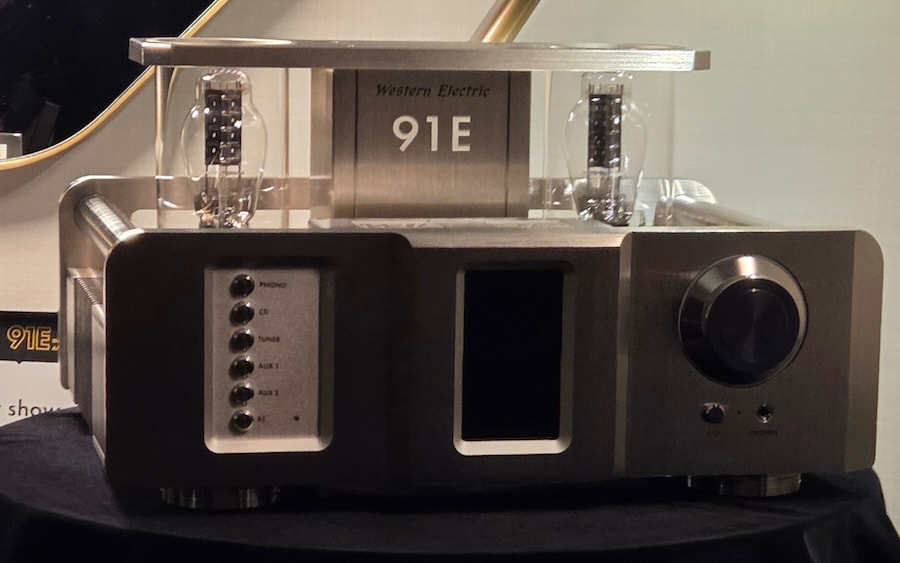

The 91E integrated amplifier, priced at $8,000, uses a pair of 300B tubes to deliver roughly 20 watts per channel. That number will not impress anyone chasing big power, but that’s not the point. Western Electric built flexibility into the design with interchangeable output modules for 4, 8, and 16 ohm loads. That opens the door to a wide range of loudspeakers, although higher sensitivity designs will make the most sense here.
Connectivity is more modern than you might expect. There are moving coil and moving magnet phono stages built-in, along with RCA inputs for a tuner, CD player, and additional analog sources. On the digital side, the 91E includes Bluetooth, USB, and Ethernet, with an ESS DAC handling up to 16-bit/96 kHz for incoming Bluetooth and USB signals.
Outputs include line out and pre out for system integration, plus dual sets of binding posts. It’s a tube integrated that leans into flexibility without pretending to be something it isn’t. No apps, no ecosystem pitch, and definitely not a Class D network amplifier. It just makes music and throws off enough heat to remind you that winter is coming.
100E Monoblocks and A2 Loudspeakers: Open Window Listening
The rest of what Western Electric brought to AXPONA 2026 leans newer, and in some cases, still short on published detail. The 100E monoblocks were impossible to miss. Physically and visually, they owned the room.
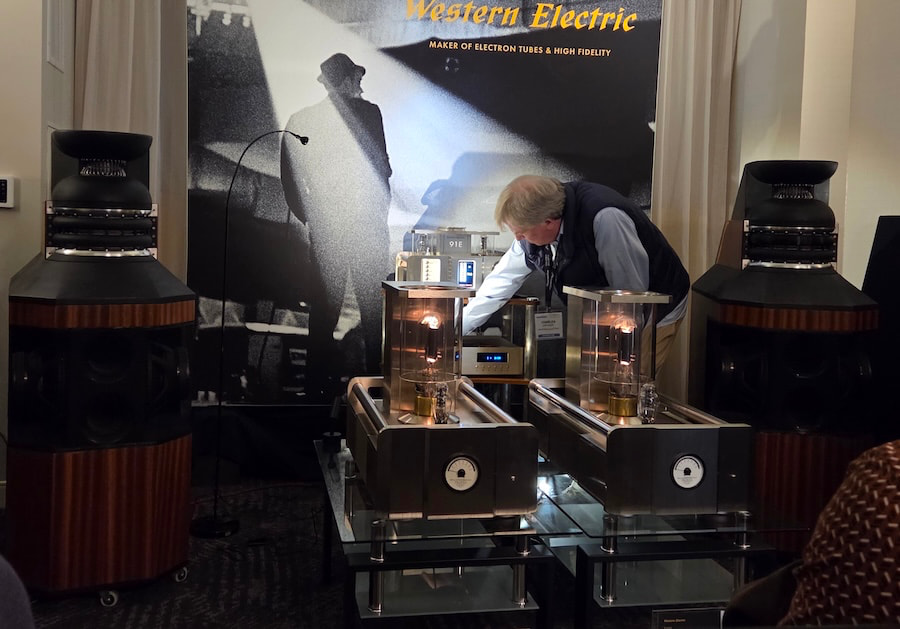

Each chassis is built around that 14 inch tall 308B, and yes, it glows in a way that will stop you in your tracks. Subtle is not part of the brief here. Rated at 160 watts per amplifier, the 100E is doing something few tube designs attempt, delivering serious output from a single ended architecture that looks more like industrial art than consumer audio.
Size is part of the story. At roughly 32 inches deep and close to 22 inches wide, these amplifiers are going to dictate the layout of most rooms. Weight is estimated around 160 pounds each, so once they are in place, they are staying there. This is not gear you casually move around on a Saturday afternoon.
The topology is just as unconventional. A 12AT7 handles the input stage, a 300B is used in the mid stage, and the 308B takes over as the output tube. Seeing a 300B in that middle role tells you everything about the scale of this design. Nothing about it is typical.
Heat is not an afterthought either. With plate voltage around 1500 volts and plate dissipation exceeding 220 watts, these amplifiers are going to generate serious thermal output. Ventilation is not optional, especially in smaller rooms.
The 100E is impedance matched to the 91E, so building a complete Western Electric system is straightforward if you are willing to commit. At $75,000 each, the monoblocks sit in a very different bracket than the 91E, and the new A2 loudspeakers at $70,000 per pair make it clear this is a full system play, not just a statement amplifier. You accountant would like a word.
Big System Energy, Small Room Reality
The A2 loudspeakers from Western Electric are a hybrid design built around air motion transformer tweeters and midrange drivers, paired with dual dynamic bass drivers. The goal is broad, even coverage with a 180 degree dispersion pattern. This is meant to fill a room, not lock one listener into a single chair.
That ambition ran into a familiar problem at AXPONA 2026. The hotel room was simply too small. The A2 sounded like it wanted more space, more air, more distance to breathe. Instead, it was confined to a setup that forced it to hold back. This is the kind of speaker that needs a larger ballroom or dedicated listening space to make sense.
Feeding the system was the new WE 203C CD player, priced at $12,000. It served as the primary source for a system that, all in, lands around $310,000 before you even start thinking about cables or adding a turntable.
The Bottom Line
What stuck with me most from Western Electric at AXPONA 2026 wasn’t the big glass. It was the small signal tubes quietly doing their job up front. The 12AX7 in the first stage of the 100E may not draw a crowd, but it matters more than it looks.
Western Electric is ramping up production of the 12AX7 and aiming to expand into other small signal tubes as well. If that includes something like a 6SN7, a lot of people are going to pay attention. This is not a niche development. It’s a structural shift. For the first time in decades, American amplifier manufacturers could have a domestic source for one of the most widely used tubes in both hi fi and instrument amplifiers.
For years, “made in the USA” has come with an asterisk. Chassis, transformers, assembly. Sure. Tubes? Usually sourced from Russia, Slovakia, or China. Bringing small signal tube production back to the U.S. changes that conversation in a real way.
With the factory in Rossville, GA, USA only a few hours from me, there’s a good chance to see this firsthand. And if that happens, it’s worth documenting. People should see how this is being done, not just read about it.
Honestly, if Western Electric had shown nothing but that 12AX7 effort, it still would have been one of the most important rooms at the show.
For more information: westernelectric.com
You must be logged in to post a comment Login