Tech
Wharfedale Super Denton Review: The British Bulldog of Standmount Speakers

Wharfedale has spent the past decade rummaging through its attic with considerably more success than most British institutions. Instead of finding damp tweed, unpaid tax bills, and a portrait of an uncle nobody discusses, it rediscovered the Denton, Linton, and Dovedale.
The resulting Heritage Series has become one of the loudspeaker industry’s more convincing revivals because Wharfedale did not simply reproduce its old cabinets and hope everyone had forgotten how loudspeakers work. The company retained the broad baffles, wood veneers, cloth grilles, and furniture friendly proportions, while Peter Comeau and his engineering team rebuilt the drivers, crossovers, and cabinet structures for modern systems.
The Wharfedale Super Denton might be the most interesting expression of that strategy.
It is compact without being small, traditionally styled without looking like a stage prop, and broad across the shoulders in a way that explains the British Bulldog comparison. Think Davey Boy Smith after tea at Fawlty Towers: solid, slightly stubborn, and wholly unimpressed by the skinny Scandinavian loudspeaker across the room or Manuel’s attempt to carry it upstairs.
That does not automatically make it a great loudspeaker. Walnut veneer and a distinguished family history can make almost anything look persuasive under the right lighting; Selfridges has built an empire on less, while Harrods simply adds another zero. The Super Denton still has to justify the pedigree through its engineering, but the ingredients suggest Wharfedale may have produced something considerably more substantial than another well dressed tribute act.
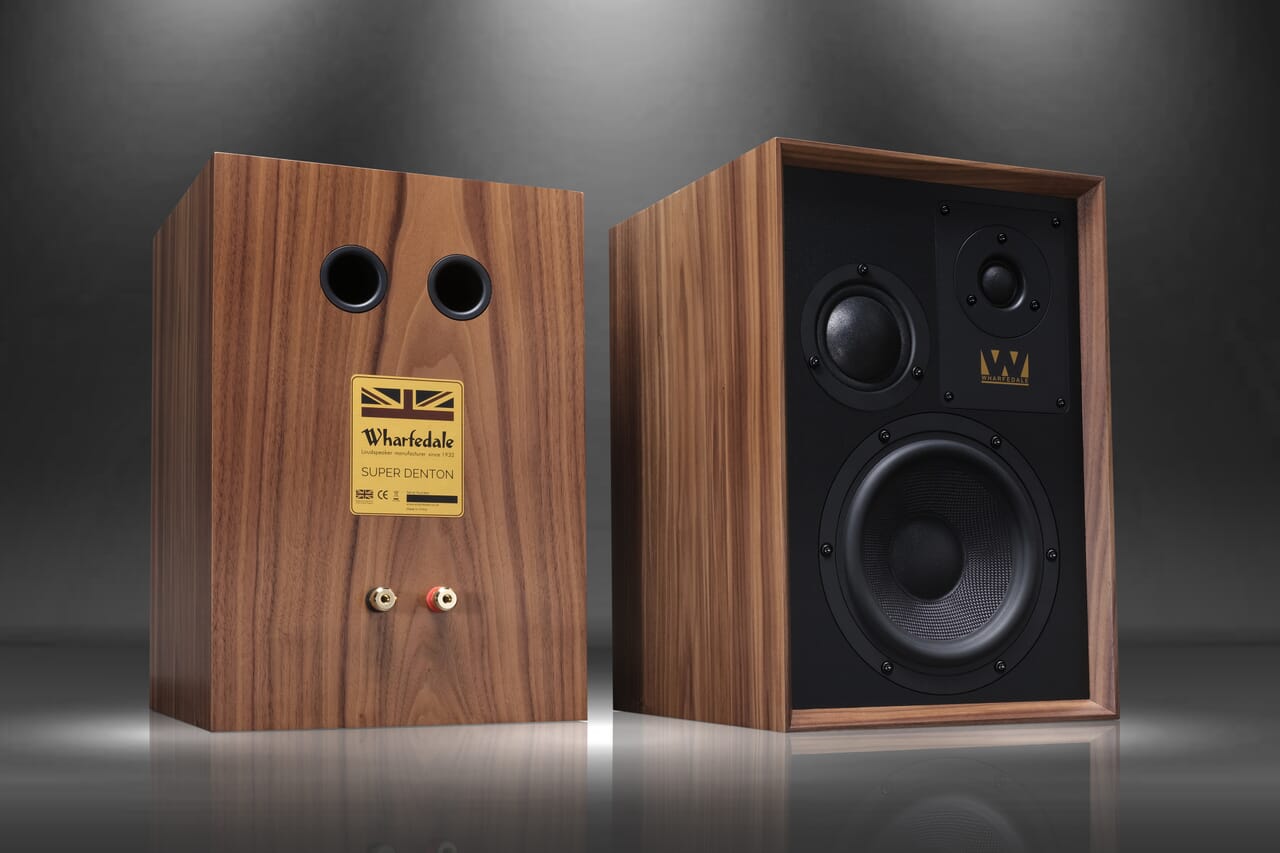

The Super Denton does, however, offer something unusual at its current $1,499 per pair price: a genuine three way driver configuration inside a cabinet measuring only 14.17 inches tall. Wharfedale is not the only manufacturer building compact three way loudspeakers, but it remains a relatively uncommon approach at this size and price.
Related Reviews:
Where Does the Super Denton Fit?
Wharfedale’s Heritage Series began its modern revival in 2014 with the Denton 80th Anniversary, followed by the Denton 85th Anniversary and the much larger Linton. The range has since expanded to include the Super Linton, Dovedale, limited production Aston, Denton 1S, and Heritage Centre channel. The family tree now has enough branches to require a solicitor and several uncomfortable conversations about inheritance.
Within that increasingly crowded lineup, the Super Denton occupies a very specific position.
The Denton 85th Anniversary is a traditional two way standmount using a 6.5-inch woven Kevlar midbass driver and 1-inch soft dome tweeter. The newer Denton 1S is a more contemporary interpretation, using a coaxial driver, wall mounting capability, and a rear panel Brilliance adjustment for near wall placement. The Linton, Super Linton, and Dovedale are significantly larger three way designs intended for listeners with more floor space and fewer objections from the furniture committee.
The Super Denton is the compact, conventional three way option.
It is not merely a smaller Linton, although the family resemblance is obvious. It uses a dome midrange rather than the larger cone midrange found in the Linton models, and its smaller cabinet creates a different set of demands involving bass extension, driver integration, amplifier control, and placement.
It is also not the affordable entrance into the Heritage Series. The Denton 1S currently sells for $999 per pair, while the Super Denton has increased from its original $1,399 U.S. price to $1,499 per pair. That puts it firmly into a competitive part of the standmount market where a handsome cabinet and several decades of history will only get one so far.


The Denton 3 Connection
The Denton name dates back to 1967, when compact loudspeakers were beginning to make hi-fi systems more practical for listeners who did not possess a ballroom or a tolerant spouse.
Most Denton models used two way driver configurations, but the Denton 3 broke from that formula in 1971 by combining separate bass, midrange, and treble drivers inside a comparatively small cabinet. Wharfedale claimed it was the smallest three way loudspeaker available at the time.
The Super Denton is based on that idea rather than being a direct reproduction.
Its external proportions and three way configuration refer back to the Denton 3, but the cabinet construction, driver materials, crossover network, damping, and manufacturing methods are modern. That distinction matters. Nobody needed Wharfedale to reproduce a 1971 crossover with period correct capacitors and the electrical temperament of a Morris Marina.
Wharfedale retained the original concept: fit a dedicated midrange driver between the woofer and tweeter without allowing the cabinet to expand into Linton territory.
That sounds straightforward until one considers how much hardware, internal volume, bracing, damping, and crossover circuitry must be accommodated inside a 14.7 liter enclosure.
Design and Construction
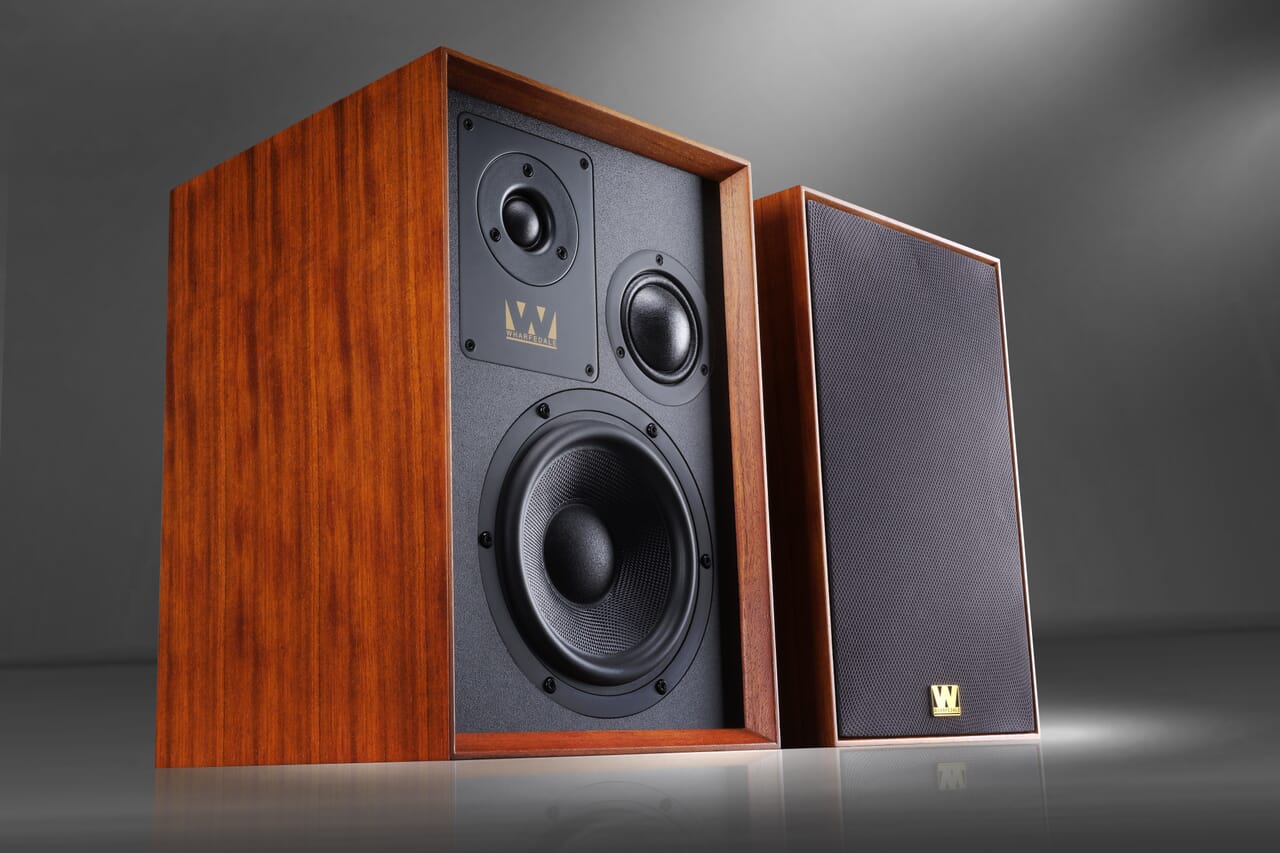
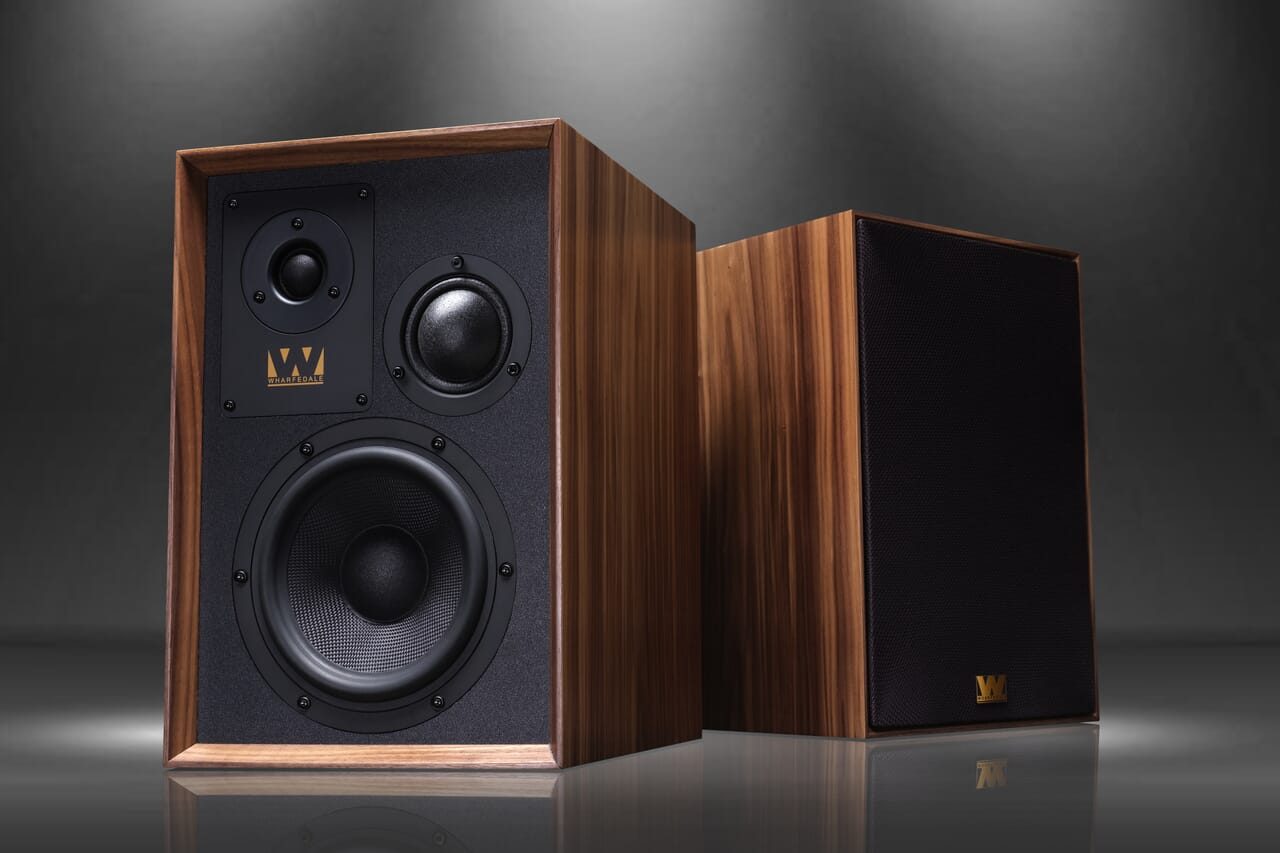
The Super Denton measures 14.17 inches high, 9.69 inches wide, and 11.61 inches deep with its terminals included. Each loudspeaker weighs just over 20 pounds, which is substantial for the size and a useful warning against placing them on a decorative shelf held up by optimism and two drywall anchors.
The proportions are traditional Wharfedale. The cabinet is relatively wide and shallow compared with many contemporary standmount designs, with an inset front baffle, removable fabric grille, and hand matched real wood veneer.

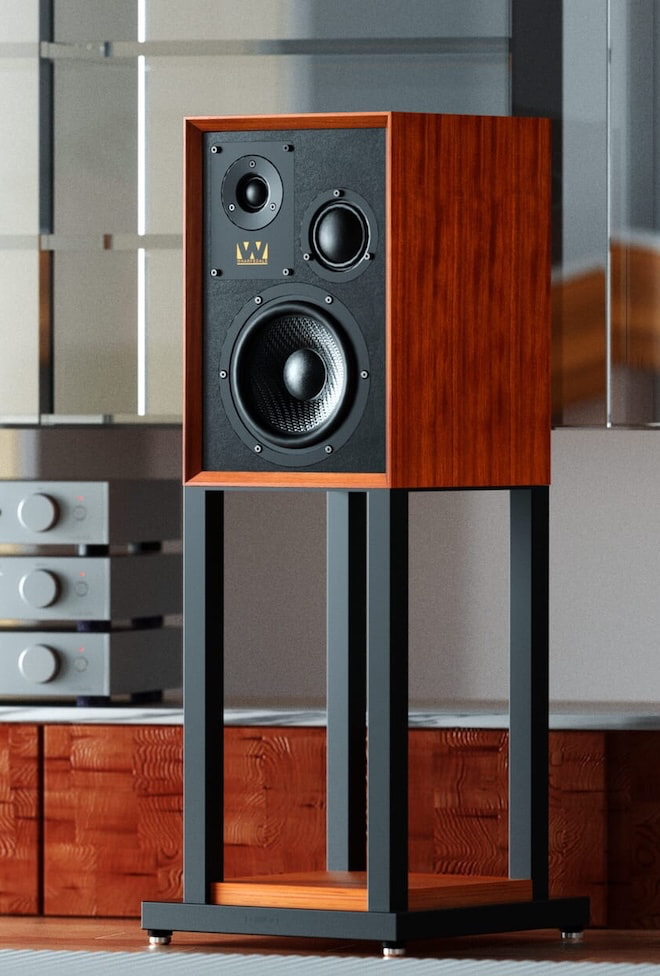
Three finishes are available: Black Oak, Walnut, and Red Mahogany. The Walnut review pair looks especially appropriate because it emphasizes the cabinet proportions without making the speakers resemble something removed from the smoking room of a minor country estate.
The cabinet walls use multiple materials rather than a single thickness of MDF. An internal layer of high density particle board is bonded to an external MDF layer using a damping adhesive. The different materials are intended to distribute cabinet resonances across a wider range rather than allowing one dominant panel resonance to announce itself during every bass note.
Wharfedale also uses internal bracing and layers of long hair fiber for acoustic damping. The midrange and tweeter are isolated within their own rear chambers, reducing their exposure to pressure generated by the 6.5-inch woofer inside the main enclosure.
Two rear firing ports provide the bass reflex loading. That arrangement preserves the clean appearance of the front baffle but makes placement directly against a wall unlikely to produce ideal results. The rear panel also contains a single pair of binding posts rather than biwire terminals, sparing owners the expense of purchasing twice as much cable to achieve precisely nothing useful.
Mirror Imaged Pairs

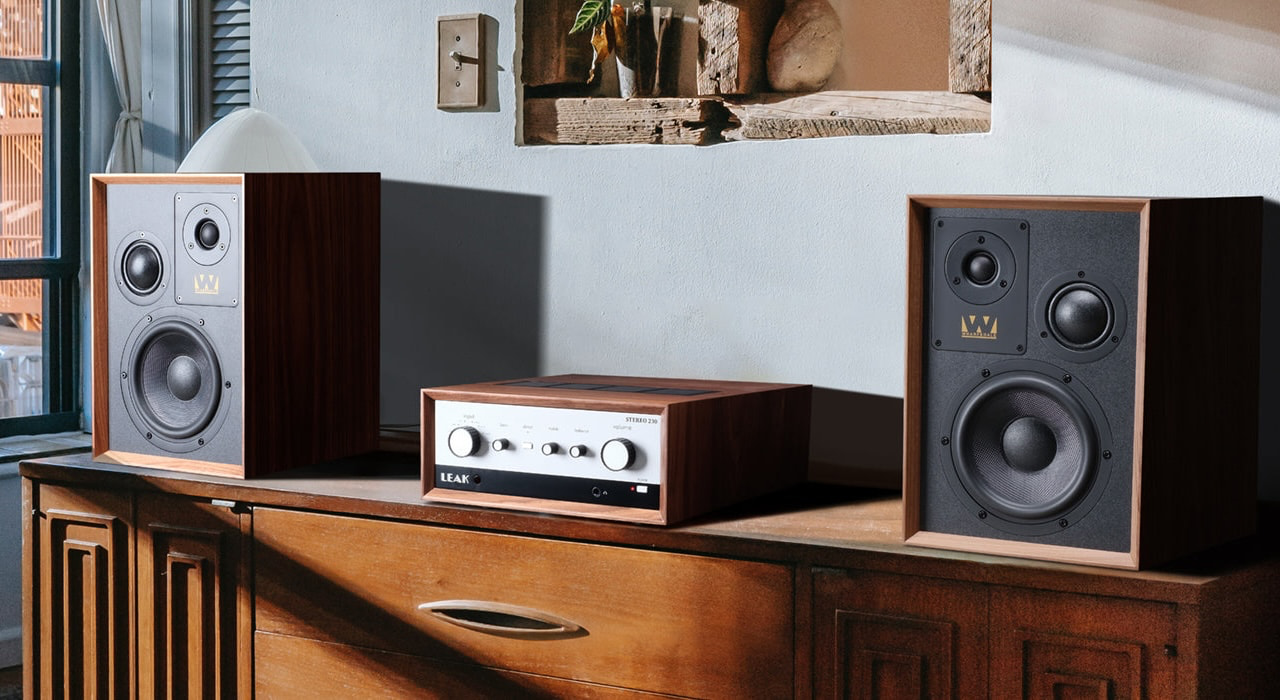
The Super Denton is supplied as a matched, mirror imaged pair.
The 2-inch midrange dome and 1-inch tweeter are offset from the vertical center of the baffle, with one cabinet configured for the left channel and the other for the right. The asymmetrical placement helps distribute diffraction from the cabinet edges and allows Wharfedale to fit all three drivers onto the compact front baffle.
It also means the two loudspeakers are not interchangeable decorative boxes. Their orientation can be changed by positioning the midrange and tweeter assemblies toward the inside or outside, but that decision affects dispersion, image focus, and the relationship between the speakers and nearby sidewalls.
Wharfedale clearly had to make compromises to package three drivers inside a cabinet this size. The offset layout is one of them, although it is an engineering decision rather than a stylistic flourish pasted on by someone wearing an expensive scarf from some expensive store in London.
Three Drivers in a Rather Small Cupboard
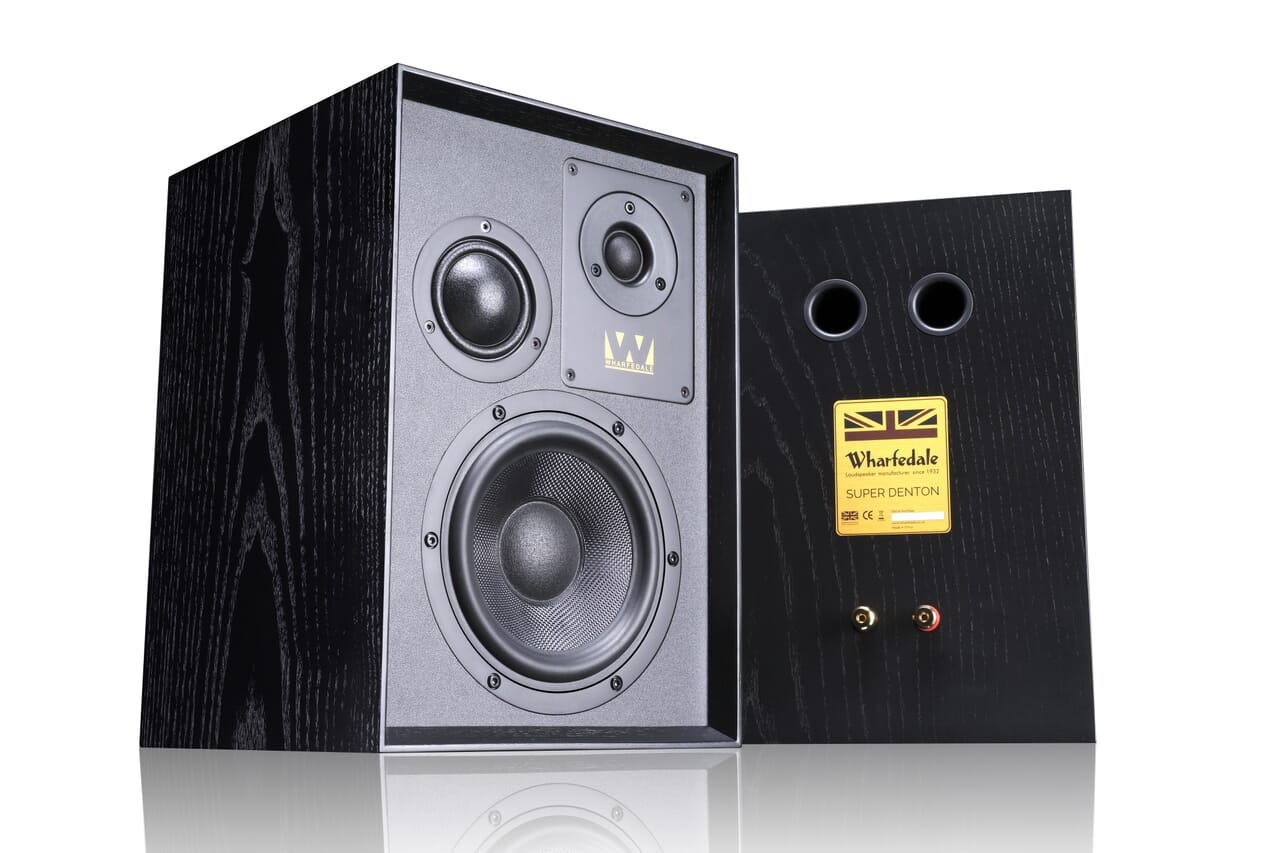
The Super Denton uses a 6.5-inch black woven Kevlar woofer mounted in a cast chassis. The driver handles bass and lower midrange information before handing over to the dome midrange at 940Hz.
Wharfedale rates the bass response at 52Hz to 20kHz within a plus or minus 3dB window, with usable extension down to 40Hz at minus 6dB. That is a respectable specification for a 14.7 liter enclosure, although it does not make the Super Denton a full range loudspeaker. Anyone demanding organ pedal notes from a cabinet this size should consult a subwoofer or perhaps a priest.
The 2-inch soft dome midrange is derived from work completed for Wharfedale’s EVO4 Series. A dome midrange offers wider dispersion than many small cone drivers and allows the woofer to operate over a narrower portion of the vocal range.
That is one of the Super Denton’s most significant differences from both the Denton 85 and the larger Linton models. The dedicated dome handles frequencies from 940Hz to 4.6kHz, covering a substantial part of the region occupied by vocals, guitars, strings, piano, and brass instruments.
Above 4.6kHz, a 1-inch soft dome tweeter handles the upper frequencies. Both dome drivers are positioned close together to reduce the physical distance between their acoustic centers, while their separate internal chambers isolate them from the woofer.
The crossover therefore has two rather important handovers to manage. Integrating three drivers in a small cabinet is not automatically superior to using two. It simply gives the designer more control over how much of the frequency range each driver must reproduce, followed by more opportunities to get the crossover wrong.
Cunning plans often work that way.
Wharfedale Super Denton Specifications
- Design: 3-way vented box standmount
- Enclosure: Bass reflex with twin rear firing ports
- Bass Driver: 6.5-inch black woven Kevlar cone
- Midrange Driver: 2-inch soft dome
- Tweeter: 1-inch soft dome
- Frequency Response: 52Hz to 20kHz +/-3dB
- Bass Extension: 40Hz at -6dB
- Crossover Frequencies: 940Hz and 4.6kHz
- Sensitivity: 87dB, 2.83V at 1 meter
- Nominal Impedance: 6 ohms, compatible with 8 ohm amplifiers
- Minimum Impedance: 3.4 ohms
- Recommended Amplifier Power: 25 to 120 watts
- Maximum Rated SPL: 103dB
- Cabinet Volume: 14.7 liters
- Dimensions: 14.17 x 9.69 x 11.61 inches, including terminals
- Weight: 20.28 pounds each
- Finishes: Black Oak, Walnut, and Red Mahogany
- Stands: Not included

Listening
My first extended experience with the Super Denton came while assembling an Audiophile System Builder around the MOON 250i V2. That pairing revealed something important rather quickly: the Wharfedales might not look especially demanding on paper, but they respond decisively to an amplifier with proper current delivery and control.
The 25 watt Naim NAIT 50 produced an appealing tonal balance, but the 250i V2 tightened the bottom end, improved impact, and demonstrated that the Super Denton could reach deeper and sound considerably larger than its 52Hz specification might suggest.
I can already hear the upgrade mice screeching in the lunchroom, gnawing through another credit limit while declaring that the loudspeakers they worshipped six months ago are now the system’s obvious bottleneck.
The Upgrade Express has a very simple timetable. Buy a loudspeaker you like, enjoy it for twelve months, and then begin staring at the larger and more expensive model from the same company as though it contains the final chapter of the Book of Revelations.
Magnepan LRS+ owners look toward the larger panels. Q Acoustics 5040 owners start measuring the room for the 5050. Super Denton owners wonder whether the Linton, Super Linton, or Dovedale represents the inevitable next stop. DeVore Fidelity O/baby owners begin performing financial calculations that would make the Treasury suspicious.
But what happens when you already like the loudspeakers you own?
Does it make more sense to replace them with something larger and theoretically better, or to invest in a superior amplifier and discover how much performance was sitting there unnoticed because the existing electronics had reached their limit first?
That question became increasingly difficult to ignore with the Super Denton. The Quad 3 was an excellent partner and one I could have lived with quite happily, but the longer I listened, the more I wondered whether the Wharfedales had considerably more to give. Rather than immediately booking another ticket on the Upgrade Express, I decided to change the locomotive.
Enter the Advance Paris A10 Classic and the new MOON by Simaudio 371 Network Amplifier.
Yes, both amplifiers cost significantly more than the speakers. That may appear to violate one of the sacred commandments of sensible system building, although most of those commandments were written by people trying to sell you another pair of loudspeakers. The real question was not whether the combination looked balanced on a spreadsheet. It was whether the Super Denton could justify the investment.
It could.
That does not mean anyone needs to spend $6,500 on an amplifier for the Super Denton. It does mean that buyers can start with something more modest and upgrade the electronics later without immediately discovering that the loudspeakers have reached the end of the road.
The British Bulldog proved more than capable of running with considerably more expensive company, leaving the Upgrade Express looking like Basil Fawlty trying to conduct a fire drill with Manuel holding the extinguisher.
I went back and forth between both amplifiers and would comfortably recommend either one, although they impose their authority in very different ways.
The MOON delivers a firmer backhand to the Super Denton—which, rather unexpectedly, appears to enjoy being told what to do. Its bass is tighter, its timing more exact, and its presentation more precise. This is the stern headmaster with the paddle, reminding the Wharfedale that it may be wearing walnut veneer, but it is most certainly not in charge.
The Advance Paris is less analytical and considerably sweeter through the top end. It gives the Super Denton more tonal richness and a little more warmth, without allowing the bass to become soft or indolent. One amplifier applies discipline; the other offers persuasion, a glass of red wine, and the strong possibility of poor decisions after dinner.
Nick Cave and the Fine Art of Feeling Worse
Nick Cave’s “Avalanche” has become my preferred corrective whenever I start feeling suspiciously pleased with myself and require a reminder of my bad behavior and questionable choices.
It also feels uncomfortably like a conversation I once had with someone. She was gentle with the biltong. Possibly.
The MOON 371 presented Cave’s piano and gravelly voice with greater accuracy, firmer tonal weight, and considerably more impact than the Quad 3. The Super Denton came alive with this track, pushing Cave forward of the loudspeakers and giving his voice a physical presence that made the entire performance feel more immediate.
The Advance Paris A10 Classic approached the recording differently. It added more texture, greater top end shimmer, and a sweeter overall balance, but delivered less upper bass and lower midrange punch. Cave sat a little farther back, with more atmosphere around him and less insistence that he was about to climb across the coffee table and review my text messages.
Neither presentation was wrong. The MOON was more precise, direct, and forceful; the Advance Paris was richer, more textured, and slightly more forgiving. They simply placed Cave differently in the room, and the better choice will depend on whether you prefer the interrogation or the confession.
Lee Morgan, Liberty, and Léa Seydoux
Every time I listen to Lee Morgan’s “Search for the New Land,” I shake my head at how young he was, how good he was, and how much music he managed to leave behind before everything ended far too soon.
Between Morgan and Miles Davis, I am never quite sure whether to storm the Bastille in the name of liberté or collapse into a faded café chair somewhere in Paris, drink coffee, and share a galette with Léa Seydoux.
Both transcend time.
So do her legs.
The MOON 371 delivered Morgan’s trumpet with enormous presence and considerable top end energy. It was impossible to ignore. The horn charged into the room with real bite and authority, while the Super Denton kept the performance firmly anchored and pushed the leading edge of each note forward without turning it brittle or aggressive.
The Advance Paris A10 Classic created a more holographic scene. The musicians appeared more naturally distributed across the room, with greater air around the trumpet, piano, bass, and drums. They were perhaps not planted as firmly on the floor as they were through the MOON, but the presentation felt deeper, sweeter, and more atmospheric.
The MOON gave the band sharper outlines and greater physical authority. The Advance Paris made the room disappear more convincingly.
Neither presentation left much to complain about. And frankly, if you cannot live with sound at this level, you may be spending too much time reading forum arguments and not nearly enough time listening to records.
Boards of Canada, Aphex Twin, and Sunday Gravy
I cannot entirely explain it, but age has sent me back toward Boards of Canada and Aphex Twin with alarming frequency. Perhaps I genuinely missed the music. Perhaps I enjoy it because my family loathes it so completely that they leave me alone to listen and write.
Tyrion the Westie simply sits on the floor staring at me as though he has been to this club before and is still wondering where everything went wrong with that Beagle.
Tracks such as Boards of Canada’s “Roygbiv” and Aphex Twin’s “Xtal” exposed the Super Denton’s low frequency limitations more clearly than the acoustic recordings. These loudspeakers do benefit from a subwoofer, particularly a properly integrated REL, but that is a system discussion for another review in late August.
Even without one, both the MOON 371 and Advance Paris A10 Classic drove the Super Denton with considerably more authority than the Quad 3. Bass lines had greater definition, electronic percussion carried more impact, and dense layers of synthesizers remained easier to follow as the recordings expanded across the room.
The MOON delivered the firmer foundation. Its superior control gave the music more energy and kept the lowest available notes tighter, faster, and more clearly separated. The Advance Paris produced the more spacious and atmospheric presentation, allowing the synthesized textures to drift farther beyond the cabinets with a little more sweetness and less insistence around the edges.
Both amplifiers served up atmosphere, energy, layers of synthesizers, and convincing spaciousness—the way Mamma used to make the Sunday gravy.
Easy on the veal shanks, Bubie. And perhaps fewer beef sausages and peppers this time.
The Bottom Line
The Wharfedale Super Denton is unique because it combines a genuine three way design, excellent cabinet work, and the ability to scale with far better electronics without annexing the living room. It sounds substantial, tonally rich, spacious, and considerably more capable than its size or price would suggest.
The limitations are real. Bass extension is good rather than subterranean, electronic music benefits from a properly integrated subwoofer, and listeners chasing forensic detail or surgical neutrality should probably continue their joyless march through the forums.
These are for listeners who value tonal weight, natural vocals, long term listenability, and a loudspeaker that rewards amplifier upgrades rather than immediately demanding replacement.
The Super Denton is one of my favorite loudspeakers available right now. Before selling them for the next model up, try a better amplifier first. The Upgrade Express will still be at the station, idling noisily while several men with measuring microphones argue over the timetable.
Pros:
- Genuine three way design in a relatively compact cabinet
- Rich tonal weight with excellent vocal presence and texture
- Scales remarkably well with better amplification
- Spacious presentation with strong image depth
- Smooth top end encourages long listening sessions
- Excellent cabinetry and real wood veneer finishes
- One of the strongest values at $1,499 per pair
Cons:
- Twin rear ports require breathing room from the wall
- Bass is substantial for the size but not truly full range
- Electronic music and larger rooms benefit from a subwoofer
- Warm sounding amplifiers can push the balance too far
- Not the final word in speed, forensic detail, or treble openness
- Proper stands are required and not included
Our Ratings:
★★★★★★★★★★ Sound Quality
★★★★★★★★★★ Build Quality
★★★★★★★★★★ Value
You must be logged in to post a comment Login