Tech
What Happened to Cabasse? Legendary French Hi-Fi Brand Enters Receivership

The historic French hi-fi manufacturer Cabasse has entered receivership after more than 75 years in the audio industry, raising serious questions about the future of one of Europe’s most recognizable loudspeaker brands. Known for its spherical speaker designs and deep roots in French acoustic engineering, Cabasse helped shape the sound of high-end audio for generations of listeners. Now the company faces a critical restructuring process that will determine whether the iconic brand can survive.
Cabasse is hardly the only high-end audio brand to run into financial trouble as the industry shifts beneath its feet. Over the past few years, companies such as MQA, Krell Industries, Auralic, and MBL Akustikgeräte have all faced their own versions of financial turbulence as the hi-fi market continues to evolve. To its credit, Cabasse saw some of the writing on the wall years ago and began leaning heavily into wireless and connected speaker systems, while continuing to push the distinctive spherical designs that have long set the brand apart.
But the broader reality is difficult to ignore: there are simply too many brands competing for attention, and a growing number of younger listeners are choosing headphones, earbuds, and more affordable compact bookshelf speakers over the large, traditional loudspeaker systems that once defined the high-end category.
Who Is Cabasse?
Founded in 1950 by Georges Cabasse, the French company quickly established itself as one of Europe’s most technically ambitious loudspeaker manufacturers. Cabasse’s goal from the beginning was straightforward but demanding: reproduce music as faithfully as possible without coloration or distortion. That philosophy pushed the company to invest heavily in acoustic research and eventually led to its development of coaxial driver technology, aligning multiple drivers on a single axis so sound radiates from a single point source.

Cabasse’s engineering work extended well beyond home hi-fi. By the early 1950s the company was already supplying sound systems to French cinemas and large venues, and over the following decades it built loudspeakers for studios, theaters, and broadcast environments while continuing to refine its consumer loudspeaker designs. Innovation remained a defining trait of the brand, with Cabasse introducing active loudspeakers as early as the late 1950s and continuing to refine its coaxial and multi-driver technologies through the 1970s, 1980s, and 1990s.
One of Cabasse’s most recognizable achievements came with the development of its SCS (Spatially Coherent System)approach to driver integration, designed to improve phase alignment and create a more realistic soundstage. That engineering philosophy ultimately led to the creation of La Sphère, one of the most visually distinctive loudspeakers in high-end audio and a product that reinforced Cabasse’s reputation for pushing the limits of loudspeaker design.
More recently, Cabasse has tried to balance its traditional hi-fi engineering with the realities of modern listening habits. Products like the Cabasse Rialto wireless bookshelf system and the Cabasse Pearl Theatre immersive home theater platform demonstrate the company’s push toward connected audio and streaming-focused systems. At the same time, statement products such as La Sphère Evo continue to showcase the company’s commitment to ambitious acoustic engineering, combining Cabasse’s quad-coaxial driver technology with modern DSP processing and extremely high power amplification.
After more than seven decades of loudspeaker innovation, Cabasse remains one of the most recognizable names in French hi-fi, known for its distinctive spherical designs and engineering-driven approach to sound reproduction. What happens next will determine whether that legacy continues.

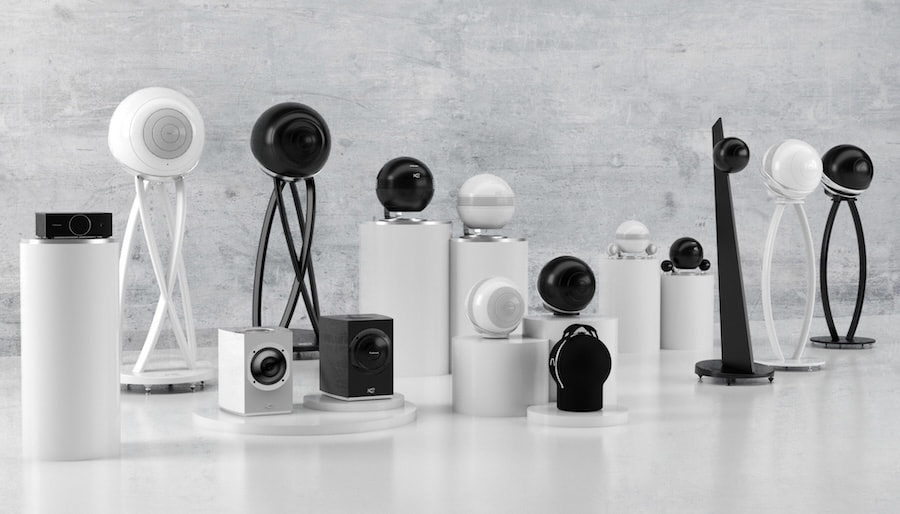
Cabasse Enters Receivership
French luxury hi-fi manufacturer Cabasse has been placed into receivership by the Montpellier Commercial Court, effective March 9, 2026. The proceedings follow the company’s own filing on February 27, 2026, after it declared a cessation of payments.
As one of France’s oldest and most respected audio brands, Cabasse has reportedly been struggling with falling revenues and mounting debts. Trading of Cabasse shares on Euronext Growth Paris was suspended on February 27 and resumed on March 13, 2026.
The company was acquired by Canon Inc. in 2006. In 2014, French group AwoX acquired Cabasse from Canon for €4.5 million with a strategy focused on luxury wireless audio and returning high-end speaker production to France.
AwoX, which was renamed VEOM Group in 2020, has now also filed for judicial reorganisation. VEOM Group, which also owns the Chacon and DiO home automation brands, said its financial situation deteriorated and was “exacerbated by the difficulties of its subsidiary Cabasse.”
In a statement, the company said the court-supervised process is intended to examine “solutions that could ensure the sustainability of the business, preserve jobs, and address outstanding liabilities, while also launching a search for investors through either a recovery plan or a potential divestment.”

The Bottom Line
The receivership process gives Cabasse time to stabilize operations while court administrators search for investors or potential buyers. Parent company VEOM Group, which also owns the Chacon and DiO smart-home brands, has entered judicial reorganisation as well after its financial position deteriorated alongside Cabasse’s struggles. Cabasse represented roughly 29% of VEOM’s revenue in 2025, and when internal engineering and development work are included, the brand accounted for close to half of the group’s overall activity.
What happens next will likely come down to one of two outcomes: new investors recapitalize the company and keep the brand operating, or Cabasse’s assets and technology are acquired by another audio or technology group.
For consumers, the immediate impact may be uncertainty around long-term support for existing products, including warranty service, replacement parts, and software updates for the company’s connected speaker systems. If new ownership emerges, Cabasse could continue developing its distinctive coaxial-driver loudspeakers and wireless platforms. If not, another historic European hi-fi brand may end up folded into a larger group as consolidation continues across the audio industry.
You must be logged in to post a comment Login