

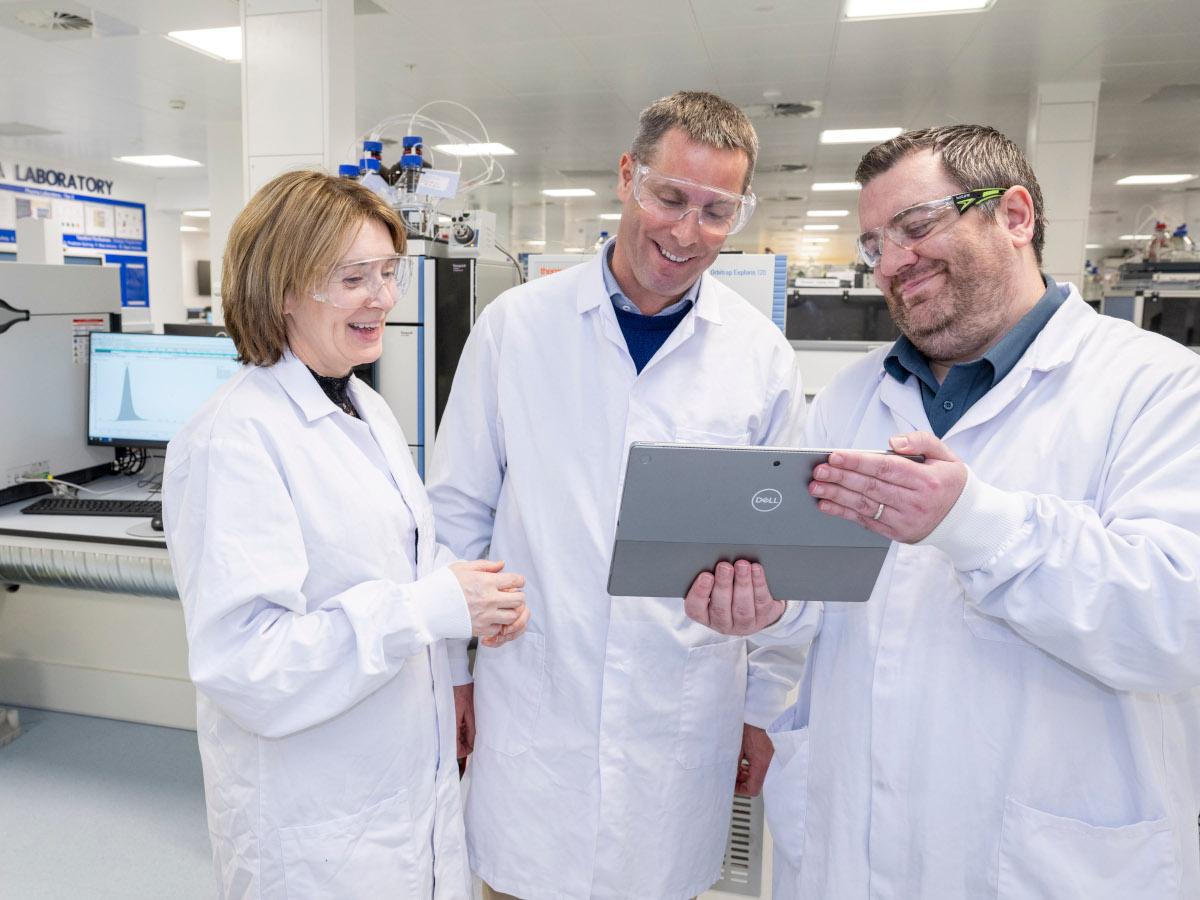

Ronan Rogers and Ruth Callanan discuss innovation in the west of Ireland and the evolution of Ireland’s STEM careers.
Ireland’s medtech sector is moving beyond traditional biomedical engineering, according to Ronan Rogers, the senior R&D director for cardiac ablation solutions at Medtronic. He explained the region has built “real depth”, not just in medtech, but across key areas such as pharmaceutical science, advanced analytics and digital technology. Areas that are now “increasingly converging”.
“That diversity of opportunity is a huge strength for Ireland,” he told SiliconRepublic.com. “It allows people from different professional backgrounds to find meaningful, high‑impact careers in healthcare, while helping Ireland move further up the value chain as a centre for complex, globally relevant innovation.”
Having recently expanded its Galway-based pharmaceutical laboratory, the Medtronic facility now serves as a west of Ireland hub for high-tech innovation and the evolving needs of the global healthcare space. Rogers is of the opinion that this is reflective of the convergence of the country’s medtech divisions.
Noting that the primary purpose of the lab “is to integrate pharmaceutical, engineering and analytical expertise under one roof to address the complex challenges of combination products, [that is] where a medical device and a medicine work together”.
“We see that convergence very clearly in this laboratory and there is a wide range of career paths in our industry, whether that’s a pharmacist drawn to the faster innovation cycles and applied science of medtech, or a software developer who wants to use their skills to solve real healthcare challenges and code with a deeper sense of purpose.”
What opportunities exist?
With the expansion comes the opportunity for students and professionals to consider a new role, either as part of Medtronic or within Galway’s thriving life science and medtech spaces.
“Galway offers a unique innovation ecosystem where infrastructure, academic partnerships and a significant medtech footprint all provide a strong foundation for sustaining Ireland’s leadership in the life sciences sector,” said Ruth Callanan, Medtronic’s director of site quality.
With the investment focused on significantly expanding R&D capability and technical depth within a critical space in the Irish medtech sector, Medtronic has increased lab space by almost a half and introduced analytical technologies that didn’t exist there before.
Callanan said: “This creates the conditions for future high‑value work as programmes grow. It strengthens Galway’s ability to attract and retain highly specialised talent, pharmaceutical scientists, chemical and materials engineers and it allows work that was previously outsourced internationally to be done here in Ireland.
“Over time, as demand and activity scale, we do expect this capability to support additional specialist roles, phased in over the coming years. Importantly, it reinforces Ireland’s position at the forefront of advanced medtech R&D and reflects a broader industry trend toward self-sufficiency in high-tech analytical testing.”
Step into the future
She explained the new lab will enable experts to integrate processes as the facility will be responsible for the entire life cycle of product development, from early phase R&D through to post-market oversight.
She added: “The laboratory utilises advanced LCMS [liquid chromatography-mass spectrometry] and GCMS [gas chromatography-mass spectrometry] technologies, which act as ‘molecular microscopes’. This allows our scientists to identify unknown compounds or impurities at extremely precise levels.”
According to Rogers, the new lab has a role to play in what he believes to be the reshaping of how STEM careers in Ireland are perceived and pursued, with Callanan noting this creates for students and professionals opportunities to engage with careers that bridge the gap between various scientific disciplines.
“A laboratory of this size and complexity requires students and professionals with a wide range of skills and experience across multiple disciplines,” she said.
“Just as importantly,” added Rogers, “we’re sending a clear signal to pharmacists, chemists and analytical scientists that medtech offers deep, intellectually challenging career paths that go well beyond traditional manufacturing or even classical biomedical engineering.”
Don’t miss out on the knowledge you need to succeed. Sign up for the Daily Brief, Silicon Republic’s digest of need-to-know sci-tech news.


























































You must be logged in to post a comment Login