Tech
What Is a Virtual Phone Number and How Does It Work?

A virtual phone number is a normal dialable telephone number whose destination can be controlled through software or a communications service instead of being permanently tied to one physical phone or fixed line. When someone calls it, the provider routes the call according to configured rules, which may send it to an app, desk phone, another telephone number, voicemail or another supported workflow.
What Is a Virtual Phone Number?
A virtual phone number separates the number people dial from the physical device that ultimately handles the communication. Twilio’s technical glossary describes a virtual phone number as a standard telephone number that is not locked to a specific phone and can route calls or messages to supported destinations or workflows.
That distinction is the key to understanding the term. The telephone number still acts as an address that other people can dial. Behind it, however, routing rules determine what should happen when a call reaches the service responsible for that number.
For example, imagine a small company with one customer-service number. During office hours, calls might ring a softphone, meaning a software-based phone application, used by two employees. After hours, the same number could send calls to voicemail or forward them to an on-call phone. Customers continue dialing the same number even though its destination changes.
Public telephone numbers also exist within national and international numbering systems. The International Telecommunication Union’s current E.164 international public telecommunication numbering plan, approved on February 13, 2026 and currently in force, defines the international numbering framework. A virtual-number service adds configurable routing and communications services behind such a number rather than creating an entirely separate kind of address that callers need to understand.
How Does a Virtual Phone Number Work?
The simplest mental model is to separate the process into three things: the number the caller dials, the provider responsible for processing that number, and the endpoint or workflow selected by the provider’s routing rules.
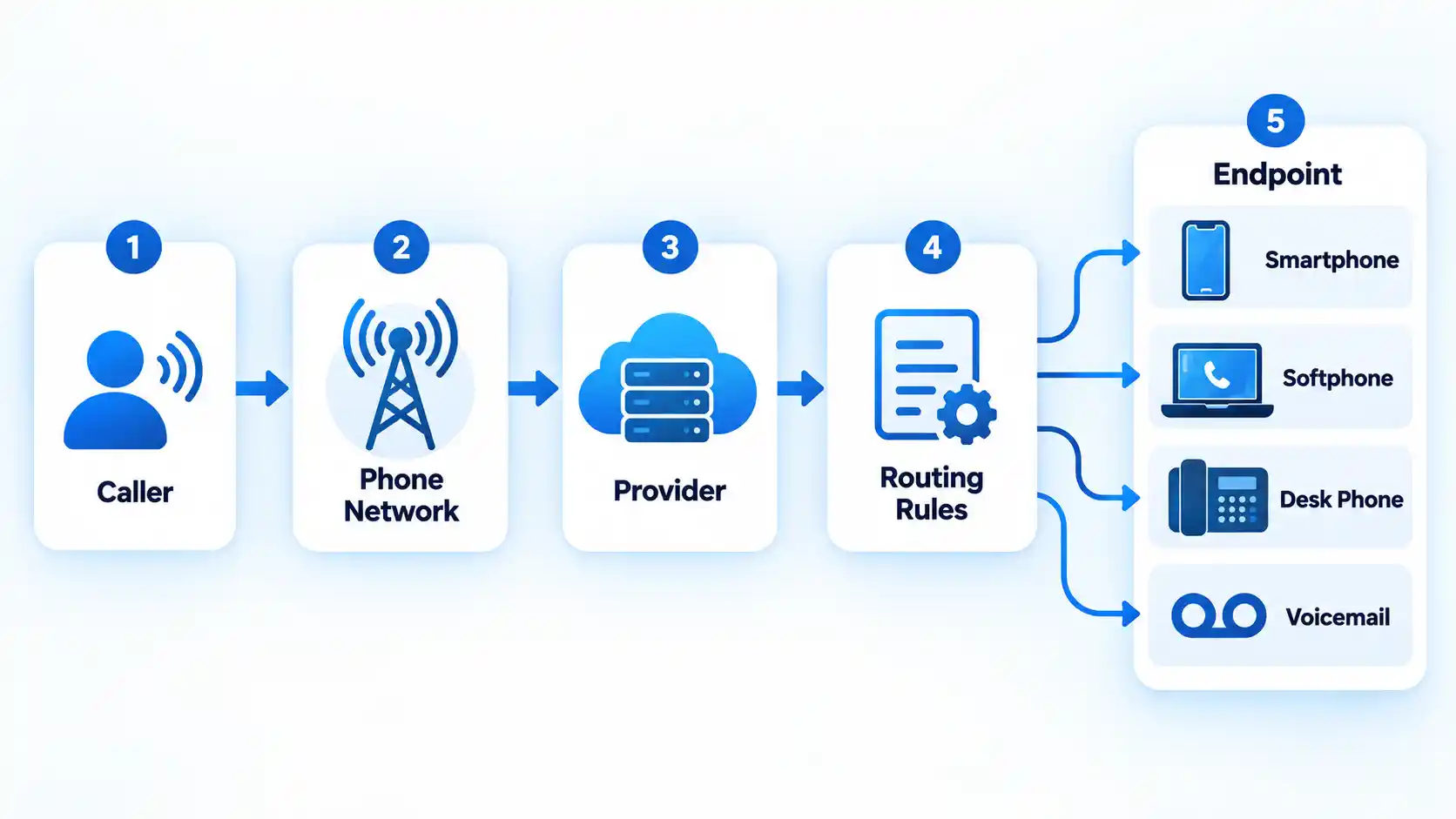

1. Someone Dials the Public Number
To the caller, the process can look ordinary. They dial a telephone number from a mobile phone, landline or another compatible calling service. They do not need a special app merely because the destination uses cloud telephony or virtual routing.
The telephone network then routes the call toward the carrier or communications platform responsible for handling that number. Exactly how this occurs varies across carriers, countries and service architectures, so it is more accurate to describe a general routing model than to assume every virtual-number provider uses identical infrastructure.
2. The Responsible Service Receives the Call
Once the call reaches the service hosting or processing the number, the platform identifies the configuration associated with it. A useful real-world example comes from Twilio’s inbound call processing documentation: when a call reaches one of its numbers, Twilio looks up routing information for that number and processes the call according to its configuration.
Twilio is one implementation rather than a universal blueprint, but it illustrates the central principle. The number is associated with routing information, and that information determines what the communications platform does next.
3. Routing Rules Decide What Happens
Depending on the service and configuration, an incoming call might:
- ring one user or extension;
- ring several employees or devices;
- enter a call queue;
- play an automated menu or interactive voice response prompt;
- forward to another telephone number;
- reach a Session Initiation Protocol (SIP) endpoint;
- trigger an application-controlled workflow; or
- go to voicemail when nobody answers.
These are examples rather than guaranteed features. The precise options depend on the provider, number type, country and service plan.
4. The Call Reaches the Selected Endpoint
An endpoint is simply the place where the communication is ultimately handled. It might be a mobile or desktop app, an Internet Protocol (IP) desk phone, a SIP device, another conventional telephone number or a voicemail system.
This makes location and device less rigid than they are with a telephone service permanently associated with one line. A support worker can potentially answer the same business number on a laptop at home, an IP phone in an office or another configured device without asking callers to learn a different public number.
5. Outbound Calls Use the Service in the Other Direction
Many virtual-number services also support outbound calling. A user starts a call through the provider’s app, phone system or another supported endpoint. The provider connects that call toward the recipient and, where permitted and correctly configured, presents an authorized telephone number as the calling number.
The important point is that the number itself and the device used to handle the call do not have to be the same thing. The provider sits between them and applies the account’s calling and routing configuration.
Is a Virtual Number the Same as VoIP?
No. A virtual phone number and Voice over Internet Protocol (VoIP) are closely related concepts, but they describe different parts of a communications system.
A virtual phone number is the address people dial and the routing relationship attached to it. VoIP is a technology for carrying voice communications using Internet Protocol networks. Many cloud phone services combine the two, which is why the terms are often used as though they were interchangeable.
A useful analogy is a street address and a delivery vehicle. The address identifies where something should be delivered. The vehicle is one way of transporting it. Similarly, a telephone number identifies a communications destination, while VoIP can provide part of the technology used to transport and process a call.
This distinction matters when diagnosing problems. A number may still exist even when an app is offline, while a VoIP call can suffer from network conditions such as latency or packet loss even though the number itself is configured correctly. Voice quality problems involving packet transport, codecs and network delay are therefore questions about how VoIP works rather than properties of the virtual number itself.
Virtual Number vs. SIM, eSIM and Call Forwarding
Several technologies can produce similar results from a user’s perspective, but they operate at different layers. The table below focuses on what each concept represents rather than on individual provider features.
| Concept | What it primarily is | Tied to a cellular subscription? | Can direct calls to different endpoints? | Does the receiving endpoint need Internet access? |
|---|---|---|---|---|
| Virtual phone number | A public number associated with configurable communications routing | Not necessarily | Often, depending on the service | Depends on the selected endpoint |
| Physical SIM | A removable secure element used as part of authenticating a subscriber’s device to a mobile network | Yes | Not by itself | No for ordinary cellular voice service |
| eSIM | A SIM implementation that allows a compatible subscription profile to be provisioned into an embedded secure element | Yes | Not by itself | No for ordinary cellular voice service |
| Call forwarding | A routing behavior that redirects calls from one number to another destination | No | Yes, within the forwarding options provided | Depends on the forwarding destination |
The GSMA explains that a conventional SIM provides a secure means of authenticating devices to mobile networks, while eSIM technology allows SIM information to be securely downloaded into an embedded secure element. An eSIM therefore changes how a mobile subscription can be provisioned into a compatible device. It is not another name for cloud telephone-number routing.
The technologies can also coexist. Someone could have a virtual business number that rings a smartphone whose cellular subscription is delivered through an eSIM. The virtual number and eSIM are doing different jobs in that arrangement. The practical differences become especially important when comparing a virtual phone number vs. eSIM for travel, business calling or maintaining a second contact number.
What Types of Virtual Phone Numbers Exist?
Virtual-number providers can offer several number categories, although the available types and permitted capabilities depend on the country and provider. Twilio, for example, documents offerings that include local, national, mobile and toll-free numbers across supported markets.
Common categories include:
- Local or geographic numbers: numbers associated with a particular city, area or numbering region.
- National or non-geographic numbers: numbers intended for broader national use rather than one specific local area, where the country’s numbering plan provides them.
- Mobile numbers: numbers assigned from mobile ranges in markets where the provider offers them.
- Toll-free numbers: numbers for which the called organization generally bears the relevant call charge rather than the caller, subject to the applicable country’s system.
- Vanity numbers: memorable numbers selected partly for branding or recognizability. The memorable format does not imply a different routing technology by itself.
Do not assume that a number supporting voice will automatically support Short Message Service (SMS), Multimedia Messaging Service (MMS), short codes or every other communications feature. Number capabilities can differ by number type, carrier, provider and jurisdiction.
What Are Virtual Phone Numbers Used For?
The main attraction of a virtual number is flexibility in what happens after somebody contacts it. That creates several practical uses without requiring the public-facing number to change.
One Number for a Distributed Team
A company can publish one support or sales number while allowing staff in different locations to answer calls through supported applications or devices. Routing rules can send a call to an available employee, a queue or voicemail instead of depending on one desk phone.
Separating Public and Personal Numbers
A freelancer, small-business owner or employee may want customers to use a business number rather than publishing a personal cellular number. The business number can then route to a device the person already uses.
Local Contact Points
Where regulations and provider availability permit it, an organization may use numbers from different geographic markets while handling calls through a centralized communications system. A local-looking number does not by itself prove that the person answering is physically located in that area.
Call Tracking and Department Routing
Different numbers can be associated with departments, locations or campaigns while still feeding into the same communications platform. Twilio documents call tracking and direct inward dialing as uses of virtual phone numbers.
Number Masking
Some platforms place an intermediary number between two participants so they can communicate without directly exposing each other’s personal telephone numbers. For example, a marketplace could provide a proxy number that lets a buyer and seller communicate without exchanging their personal numbers.
That creates separation between the participants’ public contact details, but it does not guarantee anonymity from the communications provider. The provider may maintain account, routing or other records under its policies and applicable law.
Limitations and Risks You Should Understand
Virtual numbers are flexible, but the phrase describes a broad category rather than a guarantee of specific capabilities. Several limitations deserve attention before you depend on one for an important use.
Internet and Service Availability Can Affect Calls
If your destination is a VoIP app, browser or IP phone, receiving calls can depend on Internet connectivity, electrical power, device configuration and the availability of the communications service. A number may be correctly provisioned while its chosen endpoint is temporarily unreachable.
Forwarding to a conventional telephone number can create a different dependency chain, so it is inaccurate to say that every virtual-number call requires the final user to have an Internet connection.
SMS Support Does Not Guarantee Verification-Code Support
A number may technically receive SMS while still being rejected by a bank, social network or another service for account verification. Acceptance can depend on the receiving platform’s policies, number classification, carrier relationships and the messaging route involved.
That means “supports SMS” and “works with every one-time password service” are not equivalent claims. The reasons some VoIP numbers cannot receive verification codes can involve restrictions outside the virtual-number provider’s direct control.
Caller ID Does Not Prove Who Is Calling
A virtual phone number should not automatically be treated as suspicious, but the telephone number displayed on a screen is not reliable proof of identity. The U.S. Federal Trade Commission warns that scammers can make fake names or numbers appear on caller ID, a practice known as spoofing.
Spoofing and virtual numbering are different concepts. A legitimate business can use a valid virtual number, while a scammer can falsify caller ID without legitimately controlling the displayed number.
Emergency Calling Requires Special Attention
Never assume that the presence of an ordinary-looking telephone number means emergency calling works exactly like it does on a traditional fixed or mobile line.
In the United States, the Federal Communications Commission has required providers of interconnected VoIP service to provide Enhanced 911 (E911) capabilities as a standard feature. FCC material also explains that interconnected VoIP providers use registered-location information to route 911 calls and provide emergency centers with the caller’s callback number and location information.
Those rules do not mean every product marketed as a virtual number has identical emergency-calling functionality. Before relying on a service for emergency calls, verify the provider’s current emergency-calling support, registered-location requirements and limitations for the country and service you will use.
Phone Number Rules Differ by Country
Number availability is not simply a commercial decision made by an app provider. Countries regulate their numbering resources, and requirements can vary by number type and user category. Twilio’s current regulatory documentation explains that phone-number compliance can require end-user identity and supporting documents according to the applicable country, number type and regulatory requirements.
A provider offering a local number in one country may therefore require identity, address or business documentation that it does not request for another country’s number. Some number types may also be unavailable to users who cannot satisfy applicable eligibility or documentation requirements.
Control and Portability Matter
If a telephone number becomes important to customers, clients or account recovery, consider what happens if you later change providers. Ask whether the number can be ported, what information is needed to authorize a transfer and what happens after cancellation.
In the United States, FCC materials document local number portability between several wireline and wireless service arrangements while also noting that geographic and technical limits can apply. The FCC’s number-portability review explains both the value of retaining a telephone number and existing portability limitations. Rules and technical eligibility differ internationally, so do not assume that every virtual number in every country can be transferred to another provider.
What Should You Check Before Getting a Virtual Number?
Start with what you actually need the number to do. A service that is appropriate for occasional inbound calls may not meet the requirements of a support team, a regulated business or someone who depends heavily on messaging.
- Voice capability: Check whether you need inbound calls, outbound calls or both.
- Messaging: Verify SMS and MMS separately instead of assuming every number supports both.
- Number type and location: Confirm that the required country, area code or number category is actually available to you.
- Endpoints: Check whether you can answer through mobile apps, desktop apps, browsers, SIP phones, forwarded numbers or the specific devices you use.
- Routing: Determine whether you need queues, simultaneous ringing, schedules, extensions, menus or voicemail.
- Portability: Find out whether the specific number can be transferred if you leave the provider and whether geographic or regulatory limits apply.
- Emergency calling: Verify the service’s emergency-call support and any registered-location requirements.
- Verification codes: If receiving one-time codes is important, confirm acceptance for the particular services you use rather than relying only on an “SMS capable” label.
- Compliance: Check identity, address, business-registration or local-presence requirements before obtaining an international or geographic number.
- Security: Review account protections such as multifactor authentication, administrator permissions and recovery procedures because control of an important business telephone number can be operationally sensitive.
- Costs: Compare the recurring number charge with inbound, outbound, forwarding, messaging, international and usage-based charges that apply to your expected traffic.
Before publishing the number widely, test the complete communications path yourself. Place inbound and outbound calls using the devices and networks you expect to use, confirm voicemail or fallback routing, and verify that caller ID and routing behavior match your intended configuration.
The Short Version
A virtual phone number separates the telephone number people dial from one permanently attached physical destination. Calls still travel through telecommunications networks to the service responsible for the number, but that service can use configurable routing to decide which supported device, telephone number or workflow handles the communication.
That flexibility is why virtual numbers are useful for distributed teams, business-personal separation, call routing and masked communications. It does not make every service identical. Voice and messaging capability, verification-code acceptance, emergency calling, portability and regulatory requirements can all vary by provider, number type and country, so those details should be checked before the number becomes operationally important.
You must be logged in to post a comment Login