Tech
What Should You Do If You Find Utility Markings On Your Driveway?

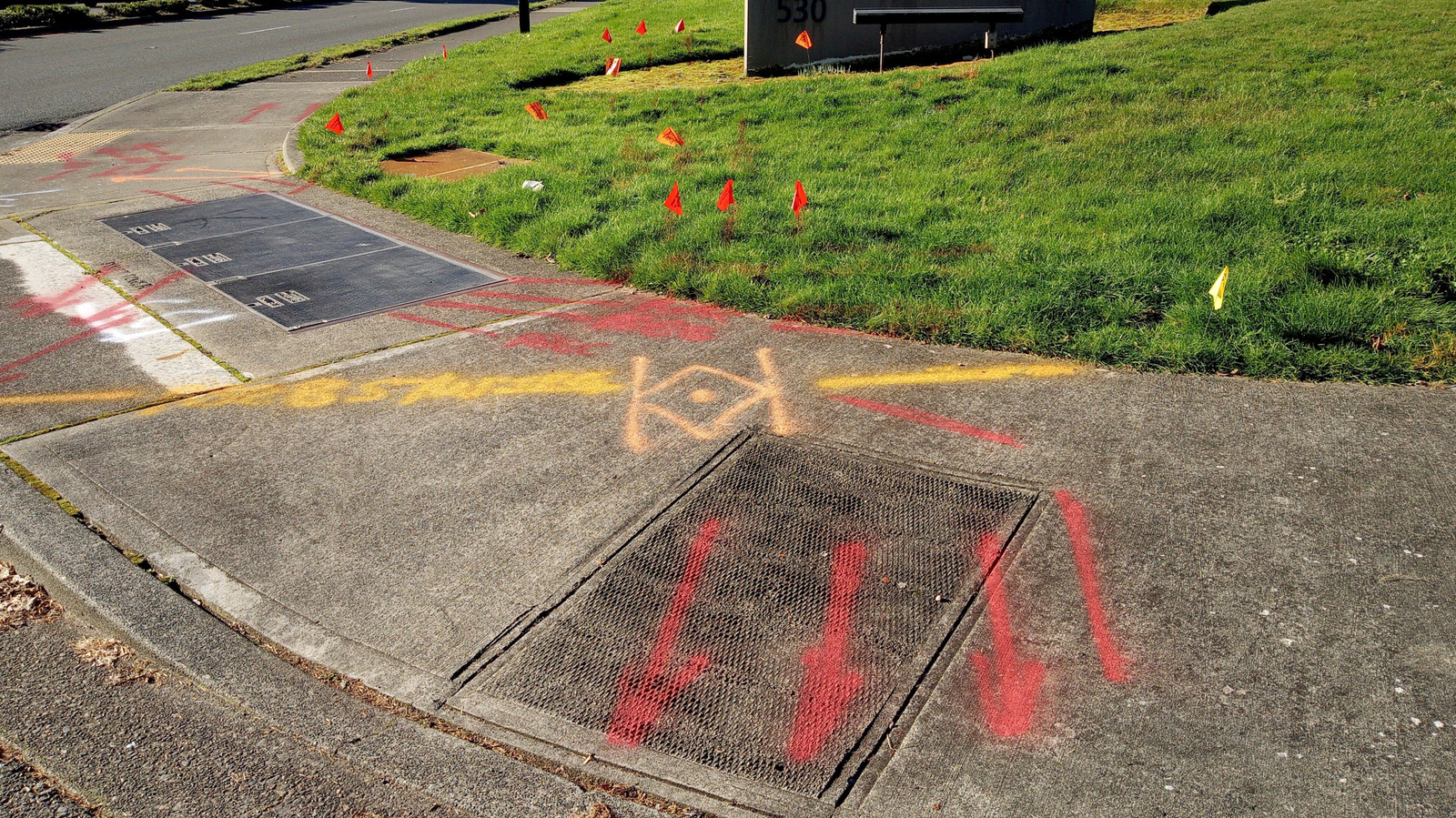

If you happen to walk outside and unexpectedly find utility markings (paint or flags) on your driveway or in your yard, it’s good advice to heed the words splashed across the cover of “The Hitchhiker’s Guide to the Galaxy” — don’t panic, it’s not the end of the world. Next, if you didn’t call the utility company, check with your neighbors to see if one of them did, and if not, then call the nationwide 811 phone number used throughout the United States for underground utility location services, because someone is planning on doing work that might directly involve your little slice of heaven.
Most property owners probably know full well that beneath their perfectly manicured landscaping efforts lies a dizzying array of underground utility lines, irrigation systems (even those using smart controllers), and water and sewer pipes. It’s also probably safe to assume that most of us have no clue where those things are. It takes professionally trained people with the right tools to come out and locate them before anyone starts digging things up to avoid triggering a cataclysmic event. Even when professionals follow these exacting safety protocols, very bad things can still happen.
For instance, a house 15 miles south of Oakland, California, exploded in December 2025, after a construction crew hit a gas line. The house next door was also severely damaged, and six people were injured. More recently, 67 homes in Mountain View, California, were under a boil-water notice for weeks after a crew replacing the neighborhood’s water pipes allowed cement slurry to seep in, subsequently introducing bacteria into the drinking water.
It’s always better to be safe than sorry
For every project that involves digging into the ground – whether it’s a simple DIY effort to repair sprinkler lines, or a larger one carried out by city workers — the area needs to be inspected at least two days beforehand. Calling 811 sends utility companies out (at no charge) to locate and mark underground lines (gas, water, electric, internet, etc.) with flags and spray paint. This safety measure is a federal law meant to prevent damage to public infrastructure, personal injuries, or unwanted service outages.
The markings all have different meanings, but follow uniform color codes mandated by the American Public Works Association (APWA). Red indicates the presence of electric power lines (invented in 1882), lighting cables, and conduit. Orange means telecommunication, alarm/signal lines, cables, or conduit. Natural gas, oil, steam, petroleum, or other flammable substances will always be designated by the color yellow. Green notifies you of sewer and drain lines, while blue is for potable drinking water. Reclaimed water, irrigation, and slurry lines are represented by purple. Pink is used for temporary survey markings or things that are either unknown or unidentified. Lastly, white outlines proposed excavation limits or routes.
Utility markings should generally remain in place until the project is complete. And if you are the one doing the digging, check your state’s tolerance laws because you may need to use hand tools instead of mechanized equipment if you’re working within 24 inches of a marked line. Ultimately, it’s better to be safe than sorry, because nobody wants to be responsible for causing a problem that brands them as “that person” in their neighbor’s eyes forever.
You must be logged in to post a comment Login