Tech
What Speed Do Fighter Jets Land At?

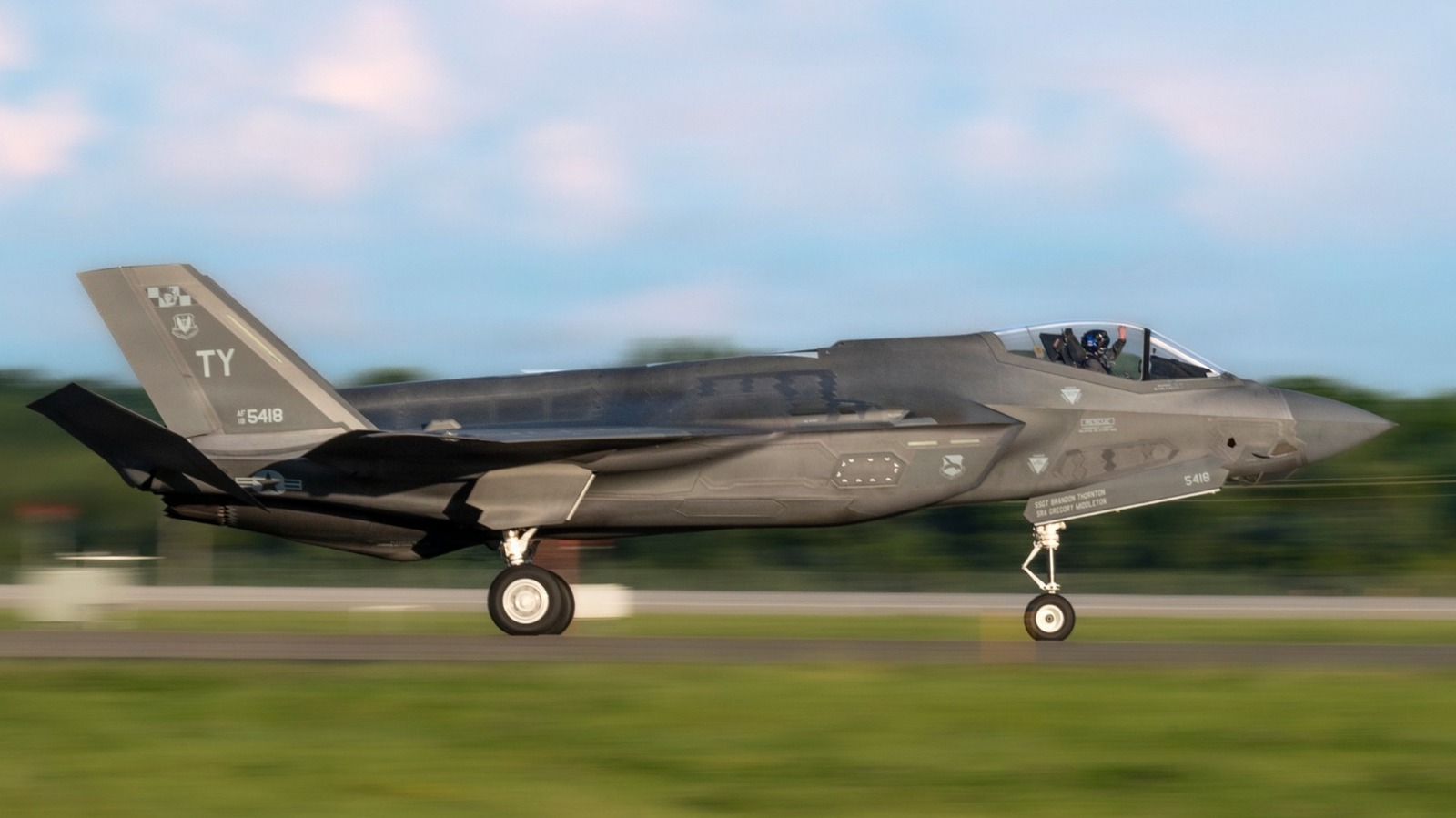

Fighter jets are some of the fastest air-breathing machines mankind has ever made, so it’s well-established that they move quickly through the air. The F-35 Lightning II, for example, has a top speed of Mach 1.6 (1,200 mph), so it’s not slow. Given how fast it and other fighter jets typically operate, it begs the question, “How fast do they land?”
Comparatively, when you’re in a fast-moving commercial passenger plane that’s coming in for a landing, you probably don’t think too much about speed. Still, you’re moving pretty fast, and the same is true of fighter jets, though it depends on where it’s landing. Touching down on a nice, paved runway is ideal in most situations, but for fighter jets, the most challenging landing happens on an aircraft carrier, which forces the plane to a nearly immediate stop almost as soon as its wheels hit the deck. That’s due to the limited space and the need to arrest the aircraft’s movement so it doesn’t fall off the edge of the ship.
Looking back at commercial jets, they typically land at between 130 and 160 mph. The same is mostly true of fighter jets, as the physics of landing don’t change all that much whether you’re talking about a 344-ton Boeing 747 or a 9.85-ton F-16 Fighting Falcon. The typical range that a fighter jet lands is between 170 and 210 mph, so they come in at greater speeds than commercial aircraft, but not by too much. There are several reasons for this, including a fighter’s design for supersonic speeds, which actually makes it safer to land faster than a commercial aircraft would.
Fighters are designed to land at high speeds
Landing for commercial aircraft is purposefully designed to be as quiet and easy as possible. If not, fewer people would board a plane knowing that it would be an uncomfortable bump at the end of their flight. Military aviators aren’t afforded such luxury, but fast landings aren’t always about combat readiness. The problem concerns a fighter’s design, which prefers maneuverability and speed to comfort. As a result, landing slowly risks stalling; while hitting the ground at speeds of 210 mph may be rough, but it’s the safest way to get a fighter jet on the ground.
When you’re talking about landing a plane onto an aircraft carrier, however, it’s a completely different level of complexity. A fighter approaches the carrier for landing at around 150 mph, but don’t forget that the carrier itself is in constant motion; even if the ship isn’t moving forward, it’s sitting atop an ever-changing ocean landscape. Once the aircraft hits the flat top’s runway, it has to stop within 350 feet, which is where the arresting cables come into play.
In the above image, an F/A-18 Super Hornet is coming in for a landing on the USS Theodore Roosevelt (CVN-71). You can see its hook, jutting out behind the landing gear. This is meant to “grab” the cable, which stops the aircraft before it runs off the edge. So, while a Navy Aviator lands at 150 mph, they also stop almost suddenly, going from 150-0 mph in a matter of seconds. That’s quite different from landing on a runway, but many brave men and women do it numerous times throughout their careers.
You must be logged in to post a comment Login