
TL;DR
Apple is aiming for a WWDC 2027 smart glasses unveil and is debating whether to include a camera amid the privacy backlash Meta created



As Apple’s Worldwide Developers Conference, WWDC 2026, approaches, the excitement is building around what Apple has in store for us this year. From Siri’s overhaul to new Apple Intelligence updates, there’s a lot to look forward to.
The annual Worldwide Developers Conference kicks off Monday at 10 a.m. PT/1 p.m. ET. For those eager to tune in, the event will be streamed live via the Apple Developer app, Apple’s website, and the Apple Developer YouTube channel.
The most anticipated announcement is a major AI upgrade to Siri, transforming it into a more conversational assistant capable of understanding context, handling multi-step tasks, and interacting more naturally across apps and services. The revamped Siri will leverage Google’s Gemini technology to enhance its capabilities.
Additionally, recent leaks from Bloomberg have unveiled a standalone Siri app that aims to compete with advanced AI chatbots like ChatGPT, Claude, and Gemini. Apple may also introduce a feature reminiscent of messaging apps, enabling users to set timers for automatically deleting conversations after 30 days, a year, or keeping them indefinitely.
According to The Information, Apple plans to introduce an AI agent integration with the app store. While details are scarce, agents allow users to delegate tasks such as booking reservations, managing everyday tasks, editing documents, or controlling smart home devices.
A new “Visual Intelligence” section is anticipated to be introduced within the Camera app, taking the place of the previous Visual Intelligence feature found in the Camera Control button. This upgrade will introduce a dedicated Siri mode that exists next to options like Photo, Video, Portrait, and Panorama. The Visual Intelligence feature leverages Google Image Search to accurately identify objects captured by the user.
In addition, the Photos app is set to receive exciting enhancements powered by Apple Intelligence. These may include intelligent scene recommendations for optimizing photos, automatic object removal for cleaner images, and an innovative AI photo editing feature that allows users to request edits simply by using natural language, new productivity functionalities in visionOS.
Apple is set to upgrade the Image Playground app, introducing higher-quality image generation, more artistic styles, better character consistency, and richer editing controls. The interface for creating new images will be simplified, offering fewer controls and a “describe a change” option for editing.
Additionally, we might see a suggested Genmoji feature that proposes custom emojis based on users’ media and text interactions. Users may also be able to generate AI wallpapers that reflect various themes and moods.
Notable updates are rumored to be coming to the Wallet app, particularly a new bill-splitting feature that will simplify sharing expenses among friends or family. Users will be able to photograph a receipt and generate payment requests to different parties effortlessly.
Alongside this, the Wallet app will also include a “Create a Pass” option that enables users to generate digital passes from physical items such as movie tickets, concert passes, or gym membership cards.
Apple is expected to enhance its AI-powered Siri experience across its devices, as well as likely incorporate more AI features and stability updates.
When you purchase through links in our articles, we may earn a small commission. This doesn’t affect our editorial independence.


Security
(Security) hole-ier than thou
Click To Pray, a prayer app endorsed by the Pope with hundreds of thousands of users worldwide, has leaked people’s names and email addresses for months – or longer – according to an ethical hacker who said she found and reported the security vulnerability six months ago to no avail. This app needs to take a vow of silence when it comes to your personal information.
The app, available in seven languages and on iOS, Android, and clicktopray.org, is the official app of the Pope’s Worldwide Prayer Network. It connects users across the globe to pray for the Holy Father’s intentions, and as of July 2026, it has 719,517 registered accounts.
It’s also very leaky, according to security sleuth BobDaHacker, who says she spotted and disclosed the vulnerability to the Pope’s Worldwide Prayer Network on January 3.
“The vulnerability is still live,” the hacker said in a Friday blog. “Nobody has ever responded. I guess my email wasn’t in their prayers.”
The Reg readers likely remember BobDaHacker for her previous research exposing a free-food flaw in McDonald’s ordering system and open controls on Chinese robot manufacturer Pudu Robotics.
This latest security hole stems from an Insecure Direct Object Reference (IDOR) bug in the prayer app. This is a very common and easy-to-exploit type of flaw that occurs when a website or an app blindly accepts user-provided input to view or modify resources without checking to see if the user is actually authorized to retrieve the data.
“You ask for your own data, the server gives it to you,” BobDaHacker explains. “You ask for someone else’s data, the server gives you that too. Thou shalt not authorize, apparently.”
When you sign up for a Click To Pray account, the app assigns you a sequential numeric user ID. As BobDaHacker uncovered, the API endpoint GET https://api[.]clicktopray.org/user/users/{id} will return user data for any account – not just your own account – so long as you supply a valid, five-digit user ID.
It doesn’t perform any authorization check or ownership validation. “Just increment the number and get someone else’s data,” she wrote.
This data includes users’ email addresses, first and last names, country, dates of birth, and whether the account has been deleted, and the API exposes all 719,517 accounts on the prayer site. “With sequential user IDs and no rate limiting, an attacker could enumerate every single account on the platform,” the hacker explained. “One GET request per user. for i in range(1, 719518): scrape(). That’s it. That’s the exploit.”
As BobDaHacker points out, many of these users are likely older individuals, not all that tech savvy, and very trusting of anything Vatican related, making these exposed accounts a “phishing goldmine.”
“Imagine getting an email that says ‘The Holy Father requests your urgent attention’ with a Vatican-looking link,” she wrote. “Grandma is clicking that. Every time.”
And then it gets even worse.
The signup endpoint, POST https://api.clicktopray.org/user/users/sign-up, returns the account’s validation_hash directly in the response body, and that value is the same UUID used in the email verification link. This means someone could sign up using any email address and verify the account before the confirmation message reached the inbox.
Plus, BobDaHacker’s email client flagged the real verification email with a warning that it had failed the domain’s authentication requirements and might have been spoofed or improperly forwarded.
“So not only is the API leaking 700,000 email addresses that could be used for phishing, but the real emails from Click To Pray already look like phishing,” the hacker noted. “An attacker wouldn’t even need to try hard. They could send a pixel-perfect phishing email and it would have the same level of email authentication as the real thing: none. God works in mysterious ways.”
The Register reached out to the Pope’s Worldwide Prayer Network and did not receive any response. BobDaHacker says she’s still praying for one, too.®
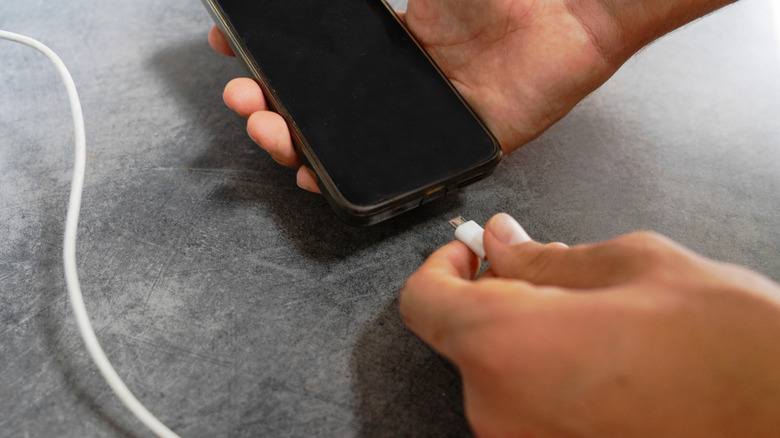
Your battery is continually losing charge.
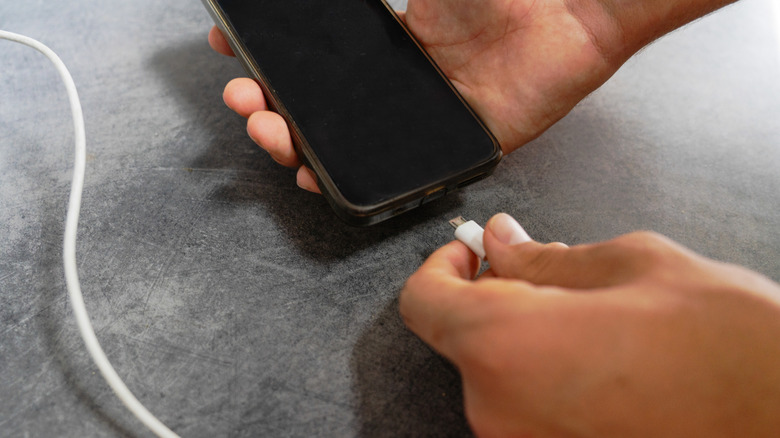
Even though smartphone batteries are getting bigger and more efficient, there’s always that inevitable event when you get a low battery notification at the worst possible time. You might think powering down the phone entirely is a way to make your smartphone last longer. But like with any battery-powered device, a phone’s battery will slowly deplete when you’re not actively using it, and even when it’s completely powered down.
Of course, the battery drains much more slowly when turned off, so it’s not a bad idea to power down the phone to conserve battery. That might be before a plane takes off, for example, and you want to ensure you have power when you arrive at your destination. If you leave an old phone in a drawer for weeks or months then decide to use it, however, you’ll find that the battery isn’t still at the same percentage it was when you left it.
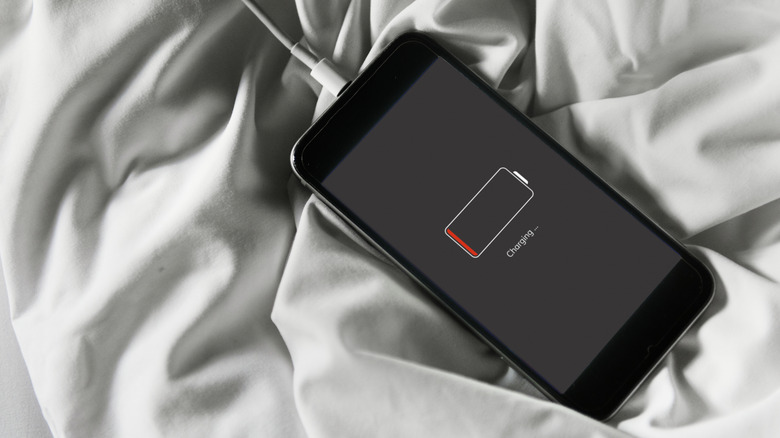
Why does this happen? One thing that draws battery from your phone while it’s off is a clock-and-wake circuit, which uses a tiny amount of current so that the power button responds when you want to turn it on and so the phone immediately knows the right time and date once it boots back up. But the biggest battery drain is something called a self-discharge, a chemical release of the lithium-ion batteries used in phones. The battery will lose about 1-2 percent of its power every month or so when turned off. If you store it in a spot that’s above room temperature, it will deplete even faster than that.
If you leave the phone on and don’t use it, the battery will logically drain much more quickly. I have left Android phones I’m testing untouched for up to a week, for example, and they easily go from about half charge to completely dead in that time. That said, if you’re giving a phone a break, it’s still a good idea to power it down completely. While there’s still that self-discharge, it will be much slower than if you leave the phone on. When the device is on, the screen lights up for notifications, the radio remains active and latched onto signals, and background apps are using power.
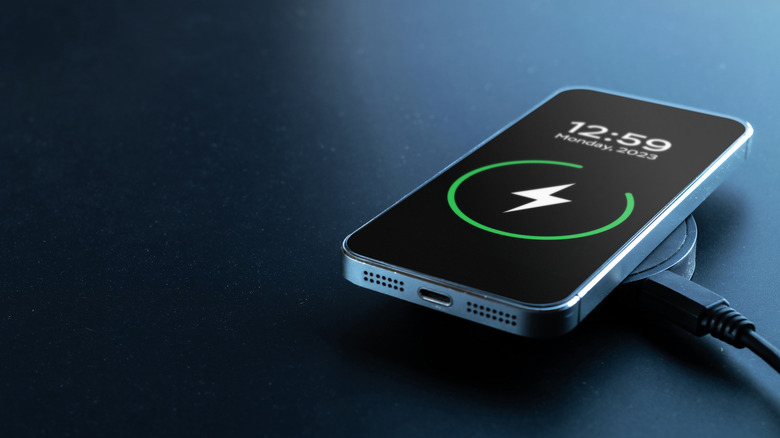
If you plan to keep a phone tucked away long-term, like if you upgraded and you’re waiting for your pre-teen to become of age so they can use it, it’s wise to keep the device charged consistently to avoid damage. Apple recommends not fully charging your phone before you put it away for an extended period, suggesting you charge an iPhone only to about 50 percent. Then recharge it every so often (Apple recommends every six months) so it’s always topped up and not lying completely dormant.
This prevents something called a deep-discharge state, which can happen when a device’s battery has been completely dead for a long period of time. If it gets to this point, the phone’s battery’s copper current collector can dissolve, redeposit, and permanently impact the phone’s battery capacity, or even potentially cause a short circuit. At the very least, the loss in battery capacity means the phone wont last as long per charge going forward.
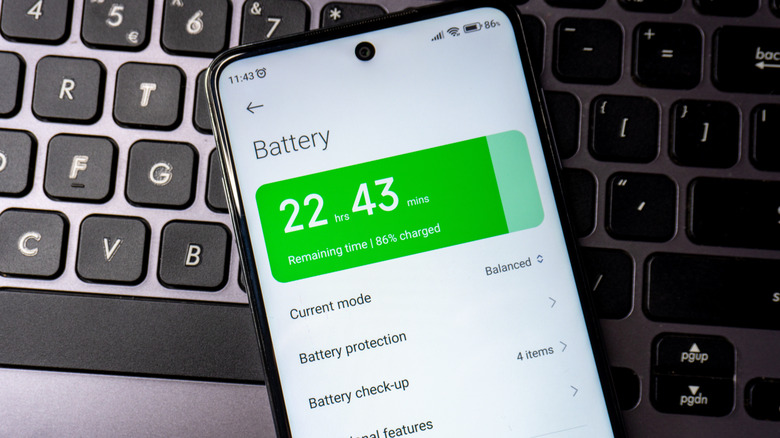
To recap, if you’re storing a phone, power it down when the battery is at about 50 percent and charge it back up to this point at least every six months. Most importantly, don’t throw it in a drawer completely dead nor fully charged. Don’t forget to store it in a cool, dry place with temperatures below 90°F.
All that said, leaving a phone lying around for months isn’t a total death sentence. I have left some of the best Android phones released over the last five years powered down for months and charged them for comparative reviews. They work fine even if the battery capacity isn’t as good. I even recently found an old BlackBerry PlayBook tablet that hadn’t been booted up since 2011. I plugged it in and it successfully charged and works! But it’s clear the battery life has lessened as it barely lasts a day before I need to recharge it.
The bottom line is that if you power down your phone, it won’t have the same charge state when you power it back up, especially if weeks or months have gone by. It might still show the same battery percentage if you’ve only powered it down for a 12-hour flight, but the battery is still draining through self-discharge and the clock-and-wake circuit, albeit so slowly you won’t notice after such a short period of time. However long you turn off the phone, powering down doesn’t mean the phone’s battery is completely on pause until you use it again. But it can help conserve what battery life you have left in a pinch.
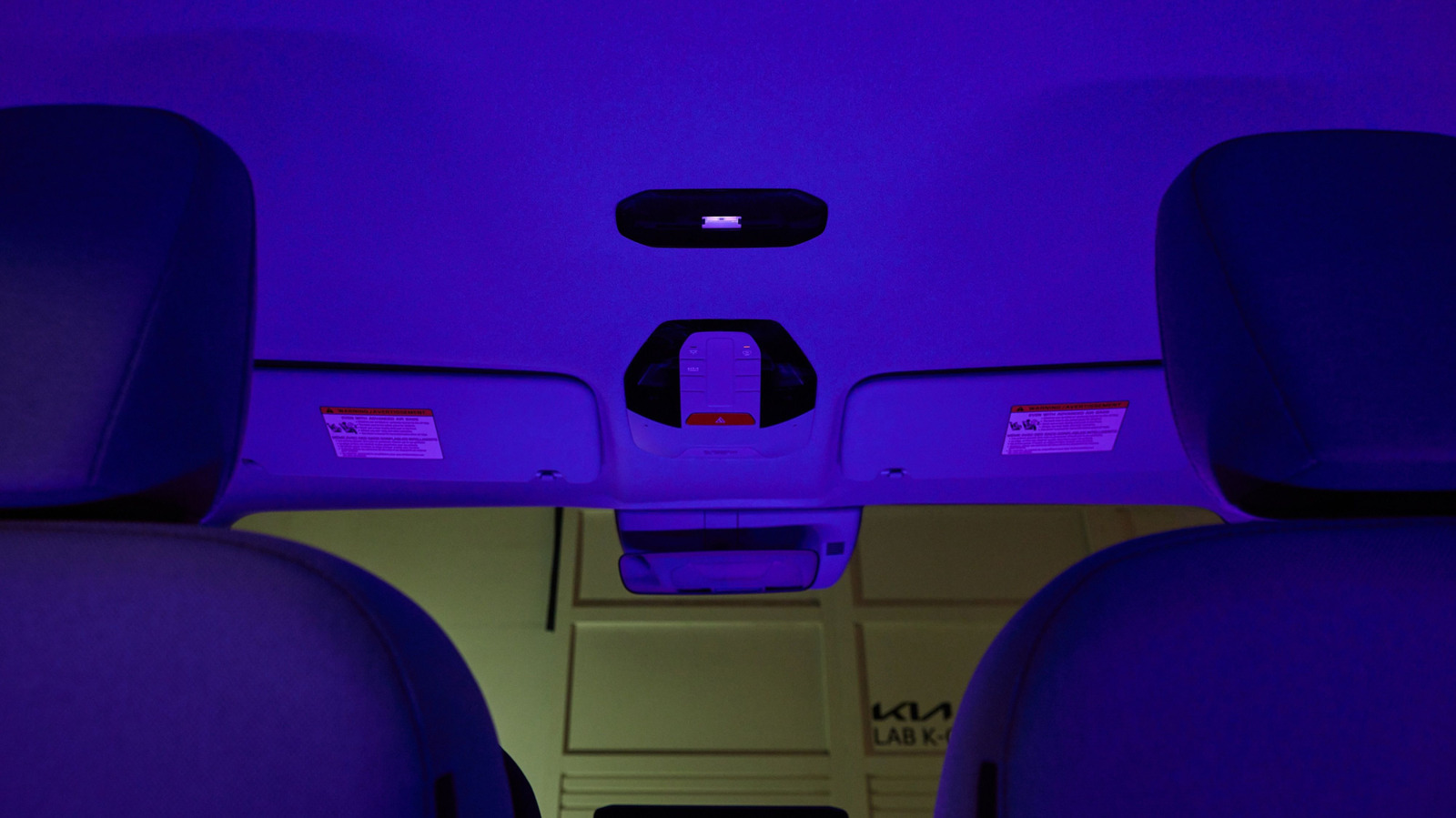
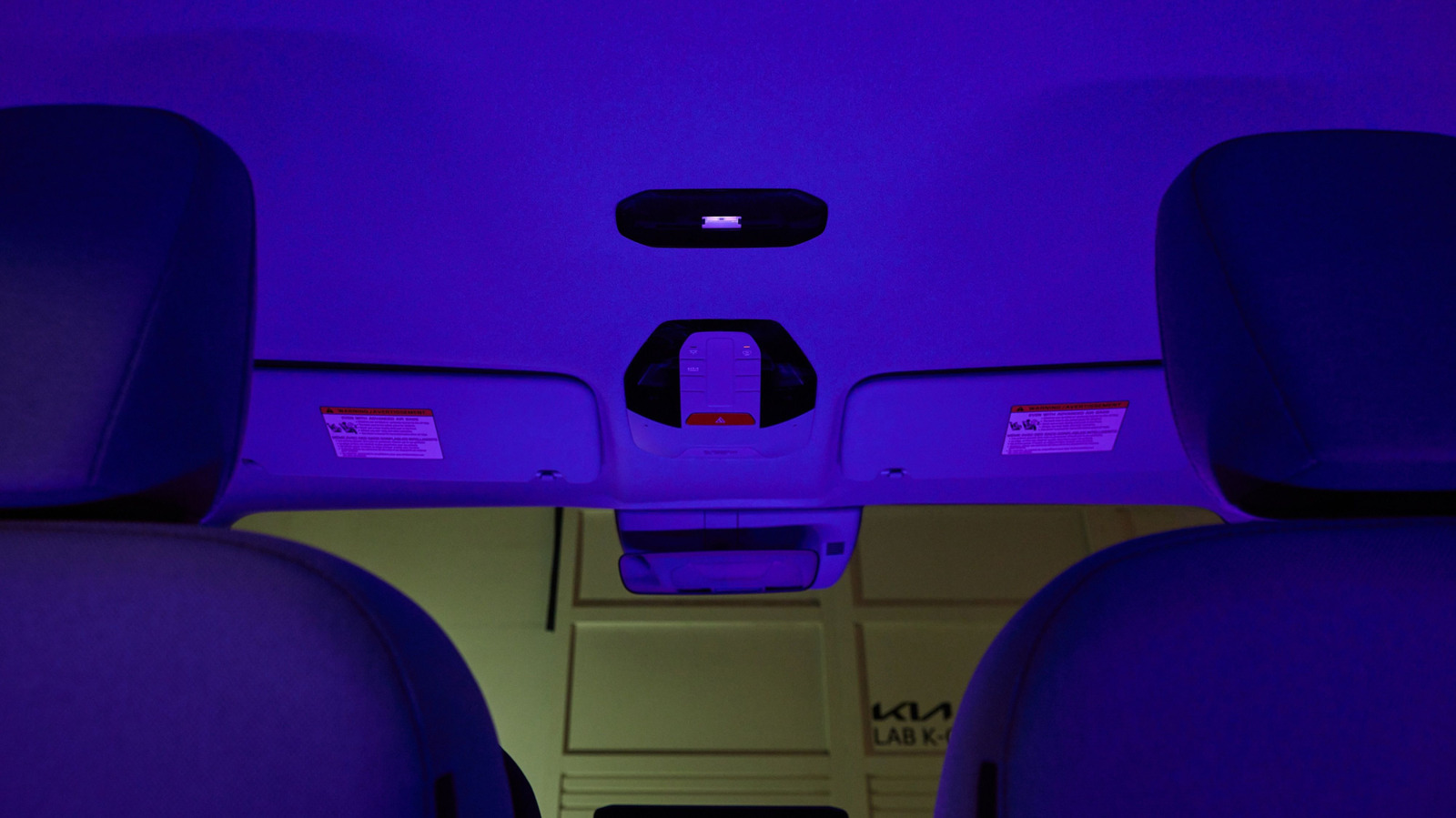
For most owners, keeping a vehicle ultra-clean isn’t an easy task. Nonetheless, the health benefits of having a car that’s free from germs are inarguable. Hyundai and Kia just unveiled new technology that aims to help make eliminating those germs a lot easier.
The carmaker is calling the technology “Plasma Care UVC,” and it uses far-ultraviolet C light with a wavelength of about 200-230 nanometers to sterilize a car’s cabin. UV sterilization devices are not new, but traditionally, some use UV light of a slightly longer wavelength than Hyundai’s new system. As a result, they have the potential to cause skin and eye damage if a human is exposed to them.
Hyundai says the far-UVC light it is using in its new technology won’t cause damage, since the light doesn’t penetrate human skin. However, it does still penetrate into bacteria and viruses, making it an effective way to sanitize a car even when the driver and passengers are present.
Although this is the first time that far-UVC light sanitizers have been fitted to a vehicle cabin, similar systems that use the same wavelength of light are already used to clean rooms in healthcare settings like hospitals, as well as sanitizing hotels and classrooms.
Hyundai says that its engineers encountered several challenges when trying to make the system work in cars, with one of the biggest being that the existing systems were simply too big to fit. Its team had to develop a new, miniaturized version of the system, as well as fitting an optical filter to ensure that no UV light of a harmful wavelength was emitted.
To test that the system worked as intended, the carmaker fitted it to a PV5 minivan. This model in particular was picked because it can be used for a range of different transport jobs, shuttling both passengers and cargo to their destinations.
Following the initial successful tests, Hyundai said that its technology could potentially be applied to autonomous vehicles and PBVs, a term that it has previously used to describe its modular electric vehicles that can be designed for a specific job. It gave the examples of school minibuses and food selling vehicles as two instances where sanitizing technology might be especially useful.
As appealing as the new technology might sound to germaphobes, it isn’t available to the general public just yet. Hyundai has not given a timeframe for when the UV sanitizers might launch in its production vehicles, saying only that it needs to conduct more safety and technical validation tests before it gives them approval for production.

“Welcome home!” NASA posted on X.com, sharing footage of a successful “parachute-assisted” landing on a Kazakhstan steppe for the Soyuz MS-28, carrying three astronauts who’d spent 241 days on the International Space Station. (And YouTube has a full two-hour video with NASA’s coverage of the landing.)
A NASA web page notes they orbited Earth 3,856 times and traveling more than 102 million miles after docking with the Space Station on November 27. It was the first mission for NASA astronaut Chris Williams and Roscosmos cosmonaut Sergei Mikaev (and the second mission for Roscosmos cosmonaut Sergey Kud-Sverchkov). “After routine post-landing medical checks, recovery teams will fly the crew by helicopter to Karaganda, Kazakhstan. Williams then will board a NASA aircraft bound for the agency’s Johnson Space Center in Houston.”
SCIENCE
So, how are those commercial replacements working out for you, NASA?
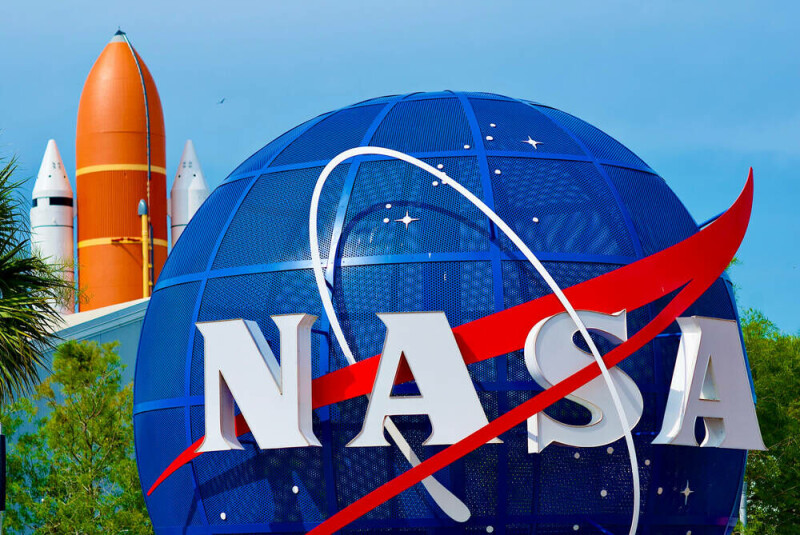
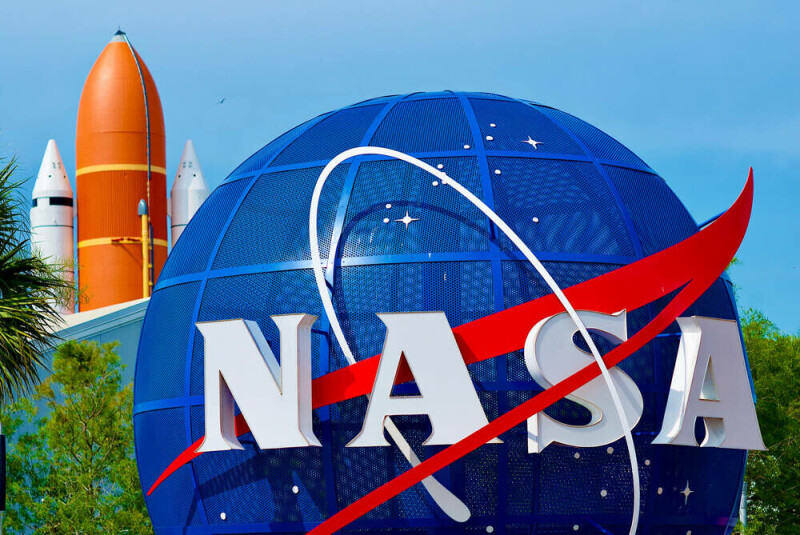
This week marks 15 years since a Space Shuttle last returned from orbit and the end of NASA’s Space Shuttle program.
Space Shuttle Atlantis landed at the Shuttle Landing Facility (SLF) at Kennedy Space Center 15 years ago this week, marking the final mission for the program.
STS-135 was originally designated STS-335, the Launch On Need (LON) mission for the previous STS-134 flight of Space Shuttle Endeavour. LON missions had been a feature of the Space Shuttle program following the Columbia disaster.
If a Space Shuttle was damaged, another could be launched at short notice to rescue the crew. NASA assigned Launch On Need flights separate STS-3xx designations, so the rescue mission for STS-116 was STS-317, STS-117 was STS-318, and so on. There were exceptions (a notable one was the STS-125 Hubble servicing mission, which had STS-400 ready to go if anything went wrong), but the Space Shuttle program should have ended with STS-134.
However, lawmakers and NASA managers opted to make STS-135 the final Space Shuttle mission. There could be no Launch On Need mission waiting in the wings this time around – the Space Shuttle program was being wound down – so the crew would have had to come down from the International Space Station (ISS) aboard Soyuz capsules if Atlantis could not return to Earth safely. There were also only four crew members, a figure not seen since the STS-6 mission of Challenger in 1983.
The crew was commanded by Christopher Ferguson, who would later join Boeing’s Commercial Crew Program and was assigned to (although did not fly) Boeing’s calamity capsule, the Starliner. The pilot for STS-135 was Douglas Hurley, who went on to fly the first crewed test flight of SpaceX’s Crew Dragon in 2020. Rounding out the crew were mission specialists Sandra Magnus and Rex Walheim.
The launch occurred on July 8, 2011, and Atlantis returned from orbit on July 21, bringing the Space Shuttle program to a conclusion.
It wasn’t, however, the end of crewed spaceflight for the US, although the gap that followed was considerably greater than expected or hoped. After the Space Shuttle retired, the US was dependent on Russia for getting its astronauts to and from the ISS. NASA later awarded Commercial Crew contracts to SpaceX and Boeing to restore launches from US soil, but it took SpaceX until 2020 to get the first humans to the outpost, and Boeing until 2024.
The latter’s mission was marked by ignominy due to failures and faults during the mission that meant managers opted to send the capsule back to Earth empty from the ISS and have the Starliner flight test crew return in 2025 aboard a SpaceX vehicle. NASA and Boeing have yet to set a definitive date for when a crew might venture to the ISS once again aboard Starliner.
All of which, 15 years after a Space Shuttle returned from orbit for the last time, has left the US space agency in a bit of a pickle. Instead of depending on the Space Shuttle, the plan was to reduce risk and add redundancy to US capabilities with two providers, but things haven’t worked out that way. To make matters worse, there is uncertainty about how much longer SpaceX will continue to fly the Crew Dragon beyond its contracted missions. The vehicle is reusable, but no more are planned to be manufactured, and SpaceX reckons that each should be good for 15 flights, with some refurbishment.
This should be enough to get through to the end of the ISS program and beyond, but in the longer term an alternative will be required. For SpaceX, this will likely be Starship.
The fate of the Space Shuttles themselves is also not completely set. Atlantis has been staged in a facility at Kennedy Space Center as if in orbit, and the California Science Center has mounted Space Shuttle Endeavour on an external tank and solid rocket boosters, as though ready for launch. The fate of Space Shuttle Discovery is, however, uncertain. Certain lawmakers would very much like to transport the retired orbiter from the Smithsonian’s Steven F. Udvar-Hazy Center in Virginia to Houston, Texas.
For others, well, there’s always a used Orion capsule. ®
Apple is aiming for a WWDC 2027 smart glasses unveil and is debating whether to include a camera amid the privacy backlash Meta created
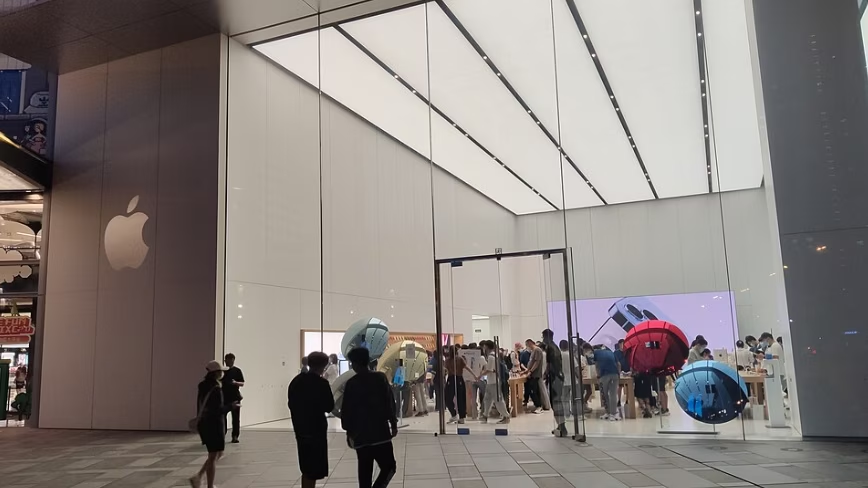
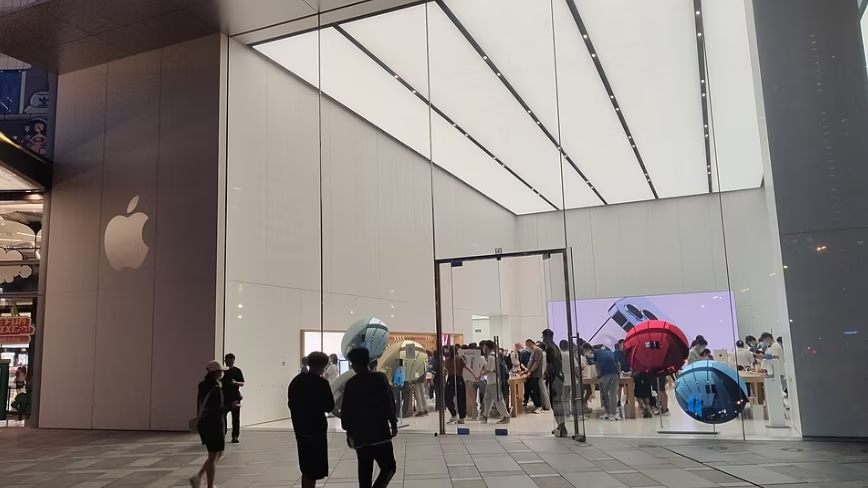
Apple is currently aiming to unveil its first smart glasses at next June’s Worldwide Developers Conference, with a consumer release by the end of 2027, according to Bloomberg’s Mark Gurman. But the company’s engineering and marketing teams are still wrestling with a question that will define the product: whether its glasses should include a camera at all. The teams developing the device, code-named N50, within Apple’s Vision hardware group see privacy as the top priority, Gurman reported on Saturday.
That caution is a direct response to the backlash Meta created. Meta has sold more than seven million pairs of its Ray-Ban smart glasses, but the product’s camera has become a lightning rod for privacy complaints, with women being secretly filmed in public and Kenyan data workers reporting they were asked to review intimate footage captured by the devices. Apple executives are acutely aware that simply entering the same category risks undermining a privacy reputation the company has spent more than a decade building.
Apple is planning safeguards that go beyond what Meta and Samsung have offered. The company will favour on-device processing, eschew facial recognition, and avoid anything resembling Meta’s proposed “super-sensing” mode, which would continuously analyse a wearer’s surroundings without activating the recording indicator light. Apple also does not plan to follow Meta’s practice of having contractors review footage captured by its glasses, having already dealt with a similar controversy around its Siri voice assistant.
One option Apple executives have debated would include the full camera system but disable photo and video recording entirely, limiting the cameras to feeding visual data into AI tools that identify objects and places. Another prototype eliminates the camera hardware altogether, retaining hands-free Siri access, music playback, and phone calls without any recording capability. Both approaches would sacrifice what has made Meta’s glasses popular: effortless first-person video of holidays, children, and sporting events.
The privacy problem is not theoretical. Apple is entering one of the most important product cycles in its history, with the 20th anniversary iPhone, a second-generation foldable, camera-equipped AirPods, and new Macs all expected in 2027. Courtrooms across New York State have already banned smart glasses, Royal Caribbean has barred them from casinos, restrooms, and children’s areas, and Samsung has called the privacy situation an “industry-shared problem” requiring a collective fix.
The glasses were originally targeted for introduction later this year under the N50 code name, but Apple delayed the timeline partly to refine its privacy message. The company knows from experience that good intentions do not prevent misuse: its AirTags, designed to locate belongings, quickly became associated with stalking. Camera-equipped glasses will inevitably face similar problems, and Apple will likely spend years updating software and working with regulators to address them.

The first half of 2026 has been marked by waves of economic uncertainty. From fuel prices to inflation to market dives, here’s why leaders should stay flexible as they prepare for the uncertain months ahead.
Furthermore, it has been marked by significant economic volatility. Business leaders have had to navigate a uniquely unpredictable market defined by wild swings in gas prices, better-than-expected inflation readings, jumpy consumer behavior and jittery markets.

Close up crypto trading,Photo by Rafael Minguet Delgado
As leaders look to the months ahead, they are bracing for more volatility. Here’s a quick snapshot of the past six months and a look at how flexibility will define success in the latter half of 2026.
In 2025, EY noted that fuel would be a difficult area of the economy to prepare for in the short term. While some market conditions appeared favorable, EY also noted that the global nature of the oil, gas and chemicals sector continued to create uncertainty.
In 2026, that prediction has been proven true more than once. By March, gas prices jumped sharply in reaction to global supply concerns. Crude oil prices rose quickly, pushing prices at the pump from $2.98 per gallon of regular gasoline in late February to $4.08 per gallon on April 2, more than a dollar in just over a month.
Easing tensions in late spring led to a quick drop as supply fears faded. All seemed to be heading back to normal. But by mid-summer, prices were on the rise again as potential oil supply chain disruptions once again became a topic of concern.
While there is no clear indicator of what is to come next, a year ago EY was already saying that companies will face a degree of uncertainty that will be higher than has been seen in several years. This won’t necessarily lead to higher fuel prices and less activity in the latter half of 2026. But it is a distinct possibility, and businesses are clearly bracing for the unknown.
EY added that even in the oil, gas and chemicals sector itself, businesses are looking for ways to manage the uncertainty. Mergers and acquisitions will likely continue, fueled by companies looking for cost advantages that reinforce their ability to survive economic downturns.
While gasoline prices have a trickle-down effect on the global economy, there are other factors that are exacerbating the current state of the economy, as well. Once again, these are a melting pot of good and bad news that is making it increasingly difficult for leaders to predict what comes next.
For example, in June, the Consumer Price Index (CPI) reading dropped by 0.4%. This brought the annual inflation rate down to a less-than-expected 3.5% reading. This was pleasant news for consumers and business owners alike.
Despite the good news, a simultaneous tech sell-off in June hit stocks hard. The tech sector was particularly vulnerable, and in a single day early in the month, the Nasdaq dropped by 4.1%, resulting in the loss of an entire month of gains. The sell-off has continued in fits and starts, and as of this writing, even the much-lauded ticker for an industry-leading space company has dropped below its IPO price within weeks of meteoric initial gains.
The one predictable thing in the current economy is that nothing is consistent. Good news and bad news are balanced, pulling markets in different directions and leaving many businesses bracing for more economic volatility in the months to come.
The hardest part of the equation is the fact that few, if any, of these developments are actually resolved. Gas prices, for instance, could continue to rise, limiting consumer spending. But they could also find relief if geopolitical tensions ease again. If that were to happen, it could open opportunities for businesses to take advantage of improved consumer sentiment.
The real factor all business leaders should be investing in isn’t predicting an accurate roadmap for the next few months. Instead, they should be investing in adaptability, resiliency and contingency plans. The more leaders can maintain a degree of flexibility through things like cash savings and flexible decision-making, the more likely they will be to make the most of the months ahead.
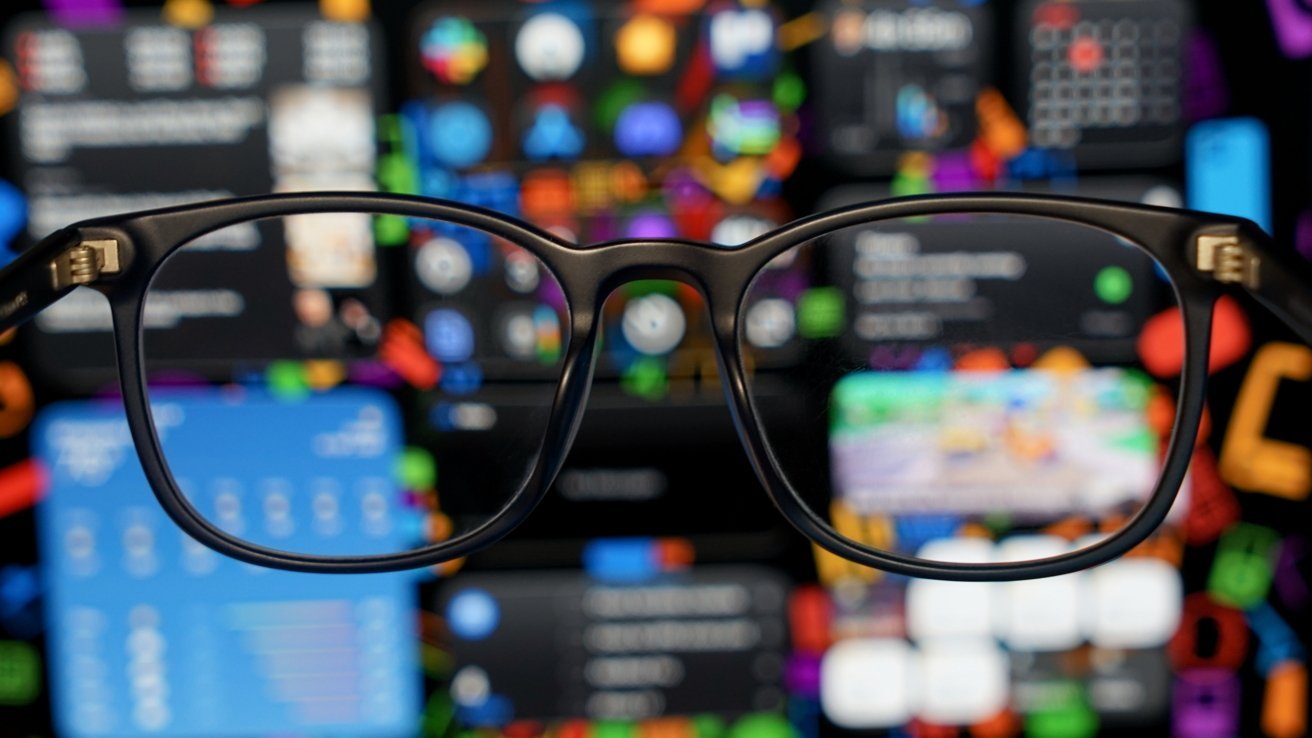
The eventual launch of Apple Glass is still expected in 2027, but based on how people distrust Meta’s smart glasses, Apple may have a challenge ahead of it.
Smart glasses have been rumored to be in development at Apple for quite a while, and aren’t expected to emerge from Cupertino anytime soon. But, when Apple actually does ship them, it will have to deal with the problem of privacy.
In Sunday’s “Power On” newsletter for Bloomberg, Mark Gurman discusses the privacy implications of smart glasses. Specifically how Apple must work hard to counter the distrust of consumers who are jaded by versions sold by Meta.
Apple will be introducing its first smart glasses at WWDC in 2027, Gurman writes, followed by a consumer release by the end of the year. The summer launch is intended to give developers an opportunity to start building apps before the public gets a chance to buy the hardware.
It’s apparently taken so long to get the glasses ready because Apple is concerned with how it maintains its image of maintaining privacy. Something both the engineering and marketing teams at Apple are working on.
While Apple’s Vision hardware group insists privacy is the top priority, it has to contend with what’s already on the market. When it comes to smart glasses, that means the releases from Meta.
Though Meta does get some credit for being a commercial success when it comes to smart glasses, it’s only part of the story. Meta’s reputation for failing when it comes to privacy protection has become an anchor around its neck.
This has had the result of poisoning the well when it comes to consumers. People are not content with being around people wearing cameras on their head, due to the possibility of being recorded while conducting everyday activities in public.
While the world is used to smartphone cameras being a problem, the stealthy nature makes smart glasses seem worse to consumers. Meta has worked to ally those privacy fears, including using an indicator light that disables recording if it’s been tampered with by the user.
Apple wants to include similar protections, but it does so with a reputation for privacy to uphold. While it could use the same privacy-forward messaging, Apple is also going to try to distinguish itself from rivals in various ways.
The favoring of on-device processing and avoiding features like facial recognition or Meta’s “super-sensing” mode should help Apple. Add in a pledge not to use the cameras or recordings for AI model training and steering clear of using third-party contractors to review footage could help too.
Apple’s also working on a number of hardware and software-based privacy features, with the glasses in mind.
There’s also the prospect of Apple eliminating the camera element, and instead providing access to AI features, calls, and audio without visual assistance. Apple has apparently already prototyped something similar.
Executives have considered the possibility of including cameras, but just for the AI tools to see the world.
This would be similar to the idea of external cameras on the rumored AirPods Pro, so AI can identify real-world items and mention environmental elements to the user. Not for users to take photographs or videos at all.
Apple has a tough challenge ahead of it in convincing the world that its smart glasses aren’t privacy-destroying devices. At least the company has a year to refine its plan before it needs to brace the users for the release.
It isn’t unusual for carmakers to launch new models or even new sub-brands in an attempt to push their lineup upmarket. Relaunching an entire brand to push upmarket is another matter entirely, but that’s exactly what Jaguar is currently in the process of doing. Sales of its existing models were slow, so Jaguar wiped the slate clean and is now replacing its entire lineup with the all-new Type 00 EV.
To say the Type 00 has proved polarizing would be an understatement. Its unusual design attracted a huge wave of criticism, although plenty of people eventually came around to the car’s looks. At the time of writing, it remains to be seen whether or not this unprecedented gamble will pay off, but given the controversy surrounding the design of Jaguar’s new-era electric GT, it seems like a great time to look back at some of the brand’s coolest designs to date.
About a decade before Jaguar staked its future on large, luxury all-electric GTs, it previewed a car that could have seen the company head down a very different path. The CX-75 is arguably one of the biggest what-ifs in Jaguar’s history, and it has continued to attract plenty of attention from both enthusiasts and collectors even 15 years after its unveiling. The first CX-75 concept car broke cover in 2010, and by 2012, Jaguar had built several fully working prototypes with assistance from Williams Advanced Engineering.
The car was unlike anything Jaguar had built before, with an F1-inspired powertrain and a carbon monocoque chassis. Its 1.6-liter gas engine produced 500 horsepower and it was assisted by electric motors that pushed its top speed to over 200 mph. Jaguar executives greenlit the car for production in 2011, only to backtrack a year later and scrap the project entirely. Speaking to Autocar at the time, brand director Adrian Hallmark blamed the economy, saying that “we feel we could make the car work, but looking at the global austerity measures in place now, it seems the wrong time to launch an £800,000 to £1 million supercar.”
Although it never reached production, the CX-75 did end up featuring in the James Bond movie “Spectre.” Seven replica cars were built for filming, albeit with a 5.0-liter supercharged V8 engine rather than the complex F1-style hybrid system of the planned production car. Former Jaguar chief designer Ian Callum also built a one-off road legal CX-75 from a former stunt car, unveiling it in 2024.
One of the most commonly repeated pieces of trivia about the Jaguar E-Type is that Enzo Ferrari once called it the most beautiful car in the world. Whether Ferrari actually ever uttered those exact words is debated, since the only surviving accounts of his quote come from people who allegedly overheard them at the 1961 Geneva Auto Show. Either way, Ferrari was clearly impressed with the Jaguar when he first saw it, and it hasn’t lost any of its charm in the intervening decades between then and now.
While the original Series I design is arguably still the most iconic, Jaguar continually tweaked the car over the course of its production. It also boosted the car’s power output to keep it competitive with its ever-changing roster of competitors. The car proved hugely popular with celebrities and collectors when it launched, and it remains that way today. Many high-profile collectors like Jay Leno have their own restored E-Types, and the most pristine examples can fetch more than $200,000 at auction.
Designing a follow-up to an icon like the E-Type was always going to be a difficult task. It didn’t help that the XJS (initially known as the XJ-S) was a different kind of car to its predecessor, focusing more on luxury cruising than traditional sporting prowess. Like many Jaguars since, the XJS also suffered from build quality issues, and it developed a reputation for being especially difficult to maintain and repair.
Its mixed reputation kept prices for used examples low for decades, but in recent years, the XJS has started to gain increasing momentum as a collectors’ car. Prices are up and interest in restomods like the TWR Supercat is high, with V12-engined versions carrying a premium.
In recent decades, V12 engines in general have become increasingly rare, and it certainly helps that the XJS’ looks have aged much better than most of its mechanical components. Less well looked after examples still have a tendency to fall apart and rack up eye-watering repair bills as a result, but when they’re working, few other cars at their price point offer the same combination of power, sophistication, and style.
The original F-Type was already a good-looking car, but Jaguar added in some extra design touches from the Le Mans-winning D-Type when it launched the F-Type Project 7. The graphics on the front and side are a tribute to the classic racer, as is its lack of a roof. It does technically come with a removable soft top, but it can only be used at lower speeds. That makes it highly impractical for the wet, windy British weather that usually blankets the country during the winter months, but the Project 7 was never meant for daily use.
Unlike the regular F-Type, the Project 7 was designed more for the track than the road. It was priced like an exclusive track day toy, too, with a retail price of £135,000 at launch, equivalent to around $214,000 at the time. Its 567 horsepower V8 engine wasn’t much more powerful than an F-Type R, but with a production run of just 250 examples, it was far more rare than any other F-Type variant. Arguably, it looked better than all of them too, with its classic racer-inspired design elements being blended with cutting-edge aero and carbon-ceramic brakes.
Alongside the E-Type, the XK120 is one of the most instantly recognizable cars in Jaguar’s history. It was first unveiled in 1948 and takes its name from the XK engine under its hood and its claimed top speed. In the end, it turned out to be even faster than its 120 mph claim, reaching 126.448 mph in testing. That was a record for a production car at the time, and it made what was already a very desirable car even more appealing to buyers.
Jaguar originally intended to build only 200 examples of the car, but it became so popular that more than 12,000 examples were eventually sold. The last example left the factory in 1954, with the car’s replacement, the XK140, debuting shortly after. The XK140 featured heavier bumpers to meet the demands of the U.S. market, as well as a new grille. Although it was a more capable car, it’s arguably not quite as good looking as the original XK120.
Before the F-Type came along, there was the XK grand tourer. In top-spec XKR-S form, it featured a supercharged V8 engine with around 540 horsepower on tap. It was relatively under-the-radar compared to most of its competition, but still had plenty of appeal to those in the know. To celebrate the end of its production run, Jaguar gave the car a racing-inspired makeover, and the result was the limited-edition XKR-S GT.
It was described by Jaguar at launch as being “the ultimate track‑focused but road‑going iteration of the XK,” with a laundry list of changes compared to the regular XKR-S. The rear wing and additional aero bits were the biggest visual differences, but Jaguar’s engineers also created a bespoke suspension for the car, as well as adding new carbon-ceramic brakes, revised steering, and plenty of other smaller tweaks.
To reduce the car’s weight, Jaguar also removed the car’s rear seats, and swapped the front seats to racing-style bucket seats. One of the few things that wasn’t changed was the supercharged V8, although it sounded even better thanks to the reduced soundproofing in the XKR-S GT. These alterations helped make the car far more expensive than its series-production counterparts, and it was much rarer too. Jaguar built 30 examples for the U.S. market out of a total of 50 cars, and charged around $175,000 for the privilege of owning one.
Today, Jaguar’s only global-level motorsports team competes in Formula E, but historically, it has been most closely associated with endurance racing. The company won the 24 Hours of Le Mans seven times, making it the fourth most successful brand in the race’s history. Only Ferrari, Audi, and Porsche have more overall wins. The first Le Mans-winning Jaguar was the C-Type, which took the crown in 1951.
The car was designed using a mix of brand new parts and parts borrowed from the XK120. Its engine and transmission both came from the latter, but its bodywork was all-new. Its shape was the work of Malcolm Sayer, a former aircraft designer who, before he was commissioned to work on the C-Type, had just returned from Baghdad University in Iraq.
According to historian Philip Porter as reported by the BBC, it was during this time teaching in Baghdad that Sayer met a German professor who taught him “a system of designing shapes mathematically” that he’d subsequently employ when designing the C-Type. Sayer later played a key role in designing both the D-Type and E-Type. He reportedly never cared much for the aesthetics of his cars, instead preferring to focus on their aerodynamic efficiency. Nonetheless, the C-Type and its successors are arguably among the best looking cars of their respective eras, as well as being fiercely competitive on track.
One of Jaguar’s best-known classics is the Mark II, which was produced between 1959 and 1967. Rather than being an all-new car, it was instead a facelift of the brand’s older saloons, which are collectively known today as Mark I models. The Mark II was a significant improvement over its predecessors both in looks and in performance, and it was far more popular with buyers.
It’s still a favorite among collectors who like to regularly drive their cars, because it’s both comfortable and fast by the standards of the era. Decades after its unveiling, in 1993, the Mark II’s design became the subject of an unusual tribute, when Japanese boutique carmaker Mitsuoka borrowed its looks for its Viewt city car. It is, to put it nicely, a bit of a head-scratcher.
Bizarrely, the Viewt was based on the JDM Nissan Micra, and only produced a little over 100 horsepower. That means a well-specified Mark II, particularly one with the 220 horsepower 3.8-liter six-cylinder engine, would still be able to comfortably outpace a Viewt, despite being roughly half a century older than its cheap Japanese imitator.
Long before the CX-75, Jaguar built another forward-thinking prototype that never ended up making it to production. The XK180 was built in 1998 to celebrate the 50th anniversary of the XK120, and it took design inspiration from Jaguar’s legendary C-Type and D-Type. The company even used the same panel supplier for the XK180 as it did for its Le Mans-winning race cars. Two prototypes were constructed, with one being right-hand drive and the other being left-hand drive. The left-hand drive prototype was sent off to be showcased in the U.S., while the other stayed in the U.K.
Under the hood of the XK180 was a 4.0-liter supercharged V8 engine, which had been borrowed from the XKR and tweaked to be substantially more powerful. With 450 horsepower on tap, the car had around 70 extra horses compared to Ferrari’s V8 supercar of the era, the F355. It’s not clear how much faster than the Ferrari it would have been, though, since Jaguar never released official performance figures for the car.
Several journalists, including Top Gear’s Jeremy Clarkson, were given the keys to the XK180 to show off its capabilities. Despite its publicity drive, Jaguar never considered the car for production. The XJ220, launched around half a decade before, had proved to be much harder to sell than Jaguar had anticipated. Its poor sales meant there simply wasn’t enough development budget left for the brand to make the XK180 a production reality.
By the time it reached the end of its production run, the XJS was getting long in the tooth. Its successor, the X100 generation XK, was a much more modern car, with sleek bodywork and a brand-new V8 engine. It first debuted in 1996, and it would take another two years for the faster, more aggressive-looking XKR to arrive in dealerships.
At launch, the XKR made 370 horsepower, but later models pushed that figure up to roughly 400 hp. Alongside its power boost, the XKR also featured various exterior tweaks, as well as larger wheels.
It served as Jaguar’s range-topping performance car — when it worked, of course. Earlier models suffered engine issues thanks to the Nikasil that lined the cylinders, with the engine failing altogether in extreme cases. That patchy reputation has helped keep used prices down compared to many of its rivals from the era.
Fresh off the glory of two wins at Le Mans with the C-Type, Jaguar engineers developed the follow-up using a similar formula. Much like the C-Type, the D-Type used a revised version of the XK engine that was initially launched in the XK120. It was paired with a lighter chassis and the most aerodynamic bodywork that Jaguar could accommodate, then sent straight back to Le Mans for testing.
The C-Type took its Le Mans wins in 1951 and 1953, with the D-Type’s first win arriving in 1955. It won again in 1956 and 1957, making it even more successful than its predecessor. Further adding to its trophy cabinet, the D-Type also took wins at Spa, Silverstone, and Sebring, among others. Despite being a cutting-edge race car, Jaguar wasn’t choosy about who could own a D-Type. It was available in the brand’s dealerships alongside its other models, and it retailed for a low £1,895, which meant Jaguar took a loss on every D-Type it sold.
The regular Jaguar XE is not an especially interesting car. It’s an entry-level luxury sedan that competes against the likes of the BMW 3-Series and Mercedes-Benz C-Class, and it never made much of an impact against its class-leading German rivals. But the XE SV Project 8 is a very different beast.
Jaguar handed an XE to its engineers and instructed them to turn it into a Nordschleife-conquering track car, and so they fitted it with a V8 engine that churned out around 600 horsepower. Then, they stripped out anything that they could to reduce its weight and fitted a motorsport-derived suspension and an all-wheel drive system.
After adding in carbon fiber racing seats, carbon-ceramic brakes, and a huge rear wing, they sent it round the Nordschleife and promptly achieved the lap record for a four-door sedan. The car was put into limited production so that wealthy owners could see what all the fuss was about. In total, just 300 examples were built.
Jaguar’s XJ220 supercar holds the unusual distinction of both being a ground-breaking world record holder and also not living up to buyers’ expectations. It achieved a Guinness World Record for the fastest production car, hitting 217.1 mph, slightly short of its original 220 mph goal. It’s also rare, with just 282 examples built. That wasn’t a deliberate move on Jaguar’s part though. Originally, the plan was to sell 350 examples, but with such low demand from buyers, Jaguar ended production early.
The lack of demand mostly stemmed from the differences between the XJ220 concept and the production version. The concept featured a 6.2-liter V12 engine, while the production version borrowed a 3.5-liter V6 engine from the MG Metro 6R4 rally car. The concept also included all-wheel drive, active aero, and adjustable suspension, none of which were present in the production version. It was still an incredibly fast and very good-looking car, just not quite as ground-breaking as Jaguar initially promised.
After proving itself as a force to be reckoned with at Le Mans in the ’50s, it would take Jaguar several decades to once again take the winner’s crown. Its sixth win would arrive courtesy of the XJR-9 in 1988, but in between those two winning eras, Jaguar developed the XJ13.
It was originally intended to mark Jaguar’s return to Le Mans, but it never ended up making it to the start line. Development took longer than initially planned, and Le Mans homologation rules changed during that time.
Jaguar would have needed to build 50 production cars in order to enter the XJ13, which wasn’t a financially viable option for the cash-strapped company. And anyway, rival carmakers like Porsche and Ferrari had already developed faster race cars in the time between the start of the XJ13’s development and its completion. As a result, the XJ13 was shelved, with only one, stunning prototype ever built.
A few years before the XJ220 concept took collectors by storm, the lesser-known XJR-15 supercar was Jaguar’s apex predator. In total, around 50 examples were built, but only 27 were road legal. Unlike the XJ220, the production XJR-15 featured a V12 engine under its sleek bodywork, as well as a cutting-edge carbon fiber chassis.
Confusingly, the Jaguar XJR-15 was not actually built by Jaguar. It was instead built by Jaguar Sport, a subsidiary of Tom Walkinshaw Racing. Walkinshaw wanted a road-legal version of the Le Mans-winning XJR-9, and so set about building one without asking Jaguar first.
Jaguar was quietly developing the XJ220 at the time, but allowed the XJR-15 to go ahead on the basis that it would be used for a racing series. TWR subsequently obliged and created a one-make series specifically for the XJR-15. The roadgoing version was essentially a race car with the bare minimum changes needed to get a license plate, making it one of the most extreme Jaguar-badged cars ever, as well as one of the coolest.

Paramount Skydance wanted to own Warner Bros. Discovery by September, but the $110 billion transaction is now frozen while 12 states and the Writers Guild of America pursue Clayton Act cases that could decide who controls a substantial piece of Hollywood. Instead of closing the deal, Paramount may spend much of the next ten months paying for the privilege of waiting.
Paramount, Warner Bros. Discovery, a coalition of 12 state attorneys general and the Writers Guild of America have agreed that the proposed acquisition cannot close until five days after the court rules on the merits of the antitrust cases or June 1, 2027, whichever comes first.
The agreement also prohibits Paramount and Warner Bros. Discovery from taking steps to integrate or consolidate their operations. The companies therefore remain separate, and the planned combination of Paramount Pictures, Warner Bros., CBS, CNN, HBO, Showtime, Paramount+, HBO Max and dozens of cable networks has been placed in legal cold storage.
The deal values Warner Bros. Discovery at approximately $81 billion in equity and $110 billion including debt, with Paramount agreeing to pay $31 per share in cash. It would be one of the largest media transactions ever completed, assuming it ever gets completed.
This stopped being a conventional merger review some time ago. It has become an expensive courtroom battle involving federal regulators, Democratic state attorneys general, Hollywood labor groups, international competition authorities and enough political baggage to fill several private jets.
The new agreement replaces the shorter temporary restraining order issued on July 20 by U.S. District Judge Araceli Martínez-Olguín of the Northern District of California.
The cases are The State of California et al. v. Paramount Skydance Corp. et al., Case No. 4:26-cv-07116-AMO, and Writers Guild of America, West, Inc. et al. v. Paramount Skydance Corp. et al., Case No. 4:26-cv-07212-AMO.
The judge had originally scheduled an August 3 hearing to determine whether the merger should remain blocked under a preliminary injunction. That hearing and its associated briefing deadlines have now been canceled. The WGA has withdrawn its preliminary injunction motion, although both the states and the guild may renew those requests later if necessary.
The parties must submit proposed trial schedules by July 31. No trial date has been established.
Paramount is calling this a victory because it removes the immediate preliminary injunction fight and creates a more direct path to a full trial. California Attorney General Rob Bonta and New York Attorney General Letitia James are also calling it a victory because Paramount cannot complete the transaction while their cases proceed.
Both sides are declaring victory, because nothing says “we won” quite like Paramount preparing to burn through roughly $7 million per day while everyone waits for a judge to decide whether the deal survives.
The July 20 ruling was not a final determination that the merger violates antitrust law. Judge Martínez-Olguín did, however, find that the states had presented enough evidence to justify stopping the companies from closing while the court considered the larger case.
The states identified three markets that they claim would be harmed:
For the temporary order, the judge focused primarily on wide release theatrical distribution.
According to the states’ evidence, Paramount and Warner Bros. would hold an estimated 27 percent share of that market. The proposed combination would also increase the Herfindahl Hirschman Index, a standard measure of market concentration, by approximately 359 points to 2,074.
The court found that those figures created a substantial enough presumption of reduced competition to justify maintaining the status quo. It also found that allowing the companies to close could result in operational consolidation, the exchange of competitively sensitive information and employee terminations or reassignments that would be extremely difficult to reverse.
Once the corporate omelet has been cooked, courts are generally not enthusiastic about being asked to put the eggs back in their shells.
The judge also declined to accept Paramount’s argument that greater efficiency in streaming would offset potential damage in the theatrical market. That does not mean the streaming argument is irrelevant to the final case, but it was not enough to defeat the states’ request for temporary relief.

Paramount argues that the states have defined the entertainment market too narrowly.
Its position is that Paramount and Warner Bros. Discovery do not merely compete with Disney, Universal and Sony. They compete with Netflix, Amazon, Apple, YouTube and technology companies with vastly greater resources than most legacy Hollywood studios.
That argument deserves more than a dismissive shrug.
Paramount and Warner Bros. Discovery are both trying to survive an industry in which cable revenue continues to deteriorate, theatrical attendance remains inconsistent and streaming requires enormous spending before anyone discovers whether there is a sustainable business underneath it.
Paramount insists that combining the companies would create a stronger competitor, increase investment in films and television, and provide consumers with a more credible alternative to the largest technology backed entertainment platforms.
The Trump administration’s Department of Justice reached a similar conclusion when it closed its investigation in June. The Antitrust Division said its extensive review indicated that the transaction would increase competition and benefit American consumers and workers.
The European Commission has also approved the merger, although it imposed conditions involving Paramount’s European film distribution relationship with Universal. The United Kingdom’s Competition and Markets Authority is still examining the transaction.
The states argue that creating scale by removing another major competitor is not a solution. It is merely concentration wearing a more fashionable suit.
The combined company would control two of Hollywood’s five major film studios, more than 50 basic cable channels, CBS, CNN, HBO, Showtime, Paramount+, HBO Max, Discovery+ and three major television production operations.
For movie theaters, fewer major distributors could mean less negotiating leverage, less favorable revenue sharing and fewer films receiving wide theatrical releases.
For writers, actors, directors and production workers, fewer independent buyers can mean fewer places to pitch a project, fewer competing employment offers and greater power concentrated within one corporate structure.
That is the heart of the WGA’s separate Clayton Act case. The guild argues that the merger would reduce writing opportunities, weaken compensation and leave creators with fewer employers. The July 24 standstill agreement applies to both the states’ lawsuit and the WGA action.
Paramount says a stronger company would produce more. The WGA fears a larger company would have more power to produce less and pay less for it.
Welcome to the actual fight.
The political divide is impossible to ignore.
Every attorney general involved in the state lawsuit is a Democrat. The Trump administration’s Justice Department, meanwhile, cleared the merger and issued an unusually detailed statement arguing that the transaction would strengthen competition.
Critics have also raised questions about the Ellison family’s relationship with President Trump and about what Paramount ownership could mean for CNN, particularly after the editorial upheaval surrounding CBS News.
There is no court finding that the Justice Department’s decision was politically motivated. The party affiliation of the attorneys general does not invalidate their market analysis either.
But the optics are dreadful.
One political camp sees the merger as a necessary counterweight to Netflix and Big Tech. The other sees it as an illegal concentration of entertainment, news and employment power. Each side insists it is protecting consumers, workers and democracy, which is generally the moment one should check that the silverware is still on the table.
The more important question is whether either side is still focused on the structural problem facing the industry.
Legacy studios need greater scale to compete with technology companies capable of subsidizing entertainment from cloud computing, advertising, hardware sales and other businesses. Yet repeatedly combining studios also leaves fewer buyers for creative work, fewer independent decision makers and an ever smaller number of companies deciding what gets produced and distributed.
Hollywood is being asked to choose between concentration and irrelevance. Neither option looks especially healthy.
The delay comes with a substantial financial cost.
Paramount agreed to pay Warner Bros. Discovery shareholders an additional 25 cents per share for every quarter the merger remains incomplete after September 30, 2026. That works out to approximately $650 million per quarter, or roughly $7 million per day.
Should the legal battle run until June 2027, Paramount’s additional payments could approach $1.7 billion.
Paramount accepted that provision while competing against Netflix for Warner Bros. Discovery. It helped make Paramount’s offer more attractive by transferring much of the regulatory delay risk away from WBD shareholders.
The company cannot now act surprised that someone eventually turned on the meter.
Nothing changes immediately for Paramount+ or HBO Max subscribers.
The services will remain under separate ownership while the cases proceed, and the companies cannot begin integrating their operations under the proposed transaction. Any combined streaming platform, unified technology system or larger corporate restructuring must wait.
That does not prevent Paramount+ or HBO Max from independently changing prices, programming or subscription tiers. Streaming companies have never required a federal judge’s assistance to make a monthly bill more irritating.
The longer delay also leaves open major questions involving theatrical distribution, physical media, licensing arrangements, CNN and CBS News, and the future of overlapping cable networks.
Employees face the least appealing version of corporate uncertainty: potentially ten months of waiting to learn whether their departments will eventually be combined, sold, reduced or eliminated.
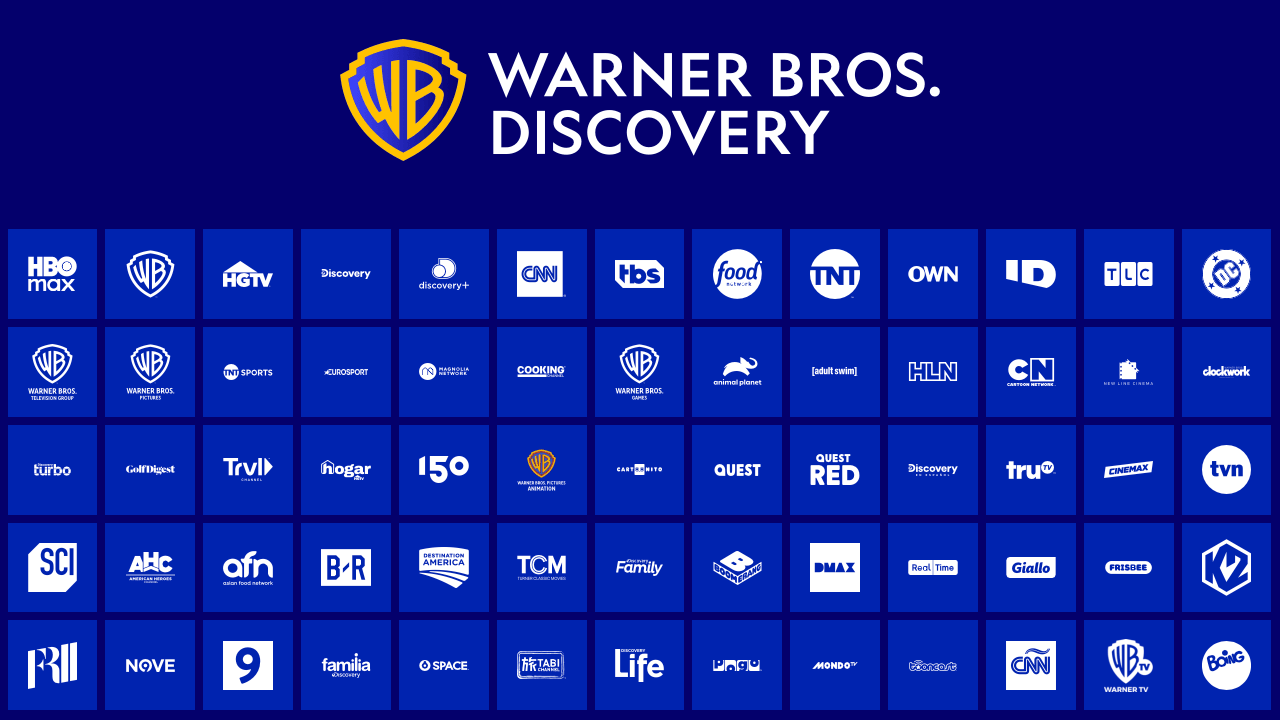
The Paramount Warner Bros. Discovery merger has moved beyond regulatory review and into a full contest over what competition in modern entertainment actually means.
Paramount has a legitimate argument that traditional media companies need greater scale to compete with Netflix, Amazon, Apple and YouTube. The states and the WGA have an equally legitimate concern that combining two of Hollywood’s five major studios could reduce competition for audiences, theaters and creative workers.
The court must now decide which market definition reflects reality: the narrower world of studios, theatrical distribution and cable licensing, or the much larger ecosystem dominated by global streaming and technology platforms.
Politics has not merely entered the discussion. It is sitting at the head of the table and asking everyone else to explain themselves.
The merger might still happen. It might be blocked. It could also collapse beneath the weight of legal fees, ticking payments and corporate fatigue.
For now, Paramount and Warner Bros. Discovery remain competitors, the trial clock has started and the financial clock begins on September 30.
Hollywood wanted a new empire. It received two antitrust cases, a political war and a $7 million daily invoice.





Weekend Open Thread: Brooks Brothers


Big Money Is Entering XRP


Grayscale Files For Worldcoin ETF, WLD Registers Sharp Rise


Sail Virtually Aboard The “Itanic” With IA-64 Emulator

Turtle Beach Command Series KB7 review: a nifty screen-equipped gaming keyboard


Unregistered fitter used Gas Safe logo on business flyers

New Jersey voter registration controversy explained: How 6,600 noncitizens got on the rolls, and what happens next

Johnny Depp’s R-Rated Gothic Cult Classic Gets New Release Ahead of Sydney Sweeney Remake


Ethics, other provisions in crypto Clarity Act to be further discussed


Watch Flock Safety CEO Garrett Langley discuss the future of surveillance at TechCrunch Disrupt 2026

Shanghai science forum photos show China’s AI and robotics advances in rivalry with US


Circle’s President Sold Over 360,000 Shares, The Filings Explain Why


Subway Sandwich Computers Get a Second Life as Gaming Machines


The Peugeot Family: How 200 Years of an “Old Money” Dynasty Died in A Boardroom


2026 3M Open leaderboard: Scottie Scheffler finds putter in Round 1, sits three back


How To Use Claude’s Reflect Dashboard And Learn When It’s Time To Touch Grass


16 Dresses for the High Summer Event


Stephen Colbert Returns to Social Media After Late Show End


The 35 Best Board Games for Family Game Night


Andrew Cuomo joins OKX board as crypto exchange expands in U.S.


You must be logged in to post a comment Login