Tech
Which Is Faster & How Do They Compare In HP?

The Dodge Challenger SRT Hellcat has solidified itself in automotive history as the fastest muscle car ever made. However, since it was discontinued in 2023, Chevy has been pushing the Corvette’s performance and design to the limit. The 2027 Corvette Stingray has become the first sports car under $100,000 to reach over 200 miles per hour, and that’s just the base model.
The 2023 Dodge Challenger SRT Hellcat has an iconic supercharged 6.2-liter V-8 engine that makes 717 horsepower and 650 lb-ft. of torque. This base model Hellcat can reach 60 mph in 3.8 seconds and hit a quarter mile in 11.9 seconds at 124 mph. The top speed is 203 mph. The 2027 Corvette Z06 has a 5.5L V8 LT6 engine considered the most powerful naturally aspirated V8 at 670 hp and 460 lb.-ft. of torque. This allows the Z06 to hit 60 mph in 2.6 seconds, then complete the quarter mile at 10.6 seconds at around 131 mph. Its top speed is 195 mph.
Comparing these two track-oriented beasts, the Hellcat has slower acceleration but a higher top speed. Even the Redeye variation with an enhanced Hellcat engine can’t hit 60 mph as fast as the Z06. This is likely due to the Z06’s lighter weight — it is 3,500 pounds compared to the Hellcat’s 4,654 pounds with a widebody design. This is also why the Hellcat requires more horsepower to launch itself. While the Hellcat is an incredible machine with an unmistakable whine and intense aura, there are faster cars out there.
Which cars are called the Corvette Killer?

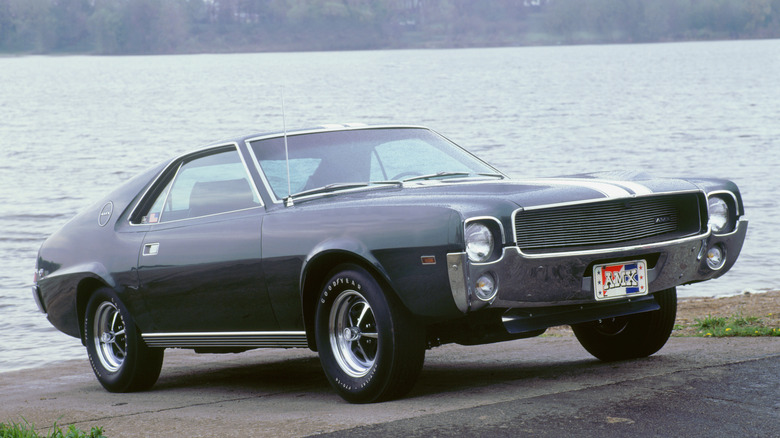
The Corvette has come a long way since it was debuted in 1953. Chevy has been attempting to boost its performance every year, and automakers have continued to take it upon themselves to bring the Corvette down. The 1968 AMC AMX was a shorter two-seater that arrived with only V8 options. The 390ci V8 was its most popular option, with 315 hp and the ability to reach a top speed of 125 mph. Its 0-60 mph spring was 6.6 seconds and the quarter mile was 14.8 seconds. It set plenty of speed records during its time, but it wasn’t enough to compete, with only a quarter of the Corvette’s production that year.
In 1979, the Guanci SJJ attempted to take down the Corvette once more. Meant to take the Corvette’s place, the SJJ had a 5.7-liter V8 that produced 250 hp and allowed it to hit 60 mph in 10.9 seconds. It wanted to take that American performance and pair it with European design elements, but the SJJ never made it to production, with many skeptical about its high price point.
The next decade saw Buick attempt to take down the Corvette with the 1987 Buick GNX, an “evolved” version of the Grand National. It was called the Corvette killer because it was the fastest car made that year, but only 547 saw the light of day. Meant to blend flashy looks with aggressive performance, it had a turbocharged 12-valve V6 that produced 300 hp and reached a top speed of 124 mph. Car and Driver called it “axe-wielding barbarian laying waste to everything in its path” back in 1987, but it still wasn’t enough to stop the Corvette’s momentum. Now, the Corvette is often referred to as a “supercar killer ” instead.
You must be logged in to post a comment Login