Shortly after Trump took office for a second time, his administration made it clear that it felt constitutional rightswere merely privileges it would extend only to those who fully supported whatever the hell the administration happened to be doing.
At the time, the administration was not only engaged in a full-blown, bigoted war against migrants, but throwing all of its support behind Israel’s ongoing anti-Palestinian efforts, which look a whole lot like actual genocide.
U.S. Citizenship and Immigration Services has announced it will begin screening immigrants’ social media for evidence of antisemitic activity as grounds for denying immigration benefit requests. The screenings will affect people applying for permanent residence status as well as foreigners affiliated with educational institutions. The policy will go into effect immediately.
In a statement issued Wednesday morning, the Department of Homeland Security said it will “protect the homeland from extremists and terrorist aliens, including those who support antisemitic terrorism, violent antisemitic ideologies and antisemitic terrorist organizations such as Hamas, Palestinian Islamic Jihad, Hezbollah, or [the Houthis].”
Advertisement
But, in true MAGA fashion. Trump’s anti-antisemitic efforts only affected people who were more brown than white. A month later, Trump was opening the immigration door to South African “refugees,” but only the white ones. This decision was presumably based on lizard brain analysis of out-of-context clips shown on social media and/or Fox News that pretended whites in South Africa were being persecuted by the Black residents they’d persecuted for decades under apartheid.
And that included white South Africans who engaged in antisemitic speech, who were given a free pass to play their version of the race card to gain unvetted admittance to the Land of Opportunity.
Nine months later, the doors have been thrown wide open for white South Africans, with the administration yet again claiming — without facts in evidence — that these particular South Africans were more deserving of expedited asylum proceedings than anyone from any country where actual violence and persecution targets residents who are not white enough for the administration to consider worthy of naturalization.
The U.S. aims to process 4,500 refugee applications from white South Africans per month, far above President Donald Trump’s stated refugee program cap, and is installing trailers on embassy property in Pretoria to support the effort, a U.S. contracting document said.
While both versions of the Trump administration may have rendered satire mostly obsolete, it can’t eradicate irony. And here’s where it gets absolutely hilarious. White South Africans are now thinking their homeland is a better option than living here under this administration, as Reuters reports.
Advertisement
Andrew Veitch left South Africa after being held up at gunpoint in his car. But now he feels there are greater threats in the United States, he said, citing mass shootings in public places as well as violence by U.S. immigration officers.
“People are being shot in broad daylight. American citizens are being shot and killed,” said the 53-year-old, who moved to California in 2003. “I don’t want to live in a place like this.”
It’s a valid point — one that people who have lived here for their entire lives are making, albeit without the easily available option of just pressing CTRL-Z on their temporary protected status. Veitch isn’t the only one wanting to return to the allegedly-hyper-violent country of South Africa, rather than continue to live in the Land of Opportunity that is daily being rebranded as the Land of Impending Martial Law.
Other South African (white) “refugees” are heading back home because the financial climate is preferable, even if they choose to ignore the threat Trump poses to every freedom Americans hold dear. After 20 years of US residence, it’s the Trump administration that’s encouraging South African (white) migrant Naomi Saphire to return to her homeland.
[Saphire] had been settled in the United States for two decades when she came back for a holiday and realized how much she missed home.
Last year, she left North Carolina for a seaside town in South Africa’s Western Cape, where she said her three children spend more time outdoors, health insurance is affordable and she prefers the schools.
Advertisement
“My heart is just full of gratefulness to be here,” the 46-year-old said from her home in Plettenberg Bay. “The U.S. has been really good to me (but) I just felt like I was depriving my kids of this life.”
As for the supposed violence targeting white South Africans Trump is now pretending to “save” from their misery with his “let’s get a bunch more whites in here” immigration policies, it’s as mythical as divorced from reality as Trump’s self-perception as the smartest, savviest businessman/politician to ever grace the Earth with his presence:
Crime and joblessness are major issues in South Africa, but the unemployment rate is 35% for Black people compared with 8% for whites, according to the latest figures from the national statistics agency Stats SA.
Police statistics released last year showed that even farm murders, which Trump has focused on, killed more Black people than whites. Reuters has found that photos and videos Trump has presented on the matter were taken out of context or misrepresented.
While this might seem like the most useless of anecdotal evidence, there’s reason to believe white South Africans will either ignore the Trump’s invitation to further whiten the US, or head back home where things are still pretty fucking good for whites, but without having to deal with a megalomaniac chaos agent who seems to believe World War III will finally allow Truth Social to turn a profit.
Advertisement
White South Africans have been rejecting the United States since 2022, when a law allowed them to regain their citizenship after it was stripped by a post-apartheid law passed in 1995. 15,000 white South Africans took advantage of that to return to their homeland. Now that Trump’s back in office, even more whites are exiting than entering the United States, despite the administration’s warm welcome of white migrants into its white Christian nationalism plans.
Home Affairs Minister Leon Schreiber said 1,000 people had reclaimed their citizenship, a number he expected to grow significantly as the programme takes off.
One of the main reasons for exiting the US was “lower cost of living,” something Trump has actively worked against achieving, starting with his indiscriminate (and apparently unlawful) tariffs and continuing through his destabilization of the world economy by (1) being buddies with Russia, (2) starting yet another forever war in the Middle East, (3) refusing to engage honestly with inflation and joblessness, and (4) decreasing American productivity by forcibly ejecting hundreds of thousands of people who work harder, pay more in taxes, and commit fewer crimes than US citizens.
And now it’s clear this administration is so inept and inherently dangerous it can’t even convince white people to live here. Let that sink in for a bit.
Jeff Bezos is reportedly seeking $100 billion for a new fund, the likes of which will be used to buy up companies in major industrial sectors and, ultimately, modernize and automate them with AI, according to sources cited by The Wall Street Journal.
The effort is related to Bezos’ AI startup, Project Prometheus. Bezos, whose involvement with the company was originally reported in November, is serving as co-founder and co-CEO, alongside former Google executive Vik Bajaj.
Prometheus, which launched with $6.2 billion in funding, is focused on creating high-level AI models to improve manufacturing and engineering in aerospace, automotive, and other sectors. The new manufacturing fund will support that mission by buying up companies that will ultimately use Prometheus’ models.
According to the WSJ, Bezos recently traveled to Singapore and the Middle East in his mission to raise funds for the effort. The plan is to acquire companies in areas like aerospace, chipmaking, and defense.
Advertisement
TechCrunch reached out to Bezos via Amazon for more information.
Until now, if you were seated at your Sega Genesis and wanted to check your stock portfolio, you were out of luck. You had to get a smartphone, or a computer, or maybe even a television to look up stock prices and understand your financial position. Thankfully, though, Sega’s neglect of its hero platform has finally been corrected. [Mike Wolak] has given the 16-bit console the real-time stock ticker it so desperately needed.
The build runs on a MegaWiFi cartridge, which uses an ESP8266 or ESP32 microcontroller to add WiFi communication to the Sega Genesis (or Mega Drive). [Mike] wrote a custom program for the platform that would query the Finnhub HTTPS API and display live stock prices via the Genesis’s Video Display Processor. It does so via a clean console-like interface that would be familiar to users of other 16-bit machines from this era, though seeing so much textual output would have been uncommon.
By default, the stock ticker is set to show prices for major tech stocks, but you can set it up to display any major symbol available in the Finnhub data stream. You can configure up to eight custom stocks and input your holdings, and the software will calculate and display your net worth in real time.
All the files are available for those eager to monitor their portfolios on a Sega, as the financial gods intended. [Mike] notes it took a little work to get this project over the line, particularly as the ESP32-C3 doesn’t support HTTPs with stock firmware. A few other hacks were needed to keep the Genesis updating the screen during HTTP queries, too.
Advertisement
If you have a concentrated portfolio and a spare Sega Genesis, this could be a fun retro way to keep an eye on your holdings. Alternatively, you might prefer to go the classic paper tape route.
According to recent statements by SK Group chairman Chey Tae-won, ongoing issues in the memory and silicon supply chain are unlikely to improve for another four to five years. SK Group owns SK Hynix, the world’s third-largest semiconductor manufacturer and an integrated device manufacturer with in-house foundry capabilities. While SK… Read Entire Article Source link
As everyone waits for the new Apple Foundation Models trained by Gemini, Google is pushing ahead on bringing a native Gemini app to the Mac. It’ll be similar to those offered by Anthropic and OpenAI.
If you aspire to a career in engineering then make sure you are keeping an eye on the professional lives of these six women.
During the month of March, SiliconRepublic.com is paying particular attention to careers and skills in the engineering space, and what better way to continue that coverage than with an exploration of some of the most exciting women in this field.
The following engineers have contributed greatly to their industries, through their work, discoveries, builds, and advocacy for themselves and others.
Áine Brazil
A managing principal at structural engineering company Thornton Tomasetti, Salthill’s Áine Brazil holds a bachelor’s degree in engineering from the University of Galway and a master’s degree in engineering from the Imperial College of Science and Technology in London. She was the first president of the Structural Engineers Association of New York and is a member of the American Concrete Institute, the American Society of Civil Engineers and the Institute of Engineers in Ireland.
Advertisement
In her 30-plus-year career she has overseen several crucial projects; for example, she led the structural engineering team for the design of more than 3m square feet of high-rise office development in the Times Square area, as well as the expansion of New York Hospital spanning the FDR highway, the 60-storey 731 Lexington Avenue mixed-use project, and the Nationwide Arena in Columbus, Ohio.
She has been included on the list ‘New York’s 100 Most Influential Women in Business’, by Crain’s New York Business, and has authored numerous technical papers and lectured at universities throughout the US including Cornell, Princeton, and Columbia.
Justine Butler
A chemical engineer with more than 18 years of experience in the pharmaceutical space, Justine Butler is currently the director of engineering at Jacobs Life Sciences for Ireland, the UK and the Nordic region. She has significant experience in leading teams and is responsible for the engineering design of a wide-ranging project portfolio.
She is the first woman to hold this position at the organisation and is also among its youngest people working in a leadership capacity in her region. Butler was also the first young engineer to serve on Engineers Ireland’s council and executive committee after first chairing its young engineers committee. In 2024, she was honoured with the ‘Women in STEM – Engineering’ award, given by Engineers Ireland.
Advertisement
Dervilla Mitchell
A former deputy chair of Arup Group, Dervilla Mitchell is a civil engineer with a background in the design of the built environment. She has led a number of major projects, including the Athletes’ Village for the London 2012 Olympics, Terminal 5 at Heathrow airport, Dublin airport’s Terminal 2, and Abu Dhabi airport’s Midfield Terminal. She is the co-chair of the Royal Academy of Engineering and also chairs the UK’s National Engineering Policy Centre’s decarbonisation group.
Georgina Molloy
A programme manager for energy performance at the Sustainable Energy Authority of Ireland (SEAI), Georgina Molloy is also the chair of the Engineers Ireland Women in Engineering group. As part of her role there, Molloy chairs a committee of 12 engineers with the aim of achieving better gender balance and supporting women who have chosen a career in the engineering space.
She is a chartered structural engineer with more than 20 years of experience working in consulting engineering practices large and small, and has spent a considerable portion of that time in scaffold and temporary works design and construction. Molloy is particularly passionate about working on refurbishment projects and enjoys being part of teams that bring old builds of historical importance back to life.
Norah Patten
Set to be the first Irish person in space, Norah Patten is an aerospace engineer and bioastronautics researcher at the International Institute for Astronautical Sciences (IIAS). She has received multiple recognitions for her contributions to the industry, such as a 2015 ’emerging space leader’ award, an appearance in Limerick’s ‘top 40 under 40’ for 2018, and an IIAS ‘science educator’ accolade, among others.
Advertisement
She is a regular keynote speaker, an author and an advocate for other women in the industry. Later in the year, Patten will join Kellie Gerardi of the US and Dr Shawna Pandya of Canada as crew members aboard Virgin Galactic’s new Delta vehicle for a space mission organised by the US-based IIAS.
Anisa Pjetri
A former senior structural engineer and project manager at AtkinsRéalis, Anisa Pjetri is now an associate director at the company. She earned a BSc in civil engineering in Albania and an MSc in structural engineering in London before relocating to Ireland, where she earned a chartership from Engineers Ireland and took up a position at AtkinsRéalis.
Pjetri has 12 years of international expertise in designing, planning and overseeing the construction of a wide variety of buildings, structures and infrastructure for residential, commercial, medical, industrial and hospitality projects. In 2025, she was a finalist for the Chartered Engineer of the Year award.
Don’t miss out on the knowledge you need to succeed. Sign up for the Daily Brief, Silicon Republic’s digest of need-to-know sci-tech news.
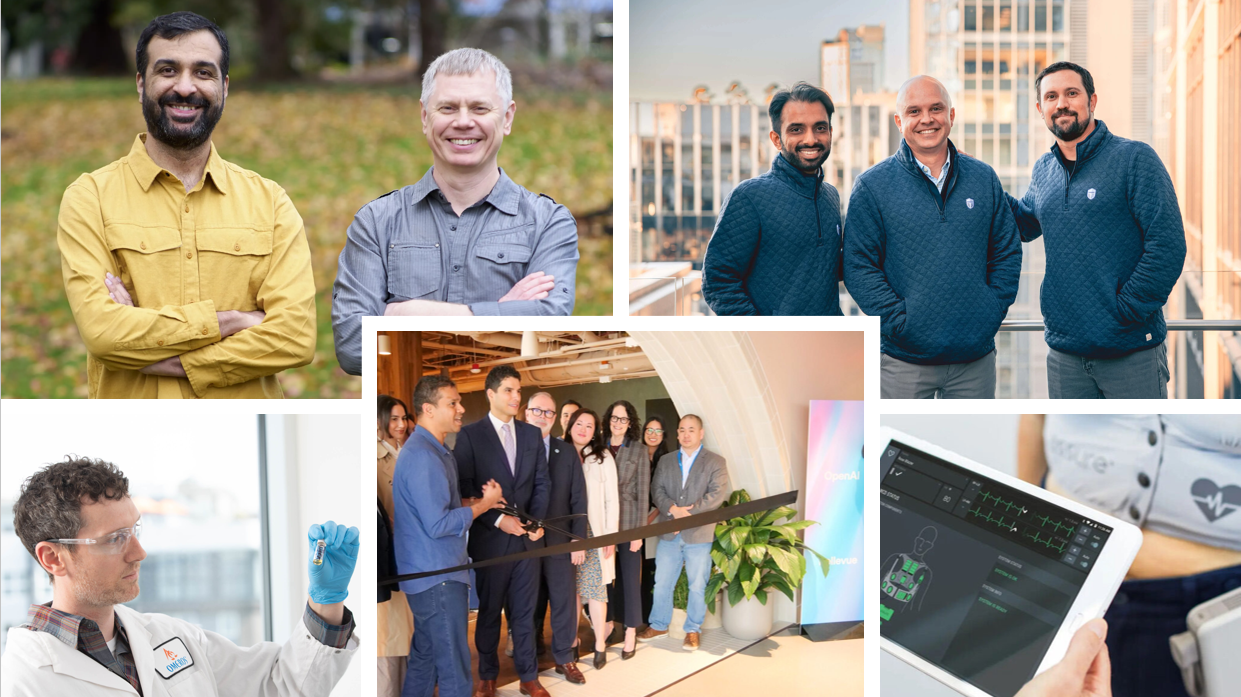
The finalists for Deal of the Year at the 2026 GeekWire Awards. Clockwise from top left: Temporal co-founders Samar Abbas and Maxim Fateev; Protect AI co-founders Badar Ahmed, Daryan Dehghanpisheh, and Ian Swanson; Kestra Medical Technologies’ cardiac monitoring device; the ribbon cutting at OpenAI’s new Bellevue office, home to the former Statsig team; an Omeros lab. (GeekWire / Company Photos)
The finalists for Deal of the Year at the 2026 GeekWire Awards include two major acquisitions, a landmark licensing deal, a big funding round, and a rare IPO — collectively representing billions of dollars in transactions.
This award, presented by Wilson Sonsini, recognizes the transactions that made the biggest impact in tech and innovation in Seattle and the Pacific Northwest. The Deal of the Year finalists this year are Kestra Medical Technologies, Omeros, Protect AI, Statsig, and Temporal.
Now in its 18th year, the GeekWire Awards is the premier event recognizing the top leaders, companies and breakthroughs in Pacific Northwest tech, bringing together hundreds of people to celebrate innovation and the entrepreneurial spirit. It takes place May 7 at the Showbox SoDo in Seattle.
Seattle startup Lexion was the Deal of the Year winner last year after being acquired by Docusign for $165 million, a successful exit for the AI-powered contract management company, which got its start in 2018 at the Allen Institute for AI in Seattle.
Continue reading for information on Deal of the Year finalists, who were chosen by a panel of independent judges from community nominations. You can help pick the winner: Cast your ballot here or in the embedded form at the bottom. Voting runs through April 10.
Statsig was acquired by OpenAI for $1.1 billion in an all-stock deal announced in September, in a surprise exit for the Bellevue, Wash.-based product experimentation platform. The deal also landed Statsig CEO Vijaye Raji, a former Facebook engineering leader, in the newly created role of CTO of Applications at OpenAI.
Advertisement
Founded in 2021, Statsig powers A/B testing, feature flagging, and real-time decisioning for major companies. It had raised more than $153 million, including a $100 million Series C round at a $1.1 billion valuation just months before the acquisition, with backing from Sequoia and Madrona. Statsig now forms the nucleus of OpenAI’s new Bellevue engineering office.
Kestra Medical Technologiesraised $202 million in its IPO in March 2025, pricing shares above the expected range in a strong debut for the Kirkland, Wash.-based maker of wearable cardiac devices. Shares began trading on the Nasdaq at more than 30% above the IPO price.
Founded in 2014, Kestra makes devices that detect and respond to sudden cardiac arrest. Its IPO marked the end of a long dry stretch with no traditional IPOs for Seattle-area tech companies since 2021.
Omeros Corporation, a Seattle-based clinical-stage biopharmaceutical company, struck a deal worth up to $2.1 billion with pharmaceutical giant Novo Nordisk for zaltenibart, its clinical-stage drug candidate in development for rare blood and kidney disorders. Announced in October, the agreement gives Novo Nordisk exclusive global rights to develop and commercialize the drug.
Advertisement
Founded in 1994 by orthopedic surgeon Gregory A. Demopulos, who still serves as CEO, Omeros went public in 2009 and recently received FDA approval for its lead drug Yartemlea, the first therapy for a rare post-transplant complication.
Protect AI, a Seattle startup that helps companies secure machine learning systems, agreed to be acquired by cybersecurity giant Palo Alto Networks in a deal announced in April. Terms were not disclosed, but sources familiar with the deal said it was valued north of $500 million.
Founded in 2022 by former engineering leaders at Amazon and Oracle, Protect AI serves Fortune 500 companies across finance, healthcare, and government. Palo Alto Networks said the deal will bolster its ability to secure the new attack surfaces created by AI.
Temporalraised $300 million in a Series D round at a $5 billion valuation in February, doubling its valuation from just months earlier. The Bellevue, Wash.-based company builds open-source software and a cloud service that helps companies run complex workflows reliably — what it calls “durable execution.” The rise of AI agents has amplified demand for its platform, with customers including OpenAI, ADP, and Block.
Advertisement
Founded in 2019 by co-founders Samar Abbas and Maxim Fateev, who previously built an internal orchestration engine at Uber, Temporal has raised $650 million to date, with backing from Andreessen Horowitz, Sequoia, and Madrona.
The event will feature a VIP reception, sit-down dinner and fun entertainment mixed in. Tickets go fast. A limited number of half-table and full-table sponsorships available. Contact events@geekwire.com to reserve a spot for your team today.
(function(t,e,s,n){var o,a,c;t.SMCX=t.SMCX||[],e.getElementById(n)||(o=e.getElementsByTagName(s),a=o[o.length-1],c=e.createElement(s),c.type=”text/javascript”,c.async=!0,c.id=n,c.src=”https://widget.surveymonkey.com/collect/website/js/tRaiETqnLgj758hTBazgd5M58tggxeII7bOlSeQcq8A_2FgMSV6oauwlPEL4WBj_2Fnb.js”,a.parentNode.insertBefore(c,a))})(window,document,”script”,”smcx-sdk”); Create your own user feedback survey
An analyst at Barclays believes that if the iPhone Fold launches in 2026, it will be in December, months after the iPhone 18 Pro. He’s the only one saying this.
iPhone Fold could launch in December
Many rumors point to the iPhone Fold launching in late 2026 alongside the iPhone 18 Pro, though no parts have leaked yet. It will be an incredibly expensive device and Apple’s first attempt at a foldable. A note from Barclays analyst Tim Long, viewed byMacRumors suggests the iPhone Fold will release in December 2026. He offers no detail as to why it would come out three months after its announcement other than supply chain sources. Rumor Score: 🙄 Unlikely Continue Reading on AppleInsider | Discuss on our Forums
Peter O’Brien has received the 2025 Semi European Award, which recognises those who have had an impact on global semiconductor innovation.
Tyndall National Institute’s photonics expert Prof Peter O’Brien has been honoured by the global semiconductor industry for his work in the sector.
O’Brien is the head of research for photonics packaging and systems integration at the University College Cork-based deep-tech institute. He has received the 2025 Semi European Award, which recognises leaders whose work has had a significant impact in global semiconductor innovation.
Semi is a global industry association representing companies and research organisations across the semiconductor and electronics development and manufacturing supply chain.
Advertisement
O’Brien has been recognised for his contributions to photonics electronic packaging, his leadership in Europe’s semiconductor pilot lines, and his work in developing specialised training programmes for up-and-coming researchers in the field.
“It is a great honour to receive the Semi European Award for 2025,” said O’Brien. “Through this award, I would like to recognise my many collaborators around the world. Working together, we accelerate research and development, turning early ideas into impactful breakthroughs.”
Prof William Scanlon, the CEO of Tyndall, added: “Prof O’Brien’s leadership and vision have placed Tyndall at the forefront of advanced packaging globally, and his contributions are shaping Europe’s semiconductor future.”
Meanwhile, Eric Beyne, a senior fellow at the Belgium-based nanoelectronics and digital tech research and innovation hub IMEC, received the Special Service Award at the ceremony earlier this month for his contributions to high-density interconnection and packaging technologies, and helping advance next-gen semiconductor integration techniques.
Advertisement
“We are honoured to recognise Peter O’Brien and Eric Beyne for their outstanding contributions to advancing semiconductor innovation and strengthening Europe’s technology ecosystem,” said Semi Europe president Laith Altimime.
“Their leadership and vision have helped drive transformative progress across the industry while inspiring the next generation of engineers and researchers, reflecting the spirit of collaboration and innovation that continues to propel the semiconductor industry toward a more resilient, digital and sustainable future.”
Tyndall has made several major announcements this year. The Cork-based research institute recently announced a €100m expansion project.
Picture a VP of finance at a large retailer. She asks the company’s new AI analytics agent a simple question: “What was our revenue last quarter?” The answer comes back in seconds.
Confident.
Clean.
Wrong.
Advertisement
The 💜 of EU tech
The latest rumblings from the EU tech scene, a story from our wise ol’ founder Boris, and some questionable AI art. It’s free, every week, in your inbox. Sign up now!
That exact scenario happens more frequently than many organizations would care to admit. AtScale, which enables organizations to deploy governed analytics environments and semantic consistency, has found that simply increasing model parameterization alone cannot address the AI governance and context issues enterprises face.
When AI systems query inconsistent or ungoverned data, adding more model complexity doesn’t contain the problem, it compounds it. Organizations across industries have acted quickly to develop agentic AI, deploying systems that analyze data, generate insights, and trigger automated workflows. In response to this trend, the AI models have adapted to react quickly via larger model parameters, increased computing power, and additional features. The underlying assumption has been that as long as the model gets large enough, the eventual result will be reliable.
Advertisement
However, there are indications that this assumption may not hold up. Recent TDWI research found that nearly half of respondents characterized their AI governance initiatives as either immature or very immature. This may have more to do with data lineage and the business definitions on which these models are based than with the models’ capabilities.
Why bigger models don’t solve governance
The AI industry tends to operate on an unexamined assumption about what drives better performance: as we build more advanced models, they will somehow self-correct their performance errors. In enterprise analytics, that assumption can fall apart quickly.
While scale may improve the breadth of reasoning in a model, it doesn’t automatically enforce which definition of gross margin the business has agreed to use. It doesn’t resolve metric inconsistencies that have lived in separate dashboards for years. And it also doesn’t produce traceable lineage on its own.
Governance problems don’t resolve at scale. Business rules buried in individual tools, inconsistent definitions across teams, and outputs with no audit trail are structural issues, and a larger model doesn’t fix structure. It just produces unreliable answers more fluently.
Advertisement
At AtScale, there’s a consistent theme among our clients: When inconsistent data definitions followed organizations into their AI layer, the problems didn’t stop there. They propagated forward, typically at greater speed and with less transparency than the previous layer had offered.
Performance and responsibility are separate jobs. A model reasons. A governance layer defines what the model reasons over, constrains how it applies business logic, and ensures outputs can be traced back to a source of record. One cannot substitute for the other.
The real risk: Unconstrained agents in enterprise environments
The problem with AI agents is seldom the model itself. It’s what the model is working with, and if anyone can see what it did.
With common context, AI agents might read data differently on different systems. In large enterprises, even small differences in definitions can lead to different results. Structural risks typically stem from four main causes:
Advertisement
Agents pull from sources where the same metric can mean different things to different teams, making data definitions less clear.
Metrics from different departments that don’t agree – two agents give two answers, but it’s not clear which one is right.
Unclear reasoning produces outputs without a clear lineage as to how a decision was made.
Audit gaps: When outputs can’t be traced back to a governed source of record, there’s no reliable way to catch errors, assign accountability, or course-correct.
These are not signs that AI is not working. They show that the infrastructure around AI hasn’t kept up.
What guardrails actually mean in AI analytics
Guardrails are often viewed as a limitation. However, in many cases, guardrails are the very conditions that permit AI agents to operate with greater confidence.
Guardrails can help align AI-generated outputs with established business logic. They also create a structure in which autonomous agents can operate; this way, as autonomy increases, so does reliability. In analytics, guardrails typically exist in several specific formats:
Shared data definitions: A single definition of terms such as revenue, churn, or margin that are shared across all systems.
Business logic constraints: Rules governing how calculations are to be performed, regardless of the tools or agents performing those calculations.
Lineage visibility: The capability to identify where any output originated from.
Access controls: Defined permissions determining what data an agent can query.
Standardization of metrics: Consistent definitions applicable across departments and platforms.
The intention isn’t to impede AI’s performance. It’s to offer AI a base upon which it can stand.
The role of the semantic layer as a constraint framework
A semantic layer sits between data and the applications and AI agents that use it, defining business concepts, implementing logical processes, and providing a common framework of terms for all applications and AI agents to draw upon.
A semantic layer does not manipulate or duplicate data; it defines what the data represents. By asking questions of a governed semantic layer rather than the base table, AI agents can generate output based on business-defined logic, rather than on inference. The distinction of this output becomes particularly important when multiple AI agents across multiple systems must produce similar outputs.
Advertisement
From AtScale’s perspective, the semantic layer serves as a context boundary that can help ensure AI agents interpret data according to shared business definitions. The semantic layer is more analogous to a common language, as opposed to a guardrail, that ensures all systems operate with a common understanding.
Governance is an architectural question, not a model question
Enterprise organizations realize that AI governance is less about building the largest model and more about making an environment where the chosen model can work well. A well-designed and governed architecture (with shared definitions for concepts, traceable logic, and a shared context across all systems) will likely deliver better, more reliable results than a larger model running in an uncontrolled data environment.
Scaling models without improving semantic clarity tends to add complexity, not reduce it. As each additional tool, system, or workflow is added to an uncontrolled environment, the opportunities for divergence increase.
In this sense, responsible AI is an infrastructure challenge. Organizations with successful AI deployments treat the meaning of their data as a design decision,before the model is even chosen.
Advertisement
Economic and operational implications
Governance gaps do not stay abstract for long. They tend to show up in the budget.
Ambiguity in data meaning may increase operational friction, agents that produce inconsistent outputs require human review, reconciliation cycles, and rework that compounds across teams and tools. When lineage is not clear, audits cost more. Retrofitting controls after deployment typically costs more than building the right architecture from the start.
In complex enterprise settings, costs can show up in predictable ways: redundant validation when outputs don’t match across systems, excess compute triggered by unclear queries, and slower analysis as teams pause to figure out which answer is actually reliable. Clear semantic constraints can mean fewer validation cycles, and that operational value is becoming easier to measure.
The path forward: Constrained autonomy
AI agents aren’t a future consideration, they’re already in use. What’s still catching up is the infrastructure around them. Agents without clear context and constraints tend to operate beyond what the organization can actually govern. That gap doesn’t close on its own.
Advertisement
The differentiator in enterprise AI, AtScale contends, won’t be model scale, it will be the clarity of the environment models operate in. As agents become more common in business workflows, how well the semantic layer is defined may matter more than how large the model is.
This shift toward governed context and constrained autonomy is explored in more detail in AtScale’s 2026 State of the Semantic Layer report, which examines how open standards, interoperability, and semantic governance are shaping the next phase of enterprise intelligence.
DoorDash has launched a new option for its gig economy workers to earn some extra cash. The delivery service introduced Tasks, which it describes as “short activities Dashers can complete between deliveries or in their own time.” It gives taking pictures of restaurant dishes or recording video of unscripted conversations in languages other than English as examples. These materials will be used to train artificial intelligence and robotics models.
A representative from DoorDash told Bloomberg News that it will use Tasks content for evaluating its in-house AI models as well as those made by its partner companies in retail, insurance, hospitality and tech. DoorDash is piloting a standalone app for Tasks where Dashers will submit their content. The blog post notes that pay will be displayed upfront, and compensation will vary based on the complexity of the activity.
This idea isn’t new. We’ve seen otherstartups in AI and robotics offering payment for content filmed by regular people. Considering how many lawsuits are underway against AI companies that have already benefited from unauthorized use of copyrightedmaterials, at least this approach lets people be directly compensated for training content.






 By default, the stock ticker is set to show prices for major tech stocks, but you can set it up to display any major symbol available in the Finnhub data stream. You can configure up to eight custom stocks and input your holdings, and the software will calculate and display your net worth in real time.





















































You must be logged in to post a comment Login