Tech
Why An Aircraft’s Weight And Balance Matters: The Physics Explained



Whether you’re a novice getting your PPL, an experienced pilot with thousands of hours of flight time, or an avid simmer, you’re probably familiar with the basics of aircraft weight and balance. Arguably, it’s one of the most important and fundamental concepts of flight; you cannot fly an aircraft that is overweight, nor can you fly one with all its weight in the nose or tail. Okay, that much is common sense, but let’s be more specific. Why, exactly, does this matter so much? Why do rules like MTOW and center of gravity need to be accurately calculated?
The short answer is that manufacturers determine what is and isn’t acceptable for their specific aircraft from the factory, and list these parameters as reference points. If any of these aren’t adhered to, then you won’t be able to sustain flight, if indeed you can take off at all. That’s because an overweight aircraft cannot produce enough lift to overcome the force pushing all that weight toward the ground, and an unbalanced aircraft will either want to go nose up or nose down to the point where it’s uncontrollable.
Full lectures are available online for free that describe this phenomenon in detail, such as this one from the Free Pilot Training YouTube Channel. You could also peruse the official FAA handbook on the topic. But what about a more general overview and basic guidelines to get you started? That’s what we’ll address in this article. Let’s take a look and explain the physics behind these concepts.
Why an aircraft’s weight matters
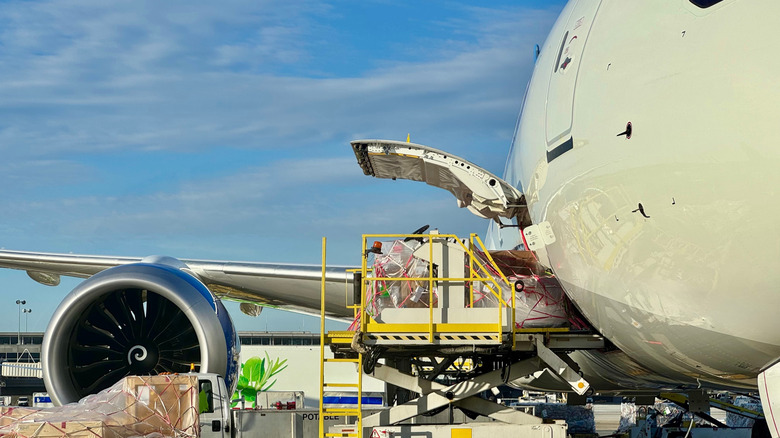
If you’re a frequent flyer, you’ve undoubtedly noticed that many international and budget flights have baggage weight restrictions, generally around 30 to 40 pounds. Why this limit is so important relates to an aircraft’s overall weight and where that weight is placed — more on the second point later.
Firstly, what exactly is weight? In aeronautics, weight is defined as the force generated by gravity pulling the aircraft back to Earth. Every component of the aircraft bears a specific weight, which is all calculated on the Newtonian equation of W=mg, or Weight = Mass multiplied by Gravity. The mass is determined by a component’s material composition; an object’s mass is its total density multiplied by its volume. Therefore, a denser part in the same space is heavier than an identical part made from a less dense material.
All of these factors go into an aircraft’s structural Maximum Takeoff Weight (MTOW), the absolute weight limit the aircraft can safely take off with. This is a hard limit that doesn’t change with external factors like altitude and air pressure; the equations account only for the gravitational force and density. Therefore, a Boeing 737 has this same weight limit regardless of whether it’s in Denver or Amsterdam, though its actual safe takeoff weight will be lower in Denver’s thin air.
Manufacturers want to shed as much weight as possible without compromising structural rigidity to allow for more fuel, passengers, cargo, and on-board systems to be carried. They can also increase the weight the aircraft can carry during takeoff by adding more power, more durable structural members, or even small rocket engines that provide extra speed, known as JATO (jet-assisted takeoff).
Why weight placement matters
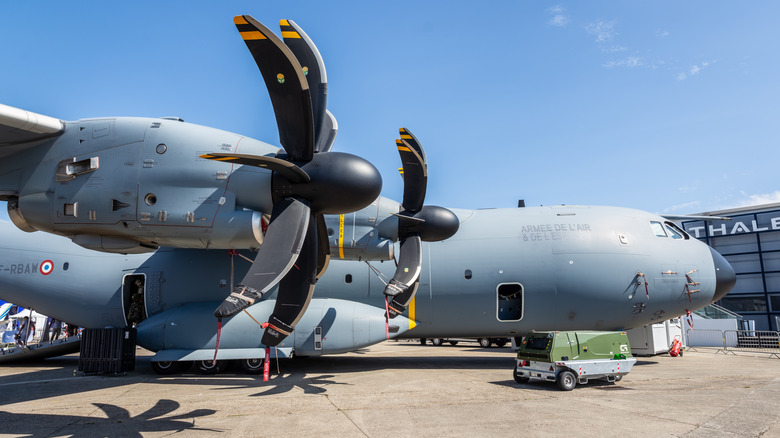
If the weight is the total force pushing down on the aircraft, then its center of gravity is the point where that weight is evenly distributed. In other words, if you were on a seesaw and a different weight was opposite you, it’s where you (or the weight) would need to be for that seesaw to be perfectly balanced.
Take a basic front-engine airplane, for example. You have a big lump of engine in the front and nothing in the back — common sense means the aircraft is nose-heavy. To balance that out, you have the aircraft’s tail, which provides a certain amount of downward force to counteract the force exerted by the weight differential. This can then be extrapolated to all aircraft as well; a typical passenger airliner, for instance, will account for the weight of all passengers, cargo, and fuel on board, which is why some flights have weight limits.
Now you know how to find the balance; next is the Center of Lift (COL). You want the COL slightly behind the center of gravity (CG), so the aircraft naturally tends to go nose-down. This tendency has a term: the Angle of Attack, or AOA, which is defined as the angle at which the wing’s chord line (an imaginary line from the leading to the trailing edge) intersects the wind. A higher AOA means the aircraft is pitched up. Too much AOA and the aircraft stalls; too little and it’s plummeting. You want to balance the aircraft so that the COL naturally tends to keep the aircraft at the ideal AOA, allowing it to fly without stressing its control surfaces. An awkward CG is why some rear-engine aircraft, like the Boeing 727, proved especially tricky to fly.
You must be logged in to post a comment Login