Tech
Why The US Military Cleverly Built A Drone Specifically To Get Shot Down

Within the realm of today’s conflicts, drones have become increasingly associated with kinetic targeting. Every step of the targeting cycle, from reconnaissance through surveillance to munition delivery, has emerged as a key arena for drone employment. However, one of the most ingenious early uses of an unmanned system was considerably stranger. This drone’s mission wasn’t to deliver a munition, but to deliberately fly into the engagement envelope of an enemy surface-to-air missile.
Throughout the early stages of the Vietnam War, American intelligence agencies were desperate to develop a technical understanding of the Soviet-designed S-75 Dvina, more commonly known by its NATO designation, the SA-2 Guideline. The problem was that some of the most valuable command and fuzing signals were difficult to collect from a safe distance. These generally operated at higher frequencies, were particularly short-ranged, or were shaped into specific directional beams, making conventional stand-off collection difficult.
The answer came in the form of the Ryan Model 147D/E. Derived from the Firebee target-drone, the Model 147D, and later the 147E, were specialized electronic-intelligence (ELINT) collection drones designed to collect radar signals, a concept that was quickly termed “SAM sniffing”.
The 147D/E carried specialized ELINT collection equipment and were fitted with radar beacons intended to mimic high-value American targets. They also carried radio equipment, enabling collected information to be relayed to a Boeing ERB-47H operating outside of the SA-2’s envelope. The overall technique was relatively simple, albeit requiring substantial indifference to the survival of the 147D/E. Put the drone and its collection equipment inside the guidance track of the missile, record every frequency and pulse duration from identification through terminal guidance to detonation, and send as much on as possible before the missile triggered its 400-lb high explosive warhead.
SAM sniffing and the collection of electronic intelligence

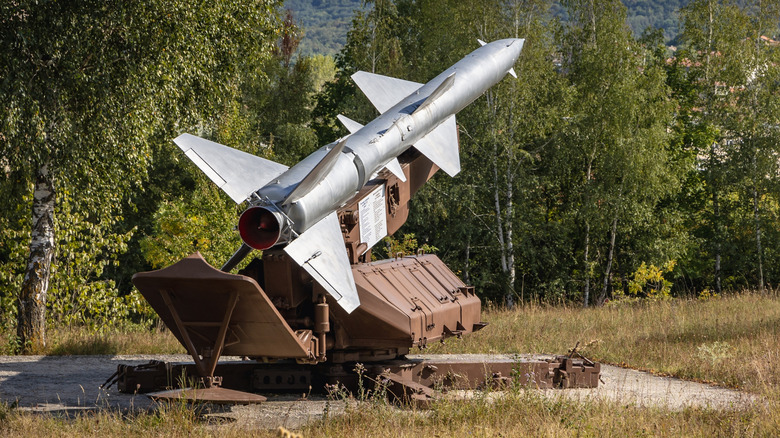
Defeating an adversary radar-guided missile begins with knowing what electronic signatures represent the functions or processes the missile is in at any point in time. As a missile’s radar transitions from target acquisition through tracking to terminal guidance, its operating parameters typically shift. Frequency increases, while detection range and field of view narrow in exchange for higher update rates, finer angular resolution, and greater tracking accuracy.
Knowing those operating frequencies enables a defending aircraft to identify when a threat radar is active and when the aircraft is being spiked. Simultaneously, electronic attack efforts like jamming can be substantially more effective as they can be better directed against those operating frequencies.
During the Vietnam War, understanding the SA-2’s electronic signatures very quickly emerged as one of the critical intelligence priorities of the air war. Collecting these signals was seen as critical in supporting the development of warning systems and the design of electronic countermeasures.
The difficulty was that an SA-2 engagement incorporated a variety of different signals to achieve different outcomes. The most critical of these for Western intelligence collection were the terminal guidance and proximity-fuzing signals associated with the missile in its final stages of flight. Because these signals were relatively high-frequency, transmitted with very little excess power, or confined to a narrow pencil beam, collecting them from a distance was impossible. In response, the value of an individual drone was determined to be lower than the value of the intelligence, and thus the Model 147D, and its later E variant, was conceived.
From Vietnam to the modern electronic battlefield
The most notable success of the 147D/E came in early 1966. Operation United Effort, the American mission to collect electronic data on the SA-2’s Fan Song and Spoon Rest radars, was yet to obtain those critical terminal signals. However, on 13 February, a Model 147E, masquerading as a Lockheed U-2, was ushered into an SA-2 envelope in the skies above North Vietnam. The missile operators took the bait by tracking, targeting, and engaging the “U-2” in their airspace. By the time the wreckage hit the ground, all of the secrets of the SA-2 were safely tucked away inside an ERB-47H that was tracking back toward Da Nang Airbase.
The intelligence had immediate strategic value. Perhaps the most notable result was the development of the AN/APR-26 launch-warning receiver, an aircraft defensive suite optimized to identify SA-2 launch signals. By the end of the Vietnam War, the AN/APR-26 was a common sight on American aircraft.
Beyond Vietnam, Western exploitation of the SA-2 emissions collected by the Model 147D/E heavily shaped wider technical intelligence efforts and the ensuing missions of Wild Weasel squadrons in later wars. UN and Coalition forces embroiled in conflicts from the Gulf, to the Balkans, and back to the Gulf, all made use of the findings derived from the 147D/E’s collection efforts to counter the SA-2s fielded by Iraqi Armed Forces, the Army of Republika Srpska, and the Armed Forces of Yugoslavia.
Today, additive manufacturing and simplified mass are changing how military assets are designed and employed. Alongside this, the role of electronic warfare continues to become increasingly relevant on the battlefield. In this environment, the idea of reconnaissance via attrition, the same thinking that led to the development of the Model 147D/E, is well-placed to re-emerge as a favored means of intelligence collection.
You must be logged in to post a comment Login