Tech
Why There’s More Than Just Minimum Ground Clearance To Safely Off-Roading


We may receive a commission on purchases made from links.
The first aspect that comes to mind when considering a vehicle for off-roading is often ground clearance. However, most four-wheel-drive trucks and SUVs come off the showroom floor with enough ground clearance to explore a variety of two-track roads and trails.
For example, the 2026 Jeep Wrangler Sport rolls off the assembly line with 9.7 inches of ground clearance and even the 2025 Subaru Outback Wilderness clears 9.5 inches. Compared to something like a 2026 Chevrolet Corvette with its 5.3-inch ground clearance that’s an extra four-plus inches. In reality, the Corvette could barely clear a loaf of bread, while the Wrangler could clear a basketball. There’s even some trucks and SUVs that have higher ground clearance than a Jeep Wrangler.
Granted, if you want to venture off those limited-maintenance roads onto more technical off-road trails, you’ll likely want more ground clearance. My first experience going to an off-highway-vehicle (OHV) area came as I drove my new-to-me bone-stock 2000 Jeep Wrangler Sport to a “Novice Run” hosted by a local off-road club. The trail led through what they called “the rock garden” where I lost the outer portion of my rear bumper while having the time of my life. Two months later I returned with new bumpers, a 4-inch lift and 3-inch-larger diameter tires to sail through the rock garden without so much as a scrape.
In reality, the extra 1.5 inches of ground clearance gained from the larger tires played only a small part in that successful run. Two months of additional off-road driving experience, the improved approach and departure angle provided by the aftermarket bumpers, and the lift kit with swaybar disconnect also helped.
Provisions for safer off-roading
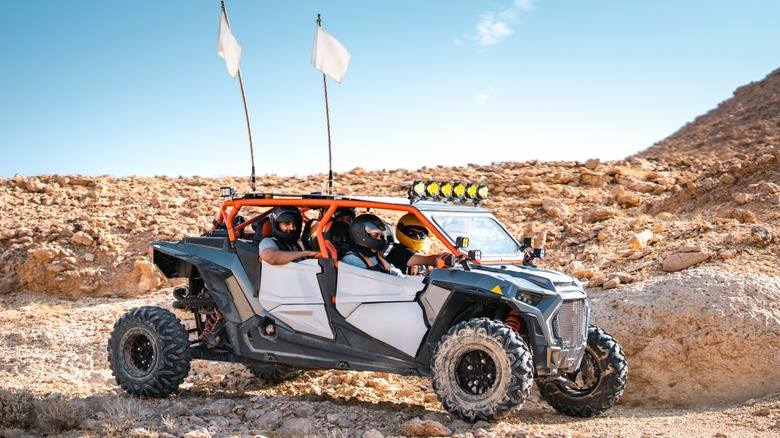
The first step to safely off-roading is choosing a vehicle that fits your intended adventure style. There are many options ranging from pickup trucks and SUVs, to ATVs, UTVs, and purpose built off-road buggies.
If you have modest off-roading goals met by a vehicle of your choosing, there are still some things to keep in mind before setting out on your first off-road adventure. In addition to basics, like checking the weather, trail conditions, and going with a group or at least letting someone reliable know where you’re going and when you plan to return, you’ll want to have a few necessities with you.
There are some essentials that should be in every vehicle in case of emergency, like jumper cables, some drinking water, a first aid kit, and tools to change or repair a flat tire. That kit in an off-road vehicle should be more robust, including provisions to spend the night trailside if needed. In addition, some basic hand tools, extra fuses, flashlights, tow straps, and other vehicle recovery gear could keep you from using the overnight provisions and increase the odds of making it home in time for dinner.
Vehicle considerations for safer off-roading
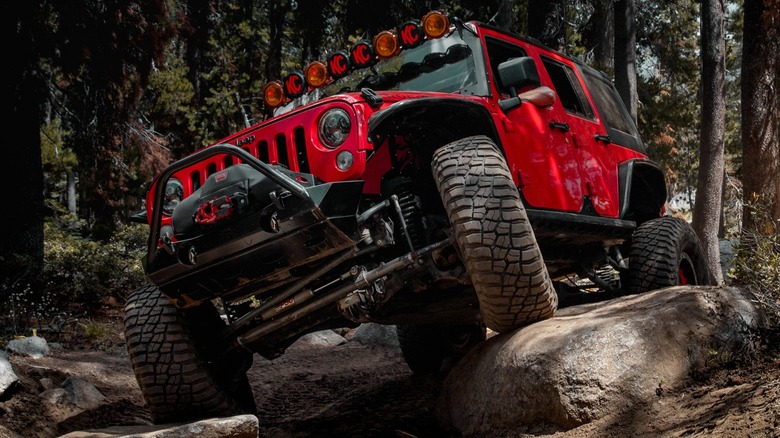
The best off-roading vehicles are equipped with 4WD or AWD. While 4X4 models are typically best suited for serious off-roading, the simplest 4X4 and 4WD systems may not provide power to all four tires in some circumstances. Advanced, or modified in some cases, 4X4 systems use locking differentials to deliver power across the axles. While popular on rear axles, lockers are sometimes found in both, front and rear differentials.
Off-road oriented vehicles typically feature specialized tires mounted on study wheels that sometimes feature a locking ring around the tire’s bead called a bead-lock. Bead-locks, along with heavy-duty tire sidewalls, allow running the tires off-road at lower air pressures than we’d use on the highway. Lower tire pressures create a larger contact-patch with the ground and allow the tire to flex over rocks.
Suspension articulation is another factor in maintaining traction. Even with the best tires and locked differentials, the available traction is halved if two of the four tires are off the ground. Serious off-road vehicles, like the Jeep Wrangler Rubicon and some Toyotas, allow the driver to disconnect the vehicle’s stabilizer (or sway) bar to allow more articulation of the axle. If your rig didn’t come with swaybar disconnects, there are relatively inexpensive options to add manual versions, like this adjustable front swaybar disconnect kit for Jeep Wrangler TJ and Cherokee XJ models.
Still, the best way to safely off-road is to stay within your limits. Novice off-roaders should go with an experienced group and listen to their advice. Most off-road parks provide maps with trail ratings and many of the most difficult obstacles have a way to bypass them. There’s less shame in taking the bypass than having to be winched out of a spot you shouldn’t have been in while everyone waiting on you watches.
You must be logged in to post a comment Login