A lot of the conversation around AI in healthcare focuses on diagnostics and drug discovery or on doctor-patient visits. But a less visible part of the system affects whether patients actually get seen at all, and it has less to do with the number of doctors in the world (too few) and more with the administrative work (too much) that happens between a primary care doctor writing a referral and a specialist’s office getting a patient on the schedule. That gap, it turns out, is huge, stubbornly manual, and increasingly attracting serious interest from venture capitalists.
Kaled Alhanafi, a former Lyft and Cruise executive, and Chetan Patel, who spent a decade building cardiac devices at Medtronic, co-founded Basata after each experienced the problem directly.
For Patel, the issue became personal when his wife fainted on a flight with their young children. Even with his deep knowledge of cardiology and the specific devices that could help her, he says navigating the administrative process to get her appropriate care took far longer than it should have. “We have the best doctors, we have some of the best medicines, but the care gap is just so wide,” he said.
Alhanafi describes a parallel experience with his own father, who was referred to three cardiology groups after a serious carotid artery diagnosis. According to Alhanafi, only one called back within a couple of weeks. Another responded after the surgery was already done. The third still hasn’t called.
Advertisement
These aren’t unusual outcomes, as nearly anyone who has tried to see a specialist in recent years can attest. Specialty practices that receive referrals are frequently processing hundreds or thousands of documents — most arriving by fax — with small administrative teams. Practices lose patients not because they don’t want to see them, the company argues, but because they can’t get through the intake backlog.
Basata, founded two years ago in Phoenix, is trying to fix this. When a referral comes in — still typically by fax, alas — Basata’s system reads and processes the document, extracts the relevant clinical information, and then an AI voice agent calls the patient directly to schedule the appointment.
Patients can also call the practice at any hour and reach an AI agent that can answer questions or handle common administrative needs like prescription renewals. Alhanafi says the company has recordings of patients audibly surprised by how quickly they’re contacted after a referral is sent. The goal, he says, is for a patient to have a scheduled appointment by the time they reach their car in the parking lot after seeing their primary care doctor.
Techcrunch event
Advertisement
San Francisco, CA | October 13-15, 2026
The company integrates with the electronic medical record systems that specific specialties actually use, which is why it says it has moved carefully — cardiology first, then urology — rather than trying to serve every corner of the market at once. The founders say they recently turned down a large deal in a specialty they haven’t yet mapped thoroughly enough to feel confident doing well.
Advertisement
The revenue model is usage-based: practices pay per document processed and per call handled, rather than per seat. The company says it has processed referrals for roughly 500,000 patients to date, with about 100,000 of those coming in the last month alone.
Basata says it has raised $24.5 million in total, including a new $21 million Series A round led by Lan Xuezhao of Basis Set Ventures, who began her career modeling the human brain as a PhD researcher before moving into corporate strategy at McKinsey and Dropbox and ultimately into investing. Cowboy Ventures, founded by Aileen Lee, also participated, as has Victoria Treyger, a former general partner at Felicis Ventures who more recently stood up her own venture firm, Sofeon (this is its first investment).
The space is getting crowded. Tennr, a New York-based startup founded in 2021, has raised over $160 million to date — including from Andreessen Horowitz, IVP, Lightspeed, and Google Ventures — and is now valued at $605 million. Tennr focuses heavily on document intelligence and has says it has built proprietary language models trained on tens of millions of medical documents. Assort Health, backed by Lightspeed, focuses on automating patient phone communication for specialty practices and last year raised at a $750 million valuation.
Lee said the founders’ years of experience are an asset in a space filling up with well-funded competitors. “There are a lot of [VCs] chasing around high school dropouts and college dropouts, but when you’re selling to medical practices, trust is a really big deal,” she said. “These doctors want to look you in the eye and know that they can count on you.”
Advertisement
Basata’s founders meanwhile argue that their differentiation lies in combining both capabilities into a single end-to-end workflow tailored to specific specialties instead of building a tool that handles just one part of the process. That may be harder to sustain as better-funded competitors expand, but there’s clearly a market signal here.
Of course, like many AI companies automating work that humans currently do, Basata will eventually face a harder question about where the line is between augmenting workers and displacing them. For now, the founders say the administrative staff they work with aren’t worried about that; they’re more worried about drowning. Indeed, Alhanafi notes that the administrative staff at specialty practices have often been in their roles for decades and know the work intimately; they’re also buried in volume that no reasonable number of hires could fully absorb.
Whether AI merely expands what these workers can do or gradually makes many of their functions unnecessary is a question that applies well beyond healthcare. For now, Basata’s pitch is the former: that freeing administrators from the most repetitive parts of the job makes them better at the rest of it. Judging by one stat shared by Alhanafi — that 70% of the company’s new deals now come through word of mouth — it seems the people closest to the problem find that argument convincing.
Pictured above, left to right: Chetan Patel, who is co-founder and president of Basata; Kaled Alhanafi, the company’s CEO; and Vivin Paliath, the company’s third co-founder and CTO.
Advertisement
When you purchase through links in our articles, we may earn a small commission. This doesn’t affect our editorial independence.
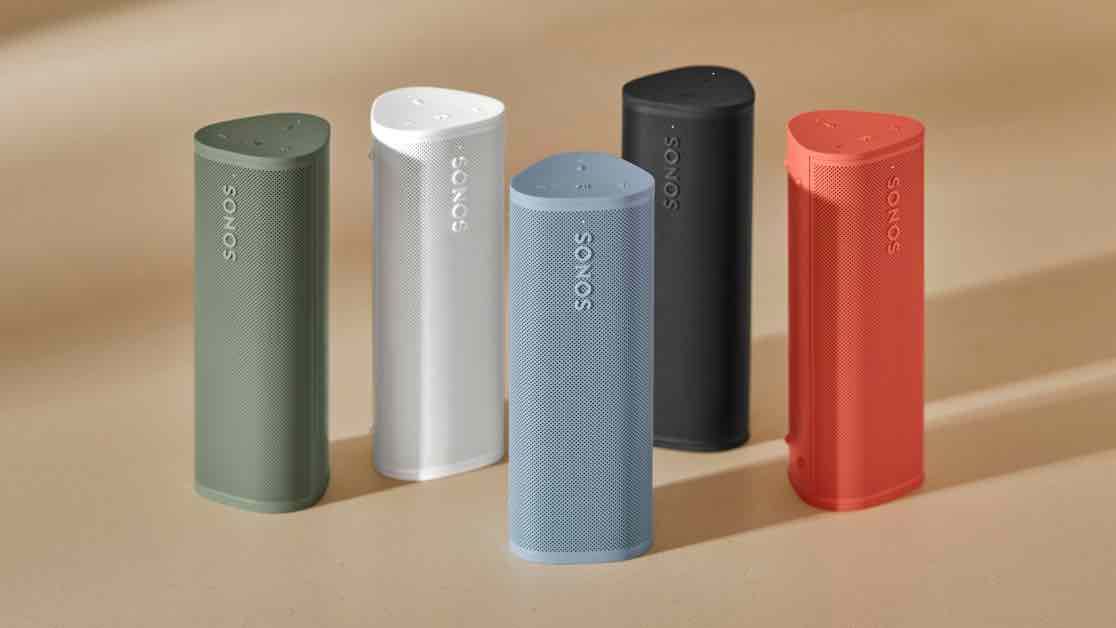
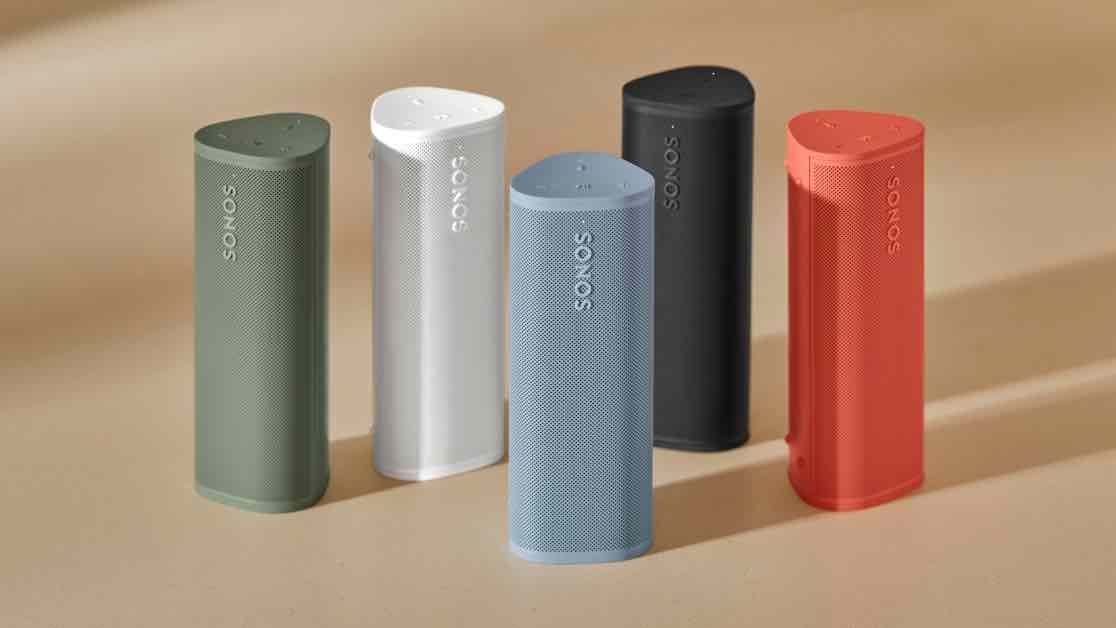
The Sonos Roam 2 is a sleek portable speaker with a built-in battery, which means you can either put it in a room and leave it or take it with you into the garden, to the beach, or even to a friend’s house. Just connect it to your phone, choose a track, and the Roam 2 will take care of the rest.
The £134 sale price is £5 cheaper than we saw during Black Friday and an incredible £45 off its retail price. If you want a bargain price for a premium Bluetooth speaker, this is it.
Advertisement
Today’s best Sonos speaker deal
“The Sonos Roam 2 delivers rich and clear sound reproduction that shows off every element of a track, and it’s very intuitive to use the speaker over Bluetooth or Wi-Fi.” That’s the verdict we reached in our Sonos Roam 2 review, where we gave it a near-perfect 4.5 out of five stars.
More specifically, we love the speaker’s ability to produce decent audio across the frequency range, which makes it an ideal choice for listening to a broad array of genres and artists. So, no matter what you’re into, the Roam 2 will not disappoint.
From a design perspective, the speaker not only looks fantastic but also boasts an IP67 resistance rating, which means it’s ready for a trip to the beach or a tumble in a park. And at just 0.95 lbs, you can sling it in a bag without feeling weighed down. All in, the Roam delivers in every area that it matters.
Advertisement
The fact that this is a record-low price makes now the perfect time to snag the Roam 2. If you’d like to see what else is out there before buying, then have a look at our best Bluetooth speakers guide and our audio deals page.
Sony’s Xperia phones have rarely looked boring, but they’ve often felt too reserved for their own good. The latest Xperia 1 VIII leak changes that, with official-looking images showing Sony’s next premium phone in shades that actually want attention.
In a crowded high-end Android market, the first impression now has to work harder. Sony’s next phone still needs the usual flagship strengths, but a sharper visual identity gives it a better chance of standing out.
The leaked images, shared by Sumaho Digest, reportedly show the Xperia 1 VIII in Graphite Black, Iolite Silver, Garnet Red, and Native Gold.
There’s still a problem, as the same leak points to a possible price bump and a camera change that could irritate longtime Xperia fans, especially if Sony moves away from continuous optical zoom.
Advertisement
Is this Sony loosening up
The new leak is interesting because the hardware design doesn’t seem dramatically different. It still looks like a Sony phone, with the tall, squared-off shape that has defined the Xperia line for years.
AI-enhanced leaksDigital Trends
The shift is mostly attitude. Graphite Black is safe, Iolite Silver keeps things clean, and Native Gold adds warmth. But Garnet Red gives the lineup its clearest personality.
Sony has spent years leaning on camera credibility, creator features, and enthusiast appeal. A more expressive palette suggests it knows the phone also has to compete visually.
Will the camera lose its edge
The possible downside is the zoom system. The leak suggests Sony may drop the continuous optical zoom used on recent Xperia flagships and move to fixed telephoto steps instead.
That would be a real change because zoom flexibility has been one of Xperia’s clearest enthusiast hooks. Even people who never bought one could understand why the feature mattered.
Fixed zoom points wouldn’t automatically make the camera worse. Plenty of excellent phones use that setup. But if the Xperia 1 VIII also costs more, Sony will need a stronger case for why its camera still feels special.
Can Sony justify the bump
The Xperia 1 VIII is rumored to launch in Hong Kong on May 20, with the leak also pointing to higher prices than the Xperia 1 VII. That makes the new styling feel exciting and risky at the same time.
A more stylish Xperia is easy to like. A pricier Xperia with a less unusual zoom setup is harder to defend, unless Sony can show meaningful gains in image processing, battery life, performance, or display quality.
For now, the leaked colors are doing useful work. They make the Xperia 1 VIII feel less predictable. The next test is whether the finished phone backs up the swagger.
Armored vehicles now roll out with thick layers of explosive reactive armor that detonate on contact and blunt older anti-tank munitions. Saab created the HEAT 758 to cut straight through that problem. The round slides into the familiar 84-millimeter Carl-Gustaf recoilless rifle and carries two shaped charges arranged in sequence. The lead charge strikes first and clears a path by disrupting the reactive plates. Moments later the main charge jets forward and bores into the vehicle’s base armor.
Engineers optimized the design so that the entire package can defeat up to 700 millimeters of armor. That depth is comparable to the heaviest tanks currently in service. The range extends to 600 meters while keeping the round around the same size and weight as the previous HEAT 751. Soldiers bear no additional burden while gaining increased distance and power with each shot.
2 AVIATION LEGENDS, 1 BUILD – Recreate the iconic Boeing 747 and NASA Space Shuttle Enterprise with the LEGO Icons Shuttle Carrier Aircraft…
DEPLOY LANDING GEAR – Turn the dial to extend the massive 18-wheel landing system on your airplane model, just like real flight operations
AUTHENTIC FEATURES & DETAILS – Remove the tail cone, engines, and landing gear from the NASA shuttle and stow them in the cargo bay during flight
Firebolt technology is at the heart of the advancement. The round chambers in the Carl-Gustaf M4 communicate data with the launcher and the connected fire control unit. The aiming system receives data on propellant temperature, ammunition type, and ambient variables directly. Gunners avoid the archaic manual dials and settings. The weapon handles the computations, resulting in a cleaner ballistic solution. Accuracy improves as fewer variables slip through under stress.
Advertisement
Years of battlefield reports served as the basis for development. Ukrainian crews have already proved the HEAT 751’s effectiveness against Russian T-90 tanks fitted with Kontakt-5 and Relikt armor. Saab examined probable outcomes, ran tens of thousands of numerical simulations, and meticulously refined every aspect of the new round. Carbon-composite sleeves and a titanium liner keep the ammunition light and durable inside the barrel. The muzzle velocity is 255 meters per second, which is enough to cover the extra range without sacrificing punch.
Live demonstrations in Karlskoga, Sweden, ended only a few days ago. Customers saw the round perform exactly as expected against representative targets. An anonymous buyer has already placed an order, and production lines are moving. The date corresponds to a significant shift in how modern armies think about spread firepower. A single squad with a Carl-Gustaf and these bullets can pose a danger to vehicles that previously required coordinated heavy weapons. [Source]
Oriveti is a Hong Kong based personal audio brand that has built a steady presence in the in-ear monitor market with models that focus on balanced tuning and solid build quality at competitive prices. Its products typically sit in the midrange segment, where it competes with brands such as Moondrop, FiiO, and DUNU, all of which target listeners looking for strong performance without moving into flagship pricing.
Against that backdrop, Oriveti has introduced a new sub-brand called bleqk, short for “Basic Line Exquisite Quality Kept,” as part of its expanding IEM lineup. The first model under this label is the Purecaster, an all-metal in-ear monitor that includes interchangeable tuning filters, a single dynamic driver, and a detachable modular cable system. Positioned as a more refined entry point within the company’s range, the Purecaster reflects Oriveti’s effort to balance build quality, tuning flexibility, and everyday usability, without moving into its higher-priced offerings.
About My Preferences: This review is a subjective assessment and reflects my personal listening preferences. I do my best to stay consistent and fair in how I evaluate gear, but bias is part of the process and not something that can be completely removed. With that in mind:
My preferred sound signature includes solid sub bass extension, controlled and textured mid bass, a slightly warm midrange, and a clean, extended treble response.
I have mild sensitivity to treble, especially in the upper regions.
Advertisement
Testing equipment and standards can be found here.
Oriveti Purecaster Specifications:
Cable: Detachable modular cable with 3.5 mm and 4.4 mm terminations
Driver: Single 12.2mm dynamic driver
Impedance: 32 ohms
Sensitivity: 112.5 dB/mW at 1 kHz (±3 dB)
Frequency Response: 20 Hz to 20 kHz
Total Harmonic Distortion: Less than 0.08%
Shell Material: CNC machined aluminum
Connector Type: 0.78 mm 2 pin
Build
Photo credit: Resonance Reviews
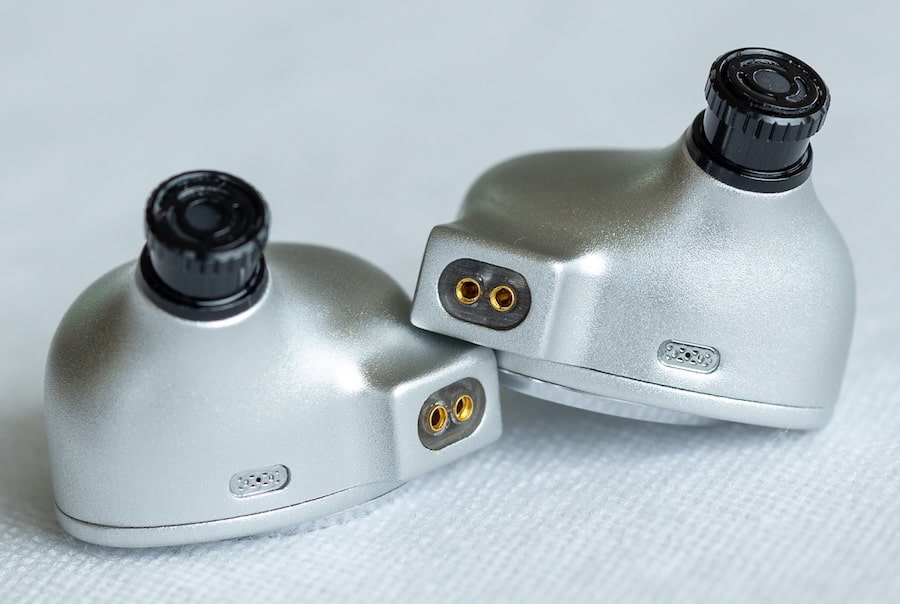
If there’s one thing that Oriveti knows how to do, it’s work with metal. This IEM is put together quite well, and its CNC’d aluminum shells look great. The solidity of the Purecaster also gives it an excellent hand-feel.
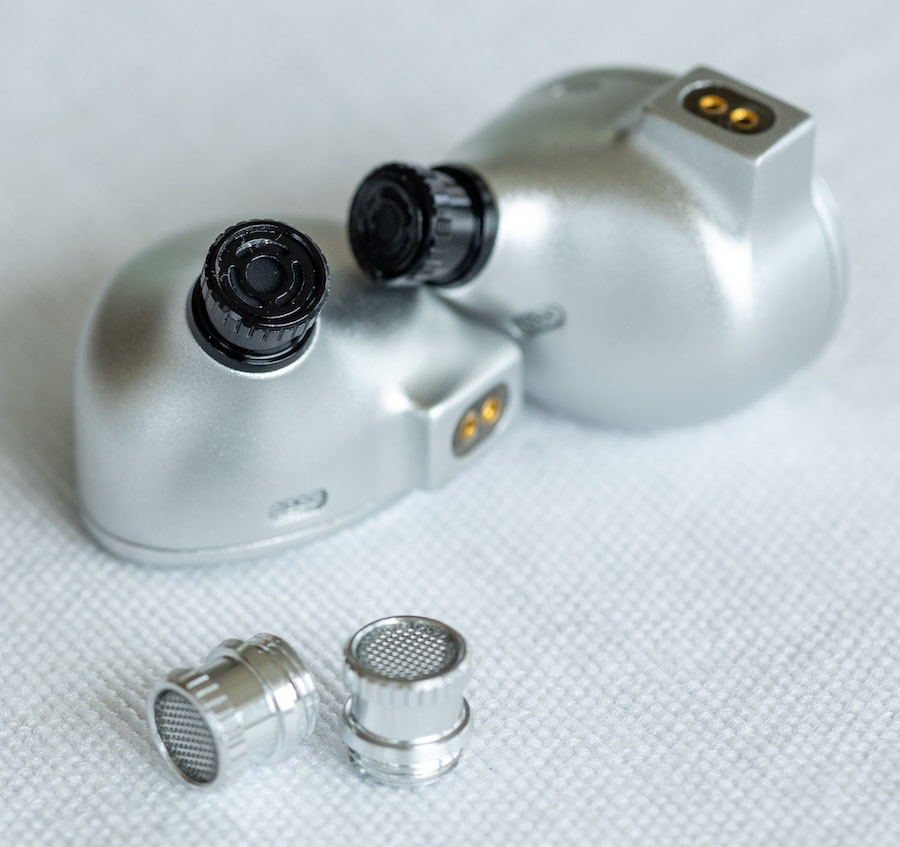
The top of the Purecaster’s shells host its 0.78mm 2-pin sockets. The sockets set in plastic blocks, which in turn are glued flush with the aluminum shell.
The Purecaster’s nozzles are also metal, and secure nicely to the threads cut into the main chassis.
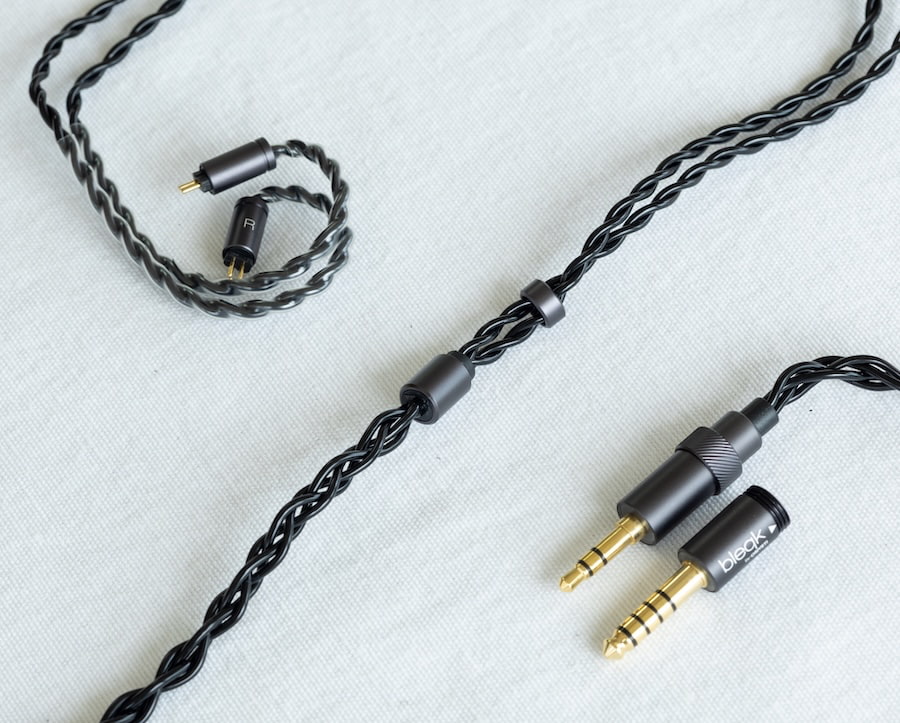
Oriveti went with a well-constructed modular cable for the Purecaster. It features a simple 4-core chain braid and generous strain-relief. It includes metal finishing bits for the termination, Y-splitter, and chin-cinch, which again feel nice in the hand.
Advertisement
Photo credit: Resonance Reviews
Comfort
Comfort is a metric that relies heavily on factors influenced by your individual ear anatomy. Mileage will vary.
Advertisement. Scroll to continue reading.
I had no comfort issues with the Purecaster. It is fairly small and light, and its shell geometry matches up well with my ear. The included cable is likewise quite comfortable. It is reasonably soft while not transmitting very much in the way of microphonics. The Purecaster’s stock eartips are pretty comfortable, but produce an average seal for me.
Accessories
Photo credit: Resonance Reviews
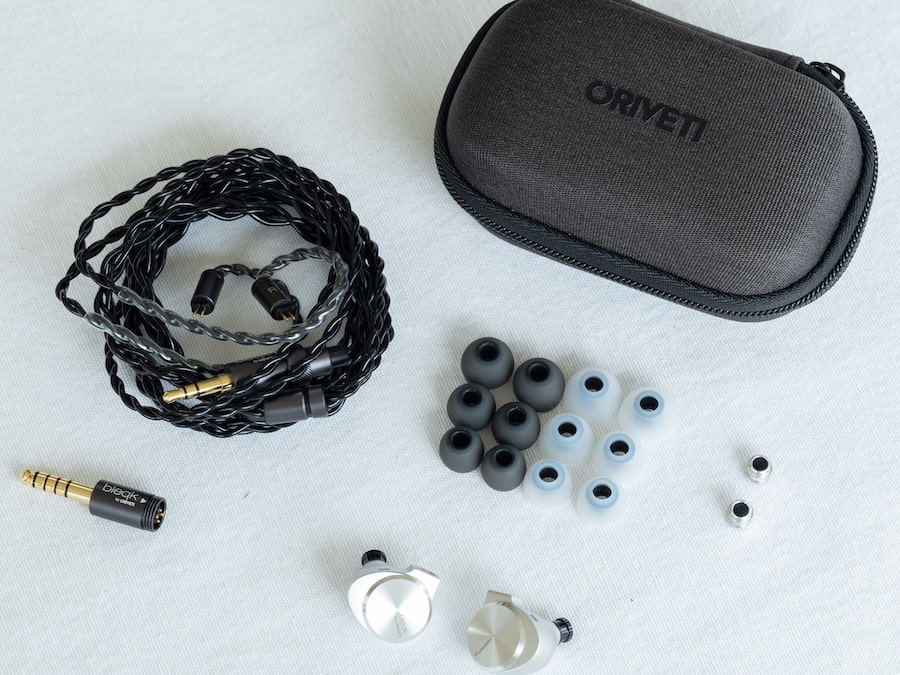
What’s in the Box
Semi hard carrying case
Detachable modular cable (0.78 mm 2 pin)
3.5 mm termination
4.4 mm termination
Six pairs of silicone ear tips
Two pairs of tuning filters
The accessory package is well thought out and covers the essentials. The included silicone tips provide a good seal and remain comfortable during longer listening sessions. The carrying case strikes a practical balance it is compact enough for a pocket, but still has room for the IEM, an extra termination, spare tips, and even a small USB-C DAC.
The only omission is foam ear tips. Given how dependent the tuning is on achieving a proper seal, including at least one set would have made more sense.
Advertisement
Listening
The Purecaster includes two sets of tuning nozzles: black and silver. The black nozzles shift the tuning toward a brighter presentation, with more energy in the upper frequencies. In practice, that can come across as stiff and sharp, especially on poorly recorded material or at higher volumes. They may appeal to listeners with reduced treble sensitivity or those who prefer a more forward top end, but in my case, the presentation pushed past my comfort threshold.
I spent the majority of my listening time with the silver nozzles, which offer a more balanced and manageable treble response.
With the silver nozzles installed, the Purecaster still leans bright, but the presentation shifts from sharp to more open and airy. There’s a sense of lightness and space rather than outright aggression. The upper treble is reasonably well controlled, with a gradual roll off past 12 kHz that helps avoid an overly metallic or artificial edge.
The midrange tilts toward the upper region, with a noticeable emphasis centered around the 2 to 3 kHz range, which brings vocals and presence forward in the mix.
Advertisement
By contrast, the Purecaster’s lower mids are slightly recessed, which pulls warmth out of the mix. The bass follows a similar approach. Even with the silver nozzles, it is not forward or particularly punchy. Instead, you get a “HiFi-styled” presentation of “look-don’t-touch” bass. It is there, but only in the academic sense.
Fast, Controlled, and Organic Treble
The Purecaster’s lower-treble captures the edges of hi hats and cymbals well, modeling their decay organically. This is indicative of strong technical abilities, which lines up with the Purecaster’s overall strong layering abilities. It did a great job capturing the metallic edge and fine texture of the guitar and percussion in the intro of “Give Me Novacaine” by Green Day, then maintained strong separation as the track moved into its more chaotic chorus.
Tracks with a big, open sense of space like “Midnight City” by M83 take full advantage of the Purecaster’s spacious upper register, projecting a sense of scale that isn’t all that common among single dynamic driver IEMs. The Purecaster also does a good job resolving the layered textures of the track’s synths, keeping things clear without drifting into sharpness or sibilance.
A Little Too Cleanroom
I can see what Oriveti is aiming for with this midrange: a more neutral presentation that avoids added warmth in favor of a cleaner, HiFi-style tuning. For some listeners, that approach will make a lot of sense. But I tend to prefer a bit more presence in the lower mids, especially with vocal-heavy material. On the Purecaster, male vocals can come across slightly thin due to the upper-midrange emphasis. That tilt pulls some weight out of the lower registers, which can leave tracks like “Get Stoned” by Hinder sounding a bit dry.
Advertisement
Brighter vocals, especially on atmosphere-heavy tracks, tend to fare much better. The lo fi textures of “back to friends” by sombr come through with a clean, well-defined clarity that stands out given the Purecaster’s price point.
Advertisement. Scroll to continue reading.
Albums with warmer mastering also pair well with the Purecaster’s “cleanroom” midrange. “Simple Math” by Manchester Orchestra is a good example, where the added warmth in the mix helps restore some depth and body to the presentation. On “Pale Black Eye,” the muted guitars and measured drum hits come through with a convincing sense of balance and harmonic completeness, reinforcing how dependent the Purecaster can be on track synergy.
The Tight-Pursed Accountant of Bass
The Purecaster has a pretty restrained bass region. It’s tilted towards the sub-bass, leaving the mid-bass fairly flat. This means that the Purecaster is capable of the occasional rumble, but doesn’t punch much. The bass heavy mix of “Derezzed (The Glitch Mob Remix)” by The Glitch Mob manages to pull out a respectable amount of sub bass rumble, but it stops short of delivering real tactility on drum hits. Rock and alternative tracks follow a similar pattern, coming across as fairly neutral and rarely producing a sense of physical impact from the drums.
Advertisement
That said, its not impossible to come across a strongly-synergistic track, or at least one that lines up well with the Purecaster’s frequency response curve. “It’s Nice to Know You Work Alone” by Silversun Pickups delivers a relatively full presentation of bass guitar and drums on the Purecaster, which helps create a more immersive and deeper sense of soundstage.
Comparisons
Comparisons are selected solely based on what I think is interesting. If you would like me to add more comparisons, feel free to make a request in the comments below.
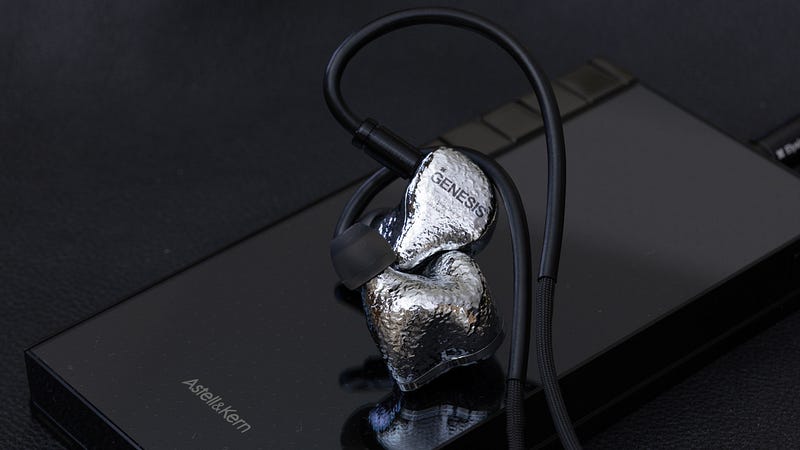
The Genesis G318s is a single-dynamic IEM from EarAcoustic Audio. The G318s costs $100 more than the Purecaster, coming it at $249. It features solid aluminum shells and a detachable 2-pin cable. The Purecaster has a braided plastic-coated cable with a modular termination, while the G318s features a cloth-coated cable with a fixed 4.4mm termination. I like the Purecaster’s cable and eartips more than the G318s’s, though the G318s has a more-spacious carrying case.
The G318s is a warmer, bassier IEM. Its focus is squarely on delivering comfort and energy without sounding too thick — essentially the inverse of the Purecaster. It delivers an elevated mid and sub-bass region, allowing it to kick and rumble with greater intent and depth than the Purecaster. While the Purecaster can rumble, it does so only on a select few tracks, making it less consistent with electronic genres. The G318s has a flatter lower-midrange and less-emphasized upper-midrange, setting its vocals more towards the center of the stage. The Purecaster has a brighter, more forward upper-register on the whole, allowing it to separate and articulate certain subtle treble-bound textures more-easily than the G318s. The G318s is no slouch in terms of upper-register performance, but the nature of its tuning makes it less likely to bring something subtle far enough in forward to catch a casual-listener’s attention.
Between the two IEMs, I’m choosing the G318s. Its tuning lines up better for my music library and tuning preferences. The extra $100 bump in price, while significant, is one I’m willing to pay to get extra flexibility and tonal completeness. If you’re focusing on price-to-performance, however, you’ll likely want to stick with the Purecaster’s cleaner and brighter tuning style.
The NM25 is an aluminum-shelled IEM featuring a single dynamic driver per-side. It costs $199, making it $50 pricier than the Purecaster. Both IEMs use detachable cables, though the Purecaster’s is thicker and uses a flush connector rather than an extruded one. The Purecaster’s cable is also modular, giving you the option to utilize a 4.4mm termination, should you feel the need. The NM25’s cable is a fixed 3.5mm, but does offer a bit more comfort and ergonomics while on the move. The Purecaster includes a more-usable case that has space for a DAC, while also packing a better selection of stock eartips.
Both the Purecaster and NM25 are bright sounding IEMs, but the NM25 is a bit brighter than the Purecaster, even with its black “treble” nozzles installed. The Purecaster has a similarly-forward upper-midrange, but has a lesser lower-midrange valley. The NM25’s bass is less emphasized than the Purecaster’s bass, and it doesn’t rumble with even a similar level of intensity to the Purecaster. The Purecaster’s mid-bass is likewise a little more-elevated than the NM25’s, delivering a bit more weight in deep string instrumentation and solo-piano performances.
Between the two, I’m selecting the Purecaster. For $50 less, you get better-balanced sound, similar performance, and improved accessories across the board. The NM25’s crucial lack of lower-register emphasis makes it less genre-flexible than the Purecaster, impacting its ability to render atmospheric weight in a variety of tracks that the Purecaster nails.
The Venus is one of my favorite IEMs. It packs a four-driver hybrid configuration in resin shells and costs $168. It also includes a detachable modular cable and comes with a USB-C termination that the Purecaster lacks. The Venus’s stock eartips aren’t anything too special, and are similar in quality to the Purecaster’s eartips. The Purecaster comes with a more-practical and better-protecting case than the Venus does, though the Venus’s case is easier to fit into a tight pocket than the Purecaster’s is.
The Venus is a warmer, more V-shaped IEM than the Purecaster. It features a slightly more-lifted sub-bass and more-substantial mid-bass. The Venus’s lower-mids are thicker and less-recessed than the Purecaster’s are, and it has a similar level of upper-midrange emphasis. The Purecaster has a less-forward lower-treble than the Venus, but picks up a lot of upper-treble energy that the Venus does not have.
Advertisement. Scroll to continue reading.
Advertisement
Both IEMs are quite performant, but the Venus manages to arranges cascading and contrasting layers of instrumentation with a level of care and precision that the Purecaster sometimes does not match. Beyond basic separation and articulation, the Venus also brings out more texture and tonal nuance than the Purecaster, and does so more consistently.
If I had to choose between these two IEMs, I’d go with the Venus. Its included USB- -C termination, stronger bass response, and closer alignment with my preferences make for a more immersive listening experience overall. That said, I do not have much sensitivity to 5 kHz or 8 kHz emphasis. If you prefer a leaner presentation or are sensitive to energy in those regions, the Purecaster may be the better fit.
Oriveti Purecaster IEM | Photo credit: Resonance Reviews
The Bottom Line
The Oriveti bleqk Purecaster is a well built, value focused IEM with excellent aluminum shells, a comfortable modular cable, strong layering, clear vocals, and impressive midrange and treble texture. There is a lot here that feels more premium than the price suggests.
The problem is not quality. It is tuning. The Purecaster leans clean, bright, and controlled, with solid sub bass extension but not enough bass weight or lower midrange warmth to make it feel fully grounded. The result is an IEM that sounds detailed and precise, but sometimes too sterile for its own good. The black tuning filter only pushes that brightness further, when a bass focused option would have made far more sense.
Advertisement
This is a good fit for treble focused listeners, fans of clean dynamic driver IEMs, and anyone who wants a cooler, more detail oriented Hi-Fi presentation with premium build quality. It is not the right choice for bassheads, warmth seekers, or listeners who want a fuller, more relaxed, traditionally fun sound.
Oriveti’s idea behind bleqk makes sense: simple, better built IEMs at accessible pricing. The Purecaster gets the hardware right and comes close on performance. It just needs a little more body, warmth, and mischief in the tuning.
Pros:
All metal shells with a clean, durable finish
Soft, ergonomic cable that is easy to handle
Solid sub bass extension with good reach
Above average layering and instrument separation
Clear, intelligible vocal presentation
Strong midrange and treble texturing
Natural, organic bass tonality
Cons:
Bass lacks emphasis for listeners who prefer a fuller low end
Upper register can sound thin at times
Black filter tuning leans too bright and can become sharp
The latest smart home devices and appliances promise to make everyday household tasks more convenient, but they come at a cost. Not only are they often more expensive than their non-smart counterparts, but if you buy them to replace your older devices, you’ll end up with a load of still-functional tech you don’t have space for. If you’re not keen on coughing up the cash for a boatload of the latest smart appliances, there are still plenty of simple things you can do to make almost every room of your home feel a little smarter.
One of the cheapest smart upgrades you can make is investing in a set of smart plugs, which allow you to switch connected devices on and off remotely. There is a huge range of dumb home devices and appliances that can be made more useful with a smart plug, from LED lighting and lamps to coffee machines. You could even attach a smart plug to a hard-to-reach floor lamp or a window air conditioner, so that the next time you need to turn them on or off, you won’t have to hurt your back.
Advertisement
Plenty of cheap smart plugs are available
Nanci Santos/Getty Images
We’ve already covered which smart plugs are worth buying, so we’ll keep the details brief here, but the short answer is that there isn’t one particular plug that’s definitively better than the rest. Each smart plug will be compatible with a slightly different list of smart home devices and platforms, and some are suitable for outdoor use while others need to be kept inside. What counts as the best option will vary based on your home’s existing tech setup, but the good news is that there are plenty of affordably priced smart plugs on the market from a variety of manufacturers.
It’s worth taking some time to choose carefully, since picking the right smart plug can make a big difference to its usefulness. Among other things, you’ll need to pick a plug that’s compatible with your favorite voice assistant, whether you prefer using Amazon Alexa, Google Assistant, or Siri via Apple HomeKit.
In addition to making your existing appliances more useful, a smart plug can also be a cheap way to cut down on your energy bills. Some smart plugs can detect when a connected device is in standby mode and automatically cut its power, preventing it from drawing energy while you’re not using it. Smart plugs are one of many energy-saving devices that can help cut your power bill, and in some cases, you might even be able to save enough that the plug ends up paying for itself.
You may not have intended to install an AI model onto your computer, but you might have one anyway. Google Chrome has been quietly installing a 4GB model onto devices without asking or notifying people.
Google has been installing Gemini Nano — an AI model that runs on devices such as smartphones and laptops instead of in the cloud — onto some people’s Chrome browsers without their permission, according to Alexander Hanff, a Swedish computer scientist and lawyer known as That Privacy Guy. And tech giant doesn’t tell you that it’s on your device after it’s installed, either.
Hanff said Gemini Nano will only be installed if the person’s device meets the hardware requirements. It’s unknown how many people have gotten the install.
Advertisement
Gemini Nano performs tasks such as detecting scam phone calls, helping you write text messages, summarizing recordings and analyzing Pixel phone screenshots. It’s not to be confused with the AI Mode pill in the address bar. If you use AI Mode, your queries are routed to Google Gemini servers — not to Gemini Nano.
A Google spokesperson told CNET that Gemini Nano will automatically uninstall if the device doesn’t have enough resources, such as processing power, RAM memory, storage space or network bandwidth.
“In February, we began rolling out the ability for users to easily turn off and remove the model directly in Chrome settings,” the spokesperson said. “Once disabled, the model will no longer download or update.”
Google gives more information about on-device generative AI models in Chrome on this web page.
Advertisement
If you’re running Chrome, you might have Gemini Nano. Go to your file manager — File Explorer (on Windows), Files (on Chromebooks), Finder (on Macs) — and search for a folder called OptGuideOnDeviceModel. In that folder, there will be a file called weights.bin, and that is where Gemini Nano lives.
Hanff said Chrome users will not know they have Gemini Nano unless they search for it, because “Chrome did not ask” and “Chrome does not surface it.”
If you want to get rid of Gemini Nano, there are a couple of ways. One is to uninstall Chrome entirely. The other way is to type “chrome://flags” into your browser address bar, then find “Enables optimization guide on device” and turn it off.
Why does it matter?
Hanff said the push might be intended to help Google cut costs by moving AI work off its own servers and onto your computer.
Advertisement
“Running inference on users’ own hardware allows them to push ‘AI features’ without the compute costs,” Hanff told CNET.
But Hanff suggested there could be legal ramifications, at least in Europe. He suggested that the Gemini Nano install could constitute a breach of the European Union’s General Data Protection Regulation’s principles of lawfulness, fairness and transparency. Hanff said that, considering the potential environmental impacts, Google should have announced it under the Corporate Sustainability Reporting Directive.
“Google has given us every reason not to trust them with a history spanning two decades of global privacy violations at massive scale,” Hanff told CNET. “So, I suspect they figured asking permission (what the law requires) would hinder their ability to push this model and, of course, whatever comes after it.”
This Sunday is Mother’s Day, and my mom turned 79 this week. She still has her mental health. Which is more than I can say for some of the people currently running the world, but let’s not ruin the challah before we even slice it.
Like any proper Jewish mother and Bubie operating in 2026, she remains loving, formidable, occasionally unhinged, and fully capable of turning a 12-minute phone call from Florida into a hostag e negotiation with weather updates, medical footnotes, and a side order of guilt. We talk three or four times a week, and while the monologues can drift somewhere between family briefing, courtroom questioning, and cable-news crawl, I’m grateful that I still get to hear them.
Have we always agreed on everything? Not exactly. My taste in women and wives has apparently required a congressional inquiry. Being bipolar? “Not a thing.” Hospitalized? Also apparently up for debate, despite the fact that I have the Nurse Ratched scars and a lifetime supply of insurance bills to suggest otherwise.
But putting all of that aside, and I do mean all of it, I’m lucky. Lucky that she’s still here. Lucky that she still picks up the phone. Lucky that she still cares enough to tell me I’m wrong, question my life choices, conduct a long-distance medical audit from Florida, and then ask if I ate. A lot of my closest friends have lost their mothers over the past few years, and many of those same women fed me for decades: cakes, cookies, grilled cheese sandwiches, Kraft Dinner, and the occasional piece of biltong from the South African moms who clearly understood that childhood required protein and protection from the emotional damage to come when I was an adult.
Advertisement
My mother was a prosecutor. A feared one. Her nickname was “Hang ’Em High Lilli,” which tells you everything you need to know about discipline in our house and why I never missed curfew. And on the rare occasion that I did, justice was swift, sentencing was non-negotiable, and the appeal process involved sleeping on the front porch in the falling snow until my father quietly let me in. Warm family memories. With frostbite.
And more than anything, I’m grateful for what she gave me long before I knew what any of it meant: the music, the movies, the voices, the books, and the emotional wiring that turned into a lifetime obsession with high-end audio, home theater, records, films, literature, and the strange belief that all of this actually matters.
Because it does. Not the boxes. Not the price tags. Not the spec-sheet sword fights in the comments section on Audio Science Review. The memories matter. The first songs matter. The movies that rewired your brain before you had the language to explain why. The albums your mother played in the car, in the kitchen, or from the next room while you were too young to understand that those moments were being filed away permanently.
So this week’s roundup starts and ends there: with Songs of My Mother, a Mother’s Day nod to the woman who helped build the soundtrack in my head before I ever reviewed a loudspeaker, argued about a DAC, or lost part of my soul reading another press release about “disruptive lifestyle audio.”
Songs of My Mother
I’ve explained in these pages more than a few times that I was raised in a home of Holocaust survivors. I knew where Auschwitz and Bergen-Belsen were before I knew the location of the secret Rebel base on Yavin IV. That probably explains a few things. My mother was born in a DP camp in Stuttgart, West Germany, because our family’s postwar planning committee had already been handed enough bad options to fill a Soviet filing cabinet.
Advertisement
My Zsa Zsa, Avrum Kurtz with my mother in 1948 in Toronto
My grandparents could have stayed in Europe. My Bubie’s only surviving relatives — and we lost dozens on both sides of the family — were her two older sisters in Paris, both of whom barely survived the war and both of whom lost husbands and children. There was a life waiting there, or at least the bones of one: family in the Marais, leather and luggage stores run by my great-aunt and great-uncle, another great-aunt with extensive properties, and the possibility of rebuilding around people who understood the silence between sentences.
It would have been easier in some ways. Family. Money. Paris. Baguettes. Galettes. French wine. Cafés filled with stylish French Jewish women named Leia or Tammy who would have ignored me with world-class precision. Well deserved. Maybe I would have ended up working for Focal, YBA, or some other French audio company where the products are either beautifully austere or wildly over-the-top, with very little interest in the boring middle where beige people go to die.
Advertisement. Scroll to continue reading.
But they didn’t stay. They got on a boat, crossed the Atlantic, and landed in Toronto. Not exactly the Marais with better hockey. Canada gave them safety, snow, smoked meat, and the chance to build something that wasn’t haunted by every street corner. It also meant that instead of becoming some insufferable Frenchman in a scarf arguing about amplifier topology over a glass of Burgundy, I became this: a Jewish kid from Toronto, raised by survivors, shaped by records, movies, guilt, food, Maple Leafs playoff trauma, humour, and the absolute certainty that mothers do not suggest things. They issue rulings.
My parents were also big technology people. First home computer on the block. First VCR. First projection TV. First CD player. Outdoor speakers before anyone else had figured out that music could follow you into the backyard like divorce proceedings. We were not rich. Not by neighborhood standards. But I have no right to complain. Some kids got a babysitter from Denmark. I got a basement command center.
Advertisement
Being effectively taped to the basement floor with an Atari, a 28-inch Zenith, Celestion loudspeakers, a Marantz integrated amplifier, a JVC Vidstar VCR, and enough books and movies to fill a Corellian freighter was a strange form of supervision. Possibly child abuse. Possibly genius parenting. The jury is still out, but the evidence suggests it worked.
But with all of that technology came some very interesting musical choices, because apparently my mother’s record collection was curated by a French cabaret singer, a Catskills emcee, a Motown producer, and someone who had recently escaped a Nashville honky-tonk with emotional and physical injuries. Édith Piaf was a constant presence. I was not a fan. Barbara Streisand was also in heavy rotation, which means that somewhere in the house, at any given moment, someone was asking “Papa, can you hear me?” The answer, judging by the volume, was yes.
But my mother also had a much funkier side, and that’s where things got interesting. The Animals. The Rolling Stones. The Beatles. Ray Charles. The Supremes. Dolly Parton. Patsy Cline. Elvis. Etta James. Sam Cooke. Leonard Cohen. Carl Perkins. Del Shannon. Booker T. & The MGs. The Kinks. Bob Dylan. Jimi Hendrix.
So I offer, without apology, some of her favorites.
Advertisement
Not the polite list. Not the audiophile-approved dinner-party playlist for men who use record clamps and emotional suppression in equal measure. These are the songs she would approve of if I had to go out fighting: with Leia holding a stolen Imperial blaster and dropping Death Troopers in a corridor, me with Han Solo’s DL-44 punching holes through blast doors, and the Millennium Falcon waiting in the hangar with the engines hot, the hyperdrive questionable, and my mother yelling from the Emeperor’s Throne Room that I should have brought a sweater.
Ray Charles — “I Got a Woman”
Ray Charles recorded “I Got a Woman” in Atlanta on November 18, 1954, and Atlantic released it that December. Built from the gospel framework of the Southern Tones’ “It Must Be Jesus,” Charles turned the sacred into the secular and helped draw the blueprint for soul music before the industry had fully figured out what to call it. It became his first No. 1 R&B hit in early 1955, which is a polite way of saying Ray kicked the church doors open, moved the piano into the club, and nobody was quite the same afterward.
For anyone under 40 who thinks they discovered it through Kanye West’s “Gold Digger,” slow down. That 2005 track samples Ray Charles’ “I Got a Woman” and opens with Jamie Foxx interpolating Charles, fresh off playing him in Ray. It was a clever modern reframe, but the engine under the hood was still Ray: gospel heat, R&B swing, and that voice making trouble sound inevitable.
Advertisement
Frankie Lymon & The Teenagers — “Why Do Fools Fall in Love”
Released in 1956, “Why Do Fools Fall in Love” turned Frankie Lymon & The Teenagers into one of early rock and roll’s first true teen sensations. Lymon was only 13 when he recorded it, and that impossibly high, bright lead vocal helped push the single to No. 1 on the R&B chart, No. 6 on the U.S. pop chart, and No. 1 in the U.K. The song’s authorship and royalties later became a legal mess, because of course the music business saw a teenage Black singer with a generational voice and thought, “How can we make this worse?”
As for the title question, my mother has been asking a version of it about me since I was old enough to carry a Star Wars knapsack and a Sherwood hockey stick to school. “Why do fools fall in love?” became less doo-wop lyric and more maternal cross-examination, especially after she reviewed some of my romantic choices and mentally prepared sentencing guidelines. Frankie made it sound innocent. My mother made it sound like her closing argument before sentencing.
Johnny Cash — “I Walk the Line”
Advertisement
Released by Sun Records in 1956, “I Walk the Line” became Johnny Cash’s first No. 1 country hit and helped define the Man in Black before the mythology got fully dressed and started glaring from the corner. Written by Cash and produced by Sam Phillips, the song was built around that clipped, train-like rhythm and Cash’s low vocal discipline, with the lyric framed around fidelity, temptation, and keeping himself in check while married to Vivian Liberto.
Advertisement. Scroll to continue reading.
“I keep a close watch on this heart of mine” hits a little differently when you’ve spent quality time incarcerated at one of the state’s better mental health facilities, where the décor says “institutional beige,” the food says “appeal denied,” and the staff speaks fluent Nurse Ratched with a side of clipboard. Cash sang it like a man trying to stay on the rails. I heard it later as someone who knew what it felt like when the rails were no longer taking calls. My mother probably heard it and thought, “Good. Finally, a man with boundaries.” Then asked why I didn’t have any.
Sam Cooke — “You Send Me”
Advertisement
Released in 1957 on Keen Records, “You Send Me” was Sam Cooke’s debut pop single and the record that moved him from gospel royalty with The Soul Stirrers into secular superstardom. Written by Cooke, produced by Bumps Blackwell, and arranged by René Hall, it reached No. 1 on both the Billboard pop and R&B charts, which is a tidy way of saying that Cooke didn’t just cross over; he walked into the room, took the microphone, and made everyone else sound like they were still waiting for permission.
Cooke remains, for my money, the greatest soul and R&B singer of all time. Smooth without being soft. Romantic without sounding neutered. Spiritual even when he was singing to someone across the room and not upstairs. And then, in December 1964, he was dead at 33, shot at the Hacienda Motel in Los Angeles by motel manager Bertha Franklin; authorities ruled it justifiable homicide, though the circumstances have remained disputed for decades.
Elvis Presley — “Are You Lonesome Tonight?”
Written by Roy Turk and Lou Handman in 1926, “Are You Lonesome Tonight?” had been around for decades before Elvis Presley recorded his version at RCA Studio B in Nashville on April 4, 1960. RCA released it that November, and Elvis took it to No. 1 on the Billboard Hot 100 for six weeks.
Advertisement
Even that level of lonesome never justified any of my behavior in my mother’s eyes. Loneliness? Not a defense. Bad judgment? Also not a defense. Romantic stupidity? She had sentencing guidelines prepared before I finished explaining myself. As kids, we always assumed she played this one because my father was constantly on the road, either running our pizza empire — you had to be there — or giving financial seminars to people who probably behaved better than I did. Elvis asked, “Are you lonesome tonight?” My mother heard, “Where is your father, why are you like this, and did anyone remember to turn off the oven?”
Del Shannon — “Runaway”
Released in February 1961, “Runaway” was written by Del Shannon and keyboardist Max Crook, recorded at Bell Sound Studios in New York, and built around Crook’s strange, brilliant Musitron keyboard break; one of those sounds that still feels like it escaped from a haunted jukebox and refused to identify itself.
We always wondered whether my mother played “Runaway” as a subtle hint to the five of us, or whether she just liked that it became the theme song to Crime Story, the Michael Mann-produced police/gangster series I loved in the 1980s. Del Shannon re-recorded it for the show with altered lyrics, which made perfect sense: the original already sounded like someone fleeing bad decisions down a wet alley at 2 a.m. In our house, it could have been a warning, a soundtrack, or a maternal threat with a backbeat. With my mother, those categories were never mutually exclusive.
Advertisement
Booker T. & The M.G.’s — “Green Onions”
Released in 1962, “Green Onions” is one of the defining instrumentals of the Stax era: Booker T. Jones on Hammond organ, Steve Cropper on guitar, Lewie Steinberg on bass, and Al Jackson Jr. on drums. Built around a 12-bar blues groove and Booker T.’s Hammond M3 riff, the track hit No. 3 on the Billboard Hot 100 and became the kind of record that doesn’t need lyrics because it already walks into the room wearing sunglasses.
Steve Cropper later became famous to another generation as Steve “The Colonel” Cropper in The Blues Brothers, but before the black suits, porkpie hats, and vehicular felonies, he helped build the Memphis soul sound at Stax and played on enough essential records to make most guitar heroes look like they were still tuning in the hallway. Cropper died in December 2025 at 84, but “Green Onions” still sounds like trouble getting organized. I loved The Blues Brothers so much that I named my son after Joliet Jake.
Jimi Hendrix — “Hey Joe”
Advertisement
Released in the U.K. on December 16, 1966, “Hey Joe” was the debut single from The Jimi Hendrix Experience, backed with “Stone Free,” and it reached No. 6 on the U.K. singles chart. The song predates Hendrix — Billy Roberts is credited with writing it, and The Leaves had already taken a faster garage-rock version into the U.S. Top 40 — but Hendrix’s version slowed the tempo, leaned into the tension, and gave the song a darker, more deliberate shape.
It is also, let’s not dance around the crime scene, a murder ballad about a man who shoots his unfaithful woman and heads for Mexico. Which means my mother’s prosecutor brain would have skipped the guitar tone entirely and gone straight to indictment, conviction, sentencing, and whether the accused had the nerve to wear a clean shirt to court. Adultery was not a grey area in our house. The Torah treated it as a capital offense worthy of stoning. My mother called that “something to do after breakfast.” Hendrix made “Hey Joe” sound dangerous and doomed. Mom would have called it Exhibit A.
The Animals — “House of the Rising Sun”
Recorded in 1964, The Animals’ version of “House of the Rising Sun” brought a traditional folk song about ruin in New Orleans into the British Invasion era. Released by MGM in the U.S. and Columbia in the U.K., it reached No. 1 on both sides of the Atlantic, driven by Eric Burdon’s vocal and Hilton Valentine’s arpeggiated guitar intro, which remains one of the most recognizable openings in rock.
Advertisement
Advertisement. Scroll to continue reading.
I remember my mother playing it for us on their Thorens and thinking this was the greatest song imaginable if one had to go out in a blaze of glory. Not Sharon Stone dying in Casino glory. Too much powder, too much bad judgment, not enough lift. More like sitting in the cockpit of the Falcon, throttles forward, flying straight into the Death Star’s reactor core while everyone else argues about whether the hyperdrive works. In hindsight, that may not have been the healthiest takeaway from a childhood listening session, but compared to some of my later decisions, it was practically a strategic plan.
Google I/O hasn’t even started yet, but the company is getting ahead of things with its recently teased wearable strap. The Fitbit Air is a screenless device that you can put in a wristband or a chest strap. If you’re deep into fitness wearables, you’ll notice it looks like the Whoop, but with jazzier strap colors. Weighing in at a mere 12 grams (0.42 ounce, it’s available for pre-order today for $100.
Central to the Air experience is the Google Health Coach, which has been in public preview since last October. This is a Gemini-powered interface that can offer personalized suggestions based on your data. The Health Coach will create “dynamic, tailored fitness plans that fit your goals”, apparently. Expect to hear more on all the AI features when the strap eventually lands on May 26.
Each purchase of the Fitbit Air (including a $130 Special Edition) includes 3 months of Google Health Premium. After that, expect to pay $10 a month for access to the most advanced, AI-infused features.
Advertisement
– Mat Smith
Advertisement
The biggest stories you might have missed
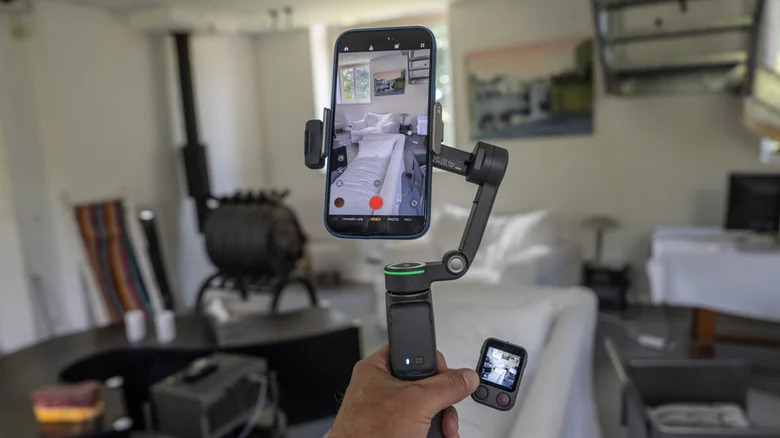
DJI’s Osmo Mobile 8P gimbal has a detachable remote with a screen
Steve Dent for Engadget
In the opposite direction of Google’s faceless wearable, DJI’s latest camera gimbal comes with a detachable remote with its own screen. The Osmo Mobile 8P remote lets you capture video solo and also features DJI’s latest tracking tech to keep vloggers in frame. DJI’s Osmo Mobile 8P is a more professional version of the Osmo Mobile 8 that arrived late last year and it hooks directly into Apple’s DockKit, like rival gimbals from Insta360 and GoPro.
The handle houses the detachable “Frametap” remote control, with a built-in screen, joystick controller and record button. It lets you tilt and rotate the gimbal and activate smartphone camera recording from over 150 feet away.
DJI’s Osmo Mobile 8P is now available in Europe, starting at £135/€145 in the standard combo or £169/€169 in the Advanced Tracking Combo with the Multifunctional Module 2. It’s not yet available in the US.
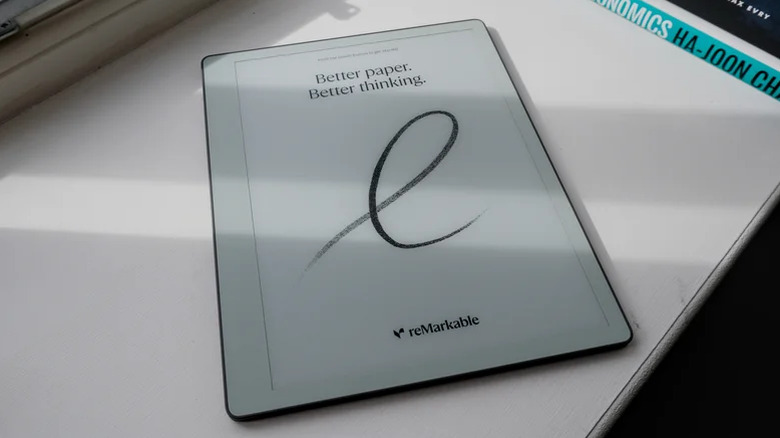
The Paper Pure is a gorgeous, repairable writing slate that offers the best monochrome writing experience out there. However, in reMarkable’s quest for “distraction-free” purity, they’ve omitted a backlight and doubled down on the company’s clunky file-sync workflow that feels increasingly archaic. With the company pivoting toward enterprise sales and trimming its sails, the Pure is a stunning tool for a specific (and well-lit) niche.
Snap’s deal with Perplexity to put the AI search engine directly in Snapchat is dead. The two companies “amicably ended the relationship” earlier this year, Snap disclosed in its latest earnings report. In a statement, a spokesperson for Perplexity said that the planned feature was “not the right fit” for either company.
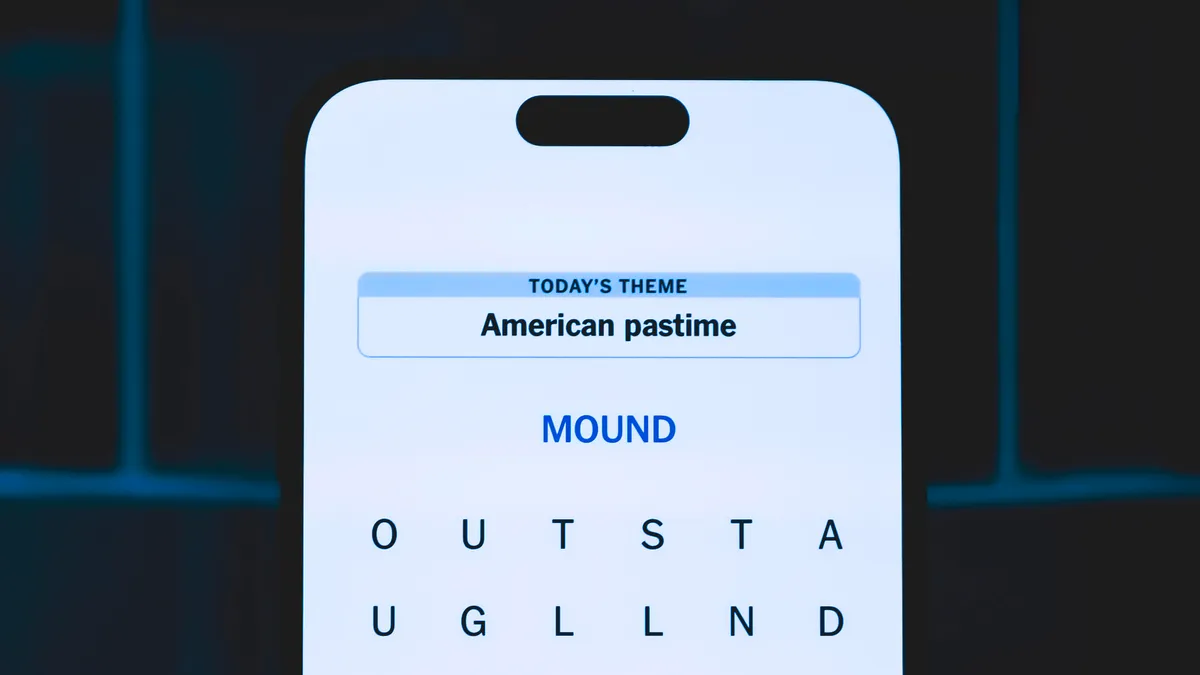
Looking for the most recent Strands answer? Click here for our daily Strands hints, as well as our daily answers and hints for The New York Times Mini Crossword, Wordle, Connections and Connections: Sports Edition puzzles.
Today’s NYT Strands puzzle is pretty ho-hum. (That’s a hint, not an insult.) Some of the answers are difficult to unscramble, so if you need hints and answers, read on.
If that doesn’t help you, here’s a clue: Not very exciting.
Clue words to unlock in-game hints
Your goal is to find hidden words that fit the puzzle’s theme. If you’re stuck, find any words you can. Every time you find three words of four letters or more, Strands will reveal one of the theme words. These are the words I used to get those hints but any words of four or more letters that you find will work:
STEAD, DIRT, MANOR, MILL, NILL, DIARY, COTS, COST
Answers for today’s Strands puzzle
These are the answers that tie into the theme. The goal of the puzzle is to find them all, including the spangram, a theme word that reaches from one side of the puzzle to the other. When you have all of them (I originally thought there were always eight but learned that the number can vary), every letter on the board will be used. Here are the nonspangram answers:
BASIC, COMMON, PROSAIC, PEDESTRIAN, ORDINARY
Today’s Strands spangram
The completed NYT Strands puzzle for May 8, 2026.
NYT/Screenshot by CNET
Today’s Strands spangram is RUNOFTHEMILL. To find it, start with the R that’s the second letter on the top row, and wind down.
Advertisement
Toughest Strands puzzles
Here are some of the Strands topics I’ve found to be the toughest.
#1: Dated slang. Maybe you didn’t even use this lingo when it was cool. Toughest word: PHAT.
#2: Thar she blows! I guess marine biologists might ace this one. Toughest word: BALEEN or RIGHT.
#3: Off the hook. Again, it helps to know a lot about sea creatures. Sorry, Charlie. Toughest word: BIGEYE or SKIPJACK.
Kaleidescape, once deemed a “rich man’s toy,” has been making in-roads lately with products priced within reach of those with more reasonable means. With its most affordable movie player priced at $1,995, Kaleidescape is still not “cheap” by any means. But considering the price of entry just three years ago was over $10,000 for a basic player and server, we’re definitely seeing progress.
For those unfamiliar, Kaleidescape is a platform for movie lovers who want to experience films in their highest possible audio and video quality, without the need for massive disc collections taking up an entire wall in your home. With bit rates higher than the highest quality physical media, 4K resolution with Dolby Vision HDR and lossless Dolby Atmos and DTS:X surround, Kaleidescape offers an uncompromising viewing and listening experience combined with the convenience of digital downloads. As Our Editor in Chief Ian White puts it, Kaleidescape is for ‘people who understand that “good enough” is usually neither.’
Although I’ve seen Kaleidescape in action for years at events like CEDIA, CES and the TV Shootout, my first direct experience with Kaleidescape, from a reviewing experience, was with their Strato V player ($4,499). It’s a 4K movie player with nearly a terabyte of on-board storage. That’s room for about ten or eleven 4K movies. I was fairly blown away by the quality and convenience, though the user interface was a less robust version of their best-in-breed menu system. The standard Kaleidescape interface allows owners to easily browse through large collections of films, with associations made by genre, cast, director and other meta data.
The Kaleidescape “Collections” interface is what loads by default if you are only using on-board player storage for your movies (no server).
With only 5 to 10 movies on a player, the full user interface is overkill, so the system defaults to a simpler navigation experience if you are only using a standalone player, with no external servers. This time around, I requested the Strato E player ($2,995) with one of the company’s movie servers, the 8 TB Mini Terra Prime ($9,995), so I could enjoy the full Kaleidescape user experience.
As an aside, I should mention that the launch price of the Mini Terra Prime last year was $5,995 but AI has driven the costs of chips and solid state storage significantly, leading to that 67% price increase. Kaleidescape also offers a 6 TB Compact Terra Prime server for $4,995 which uses traditional hard drives for storage. All of Kaleidescape’s servers are industrial quality and all maintain the secure digital ecosystem that is required by the studios in order to do business. Unfortunately you can’t just load up on standard disc drives to house your growing movie collection; you need to keep it all in brand.
Advertisement
What Is It?
The Kaleidescape Strato E is a 4K media player with Dolby Vision and HDR10 HDR, as well as lossless audio support including Dolby Atmos, Dolby TrueHD, DTS:X, DTS-HD Master Audio and multi-channel PCM decoding. The player has half a terabyte of on-board storage, enough for roughly five or six 4K movies, as well as the option to play videos from a Kaleidescape server within your local network.
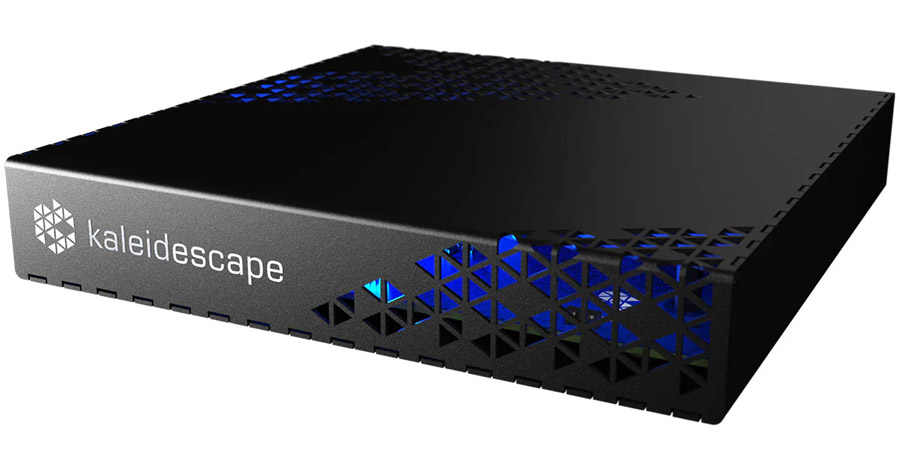
At $2,995, The Strato E is currently the most affordable 4K-capable Kaleidescape player. The company offers a more affordable player, with the same form factor and storage (Strato M), for $1,995 but that player is limited to 1080p resolution. The Strato E sports a compact form factor, measuring in at just 6.4 x 1.1 x 6.4 inches (16.3 cm × 3 cm × 16.3 cm). It weighs 1.6 pounds (0.73 kg) and is designed for residential, marine, and commercial systems, featuring a black, perforated steel casing for passive cooling.
Like the rest of Kaleidescape’s players, the Strato E lacks WiFi, requiring a hard-wired network connection for movie downloads or connection to a local Kaleidescape server. No connection is required to play movies once they have been downloaded to the unit’s on-board storage.
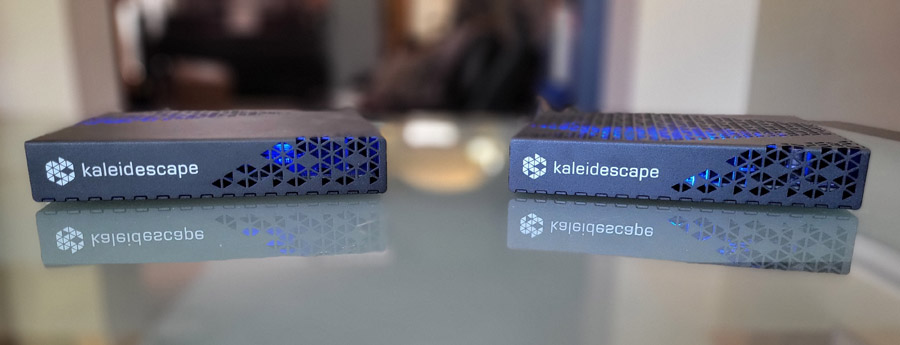
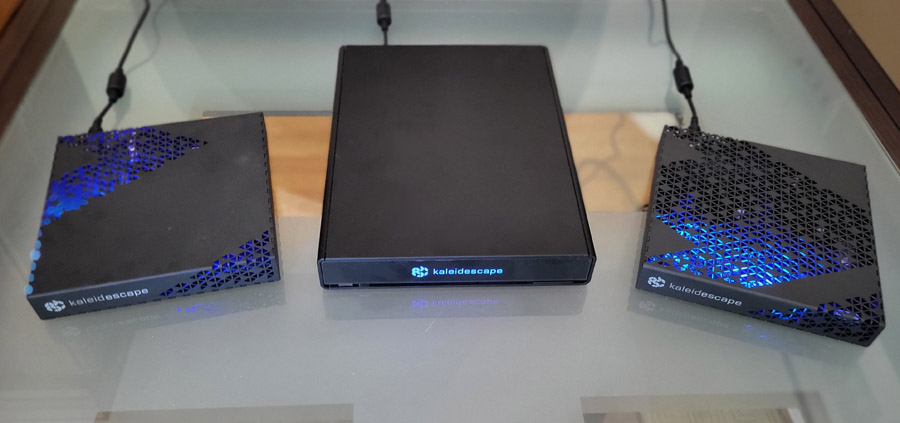
Kaleidescape Strato E player (left) and Mini Terra Prime Server (right).
The Kaleidescape Mini Terra Prime ($9,995) is a media server with 8 terabytes (TB) of solid state storage on-board. This is enough for approximately 125 movies. It requires a hard-wired network connection to your home network and out to the internet to download movies from the Kaleidescape store. Kaleidescape recommends a 2.5 GB network connection, though 1 GB (gigabit) network connectivity is also supported. Like the Strato E, the Mini Terra Prime features a compact chassis, 6.4 x 1.1 x 6.4 inches (16.3 x 3 x 16.3 cm) and weighs 1.7 pounds (0.77 kg).
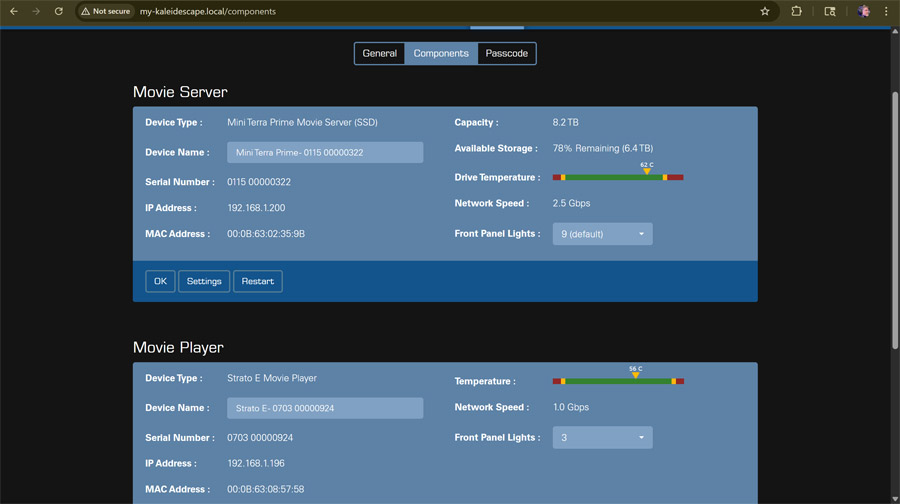
Like the Strato E, the Mini Terra Prime is fanless, designed for completely silent operation. Both the player and the server feature an on-board temperature sensor which can be viewed in the browser-based Kaleidecape admin interface. During my review, neither the player nor the server became appreciably hot, though they did both run slightly warm to the touch.
The Strato E back panel includes an ethernet port, HDMI jack and a USB port.
The Set-Up
Adding the new Strato E player to my system required activation of the player. If it’s your first player, you’ll need to create a Kaleidescape account so you can start building your library. But first you’ll need to plug the player into power, plug in a hard-wired ethernet cable connected to your home network, and plug in the player’s one HDMI output to your TV or projector. But how exactly do you turn the thing on? Use the remote! Oh, wait: there isn’t one!
Advertisement. Scroll to continue reading.
Advertisement
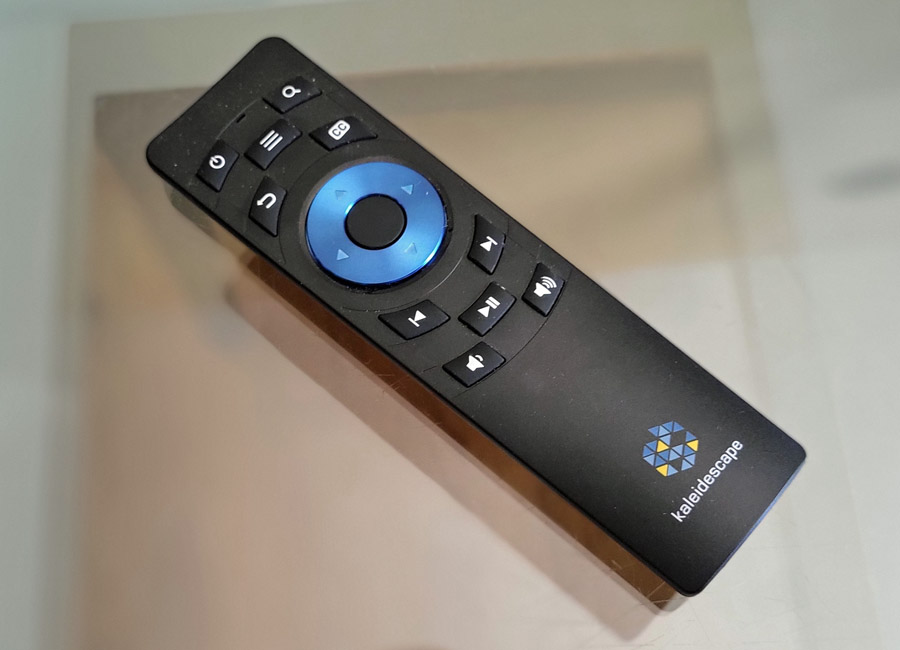
The Kaleidescape folks tell me that most of their customers never used the remote control they previously included in the box with each player as their players are typically tied into a control system like Control 4 or Crestron. So they stopped putting a remote in the box. Personally, I think a $3,000 media player should come with a remote, but maybe that’s just me? You can either purchase the Kaleidescape remote as a $50 accessory, or you can use the Kaleidescape app for iOS or Android to control playback and access the menus. I used the app, but I also had one of the remotes from an earlier review.
The Kaleidescape media player remote is a $50 option.
Once the activation and set-up process completed, I had access to the Kaleidescape movie store to start building a library. Kaleidescape was kind enough to load a few movies into the test account and gave me a store credit to explore the full download, rental and purchase operation.
I tested the Strato E player on its own at first. With about half a terabyte of on-board storage, the Strato E can store five or six 4K movies, depending on length. When you want to watch something new, you can simply download the new title and the player will automatically delete an older title if it needs to make room. All purchased movies reside in the cloud and can be downloaded at any time.
Size comparison: Kaleidescape Strato E, Strato V and Mini Terra Prime.
Movies and TV series on Kaleidscape are available either to rent or to purchase at prices comparable to other digital movie stores like iTunes and Amazon Prime Video, but generally in higher quality than either of those services. Because Kaleidecape is a download service (not a streaming service), they can offer higher quality digital files, without the risk of buffering or internet slowdowns impacting video and audio quality as it does with streaming. Kaleidescape recommends a 1 GB internet connection or higher. Over a 1GB connection, you can download a full 4K movie with Dolby Vision HDR and lossless immersive sound like Dolby Atmos or DTS-X in about 8-10 minutes.
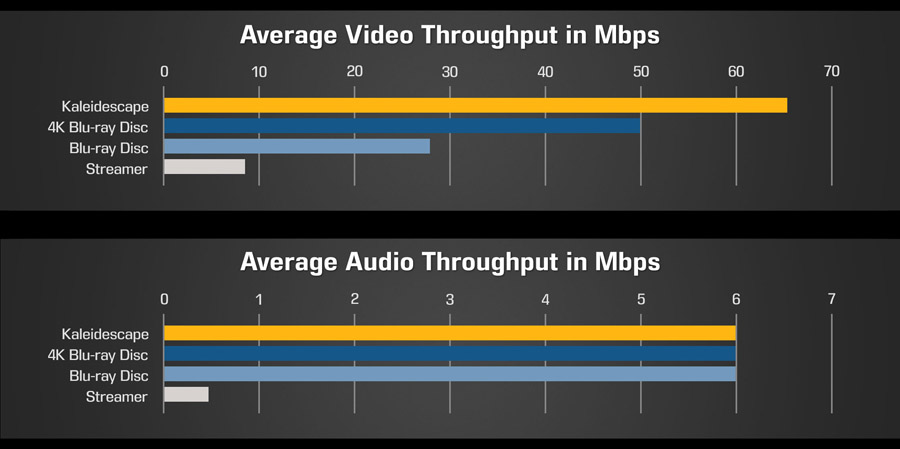
Kaleidescape file size averages around 100 GB, but can be significantly higher for longer movies or a bit smaller for shorter ones. Meanwhile most 4K UHD Blu-ray Discs are capped at 66 GB due to the size limit of a dual-layer UHD Blu-ray Disc. Some longer movies are delivered on triple layer UHD Discs which can store up to 100 GB, but these are the exception, not the rule. The larger file size of a Kaleidscape file means that they can use less compression, and this leads to better overall picture quality.
Larger file size and more reliable network bandwidth enable higher bit rates (and higher quality) for both audio and video of Kaleidescape downloads, particularly when compared to streaming.
Am I Gonna Have to Buy All My Movies Again?
While the hardware has gotten more affordable over time, Kaleidscape is still a proprietary closed ecosystem, so anything you want to watch on Kaleidedcape needs to be purchased or rented from the Kaleidescape store. And if you want to build a large library of digital movies, this can get pricey. Fortunately, for those who already have an extensive movie collection, Kaleidecape offers a “Disc to Digital” system which allows you to buy digital copies of movies you already own on DVD or Blu-ray Disc at a discount.
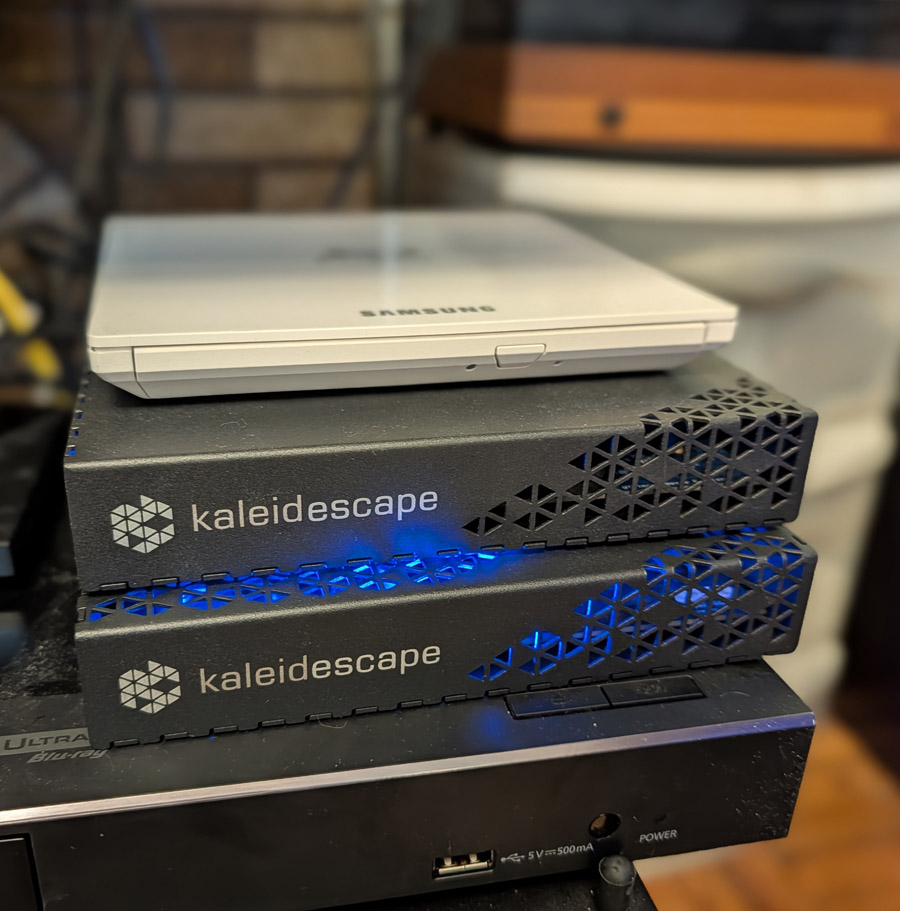
To take advantage of this, you will need a USB/Blu-ray Disc Drive. Kaleidescape recommends using a drive with external power (not USB-powered) and even recommends a few compatible drives. But these models are all discontinued. I found success with a slim Samsung SE-506 Blu-ray Writer, which is powered by the USB cable.
Advertisement
This slim Samsung BD drive was able to read and catalog my DVDs and Blu-rays with Kaleidescape in order to be eligible for “Disc to Digital” discounts.
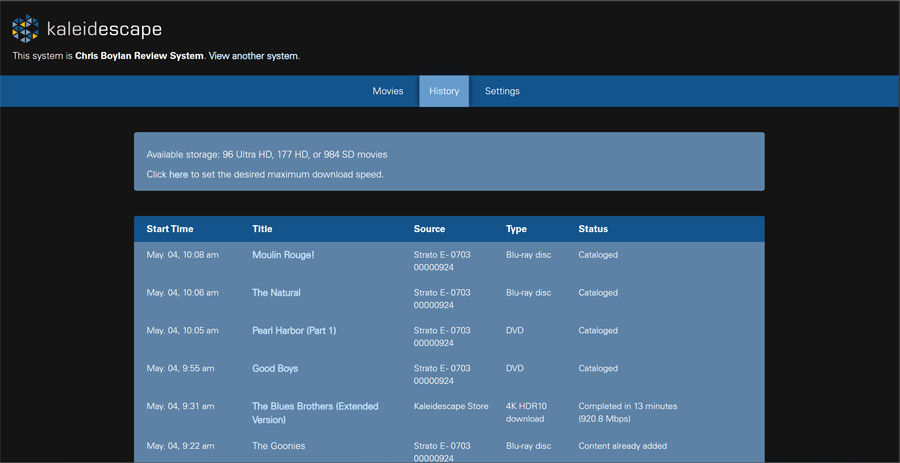
You simply connect the drive to the USB port on the back of a Strato movie player, make sure the player is powered on, insert a DVD or Blu-ray Disc into the drive and the Kaleidescape system will catalog the disc in a matter of seconds. Once the title is cataloged, the system will then notify you in the Kaleidescape store of a “Disc to Digital” offer. Click that link or search the store for the title you just scanned and you should see the discount applied. Note that it sometimes takes several minutes after the scan is completed for the Disc to Digital offer to show up in the store, so be patient.
You can see a history of disc scans and downloads in the “History” panel in the Kaleidescape admin interface.
For the titles I tested, the Disc to Digital discount varied from a couple of dollars off to more than $20 off. “The Goonies” normally sells for $24.99 on Kaleidescape, but after scanning my Blu-ray, the price of the 4K version dropped to $4.92. If you scan a DVD, you’ll also get a lower price, but you will pay a bit more than if you already own and scan the Blu-ray version (which makes sense).
“Blues Brothers” 4K dropped from $14.99 to $4.92 after scanning in my Blu-ray Disc.
In many cases, the price of a 4K upgrade on Kaleidescape was $8.59 if I owned and scanned the DVD, but $4.92 if I scanned the Blu-ray. Kaleidescape doesn’t officially support scans of 4K/UHD titles, but some owners report that their Blu-ray Drives can scan 4K Discs just like Blu-ray Discs. In any case, most UHD Blu-ray Discs come with a Blu-ray version of the film so you can always scan that if you want to get the disc to digital discount. Sadly, Kaleidescape doesn’t support other digital copy services such as Movies Anywhere or VUDU/Fandango at Home so there’s no way to transfer or get credit for ownership of existing digital copies in the Kaleidescape ecosystem.
And now back to set up…
After some time using the Strato E on its own, I added the Mini Terra Prime server to the account so I could start using the full Kaleidescape User Interface. This entailed plugging the Mini Terra Prime into power and into a network cable connected to a network switch. The server comes with a QR code you can scan to get into the admin interface, but you can also just point any web browser to the Kaleidescape system’s IP address (in my case: http://192.168.1.200/) or to its host name http://my-kaleidescape.local and follow the links to add a new component to your current system. Note: these URLs only work if your computer or mobile device is on the same physical network as an existing Kaleidescape system.
Advertisement. Scroll to continue reading.
Kaleidescape’s admin panel allows you to view the status and make adjustments to settings of the components within your Kaleidescape system.
By moving all of the “heavy lifting” of system set-up and configuration to this web-based admin interface, two things happen: a) Kaleidescape can keep the main user interface simple for its end users and b) the system can be administered remotely by a dealer or custom installer, or by a handy DIYer. In the past, most Kaleidescape customers went through custom installation firms for purchase and installation, but with the pricing of the players coming down, tech-savvy hobbyists are now doing this set-up and configuration on their own.
Adding the server was simple but after I did so, that web-based admin interface became inaccessible for about 15 minutes. A Kaleidescape rep told me that this outage is to be expected as the server did an automatic software update once it was added to the system. If you install a player with up to date software, the outage is shorter.
Advertisement
When the system came back online, the server was now added to the system and the movies that had been stored on the player were deleted from its local storage. I had thought maybe the set-up process would move the movies from the player to the server, but it did not. So I went into the movie store and selected these and several other movies from the test account to download to the server. Movie downloads can happen overnight or in the background while you’re watching a different movie. Also, when you pre-order a movie, the system will download it in the background so it becomes available to watch right at its official release date and time.
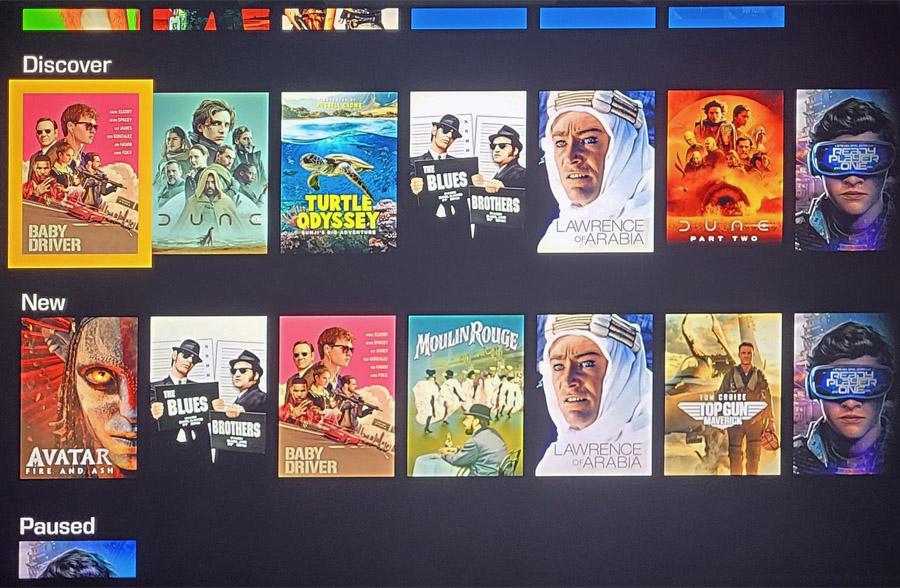
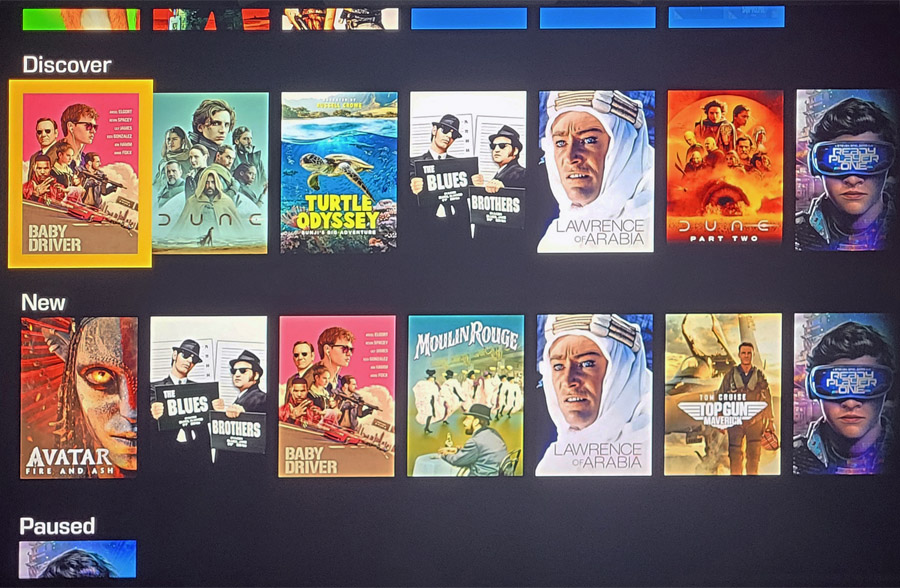
A click on the triangle in the Kaleidescape “covers” interface allows you to find related movies by genre, by director, or by actor.
Adding the Server to the system enabled the more powerful “Covers” user interface that Kaleidescape is known for. The title you have selected is automatically surrounded by similar movies you also may like. And with a couple of button presses on the remote or in the remote control section of the mobile app, you can re-arrange the list of recommendations by genre, director or actor. You can set the interface to only show movies you already own or to expand its recommendation out to the Kaleidescape store so you can discover more movies or shows that you might like.
In terms of speed of access, I saw no noticeable delay when playing back titles from the server, compared to using the player’s local storage. I connected the server and player to my home network using a 2.5GB network switch, which is what Kaleidescape recommends. In the admin interface I could see that the Mini Terra Prime server was indeed capable of 2.5 GB network bandwidth, while the Strato E player was capped at 1 GB. This makes sense as the server can deliver movies to multiple players within a home network concurrently. The Mini Terra Prime supports up to 25 concurrent player connections so it needs a “fatter pipe” than the player does. Now all I need is 24 more players, and rooms to put them in, in order to test this.
Throughout the viewing experience, I didn’t experience any buffering nor other sorts of glitches in video or audio playback. I selected a title, hit Play and it started playing within seconds. Most of the titles I watched were available in 4K resolution with HDR10 or Dolby Vision HDR which looked as good as the best 4K UHD Blu-ray Discs I own. In fact, I compared video quality on Kaleidescape with a UHD Blu-ray Disc on several titles, including “Blade Runner: The Final Cut,” “Dune” and “Dune Part Two” and was unable to spot any meaningful differences in image quality.
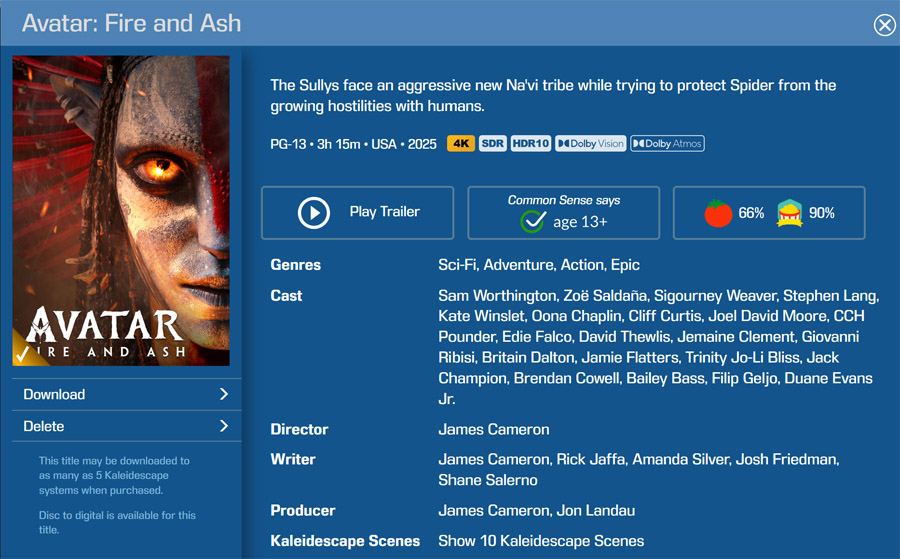
Many films, including major releases like the latest “Avatar” movie, are available on Kaleidescape in 4K resolution with HDR10 and Dolby Vision HDR as well as lossless Dolby Atmos immersive surround sound.
Most of the newer titles I viewed (but not all) were available in Dolby Atmos immersive surround. But this isn’t the same Dolby Atmos from streaming services like Netflix or Apple TV. The Kaleidescape version of Dolby Atmos uses the Dolby True HD lossless surround codec as the transport layer – just like on Blu-ray Disc and UHD Blu-ray – which means you get none of the compression artifacts that can affect the audio over streaming services.
For DTS:X, the story is similar – the transport layer for DTS:X on Kaleidescape is lossless DTS-HD Master Audio, not the lossy DTS:X Profile 2 codec used on streaming services like Disney+ and Sony Pictures Core. The only title I noticed that didn’t quite match the UHD Blu-ray version was “The Blues Brothers” which has a DTS:X soundtrack on UHD Blu-ray but only DTS-HD soundtrack on Kaleidescape. But this may not be true forever. Kaleidescape frequently posts enhanced/updated versions of movies online, usually at no additional charge to customers. It’s the only movie investment that actually gets better over time.
Advertisement
“All those moments will be lost, in time, like tears, in rain.” – Roy Batty (“Blade Runner”)
Scripts and Custom Scenes – Kaleidescape’s Killer Feature?
As a movie lover, I have an extensive collection of movie quotes living rent-free inside my brain. Certain scenes and cinematic moments have left indelible marks on my psyche and provide a wealth of inside jokes with those of similar tastes and predilections. With Kaleidescape’s ability to instantly access any part of any movie in your collection, you can put together a playlist of all your favorite movie moments.
When Kaleidescape adds a new title to their collection, they curate custom scenes for popular or memorable parts of the film. They also give you the ability to create your own custom scenes with a couple of presses of a button on the remote or in the app. It’s simple, just find the start of the scene, hit the pause button then the menu button (three horizontal lines), select “Add New Scene” and follow the prompts. Once you’ve identified and stored your favorite scenes, you can string these scenes together in a playlist which they call a “script.”
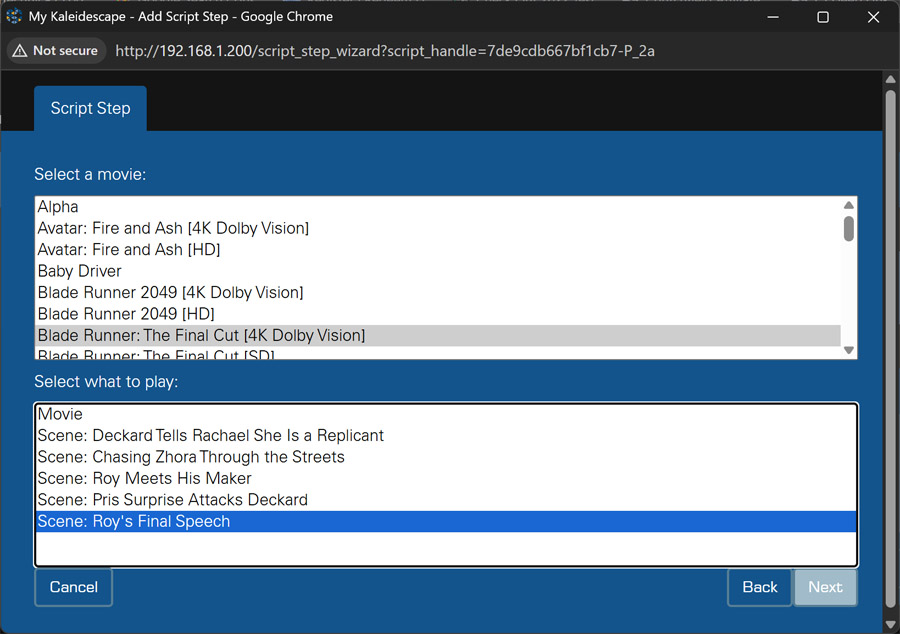
Once you’ve marked your favorite scenes, you can build a playlist or “script” in the Kaleidescape browser interface.
To build a script, you’ll need to go to the browser-based admin menu from Chrome or another browser. Just find the Scripts tab to create a new script or manually add “/scripts” to the end of the URL (e.g., http://my-kaleidescape.local/scripts). Here you can select each movie or TV show and then select a scene to add to your script. After you’ve added all the steps, you can find the script in your regular Kaleidescape player menu, in the “Collections” section. Scroll down to “Scripts,” select your script and enjoy your very own custom movie medley.
Advertisement. Scroll to continue reading.
Final Thoughts
Kaleidescape may have established itself as a no-compromise media player and movie library for the 1% who could afford it for their mansions and their yachts (Elmer J. Fudd, I’m looking at you), but times are changing. At $12,990, this specific system is still pretty pricey, but with a basic entry-level 4K player with built-in movie storage starting at under $3,000 and an entry level player/server combo starting at $6,500, the Kaleidescape ecosystem is becoming more attainable for those who love movies and want the absolute best way of enjoying them at home.
Advertisement
Pros:
Picture and sound quality that rivals, or exceeds the best physical media
Huge selection of titles in the Kaleidescape store
Convenience of instant downloads
Disc-to-Digital features offers steep discounts when you upgrade movies you already own on physical media to Kaleidescape versions
Intuitive user interface
Simple set-up and instant access to up to 125 4K movies
Custom scenes and scripts allow you to compile a “greatest hits” of your favorite movie or TV scenes
Cons:
Relatively expensive (particularly the server)
No support for 3rd party digital copy platforms like Movies Anywhere
No remote control included with players ($50 option)
Outages in the admin interface during system configuration changes can be confusing


































































You must be logged in to post a comment Login