Tech
Windows 11 KB5079473 & KB5078883 cumulative updates released


Microsoft has released Windows 11 KB5079473 and KB5078883 cumulative updates for versions 25H2/24H2 and 23H2 to fix security vulnerabilities, bugs, and add new features.
Today’s updates are mandatory as they contain the March 2026 Patch Tuesday security patches for vulnerabilities discovered in previous months.
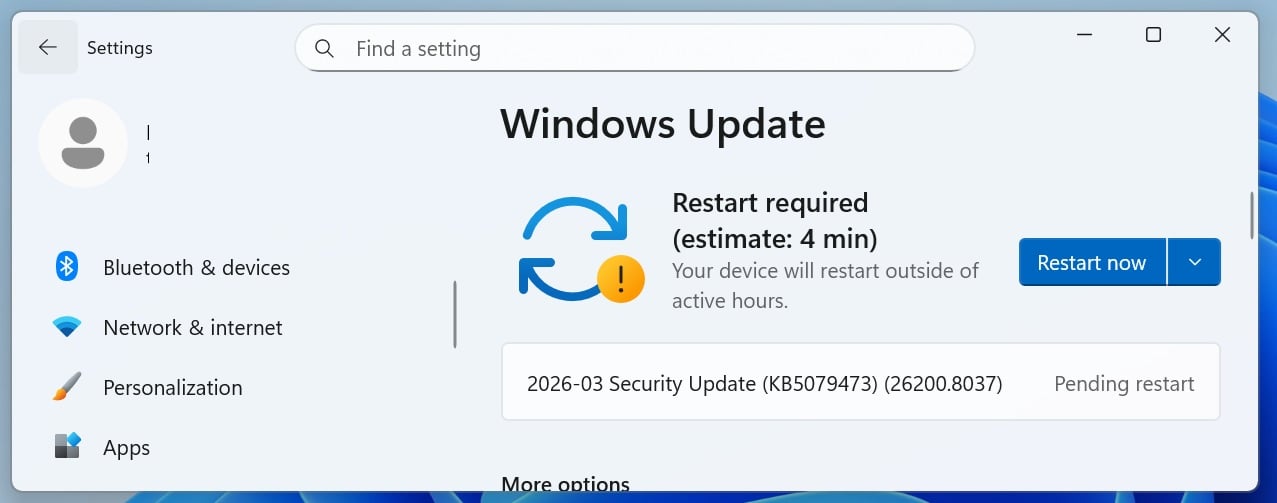
You can install today’s update by going to Start > Settings > Windows Update and clicking on ‘Check for Updates.’

You can also manually download and install the update from the Microsoft Update Catalog.
This is the third ‘Patch Tuesday’ release in 2026, and it’s based on 24H2, which means 25H2 gets the same update. There are no exclusive or special changes. You’ll get the same fixes across the two versions of Windows 11.
What’s new in the March 2026 Patch Tuesday update
After installing today’s security updates, Windows 11 25H2 (KB5079473) will have its build number changed to 26200.8037 25H2 and 26100.8037 (24H2), and 23H2 (KB5078883 ) will be changed to 22631.6783.
Microsoft says this update includes additional high-confidence device targeting data, increasing coverage of devices eligible to automatically receive new Secure Boot certificates. This means more devices should get a Secure Boot update, but the installation is automatically handled by Microsoft.
In addition, a bug has been fixed that improves File Explorer search reliability when searching across multiple drives or “This PC”.
Microsoft says this update also improves how Windows Defender Application Control (WDAC) handles COM objects, allowing listing policies.
Here’s the full list of fixes and improvements:
-
[Emoji] New! The Emoji 16.0 release introduces a small thoughtfully curated set of new emojis, one from each major category. Each emoji carries timeless symbolism and practical versatility. These new emojis now appear in the emoji panel.
-
[Backup & Restore] New! The first sign-in restore experience is now part of Windows Backup for Organizations, bringing this restore capability to more device types. This experience restores user settings and Microsoft Store apps automatically at first sign-in on Microsoft Entra hybrid joined devices, Cloud PCs, and multi‑user environments. This capability helps create a consistent setup process during device refreshes, upgrades, or migrations.
-
[Quick Machine Recovery] New! Quick Machine Recovery (QMR) now turns on automatically for Windows Professional devices that are not domain‑joined and not enrolled in enterprise endpoint management. These devices receive the same recovery features available to Windows Home users. For domain‑joined or enterprise managed devices, QMR stays off unless it is enabled by the organization.
-
[Taskbar & System Tray]
-
New! A built‑in network speed test is now available from the taskbar. You can open it from the Wi‑Fi or Cellular Quick Settings, or by right-clicking the network icon in the system tray. The speed test opens in the default browser and measures Ethernet, Wi‑Fi, and cellular connections. This feature helps check network performance and troubleshoot issues.
-
Improved: When the taskbar is set to uncombined and you have an app open with multiple windows, they no longer all move as a set to the overflow area when there is not enough space on the taskbar. Only the windows that don’t fit move to the overflow menu. This change prevents the overflow menu from appearing with large unused space.
-
-
[Accounts] New! The account menu on the Start menu now includes a new option that directs you to the benefits page, making it easier to explore and manage your Microsoft account benefits.
-
[Camera Settings] New! You can control pan and tilt for supported cameras in the Settings app. The controls appear under Settings > Bluetooth & devices > Cameras, in the “Basic settings” section for your selected camera.
-
[Built-in Sysmon] New! Windows now brings System Monitor (Sysmon) functionality natively to Windows. Sysmon helps you capture system events for threat detection, and you can use custom configuration files to filter the events you want to monitor. Windows writes captured events to Windows Event Log, which allows security tools and other applications to use them.
Built‑in Sysmon is off by default. You must enable it before you can use it.
Option 1: Settings
-
Go to Settings > System > Optional features > More Windows features, then select Sysmon.
Option 2: PowerShell or Command Prompt
-
Run the following command: Dism /Online /Enable-Feature /FeatureName:Sysmon
-
After the feature installs, complete the setup by running: sysmon -i
Note: If you already installed Sysmon from the Sysinternals, uninstall it before enabling the built‑in version.
Learn more about Sysmon functionality.
-
-
[Widgets] New! Widget Settings now open as a full‑page experience in the Widgets app instead of opening in a dialog.
-
[Desktop Background] New! You can set WebP (.webp) images as your desktop background from Settings > Personalization > Background, or by right‑clicking the image in File Explorer.
-
[Search on Taskbar]
-
New! Group headers now show the number of results, so you can quickly see when more results are available. Select a group header to see all results for that group and hide results from other groups.
-
New! You can preview search results by hovering over a result and selecting Preview to see the content without opening it.
-
Improved: Updated the icon for the Search process in Task Manager so it now shows a magnifying glass.
-
-
[Storage Settings] Improvements for Storage Settings include:
-
[Remote Server Administration Tools (RSAT)] New! This update adds support for Remote Server Administration Tools (RSAT) on Windows 11 Arm64 devices. IT administrators can now install and use tools such as Active Directory Domain Services and Lightweight Directory Services Tools, Active Directory Certificate Services Tools, Server Manager, Group Policy Management Tools, DNS Server Tools, and DHCP Server Tools. These tools are available as optional features and can be installed through Settings > System > Optional Features or from Control Panel > Programs > Turn Windows features on or off.
-
[Windows Update Settings] Improved: Responsiveness of the Windows Update settings page.
-
[Login and lock screens] Improved: Sign‑in screen reliability.
-
[Nearby Sharing] Improved: Reliability when sending larger files with Nearby Sharing.
-
[Projecting] Improved: Reliability of displaying the project menu after pressing Windows logo key + P.
-
[Printing] Improved: Performance of the Windows printing service (spoolsv.exe) to help printing run more smoothly and reduce slowdowns during high‑volume printing.
-
[File Explorer]
-
Improved: You can now open a new File Explorer window more reliably. Holding the Shift key and selecting the File Explorer icon on the taskbar, or using the middle mouse button, now opens a new instance of File Explorer instead of the current one.
-
Improved: File Explorer now includes an Extract all option on the command bar when you browse non‑ZIP archive folders.
-
Improved: Reliability of displaying devices on the Network page in File Explorer.
-
-
[Display]
-
Improved: This update improves reliability when your PC wakes from sleep.
-
Improved: Display-related performance improvements to help reduce the time for a PC to resume from sleep, especially when the system is under heavy load and in other scenarios.
-
-
[Other] Improved: This update improves visual consistency across Windows, including the taskbar when auto‑hide is on, credential fields in the Windows Security dialog, and the print dialog.
Microsoft is not aware of new issues with this month’s Patch Tuesday.


Malware is getting smarter. The Red Report 2026 reveals how new threats use math to detect sandboxes and hide in plain sight.
Download our analysis of 1.1 million malicious samples to uncover the top 10 techniques and see if your security stack is blinded.