Tech
xDuoo DP-10 Review: Is This $999 Digital Transport an Eversolo Alternative?

xDuoo is a Chinese audio manufacturer that, over more than a decade, has released some well-regarded personal audio products, including the TA-22 and TA-26 tube amplifiers and the XD-05 portable amplifier, among many others.
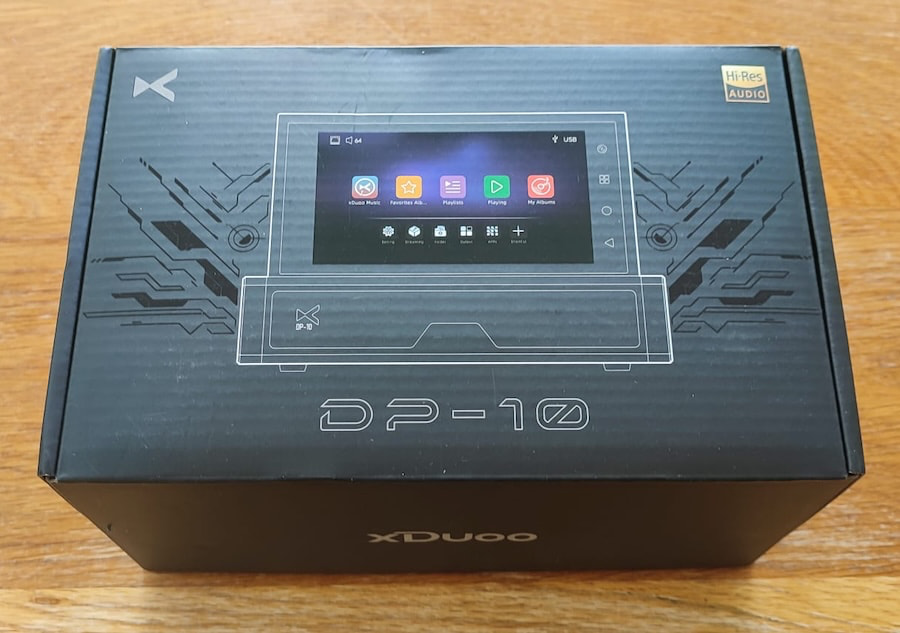
Now, the brand has come out with a new product, the DP-10. Designed to sit at the very front of a digital audio system and manage everything that happens before conversion takes place, it is a dedicated streaming transport and digital audio player intended to feed an external DAC, DAC/headphone amplifier, or another component with digital inputs.
That means there is no conventional analogue output stage and no attempt to replace the DAC that you may already own. Instead, the DP-10 acts as a central source for streaming services, locally stored music, network libraries, and external drives before sending that material onward through one of its digital outputs.
At $999, it sits well above inexpensive network bridges and compact streaming accessories, but it also occupies a more specialized position than all-in-one products from Eversolo, FiiO, and others that combine streaming, DAC conversion, and analogue outputs in the same chassis.
The appeal of the DP-10 is therefore fairly specific. But is it really what you need for your system? Read on to find out.
Related Reviews:
xDuoo DP-10 Technology, Features and Codec Support
The DP-10 runs Android 14 on hardware comprising 8GB of RAM and 64GB of built-in storage, with a 5.5-inch, 1080 x 1920 touchscreen providing direct access to playback, settings, and supported applications.
That combination is more substantial than the stripped-down embedded platforms found in many traditional network transports, and xDuoo has clearly positioned the DP-10 as something closer to a dedicated Android music player without the battery, DAC, or headphone amplifier normally associated with a DAP.
High-resolution playback support is correspondingly broad.

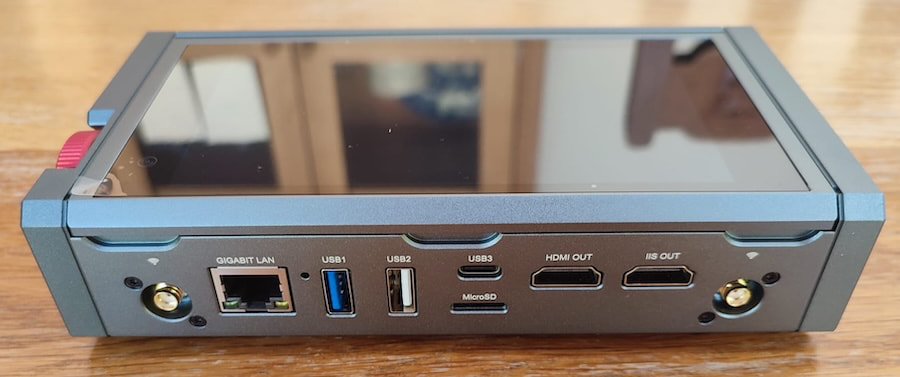
Through USB, the DP-10 supports PCM up to 32-bit/768kHz and DSD512, while its coaxial, optical, AES, HDMI, and I²S digital outputs support PCM up to 24-bit/192kHz and DSD64. That is still more than sufficient for almost every commercially available music file.
Networking is handled by dual-band Wi-Fi 6 or Gigabit Ethernet, and Bluetooth 5.4 is included for wireless transmission and reception. Supported codecs include SBC, AAC, aptX, aptX HD, aptX Adaptive, and LDAC, although codec availability varies depending on whether the DP-10 is transmitting or receiving.
xDuoo also supports UPnP, SMB, DLNA, AirPlay, and QPlay, giving the DP-10 several ways to interact with music stored elsewhere on a home network or sent from another device.
The more important point, however, is not the number of formats written on the specification sheet.
It is that xDuoo has designed the DP-10 around the idea that a modern digital source should accommodate several different types of listeners at once: the streaming subscriber, the NAS user, the collector with a large local library, and the audiophile who wants to choose exactly how the signal reaches the DAC.

Design & Build
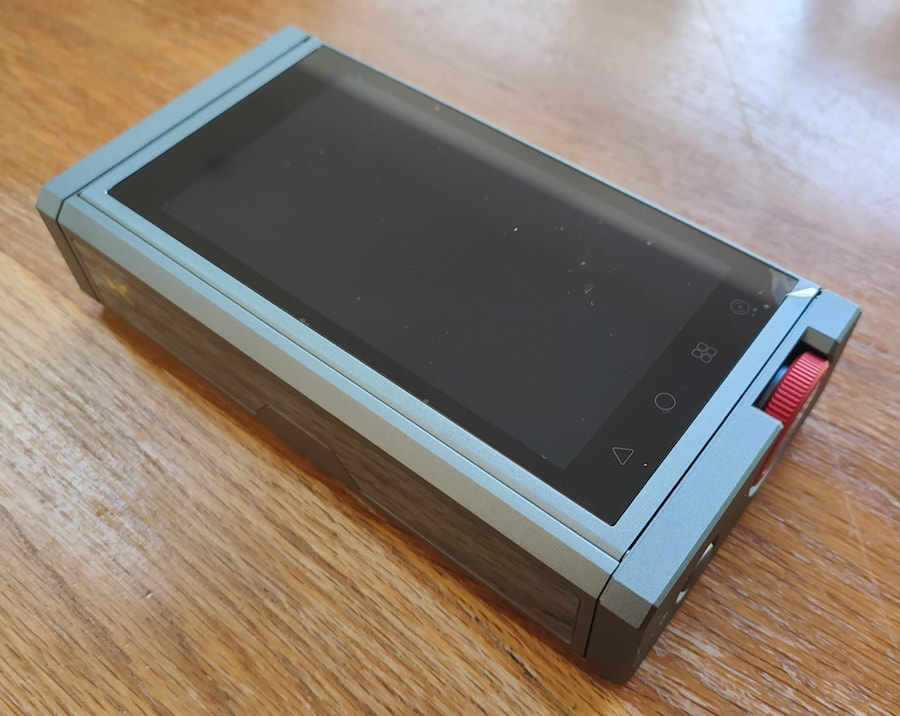
The DP-10 is considerably smaller than a conventional full-width hi-fi component.
At approximately 18.2 x 10.7 x 4.3 cm and 750 g, it occupies roughly the same amount of space as a substantial desktop DAC or headphone amplifier and should be easy to accommodate on a desk, bedside table, or compact equipment rack.
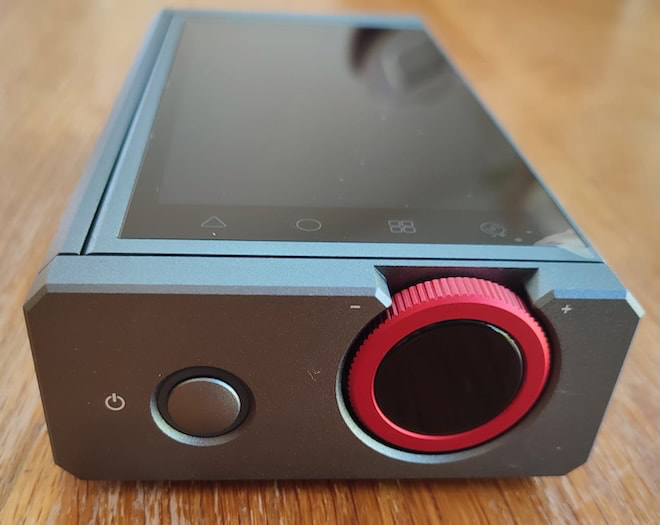
The 5.5-inch display dominates the front panel and can operate in either landscape or portrait orientation.
At 1920 x 1080, it is sharp enough for album art, browsing, and menu navigation, although the relatively small screen inevitably makes extended text entry less comfortable than it would be on a tablet or one of the larger streaming displays now appearing on the market.
The DP-10 is small enough to sit neatly beside an external DAC rather than becoming the visual centerpiece of an audio system, so the smaller screen was probably an intentional compromise.
The chassis is also fanless, which is preferable for any product intended for close-range desktop listening or placement alongside sensitive audio equipment. I found that the DP-10 remained cool enough during normal operation without requiring active cooling, even after extended listening sessions in the hot summer weather that has persisted in the UK for quite some time now.
There is no internal battery, so this is not a portable player in the traditional sense. It always requires external power and is better thought of as a compact stationary transport that happens to be easy to move between systems.
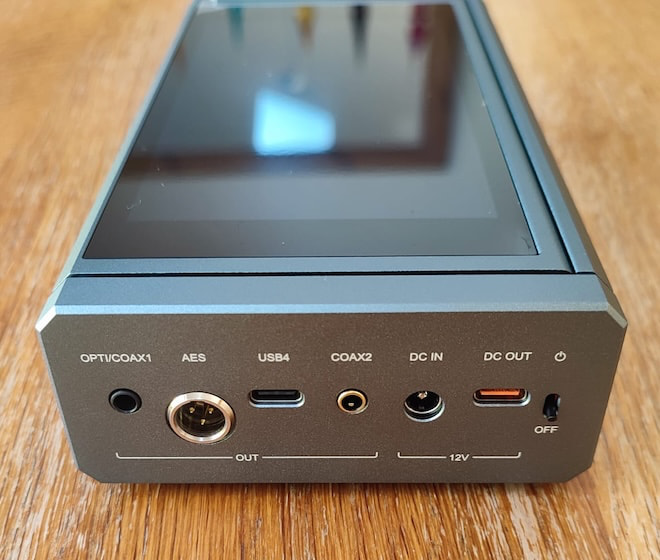
A USB-C DC OUT port can also supply power to compatible external equipment, including products such as xDuoo’s own XD05 Pro, which could make it easier to assemble a tidy desktop stack without adding another power adapter.
Storage
Storage is one of the DP-10’s more compelling features and one of the clearest reasons to choose it over a simpler streaming bridge.
The 64GB of internal storage is primarily useful for applications and modest amounts of local content, but xDuoo has also fitted an M.2 NVMe slot supporting 2260, 2280, and 22110 SSDs with capacities up to 4TB.
With a large SSD installed, the DP-10 can function as a self-contained local music source without relying on a separate computer or NAS. A large FLAC or DSD collection can live inside the transport itself and be sent directly to an external DAC.
There is also support for microSD cards up to 2TB, along with external USB storage devices. For users with particularly large libraries, or those who already keep their music on network storage, SMB and UPnP support allow the DP-10 to access files elsewhere on the local network.
Gigabit Ethernet is likely to be the preferable connection for very large libraries or prolonged high-resolution playback, although Wi-Fi 6 provides considerably more flexibility where a wired connection is impractical.
The DP-10 can also work with compatible external USB optical drives for direct CD playback and ripping.
That is a relatively uncommon feature in this category and potentially useful for listeners who still own substantial CD collections but would prefer to centralize them as files rather than maintain a separate disc transport.

Streaming
Android 14 gives the DP-10 considerably more flexibility than a closed streaming platform, at least in principle.
xDuoo supports major services including Spotify, Apple Music, TIDAL, Qobuz, and Amazon Music, alongside applications such as Foobar2000, TuneIn, and Jellyfin.
The platform is also designed to bypass Android’s conventional sample-rate conversion behavior, allowing supported music to be sent onward at its native sample rate rather than being resampled by the operating system.
It is important to note that the DP-10 does not provide the completely conventional Google Play Store experience that Android smartphone and tablet users may expect. Not every application traditionally available on a smartphone or DAP can necessarily be downloaded directly to the DP-10, with some requiring alternative installation methods such as APKPure.
Users who primarily rely on a handful of established music services are unlikely to find this especially problematic. Those who routinely experiment with more obscure Android applications may find it somewhat more limiting.
Remote-control functionality is also important because the relatively small front display will not always be the most convenient way to browse a large library from across the room.
AirPlay, DLNA, and QPlay provide additional ways to send music from other devices without requiring direct interaction with the DP-10 itself.

Connectivity
The rear panel is where the DP-10’s purpose becomes particularly clear.
xDuoo has provided USB, coaxial S/PDIF, optical, AES/EBU, HDMI and I²S over HDMI outputs, giving it one of the broader selections of digital connections in this price range.
USB is the most capable interface from a format-support perspective, with PCM up to 32-bit/768kHz and DSD512 available to compatible DACs.
Coaxial, optical and AES/EBU cover the overwhelming majority of conventional DACs, while I²S is likely to appeal to more technically inclined users with compatible converters.
AES/EBU is particularly welcome because it remains common on professional and higher-end digital equipment but is frequently omitted from more consumer-focused streamers.
The inclusion of so many outputs also gives the DP-10 a practical advantage for anyone who regularly changes DACs or uses more than one digital system.
Rather than buying a transport around one preferred connection standard, the DP-10 leaves that decision largely to the downstream component. And Bluetooth 5.4 adds another wireless option. Its presence is more about convenience and compatibility than replacing the wired digital outputs.
Living With the xDuoo DP-10 Day to Day
The strongest argument for the DP-10 is not any individual specification. It is consolidation.
A single device can access Qobuz or another streaming platform, browse a NAS, play music from an internal NVMe drive, read a microSD card, access external USB storage and even work with a USB CD drive. That breadth allows the DP-10 to replace several different digital sources in a system.
For a listener like me who currently switches between a laptop, smartphone, USB drive, and network streamer depending on what I want to hear, that alone has considerable appeal.
Its compact dimensions also make it particularly suitable for desktop systems where space is limited and a full-width streamer would be excessive.
My only minor gripe, which I touched on earlier, is with the software polish. The interface was slow at times, with long loading times and a laggy screen, and, as mentioned, not all of the applications I like to use on an Android device were usable on the DP-10.
A DAC can disappear into a system once the input and filter are selected. A transport is something the listener may browse, search, and control every day. Minor software irritations therefore have a tendency to become more noticeable over time.
Listening
Assessing the sound quality of a digital transport is a lot more difficult than reviewing a DAC, amplifier, or pair of headphones.
The DP-10 does not perform the final digital-to-analogue conversion, so the tonal balance and overall character of the finished system remain largely dependent on the DAC, amplification, and transducers connected downstream.
I spoke to another reviewer who said he noticed improved imaging precision and a blacker background compared with connecting his desktop stack directly to a PC, but I’ll admit that I struggled to hear any meaningful difference in sonic performance.
That is despite the fact that the DP-10 uses separate low-noise power regulation and an ultra-low-phase-noise clock architecture intended to reduce electrical interference and timing errors before the digital signal leaves the player.
Even so, that does not mean the DP-10 won’t improve the experience of listening to your system. Its real strength is making the rest of the digital chain easier to use while remaining as sonically unobtrusive as possible.
For me, that is arguably more important. The DP-10 lets you focus on the music rather than constantly fiddling with a laptop, phone, USB drive, streamer, and the small mountain of hardware that somehow accumulates around a modern digital system.

The Bottom Line
While I wasn’t able to directly compare the xDuoo DP-10 with another dedicated digital transport during the review period, the value it provided makes it easy to recommend, but only if you have a very specific goal in mind. It makes the most sense for listeners who already own a DAC they are happy with and want a more capable digital front end without paying for another conversion stage.
Its strongest qualities are flexibility and system integration. The combination of Android 14, internal NVMe storage, microSD and USB expansion, NAS access, major streaming services, CD playback and ripping, and an unusually broad selection of digital outputs gives it considerably more scope than a basic network bridge.
There are, however, some obvious omissions at $999. The much less expensive WiiM Ultra includes an internal DAC, analogue inputs and outputs, phono input, HDMI ARC, subwoofer and headphone outputs, and room correction. Eversolo’s DMP-A6 Gen 2 is actually less expensive at $859 and combines streaming with dual internal DACs, RCA and balanced XLR outputs, HDMI ARC, and preamplifier functionality.
That does not make the DP-10 poor value, but it does make its audience considerably narrower. You are paying for storage flexibility, Android, extensive digital connectivity, and the ability to use the DAC you already selected rather than for a complete streaming and conversion solution.
If that describes your system, the DP-10 makes considerable sense. Its purpose is to organize, access, and deliver digital music without forcing another DAC or analogue stage into the signal chain, and it does that very well. Just understand what you are buying: this is a $999 digital transport for listeners who already have the rest of the system figured out.
Pros:
- Exceptionally broad range of digital outputs
- Supports USB audio up to PCM 32-bit/768kHz and DSD512
- Android 14 with support for major streaming platforms
- Internal M.2 NVMe storage expansion up to 4TB
- microSD, USB storage and NAS playback support
- Wi-Fi 6 and Gigabit Ethernet
- External USB CD playback and ripping
- Compact, fanless chassis
- Particularly well suited to systems built around an existing external DAC
- Strong flexibility for both streaming and locally stored music
Cons:
- No integrated DAC or analogue outputs
- Android implementation is less polished than the hardware
- No conventional Google Play Store experience
- Some applications may require sideloading or additional setup
- Interface speed is not class-leading
- $999 is difficult to justify for users who only need basic streaming
Our Ratings
★★★★★★★★★★ Performance
★★★★★★★★★★ Usability
★★★★★★★★★★ Build Quality
★★★★★★★★★★ Value
You must be logged in to post a comment Login